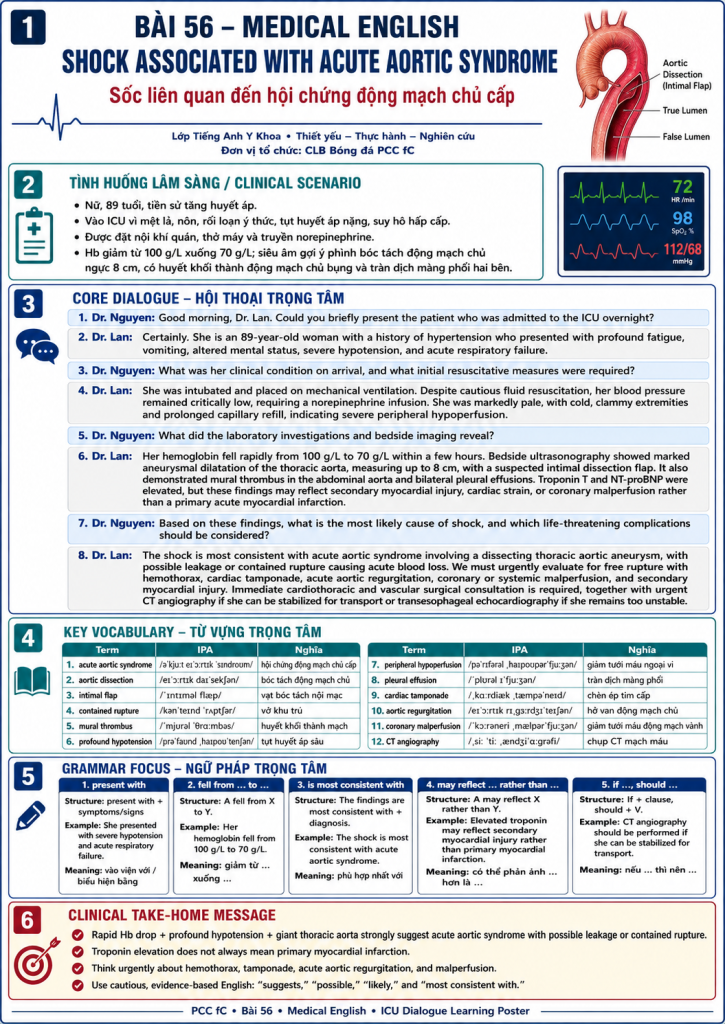
Bài 56 – Tiếng Anh Y Khoa: Sốc liên quan tới hội chứng động mạch chủ cấp * Shock associated with acute aortic syndrome
PCC Language – Thăng Long, Hà Nội, ngày 13/7/2026, Sốc ở người bệnh cao tuổi thường có biểu hiện phức tạp và dễ bị nhầm với nhồi máu cơ tim, sốc tim hoặc sốc nhiễm khuẩn. Trong tình huống lâm sàng này, sự kết hợp giữa tụt huyết áp nặng, da niêm nhợt, giảm nhanh hemoglobin và hình ảnh động mạch chủ ngực giãn lớn kèm vạt lóc tách giúp định hướng đến hội chứng động mạch chủ cấp có biến chứng rò hoặc vỡ. Bài 56 tập trung rèn luyện kỹ năng trình bày bệnh nhân, phân tích nguyên nhân sốc, mô tả kết quả siêu âm tại giường và đề xuất xử trí cấp cứu bằng tiếng Anh. Qua đoạn hội thoại giữa bác sĩ nội trú và bác sĩ chính, người học sẽ thực hành tư duy lâm sàng có hệ thống, sử dụng thuật ngữ chuyên ngành chính xác và giao tiếp hiệu quả trong môi trường hồi sức tích cực.
BÀI 56 – MEDICAL ENGLISH
SHOCK ASSOCIATED WITH ACUTE AORTIC SYNDROME
Sốc liên quan đến hội chứng động mạch chủ cấp
LỚP TIẾNG ANH Y KHOA
Thiết yếu – Thực hành – Nghiên cứu
Đơn vị tổ chức: CLB Bóng đá PCC fC
Chương trình: 5 Giờ Sáng Tươi Tốt Đẹp
I. LEARNING OBJECTIVES – MỤC TIÊU BÀI HỌC
Sau bài học, học viên có thể:
- Trình bày ngắn gọn một người bệnh sốc tại ICU.
- Mô tả các dấu hiệu giảm tưới máu ngoại vi.
- Báo cáo kết quả xét nghiệm và siêu âm tại giường.
- Sử dụng ngôn ngữ thận trọng khi chẩn đoán chưa được xác định.
- Phân biệt tổn thương cơ tim thứ phát với nhồi máu cơ tim nguyên phát.
- Đề xuất các bước chẩn đoán và hội chẩn khẩn cấp trong hội chứng động mạch chủ cấp.
II. CLINICAL SCENARIO – TÌNH HUỐNG LÂM SÀNG
Một phụ nữ 89 tuổi, có tiền sử tăng huyết áp, nhập ICU vì:
- Mệt lả.
- Nôn.
- Rối loạn ý thức.
- Tụt huyết áp nặng.
- Suy hô hấp cấp.
Người bệnh phải đặt nội khí quản, thở máy và sử dụng norepinephrine.
Hemoglobin giảm nhanh từ 100 g/L xuống 70 g/L trong vài giờ. Siêu âm tại giường ghi nhận động mạch chủ ngực giãn dạng túi phình, đường kính lớn nhất khoảng 8 cm, nghi có vạt bóc tách nội mạc. Ngoài ra còn có huyết khối thành động mạch chủ bụng và tràn dịch màng phổi hai bên.
III. CORE DIALOGUE – HỘI THOẠI TRỌNG TÂM
An Eight-Turn ICU Dialogue
1. Dr. Nguyen, Attending Physician
Good morning, Dr. Lan. Could you briefly present the patient who was admitted to the ICU overnight?
Dịch:
Chào buổi sáng, bác sĩ Lan. Bác sĩ có thể trình bày ngắn gọn về người bệnh được nhập ICU đêm qua không?
2. Dr. Lan, Resident
Certainly. She is an 89-year-old woman with a history of hypertension who presented with profound fatigue, vomiting, altered mental status, severe hypotension, and acute respiratory failure.
Dịch:
Vâng. Đây là một phụ nữ 89 tuổi, có tiền sử tăng huyết áp, nhập viện vì mệt lả, nôn, rối loạn ý thức, tụt huyết áp nặng và suy hô hấp cấp.
3. Dr. Nguyen, Attending Physician
What was her clinical condition on arrival, and what initial resuscitative measures were required?
Dịch:
Tình trạng lâm sàng của người bệnh khi nhập viện như thế nào và những biện pháp hồi sức ban đầu nào đã được thực hiện?
4. Dr. Lan, Resident
She was intubated and placed on mechanical ventilation. Despite cautious fluid resuscitation, her blood pressure remained critically low, requiring a norepinephrine infusion. She was markedly pale, with cold, clammy extremities and prolonged capillary refill, indicating severe peripheral hypoperfusion.
Dịch:
Người bệnh được đặt nội khí quản và thở máy. Mặc dù đã được hồi sức dịch thận trọng, huyết áp vẫn ở mức rất thấp, do đó cần truyền norepinephrine. Người bệnh nhợt rõ, các đầu chi lạnh, ẩm và thời gian làm đầy mao mạch kéo dài, cho thấy tình trạng giảm tưới máu ngoại vi nặng.
5. Dr. Nguyen, Attending Physician
What did the laboratory investigations and bedside imaging reveal?
Dịch:
Các xét nghiệm và chẩn đoán hình ảnh tại giường cho thấy điều gì?
6. Dr. Lan, Resident
Her hemoglobin fell rapidly from 100 g/L to 70 g/L within a few hours. Bedside ultrasonography showed marked aneurysmal dilatation of the thoracic aorta, measuring up to 8 cm, with a suspected intimal dissection flap. It also demonstrated mural thrombus in the abdominal aorta and bilateral pleural effusions. Troponin T and NT-proBNP were elevated, but these findings may reflect secondary myocardial injury, cardiac strain, or coronary malperfusion rather than a primary acute myocardial infarction.
Dịch:
Hemoglobin của người bệnh giảm nhanh từ 100 g/L xuống 70 g/L trong vài giờ. Siêu âm tại giường cho thấy động mạch chủ ngực giãn dạng túi phình rõ, đường kính lớn nhất khoảng 8 cm, nghi có vạt bóc tách nội mạc. Siêu âm cũng phát hiện huyết khối thành trong động mạch chủ bụng và tràn dịch màng phổi hai bên. Troponin T và NT-proBNP tăng, nhưng những bất thường này có thể phản ánh tổn thương cơ tim thứ phát, tình trạng tăng gánh tim hoặc giảm tưới máu động mạch vành hơn là một nhồi máu cơ tim cấp nguyên phát.
7. Dr. Nguyen, Attending Physician
Based on these findings, what is the most likely cause of shock, and which life-threatening complications should be considered?
Dịch:
Dựa trên các kết quả này, nguyên nhân có khả năng nhất của tình trạng sốc là gì và cần nghĩ đến những biến chứng đe dọa tính mạng nào?
8. Dr. Lan, Resident
The shock is most consistent with acute aortic syndrome involving a dissecting thoracic aortic aneurysm, with possible leakage or contained rupture causing acute blood loss. The rapid fall in hemoglobin, profound hypotension, severe peripheral hypoperfusion, and an aortic diameter of 8 cm strongly support this diagnosis.
We must urgently evaluate for free rupture with hemothorax, cardiac tamponade, acute aortic regurgitation, coronary or systemic malperfusion, and secondary myocardial injury. Immediate cardiothoracic and vascular surgical consultation is required, together with urgent CT angiography if she can be stabilized for transport or transesophageal echocardiography if she remains too unstable.
Dịch:
Tình trạng sốc phù hợp nhất với hội chứng động mạch chủ cấp liên quan đến túi phình bóc tách động mạch chủ ngực, có khả năng rò rỉ hoặc vỡ khu trú gây mất máu cấp. Hemoglobin giảm nhanh, tụt huyết áp sâu, giảm tưới máu ngoại vi nặng và đường kính động mạch chủ 8 cm là những bằng chứng ủng hộ mạnh cho chẩn đoán này.
Cần khẩn trương đánh giá tình trạng vỡ tự do gây tràn máu màng phổi, chèn ép tim cấp, hở van động mạch chủ cấp, giảm tưới máu động mạch vành hoặc các cơ quan khác và tổn thương cơ tim thứ phát. Cần hội chẩn ngay với phẫu thuật tim lồng ngực và phẫu thuật mạch máu, đồng thời chụp CT mạch máu khẩn cấp nếu người bệnh đủ ổn định để vận chuyển hoặc thực hiện siêu âm tim qua thực quản nếu người bệnh vẫn quá bất ổn.
IV. KEY VOCABULARY – TỪ VỰNG TRỌNG TÂM
| Từ hoặc cụm từ | Phiên âm IPA | Nghĩa |
| acute aortic syndrome | /əˈkjuːt eɪˈɔːrtɪk ˈsɪndroʊm/ | hội chứng động mạch chủ cấp |
| aortic aneurysm | /eɪˈɔːrtɪk ˈænjərɪzəm/ | phình động mạch chủ |
| aortic dissection | /eɪˈɔːrtɪk daɪˈsekʃən/ | bóc tách động mạch chủ |
| intimal flap | /ˈɪntɪməl flæp/ | vạt bóc tách nội mạc |
| contained rupture | /kənˈteɪnd ˈrʌptʃər/ | vỡ khu trú, vỡ được giới hạn |
| mural thrombus | /ˈmjʊrəl ˈθrɑːmbəs/ | huyết khối bám thành |
| profound hypotension | /prəˈfaʊnd ˌhaɪpoʊˈtenʃən/ | tụt huyết áp sâu |
| peripheral hypoperfusion | /pəˈrɪfərəl ˌhaɪpoʊpərˈfjuːʒən/ | giảm tưới máu ngoại vi |
| capillary refill | /kəˈpɪləri ˌriːˈfɪl/ | thời gian làm đầy mao mạch |
| pleural effusion | /ˈplʊrəl ɪˈfjuːʒən/ | tràn dịch màng phổi |
| hemothorax | /ˌhiːmoʊˈθɔːræks/ | tràn máu màng phổi |
| cardiac tamponade | /ˌkɑːrdiæk ˌtæmpəˈneɪd/ | chèn ép tim cấp |
| aortic regurgitation | /eɪˈɔːrtɪk rɪˌɡɜːrdʒɪˈteɪʃən/ | hở van động mạch chủ |
| coronary malperfusion | /ˈkɔːrəneri ˌmælpərˈfjuːʒən/ | giảm tưới máu động mạch vành |
| myocardial injury | /ˌmaɪəˈkɑːrdiəl ˈɪndʒəri/ | tổn thương cơ tim |
| norepinephrine infusion | /ˌnɔːrepɪˈnefrɪn ɪnˈfjuːʒən/ | truyền norepinephrine |
| CT angiography | /ˌsiː ˈtiː ˌændʒiˈɑːɡrəfi/ | chụp cắt lớp vi tính mạch máu |
| transesophageal echocardiography | /ˌtrænzɪˌsɑːfəˈdʒiːəl ˌekoʊkɑːrdiˈɑːɡrəfi/ | siêu âm tim qua thực quản |
V. USEFUL CLINICAL EXPRESSIONS – MẪU CÂU LÂM SÀNG
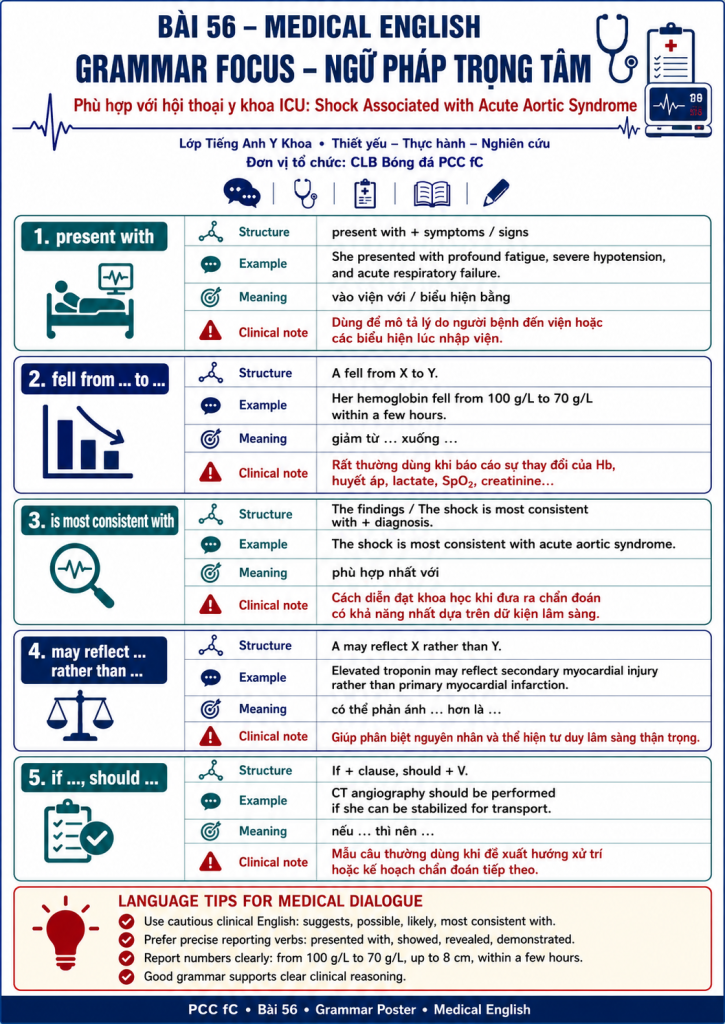
1. Trình bày người bệnh
She is an 89-year-old woman with a history of hypertension.
Cấu trúc:
Patient + be + age + with a history of + disease.
Ví dụ:
- He is a 65-year-old man with a history of coronary artery disease.
- She is a 72-year-old woman with a history of chronic kidney disease.
2. Mô tả lý do nhập viện
She presented with severe hypotension and acute respiratory failure.
Cấu trúc:
Present with + triệu chứng hoặc hội chứng.
Ví dụ:
- The patient presented with sudden-onset chest pain.
- He presented with altered mental status and shock.
Không nên nói:
She presented severe hypotension.
Cách đúng:
She presented with severe hypotension.
3. Báo cáo sự thay đổi của xét nghiệm
Her hemoglobin fell from 100 g/L to 70 g/L within a few hours.
Cấu trúc:
Parameter + rose/fell/increased/decreased + from A to B + within/over a period.
Ví dụ:
- Her lactate increased from 3 to 8 mmol/L within two hours.
- His blood pressure fell from 100/60 to 70/40 mmHg.
Phân biệt
- fell from 100 to 70: giảm từ 100 xuống 70.
- fell by 30: giảm một lượng 30.
- fell to 70: giảm xuống còn 70.
4. Trình bày chẩn đoán có khả năng nhất
The shock is most consistent with acute aortic syndrome.
Cấu trúc:
The findings are most consistent with + diagnosis.
Đây là cách diễn đạt khoa học, tránh khẳng định tuyệt đối khi chưa có bằng chứng xác định.
Các cách nói tương tự:
- The findings strongly suggest acute aortic syndrome.
- Acute aortic syndrome is the leading diagnosis.
- The clinical picture is highly suggestive of aortic rupture.
5. Phân biệt hai nguyên nhân
These findings may reflect secondary myocardial injury rather than a primary acute myocardial infarction.
Cấu trúc:
A may reflect X rather than Y.
Ví dụ:
- The elevated troponin may reflect demand ischemia rather than plaque rupture.
- The pleural effusion may represent hemothorax rather than heart failure.
6. Đưa ra phương án phụ thuộc tình trạng người bệnh
CT angiography should be performed if she can be stabilized for transport.
Transesophageal echocardiography should be considered if she remains too unstable.
Cấu trúc:
If + hiện tại đơn, should/can/must + động từ nguyên thể.
Ví dụ:
- If the patient remains hypotensive, vasopressor support should be continued.
- If transport is unsafe, bedside imaging should be performed.
VI. GRAMMAR FOCUS – NGỮ PHÁP TRỌNG TÂM
1. Câu bị động trong báo cáo y khoa
Chủ động
The medical team intubated the patient.
Bị động
The patient was intubated.
Trong hội thoại lâm sàng, câu bị động được sử dụng khi cần nhấn mạnh người bệnh hoặc thủ thuật hơn là người thực hiện.
Các ví dụ:
- She was placed on mechanical ventilation.
- Norepinephrine was initiated.
- A mural thrombus was detected.
- CT angiography should be performed urgently.
2. Modal verbs diễn đạt mức độ chắc chắn
| Cấu trúc | Mức độ |
| may reflect | có thể phản ánh |
| might indicate | có thể gợi ý |
| is likely to represent | nhiều khả năng là |
| strongly suggests | gợi ý mạnh |
| is most consistent with | phù hợp nhất với |
| confirms | xác nhận |
Khi chưa có CTA hoặc TEE, nên sử dụng:
- suspected
- possible
- likely
- suggestive of
- consistent with
Không nên khẳng định:
The aorta has ruptured.
Nên nói:
Aortic rupture is strongly suspected.
Hoặc:
The findings suggest possible leakage or contained rupture.
3. “Requiring” để trình bày hậu quả
Her blood pressure remained critically low, requiring a norepinephrine infusion.
“Requiring” rút gọn cho:
Her blood pressure remained critically low, and this required a norepinephrine infusion.
Ví dụ:
- She developed respiratory failure, requiring intubation.
- His condition deteriorated rapidly, requiring emergency surgery.
VII. CLINICAL REASONING – TƯ DUY LÂM SÀNG
Question 1
Why is primary acute myocardial infarction less likely to be the main cause of shock?
Suggested answer
Primary acute myocardial infarction is less likely because the patient has a markedly dilated thoracic aorta with a suspected intimal flap, a rapid fall in hemoglobin, profound hypotension, and pleural effusions. Elevated cardiac biomarkers may result from secondary myocardial injury, cardiac strain, or coronary malperfusion.
Question 2
Why is the rapid fall in hemoglobin clinically important?
Suggested answer
A rapid fall in hemoglobin suggests acute blood loss. In this clinical context, it raises concern for leakage or rupture of the aortic aneurysm, possibly causing hemothorax or internal bleeding.
Question 3
Why must fluid resuscitation be cautious?
Suggested answer
Excessive fluid administration may increase blood pressure and aortic wall stress, potentially worsening bleeding or rupture. Resuscitation should therefore be individualized while maintaining adequate organ perfusion.
Question 4
Why is bedside ultrasound not sufficient to confirm the complete diagnosis?
Suggested answer
Bedside ultrasound can identify aortic dilatation, an intimal flap, pericardial effusion, pleural effusion, or abdominal aortic abnormalities. However, it may not fully define the extent of the dissection, the site of rupture, or branch-vessel involvement. Definitive imaging is usually required.
VIII. PRONUNCIATION PRACTICE – LUYỆN PHÁT ÂM
Đọc chậm, sau đó tăng dần tốc độ:
Sentence 1
Her hemoglobin fell rapidly from one hundred grams per liter to seventy grams per liter.
Sentence 2
Bedside ultrasonography showed a suspected intimal dissection flap.
Sentence 3
The shock is most consistent with acute aortic syndrome.
Sentence 4
Elevated troponin may reflect secondary myocardial injury rather than primary myocardial infarction.
Sentence 5
Urgent cardiothoracic and vascular surgical consultation is required.
IX. PRACTICE EXERCISES – BÀI TẬP THỰC HÀNH
Exercise 1: Fill in the blanks
Điền từ thích hợp:
intimal – hypoperfusion – rupture – norepinephrine – hemoglobin
- Her __________ fell from 100 g/L to 70 g/L.
- The ultrasound showed a suspected __________ flap.
- Cold extremities and delayed capillary refill indicate peripheral __________.
- Persistent hypotension required a __________ infusion.
- The rapid blood loss raised concern for aortic __________.
Exercise 2: Choose the best answer
1. “The findings are most consistent with” được sử dụng để:
A. Khẳng định chẩn đoán chắc chắn.
B. Trình bày chẩn đoán phù hợp nhất dựa trên bằng chứng hiện có.
C. Loại trừ hoàn toàn các chẩn đoán khác.
D. Mô tả một thủ thuật.
2. Câu nào phù hợp nhất khi chưa có CTA?
A. The aorta has definitely ruptured.
B. The patient certainly has free aortic rupture.
C. The findings suggest possible aortic leakage or contained rupture.
D. There is no need for further imaging.
3. “Rather than” trong hội thoại có nghĩa là:
A. Đồng thời với.
B. Do đó.
C. Hơn là hoặc thay vì.
D. Mặc dù.
Exercise 3: Correct the mistakes
1.
She presented severe hypotension and respiratory failure.
2.
Her hemoglobin fell by 100 g/L to 70 g/L.
3.
The findings confirm aortic rupture, although CT angiography has not been performed.
4.
She was intubated and placed in mechanical ventilation.
Exercise 4: Clinical role-play
Student A – Attending Physician
Hỏi nội trú về:
- Tình trạng khi nhập ICU.
- Các biện pháp hồi sức ban đầu.
- Kết quả hemoglobin.
- Kết quả siêu âm.
- Nguyên nhân sốc.
- Các biến chứng cần loại trừ.
Student B – Resident
Trình bày:
- Người bệnh nữ, 89 tuổi.
- Tiền sử tăng huyết áp.
- Tụt huyết áp và suy hô hấp.
- Đặt nội khí quản, thở máy và truyền norepinephrine.
- Hemoglobin giảm từ 100 xuống 70 g/L.
- Động mạch chủ ngực giãn 8 cm, nghi có vạt bóc tách.
- Nghi rò rỉ hoặc vỡ khu trú.
- Cần CTA hoặc TEE và hội chẩn ngoại khoa khẩn cấp.
X. ANSWER KEY – ĐÁP ÁN
Exercise 1
- hemoglobin
- intimal
- hypoperfusion
- norepinephrine
- rupture
Exercise 2
- B
- C
- C
Exercise 3
1. Correct
She presented with severe hypotension and respiratory failure.
2. Correct
Her hemoglobin fell from 100 g/L to 70 g/L.
Hoặc:
Her hemoglobin fell by 30 g/L.
3. Correct
The findings suggest possible aortic rupture, although CT angiography has not been performed.
4. Correct
She was intubated and placed on mechanical ventilation.
XI. FIVE-SENTENCE CLINICAL SUMMARY
Học viên luyện trình bày tình huống trong năm câu:
She is an 89-year-old woman with hypertension who presented with profound hypotension, altered mental status, and acute respiratory failure.
She required intubation, mechanical ventilation, and norepinephrine support.
Her hemoglobin fell rapidly from 100 g/L to 70 g/L within a few hours.
Bedside ultrasound showed an 8-centimeter thoracic aortic aneurysm with a suspected intimal flap.
Acute aortic syndrome complicated by possible leakage or contained rupture is the leading diagnosis, requiring urgent surgical consultation and definitive imaging.
XII. TAKE-HOME MESSAGE – THÔNG ĐIỆP GHI NHỚ
Clinical message
Ở người bệnh sốc có túi phình động mạch chủ lớn, nghi vạt bóc tách và hemoglobin giảm nhanh, cần ưu tiên nghĩ đến:
Acute aortic syndrome complicated by leakage or rupture.
Không nên quy kết tình trạng sốc cho nhồi máu cơ tim chỉ dựa trên troponin tăng.
English message
Khi chẩn đoán chưa được xác nhận, hãy sử dụng ngôn ngữ khoa học và thận trọng:
- suspected
- possible
- likely
- suggestive of
- most consistent with
Precise language reflects precise clinical thinking.
GỢI Ý PHÂN BỔ THỜI GIAN
| Hoạt động | Thời gian |
| Giới thiệu tình huống | 2 phút |
| Đọc và phân vai hội thoại | 5 phút |
| Từ vựng và phát âm | 5 phút |
| Ngữ pháp trọng tâm | 4 phút |
| Tư duy lâm sàng | 4 phút |
| Role-play và chữa bài | 5 phút |
Tổng thời gian: 25 phút
PCC fC MESSAGE
Học tiếng Anh từ người bệnh – rèn tư duy từ thực hành – lan tỏa tri thức bằng tinh thần đồng đội.
CLB Bóng đá PCC fC
Vì một đam mê: Khỏe – Vui – Hạnh phúc
PCC fC