Bài 69 – Tiếng Anh Y Khoa: Giải phẫu các cơ mặt trước và khám lâm sàng * Anterior muscle anatomy and clinical examination
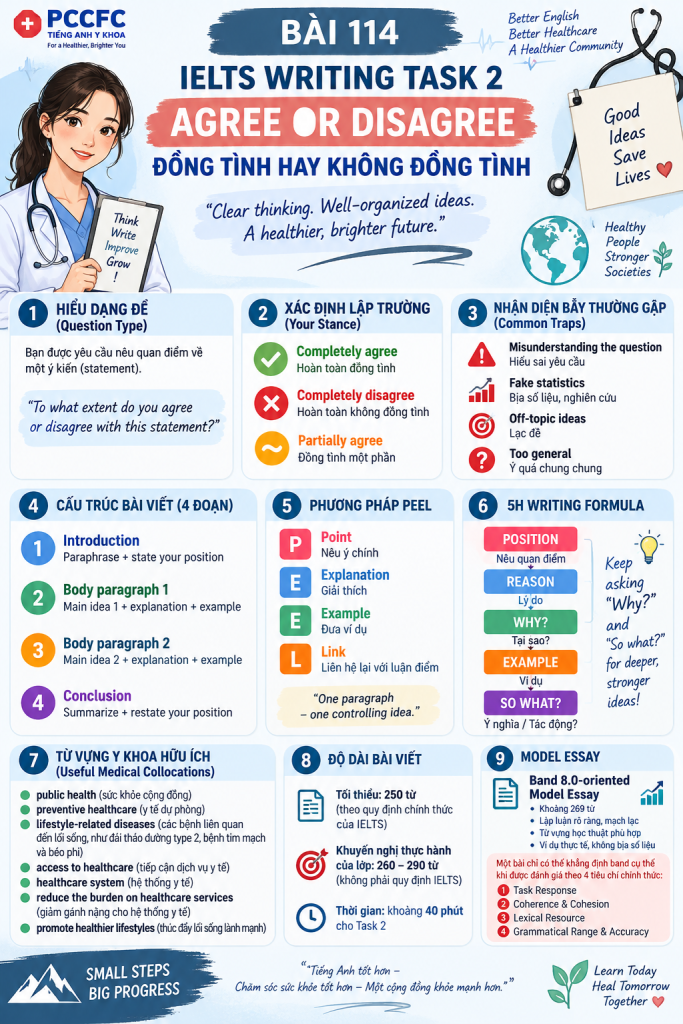
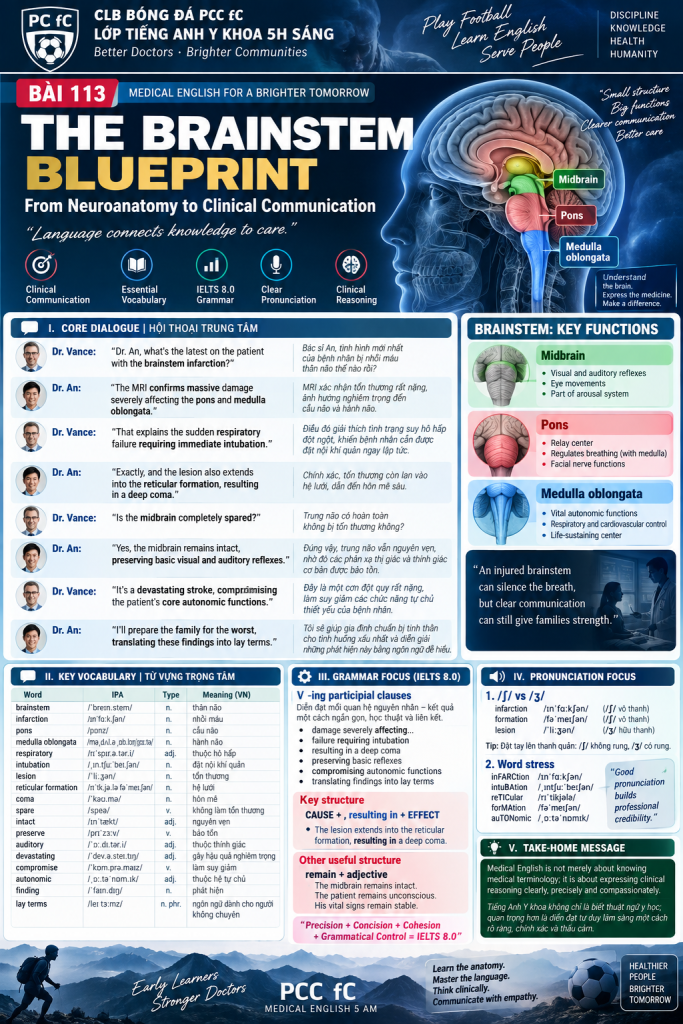
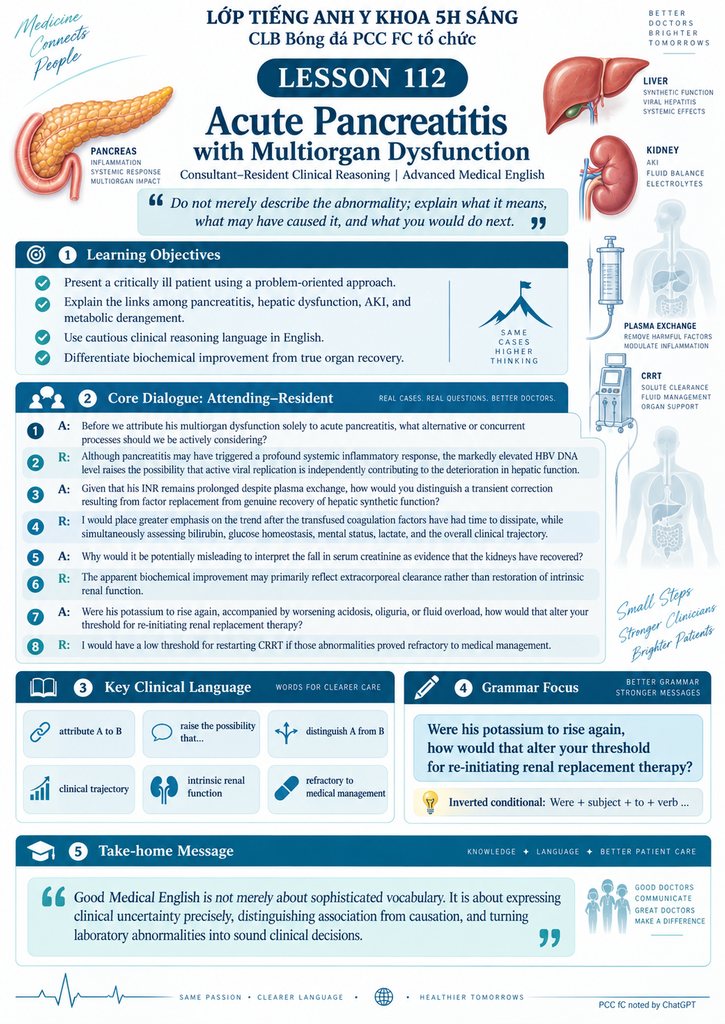
PCC Language – Thăng Long, Hà Nội, 28/7/2026, Trong thăm khám lâm sàng, việc nhận biết tên cơ chỉ là bước khởi đầu; điều quan trọng hơn là hiểu vị trí giải phẫu, chức năng vận động và cách mô tả chính xác những gì đang quan sát được ở người bệnh. Bài 69 – Anterior Muscle Anatomy and Clinical Examination giúp học viên kết nối kiến thức giải phẫu các cơ mặt trước với ngôn ngữ sử dụng tại giường bệnh, thông qua một đoạn hội thoại ngắn, khoa học và có tính ứng dụng cao. Từ câu mẫu trọng tâm về cơ delta và cơ trên gai, chúng ta sẽ luyện cách xác định chủ ngữ, động từ, bổ ngữ, trạng ngữ và mệnh đề đối chiếu; đồng thời củng cố từ vựng, phiên âm và các cấu trúc thường gặp khi hướng dẫn bệnh nhân thực hiện động tác khám. Mục tiêu của bài học không chỉ là nói đúng một câu tiếng Anh, mà là hình thành tư duy: nhìn thấy vận động, xác định cơ liên quan và diễn đạt kết quả khám một cách rõ ràng, logic và chuyên nghiệp.
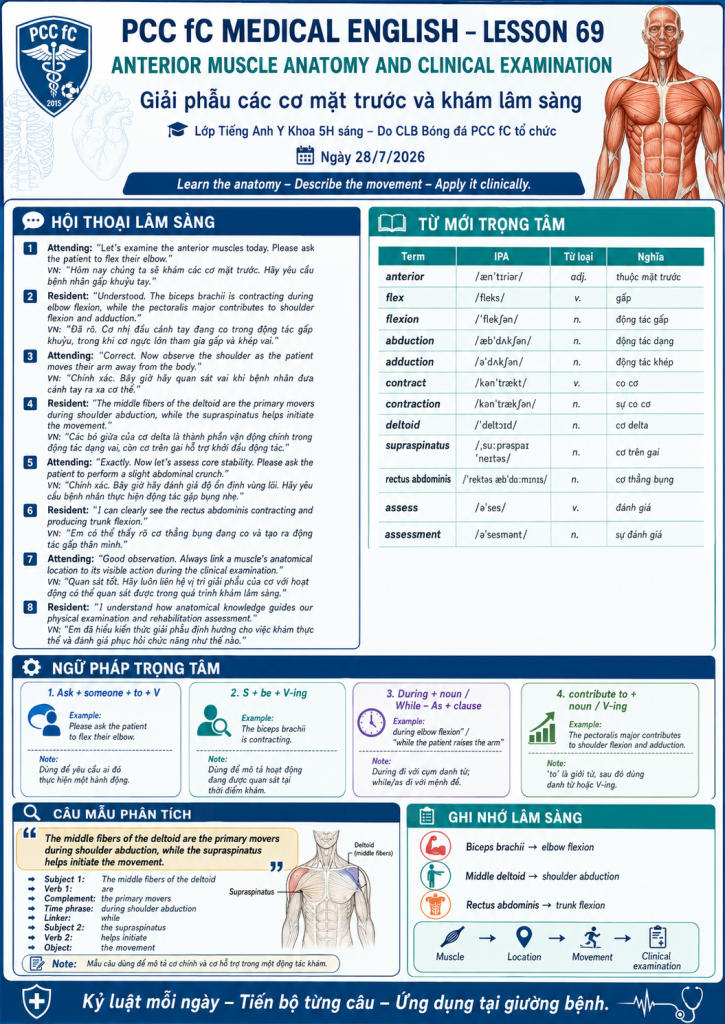
PCC fC MEDICAL ENGLISH – LESSON 69
ANTERIOR MUSCLE ANATOMY AND CLINICAL EXAMINATION
Giải phẫu các cơ mặt trước và khám lâm sàng
Lớp Tiếng Anh Y Khoa 5H sáng
Do CLB Bóng đá PCC fC tổ chức
Ngày 28/7/2026
Learn the anatomy – Describe the movement – Apply it clinically.
Học giải phẫu – Mô tả vận động – Ứng dụng lâm sàng.
I. LEARNING OBJECTIVES – MỤC TIÊU BÀI HỌC
Sau bài học, học viên có thể:
- Gọi đúng tên một số cơ chính ở mặt trước cơ thể bằng tiếng Anh.
- Phát âm đúng các thuật ngữ giải phẫu quan trọng.
- Mô tả chức năng và hoạt động co cơ trong quá trình khám.
- Hướng dẫn bệnh nhân thực hiện các động tác khám cơ bản.
- Sử dụng chính xác các cấu trúc:
- ask someone to do something
- be + V-ing
- during + noun
- while/as + clause
- contribute to + noun/V-ing
- Trình bày mối liên hệ:
Muscle → Anatomical location → Movement → Clinical examination
II. WARM-UP – KHỞI ĐỘNG
Hãy thử trả lời bằng tiếng Anh:
- Which muscle is mainly responsible for elbow flexion?
- Which muscle is the primary mover during shoulder abduction?
- Which abdominal muscle produces trunk flexion?
- How would you ask a patient to flex their elbow?
- How would you describe a muscle that is contracting now?
III. CLINICAL DIALOGUE – HỘI THOẠI LÂM SÀNG
Anterior Muscle Examination
Khám các cơ mặt trước
1. Attending Physician
Let’s examine the anterior muscles today. Please ask the patient to flex their elbow.
Hôm nay chúng ta sẽ khám các cơ mặt trước. Hãy yêu cầu bệnh nhân gấp khuỷu tay.
2. Resident
Understood. The biceps brachii is contracting during elbow flexion, while the pectoralis major contributes to shoulder flexion and adduction.
Đã rõ. Cơ nhị đầu cánh tay đang co trong động tác gấp khuỷu, trong khi cơ ngực lớn tham gia vào động tác gấp và khép vai.
3. Attending Physician
Correct. Now observe the shoulder as the patient moves their arm away from the body.
Chính xác. Bây giờ hãy quan sát vai khi bệnh nhân đưa cánh tay ra xa cơ thể.
4. Resident
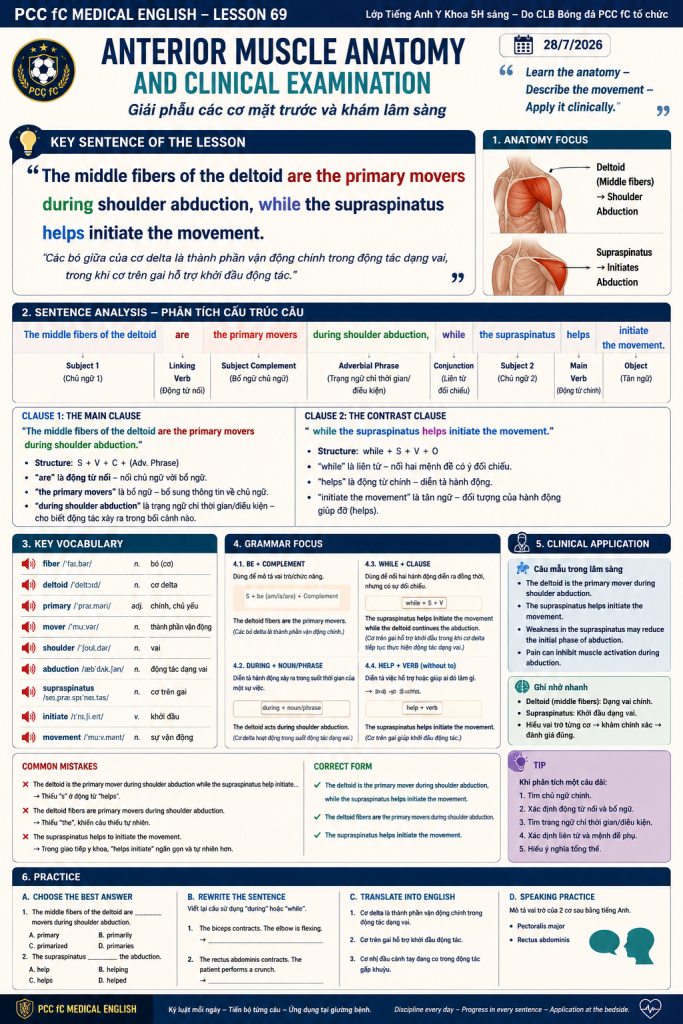
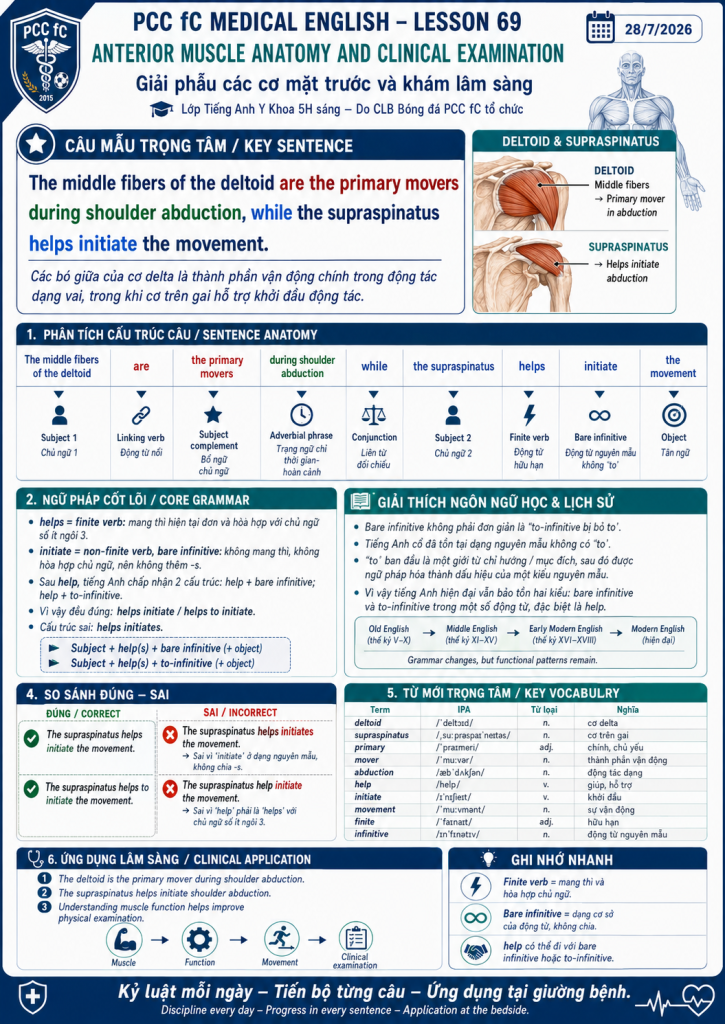
The middle fibers of the deltoid are the primary movers during shoulder abduction, while the supraspinatus helps initiate the movement.
Các bó giữa của cơ delta là thành phần vận động chính trong động tác dạng vai, trong khi cơ trên gai hỗ trợ khởi đầu động tác.
5. Attending Physician
Exactly. Now let’s assess core stability. Please ask the patient to perform a slight abdominal crunch.
Chính xác. Bây giờ chúng ta hãy đánh giá độ ổn định của vùng lõi. Hãy yêu cầu bệnh nhân thực hiện một động tác gập bụng nhẹ.
6. Resident
I can clearly see the rectus abdominis contracting and producing trunk flexion.
Em có thể thấy rõ cơ thẳng bụng đang co và tạo ra động tác gấp thân mình.
7. Attending Physician
Good observation. Always link a muscle’s anatomical location to its visible action during the clinical examination.
Quan sát tốt. Hãy luôn liên hệ vị trí giải phẫu của một cơ với hoạt động có thể quan sát được trong quá trình khám lâm sàng.
8. Resident
I understand how anatomical knowledge guides our physical examination and rehabilitation assessment.
Em đã hiểu kiến thức giải phẫu định hướng cho việc khám thực thể và đánh giá phục hồi chức năng như thế nào.
IV. DIALOGUE MAP – SƠ ĐỒ LOGIC HỘI THOẠI
Bước 1: Ra yêu cầu khám
Please ask the patient to flex their elbow.
Bước 2: Quan sát hoạt động cơ
The biceps brachii is contracting.
Bước 3: Liên hệ cơ với động tác
The pectoralis major contributes to shoulder flexion and adduction.
Bước 4: Đánh giá một nhóm cơ khác
Let’s assess core stability.
Bước 5: Tổng hợp kiến thức giải phẫu và lâm sàng
Anatomical knowledge guides our physical examination.
V. KEY VOCABULARY – TỪ VỰNG TRỌNG TÂM
| Từ/cụm từ | Phiên âm IPA | Từ loại | Nghĩa |
| anterior | /ænˈtɪriər/ | adjective | thuộc mặt trước |
| anatomy | /əˈnætəmi/ | noun | giải phẫu học |
| anatomical | /ˌænəˈtɑːmɪkəl/ | adjective | thuộc giải phẫu |
| muscle | /ˈmʌsəl/ | noun | cơ |
| muscular | /ˈmʌskjələr/ | adjective | thuộc hệ cơ |
| examine | /ɪɡˈzæmɪn/ | verb | khám, kiểm tra |
| examination | /ɪɡˌzæmɪˈneɪʃən/ | noun | sự thăm khám |
| flex | /fleks/ | verb | gấp một khớp |
| flexion | /ˈflekʃən/ | noun | động tác gấp |
| extend | /ɪkˈstend/ | verb | duỗi |
| extension | /ɪkˈstenʃən/ | noun | động tác duỗi |
| abduct | /æbˈdʌkt/ | verb | dạng ra khỏi đường giữa |
| abduction | /æbˈdʌkʃən/ | noun | động tác dạng |
| adduct | /əˈdʌkt/ | verb | khép về phía đường giữa |
| adduction | /əˈdʌkʃən/ | noun | động tác khép |
| contract | /kənˈtrækt/ | verb | co cơ |
| contraction | /kənˈtrækʃən/ | noun | sự co cơ |
| observe | /əbˈzɜːrv/ | verb | quan sát |
| observation | /ˌɑːbzərˈveɪʃən/ | noun | sự quan sát |
| assess | /əˈses/ | verb | đánh giá |
| assessment | /əˈsesmənt/ | noun | sự đánh giá |
| movement | /ˈmuːvmənt/ | noun | sự vận động |
| stability | /stəˈbɪləti/ | noun | độ ổn định |
| initiate | /ɪˈnɪʃieɪt/ | verb | khởi đầu |
| produce | /prəˈduːs/ | verb | tạo ra |
| contribute | /kənˈtrɪbjuːt/ | verb | góp phần, tham gia |
| rehabilitation | /ˌriːhəˌbɪlɪˈteɪʃən/ | noun | phục hồi chức năng |
| palpation | /pælˈpeɪʃən/ | noun | sự sờ nắn |
| tenderness | /ˈtendərnəs/ | noun | đau khi ấn |
| weakness | /ˈwiːknəs/ | noun | yếu cơ |
VI. MUSCLE NAMES – TÊN CÁC CƠ QUAN TRỌNG
| Tên cơ | Phiên âm IPA | Từ loại | Chức năng được nhắc trong bài |
| biceps brachii | /ˈbaɪseps ˈbreɪki.aɪ/ | noun | gấp khuỷu, hỗ trợ ngửa cẳng tay |
| pectoralis major | /ˌpektəˈreɪlɪs ˈmeɪdʒər/ | noun | gấp, khép và xoay trong vai |
| deltoid | /ˈdeltɔɪd/ | noun | dạng vai, tùy theo bó cơ |
| supraspinatus | /ˌsuːprəspaɪˈneɪtəs/ | noun | hỗ trợ khởi đầu dạng vai |
| rectus abdominis | /ˈrektəs æbˈdɑːmɪnɪs/ | noun | gấp thân mình |
| external oblique | /ɪkˈstɜːrnəl əˈbliːk/ | noun | xoay và gấp thân |
| intercostal muscle | /ˌɪntərˈkɑːstəl ˈmʌsəl/ | noun | tham gia vận động lồng ngực |
| diaphragm | /ˈdaɪəfræm/ | noun | cơ hô hấp chính |
VII. PRONUNCIATION FOCUS – TRỌNG TÂM PHÁT ÂM
1. Muscle
muscle /ˈmʌsəl/
- Chỉ có hai âm tiết.
- Chữ c không được phát âm riêng.
- Không đọc thành /ˈmʌskəl/.
2. Anterior
anterior /ænˈtɪriər/
Nhấn âm tiết thứ hai:
an-TEER-ior
3. Contract
Khi là động từ:
contract /kənˈtrækt/
Nhấn âm tiết sau:
con-TRACT
4. Assessment
assessment /əˈsesmənt/
Nhấn vào âm -sess-:
a-SESS-ment
5. Biceps brachii
biceps brachii /ˈbaɪseps ˈbreɪki.aɪ/
- biceps: nhấn âm đầu.
- brachii: có thể luyện theo ba phần: BRAY-kee-eye.
6. Supraspinatus
supraspinatus /ˌsuːprəspaɪˈneɪtəs/
Chia nhỏ:
supra – spin – atus
VIII. WORD FORMATION – HỌ TỪ
1. Flex
| Dạng từ | Từ | Ví dụ |
| Verb | flex | Flex your elbow. |
| Noun | flexion | Elbow flexion is intact. |
| Adjective | flexed | Keep the elbow flexed. |
| Adjective | flexible | The joint remains flexible. |
2. Contract
| Dạng từ | Từ | Ví dụ |
| Verb | contract | The muscle contracts. |
| Noun | contraction | Muscle contraction is visible. |
| Adjective | contracted | The muscle remains contracted. |
| Present participle | contracting | The biceps is contracting. |
3. Assess
| Dạng từ | Từ | Ví dụ |
| Verb | assess | Assess muscle strength. |
| Noun | assessment | Perform a neurological assessment. |
| Past participle | assessed | Strength was assessed bilaterally. |
4. Observe
| Dạng từ | Từ | Ví dụ |
| Verb | observe | Observe the shoulder movement. |
| Noun | observation | That is a good observation. |
| Adjective | observable | No observable weakness was noted. |
IX. MEDICAL WORD ROOTS – GỐC TỪ Y KHOA
| Thành tố | Ý nghĩa | Ví dụ | Giải thích |
| bi- | hai | biceps | cơ có hai đầu |
| tri- | ba | triceps | cơ có ba đầu |
| brachi- | cánh tay | brachii | liên quan vùng cánh tay |
| pector- | ngực | pectoralis | liên quan vùng ngực |
| supra- | phía trên | supraspinatus | nằm phía trên gai vai |
| inter- | ở giữa | intercostal | nằm giữa các xương sườn |
| cost- | xương sườn | intercostal | liên quan xương sườn |
| rectus | thẳng | rectus abdominis | cơ có hướng thớ tương đối thẳng |
| abdomin- | bụng | abdominis | thuộc vùng bụng |
| oblique | chéo | external oblique | thớ cơ chạy chéo |
X. GRAMMAR FOCUS 1
ASK SOMEONE TO DO SOMETHING
Cấu trúc
ask + someone + to + verb
Dùng khi yêu cầu hoặc hướng dẫn một người thực hiện hành động.
Ví dụ trong hội thoại
Please ask the patient to flex their elbow.
Phân tích
- ask: động từ chính
- the patient: tân ngữ chỉ người
- to flex: động từ nguyên mẫu có “to”
- their elbow: tân ngữ của “flex”
Ví dụ lâm sàng
- Ask the patient to raise their arm.
- Ask her to take a deep breath.
- Ask him to squeeze your fingers.
- Ask the patient to resist your pressure.
- Ask them to relax the abdominal muscles.
Lỗi thường gặp
Ask the patient flex their elbow. ❌
Ask the patient to flex their elbow. ✅
XI. GRAMMAR FOCUS 2
THE PRESENT CONTINUOUS FOR OBSERVABLE ACTIONS
Cấu trúc
Subject + am/is/are + V-ing
Ví dụ
The biceps brachii is contracting.
Thì hiện tại tiếp diễn được dùng vì hoạt động co cơ đang xảy ra tại thời điểm người khám quan sát.
Ví dụ lâm sàng
- The patient is flexing the elbow.
- The deltoid is contracting.
- The abdominal wall is moving with respiration.
- The patient is compensating with trunk movement.
- The muscle is becoming more prominent.
So sánh
Hiện tại đơn: chức năng hoặc sự thật giải phẫu
The biceps brachii flexes the elbow.
Cơ nhị đầu có chức năng gấp khuỷu.
Hiện tại tiếp diễn: hoạt động đang được quan sát
The biceps brachii is contracting now.
Cơ nhị đầu đang co ở thời điểm hiện tại.
XII. GRAMMAR FOCUS 3
DURING, WHILE VÀ AS
1. During + noun phrase
The biceps contracts during elbow flexion.
Sau during là danh từ hoặc cụm danh từ.
- during shoulder abduction
- during inspiration
- during the examination
- during active movement
2. While + subject + verb
The biceps contracts while the patient flexes the elbow.
Sau while là một mệnh đề đầy đủ.
- while the patient raises the arm
- while the muscle is contracting
- while the examiner applies resistance
3. As + subject + verb
Observe the shoulder as the patient moves their arm away from the body.
Trong câu này, as có nghĩa là “khi” hoặc “trong lúc”.
So sánh
Observe the muscle during contraction.
Observe the muscle while it is contracting.
Observe the muscle as the patient performs the movement.
Lỗi thường gặp
during the patient raises the arm ❌
while the patient raises the arm ✅
during shoulder elevation ✅
XIII. GRAMMAR FOCUS 4
CONTRIBUTE TO + NOUN/V-ING
Cấu trúc
contribute to + noun
contribute to + V-ing
Chữ to trong cấu trúc này là giới từ, không phải dấu hiệu của động từ nguyên mẫu.
Ví dụ trong bài
The pectoralis major contributes to shoulder flexion and adduction.
Ví dụ khác
- The diaphragm contributes to inspiration.
- Core muscles contribute to maintaining trunk stability.
- Weakness may contribute to impaired mobility.
- Pain can contribute to reduced range of motion.
Lỗi thường gặp
contribute to maintain stability ❌
contribute to maintaining stability ✅
help maintain stability ✅
XIV. GRAMMAR FOCUS 5
HELP + VERB
Hai cấu trúc đều đúng
help + verb
help + to + verb
Ví dụ:
The supraspinatus helps initiate shoulder abduction.
The supraspinatus helps to initiate shoulder abduction.
Trong giao tiếp lâm sàng, dạng không có to thường ngắn gọn và tự nhiên hơn.
XV. GRAMMAR FOCUS 6
LINK A TO B
Cấu trúc
link + A + to + B
Ví dụ trong hội thoại
Always link a muscle’s anatomical location to its visible action.
Ví dụ khác
- Link the symptom to the underlying lesion.
- Link the movement to the responsible muscle.
- Link the physical finding to the affected nerve.
- Link anatomical knowledge to clinical practice.
XVI. SENTENCE ANALYSIS – PHÂN TÍCH CÂU TRỌNG TÂM
Câu trọng tâm
The middle fibers of the deltoid are the primary movers during shoulder abduction, while the supraspinatus helps initiate the movement.
1. Mệnh đề thứ nhất
Chủ ngữ
The middle fibers of the deltoid
- The middle fibers: trung tâm của cụm chủ ngữ
- of the deltoid: cụm giới từ bổ nghĩa cho “fibers”
Động từ nối
are
Bổ ngữ chủ ngữ
the primary movers
Trạng ngữ
during shoulder abduction
2. Mệnh đề thứ hai
while the supraspinatus helps initiate the movement
- while: liên từ
- the supraspinatus: chủ ngữ
- helps initiate: cụm động từ
- the movement: tân ngữ
3. Khung câu có thể tái sử dụng
Muscle A is the primary mover during movement X, while muscle B helps initiate or stabilize the movement.
Ví dụ
The diaphragm is the primary muscle of inspiration, while the external intercostal muscles help expand the rib cage.
XVII. CLINICAL LANGUAGE PATTERNS
CÁC MẪU CÂU GIAO TIẾP LÂM SÀNG
1. Hướng dẫn bệnh nhân
- Please flex your elbow.
- Please extend your arm.
- Move your arm away from your body.
- Bring your arm back toward your body.
- Raise your arm above your head.
- Hold this position.
- Do not let me push your arm down.
- Relax your muscles.
- Perform a slight abdominal crunch.
- Tell me if you feel any pain.
2. Mô tả quan sát
- The muscle is contracting normally.
- The movement is smooth and symmetrical.
- There is reduced movement on the left side.
- The patient has difficulty initiating the movement.
- The patient is compensating with trunk rotation.
- No visible muscle wasting is noted.
- There is mild asymmetry between the two sides.
- The muscle becomes prominent during contraction.
3. Mô tả sức cơ
- Muscle strength is normal.
- Strength is reduced on the right side.
- The patient can move against gravity.
- The patient can maintain the position against resistance.
- The patient cannot overcome external resistance.
- There is no objective muscle weakness.
4. Mô tả đau và sờ nắn
- The muscle is tender on palpation.
- No focal tenderness is present.
- The patient reports pain during active movement.
- Passive movement does not reproduce the pain.
- There is no palpable defect in the muscle.
XVIII. CLINICAL–ANATOMICAL SUMMARY
TÓM TẮT GIẢI PHẪU – LÂM SÀNG
| Cơ | Động tác nổi bật | Câu mô tả tiếng Anh |
| Biceps brachii | Gấp khuỷu | The biceps brachii contracts during elbow flexion. |
| Pectoralis major | Gấp và khép vai | The pectoralis major contributes to shoulder flexion and adduction. |
| Deltoid – middle fibers | Dạng vai | The middle fibers of the deltoid produce shoulder abduction. |
| Supraspinatus | Hỗ trợ khởi đầu dạng vai | The supraspinatus helps initiate shoulder abduction. |
| Rectus abdominis | Gấp thân mình | The rectus abdominis produces trunk flexion. |
| External oblique | Gấp và xoay thân | The external oblique contributes to trunk flexion and rotation. |
| Diaphragm | Hít vào | The diaphragm contracts during inspiration. |
XIX. COMMON LANGUAGE ERRORS
CÁC LỖI THƯỜNG GẶP
1. Nhầm “arm” và “elbow”
Flex your arm. △
Câu trên có thể hiểu được nhưng không xác định rõ khớp.
Flex your elbow. ✅
2. Nhầm flexion với extension
- flexion: làm giảm góc giữa hai phần cơ thể
- extension: làm tăng góc hoặc duỗi khớp
3. Nhầm abduction với adduction
- abduction: ra xa đường giữa
- adduction: về phía đường giữa
Mẹo nhớ:
Abduction takes the limb away.
4. Dùng sai sau “contribute to”
contributes to stabilize the trunk ❌
contributes to stabilizing the trunk ✅
helps stabilize the trunk ✅
5. Dùng sai “during”
during the patient performs the movement ❌
while the patient performs the movement ✅
during the movement ✅
6. Nhầm “contract” và “contraction”
The muscle is contraction. ❌
The muscle is contracting. ✅
Muscle contraction is visible. ✅
XX. PRACTICE 1 – MATCHING
Ghép từ với nghĩa phù hợp.
- Flexion
- Abduction
- Contraction
- Stability
- Assessment
- Palpation
A. Sự đánh giá
B. Sự co cơ
C. Động tác gấp
D. Sự sờ nắn
E. Độ ổn định
F. Động tác dạng
XXI. PRACTICE 2 – WORD FORM
Điền dạng đúng của từ trong ngoặc.
- The biceps brachii is ______ during elbow flexion.
(contract) - Shoulder ______ is mainly produced by the middle deltoid fibers.
(abduct) - The examiner performed a detailed muscle strength ______.
(assess) - The movement was clearly ______ during the examination.
(observe) - The patient had difficulty ______ the movement.
(initiate) - The rectus abdominis contributes to trunk ______.
(flex)
XXII. PRACTICE 3 – DURING, WHILE OR AS
Điền during, while hoặc as.
- The biceps contracts ______ elbow flexion.
- Observe the deltoid ______ the patient raises the arm.
- The patient experienced pain ______ the examination.
- Palpate the abdominal muscles ______ the patient performs a crunch.
- The muscle becomes prominent ______ it contracts.
- The examiner applies resistance ______ active movement.
XXIII. PRACTICE 4 – CORRECT THE ERRORS
Sửa các câu sau:
- Ask the patient flex their elbow.
- The biceps is contraction during elbow flexion.
- Observe the shoulder during the patient raises the arm.
- The pectoralis major contributes to adduct the shoulder.
- The supraspinatus helps initiating the movement.
- The rectus abdominis produce trunk flexion.
XXIV. PRACTICE 5 – TRANSLATION
Dịch sang tiếng Anh:
- Hãy yêu cầu bệnh nhân gấp khuỷu tay.
- Cơ nhị đầu cánh tay đang co trong động tác gấp khuỷu.
- Hãy quan sát vai khi bệnh nhân đưa cánh tay ra xa cơ thể.
- Các bó giữa của cơ delta là thành phần vận động chính trong động tác dạng vai.
- Cơ trên gai hỗ trợ khởi đầu động tác.
- Tôi có thể thấy rõ cơ thẳng bụng đang co.
- Cơ thẳng bụng tạo ra động tác gấp thân mình.
- Kiến thức giải phẫu định hướng cho quá trình khám thực thể.
XXV. PRACTICE 6 – COMPLETE THE CLINICAL COMMANDS
Hoàn thành các câu hướng dẫn:
- Please ______ your elbow.
- Move your arm ______ from your body.
- Hold this ______ for five seconds.
- Do not let me ______ your arm down.
- Please ______ a slight abdominal crunch.
- Tell me if you ______ any pain.
XXVI. SPEAKING PRACTICE – LUYỆN NÓI
Tình huống
Bạn đang khám sức cơ chi trên cho một bệnh nhân.
Hãy sử dụng ít nhất năm câu sau:
- Giới thiệu mục đích khám.
- Yêu cầu bệnh nhân gấp khuỷu.
- Yêu cầu bệnh nhân dạng vai.
- Yêu cầu bệnh nhân giữ tư thế chống lại lực cản.
- Mô tả hoạt động của cơ.
- Hỏi bệnh nhân có đau hay không.
- Nhận xét sự đối xứng giữa hai bên.
Bài nói mẫu
I am going to examine the muscles of your upper limbs. Please flex your right elbow and hold this position. Do not let me push your arm down. Now move your arm away from your body. The deltoid is contracting normally, and the movement appears symmetrical. Do you feel any pain during the examination?
XXVII. MINI CLINICAL PRESENTATION
Mẫu trình bày ngắn
On examination, the patient was able to flex both elbows against resistance. The biceps brachii contracted symmetrically. Shoulder abduction was full bilaterally, with no visible muscle wasting or compensatory trunk movement. The patient reported no pain during active movement.
Dịch nghĩa
Khi khám, bệnh nhân có thể gấp cả hai khuỷu chống lại lực cản. Hai cơ nhị đầu cánh tay co đối xứng. Động tác dạng vai đầy đủ hai bên, không thấy teo cơ hoặc vận động bù trừ của thân mình. Bệnh nhân không đau khi vận động chủ động.
XXVIII. ANSWER KEY – ĐÁP ÁN
Practice 1
1–C
2–F
3–B
4–E
5–A
6–D
Practice 2
- contracting
- abduction
- assessment
- observable
- initiating
- flexion
Practice 3
- during
- as/while
- during
- while/as
- as/while
- during
Practice 4
- Ask the patient to flex their elbow.
- The biceps is contracting during elbow flexion.
- Observe the shoulder while the patient raises the arm.
- The pectoralis major contributes to adducting the shoulder.
Hoặc: The pectoralis major contributes to shoulder adduction. - The supraspinatus helps initiate the movement.
- The rectus abdominis produces trunk flexion.
Practice 5
- Please ask the patient to flex their elbow.
- The biceps brachii is contracting during elbow flexion.
- Observe the shoulder as the patient moves their arm away from the body.
- The middle fibers of the deltoid are the primary movers during shoulder abduction.
- The supraspinatus helps initiate the movement.
- I can clearly see the rectus abdominis contracting.
- The rectus abdominis produces trunk flexion.
- Anatomical knowledge guides the physical examination.
Practice 6
- flex
- away
- position
- push
- perform
- feel
XXIX. KEY TAKEAWAYS – NỘI DUNG CẦN NHỚ
1. Từ vựng
- flexion: động tác gấp
- extension: động tác duỗi
- abduction: động tác dạng
- adduction: động tác khép
- contraction: sự co cơ
- assessment: sự đánh giá
2. Ngữ pháp
Ask the patient to flex their elbow.
The muscle is contracting.
The muscle contracts during elbow flexion.
Observe the muscle while the patient performs the movement.
The muscle contributes to maintaining stability.
3. Tư duy lâm sàng
Không học tên cơ một cách riêng lẻ. Hãy liên hệ:
Tên cơ → Vị trí → Chức năng → Động tác khám → Nhận xét lâm sàng
XXX. HOMEWORK – BÀI TẬP VỀ NHÀ
Nhiệm vụ 1: Vocabulary
Đọc và ghi âm 10 từ:
- anterior
- anatomy
- muscle
- flexion
- abduction
- contraction
- deltoid
- supraspinatus
- rectus abdominis
- rehabilitation
Nhiệm vụ 2: Dialogue
Đọc toàn bộ hội thoại hai lần:
- Lần 1: đọc chậm, chú ý phát âm.
- Lần 2: đọc theo tốc độ giao tiếp lâm sàng.
Nhiệm vụ 3: Clinical speaking
Tự ghi âm một đoạn 45–60 giây mô tả cách khám:
- elbow flexion;
- shoulder abduction;
- abdominal muscle contraction.
Nhiệm vụ 4: Model sentence
Học thuộc câu:
The middle fibers of the deltoid are the primary movers during shoulder abduction, while the supraspinatus helps initiate the movement.
MESSAGE OF LESSON 69
Anatomy becomes clinically meaningful when we can observe, describe, and examine movement accurately.
Kiến thức giải phẫu chỉ thực sự có ý nghĩa lâm sàng khi chúng ta có thể quan sát, mô tả và thăm khám vận động một cách chính xác.
PCC fC MEDICAL ENGLISH
Kỷ luật mỗi ngày – Tiến bộ từng câu – Ứng dụng tại giường bệnh.
Discipline every day – Progress in every sentence – Application at the bedside.