Bài 84 – Tiếng Anh Y Khoa: Nguyên nhân lâm sàng tới bệnh lý mạch máu ổ bụng * Clinical reasoning in abdominal
BÀI 84 – FROM ABDOMINAL PAIN TO OMENTAL INFARCTION
Clinical Reasoning in Abdominal Vascular Disease
Medical English Class – PCC fC Football Club
Chủ đề: Omental Infarction – Mesenteric Ischemia – Thrombotic Work-up
Thông điệp: Treat the patient, not the label.
Triết lý học tập: Diagnosis is a process, not a label.
I. CASE-BASED INTRODUCTION | DẪN NHẬP CA BỆNH
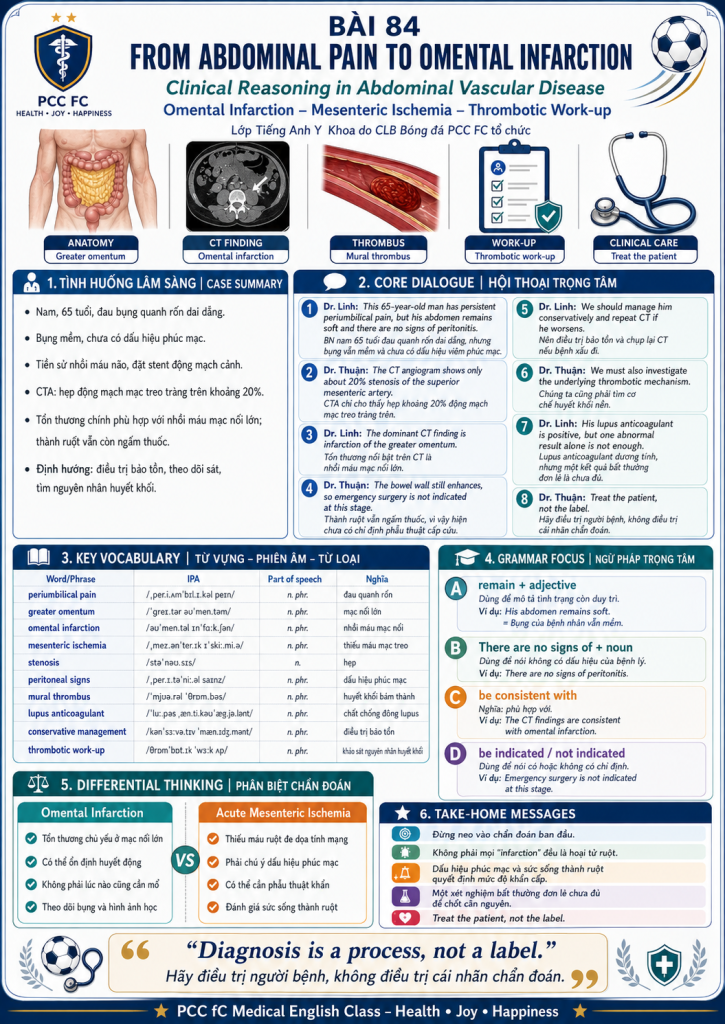
Một bệnh nhân nam 65 tuổi nhập viện vì đau bụng quanh rốn từng cơn, không sốt, không nôn; khám ban đầu bụng mềm, chướng nhẹ và chưa có dấu hiệu kích thích phúc mạc. Người bệnh có tiền sử nhồi máu não do bệnh lý động mạch cảnh, đã can thiệp nội mạch và đặt stent, đang điều trị aspirin + clopidogrel.
Điểm đặc biệt của ca bệnh là chẩn đoán ban đầu hướng tới tắc mạch mạc treo, nhưng MSCT mạch tạng cho thấy động mạch mạc treo tràng trên chỉ hẹp khoảng 20% ở đoạn gốc. Tổn thương nổi bật thực sự là các đám thâm nhiễm ở mạc nối lớn, tăng lên so với phim trước và được kết luận nghĩ nhiều đến nhồi máu mạc nối – omental infarction. Đồng thời có huyết khối bám thành ở hệ động mạch chủ–chậu.
Trong diễn biến, bệnh nhân vẫn ổn định huyết động, bụng mềm và không có dấu hiệu phúc mạc. Ngoại khoa đánh giá chưa có chỉ định can thiệp cấp cứu, ưu tiên điều trị bảo tồn và theo dõi sát tình trạng bụng.
Ca bệnh sau đó đặt ra một câu hỏi sâu hơn:
Why did this patient develop thrombosis?
Tại sao người bệnh này lại xuất hiện huyết khối?
Hội chẩn toàn viện đã mở rộng tìm nguyên nhân gồm Protein C, Protein S, Antithrombin III, sàng lọc ung thư, kháng thể kháng phospholipid và đánh giá các nguồn huyết khối khác.
II. LEARNING OBJECTIVES | MỤC TIÊU BÀI HỌC
Sau bài học, học viên có thể:
- Trình bày một bệnh nhân đau bụng theo cấu trúc tiếng Anh lâm sàng ngắn gọn.
- Phân biệt về thuật ngữ:
- omental infarction
- mesenteric ischemia
- mesenteric arterial occlusion
- Mô tả những dấu hiệu CT quan trọng bằng tiếng Anh.
- Sử dụng chính xác các cụm:
- the abdomen remains soft
- there are no peritoneal signs
- the bowel wall still enhances
- emergency surgery is not indicated
- Thảo luận giữa conservative management và urgent intervention.
- Trình bày một thrombotic work-up có hệ thống.
- Hiểu rằng một xét nghiệm bất thường đơn độc không đồng nghĩa với một chẩn đoán hoàn chỉnh.
- Thực hành tư duy:
Clinical findings → Imaging → Severity → Management → Etiology
III. CLINICAL SCENARIO | TÌNH HUỐNG LÂM SÀNG
Scenario:
Dr. Thuận and Dr. Linh are reviewing a 65-year-old man admitted with persistent periumbilical abdominal pain. He has a history of ischemic stroke and carotid artery stenting. The initial diagnosis was mesenteric vascular occlusion, but CT angiography suggests a different explanation.
IV. CORE DIALOGUE – 8 SENTENCES
1. Dr. Linh
This 65-year-old man has persistent periumbilical pain, but his abdomen remains soft and there are no signs of peritonitis.
Dịch: Người bệnh nam 65 tuổi này đau dai dẳng quanh rốn, nhưng bụng vẫn mềm và không có dấu hiệu viêm phúc mạc.
2. Dr. Thuận
Exactly. The CT angiogram shows only about 20% stenosis of the superior mesenteric artery, so this is not the classic picture of occlusive acute mesenteric ischemia.
Dịch: Đúng vậy. CT mạch chỉ cho thấy động mạch mạc treo tràng trên hẹp khoảng 20%, vì vậy đây không phải hình ảnh điển hình của thiếu máu mạc treo cấp do tắc nghẽn.
3. Dr. Linh
Instead, the dominant CT finding is inflammation and infarction of the greater omentum, consistent with omental infarction.
Dịch: Thay vào đó, tổn thương chủ đạo trên CT là tình trạng viêm và nhồi máu của mạc nối lớn, phù hợp với nhồi máu mạc nối.
4. Dr. Thuận
More importantly, the bowel wall still enhances and he has no peritoneal signs, so emergency surgery is not indicated at this stage.
Dịch: Quan trọng hơn, thành ruột vẫn còn ngấm thuốc và người bệnh không có dấu hiệu phúc mạc, vì vậy hiện tại chưa có chỉ định phẫu thuật cấp cứu.
5. Dr. Linh
We should therefore manage him conservatively, control his pain, perform serial abdominal examinations, and repeat CT promptly if his condition worsens.
Dịch: Vì vậy chúng ta nên điều trị bảo tồn, kiểm soát đau, khám bụng lặp lại và chụp lại CT kịp thời nếu tình trạng xấu đi.
6. Dr. Thuận
Correct, but we must also investigate the underlying thrombotic mechanism, given his previous ischemic stroke and the mural thrombus in the aorto-iliac circulation.
Dịch: Đúng, nhưng chúng ta cũng phải tìm cơ chế huyết khối nền, đặc biệt khi bệnh nhân từng nhồi máu não và hiện có huyết khối bám thành trong hệ động mạch chủ–chậu.
7. Dr. Linh
His lupus anticoagulant is positive, but one abnormal result alone is not enough to establish the underlying diagnosis.
Dịch: Xét nghiệm lupus anticoagulant của người bệnh dương tính, nhưng chỉ một kết quả bất thường đơn độc chưa đủ để xác lập chẩn đoán nguyên nhân.
Trong hồ sơ, lupus anticoagulant được ghi nhận dương tính với dRVVT confirm ratio 1,38.
8. Dr. Thuận
That is the key lesson: treat the patient, not the label—distinguish omental infarction from life-threatening mesenteric ischemia, individualize antithrombotic therapy, and keep searching for the cause of thrombosis.
Dịch: Đó chính là bài học cốt lõi: hãy điều trị người bệnh chứ không điều trị một cái “nhãn” — cần phân biệt nhồi máu mạc nối với thiếu máu mạc treo đe dọa tính mạng, cá thể hóa điều trị chống huyết khối và tiếp tục tìm nguyên nhân gây huyết khối.
V. KEY VOCABULARY | TỪ VỰNG TRỌNG TÂM
| English | IPA | Nghĩa |
| periumbilical pain | /ˌper.i.ʌmˈbɪl.ɪ.kəl peɪn/ | đau quanh rốn |
| omentum | /əʊˈmen.təm/ | mạc nối |
| greater omentum | /ˈɡreɪ.tər əʊˈmen.təm/ | mạc nối lớn |
| omental infarction | /əʊˈmen.təl ɪnˈfɑːk.ʃən/ | nhồi máu mạc nối |
| mesenteric ischemia | /ˌmez.ənˈter.ɪk ɪˈskiː.mi.ə/ | thiếu máu mạc treo |
| superior mesenteric artery | /suːˈpɪə.ri.ər ˌmez.ənˈter.ɪk ˈɑː.tər.i/ | động mạch mạc treo tràng trên |
| stenosis | /stəˈnəʊ.sɪs/ | hẹp |
| occlusion | /əˈkluː.ʒən/ | tắc nghẽn |
| peritonitis | /ˌper.ɪ.təˈnaɪ.tɪs/ | viêm phúc mạc |
| peritoneal signs | /ˌper.ɪ.təˈniː.əl saɪnz/ | dấu hiệu kích thích phúc mạc |
| bowel wall enhancement | /ˈbaʊ.əl wɔːl ɪnˈhɑːns.mənt/ | ngấm thuốc thành ruột |
| mural thrombus | /ˈmjʊə.rəl ˈθrɒm.bəs/ | huyết khối bám thành |
| thrombosis | /θrɒmˈbəʊ.sɪs/ | huyết khối |
| anticoagulation | /ˌæn.ti.kəʊˌæɡ.jəˈleɪ.ʃən/ | điều trị chống đông |
| antiplatelet therapy | /ˌæn.tiˈpleɪt.lət ˈθer.ə.pi/ | điều trị kháng kết tập tiểu cầu |
| conservative management | /kənˈsɜː.və.tɪv ˈmæn.ɪdʒ.mənt/ | điều trị bảo tồn |
| serial examination | /ˈsɪə.ri.əl ɪɡˌzæm.ɪˈneɪ.ʃən/ | khám lặp lại theo thời gian |
| underlying mechanism | /ˌʌn.dəˈlaɪ.ɪŋ ˈmek.ə.nɪ.zəm/ | cơ chế nền |
| thrombotic work-up | /θrɒmˈbɒt.ɪk ˈwɜːk.ʌp/ | khảo sát nguyên nhân huyết khối |
| lupus anticoagulant | /ˈluː.pəs ˌæn.ti.kəʊˈæɡ.jə.lənt/ | chất chống đông lupus |
VI. HIGH-YIELD COLLOCATIONS
Học theo cụm từ, không chỉ học từng từ riêng lẻ:
- persistent abdominal pain – đau bụng dai dẳng
- remain hemodynamically stable – duy trì huyết động ổn định
- a soft abdomen – bụng mềm
- develop peritoneal signs – xuất hiện dấu hiệu phúc mạc
- show arterial stenosis – cho thấy hẹp động mạch
- demonstrate bowel-wall enhancement – cho thấy thành ruột còn ngấm thuốc
- raise concern for ischemia – làm dấy lên lo ngại thiếu máu
- require urgent surgery – cần phẫu thuật khẩn
- manage conservatively – điều trị bảo tồn
- perform serial examinations – khám lặp lại
- identify the source of thrombosis – xác định nguồn/căn nguyên huyết khối
- investigate an underlying cause – tìm nguyên nhân nền
- establish a diagnosis – xác lập chẩn đoán
- individualize treatment – cá thể hóa điều trị
VII. MEDICAL ENGLISH GRAMMAR
1. “His abdomen remains soft.”
Cấu trúc
Subject + remain + adjective
remain là linking verb.
- The abdomen remains soft.
- The patient remains stable.
- His blood pressure remains normal.
Không nói:
❌ remains softly
Mà phải dùng:
✅ remains soft
2. “There are no signs of peritonitis.”
Cấu trúc cực kỳ thông dụng trong báo cáo lâm sàng:
There is/are no evidence/signs of + disease
Ví dụ:
- There is no evidence of bowel necrosis.
- There are no signs of peritoneal irritation.
- There is no evidence of active bleeding.
3. “The CT angiogram shows…”
Động từ báo cáo hình ảnh:
- CT shows
- CT reveals
- CT demonstrates
- MRI suggests
- Imaging is consistent with…
Mức độ chắc chắn
shows → mô tả thấy gì
suggests → gợi ý
is consistent with → phù hợp với
confirms → chỉ dùng khi thực sự đủ căn cứ xác nhận
4. “Consistent with omental infarction.”
Một mẫu câu rất quan trọng:
be consistent with + noun
- The findings are consistent with omental infarction.
- The CT findings are consistent with bowel ischemia.
Không nên dịch máy móc là “nhất quán với”.
Trong y khoa:
consistent with = phù hợp với / tương thích với
5. “Surgery is not indicated at this stage.”
Cấu trúc bị động chuyên ngành:
be indicated
= có chỉ định
be contraindicated
= chống chỉ định
Ví dụ:
- Emergency surgery is indicated.
- Anticoagulation is not indicated at present.
- Thrombolysis is contraindicated.
6. CONDITIONAL – CÂU ĐIỀU KIỆN LÂM SÀNG
Repeat CT promptly if his condition worsens.
Mẫu:
Imperative + if + present simple
- Repeat CT if the pain worsens.
- Call surgery if peritoneal signs develop.
- Obtain lactate if ischemia is suspected.
Đây là kiểu câu đặc biệt hữu ích khi viết medical orders / management plans.
VIII. CLINICAL REASONING | TƯ DUY LÂM SÀNG
Step 1 – Do not anchor on the first diagnosis
Initial label:
“Mesenteric vascular occlusion”
Nhưng câu hỏi phải là:
Does the imaging actually demonstrate a major mesenteric arterial occlusion?
Trong ca này, MSCT ghi nhận động mạch mạc treo tràng trên chỉ hẹp khoảng 20%, trong khi tổn thương mạc nối mới là bất thường nổi bật.
Bài học:
Avoid diagnostic anchoring.
IX. OMENTAL INFARCTION VS MESENTERIC ISCHEMIA
| Feature | Omental infarction | Acute mesenteric ischemia |
| Cơ quan chính | Greater omentum | Intestine |
| Vấn đề chính | Infarction of omental fat | Inadequate bowel perfusion |
| CT trọng tâm | Omental inflammatory/infarcted lesion | Vessel + bowel-wall abnormalities |
| Peritonitis | Có thể không có | Báo động thiếu máu/hoại tử ruột tiến triển |
| Bowel enhancement | Thường được bảo tồn nếu ruột không thiếu máu | Có thể giảm/mất khi thiếu máu nặng |
| Emergency surgery | Không mặc nhiên | Có thể bắt buộc nếu bowel infarction/peritonitis |
| Theo dõi | Clinical course rất quan trọng | Clinical deterioration là red flag |
Pearl
Not every abdominal infarction is intestinal infarction.
X. THE MOST IMPORTANT DECISION
Does this patient need emergency surgery?
Không chỉ nhìn vào từ “infarction”.
Phải đánh giá:
Hemodynamic status
↓
Abdominal examination
↓
Peritoneal signs
↓
Bowel-wall enhancement
↓
Imaging progression
↓
Clinical deterioration
Trong hồ sơ, hội chẩn toàn viện ghi nhận tổn thương có lan rộng nhưng thành ruột vẫn ngấm thuốc; ngoại khoa chưa chỉ định can thiệp cấp cứu.
Clinical English sentence
“The decision to operate should be driven by bowel viability and clinical deterioration rather than by the word ‘infarction’ alone.”
XI. SECOND-LEVEL REASONING: WHY DID HE THROMBOSE?
Đây là tầng tư duy làm cho ca bệnh trở nên đặc biệt.
Người bệnh có:
- tiền sử biến cố thiếu máu não,
- bệnh lý động mạch lớn,
- huyết khối bám thành hệ động mạch chủ–chậu,
- tổn thương nhồi máu mạc nối.
Do đó câu hỏi không dừng ở:
What is the abdominal diagnosis?
mà phải tiến tới:
Why is this patient developing thrombotic events?
XII. THROMBOTIC WORK-UP | KHẢO SÁT HUYẾT KHỐI
Hội chẩn toàn viện đề nghị khảo sát nhiều hướng: Protein C, Protein S, ATIII, ung thư, antiphospholipid antibodies và các nguyên nhân huyết khối khác.
Một framework tiếng Anh dễ nhớ:
V – C – A – H
V – Vascular
- Atherosclerosis
- Aortic disease
- Arterial stenosis
C – Cardiac
- Atrial fibrillation
- Intracardiac thrombus
- Embolic source
A – Autoimmune
- Lupus anticoagulant
- Anticardiolipin antibodies
- Anti-β2 glycoprotein I antibodies
H – Hematologic / Hypercoagulable
- Protein C
- Protein S
- Antithrombin
- Myeloproliferative disorders
- Occult malignancy
XIII. AN IMPORTANT LABORATORY LESSON
Trong hồ sơ:
Lupus anticoagulant: positive
dRVVT confirm ratio: 1.38
Nhưng tư duy đúng không phải:
Positive lupus anticoagulant = APS.
Mà là:
A laboratory abnormality must be interpreted in its clinical context.
Medical English expression
“One abnormal laboratory result should trigger further evaluation rather than premature diagnostic closure.”
Vocabulary
premature diagnostic closure
= đóng chẩn đoán quá sớm
Đây là một lỗi tư duy lâm sàng rất quan trọng.
XIV. ANTICOAGULATION OR ANTIPLATELET THERAPY?
Đây là một trong những vấn đề khó nhất của ca.
Người bệnh vốn đang dùng dual antiplatelet therapy sau bệnh lý động mạch cảnh và stent.
Hội chẩn Tim mạch trong hồ sơ ghi nhận tại thời điểm đánh giá chưa có đủ bằng chứng để sử dụng chống đông, tiếp tục thuốc kháng kết tập tiểu cầu và tìm nguyên nhân huyết khối.
Do đó không nên học công thức:
Thrombosis → anticoagulation automatically
Mà nên học:
The indication for anticoagulation depends on the thrombotic mechanism, vascular territory, bleeding risk, and competing antiplatelet indications.
Key phrase
Antithrombotic therapy must be individualized.
XV. SENTENCE OF THE LESSON
“Treat the patient, not the label.”
Phân tích
Treat
→ động từ mệnh lệnh
the patient
→ đối tượng thực sự của điều trị
not the label
→ đối lập với việc hành động chỉ dựa vào “nhãn chẩn đoán”
Trong ca này, câu nói có ít nhất bốn tầng ý nghĩa:
- Đừng đồng nhất “tắc mạch mạc treo” ban đầu với acute mesenteric ischemia.
- Đừng đồng nhất “infarction” với bắt buộc phải phẫu thuật.
- Đừng đồng nhất lupus anticoagulant dương tính với một chẩn đoán căn nguyên hoàn chỉnh.
- Đừng đồng nhất sự hiện diện của huyết khối với chỉ định chống đông tự động.
XVI. PRONUNCIATION DRILL
Đọc theo cụm:
periumbilical pain
/ˌper.i.ʌmˈbɪl.ɪ.kəl peɪn/
superior mesenteric artery
/suːˈpɪə.ri.ər ˌmez.ənˈter.ɪk ˈɑː.tər.i/
omental infarction
/əʊˈmen.təl ɪnˈfɑːk.ʃən/
peritoneal signs
/ˌper.ɪ.təˈniː.əl saɪnz/
mural thrombus
/ˈmjʊə.rəl ˈθrɒm.bəs/
lupus anticoagulant
/ˈluː.pəs ˌæn.ti.kəʊˈæɡ.jə.lənt/
Shadowing sentence
“The bowel wall still enhances, and there are no peritoneal signs.”
Đọc 3 lần:
- chậm và chính xác,
- tốc độ hội thoại,
- tốc độ báo cáo ca bệnh.
XVII. CLINICAL QUESTIONS FOR CLASS DISCUSSION
Question 1
What is the key imaging finding in this patient?
Suggested answer:
The key finding is infarction of the greater omentum rather than significant occlusion of the superior mesenteric artery.
Question 2
Why is emergency surgery not immediately required?
Suggested answer:
Because the patient is clinically stable, has no peritoneal signs, and the bowel wall remains enhanced.
Question 3
What findings would make you more concerned about bowel infarction?
Suggested vocabulary:
- worsening abdominal pain
- peritoneal signs
- hemodynamic instability
- progressive metabolic acidosis
- rising lactate
- worsening CT findings
- impaired bowel-wall enhancement
Question 4
Why is the thrombotic work-up important?
Suggested answer:
Because this patient has more than one thrombotic or ischemic event, so an underlying vascular, cardiac, autoimmune, hematologic, or malignant cause should be considered.
Question 5
Does a positive lupus anticoagulant automatically establish the diagnosis?
Answer:
No. It should be interpreted together with the clinical context and the complete laboratory evaluation.
XVIII. ROLE-PLAY
Student A – Resident
Present the patient in 30 seconds.
Start with:
“This is a 65-year-old man with a history of ischemic stroke and carotid stenting who presented with…”
Student B – Consultant
Ask five questions:
- Are there any peritoneal signs?
- What does the CT angiogram show?
- Is the bowel wall still enhancing?
- Does he need emergency surgery?
- What is your plan to investigate the cause of thrombosis?
XIX. 30-SECOND CASE PRESENTATION
Model answer
This is a 65-year-old man with previous ischemic stroke and carotid artery stenting who presented with persistent periumbilical abdominal pain. He remains hemodynamically stable with a soft abdomen and no peritoneal signs. CT angiography shows only mild superior mesenteric artery stenosis, while the dominant finding is compatible with greater omental infarction. As there is no current evidence of bowel compromise requiring emergency surgery, conservative management and serial abdominal examinations are appropriate while the underlying thrombotic mechanism is investigated.
XX. ONE-MINUTE ADVANCED PRESENTATION
A 65-year-old man with hypertension, type 2 diabetes, previous ischemic stroke and right internal carotid artery stenting presented with persistent periumbilical abdominal pain. Although the initial concern was mesenteric vascular occlusion, CT angiography demonstrated only approximately 20% stenosis at the origin of the superior mesenteric artery. The dominant abnormality consisted of inflammatory and infarct-like changes involving the greater omentum, with adjacent colonic-wall thickening. Clinically, the patient remained stable, with a soft abdomen and no peritoneal signs. Surgical consultation therefore favored conservative treatment and close observation. Given his previous ischemic events and associated mural thrombosis, the next major clinical question is the underlying thrombotic mechanism, requiring multidisciplinary vascular, cardiac, autoimmune and hematologic evaluation.
XXI. COMMON ERRORS
❌ He has a mesenteric infarction.
Câu này quá mơ hồ.
✅
He has CT findings consistent with omental infarction.
❌ The CT found an infarction.
Tự nhiên hơn:
✅
The CT showed findings consistent with omental infarction.
❌ He doesn’t have indication for surgery.
✅
There is no indication for emergency surgery at present.
hoặc
Emergency surgery is not indicated at this stage.
❌ We need to find the reason of thrombosis.
✅
We need to investigate the cause of thrombosis.
hoặc
We need to identify the underlying thrombotic mechanism.
XXII. FIVE CLINICAL ENGLISH PEARLS
1. Abdomen remains soft
→ cách mô tả diễn biến khám bụng.
2. No peritoneal signs
→ cụm ngắn nhưng có giá trị quyết định.
3. The bowel wall still enhances
→ ngôn ngữ hình ảnh học rất thực tế.
4. Conservative management is appropriate
→ cách trình bày lựa chọn điều trị.
5. Investigate the underlying mechanism
→ chuyển từ xử lý biểu hiện sang tìm căn nguyên.
XXIII. TAKE-HOME MESSAGES
1. Do not anchor on the first diagnosis.
Đừng neo tư duy vào chẩn đoán ban đầu.
2. Differentiate omental infarction from intestinal ischemia.
Nhồi máu mạc nối không đồng nghĩa với thiếu máu/hoại tử ruột.
3. Clinical examination still matters.
Một CT bất thường không thay thế được khám bụng lặp lại.
4. Assess bowel viability.
Tình trạng tưới máu và sức sống thành ruột quyết định mức độ khẩn cấp.
5. Do not treat a laboratory result in isolation.
Không điều trị một xét nghiệm tách rời bối cảnh.
6. Antithrombotic therapy requires mechanism-based reasoning.
Điều trị chống huyết khối phải dựa vào cơ chế.
7. Always ask: Why did this happen?
Sau chẩn đoán hiện tượng phải tiếp tục tìm căn nguyên.
XXIV. PCC fC CLINICAL THINKING FORMULA
SEE → THINK → VERIFY → ACT → REASSESS
SEE
What do I actually see clinically and on imaging?
THINK
What mechanisms could explain it?
VERIFY
Does the evidence truly support my diagnosis?
ACT
What intervention is justified now?
REASSESS
Has the patient improved, remained stable, or deteriorated?
XXV. FINAL MESSAGE
“Treat the patient, not the label.”
“Diagnosis is a process, not a label.”
Một bác sĩ giỏi không chỉ hỏi:
“What is the diagnosis?”
mà còn phải hỏi:
“What evidence supports it?”
“How dangerous is it right now?”
“Does the patient need intervention today?”
“What mechanism explains the disease?”
“What information could change my decision?”
PCC fC Medical English
Learn English – Learn Medicine – Learn Clinical Thinking
Khỏe – Vui – Hạnh phúc | Health – Joy – Happiness