Bài 110 – Tiếng Anh Y Khoa: Lập luận lâm sàng trong bệnh lao có giảm các dòng tế bào máu * Clinical Reasoning in Tuberculosis with Cytopenias
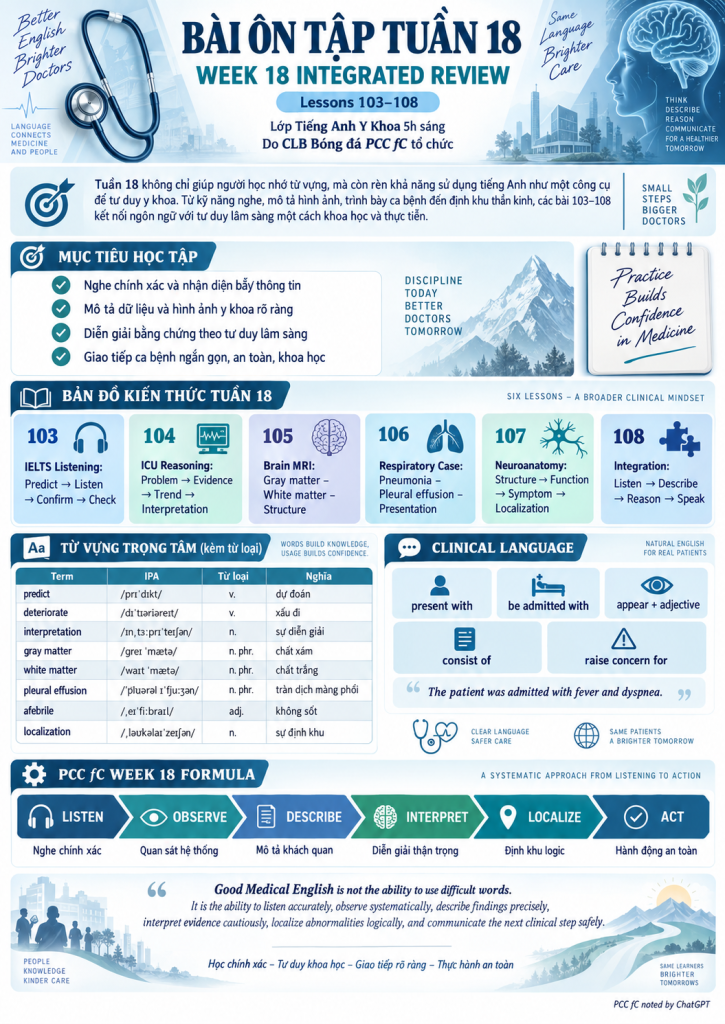
PCC Language – Thăng Long Hà Nội, ngày 15/9/2026, Bài 110 đưa người học vào một tình huống lâm sàng có giá trị giáo dục cao: bệnh nhân trẻ mắc lao phổi và lao hạch trung thất, đồng thời xuất hiện giảm nhiều dòng tế bào máu, bất thường tủy xương, mệt tăng dần, chóng mặt và các biểu hiện xuất huyết dưới da. Đây là một ca bệnh phù hợp để rèn luyện không chỉ tiếng Anh y khoa, mà quan trọng hơn là tư duy lâm sàng có hệ thống: mô tả chính xác triệu chứng, nhận diện dấu hiệu cảnh báo, xây dựng chẩn đoán phân biệt, đánh giá độc tính thuốc và tránh “đóng chẩn đoán” quá sớm. Thông qua 8 câu tiếng Anh cốt lõi, học viên sẽ luyện cách trình bày bệnh án ngắn gọn, sử dụng các thuật ngữ như multilineage cytopenia, dysplasia, thrombocytopenia, hemolysis, adverse drug effects và diagnostic closure, đồng thời học cách diễn đạt mức độ chắc chắn trong y khoa một cách chuẩn mực. Thông điệp xuyên suốt của bài học là: một chẩn đoán đã có không được phép làm chúng ta ngừng suy nghĩ trước những triệu chứng mới.
Lesson 110 reminds us: good clinical English should reflect good clinical reasoning.
Tiếng Anh y khoa tốt phải đi cùng tư duy lâm sàng tốt.
LESSON 110 – MEDICAL ENGLISH AT 5 A.M.
Clinical Reasoning in Tuberculosis with Cytopenias
Tư duy lâm sàng ở bệnh nhân lao kèm giảm các dòng tế bào máu
Medical English Class organized by PCC fC Football Club
Teaching philosophy: Do not treat a laboratory value in isolation. Do not treat a diagnosis in isolation. Treat the whole patient.
1. Learning objectives
Sau bài học 110, học viên có thể:
| Objective | Expected competence |
| Case presentation | Trình bày ngắn gọn một bệnh nhân lao có bất thường huyết học |
| Describe hematologic abnormalities | Sử dụng chính xác anemia, leukopenia, thrombocytopenia, multilineage cytopenia |
| Interpret bone-marrow findings | Phân biệt dysplastic changes với chẩn đoán xác định MDS |
| Recognize warning signs | Nhận diện petechiae, spontaneous bruising, fever, worsening fatigue |
| Build a differential diagnosis | Lập chẩn đoán phân biệt có hệ thống |
| Plan investigations | Đề xuất xét nghiệm huyết học, đông máu, tan máu và chức năng gan |
| Review drug toxicity | Phân tích mối liên quan thời gian giữa thuốc chống lao và biến cố |
| Avoid diagnostic error | Hiểu khái niệm premature diagnostic closure |
2. Lead-in – 90 seconds
Teacher asks:
A young patient with tuberculosis becomes increasingly tired and develops spontaneous bruising.
What should we think about first: tuberculosis progression, drug toxicity, bleeding disorder, or bone-marrow disease?
Suggested answer:
We should not jump to a single diagnosis. We need to reassess the patient, repeat the blood count, evaluate coagulation, look for hemolysis, and review the medications.
Clinical message
One symptom may have several mechanisms.
Mệt ở bệnh nhân này có thể liên quan đến thiếu máu, nhiễm trùng, thuốc, tổn thương gan, dinh dưỡng hoặc bệnh lý tủy — không nên mặc nhiên cho rằng chỉ do lao.
3. Core clinical dialogue – 8 lines
Doctor A – Case presentation
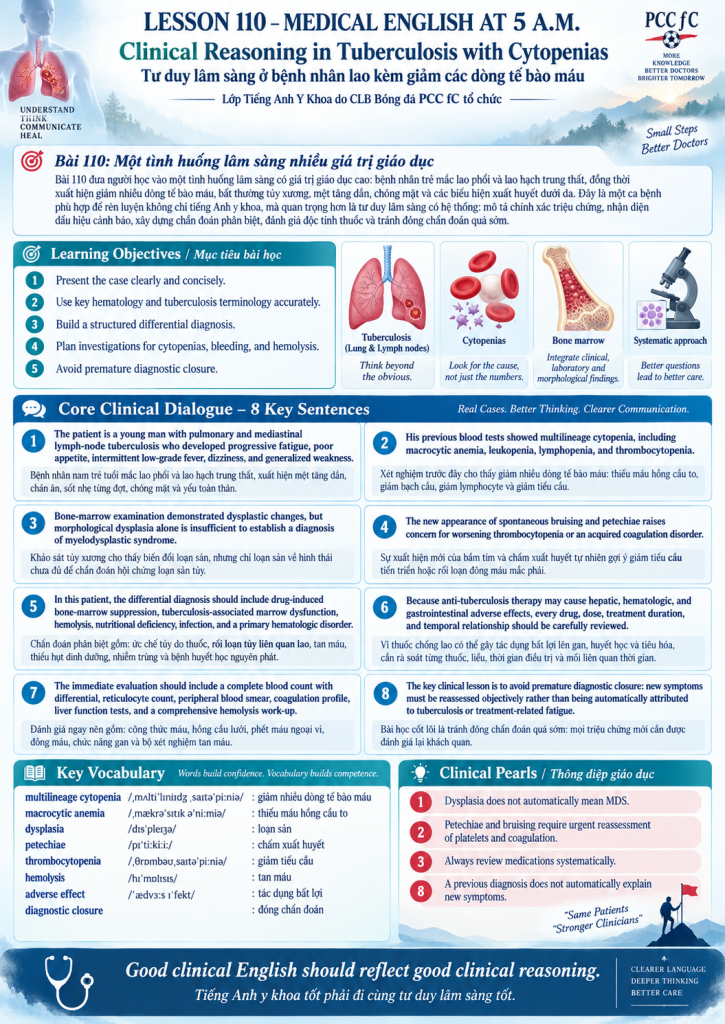
1. “The patient is a young man with pulmonary and mediastinal lymph-node tuberculosis who developed progressive fatigue, poor appetite, intermittent low-grade fever, dizziness, and generalized weakness.”
Dịch:
Bệnh nhân là nam trẻ tuổi mắc lao phổi và lao hạch trung thất, xuất hiện mệt tăng dần, chán ăn, sốt nhẹ từng đợt, chóng mặt và yếu toàn thân.
Teaching point:
Câu mở đầu bệnh án tốt cần có patient + underlying disease + major new symptoms.
Doctor B – Hematologic background
2. “His previous blood tests showed multilineage cytopenia, including macrocytic anemia, leukopenia, lymphopenia, and thrombocytopenia.”
Dịch:
Các xét nghiệm máu trước đây cho thấy giảm nhiều dòng tế bào máu, gồm thiếu máu hồng cầu to, giảm bạch cầu, giảm lymphocyte và giảm tiểu cầu.
Clinical pearl
Cytopenia không phải là một bệnh; đó là một biểu hiện cần tìm nguyên nhân.
Doctor A – Bone marrow interpretation
3. “Bone-marrow examination demonstrated dysplastic changes, but morphological dysplasia alone is insufficient to establish a diagnosis of myelodysplastic syndrome.”
Dịch:
Khảo sát tủy xương cho thấy những biến đổi loạn sản, nhưng chỉ có loạn sản về hình thái chưa đủ để xác lập chẩn đoán hội chứng loạn sản tủy.
Key educational point
Dysplasia ≠ MDS
Một hình ảnh tủy bất thường cần được đặt trong bối cảnh:
clinical course + CBC + marrow morphology + secondary causes ± cytogenetics/molecular studies.
Đây là một trong những bài học quan trọng nhất của Lesson 110.
Doctor B – New warning sign
4. “The new appearance of spontaneous bruising and petechiae raises concern for worsening thrombocytopenia or an acquired coagulation disorder.”
Dịch:
Sự xuất hiện mới của các vết bầm và chấm xuất huyết tự nhiên làm tăng lo ngại về giảm tiểu cầu tiến triển hoặc rối loạn đông máu mắc phải.
Bedside reasoning
Petechiae → think platelets.
Large ecchymoses/bleeding → think platelets and/or coagulation.
Nhưng không được chẩn đoán chỉ dựa vào hình thái xuất huyết; cần xét nghiệm.
Doctor A – Differential diagnosis
5. “In this patient, the differential diagnosis should include drug-induced bone-marrow suppression, tuberculosis-associated marrow dysfunction, hemolysis, nutritional deficiency, infection, and a primary hematologic disorder.”
Dịch:
Chẩn đoán phân biệt cần bao gồm ức chế tủy do thuốc, rối loạn chức năng tủy liên quan lao, tan máu, thiếu hụt dinh dưỡng, nhiễm trùng và bệnh huyết học nguyên phát.
Clinical reasoning framework
Có thể nhớ theo 6D:
| 6D framework | Meaning |
| Drug | Thuốc |
| Disease | Bệnh nền/nhiễm trùng |
| Destruction | Phá hủy tế bào, ví dụ tan máu |
| Deficiency | B12, folate, dinh dưỡng… |
| Dysplasia | Rối loạn sinh tủy |
| Disseminated process | Bệnh hệ thống/xâm nhập tủy cần loại trừ |
Doctor B – Medication safety
6. “Because anti-tuberculosis therapy may cause hepatic, hematologic, and gastrointestinal adverse effects, every drug, dose, treatment duration, and temporal relationship should be carefully reviewed.”
Dịch:
Vì điều trị chống lao có thể gây tác dụng bất lợi trên gan, huyết học và tiêu hóa, cần rà soát cẩn thận từng thuốc, liều, thời gian điều trị và mối liên quan về thời gian.
High-value phrase
temporal relationship
= mối liên quan về thời gian giữa drug exposure → adverse event.
Không nên chỉ hỏi:
“What drugs are you taking?”
Mà nên hỏi:
“When was each drug started, and when did the symptoms begin?”
Doctor A – Investigation plan
7. “The immediate evaluation should include a complete blood count with differential, reticulocyte count, peripheral blood smear, coagulation profile, liver function tests, and a comprehensive hemolysis work-up.”
Dịch:
Đánh giá ngay nên bao gồm công thức máu và bạch cầu biệt hóa, hồng cầu lưới, phết máu ngoại vi, xét nghiệm đông máu, chức năng gan và bộ xét nghiệm đánh giá tan máu.
Clinical logic
CBC → tế bào nào đang giảm?
Reticulocyte count → tủy có đáp ứng không?
Peripheral smear → hình thái có bất thường không?
Coagulation tests → xuất huyết có liên quan đông máu không?
Hemolysis work-up → thiếu máu do phá hủy hồng cầu không?
Liver tests → có độc tính thuốc/bệnh gan đi kèm không?
Doctor B – Final lesson
8. “The key clinical lesson is to avoid premature diagnostic closure: new symptoms must be reassessed objectively rather than being automatically attributed to tuberculosis or treatment-related fatigue.”
Dịch:
Bài học lâm sàng quan trọng là tránh đóng chẩn đoán quá sớm: mọi triệu chứng mới phải được đánh giá lại khách quan thay vì tự động quy cho bệnh lao hoặc tình trạng mệt liên quan điều trị.
The sentence to remember
“A previous diagnosis explains the past; it does not automatically explain the present.”
Một chẩn đoán trước đây có thể giải thích quá khứ, nhưng không mặc nhiên giải thích mọi triệu chứng hiện tại.
4. Key vocabulary
| Word / Phrase | Pronunciation | Word class | Meaning |
| fatigue | /fəˈtiːɡ/ | n. | mệt mỏi |
| cytopenia | /ˌsaɪtəˈpiːniə/ | n. | giảm tế bào máu |
| multilineage | /ˌmʌltiˈlɪniɪdʒ/ | adj. | nhiều dòng tế bào |
| macrocytic | /ˌmækrəʊˈsɪtɪk/ | adj. | hồng cầu to |
| dysplasia | /dɪsˈpleɪʒə/ | n. | loạn sản |
| petechiae | /pɪˈtiːki.iː/ | n. plural | chấm xuất huyết |
| bruising | /ˈbruːzɪŋ/ | n. | bầm tím |
| thrombocytopenia | /ˌθrɒmbəʊˌsaɪtəˈpiːniə/ | n. | giảm tiểu cầu |
| hemolysis | /hɪˈmɒlɪsɪs/ | n. | tan máu |
| reticulocyte | /rɪˈtɪkjələsaɪt/ | n. | hồng cầu lưới |
| bone-marrow suppression | — | n. phrase | ức chế tủy |
| adverse effect | /ˈædvɜːs ɪˈfekt/ | n. phrase | tác dụng bất lợi |
| differential diagnosis | — | n. phrase | chẩn đoán phân biệt |
| temporal relationship | — | n. phrase | mối liên quan thời gian |
| diagnostic closure | — | n. phrase | đóng/kết thúc quá trình chẩn đoán |
5. Grammar focus
Should include + noun
The differential diagnosis should include hemolysis.
Dùng để đề xuất những khả năng cần được xem xét.
Raises concern for + disease/condition
Petechiae raise concern for thrombocytopenia.
Cấu trúc rất hữu ích khi trình bày lâm sàng vì không khẳng định quá mức.
Không nên nói:
“Petechiae prove thrombocytopenia.”
Nên nói:
“Petechiae raise concern for thrombocytopenia.”
Đây cũng là cách sử dụng tiếng Anh phản ánh tư duy y học xác suất.
Insufficient to establish a diagnosis
Morphological dysplasia alone is insufficient to establish a diagnosis of MDS.
Cấu trúc có giá trị cao trong viết bài khoa học và hội chẩn.
6. Clinical reasoning challenge
Giảng viên đưa tình huống:
The patient returns today with worsening fatigue, dizziness, spontaneous bruising, and intermittent fever. What are your first three priorities?
Một câu trả lời tốt:
First, I would repeat the complete blood count to assess the severity of anemia, leukopenia, and thrombocytopenia. Second, I would evaluate the bruising with a coagulation profile and peripheral blood smear. Third, I would review the anti-tuberculosis regimen and investigate possible drug toxicity, hemolysis, and infection.
Điểm giáo dục ở đây không phải học thuộc một đáp án, mà là hình thành thứ tự:
Recognize danger → obtain objective data → identify mechanism → treat the cause.
7. Mini-quiz
Question 1: What does multilineage cytopenia mean?
Answer: A reduction in more than one blood-cell lineage.
Question 2: Does bone-marrow dysplasia automatically mean MDS?
Answer: No. Secondary causes must be considered and diagnostic criteria must be fulfilled.
Question 3: What do new petechiae make you particularly concerned about?
Answer: Thrombocytopenia, while other causes of bleeding must also be considered.
Question 4: Which simple test helps distinguish decreased red-cell production from an appropriate marrow response?
Answer: The reticulocyte count.
Question 5: What cognitive error is highlighted in this lesson?
Answer: Premature diagnostic closure.
8. Speaking challenge – 30 seconds
Mỗi học viên trình bày bệnh nhân bằng 4 câu, không nhìn bài:
This is a young man with tuberculosis and a history of multilineage cytopenia. He now presents with worsening fatigue, intermittent fever, dizziness, and spontaneous bruising. Previous bone-marrow examination showed dysplastic changes, but MDS has not been established. We should urgently reassess his blood counts, coagulation status, hemolysis markers, liver function, and current medications.
Đây là đoạn rất phù hợp để luyện clinical handover và trình bày ca trong giao ban quốc tế.
PCC fC Clinical Pearl – Lesson 110
Do not anchor on the old diagnosis.
Do not label before you investigate.
Do not confuse an abnormal finding with a definitive diagnosis.
Đừng neo tư duy vào chẩn đoán cũ.
Đừng gắn nhãn bệnh khi chưa điều tra đầy đủ.
Đừng nhầm một dấu hiệu bất thường với một chẩn đoán xác định.
Take-home message
Good doctors recognize patterns. Great doctors know when a familiar pattern may be misleading.
Bác sĩ giỏi nhận ra mô hình bệnh tật; bác sĩ xuất sắc còn biết khi nào chính mô hình quen thuộc đó có thể dẫn mình đi sai hướng.
LESSON 110 | Medical English at 5 A.M. | PCC fC Football Club