Bài ôn tập Tuần 20 – Tiếng Anh Y Khoa: Từ Tư Duy Lâm Sàng Đến Giao Tiếp Y Khoa * English: Week 20 Review – From Clinical Reasoning to Medical Communication
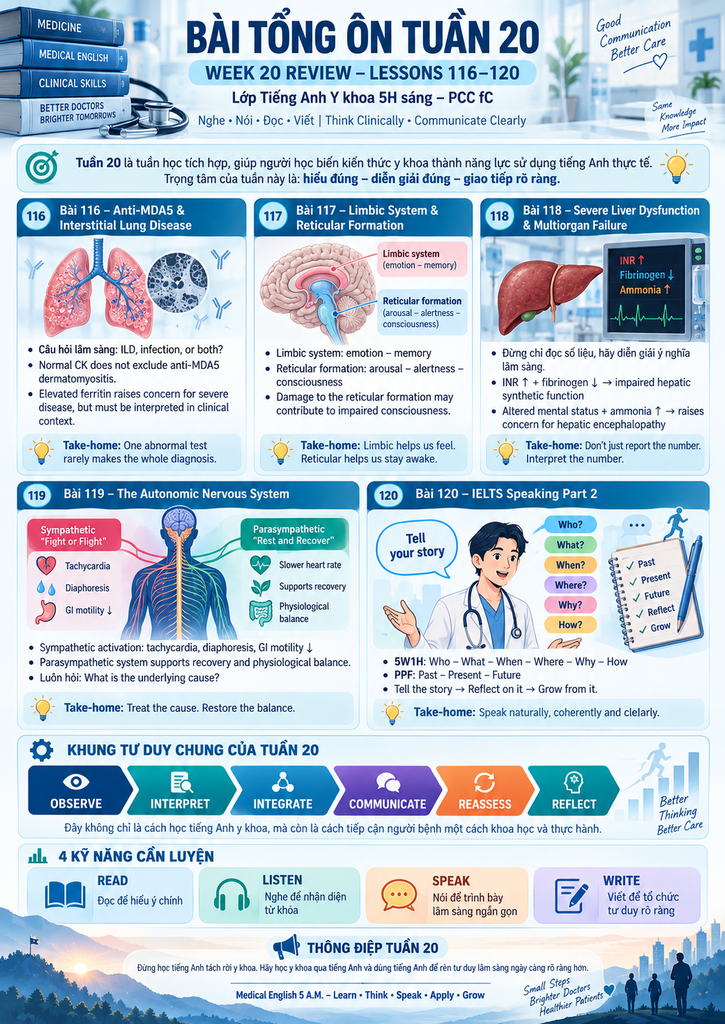
PCC Language – Thăng Long, Hà Nội, ngày 27/9/2026, Tuần 20 là một tuần học giàu tính tích hợp của Lớp Tiếng Anh Y khoa 5H sáng, khi người học không chỉ ôn lại kiến thức từ Bài 116 đến Bài 120 mà còn luyện cách biến kiến thức y khoa thành năng lực sử dụng tiếng Anh thực tế. Từ anti-MDA5 và bệnh phổi kẽ, hệ limbic và reticular formation, suy gan nặng kèm suy đa tạng, hệ thần kinh tự chủ, cho đến kỹ năng kể một trải nghiệm y khoa trong IELTS Speaking Part 2, mỗi bài đều hướng tới một mục tiêu chung: hiểu đúng – diễn giải đúng – giao tiếp rõ ràng. Bài tổng ôn tuần này được thiết kế theo 4 kỹ năng Nghe – Nói – Đọc – Viết, kết hợp với tư duy lâm sàng theo trình tự:
Observe → Interpret → Integrate → Communicate → Reassess → Reflect
Người học không cần ghi nhớ quá nhiều trong một lần. Hãy tập trung vào các từ khóa, mẫu câu cốt lõi và khả năng trình bày một vấn đề y khoa bằng chính ngôn ngữ của mình. Mỗi ngày một chút: đọc để hiểu, nghe để nhận diện, nói để phản xạ, viết để tổ chức tư duy. Khi được lặp lại đều đặn, tiếng Anh y khoa sẽ dần trở thành một công cụ tự nhiên trong học tập, giao tiếp và thực hành chuyên môn.
Medical English 5 A.M. – Learn, Think, Speak, Apply and Grow.
BÀI TỔNG ÔN TUẦN 20
WEEK 20 REVIEW – LESSONS 116–120
LISTEN • SPEAK • READ • WRITE
THINK CLINICALLY • COMMUNICATE CLEARLY
Lớp Tiếng Anh Y khoa 5H sáng
Do CLB Bóng đá PCC fC tổ chức
I. MỤC TIÊU TUẦN 20
Sau bài tổng ôn, người học có thể:
1. READ – ĐỌC: hiểu một đoạn Medical English và tìm được ý chính.
2. LISTEN – NGHE: nhận ra các từ khóa quan trọng trong một tình huống lâm sàng.
3. SPEAK – NÓI: trình bày một vấn đề y khoa trong 30–60 giây.
4. WRITE – VIẾT: viết 3–5 câu diễn giải dữ kiện lâm sàng rõ ràng.
Quan trọng hơn:
Không chỉ biết tiếng Anh của một dữ kiện, mà phải biết dữ kiện đó có ý nghĩa gì đối với người bệnh.
II. LESSON 116
ANTI-MDA5 & INTERSTITIAL LUNG DISEASE
1. READ – ĐỌC HIỂU
A patient with anti-MDA5 antibodies may develop severe interstitial lung disease even when muscle involvement is minimal and CK remains normal. Markedly elevated ferritin may raise concern for progressive disease. However, pulmonary infection must also be considered, particularly before intensive immunosuppressive therapy.
Hiểu nhanh
Anti-MDA5 (+) + tổn thương phổi + CK bình thường
không đồng nghĩa:
“Không phải dermatomyositis.”
Ngược lại:
A normal CK does not exclude anti-MDA5 dermatomyositis.
Ferritin tăng cao có thể giúp nhận diện nguy cơ, nhưng phải đặt trong clinical context.
Clinical question
Is this autoimmune ILD, infection, or both?
Đây mới là câu hỏi quan trọng.
2. LISTEN – NGHE TỪ KHÓA
Khi nghe đoạn trên, tập trung bắt 5 cụm:
anti-MDA5
interstitial lung disease
normal CK
elevated ferritin
pulmonary infection
Không cố nghe từng từ.
Listening principle
Listen for meaning, not every word.
3. SPEAK – NÓI 30 GIÂY
This patient is positive for anti-MDA5 antibodies and has pulmonary abnormalities. A normal CK does not exclude the diagnosis. Elevated ferritin raises concern for severe disease. However, infection should also be considered. The major clinical question is whether the lung abnormalities are caused by autoimmune ILD, infection, or both.
4. WRITE – VIẾT
Hoàn thành:
A normal CK does not __________ anti-MDA5 dermatomyositis.
Elevated ferritin may __________ concern for severe disease.
The pulmonary findings should be interpreted in the __________ context.
Answers: exclude – raise – clinical
REMEMBER
NORMAL TEST ≠ NO DISEASE
Một xét nghiệm bình thường không nhất thiết loại trừ bệnh.
III. LESSON 117
LIMBIC SYSTEM & RETICULAR FORMATION
1. READ
The limbic system is closely involved in emotion and memory, whereas the reticular formation plays an important role in arousal and consciousness. Therefore, damage involving the reticular formation may contribute to a reduced level of consciousness.
Simplify it
Limbic system
→ Emotion
→ Memory
Reticular formation
→ Arousal
→ Alertness
→ Consciousness
2. LISTEN
Hãy nhận ra ba từ:
arousal – alertness – consciousness
Đây là một “word family” về mức độ thức tỉnh và ý thức.
3. SPEAK
Clinical case:
Brainstem injury + GCS 5 + no eye opening
Nói:
The patient has severely impaired consciousness. Because the reticular formation is involved in maintaining arousal, brainstem injury may contribute to his reduced level of consciousness.
Điểm ngôn ngữ
Không nên khẳng định quá mức:
Brainstem injury causes coma.
Nên nói:
Brainstem injury may contribute to impaired consciousness.
4. WRITE
Ghép hai câu:
The reticular formation is damaged.
The patient develops impaired consciousness.
→
If the reticular formation is damaged, the patient may develop impaired consciousness.
REMEMBER
LIMBIC → FEEL
RETICULAR → WAKE
IV. LESSON 118
SEVERE LIVER DYSFUNCTION & MULTIORGAN FAILURE
Đây là bài trọng tâm nhất để học Clinical English.
1. READ
The patient has severe hepatic dysfunction with marked coagulopathy, altered mental status, renal impairment, infection, and fluid overload. The abnormal coagulation profile indicates impaired hepatic synthetic function. Neurological changes raise concern for hepatic encephalopathy and require serial reassessment.
Đừng chỉ đọc số
Ví dụ:
INR 3.22
Đọc số mới chỉ là:
DATA
Bác sĩ cần đi tiếp:
DATA
INR ↑
↓
INTERPRETATION
Impaired hepatic synthetic function
↓
RISK
Bleeding / clinical deterioration
↓
ACTION
Monitor – reassess – treat
2. LISTEN
Khi nghe một ca ICU, hãy tìm 4 loại thông tin:
PROBLEM – Vấn đề gì?
SEVERITY – Nặng đến đâu?
TREND – Đang tốt lên hay xấu đi?
PRIORITY – Việc quan trọng nhất tiếp theo?
Đây là cách nghe có mục tiêu.
3. SPEAK
Không nói:
INR is 3.22. Fibrinogen is low. Ammonia is high.
Hãy nói:
The patient has severe hepatic dysfunction complicated by coagulopathy and altered mental status. The abnormal coagulation profile suggests impaired hepatic synthetic function, while the neurological changes raise concern for hepatic encephalopathy. Close monitoring and serial reassessment are therefore essential.
Đây là bước chuyển:
REPORTING → INTERPRETING
4. WRITE
Viết theo công thức:
FINDING → MEANING → ACTION
Ví dụ:
The patient’s INR is markedly elevated, suggesting severe impairment of hepatic synthetic function. Therefore, the coagulation profile and clinical signs of bleeding should be closely monitored.
REMEMBER
DON’T JUST REPORT THE NUMBER.
INTERPRET THE NUMBER.
V. LESSON 119
THE AUTONOMIC NERVOUS SYSTEM
1. READ
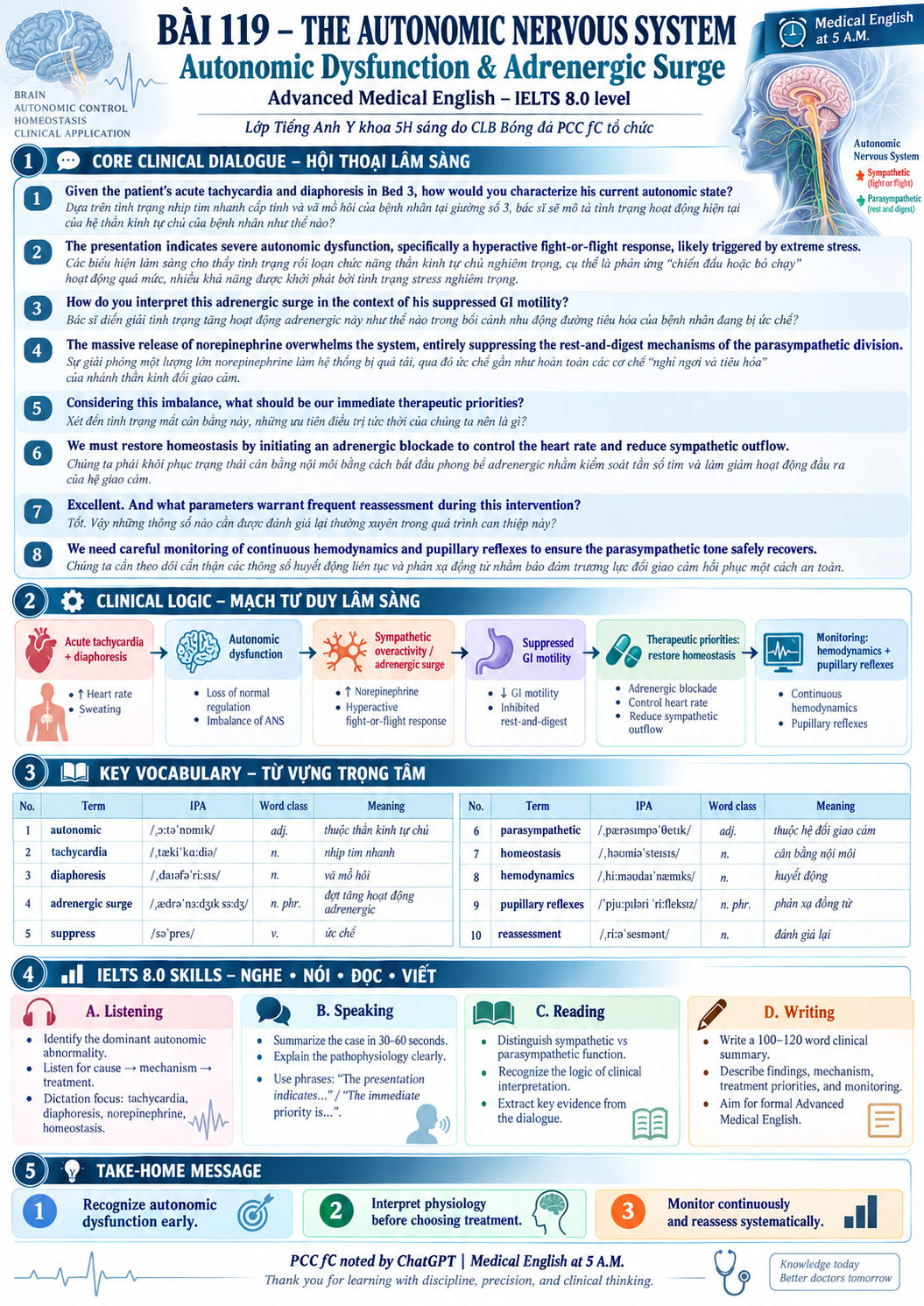
The autonomic nervous system continuously regulates essential physiological functions. During sympathetic activation, heart rate and vascular tone may increase, sweating becomes more prominent, and gastrointestinal activity may decrease. Excessive activation can lead to autonomic imbalance.
Physiological map
STRESS
↓
SYMPATHETIC ACTIVATION
↓
ADRENERGIC SURGE
↓
Heart rate ↑
Sweating ↑
Vascular tone ↑
GI motility ↓
Parasympathetic system
Ngược lại, hệ parasympathetic hỗ trợ:
rest – digestion – recovery – physiological balance
Hai hệ không hoạt động hoàn toàn tách biệt.
Chúng phối hợp để duy trì:
HOMEOSTASIS
2. LISTEN
Khi nghe:
tachycardia + diaphoresis + reduced GI motility
hãy nghĩ ngay:
sympathetic overactivity
Nhưng không dừng ở đó.
Câu tiếp theo phải là:
What is causing it?
3. SPEAK
The patient has tachycardia, diaphoresis, and reduced gastrointestinal activity. These findings may suggest increased sympathetic activity or an adrenergic surge. However, the underlying cause must be identified and treated.
Cấu trúc này rất hữu ích:
These findings may suggest… However…
4. WRITE
Dùng ba từ:
sympathetic – homeostasis – underlying cause
Excessive sympathetic activation may disturb physiological homeostasis. Therefore, management should focus not only on controlling the abnormal physiological responses but also on identifying and treating the underlying cause.
REMEMBER
TREAT THE CAUSE
RESTORE THE BALANCE
VI. LESSON 120
IELTS SPEAKING PART 2
A MEMORABLE MEDICAL EXPERIENCE
Bốn bài trước giúp chúng ta hiểu và phân tích.
Bài 120 giúp chúng ta kể lại và phản tư.
1. READ THE CUE CARD
Describe a memorable medical experience.
You should say:
- what happened;
- when and where it happened;
- who was involved;
- what you did;
and explain why it was memorable.
2. LISTEN TO YOUR OWN STORY
Trước khi nói, hãy hình dung câu chuyện theo:
5W1H
WHO?
Ai?
WHAT?
Điều gì xảy ra?
WHEN?
Khi nào?
WHERE?
Ở đâu?
WHY?
Tại sao đáng nhớ?
HOW?
Nó ảnh hưởng đến mình thế nào?
3. SPEAK WITH PPF
PAST → PRESENT → FUTURE
PAST
What happened?
During a particularly demanding emergency shift, I treated a critically ill patient…
PRESENT
What does it mean to me now?
Looking back, this experience taught me the importance of rapid assessment and teamwork.
FUTURE
How will I improve?
In the future, I hope to become more confident and effective when managing similar emergencies.
4. WRITE BEFORE YOU SPEAK
Không viết cả bài.
Chỉ viết keywords:
ED – middle-aged man – shock – rapid deterioration – teamwork – learned – future
Sau đó nói tự nhiên.
Principle
Keywords support speaking. Full sentences encourage reading.
REMEMBER
STORY → REFLECTION → GROWTH
VII. 12 CỤM TỪ PHẢI DÙNG ĐƯỢC
Đừng chỉ “biết nghĩa”.
Hãy dùng thành câu.
1. does not exclude
A normal CK does not exclude the diagnosis.
2. raises concern for
The findings raise concern for disease progression.
3. may suggest
Tachycardia may suggest sympathetic activation.
4. may contribute to
Brainstem injury may contribute to impaired consciousness.
5. is consistent with
The findings are consistent with severe hepatic dysfunction.
6. should be interpreted in context
The laboratory result should be interpreted in context.
7. warrants close monitoring
This abnormality warrants close monitoring.
8. serial reassessment
Serial reassessment is essential.
9. underlying cause
We need to identify the underlying cause.
10. therapeutic priorities
The therapeutic priorities should be reassessed.
11. looking back
Looking back, the experience changed my practice.
12. in the future
In the future, I hope to improve my communication skills.
VIII. TỪ VỰNG LÕI – HỌC THEO NHÓM
LUNG
- interstitial lung disease
- ground-glass opacity
- pulmonary infection
- immunosuppression
BRAIN
- limbic system
- reticular formation
- arousal
- consciousness
LIVER / ICU
- coagulopathy
- encephalopathy
- synthetic function
- fluid overload
- reassessment
AUTONOMIC
- sympathetic
- parasympathetic
- diaphoresis
- adrenergic surge
- homeostasis
COMMUNICATION
- memorable
- reflect
- experience
- confidence
- improvement
IX. 4-SKILL RAPID PRACTICE
A. LISTEN
Người học nghe câu:
The patient’s worsening mental status, together with severe hepatic dysfunction, raises concern for hepatic encephalopathy.
Nghe và lấy 3 keywords:
mental status – hepatic dysfunction – encephalopathy
B. SPEAK
Không nhìn bài, trả lời trong 20 giây:
Why should laboratory values not be interpreted in isolation?
Suggested answer:
Because a laboratory value represents only one part of the clinical picture. It should be interpreted together with symptoms, examination findings, trends, imaging, and the patient’s response to treatment.
C. READ
Đọc câu:
Persistent tachycardia and diaphoresis may indicate increased sympathetic activity, but the underlying cause still needs to be identified.
Tìm:
Finding: tachycardia + diaphoresis
Interpretation: sympathetic activity ↑
Next step: identify the cause
D. WRITE
Viết 3 câu theo mẫu:
Sentence 1 – Finding
The patient has…
Sentence 2 – Interpretation
These findings may suggest…
Sentence 3 – Action
Therefore, we should…
Đây là cấu trúc viết Clinical English đơn giản nhưng rất mạnh.
X. ONE CASE – FOUR SKILLS
CASE
A critically ill patient has:
- tachycardia;
- diaphoresis;
- altered mental status;
- worsening renal function.
LISTEN
Nghe và bắt 4 problems.
READ
Xác định hệ cơ quan liên quan.
SPEAK
Tóm tắt trong 30 giây:
This is a critically ill patient with autonomic and neurological abnormalities associated with worsening renal function. The tachycardia and diaphoresis may suggest sympathetic overactivity. However, the underlying cause remains uncertain and requires further assessment.
WRITE
Viết 3–4 câu:
Finding → Interpretation → Uncertainty → Action
XI. CÁCH HỌC MỖI BÀI TRONG 3 PHÚT
PHÚT 1 – INPUT
30 giây READ
Đọc đoạn ngắn.
30 giây LISTEN
Nghe lại mà không nhìn chữ.
↓
PHÚT 2 – OUTPUT
30 giây SPEAK
Tóm tắt bằng lời của mình.
30 giây WRITE
Viết 2–3 câu.
↓
PHÚT 3 – RETRIEVAL
Đóng tài liệu.
Tự trả lời:
What did I learn?
What are the three key words?
Can I explain it without looking?
XII. CÔNG THỨC ÔN TẬP TUẦN 20
Không học theo:
WORD → MEANING → NEXT WORD
Hãy học theo:
SEE IT
Đọc
↓
HEAR IT
Nghe
↓
UNDERSTAND IT
Hiểu
↓
SAY IT
Nói
↓
WRITE IT
Viết
↓
USE IT
Ứng dụng
↓
REVIEW IT
Ôn lại
XIII. 10 CÂU TỰ KIỂM TRA
Hãy trả lời bằng tiếng Anh, không nhìn đáp án.
1. Does a normal CK exclude anti-MDA5 dermatomyositis?
2. Why should elevated ferritin be interpreted in context?
3. What does the limbic system mainly do?
4. What role does the reticular formation play?
5. What does an abnormal INR tell us about severe liver dysfunction?
6. Why is serial reassessment important?
7. Name three manifestations of sympathetic activation.
8. What does homeostasis mean?
9. What does PPF stand for?
10. Why is reflection important after a medical experience?
XIV. THE WEEK 20 MASTER FRAMEWORK
Toàn bộ Tuần 20 có thể nhớ bằng sáu câu hỏi:
1. WHAT DO I SEE?
Observation
2. WHAT DOES IT MEAN?
Interpretation
3. WHAT ELSE COULD IT BE?
Differential reasoning
4. HOW CERTAIN AM I?
Clinical uncertainty
5. WHAT SHOULD WE DO NEXT?
Action & reassessment
6. CAN I EXPLAIN IT CLEARLY?
Communication
Đây không chỉ là cách học tiếng Anh.
Đó cũng chính là cách một bác sĩ tiếp cận người bệnh.
XV. TAKE-HOME MESSAGE
Bài 116 dạy:
Do not exclude disease too early.
Bài 117 dạy:
Connect anatomy with clinical function.
Bài 118 dạy:
Interpret numbers, not merely report them.
Bài 119 dạy:
Connect clinical signs with physiology and the underlying cause.
Bài 120 dạy:
Turn experience into a clear, meaningful story.
Và cả Tuần 20 dạy chúng ta:
READ TO UNDERSTAND
LISTEN TO RECOGNIZE
SPEAK TO COMMUNICATE
WRITE TO ORGANIZE
THINK TO PRACTICE
Đọc để hiểu.
Nghe để nhận diện.
Nói để giao tiếp.
Viết để tổ chức tư duy.
Và tư duy để ứng dụng vào thực hành.
MEDICAL ENGLISH 5 A.M.
15 MINUTES A DAY
INPUT → PROCESS → OUTPUT → REVIEW
Không cần học thật nhiều trong một buổi.
Điều quan trọng là mỗi ngày:
nghe một chút – đọc một chút – nói một chút – viết một chút – và dùng được một chút.
Sau nhiều ngày, những “một chút” ấy sẽ trở thành:
KNOWLEDGE → LANGUAGE → HABIT → PROFESSIONAL COMPETENCE
LỚP TIẾNG ANH Y KHOA 5H SÁNG
Organized by PCC fC Football Club
Khoẻ – Vui – Hạnh phúc
Learn • Think • Speak • Apply • Grow