Bài 128 – Tiếng Anh Y Khoa: Từ nghi ngờ ngộ độc thuốc ngủ tới viêm màng não * From suspected poisoning to acute bacterial menigitis!
PCC Language – Thăng Long, Hà Nội, 5/10/2026, Trong cấp cứu, chẩn đoán ban đầu đôi khi chỉ là một giả thuyết tạm thời. Một bệnh nhân 79 tuổi nhập viện trong bối cảnh nghi ngộ độc thuốc ngủ, nhưng khi xuất hiện sốt cao, đau đầu dữ dội và rối loạn ý thức, câu hỏi quan trọng không còn là “thuốc gì đã được uống?” mà là “liệu chúng ta có đang bỏ sót một nhiễm trùng thần kinh trung ương nguy hiểm?”. Bài 128 hôm nay sẽ đưa chúng ta đi từ suspected poisoning đến acute bacterial meningitis, qua một tình huống điển hình về diagnostic shift và anchoring bias. Thông qua hội thoại lâm sàng ở mức IELTS 8.0, chúng ta không chỉ học cách mô tả dịch não tủy, lựa chọn phác đồ kinh nghiệm và trao đổi điều trị bằng tiếng Anh, mà còn rèn một năng lực cốt lõi của người thầy thuốc: khi bằng chứng mới không còn phù hợp với chẩn đoán cũ, phải biết đánh giá lại, đổi hướng và hành động kịp thời.
Tài liệu:
BÀI 128 – LỚP TIẾNG ANH Y KHOA 5H
FROM SUSPECTED POISONING TO ACUTE BACTERIAL MENINGITIS
Từ nghi ngộ độc thuốc ngủ đến viêm màng não mủ cấp
Lớp Tiếng Anh Y khoa 5H – do CLB Bóng đá PCC fC tổ chức
Level: IELTS 8.0
Focus: Medical English • Emergency Medicine • Clinical Reasoning • Critical Care
Estimated study time: 15–20 phút
1. LEARNING OBJECTIVES – MỤC TIÊU BÀI HỌC
Sau bài học, học viên có thể:
- Trình bày một ca bệnh cấp cứu bằng tiếng Anh ở mức độ học thuật.
- Mô tả và diễn giải các bất thường của cerebrospinal fluid – CSF.
- Sử dụng ngôn ngữ để thay đổi chẩn đoán khi xuất hiện bằng chứng mới.
- Trao đổi về lựa chọn điều trị kinh nghiệm trong viêm màng não mủ.
- Sử dụng thành thạo các cấu trúc:
- Given those findings…
- We should avoid anchoring on…
- Since he is…, should our empirical regimen…?
- After obtaining… without delaying…, I would initiate…
- Nhận diện và phòng tránh anchoring bias – thiên kiến neo giữ trong tư duy lâm sàng.
2. CLINICAL WARM-UP – KHỞI ĐỘNG LÂM SÀNG
Clinical scenario
A 79-year-old man is brought to the emergency department because of drowsiness. Sleeping pills are found nearby.
At first, poisoning seems likely.
However, he subsequently develops:
- high fever,
- severe headache,
- altered mental status.
Question
Would you continue treating this patient primarily as a poisoning case? Why or why not?
Suggested response – IELTS 8.0
Although sedative poisoning could account for his reduced level of consciousness, it would not adequately explain the combination of high fever and severe headache. These additional findings should prompt an urgent reassessment for a central nervous system infection.
Clinical message:
Do not force new findings to fit an old diagnosis.
3. CORE DIALOGUE – HỘI THOẠI TRỌNG TÂM
Resident
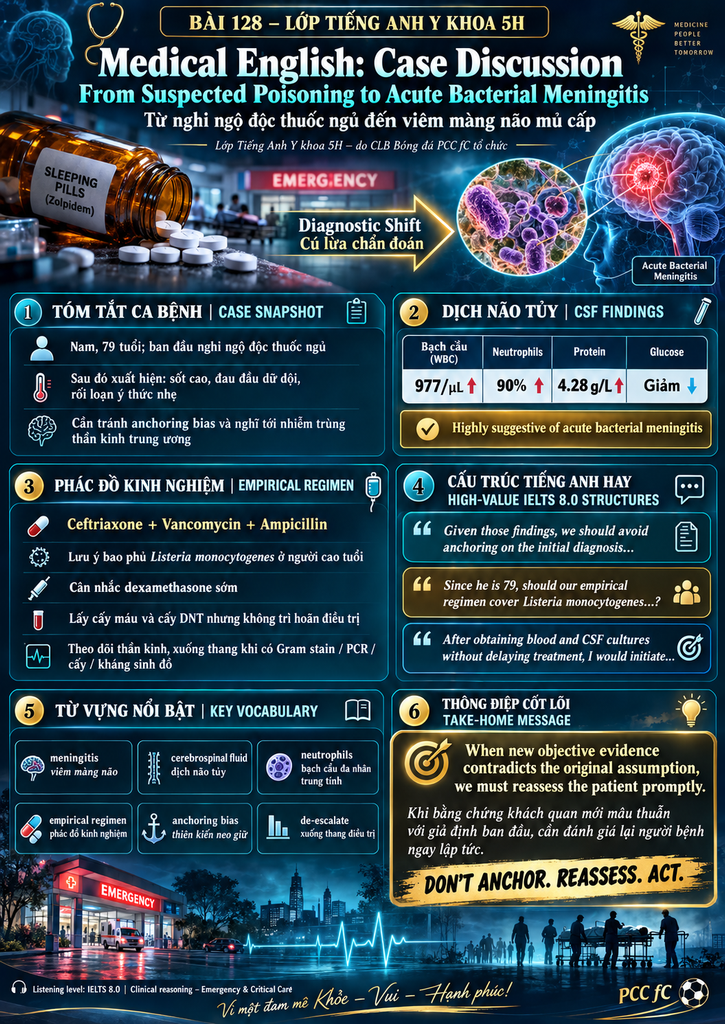
This 79-year-old man was initially admitted with suspected sleeping-pill poisoning, but he subsequently developed a high fever, severe headache, and mild impairment of consciousness.
Specialist
Given those findings, we should avoid anchoring on the initial diagnosis and promptly investigate a possible central nervous system infection.
Resident
His cerebrospinal fluid contains approximately 977 white cells per microlitre, with 90% neutrophils, while the protein concentration is markedly elevated at 4.28 grams per litre and the glucose level is low.
Specialist
That combination is highly suggestive of acute bacterial meningitis, particularly when interpreted alongside his fever, headache, and altered mental status.
Resident
Since he is 79, should our empirical regimen cover Listeria monocytogenes in addition to drug-resistant Streptococcus pneumoniae?
Specialist
Absolutely; after obtaining blood and CSF cultures without delaying treatment, I would initiate intravenous ceftriaxone, vancomycin, and ampicillin, with doses adjusted appropriately for renal function.
Resident
We should also consider early dexamethasone, closely monitor his neurological status, and de-escalate antimicrobial therapy once the Gram stain, PCR, cultures, and susceptibility results become available.
Specialist
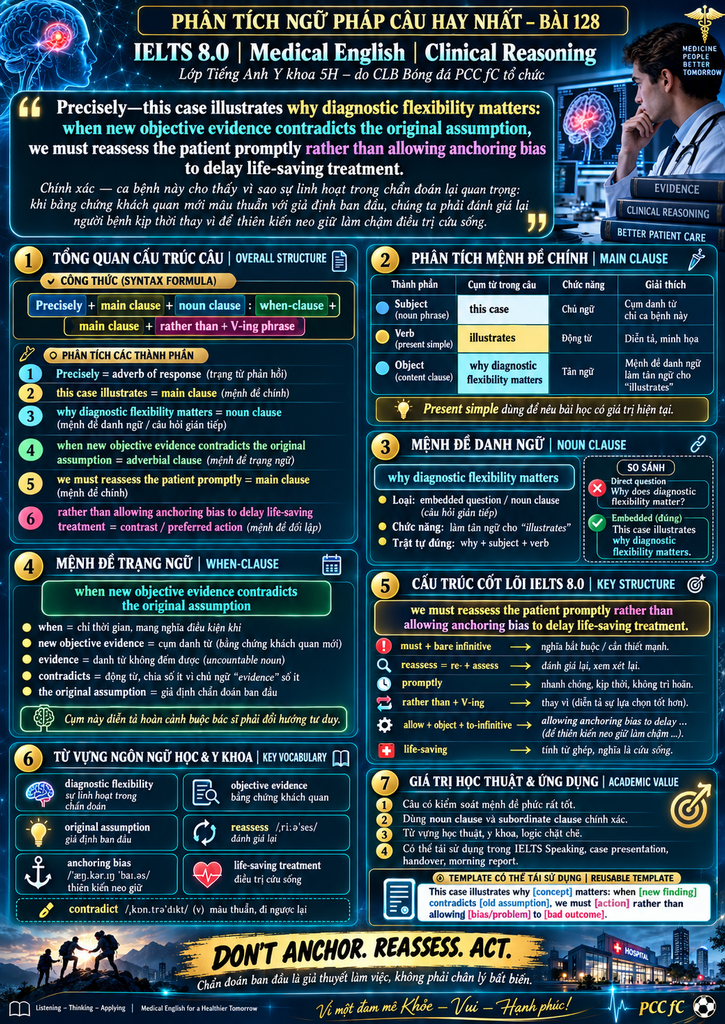
Precisely—this case illustrates why diagnostic flexibility matters: when new objective evidence contradicts the original assumption, we must reassess the patient promptly rather than allowing anchoring bias to delay life-saving treatment.
Đây chính là hội thoại trung tâm của tài liệu Bài 128. Acute_Bacterial_Meningitis_Case…
4. VIETNAMESE TRANSLATION – DỊCH HỘI THOẠI
Bác sĩ nội trú
Người bệnh nam 79 tuổi này ban đầu được nhập viện với chẩn đoán nghi ngộ độc thuốc ngủ, nhưng sau đó xuất hiện sốt cao, đau đầu dữ dội và rối loạn ý thức mức độ nhẹ.
Bác sĩ chuyên khoa
Với những dấu hiệu đó, chúng ta cần tránh bị neo giữ vào chẩn đoán ban đầu và phải nhanh chóng đánh giá khả năng nhiễm trùng hệ thần kinh trung ương.
Bác sĩ nội trú
Dịch não tuỷ của bệnh nhân có khoảng 977 bạch cầu/µL, trong đó 90% là bạch cầu đa nhân trung tính; nồng độ protein tăng rõ rệt lên 4,28 g/L, trong khi glucose giảm.
Bác sĩ chuyên khoa
Sự kết hợp này rất gợi ý viêm màng não do vi khuẩn cấp, đặc biệt khi được diễn giải cùng với tình trạng sốt, đau đầu và thay đổi trạng thái ý thức của bệnh nhân.
Bác sĩ nội trú
Vì bệnh nhân đã 79 tuổi, phác đồ điều trị kinh nghiệm của chúng ta có nên bao phủ cả Listeria monocytogenes, bên cạnh Streptococcus pneumoniae kháng thuốc không?
Bác sĩ chuyên khoa
Chắc chắn. Sau khi lấy cấy máu và cấy dịch não tuỷ mà không làm trì hoãn điều trị, tôi sẽ khởi trị ceftriaxone, vancomycin và ampicillin đường tĩnh mạch, với liều được điều chỉnh phù hợp theo chức năng thận.
Bác sĩ nội trú
Chúng ta cũng nên cân nhắc dexamethasone sớm, theo dõi sát tình trạng thần kinh và xuống thang kháng sinh khi có kết quả nhuộm Gram, PCR, nuôi cấy và kháng sinh đồ.
Bác sĩ chuyên khoa
Chính xác. Ca bệnh này cho thấy tại sao sự linh hoạt trong chẩn đoán lại quan trọng: khi bằng chứng khách quan mới trái ngược với giả định ban đầu, chúng ta phải nhanh chóng đánh giá lại bệnh nhân thay vì để anchoring bias làm chậm một điều trị có thể cứu sống người bệnh.
5. KEY MEDICAL VOCABULARY
| Vocabulary | Pronunciation | Meaning |
|---|---|---|
| meningitis | /ˌmen.ɪnˈdʒaɪ.tɪs/ | viêm màng não |
| cerebrospinal fluid | /ˌser.ə.brəʊˈspaɪ.nəl ˈfluː.ɪd/ | dịch não tuỷ |
| neutrophil | /ˈnjuː.trə.fɪl/ | bạch cầu đa nhân trung tính |
| altered mental status | /ˈɔːl.təd ˈmen.təl ˈsteɪ.təs/ | thay đổi trạng thái ý thức |
| empirical regimen | /ɪmˈpɪr.ɪ.kəl ˈredʒ.ɪ.mən/ | phác đồ điều trị kinh nghiệm |
| susceptibility | /səˌsep.təˈbɪl.ə.ti/ | độ nhạy cảm |
| de-escalate | /ˌdiːˈes.kə.leɪt/ | xuống thang điều trị |
| anchoring bias | /ˈæŋ.kər.ɪŋ ˈbaɪ.əs/ | thiên kiến neo giữ |
| renal function | /ˈriː.nəl ˈfʌŋk.ʃən/ | chức năng thận |
| life-saving treatment | /ˈlaɪf ˌseɪ.vɪŋ ˈtriːt.mənt/ | điều trị cứu sống |
Tài liệu cũng nhấn mạnh riêng các thuật ngữ meningitis, cerebrospinal, neutrophils, protein concentration, anchoring bias, empirical, susceptibility và de-escalate. Acute_Bacterial_Meningitis_Case…
6. THREE HIGH-VALUE IELTS 8.0 STRUCTURES
Structure 1 – Changing diagnostic direction
Given + findings, we should avoid anchoring on X and promptly investigate Y.
Ví dụ:
Given those findings, we should avoid anchoring on the initial diagnosis and promptly investigate a possible central nervous system infection.
Ứng dụng khác
Given the progressive hypotension and elevated lactate, we should avoid anchoring on dehydration and promptly investigate septic shock.
Structure 2 – Risk-based treatment
Since + patient factor, should our empirical regimen cover + pathogen/condition?
Since he is 79, should our empirical regimen cover Listeria monocytogenes?
Ứng dụng:
Since the patient is severely immunocompromised, should our empirical regimen provide broader antimicrobial coverage?
Structure 3 – Clinical sequence
After obtaining X without delaying Y, I would initiate Z.
After obtaining blood and CSF cultures without delaying treatment, I would initiate intravenous antibiotics.
Đây là một cấu trúc rất hữu ích khi trình bày priority và sequence of management trong IELTS Speaking hoặc thảo luận ca lâm sàng. Cấu trúc này cũng được nhấn mạnh trên trang 5 của tài liệu. Acute_Bacterial_Meningitis_Case…
7. CLINICAL REASONING – THE DIAGNOSTIC SHIFT
Initial hypothesis
Sleeping-pill poisoning
↓
New evidence
High fever + severe headache + impaired consciousness
↓
CSF findings
977 WBC/µL
90% neutrophils
Protein 4.28 g/L
Low glucose
↓
Revised diagnosis
Acute bacterial meningitis
↓
Management described in the lesson
Ceftriaxone + Vancomycin + Ampicillin
- consider early dexamethasone
- microbiological testing
- subsequent antimicrobial de-escalation
Đây chính là “diagnostic shift” được trình bày trực quan ở trang 6 của tài liệu. Acute_Bacterial_Meningitis_Case…
8. IELTS LISTENING – COMPREHENSION QUESTIONS
Nghe đoạn hội thoại 2 lần, không nhìn transcript.
Questions
1. What was the patient’s initial suspected diagnosis?
A. Ischaemic stroke
B. Sleeping-pill poisoning
C. Viral encephalitis
D. Septic shock
2. Which new clinical feature most strongly challenged the initial diagnosis?
A. Bradycardia
B. Hypertension
C. High fever
D. Polyuria
3. How many white cells were found in the CSF?
A. 97/µL
B. 197/µL
C. 977/µL
D. 9,770/µL
4. What percentage were neutrophils?
A. 50%
B. 70%
C. 80%
D. 90%
5. What was the CSF protein concentration?
A. 0.428 g/L
B. 1.28 g/L
C. 4.28 g/L
D. 42.8 g/L
6. Which additional pathogen was specifically considered because of the patient’s age?
A. Pseudomonas aeruginosa
B. Listeria monocytogenes
C. Escherichia coli
D. Haemophilus influenzae
7. Which three antibiotics were mentioned?
8. What cognitive bias is highlighted in this case?
Answers
1B – 2C – 3C – 4D – 5C – 6B
- Ceftriaxone + vancomycin + ampicillin
- Anchoring bias
9. IELTS SPEAKING – CLINICAL DISCUSSION
Question 1
Why was sleeping-pill poisoning no longer sufficient to explain the patient’s condition?
Band 8 model answer
Although sedative poisoning could reasonably account for the patient’s drowsiness, it would not adequately explain the subsequent development of high fever and severe headache. These discordant findings considerably increase the likelihood of an alternative diagnosis, particularly a central nervous system infection.
Question 2
How did the CSF findings influence the diagnosis?
The CSF profile substantially strengthened the diagnosis of acute bacterial meningitis. The marked pleocytosis with neutrophilic predominance, together with a markedly elevated protein concentration and reduced glucose level, was highly consistent with a bacterial infectious process.
Question 3
What is the main cognitive lesson from this case?
The principal lesson is that clinicians should remain diagnostically flexible. An initial hypothesis may be reasonable, but it must be reconsidered whenever new objective evidence no longer fits the original clinical picture.
10. PRONUNCIATION DRILL – 60 SECONDS
Đọc chậm → đọc theo cụm → đọc với tốc độ hội thoại:
acute bacterial meningitis
/əˈkjuːt bækˈtɪə.ri.əl ˌmen.ɪnˈdʒaɪ.tɪs/
cerebrospinal fluid
/ˌser.ə.brəʊˈspaɪ.nəl ˈfluː.ɪd/
Listeria monocytogenes
/lɪˈstɪə.ri.ə ˌmɒn.əʊ.saɪˈtɒdʒ.ə.niːz/
Streptococcus pneumoniae
/ˌstrep.təˈkɒk.əs njuːˈməʊ.ni.iː/
ceftriaxone
/ˌsef.traɪˈæk.səʊn/
vancomycin
/ˌvæŋ.kəˈmaɪ.sɪn/
ampicillin
/ˌæm.pɪˈsɪl.ɪn/
dexamethasone
/ˌdek.səˈmeθ.ə.səʊn/
11. ONE-MINUTE SHADOWING
Học viên đọc liền mạch:
Given those findings, we should avoid anchoring on the initial diagnosis and promptly investigate a possible central nervous system infection. The cerebrospinal fluid shows marked neutrophilic pleocytosis, elevated protein, and low glucose, making acute bacterial meningitis highly likely. Because the patient is elderly, the empirical regimen should provide appropriate coverage while microbiological investigations are pending. Most importantly, treatment should not be delayed while waiting for definitive results.
Mục tiêu
Không dịch trong đầu.
Không đọc từng từ.
Đọc theo meaning groups.
Given those findings / we should avoid anchoring / on the initial diagnosis / and promptly investigate / a possible CNS infection.
12. 3-MINUTE PASSIVE LISTENING SCRIPT
From Suspected Poisoning to Bacterial Meningitis: Rethinking the Diagnosis
A seventy-nine-year-old man was admitted to the emergency department after his family found him unusually drowsy. Because sleeping pills were discovered nearby, the initial working diagnosis was suspected sedative poisoning.
However, several features soon challenged that assumption.
The patient subsequently developed a high fever, severe headache, and mild impairment of consciousness. Although poisoning could potentially explain his drowsiness, it could not adequately account for the combination of fever and headache.
The medical team therefore reconsidered the diagnosis and investigated the possibility of a central nervous system infection.
Cerebrospinal fluid analysis revealed approximately nine hundred and seventy-seven white blood cells per microlitre, with ninety percent neutrophils. The protein concentration was markedly elevated at four point two eight grams per litre, while the glucose concentration was low.
Taken together, these findings were highly suggestive of acute bacterial meningitis.
Because the patient was seventy-nine years old, the clinicians also discussed the need for empirical antimicrobial coverage appropriate to his age and clinical circumstances. The dialogue describes treatment with intravenous ceftriaxone, vancomycin, and ampicillin after obtaining blood and cerebrospinal fluid cultures without delaying therapy.
Early dexamethasone was also considered, together with close neurological monitoring. Once Gram stain, PCR, culture, and susceptibility results became available, antimicrobial therapy could subsequently be reassessed and de-escalated where appropriate.
Yet the most important lesson from this case extends beyond bacterial meningitis.
It concerns the way clinicians think.
An initial diagnosis is not a permanent conclusion. When new objective evidence contradicts the original assumption, the clinician must be prepared to reconsider the entire diagnostic framework.
This is particularly important in emergency medicine, where anchoring bias may cause clinicians to continue interpreting new information through the lens of an early diagnosis.
Good clinical reasoning therefore requires both decisiveness and flexibility.
We must act rapidly when treatment is time-sensitive, but we must also remain willing to change direction when the evidence changes.
That ability—to recognize that the clinical picture no longer fits—is often just as important as making the first diagnosis correctly.
13. CASE CLOSED? LET’S DISCUSS
Ba câu hỏi cuối bài trong tài liệu rất phù hợp để giao thảo luận nhóm: Acute_Bacterial_Meningitis_Case…
Q1 – Differential diagnosis
Besides sleeping-pill poisoning and bacterial meningitis, what other conditions could present with fever, headache, and altered mental status in an elderly patient?
Q2 – Clinical procedures
Before performing a lumbar puncture to obtain CSF, what contraindications or safety issues should be considered?
Q3 – Cognitive psychology
How can medical teams systematically reduce anchoring bias during emergency-room handovers?
14. 5H MORNING CHALLENGE
Mỗi thành viên thực hiện 5 nhiệm vụ:
1 phút: đọc hội thoại.
3 phút: nghe thụ động.
3 phút: shadowing.
3 phút: học 10 từ mới.
5 phút: trả lời một câu Clinical Discussion bằng tiếng Anh.
Challenge sentence
Mỗi học viên nói trôi chảy không nhìn tài liệu:
When new objective evidence contradicts the original assumption, we must reassess the patient promptly rather than allowing anchoring bias to delay life-saving treatment.
15. TAKE-HOME MESSAGE
DON’T ANCHOR. REASSESS. ACT.
A diagnosis is a working hypothesis, not a permanent label.
Trong y khoa:
New evidence → Reassess → Reframe → Act
Trong học tiếng Anh:
Listen → Understand → Repeat → Use
Bài học cốt lõi của Bài 128
Clinical excellence is not merely the ability to make a diagnosis; it is the ability to recognize when that diagnosis must change.
Lớp Tiếng Anh Y khoa 5H
CLB Bóng đá PCC fC
Vì một đam mê Khỏe Vui Hạnh phúc!
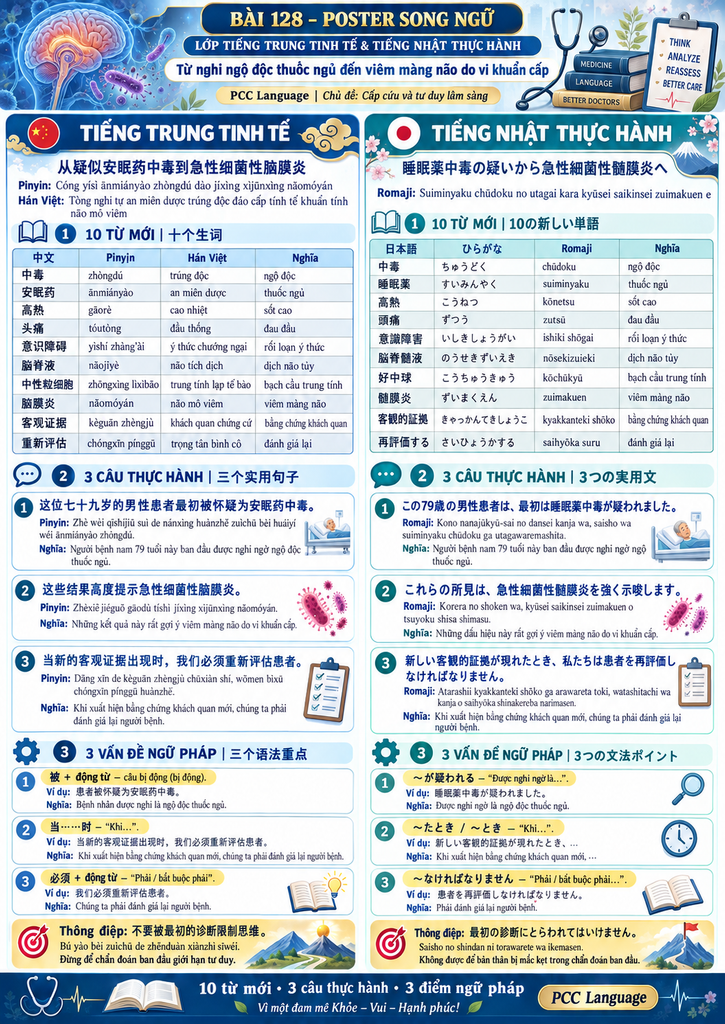
BÀI 128 – TIẾNG TRUNG TINH TẾ
从疑似安眠药中毒到急性细菌性脑膜炎
Cóng yísì ānmiányào zhòngdú dào jíxìng xìjūnxìng nǎomóyán
Hán Việt: Tòng nghi tự an miên dược trúng độc đáo cấp tính tế khuẩn tính não mô viêm
Từ nghi ngộ độc thuốc ngủ đến viêm màng não do vi khuẩn cấp
Chủ đề: 急诊医学与临床思维 – Cấp cứu và tư duy lâm sàng
I. 10 TỪ MỚI | 十个生词
| # | 中文 | Pinyin | Hán Việt | Nghĩa |
|---|---|---|---|---|
| 1 | 中毒 | zhòngdú | trúng độc | ngộ độc |
| 2 | 安眠药 | ānmiányào | an miên dược | thuốc ngủ |
| 3 | 高热 | gāorè | cao nhiệt | sốt cao |
| 4 | 头痛 | tóutòng | đầu thống | đau đầu |
| 5 | 意识障碍 | yìshí zhàng’ài | ý thức chướng ngại | rối loạn ý thức |
| 6 | 脑脊液 | nǎojǐyè | não tích dịch | dịch não tủy |
| 7 | 中性粒细胞 | zhōngxìng lìxìbāo | trung tính lạp tế bào | bạch cầu trung tính |
| 8 | 脑膜炎 | nǎomóyán | não mô viêm | viêm màng não |
| 9 | 客观证据 | kèguān zhèngjù | khách quan chứng cứ | bằng chứng khách quan |
| 10 | 重新评估 | chóngxīn pínggū | trọng tân bình cô | đánh giá lại |
Cụm cần nhớ
急性细菌性脑膜炎
jíxìng xìjūnxìng nǎomóyán
cấp tính tế khuẩn tính não mô viêm
→ viêm màng não do vi khuẩn cấp.
II. 3 CÂU THỰC HÀNH | 三个实用句子
1. Chẩn đoán ban đầu
这位七十九岁的男性患者最初被怀疑为安眠药中毒。
Pinyin:
Zhè wèi qīshíjiǔ suì de nánxìng huànzhě zuìchū bèi huáiyí wéi ānmiányào zhòngdú.
Hán Việt:
Giá vị thất thập cửu tuế đích nam tính hoạn giả tối sơ bị hoài nghi vi an miên dược trúng độc.
Nghĩa:
Người bệnh nam 79 tuổi này ban đầu được nghi ngờ ngộ độc thuốc ngủ.
2. Chuyển hướng chẩn đoán
这些结果高度提示急性细菌性脑膜炎。
Pinyin:
Zhèxiē jiéguǒ gāodù tíshì jíxìng xìjūnxìng nǎomóyán.
Hán Việt:
Giá ta kết quả cao độ đề thị cấp tính tế khuẩn tính não mô viêm.
Nghĩa:
Những kết quả này rất gợi ý viêm màng não do vi khuẩn cấp.
3. Câu tư duy lâm sàng trọng tâm
当新的客观证据出现时,我们必须重新评估患者。
Pinyin:
Dāng xīn de kèguān zhèngjù chūxiàn shí, wǒmen bìxū chóngxīn pínggū huànzhě.
Hán Việt:
Đương tân đích khách quan chứng cứ xuất hiện thời, ngã môn tất tu trọng tân bình cô hoạn giả.
Nghĩa:
Khi xuất hiện bằng chứng khách quan mới, chúng ta phải đánh giá lại người bệnh.
III. 3 VẤN ĐỀ NGỮ PHÁP | 三个语法重点
1. 被 + động từ — Câu bị động
Ví dụ:
患者被怀疑为安眠药中毒。
Huànzhě bèi huáiyí wéi ānmiányào zhòngdú.
被 – bèi – bị là dấu hiệu thường gặp của câu bị động.
Công thức:
Chủ ngữ + 被 + tác nhân (có thể lược bỏ) + động từ
Trong bài:
患者 + 被 + 怀疑 + 为……
Bệnh nhân + được/bị + nghi ngờ + là…
→ 患者被怀疑为安眠药中毒。
Người bệnh được nghi là ngộ độc thuốc ngủ.
Mẹo nhớ: Trong trình bày ca bệnh, 被 rất hữu ích khi muốn tập trung vào người bệnh hoặc chẩn đoán, không phải người thực hiện hành động.
2. 当……时 — “Khi…”
Ví dụ:
当新的客观证据出现时,我们必须重新评估患者。
Cấu trúc:
当 + sự việc + 时,+ mệnh đề chính
Trong đó:
- 当 – dāng – đương: khi
- 时 – shí – thời: lúc, thời điểm
→ 当……时 = khi…
Ví dụ y khoa khác:
当患者出现高热时,我们应该考虑感染。
Dāng huànzhě chūxiàn gāorè shí, wǒmen yīnggāi kǎolǜ gǎnrǎn.
Khi bệnh nhân xuất hiện sốt cao, chúng ta nên nghĩ đến nhiễm trùng.
Đây là cấu trúc rất hữu ích cho clinical reasoning.
3. 必须 + động từ — “Phải / bắt buộc phải”
Trong câu:
我们必须重新评估患者。
- 我们 – wǒmen: chúng ta
- 必须 – bìxū: phải, bắt buộc phải
- 重新 – chóngxīn: lại, một lần nữa
- 评估 – pínggū: đánh giá
- 患者 – huànzhě: người bệnh
Cấu trúc:
Chủ ngữ + 必须 + động từ
Ví dụ:
我们必须立即治疗。
Wǒmen bìxū lìjí zhìliáo.
Chúng ta phải điều trị ngay.
So sánh:
应该 yīnggāi = nên → khuyến nghị
必须 bìxū = phải → mức độ bắt buộc mạnh hơn.
CÂU CHỐT HÔM NAY
当新的客观证据出现时,我们必须重新评估患者。
Dāng xīn de kèguān zhèngjù chūxiàn shí, wǒmen bìxū chóngxīn pínggū huànzhě.
Đương tân đích khách quan chứng cứ xuất hiện thời, ngã môn tất tu trọng tân bình cô hoạn giả.
Khi xuất hiện bằng chứng khách quan mới, chúng ta phải đánh giá lại người bệnh.
今日信息 | Thông điệp hôm nay
不要被最初的诊断限制思维。
Bú yào bèi zuìchū de zhěnduàn xiànzhì sīwéi.
Bất yếu bị tối sơ đích chẩn đoán hạn chế tư duy.
→ Đừng để chẩn đoán ban đầu giới hạn tư duy.
Lớp Tiếng Trung Tinh Tế – PCC Language
10 từ mới • 3 câu thực hành • 3 điểm ngữ pháp
Vì một đam mê Khỏe – Vui – Hạnh phúc!
BÀI 128 – TIẾNG NHẬT THỰC HÀNH
睡眠薬中毒の疑いから急性細菌性髄膜炎へ
Suiminyaku chūdoku no utagai kara kyūsei saikinsei zuimakuen e
Từ nghi ngộ độc thuốc ngủ đến viêm màng não do vi khuẩn cấp
Chủ đề: 救急医療と臨床推論
Kyūkyū iryō to rinshō suiron
Cấp cứu và tư duy lâm sàng
I. 10 TỪ MỚI | 10の新しい単語
| # | 日本語 | ひらがな | Romaji | Nghĩa |
|---|---|---|---|---|
| 1 | 中毒 | ちゅうどく | chūdoku | ngộ độc |
| 2 | 睡眠薬 | すいみんやく | suiminyaku | thuốc ngủ |
| 3 | 高熱 | こうねつ | kōnetsu | sốt cao |
| 4 | 頭痛 | ずつう | zutsū | đau đầu |
| 5 | 意識障害 | いしきしょうがい | ishiki shōgai | rối loạn ý thức |
| 6 | 脳脊髄液 | のうせきずいえき | nōsekizuieki | dịch não tủy |
| 7 | 好中球 | こうちゅうきゅう | kōchūkyū | bạch cầu trung tính |
| 8 | 髄膜炎 | ずいまくえん | zuimakuen | viêm màng não |
| 9 | 客観的証拠 | きゃっかんてきしょうこ | kyakkanteki shōko | bằng chứng khách quan |
| 10 | 再評価する | さいひょうかする | saihyōka suru | đánh giá lại |
Cụm cần nhớ
急性細菌性髄膜炎
きゅうせいさいきんせいずいまくえん
Kyūsei saikinsei zuimakuen
→ Viêm màng não do vi khuẩn cấp
II. 3 CÂU THỰC HÀNH | 3つの実用文
1. Chẩn đoán ban đầu
この79歳の男性患者は、最初は睡眠薬中毒が疑われました。
Romaji:
Kono nanajūkyū-sai no dansei kanja wa, saisho wa suiminyaku chūdoku ga utagawaremashita.
Nghĩa:
Người bệnh nam 79 tuổi này ban đầu được nghi ngờ ngộ độc thuốc ngủ.
2. Chuyển hướng chẩn đoán
これらの所見は、急性細菌性髄膜炎を強く示唆します。
Romaji:
Korera no shoken wa, kyūsei saikinsei zuimakuen o tsuyoku shisa shimasu.
Nghĩa:
Những dấu hiệu này rất gợi ý viêm màng não do vi khuẩn cấp.
3. Câu tư duy lâm sàng trọng tâm
新しい客観的証拠が現れたとき、私たちは患者を再評価しなければなりません。
Romaji:
Atarashii kyakkanteki shōko ga arawareta toki, watashitachi wa kanja o saihyōka shinakereba narimasen.
Nghĩa:
Khi xuất hiện bằng chứng khách quan mới, chúng ta phải đánh giá lại người bệnh.
III. 3 VẤN ĐỀ NGỮ PHÁP | 3つの文法ポイント
1. ~が疑われる
“Được nghi ngờ là…”
Trong câu:
睡眠薬中毒が疑われました。
Suiminyaku chūdoku ga utagawaremashita.
- 疑う – utagau = nghi ngờ
- 疑われる – utagawareru = được/bị nghi ngờ
- 疑われました = dạng lịch sự quá khứ
Cấu trúc:
N + が + 疑われる
Ví dụ:
細菌感染が疑われます。
Saikin kansen ga utagawaremasu.
→ Nghi ngờ nhiễm khuẩn.
Đây là cấu trúc rất thường gặp trong báo cáo ca bệnh vì mang sắc thái khách quan, chuyên nghiệp.
2. ~たとき / ~とき
“Khi…”
Trong câu:
新しい客観的証拠が現れたとき、…
- 現れる – arawareru = xuất hiện
- 現れた – arawareta = đã xuất hiện
- とき – toki = khi, lúc
Cấu trúc:
V-ta + とき
→ khi một sự việc đã xảy ra / khi sự việc xuất hiện
Ví dụ:
高熱が出たとき、感染症を考えます。
Kōnetsu ga deta toki, kansenshō o kangaemasu.
→ Khi xuất hiện sốt cao, chúng ta nghĩ đến bệnh nhiễm trùng.
Đây là cấu trúc rất hữu ích khi mô tả diễn biến lâm sàng theo thời gian.
3. ~なければなりません
“Phải / bắt buộc phải…”
Trong câu:
患者を再評価しなければなりません。
Dạng gốc:
再評価する – saihyōka suru
→ đánh giá lại
Chuyển sang dạng bắt buộc:
再評価しなければなりません
→ phải đánh giá lại
Cấu trúc:
V-ない → V-なければなりません
Ví dụ:
治療をすぐに開始しなければなりません。
Chiryō o sugu ni kaishi shinakereba narimasen.
→ Chúng ta phải bắt đầu điều trị ngay.
So sánh:
~べきです = nên
~なければなりません = phải, bắt buộc
Trong cấp cứu, cấu trúc thứ hai thể hiện mức độ cần thiết mạnh hơn.
CÂU CHỐT HÔM NAY
新しい客観的証拠が現れたとき、私たちは患者を再評価しなければなりません。
Atarashii kyakkanteki shōko ga arawareta toki, watashitachi wa kanja o saihyōka shinakereba narimasen.
Khi xuất hiện bằng chứng khách quan mới, chúng ta phải đánh giá lại người bệnh.
今日のメッセージ | Thông điệp hôm nay
最初の診断にとらわれてはいけません。
Saisho no shindan ni torawarete wa ikemasen.
→ Không được để bản thân bị mắc kẹt trong chẩn đoán ban đầu.
Lớp Tiếng Nhật thực hành – PCC Language
10 từ mới • Hiragana • Romaji • 3 câu thực hành • 3 điểm ngữ pháp
Vì một đam mê Khỏe – Vui – Hạnh phúc!