Bài tổng ôn tuần 23 – Tiếng Anh Y khoa: Từ những thách thức lâm sàng đến khám phá khoa học và hạnh phúc * From Clinical Challenges to Scientific Discoveries and Happiness
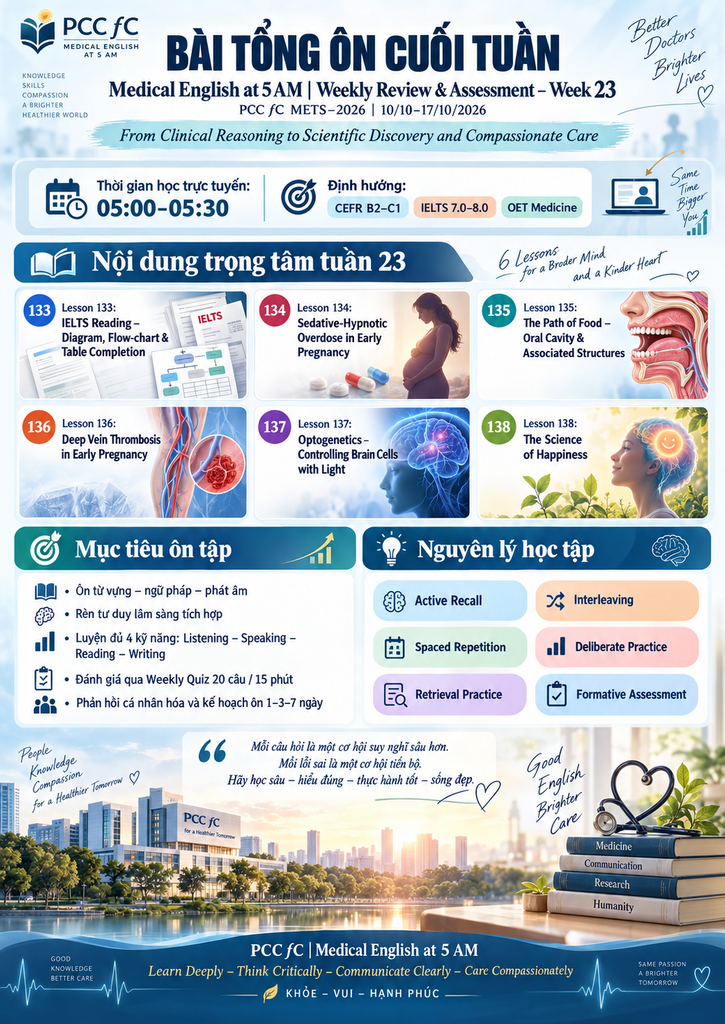
PCC Language – Thăng Long, ngày 17/10/2026, Mỗi buổi sáng thức dậy lúc 5 giờ không chỉ là một hành động rèn luyện kỷ luật, mà còn là một bước tiến nhỏ trên hành trình tích lũy tri thức, phát triển tư duy và hoàn thiện bản thân. Trong tuần học thứ 23, qua sáu bài học (Lessons 133–138), các học viên Lớp Tiếng Anh Y Khoa 5H sáng – PCC fC đã cùng khám phá những chủ đề phong phú, từ kỹ năng đọc hiểu IELTS, ngộ độc thuốc an thần trong thai kỳ, giải phẫu khoang miệng, huyết khối tĩnh mạch sâu đến quang di truyền học và khoa học về hạnh phúc.
Bài tổng ôn cuối tuần được thiết kế theo chuẩn PCC fC METS–2026, định hướng CEFR B2–C1, IELTS 7.0–8.0 và OET Medicine, vận dụng các nguyên lý khoa học giáo dục hiện đại như Active Recall, Spaced Repetition, Retrieval Practice và Formative Assessment. Mục tiêu không chỉ là ghi nhớ kiến thức, mà còn giúp học viên kết nối các bài học, vận dụng tư duy lâm sàng, phát triển khả năng giao tiếp tiếng Anh tự nhiên, chính xác và thấu cảm.
Mỗi câu hỏi là một cơ hội suy nghĩ sâu hơn; mỗi lỗi sai là một cơ hội tiến bộ; mỗi kiến thức được vận dụng đúng là một giá trị thiết thực đối với người bệnh và cộng đồng. Hãy dành 30 phút học tập tập trung, chủ động trả lời trước khi xem đáp án, mạnh dạn chia sẻ và cùng nhau tiến bộ.
Every morning is a new opportunity to learn, grow, and become a better version of ourselves. True learning is not measured by how much we remember, but by how effectively we apply knowledge, think critically, and communicate with compassion.
Với tinh thần “Học sâu – Hiểu đúng – Thực hành tốt – Sống đẹp”, chúng ta tiếp tục nuôi dưỡng văn hóa học tập suốt đời, lan tỏa tri thức và cùng nhau xây dựng một cộng đồng Khỏe – Vui – Hạnh phúc.
BÀI TỔNG ÔN TUẦN 23 – TIẾNG ANH Y KHOA 5H SÁNG
MEDICAL ENGLISH AT 5 AM | WEEKLY REVIEW & ASSESSMENT – WEEK 23
PCC fC | Medical English Training System – METS 2026
Chủ đề: From Clinical Reasoning to Scientific Discovery and Compassionate Care Từ tư duy lâm sàng đến khám phá khoa học và chăm sóc bằng lòng trắc ẩn
Thời gian: 10–17/10/2026 Nội dung: Lessons 133–138 Trình độ định hướng: CEFR B2–C1 | IELTS 7.0–8.0 | OET Medicine Hình thức: Trực tuyến 05:00–05:30 kết hợp tự học và kiểm tra ngoài giờ Đánh giá: 20 câu hỏi trong 15 phút và bài tập thực hành bốn kỹ năng Đơn vị tổ chức: PCC fC – Medical English at 5 AM
LỜI DẪN – INTRODUCTION
Học tiếng Anh y khoa không chỉ là ghi nhớ từ vựng, sử dụng đúng ngữ pháp hay đạt điểm cao trong các kỳ thi quốc tế. Mục tiêu quan trọng hơn là phát triển năng lực tư duy, diễn đạt chính xác thông tin khoa học, đưa ra quyết định lâm sàng an toàn và giao tiếp với người bệnh bằng sự thấu cảm.
Trong tuần học thứ 23, sáu bài học từ Lesson 133 đến Lesson 138 đã đưa học viên đi từ kỹ thuật đọc hiểu IELTS đến các tình huống y khoa phức tạp: ngộ độc thuốc an thần ở phụ nữ mang thai, giải phẫu khoang miệng, huyết khối tĩnh mạch sâu, quang di truyền học và khoa học về hạnh phúc.
Bài tổng ôn này không chỉ kiểm tra những điều đã học mà còn tạo cơ hội vận dụng, kết nối, phản biện và tự đánh giá. Mỗi câu trả lời, mỗi lần mắc lỗi và mỗi phản hồi đều là dữ liệu hữu ích để cải thiện việc học.
Medical English is not simply about learning medical terminology. It is about understanding evidence, making responsible decisions, and communicating with clarity and compassion.
Tiếng Anh y khoa không chỉ là học thuật ngữ chuyên ngành, mà còn là hiểu bằng chứng, đưa ra quyết định có trách nhiệm và giao tiếp rõ ràng, thấu cảm.
Nguyên lý giáo dục áp dụng: Active Recall, Retrieval Practice, Spaced Repetition, Interleaving, Deliberate Practice, Formative Assessment và Personalized Feedback.
Tài liệu được chia thành ba phần độc lập:
PART A – STUDENT EDITION: Đề dành cho học viên, không chứa đáp án.
PART B – TEACHING ASSISTANT EDITION: Đáp án, giải thích song ngữ và hướng dẫn phản hồi.
PART C – SCORECARD & IMPLEMENTATION: Bảng chấm điểm, phân tầng năng lực và kế hoạch tổ chức.
PART A – STUDENT EDITION
ĐỀ ÔN TẬP DÀNH CHO HỌC VIÊN
Instructions: Complete the exercises independently before checking the answer key. Explain your reasoning whenever possible. Accuracy, clarity, clinical judgement and compassionate communication are all important.
Hướng dẫn: Học viên tự hoàn thành bài trước khi xem đáp án. Cần chú trọng lập luận, độ chính xác y khoa, ngôn ngữ tự nhiên và giao tiếp thấu cảm.
1. WEEKLY OVERVIEW – TỔNG QUAN BÀI HỌC
| Lesson | Topic | Core knowledge and skills |
|---|---|---|
| 133 | IELTS Reading: Diagram Label, Flow-chart & Table Completion | Tìm thông tin, dự đoán đáp án, từ đồng nghĩa, trình tự, giới hạn số từ |
| 134 | Sedative-Hypnotic Overdose in Early Pregnancy | Ngộ độc an thần, ABC, nguy cơ thai kỳ, đánh giá tự gây hại, giao tiếp lâm sàng |
| 135 | The Path of Food: Oral Cavity & Associated Structures | Răng, men răng, ngà răng, tuyến nước bọt, nhai, nuốt, đau răng |
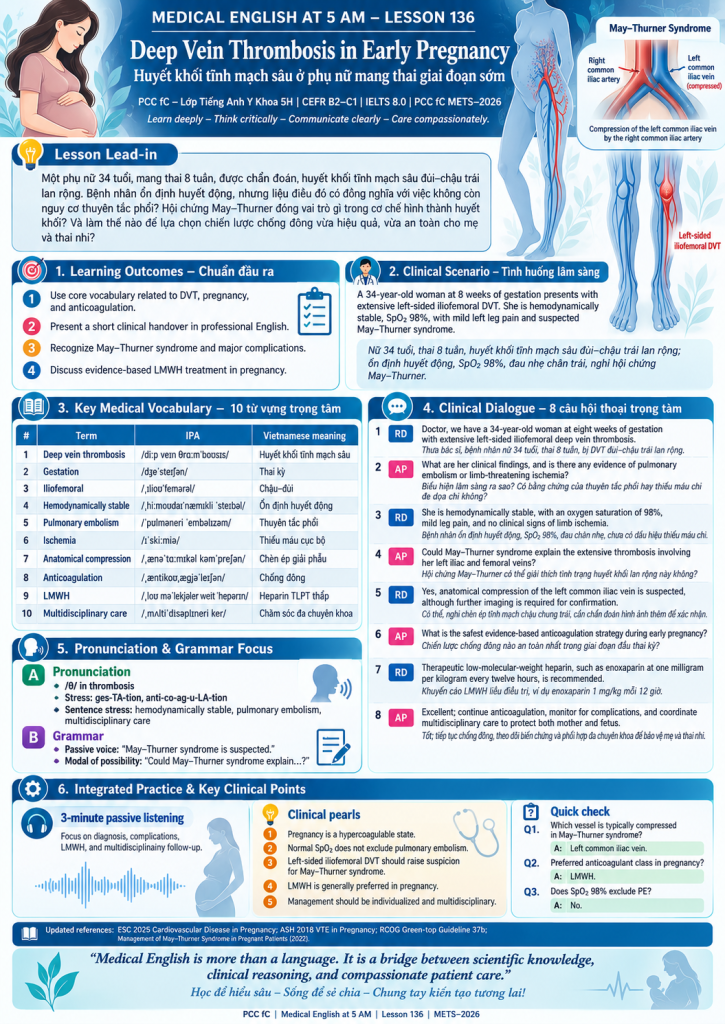
| 136 | Deep Vein Thrombosis in Early Pregnancy | Huyết khối chậu–đùi, đánh giá thuyên tắc phổi, siêu âm, chống đông |
| 137 | Optogenetics: Controlling Brain Cells with Light | Protein nhạy sáng, kênh ion, mạch thần kinh, Free Talk, tư duy nghiên cứu |
| 138 | The Science of Happiness | Hạnh phúc, sức khỏe tinh thần, tâm lý học tích cực, sinh học thần kinh, quan hệ xã hội |
Chủ đề sáu bài đã được đối chiếu với chuyên mục PCC Language, bao gồm nội dung Free Talk về Nobel Y học 2026 của Bài 137.
Weekly Knowledge Integration
Lesson 133 giúp học viên đọc và xử lý thông tin chính xác. Lessons 134 và 136 rèn luyện tư duy lâm sàng khi lựa chọn điều trị trong thai kỳ. Lesson 135 củng cố kiến thức giải phẫu và khả năng giải thích triệu chứng thường gặp. Lesson 137 phát triển tư duy nghiên cứu, phân biệt phát hiện khoa học với khả năng ứng dụng. Lesson 138 mở rộng góc nhìn về con người và vai trò của hạnh phúc trong chăm sóc sức khỏe.
Weekly guiding question:
How can scientific knowledge, clinical reasoning, and compassionate communication work together to improve patient care?
Kiến thức khoa học, tư duy lâm sàng và giao tiếp thấu cảm có thể phối hợp như thế nào để cải thiện chất lượng chăm sóc người bệnh?
2. LEARNING OUTCOMES – CHUẨN ĐẦU RA
Sau khi hoàn thành bài ôn tập và các nhiệm vụ ngoài giờ, học viên có thể:
| Learning outcome | Bloom’s level | Measurable target |
|---|---|---|
| LO1. Recall and use medical vocabulary | Remember / Apply | Nhận biết và sử dụng đúng ít nhất 16/20 thuật ngữ trong câu hoặc tình huống |
| LO2. Interpret medical information | Understand / Analyze | Đạt ít nhất 80% câu hỏi Listening và Reading |
| LO3. Demonstrate clinical reasoning | Apply / Evaluate | Xác định tối thiểu 3 vấn đề ưu tiên và trả lời đạt ≥10/15 điểm ca tích hợp |
| LO4. Communicate effectively | Apply / Create | Thực hiện role-play 90 giây với ít nhất 1 câu hỏi mở, 2 biểu đạt thấu cảm và 1 phần giải thích kế hoạch |
| LO5. Evaluate personal progress | Evaluate | Hoàn thành quiz trong 15 phút, nhận diện ít nhất 2 lỗi và xây dựng kế hoạch ôn 1–3–7 ngày |
Mục tiêu chung: Đạt từ 80/100 điểm trong đánh giá tích hợp, đồng thời không mắc lỗi nghiêm trọng liên quan đến an toàn người bệnh trong phần tình huống.
3. VOCABULARY REVIEW – ÔN TẬP 20 TỪ VỰNG TRỌNG TÂM
IPA sử dụng cách phát âm Anh–Anh tham khảo. n. = noun; v. = verb; adj. = adjective; phr. = phrase.
| No. | Vocabulary – IPA – Word class | Vietnamese meaning | Collocation and medical example |
|---|---|---|---|
| 1 | Flow-chart /ˈfləʊ tʃɑːt/ (n.) | Lưu đồ | Complete a flow-chart. Complete the flow-chart according to the clinical protocol. |
| 2 | Word limit /ˈwɜːd ˌlɪmɪt/ (n. phr.) | Giới hạn số từ | Exceed the word limit. Do not exceed the stated word limit. |
| 3 | Sedative-hypnotic /ˌsedətɪv hɪpˈnɒtɪk/ (n./adj.) | Thuốc an thần gây ngủ | Sedative-hypnotic overdose. Sedative-hypnotic overdose can impair consciousness. |
| 4 | Respiratory depression /rɪˈspɪrətri dɪˈpreʃən/ (n. phr.) | Ức chế hô hấp | Develop respiratory depression. Severe overdose may cause respiratory depression. |
| 5 | Gestation /dʒeˈsteɪʃən/ (n.) | Thai kỳ | Eight weeks of gestation. The woman is at eight weeks of gestation. |
| 6 | Airway protection /ˈeəweɪ prəˈtekʃən/ (n. phr.) | Bảo vệ đường thở | Require airway protection. The patient may require airway protection if consciousness deteriorates. |
| 7 | Oral cavity /ˈɔːrəl ˈkævɪti/ (n. phr.) | Khoang miệng | Examine the oral cavity. Digestion begins in the oral cavity. |
| 8 | Mastication /ˌmæstɪˈkeɪʃən/ (n.) | Sự nhai | Efficient mastication. Mastication breaks food into smaller particles. |
| 9 | Enamel /ɪˈnæməl/ (n.) | Men răng | Tooth enamel. Tooth enamel protects the underlying dentin. |
| 10 | Salivary gland /ˈsælɪvəri ɡlænd/ (n. phr.) | Tuyến nước bọt | Salivary gland secretion. Salivary glands produce saliva. |
| 11 | Thrombosis /θrɒmˈbəʊsɪs/ (n.) | Huyết khối | Deep vein thrombosis. Ultrasound confirmed deep vein thrombosis. |
| 12 | Anticoagulation /ˌæntikəʊˌæɡjʊˈleɪʃən/ (n.) | Điều trị chống đông | Therapeutic anticoagulation. Therapeutic anticoagulation helps prevent clot extension. |
| 13 | Iliofemoral /ˌɪliəʊˈfemərəl/ (adj.) | Thuộc chậu–đùi | Iliofemoral thrombosis. The patient had extensive iliofemoral DVT. |
| 14 | Haemodynamic stability /ˌhiːməʊdaɪˈnæmɪk stəˈbɪləti/ (n. phr.) | Ổn định huyết động | Assess haemodynamic stability. Haemodynamic stability does not exclude serious complications. |
| 15 | Optogenetics /ˌɒptəʊdʒəˈnetɪks/ (n.) | Quang di truyền học | Optogenetic research. Optogenetics enables scientists to control selected cells using light. |
| 16 | Channelrhodopsin /ˌtʃænəlrəʊˈdɒpsɪn/ (n.) | Protein kênh ion nhạy sáng | Express channelrhodopsin. Channelrhodopsin can respond to light. |
| 17 | Neural circuit /ˈnjʊərəl ˈsɜːkɪt/ (n. phr.) | Mạch thần kinh | Modulate neural circuits. Researchers investigate neural circuits involved in behaviour. |
| 18 | Well-being /ˌwel ˈbiːɪŋ/ (n.) | Trạng thái khỏe mạnh, an lành | Psychological well-being. Social support can improve psychological well-being. |
| 19 | Anhedonia /ˌænhɪˈdəʊniə/ (n.) | Giảm hoặc mất khả năng cảm nhận niềm vui | Persistent anhedonia. Persistent anhedonia requires further assessment. |
| 20 | Compassion /kəmˈpæʃən/ (n.) | Lòng trắc ẩn | Show compassion. Physicians should demonstrate compassion when discussing difficult diagnoses. |
Exercise 3A – Contextual Gap Filling
Complete the following sentences using the correct terms from the vocabulary table. Use each term once.
- A patient with suspected sedative overdose must be assessed for __________.
- The woman is currently at eight weeks of __________.
- __________ refers to the mechanical breakdown of food by chewing.
- The hard outer layer of the tooth crown is called __________.
- Patients with confirmed proximal DVT usually require therapeutic __________ unless contraindicated.
- __________ is a light-sensitive protein used in optogenetic research.
- Persistent loss of interest or pleasure is known as __________.
- Effective medical communication requires clinical accuracy and __________.
Exercise 3B – Active Recall
Without looking at the vocabulary table, explain the following differences in English:
A. Thrombosis versus anticoagulation.
B. Respiratory depression versus haemodynamic instability.
C. Optogenetics versus routine clinical treatment.
D. Well-being versus momentary pleasure.
Self-study instruction: Record your answers, wait five minutes, then attempt to recall the same concepts without notes.
4. GRAMMAR & PRONUNCIATION
4.1. Five Essential Grammar Structures
Structure 1 – Passive Voice
Formula: Subject + be + past participle.
Example: Deep vein thrombosis was confirmed by compression ultrasonography.
Dịch: Huyết khối tĩnh mạch sâu được xác nhận bằng siêu âm ép.
Use: Describing examinations, diagnoses, procedures and research results.
Structure 2 – Present Perfect for Clinical History
Formula: Subject + have/has + past participle + for/since.
Example: She has experienced left-leg swelling for two days.
Dịch: Bệnh nhân đã bị sưng chân trái trong hai ngày.
Use: Describing symptoms that started in the past and continue into the present.
Structure 3 – Relative Clauses
Formula: Noun + who/which/that + clause.
Example: Enamel, which protects the tooth, can be damaged by acid.
Dịch: Men răng, có chức năng bảo vệ răng, có thể bị tổn thương do axit.
Use: Explaining anatomy, physiology and disease mechanisms.
Structure 4 – Concession and Contrast
Formula: Although + clause, main clause.
Example: Although the patient is haemodynamically stable, serious complications may still occur.
Dịch: Mặc dù bệnh nhân ổn định huyết động, các biến chứng nghiêm trọng vẫn có thể xảy ra.
Use: Explaining clinical uncertainty and discussing risk.
Structure 5 – Hedging Scientific Claims
Formula: Subject + may/might/could + base verb.
Example: Optogenetics may contribute to the development of future neurological treatments.
Dịch: Quang di truyền học có thể đóng góp vào sự phát triển các phương pháp điều trị bệnh thần kinh trong tương lai.
Use: Distinguishing scientific possibilities from established evidence.
4.2. Grammar Error Correction
Correct the following sentences.
G1. The patient was diagnose with deep vein thrombosis.
G2. She has developed leg swelling since two days.
G3. The enamel who protects the tooth may become damaged.
G4. Although the patient is stable, but she still needs treatment.
G5. Optogenetics will certainly cure all neurological diseases.
4.3. Pronunciation Practice
| Term | Main stress | Pronunciation focus |
|---|---|---|
| Thrombosis | throm-BO-sis | Initial /θ/ |
| Gestation | ge-STA-tion | /dʒ/ and /ʃ/ |
| Anticoagulation | an-ti-co-ag-u-LA-tion | Multisyllabic rhythm |
| Optogenetics | op-to-ge-NET-ics | Stress placement |
| Compassion | com-PAS-sion | /ʃ/ |
| Anhedonia | an-he-DO-nia | Stress and connected vowels |
Speaking drill: Repeat the following sentences three times, first slowly, then naturally, and finally with appropriate clinical intonation.
A. The patient was diagnosed with extensive deep vein thrombosis.
B. Although she is stable, she still requires careful monitoring.
C. I understand your concerns, and we will discuss the treatment options together.
5. INTEGRATED CLINICAL CASE
Case Title: Two Clinical Problems, One Pregnant Patient
Simulated clinical scenario
A 34-year-old woman at eight weeks of gestation arrives at the emergency department after taking an unknown quantity of sedative medication during a period of emotional distress.
She is drowsy but responds to verbal stimulation. Her vital signs are:
Blood pressure: 112/72 mmHg. Heart rate: 96 beats/minute. Respiratory rate: 12 breaths/minute. SpO₂: 97% on room air.
She also reports two days of progressively worsening pain and swelling in her left leg. Compression ultrasound identifies extensive proximal DVT involving the left femoral and iliac veins.
After initial stabilisation, she describes poor sleep, persistent distress and loss of interest in her usual activities.
She asks:
“Doctor, will the treatment harm my baby? I’m frightened, and I don’t know what to do.”
Note: This is a newly constructed educational scenario integrating Lessons 134, 136 and 138. It is not presented as an original patient case from the website.
Clinical Reasoning Questions
C1 – Prioritisation: What are the three immediate priorities in assessing this patient? Explain why.
C2 – Risk Interpretation: Why does normal blood pressure or oxygen saturation not exclude serious complications?
C3 – Management: What is the rationale for using low-molecular-weight heparin in a pregnant patient with confirmed proximal DVT?
C4 – Communication: Write three empathetic sentences explaining the treatment plan to the patient. Include one open-ended question.
C5 – Comprehensive Care: What additional medical, obstetric and psychological assessments should be considered before discharge?
Expected response: 40–70 English words per question, except C4.
6. FOUR-SKILL PRACTICE – LISTENING, SPEAKING, READING & WRITING
6.1. LISTENING – Passive Listening (2–3 Minutes)
Title: Six Lessons, One Purpose
Instructions: Listen to the passage twice. During the first listening, identify the main themes. During the second listening, answer the comprehension questions. Do not read the transcript until both listening attempts are complete.
Listening Transcript
Every morning at five o’clock, a group of healthcare learners comes together to improve their English and develop better clinical communication skills.
This week, we explored six fascinating topics.
We began with IELTS Reading. Completing diagrams, flow-charts and tables requires careful reading, accurate information retrieval and attention to word limits. These skills are useful not only in examinations but also in interpreting medical documents.
Next, we discussed sedative-hypnotic overdose during early pregnancy. When a pregnant patient presents after an overdose, maternal stabilisation is the immediate priority. Clinicians must assess airway, breathing, circulation and consciousness while considering possible fetal risks and psychological safety.
We then explored the oral cavity. Digestion begins when teeth break down food through mastication. Saliva lubricates food and contains enzymes that initiate starch digestion.
Another important topic was deep vein thrombosis during pregnancy. Even if a patient appears haemodynamically stable, extensive thrombosis may still require prompt treatment. Low-molecular-weight heparin is generally preferred for anticoagulation during pregnancy.
We also learned about optogenetics, a research technique that uses light-sensitive proteins to influence selected cells. This technology has transformed experimental neuroscience, although many therapeutic applications remain under investigation.
Finally, we explored the science of happiness. Well-being is influenced by biological, psychological and social factors. Sleep, meaningful relationships and emotional support can contribute to a healthier life.
These six lessons remind us that medical knowledge alone is not enough. We must also interpret evidence carefully, explain uncertainty honestly and listen to our patients with compassion.
As another week comes to an end, remember that small, consistent efforts can lead to meaningful progress.
Learn deeply. Think critically. Communicate clearly. Care compassionately.
Listening Questions
L1. What three types of IELTS Reading tasks were reviewed?
L2. What is the immediate priority in managing suspected overdose during pregnancy?
L3. What are two functions of saliva?
L4. Why should optogenetics not automatically be considered an established clinical treatment?
L5. According to the passage, what three qualities should accompany medical knowledge?
6.2. SPEAKING – OET-STYLE ROLE-PLAY
Scenario: Explaining DVT Treatment During Pregnancy
Role A – Doctor: Explain the diagnosis, rationale for treatment, expected benefits and potential risks. Use clear, empathetic language.
Role B – Patient: You are eight weeks pregnant and worried that anticoagulant treatment may harm your baby. Ask about safety, duration of treatment and what might happen if treatment is delayed.
Required communication skills: Introducing the topic, acknowledging concerns, explaining in plain English, checking understanding, discussing uncertainty and agreeing on next steps.
Useful expressions:
I understand why you are concerned. — Tôi hiểu vì sao chị lo lắng.
Let me explain what we know so far. — Tôi xin giải thích những gì chúng ta đã biết.
The treatment aims to prevent the clot from getting bigger. — Điều trị nhằm ngăn huyết khối phát triển thêm.
What worries you most about the treatment? — Điều gì khiến chị lo lắng nhất về việc điều trị?
Task: 30 seconds preparation; 90 seconds role-play; 30 seconds peer feedback.
6.3. READING – SCIENTIFIC AND CLINICAL INTERPRETATION
Passage: Scientific Innovation and Responsible Medicine
Medical innovation has transformed the way researchers understand human diseases. Optogenetics, for example, allows scientists to influence selected cells using light-sensitive proteins and precisely controlled light stimulation. It has become a valuable research technique for investigating neural circuits.
However, an important distinction exists between an experimental discovery and a clinically validated treatment. Findings from laboratory studies cannot automatically be applied to routine patient care. Clinical translation requires rigorous evaluation of safety, effectiveness and long-term outcomes.
The same principle applies to managing complex clinical problems. During pregnancy, clinicians must balance maternal benefits and potential fetal risks. In suspected poisoning, a normal oxygen saturation reading does not necessarily exclude subsequent deterioration. Similarly, a patient with extensive deep vein thrombosis may need prompt treatment despite initially stable vital signs.
High-quality care therefore requires accurate scientific interpretation, careful clinical judgement and compassionate communication. Patients need explanations that are both understandable and honest about uncertainty.
Reading Questions
R1. Optogenetics can influence selected cells through light-sensitive proteins. TRUE / FALSE / NOT GIVEN.
R2. Every promising laboratory finding is immediately suitable for routine clinical care. TRUE / FALSE / NOT GIVEN.
R3. All patients involved in optogenetic research experience identical long-term outcomes. TRUE / FALSE / NOT GIVEN.
R4. Name two factors that must be evaluated before clinical translation.
R5. What three qualities are required for high-quality care according to the final paragraph?
6.4. WRITING – IELTS/OET ORIENTATION
Task A – IELTS-style mini-essay
Write 120–150 words on the following topic:
Scientific knowledge is essential in modern healthcare, but compassionate communication is equally important. To what extent do you agree?
Your response should include a clear opinion, two supporting arguments, one medical example and a concise conclusion.
Task B – OET-style clinical handover
Write 70–100 words summarising the integrated clinical case for the receiving medical team.
Include the patient’s pregnancy status, suspected overdose, confirmed proximal DVT, immediate priorities and reasons for further multidisciplinary assessment.
Both are shortened educational writing tasks; neither is a complete official IELTS or OET Writing examination.
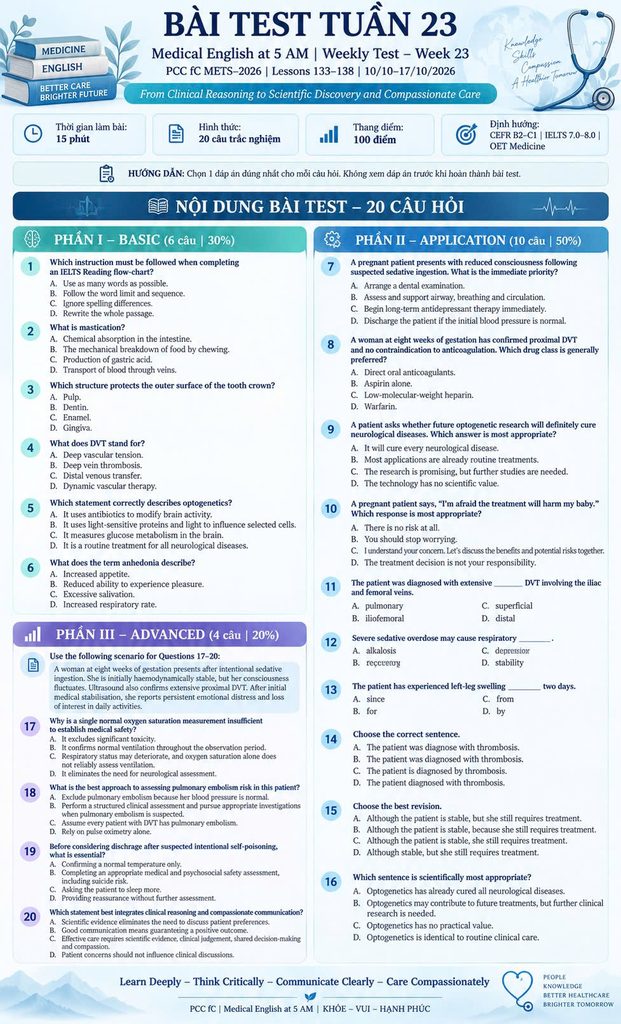
7. WEEKLY QUIZ – 20 QUESTIONS / 15 MINUTES
PCC fC METS–2026 | WEEK 23
Full name: ……………………………………………………….
Group: Xuân / Hạ / Thu / Đông
Date: 17/10/2026
Time allowed: 15 minutes
Total questions: 20
Quiz raw score: 40 points (2 points per question).
Assessment Blueprint – Ma trận đề
| Level | Questions | Number | Percentage |
|---|---|---|---|
| Basic – Remember/Understand | Q1–Q6 | 6 | 30% |
| Application – Apply/Analyze | Q7–Q16 | 10 | 50% |
| Advanced – Analyze/Evaluate | Q17–Q20 | 4 | 20% |
| Total | 20 | 100% |
SECTION I – BASIC KNOWLEDGE (Q1–Q6)
Choose the single best answer.
Q1. Which instruction must be followed when completing an IELTS Reading flow-chart?
A. Use as many words as possible. B. Follow the word limit and sequence. C. Ignore spelling differences. D. Rewrite the whole passage.
Q2. What is mastication?
A. Chemical absorption in the intestine. B. The mechanical breakdown of food by chewing. C. Production of gastric acid. D. Transport of blood through veins.
Q3. Which structure protects the outer surface of the tooth crown?
A. Pulp. B. Dentin. C. Enamel. D. Gingiva.
Q4. What does DVT stand for?
A. Deep vascular tension. B. Deep vein thrombosis. C. Distal venous transfer. D. Dynamic vascular therapy.
Q5. Which statement correctly describes optogenetics?
A. It uses antibiotics to modify brain activity. B. It uses light-sensitive proteins and light to influence selected cells. C. It measures glucose metabolism in the brain. D. It is a routine treatment for all neurological diseases.
Q6. What does the term anhedonia describe?
A. Increased appetite. B. Reduced ability to experience pleasure. C. Excessive salivation. D. Increased respiratory rate.
SECTION II – APPLICATION (Q7–Q16)
Questions 7–10: Contextual multiple choice
Q7. A pregnant patient presents with reduced consciousness following suspected sedative ingestion. What is the immediate priority?
A. Arrange a dental examination. B. Assess and support airway, breathing and circulation. C. Begin long-term antidepressant therapy immediately. D. Discharge the patient if the initial blood pressure is normal.
Q8. A woman at eight weeks of gestation has confirmed proximal DVT and no contraindication to anticoagulation. Which drug class is generally preferred?
A. Direct oral anticoagulants. B. Aspirin alone. C. Low-molecular-weight heparin. D. Warfarin.
Q9. A patient asks whether future optogenetic research will definitely cure neurological diseases. Which answer is most appropriate?
A. It will cure every neurological disease. B. Most applications are already routine treatments. C. The research is promising, but further studies are needed. D. The technology has no scientific value.
Q10. A pregnant patient says, “I’m afraid the treatment will harm my baby.” Which response is most appropriate?
A. There is no risk at all. B. You should stop worrying. C. I understand your concern. Let’s discuss the benefits and potential risks together. D. The treatment decision is not your responsibility.
Questions 11–13: Fill in the blanks
Write the correct medical term or grammatical expression.
Q11. The patient was diagnosed with extensive __________ DVT involving the iliac and femoral veins.
Q12. Severe sedative overdose may cause respiratory __________.
Q13. The patient has experienced left-leg swelling __________ two days.
Questions 14–16: Error correction
Rewrite each sentence correctly.
Q14. The patient was diagnose with thrombosis.
Answer: ……………………………………………………………………….
Q15. Although the patient is stable, but she still requires treatment.
Answer: ……………………………………………………………………….
Q16. Optogenetics has already cured all neurological diseases.
Rewrite the sentence using scientifically appropriate language.
Answer: ……………………………………………………………………….
SECTION III – ADVANCED CLINICAL REASONING (Q17–Q20)
Read the following clinical information.
A woman at eight weeks of gestation presents after intentional sedative ingestion. She is initially haemodynamically stable, but her consciousness fluctuates. Ultrasound also confirms extensive proximal DVT. After initial medical stabilisation, she reports persistent emotional distress and loss of interest in daily activities.
Q17. Why is a single normal oxygen saturation measurement insufficient to establish medical safety?
A. It excludes significant toxicity. B. It confirms normal ventilation throughout the observation period. C. Respiratory status may deteriorate, and oxygen saturation alone does not reliably assess ventilation. D. It eliminates the need for neurological assessment.
Q18. What is the best approach to assessing pulmonary embolism risk in this patient?
A. Exclude pulmonary embolism because her blood pressure is normal. B. Perform a structured clinical assessment and pursue appropriate investigations when pulmonary embolism is suspected. C. Assume every patient with DVT has pulmonary embolism. D. Rely on pulse oximetry alone.
Q19. Before considering discharge after suspected intentional self-poisoning, what is essential?
A. Confirming a normal temperature only. B. Completing an appropriate medical and psychosocial safety assessment, including suicide risk. C. Asking the patient to sleep more. D. Providing reassurance without further assessment.
Q20. Which statement best integrates clinical reasoning and compassionate communication?
A. Scientific evidence eliminates the need to discuss patient preferences. B. Good communication means guaranteeing a positive outcome. C. Effective care requires scientific evidence, clinical judgement, shared decision-making and compassion. D. Patient concerns should not influence clinical discussions.
END OF STUDENT ASSESSMENT
Please review your answers before submission. Do not consult the answer key until the assessment is complete.
PART B – TEACHING ASSISTANT EDITION
8. ANSWER KEY, EXPLANATIONS & FORMATIVE FEEDBACK
CONFIDENTIAL TEACHING MATERIAL – Công bố sau khi học viên hoàn thành bài kiểm tra.
8.1. Vocabulary Answer Key
| Item | Correct answer | Explanation |
|---|---|---|
| 3A.1 | Respiratory depression | Ức chế hô hấp là nguy cơ nghiêm trọng của ngộ độc an thần gây ngủ. |
| 3A.2 | Gestation | Thuật ngữ chỉ thai kỳ. |
| 3A.3 | Mastication | The mechanical process of chewing food. |
| 3A.4 | Enamel | Lớp bảo vệ ngoài cùng của thân răng. |
| 3A.5 | Anticoagulation | Treatment that reduces thrombus extension and thromboembolic risk. |
| 3A.6 | Channelrhodopsin | Protein nhạy sáng có thể hoạt động như kênh ion. |
| 3A.7 | Anhedonia | Diminished interest or pleasure. |
| 3A.8 | Compassion | Caring awareness of another person’s suffering, accompanied by a desire to help. |
Exercise 3B – Expected conceptual distinctions
A. Thrombosis refers to clot formation inside a blood vessel, whereas anticoagulation refers to treatment that reduces blood clotting and prevents thrombus extension or recurrence.
B. Respiratory depression involves impaired respiratory drive and/or ventilation. Haemodynamic instability refers to impaired circulatory stability or perfusion. They may coexist but are not interchangeable.
C. Optogenetics is an established experimental research method. Many potential therapeutic applications remain experimental and require clinical validation.
D. Well-being encompasses broader psychological, physical and social functioning, whereas momentary pleasure is a transient positive experience.
8.2. Grammar Answer Key
G1. The patient was diagnosed with deep vein thrombosis.
Reason: Passive voice requires was + diagnosed, not was + diagnose.
G2. She has experienced leg swelling for two days.
Reason: Use for with a duration and since with a starting point.
G3. Enamel, which protects the tooth, may become damaged.
Reason: Use which, not who, when referring to a structure or object.
G4. Although the patient is stable, she still needs treatment.
Reason: Do not combine although and but in this sentence structure.
G5. Optogenetics may contribute to the development of future treatments for neurological diseases, but further clinical research is needed.
Reason: Scientific conclusions must distinguish current evidence from future possibilities.
8.3. Integrated Clinical Case – Suggested Answers
C1 – Prioritisation
The initial priorities are assessment and stabilisation of airway, breathing and circulation; neurological monitoring and identification of the ingested medication; and evaluation of acute thromboembolic complications. Obstetric assessment and psychological safety should be incorporated after immediate stabilisation.
Giải thích: Ưu tiên hồi sức người mẹ, đánh giá độc tính và nguy cơ tiến triển. Đồng thời cần nhận diện vấn đề huyết khối, thai kỳ và nguy cơ tự gây hại.
C2 – Risk Interpretation
Normal blood pressure and oxygen saturation at a single time point do not exclude subsequent respiratory depression, hypoventilation or pulmonary embolism. Serial observations and a structured clinical assessment remain essential.
Giải thích: Dấu hiệu sinh tồn ban đầu bình thường không đủ để loại trừ biến chứng tiến triển hoặc suy hô hấp liên quan đến giảm thông khí.
C3 – Management
Low-molecular-weight heparin is generally preferred for the treatment of acute DVT during pregnancy because it does not cross the placenta and has an established maternal safety profile. Treatment requires individual assessment of bleeding risk, renal function and obstetric circumstances.
Giải thích: LMWH thường được ưu tiên trong thai kỳ. Cần phân biệt an toàn đối với thai với các nguy cơ điều trị ở người mẹ, đặc biệt chảy máu.
C4 – Communication
I understand why you are worried about your baby. We will explain the treatment benefits and possible risks carefully, and we will make decisions together. What concerns you most about starting this treatment?
Giải thích: Câu trả lời cần có thừa nhận cảm xúc, giải thích trung thực và câu hỏi mở.
C5 – Comprehensive Care
The patient requires reassessment for ongoing toxicity, an appropriate obstetric evaluation, planning for anticoagulation, and a comprehensive psychosocial assessment that includes suicide risk. Safe discharge also depends on follow-up arrangements, support systems and the absence of unresolved acute medical risks.
Giải thích: Sau ngộ độc nghi tự gây hại, không được chỉ căn cứ vào sinh hiệu ổn định để quyết định ra viện.
Lưu ý chuyên môn: Chỉ định đặt nội khí quản, lựa chọn và liều chống đông, cũng như xét nghiệm cần được cá thể hóa; các đáp án mang tính nguyên tắc chứ không phải phác đồ xử trí riêng cho một người bệnh.
8.4. Listening – Answer Key
| Question | Suggested answer |
|---|---|
| L1 | Diagram, flow-chart and table completion. |
| L2 | Maternal stabilisation, including airway, breathing and circulation. |
| L3 | Saliva lubricates food and initiates starch digestion. |
| L4 | Experimental findings do not automatically establish clinical safety and effectiveness. |
| L5 | Careful evidence interpretation, honest communication of uncertainty and compassion. |
8.5. Reading – Answer Key
| Question | Answer | Explanation |
|---|---|---|
| R1 | TRUE | The passage describes light-sensitive proteins and light-based control. |
| R2 | FALSE | Clinical translation requires evaluation beyond laboratory findings. |
| R3 | NOT GIVEN | The passage contains no statement about identical long-term outcomes. |
| R4 | Safety and effectiveness | Long-term outcomes is also acceptable. |
| R5 | Scientific interpretation, clinical judgement and compassionate communication | All three appear in the final paragraph. |
8.6. Weekly Quiz – Answer Key
| Question | Answer | Points |
|---|---|---|
| Q1 | B | 2 |
| Q2 | B | 2 |
| Q3 | C | 2 |
| Q4 | B | 2 |
| Q5 | B | 2 |
| Q6 | B | 2 |
| Q7 | B | 2 |
| Q8 | C | 2 |
| Q9 | C | 2 |
| Q10 | C | 2 |
| Q11 | iliofemoral | 2 |
| Q12 | depression | 2 |
| Q13 | for | 2 |
| Q14 | The patient was diagnosed with thrombosis. | 2 |
| Q15 | Although the patient is stable, she still requires treatment. | 2 |
| Q16 | Optogenetics has important research applications, but most proposed neurological treatments remain experimental. | 2 |
| Q17 | C | 2 |
| Q18 | B | 2 |
| Q19 | B | 2 |
| Q20 | C | 2 |
| Total | 40 |
Chấm điểm câu mở: Q14–Q16 có thể chấp nhận các cách diễn đạt tương đương khi đúng ngữ pháp, giữ nguyên ý chính và chính xác khoa học. Q16 phải thể hiện sự chưa chắc chắn và tránh khẳng định đã chữa khỏi tất cả bệnh thần kinh.
8.7. Bilingual Feedback – Giải thích trọng tâm 20 câu
| Questions | Learning point and bilingual feedback |
|---|---|
| Q1 | Respect word limits and sequence. Đọc kỹ yêu cầu trước khi tìm đáp án. |
| Q2–Q3 | Distinguish mastication from digestion and enamel from dentin. Phân biệt quá trình nhai với tiêu hóa, men răng với ngà răng. |
| Q4 | DVT means deep vein thrombosis. Không nhầm với các thuật ngữ mạch máu khác. |
| Q5 | Optogenetics uses light-sensitive proteins. Không đồng nhất công cụ nghiên cứu với điều trị thường quy. |
| Q6 | Anhedonia concerns diminished pleasure or interest. Không đồng nhất với mọi biểu hiện trầm cảm. |
| Q7 | ABC comes first in an unstable or potentially deteriorating poisoned patient. Ưu tiên hồi sức trước. |
| Q8 | LMWH is generally preferred in pregnancy. Cần cân nhắc nguy cơ chảy máu và chống chỉ định. |
| Q9 | Research promise does not guarantee clinical success. Tránh khẳng định vượt quá bằng chứng. |
| Q10 | Acknowledge concerns and discuss benefits and risks. Thấu cảm phải đi cùng thông tin chính xác. |
| Q11 | Iliofemoral describes iliac and femoral venous involvement. Sử dụng đúng thuật ngữ giải phẫu. |
| Q12 | Respiratory depression is a potentially life-threatening complication. Cần đánh giá thông khí thực tế. |
| Q13 | Use for with a duration. Dùng since khi có mốc bắt đầu. |
| Q14 | Passive voice: was diagnosed. Không bỏ đuôi -ed của quá khứ phân từ. |
| Q15 | Do not use although … but together in this construction. |
| Q16 | Use cautious language when discussing emerging therapies. |
| Q17 | SpO₂ alone does not reliably assess ventilation. Normal saturation does not exclude hypoventilation. |
| Q18 | Assess clinical suspicion of pulmonary embolism systematically. Không loại trừ chỉ vì huyết áp bình thường. |
| Q19 | Assess ongoing medical toxicity and psychosocial safety before discharge. |
| Q20 | Evidence, judgement, patient preferences and compassion should inform care. |
8.8. Teaching Assistant Feedback Model
Sử dụng mô hình Two Strengths – One Improvement – One Action:
Strength 1: What did the learner do well? Strength 2: Which skill showed progress? Improvement: Which specific error should be corrected? Action: What should the learner practise before the next lesson?
Example:
You explained the rationale for anticoagulation clearly and used appropriate medical vocabulary. You also acknowledged the patient’s concern. Next time, avoid absolute statements about fetal safety and practise explaining uncertainty in plain English.
Dịch: Bạn đã giải thích rõ lý do dùng thuốc chống đông và sử dụng thuật ngữ y khoa phù hợp. Bạn cũng đã thể hiện sự thấu cảm với người bệnh. Lần tới, hãy tránh khẳng định tuyệt đối về an toàn đối với thai và luyện cách giải thích sự chưa chắc chắn bằng ngôn ngữ dễ hiểu.
PART C – SCORECARD & IMPLEMENTATION
9. BẢNG CHẤM ĐIỂM VÀ CÁ NHÂN HÓA HỌC TẬP
9.1. Weekly Assessment Rubric – Total 100 Points
| Assessment component | Maximum score | Scoring method |
|---|---|---|
| Weekly Quiz – 20 questions | 40 | 2 points/question |
| Integrated Clinical Case – 5 questions | 15 | 3 points/question |
| Listening – 5 questions | 10 | 2 points/question |
| Reading – 5 questions | 10 | 2 points/question |
| Speaking – OET-style role-play | 15 | Analytical rubric |
| Writing – IELTS/OET-oriented | 10 | Analytical rubric |
| TOTAL | 100 |
Vocabulary, Grammar và Pronunciation Practice được dùng để đánh giá quá trình và phản hồi cá nhân hóa; không cộng điểm riêng vào bảng tổng hợp nhằm tránh tính trùng.
9.2. Clinical Case Rubric – 15 Points
Chấm mỗi câu C1–C5 theo thang:
- 3 điểm: Chính xác về lâm sàng, lập luận rõ ràng và diễn đạt tiếng Anh phù hợp.
- 2 điểm: Đúng nội dung chính, nhưng còn thiếu chi tiết hoặc lập luận.
- 1 điểm: Trả lời được một phần, thiếu các yếu tố quan trọng.
- 0 điểm: Không trả lời, sai bản chất hoặc đưa ra kết luận nguy hiểm.
Đối với các nội dung có nguy cơ ảnh hưởng đến an toàn người bệnh, trợ giảng cần ghi nhận lỗi và yêu cầu học lại, kể cả khi học viên đạt tổng điểm cao.
9.3. Speaking Rubric – 15 Points
| Criterion | Maximum |
|---|---|
| Clinical accuracy and safety | 4 |
| Empathy and patient engagement | 4 |
| Fluency, coherence and interaction | 3 |
| Vocabulary and grammar | 2 |
| Pronunciation and intelligibility | 2 |
| Total | 15 |
Speaking cần được đánh giá trực tiếp qua bài nói hoặc bản ghi âm, không chỉ dựa vào câu trả lời viết.
9.4. Writing Rubric – 10 Points
| Criterion | Maximum |
|---|---|
| Task achievement and medical accuracy | 4 |
| Organisation and coherence | 2 |
| Vocabulary and professional language | 2 |
| Grammar and mechanics | 2 |
| Total | 10 |
9.5. Listening & Reading Rubric
Mỗi câu tối đa 2 điểm.
Với câu hỏi mở: 2 điểm cho câu trả lời đầy đủ, 1 điểm cho câu trả lời đúng một phần, 0 điểm cho câu trả lời sai hoặc bỏ trống.
Với câu TRUE/FALSE/NOT GIVEN: đúng 2 điểm, sai 0 điểm.
9.6. Individual Score Sheet – Phiếu điểm học viên
PCC fC MEDICAL ENGLISH AT 5 AM – WEEK 23
Họ và tên: ……………………………………………………….
Nhóm: Xuân / Hạ / Thu / Đông
Ngày kiểm tra: ……………………………………………………
| Component | Maximum | Achieved |
|---|---|---|
| Weekly Quiz | 40 | …….. |
| Clinical Case | 15 | …….. |
| Listening | 10 | …….. |
| Reading | 10 | …….. |
| Speaking | 15 | …….. |
| Writing | 10 | …….. |
| TOTAL | 100 | …….. |
Most successful skill: ……………………………………………
Most important error: …………………………………………..
Personal learning target: ………………………………………..
Teaching assistant’s feedback: …………………………………
Reassessment date: …………………………………………….
9.7. Classification of Learning Achievement
| Score | Classification | Recommended support |
|---|---|---|
| 85–100 | Advanced | Luyện case nâng cao, phản biện và thuyết trình |
| 70–84 | Proficient / Developing | Luyện các lỗi cụ thể, cải thiện độ chính xác |
| 50–69 | Foundation Reinforcement | Ôn từ vựng, ngữ pháp và tư duy lâm sàng cơ bản |
| Below 50 | Intensive Support | Học theo nhóm nhỏ, phản hồi cá nhân, kiểm tra lại |
Các ngưỡng trên được đề xuất cho quản lý học tập nội bộ, không phải quy đổi điểm chính thức của IELTS, OET hay CEFR.
9.8. Personalized Revision – Spaced Repetition
| Schedule | Date | Activity | Evidence of progress |
|---|---|---|---|
| Day +1 | 18/10/2026 | Ôn câu sai, nhớ lại 10 thuật ngữ, sửa 2 lỗi ngữ pháp | Recall accuracy |
| Day +3 | 20/10/2026 | Làm 10 câu trộn chủ đề và thực hành một role-play | Application performance |
| Day +7 | 24/10/2026 | Kiểm tra lại bằng câu hỏi tương đương nhưng thay đổi ngữ cảnh | Retention and transfer |
Day +1 – Active Recall: Học viên không xem đáp án trước; tự nhớ lại, trả lời rồi mới đối chiếu.
Day +3 – Interleaving: Trộn nội dung IELTS Reading, ngộ độc, giải phẫu, DVT, quang di truyền và hạnh phúc để tăng khả năng nhận diện vấn đề.
Day +7 – Transfer: Sử dụng tình huống mới nhằm kiểm tra khả năng vận dụng chứ không chỉ nhớ đáp án cũ.
9.9. Personalised Feedback by Error Type
| Error category | Examples | Intervention |
|---|---|---|
| Vocabulary | Confusing thrombosis and anticoagulation | Flashcards, sentence creation |
| Grammar | Wrong passive voice, for/since | Error correction, oral repetition |
| Clinical reasoning | Failure to prioritise ABC | Case-based discussion |
| Scientific reasoning | Overstating optogenetic benefits | Evidence appraisal |
| Communication | Failure to acknowledge anxiety | OET-style role-play |
| Pronunciation | Incorrect stress in medical terms | Shadowing and short recordings |
Progress measurement
So sánh điểm ban đầu và điểm sau 7 ngày:
Learning gain = Day 7 score – Initial score.
Điểm phải được so sánh trên các bài kiểm tra tương đương về độ khó. Nên bổ sung tỷ lệ hoàn thành và loại lỗi tái diễn để đánh giá tiến bộ toàn diện hơn.
10. REFLECTION & MOTIVATION
10.1. Self-Reflection – Three Questions
R1. Which lesson challenged your thinking the most, and why?
Bài học nào khiến bạn phải suy nghĩ nhiều nhất? Tại sao?
R2. What medical concept can you now explain more confidently in English?
Khái niệm y khoa nào bạn hiện có thể giải thích bằng tiếng Anh tự tin hơn?
R3. How will you use what you have learned to improve patient care or your own well-being?
Bạn sẽ vận dụng kiến thức đã học như thế nào để cải thiện chăm sóc người bệnh hoặc sức khỏe tinh thần của bản thân?
10.2. Group Learning Activity
Title: One Clinical Message – Four Perspectives
Chia học viên thành bốn nhóm. Mỗi nhóm có một nhiệm vụ tích hợp:
| Group | Assignment |
|---|---|
| Xuân | Explain sedative toxicity and maternal safety in plain English. |
| Hạ | Explain DVT and the rationale for anticoagulation during pregnancy. |
| Thu | Explain optogenetics and distinguish scientific discovery from clinical application. |
| Đông | Discuss well-being and demonstrate compassionate communication with a distressed patient. |
Mỗi nhóm chuẩn bị một thông điệp chính, một ví dụ minh họa, một câu hỏi mở và một kết luận bằng tiếng Anh.
Áp dụng nguyên tắc Everyone Speaks Before Anyone Speaks Twice: Mỗi thành viên có cơ hội phát biểu trước khi một thành viên phát biểu lần thứ hai.
Đánh giá đồng đẳng theo mô hình Two Stars and One Wish: Hai điểm tích cực và một đề xuất cải thiện.
10.3. Weekly Motivational Message
Learn Deeply – Think Critically – Communicate Clearly – Care Compassionately.
Học sâu để hiểu đúng. Tư duy phản biện để quyết định chính xác. Giao tiếp rõ ràng để xây dựng niềm tin. Chăm sóc thấu cảm để lan tỏa giá trị tốt đẹp.
Mỗi buổi sáng thức dậy lúc 5 giờ là một cơ hội để rèn luyện tính kỷ luật, phát triển tri thức và hoàn thiện bản thân.
Thành công của việc học không chỉ nằm ở những câu trả lời đúng, mà còn ở sự trưởng thành sau mỗi lần sửa sai.
Every small improvement matters. Every thoughtful question matters. Every compassionate interaction matters.
PCC fC – KHỎE – VUI – HẠNH PHÚC
KẾ HOẠCH TỔ CHỨC BUỔI TỔNG ÔN TRỰC TUYẾN
05:00–05:30 | Weekly Review – Week 23
| Time | Activity | Learning principle |
|---|---|---|
| 05:00–05:03 | Welcome & Six-Lesson Recall | Active Recall |
| 05:03–05:08 | Vocabulary and Grammar Sprint | Retrieval Practice |
| 05:08–05:15 | Integrated Clinical Case | Interleaving |
| 05:15–05:20 | Listening and Reading Highlights | Active Processing |
| 05:20–05:26 | Speaking Role-play | Deliberate Practice |
| 05:26–05:30 | Feedback, Reflection and Assignment | Formative Assessment |
Phân công tổ chức:
Giảng viên điều phối mục tiêu, thời gian và các nội dung chuyên môn quan trọng.
Trợ giảng các nhóm Xuân – Hạ – Thu – Đông hỗ trợ học viên tham gia, nhận xét bài nói, hướng dẫn sửa lỗi và theo dõi kế hoạch ôn tập.
Bộ phận kiểm soát chất lượng đối chiếu đáp án, rubric, tiến độ nộp bài và tính nhất quán giữa các nhóm.
Ngoài giờ học: Học viên thực hiện Weekly Quiz 15 phút; hoàn thành Writing, Listening, Reading và bài Clinical Case theo thời hạn do Ban tổ chức công bố. Điểm Speaking được ghi nhận từ hoạt động trực tuyến hoặc bài ghi âm được đánh giá theo cùng rubric.
HƯỚNG DẪN SỬ DỤNG TRÊN PCCFC.VN VÀ GOOGLE FORMS
Để bảo đảm tính độc lập của bài kiểm tra và thuận tiện khi đăng tải, đề xuất tổ chức thành ba nội dung văn bản riêng:
Bài viết 1 – Student Edition: Từ lời dẫn đến hết mục 7, không công bố đáp án. Các câu trả lời được nhập trên Google Forms hoặc nộp theo hướng dẫn của lớp.
Bài viết 2 – Answer Key & Teaching Assistant Guide: Toàn bộ mục 8 cùng tiêu chí chấm điểm, chỉ chia sẻ sau khi kết thúc bài kiểm tra.
Bài viết 3 – Weekly Scorecard & Learning Progress: Mục 9, mục 10 và kế hoạch ôn 1–3–7 ngày, phục vụ thống kê kết quả và cá nhân hóa học tập.
Đối với Google Forms, có thể cấu hình trắc nghiệm tự chấm, câu điền từ với đáp án chấp nhận được, và các câu trả lời dài để trợ giảng đánh giá thủ công. Cần phân biệt điểm Quiz 40 trong rubric tổng hợp với số điểm cấu hình trên Form để tránh cộng điểm hai lần.
TÀI LIỆU HỌC TẬP VÀ CƠ SỞ THIẾT KẾ
Bài giảng PCC fC gốc:
- Lesson 133 – IELTS Reading: Diagram Label, Flow-chart & Table Completion
- Lesson 134 – Sedative-Hypnotic Overdose in Early Pregnancy
- Lesson 135 – The Path of Food
- Lesson 136 – Deep Vein Thrombosis in Early Pregnancy
- Lesson 137 – Optogenetics: Controlling Brain Cells with Light
- Lesson 138 – The Science of Happiness
Cơ sở khoa học giáo dục:
Dunlosky J. và cộng sự. Improving Students’ Learning With Effective Learning Techniques. Psychological Science in the Public Interest, 2013.
Roediger HL & Karpicke JD. Test-Enhanced Learning: Psychological Science, 2006.
Cepeda NJ và cộng sự. Distributed Practice in Verbal Recall Tasks: A Review and Quantitative Synthesis. Psychological Bulletin, 2006.
Council of Europe. Common European Framework of Reference for Languages – Companion Volume, 2020.
Cambridge English. IELTS Academic Reading and Writing assessment resources.
OET. Medicine Speaking and Writing assessment resources.
Ghi chú chất lượng: Toàn bộ tình huống tích hợp, câu hỏi, bài đọc, bài nghe và phiếu chấm được biên soạn mới phục vụ tổng ôn. Nội dung ưu tiên bám sát sáu chủ đề đã học, dùng ngôn ngữ chuẩn xác, không xem bài tập mô phỏng là dữ liệu nghiên cứu hoặc bằng chứng lâm sàng gốc.
PCC fC | MEDICAL ENGLISH AT 5 AM | WEEK 23 – METS 2026
Discipline – Knowledge – Critical Thinking – Compassion – Happiness.
Kỷ luật – Tri thức – Tư duy phản biện – Thấu cảm – Hạnh phúc.