Bài 141 – Tiếng Anh Y Khoa: Hành trình đến dạ dày – Từ sinh lý nuốt đến tư duy và giao tiếp lâm sàng * The Path to the Stomach – From Swallowing Physiology to Clinical Reasoning and Communication
PCC Language – Thăng Long, Hà Nội, ngày 21/10/2026, Mỗi lần chúng ta nuốt, hàng loạt cấu trúc giải phẫu và cơ chế sinh lý phải phối hợp chính xác để đưa thức ăn đến dạ dày, đồng thời bảo vệ đường hô hấp. Nhưng điều gì xảy ra khi cơ chế ấy bị rối loạn? Tại sao người bệnh có thể bị hít sặc, khó nuốt hoặc trào ngược dạ dày–thực quản? Trong Bài học 141 – Medical English at 5 AM, chúng ta sẽ khám phá hành trình kỳ diệu ấy thông qua hội thoại y khoa, thuật ngữ giải phẫu, phân tích ngữ pháp và tình huống lâm sàng thực tế. Với định hướng CEFR B2–C1, IELTS 8.0 và OET Medicine, bài học không chỉ giúp nâng cao năng lực tiếng Anh mà còn rèn luyện tư duy lâm sàng và kỹ năng giải thích cho người bệnh một cách khoa học, dễ hiểu và đầy thấu cảm.
“Understanding the human body helps us speak the language of medicine. Understanding our patients helps us become better doctors.”
Hiểu cơ thể con người giúp chúng ta sử dụng ngôn ngữ y khoa. Thấu hiểu người bệnh giúp chúng ta trở thành những bác sĩ tốt hơn.
Tài liệu:
MEDICAL ENGLISH AT 5 AM – LESSON 141
THE PATH TO THE STOMACH: FROM SWALLOWING PHYSIOLOGY TO CLINICAL COMMUNICATION
Hành trình của thức ăn đến dạ dày: Từ sinh lý nuốt đến giao tiếp lâm sàng
Anatomy – Physiology – Medical Terminology – Clinical Reasoning – Patient Communication
PART 1. LESSON INFORMATION – THÔNG TIN BÀI HỌC
Lesson: 141 – Medical English at 5 AM
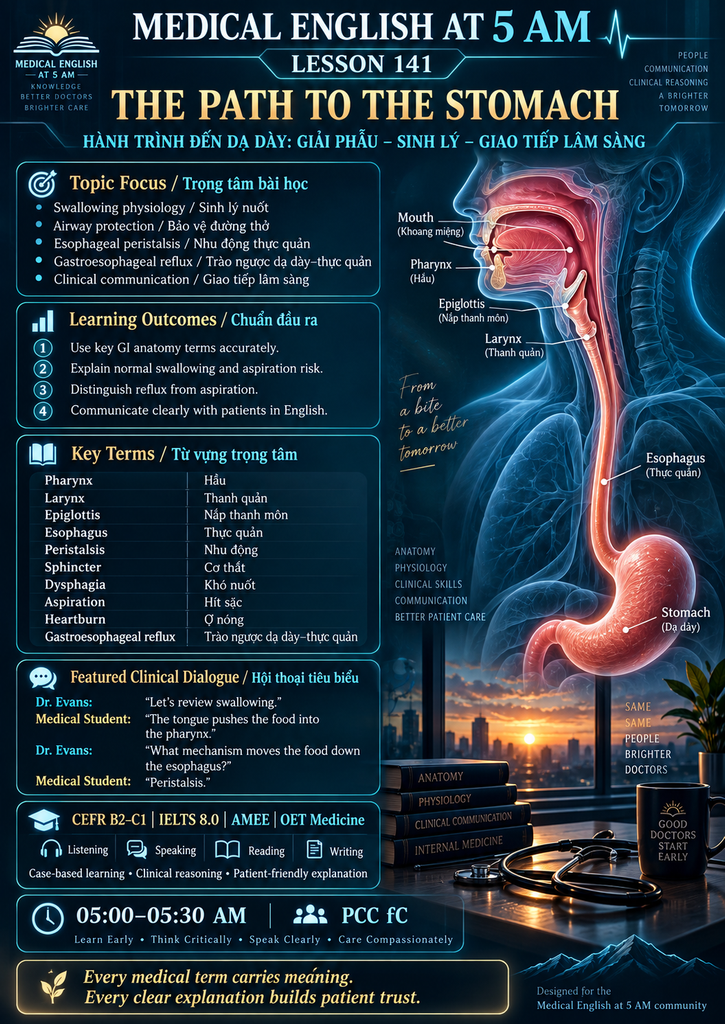
Topic: The Path to the Stomach – Understanding Swallowing, Airway Protection and Gastroesophageal Reflux.
Level: CEFR B2–C1 | IELTS 8.0-oriented | OET Medicine-inspired.
Duration: 30 minutes, 05:00–05:30 AM.
Target learners: Medical students, resident doctors, physicians, nurses and healthcare professionals.
Teaching approach: Case-based learning, outcome-based education, clinical dialogue, integrated language skills and formative assessment.
Core competencies: Medical vocabulary, pronunciation, physiological explanation, clinical reasoning, professional communication and patient education.
Source material: Gastrointestinal Medical English – The Path to the Stomach, 15-page educational document.
Teaching schedule – Phân bổ thời gian
00:00–02:00: Introduction and learning outcomes.
02:00–05:00: Clinical scenario and clinical reasoning.
05:00–10:00: Medical vocabulary and pronunciation.
10:00–14:00: Eight-turn medical dialogue.
14:00–17:00: Grammar and clinical language.
17:00–22:00: Integrated skills practice and passive listening.
22:00–27:00: OET-inspired speaking practice and clinical application.
27:00–30:00: Assessment, feedback and take-home message.
Educational philosophy: Learn the anatomy, understand the physiology, explain the pathology, and communicate with compassion.
PART 2. MEASURABLE LEARNING OUTCOMES – CHUẨN ĐẦU RA
By the end of this lesson, learners will be able to:
LO1 – Medical knowledge: Identify and accurately explain the roles of at least five anatomical structures involved in swallowing, using appropriate medical terminology.
Người học xác định và giải thích chính xác chức năng của ít nhất năm cấu trúc giải phẫu liên quan đến quá trình nuốt.
LO2 – Medical vocabulary: Correctly define and use at least 8 out of 10 target medical terms in clinically relevant sentences.
Người học giải thích đúng và vận dụng ít nhất 8/10 thuật ngữ chuyên ngành.
LO3 – Clinical communication: Perform the eight-turn clinical dialogue with intelligible pronunciation, appropriate stress and at least 80% content accuracy.
Người học thực hiện hội thoại 8 lượt nói với phát âm dễ hiểu, trọng âm phù hợp và độ chính xác nội dung tối thiểu 80%.
LO4 – Clinical reasoning: Distinguish normal swallowing, aspiration and gastroesophageal reflux by explaining at least two mechanisms and two clinically relevant consequences.
Người học phân biệt nuốt bình thường, hít sặc và trào ngược dạ dày–thực quản dựa trên cơ chế và hậu quả lâm sàng.
LO5 – Patient communication: Deliver a 45–60-second patient-friendly explanation of reflux, including one practical recommendation and a comprehension check.
Người học giải thích được cơ chế trào ngược cho người bệnh trong 45–60 giây, đưa ra ít nhất một lời khuyên phù hợp và kiểm tra lại mức độ hiểu của người bệnh.
PART 3. CLINICAL SCENARIO – TÌNH HUỐNG LÂM SÀNG
Case study: When swallowing becomes a clinical concern
A 58-year-old man is admitted following an acute ischemic stroke.
During a preliminary clinical assessment, he develops coughing and a wet-sounding voice after attempting to drink water. The medical team suspects oropharyngeal dysphagia and possible aspiration.
He also reports intermittent heartburn after large meals, particularly when lying down shortly after eating.
The team must distinguish impaired airway protection during swallowing from gastroesophageal reflux.
Because his swallowing safety has not yet been established, further oral intake is withheld pending an appropriate swallowing assessment.
Bản dịch tiếng Việt
Một bệnh nhân nam 58 tuổi nhập viện sau đột quỵ thiếu máu não cấp.
Trong quá trình đánh giá lâm sàng ban đầu, bệnh nhân xuất hiện ho và giọng ướt sau khi cố uống nước. Nhân viên y tế nghi ngờ rối loạn nuốt vùng hầu miệng và nguy cơ hít sặc.
Bệnh nhân cũng cho biết thỉnh thoảng có cảm giác nóng rát sau xương ức sau những bữa ăn lớn, đặc biệt khi nằm ngay sau ăn.
Nhóm điều trị cần phân biệt tình trạng suy giảm cơ chế bảo vệ đường thở khi nuốt với trào ngược dạ dày–thực quản.
Do chưa xác định được tính an toàn của hoạt động nuốt, bệnh nhân được tạm ngừng ăn uống qua đường miệng để chờ đánh giá nuốt phù hợp.
Clinical reasoning questions
Question 1: Which anatomical structures help protect the airway during swallowing?
Question 2: What mechanism moves swallowed material through the esophagus?
Question 3: Why might this patient cough after drinking water?
Question 4: How does gastroesophageal reflux differ from aspiration?
Essential clinical distinction
Aspiration occurs when material enters the airway below the vocal folds.
Choking refers to airway obstruction, usually caused by food or another foreign body. Aspiration may occur without complete airway obstruction and may even be silent.
Gastroesophageal reflux refers to the retrograde movement of gastric contents into the esophagus.
Clinical pearl: Coughing after swallowing suggests possible airway invasion but does not confirm aspiration. The absence of coughing does not exclude silent aspiration.
For patients with suspected post-stroke dysphagia, swallowing safety should be assessed according to the institutional stroke and dysphagia pathway before unrestricted oral intake.
PART 4. TEN ESSENTIAL MEDICAL TERMS – 10 THUẬT NGỮ Y KHOA
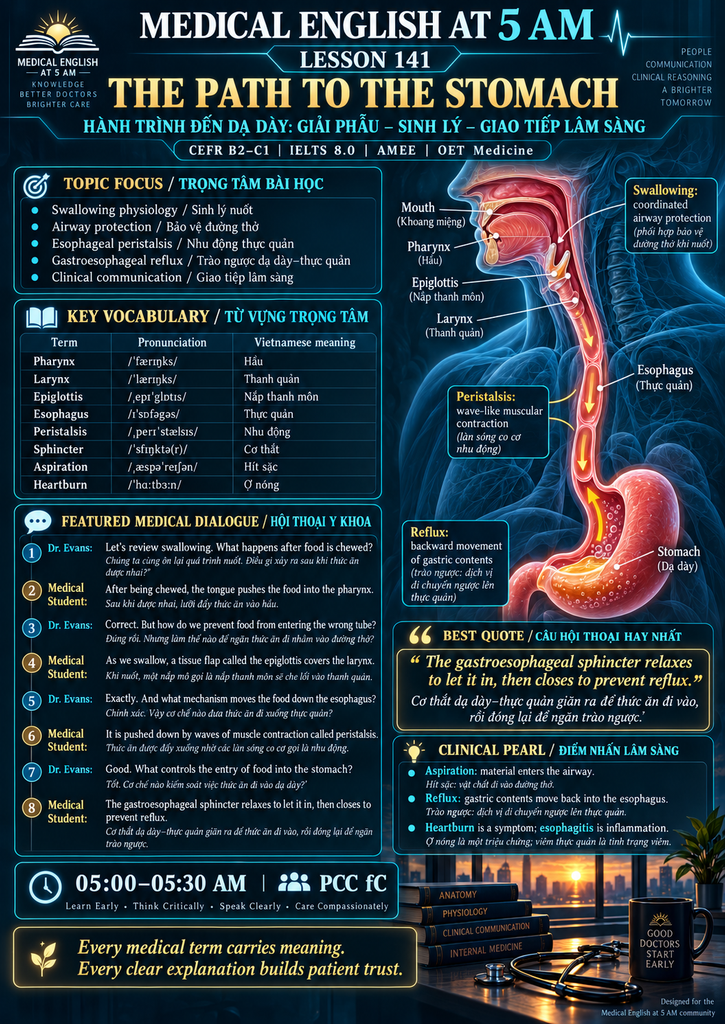
1. Pharynx /ˈfærɪŋks/
Part of speech: Noun (n.).
Vietnamese meaning: Hầu, họng.
Medical definition: A muscular passage connecting the nasal and oral cavities with the larynx and esophagus.
Example: The food bolus passes through the pharynx during swallowing.
Translation: Khối thức ăn đi qua hầu trong quá trình nuốt.
Word family: Pharyngeal (adj.), pharyngitis (n.).
2. Larynx /ˈlærɪŋks/
Part of speech: Noun (n.).
Vietnamese meaning: Thanh quản.
Medical definition: An anatomical structure involved in breathing, phonation and airway protection.
Example: The larynx elevates during the pharyngeal phase of swallowing.
Translation: Thanh quản nâng lên trong giai đoạn hầu của quá trình nuốt.
Word family: Laryngeal (adj.), laryngitis (n.).
3. Epiglottis /ˌepɪˈɡlɒtɪs/
Part of speech: Noun (n.).
Vietnamese meaning: Nắp thanh môn.
Medical definition: A flexible cartilaginous structure that contributes to airway protection during swallowing.
Example: The epiglottis inverts as part of the coordinated swallowing mechanism.
Translation: Nắp thanh môn gập xuống như một phần của cơ chế nuốt phối hợp.
Word family: Epiglottic (adj.), epiglottitis (n.).
4. Esophagus /ɪˈsɒfəɡəs/
Part of speech: Noun (n.).
Vietnamese meaning: Thực quản.
Medical definition: A muscular tube transporting swallowed material from the pharynx to the stomach.
Example: The esophagus transports food through coordinated muscular contractions.
Translation: Thực quản vận chuyển thức ăn nhờ các cơn co cơ phối hợp.
Word family: Esophageal (adj.), esophagitis (n.).
5. Peristalsis /ˌperɪˈstælsɪs/
Part of speech: Noun (n.).
Vietnamese meaning: Nhu động.
Medical definition: Coordinated waves of muscular contraction that propel contents along the gastrointestinal tract.
Example: Esophageal peristalsis moves the food bolus toward the stomach.
Translation: Nhu động thực quản đưa khối thức ăn về phía dạ dày.
Word family: Peristaltic (adj.).
6. Sphincter /ˈsfɪŋktə(r)/
Part of speech: Noun (n.).
Vietnamese meaning: Cơ thắt.
Medical definition: A ring-shaped or functionally organized muscular mechanism that regulates passage between anatomical regions.
Example: The lower esophageal sphincter helps prevent gastric reflux.
Translation: Cơ thắt thực quản dưới giúp ngăn ngừa trào ngược dịch dạ dày.
Word family: Sphincteric (adj.).
7. Gastroesophageal /ˌɡæstrəʊɪˌsɒfəˈdʒiːəl/
Part of speech: Adjective (adj.).
Vietnamese meaning: Thuộc dạ dày – thực quản.
Medical definition: Relating to both the stomach and the esophagus.
Example: Gastroesophageal reflux may cause a burning sensation behind the sternum.
Translation: Trào ngược dạ dày–thực quản có thể gây cảm giác nóng rát sau xương ức.
Word analysis: Gastr/o (stomach) + esophage/o (esophagus) + -al (pertaining to).
8. Dysphagia /dɪsˈfeɪdʒə/
Part of speech: Noun (n.).
Vietnamese meaning: Khó nuốt, rối loạn nuốt.
Medical definition: Difficulty or impairment in swallowing.
Example: Post-stroke dysphagia increases the risk of aspiration.
Translation: Rối loạn nuốt sau đột quỵ làm tăng nguy cơ hít sặc.
Word analysis: Dys- (abnormal or difficult) + -phagia (swallowing/eating).
9. Aspiration /ˌæspəˈreɪʃən/
Part of speech: Noun (n.).
Vietnamese meaning: Hít sặc; sự xâm nhập của chất vào đường thở dưới dây thanh.
Medical definition: Entry of material into the airway below the level of the vocal folds.
Example: Silent aspiration may occur without coughing.
Translation: Hít sặc thầm lặng có thể xảy ra mà không xuất hiện ho.
Word family: Aspirate (v.), aspirated (adj.).
Clinical language note: In another clinical context, aspiration may mean suction or withdrawal of fluid using a needle.
10. Heartburn /ˈhɑːtbɜːn/
Part of speech: Noun (n.).
Vietnamese meaning: Chứng ợ nóng, cảm giác nóng rát sau xương ức.
Medical definition: A burning sensation typically experienced behind the sternum, commonly associated with gastroesophageal reflux.
Example: The patient experiences heartburn after eating a large meal.
Translation: Bệnh nhân xuất hiện cảm giác nóng rát sau xương ức sau một bữa ăn lớn.
Related medical terms: Gastroesophageal reflux, reflux esophagitis, acid regurgitation.
Vocabulary challenge
Explain these differences in English:
Pharynx versus larynx.
Aspiration versus choking.
Heartburn versus esophagitis.
Advanced language principle: Medical terminology describes anatomical structures, physiological processes and diseases with precision. Patient-friendly language translates these concepts into understandable experiences.
PART 5. EIGHT-TURN MEDICAL DIALOGUE – HỘI THOẠI Y KHOA SONG NGỮ
Title: The Pre-Round Briefing – Understanding Swallowing
Characters: Dr. Evans and a Medical Student.
Context: A clinical teaching conversation reviewing normal swallowing physiology.
The English dialogue below is preserved from the original document. Vietnamese translations are provided for learning purposes.
Turn 1 – Dr. Evans
English: Let’s review swallowing. What happens after food is chewed?
Vietnamese: Chúng ta cùng ôn lại quá trình nuốt. Điều gì xảy ra sau khi thức ăn được nhai?
Turn 2 – Medical Student
English: After being chewed, the tongue pushes the food into the pharynx.
Vietnamese: Sau khi được nhai, lưỡi đẩy thức ăn vào hầu.
Turn 3 – Dr. Evans
English: Correct. But how do we prevent food from entering the wrong tube?
Vietnamese: Chính xác. Nhưng bằng cách nào cơ thể ngăn thức ăn đi nhầm vào đường thở?
Turn 4 – Medical Student
English: As we swallow, a tissue flap called the epiglottis covers the larynx.
Vietnamese: Khi chúng ta nuốt, một cấu trúc dạng nắp gọi là nắp thanh môn góp phần che chắn lối vào thanh quản.
Turn 5 – Dr. Evans
English: Exactly. And what mechanism moves the food down the esophagus?
Vietnamese: Đúng vậy. Vậy cơ chế nào đưa thức ăn di chuyển xuống thực quản?
Turn 6 – Medical Student
English: It is pushed down by waves of muscle contraction called peristalsis.
Vietnamese: Thức ăn được đẩy xuống nhờ các làn sóng co cơ gọi là nhu động.
Turn 7 – Dr. Evans
English: Good. What controls the entry of food into the stomach?
Vietnamese: Tốt. Cơ chế nào kiểm soát việc thức ăn đi vào dạ dày?
Turn 8 – Medical Student
English: The gastroesophageal sphincter relaxes to let it in, then closes to prevent reflux.
Vietnamese: Cơ chế cơ thắt ở chỗ nối dạ dày–thực quản giãn ra để thức ăn đi vào, sau đó đóng lại nhằm hạn chế trào ngược.
Clinical accuracy – Important clarification
The original dialogue provides a useful simplified explanation of swallowing.
However, airway protection involves several coordinated mechanisms, including vocal fold closure, laryngeal vestibule closure, hyolaryngeal movement and epiglottic inversion.
The epiglottis does not function as an isolated mechanical lid.
Furthermore, food enters the esophagus through the upper esophageal sphincter, whereas passage into the stomach is regulated primarily by the lower esophageal sphincter and the surrounding esophagogastric junction.
Advanced clinical wording – C1 model
During swallowing, coordinated pharyngeal contractions and laryngeal closure mechanisms protect the airway, while esophageal peristalsis propels the bolus toward the stomach.
Dịch: Trong quá trình nuốt, các cơn co cơ hầu phối hợp với cơ chế đóng thanh quản giúp bảo vệ đường thở, trong khi nhu động thực quản đẩy khối thức ăn về phía dạ dày.
Speaking practice
Round 1: Read the dialogue slowly with accurate pronunciation.
Round 2: Read at a natural clinical conversation speed.
Round 3: Close the text and explain the pathway from the pharynx to the stomach.
Communication goal: Move from memorizing individual sentences to understanding and explaining the underlying mechanism.
PART 6. PRONUNCIATION FOCUS – TRỌNG TÂM PHÁT ÂM
A. Word stress – Trọng âm từ
PHAR-ynx: /ˈfærɪŋks/ – trọng âm âm tiết thứ nhất.
LAR-ynx: /ˈlærɪŋks/ – trọng âm âm tiết thứ nhất.
e-pi-GLOT-tis: /ˌepɪˈɡlɒtɪs/ – trọng âm chính âm tiết thứ ba.
e-SO-pha-gus: /ɪˈsɒfəɡəs/ – trọng âm âm tiết thứ hai.
peri-STAL-sis: /ˌperɪˈstælsɪs/ – trọng âm chính âm tiết thứ ba.
as-pi-RA-tion: /ˌæspəˈreɪʃən/ – trọng âm chính âm tiết thứ ba.
B. Difficult consonant clusters
Pharynx – /ŋks/
Practice the final consonant cluster without adding an extra vowel.
Sphincter – /sf/
Maintain the initial /s/ followed immediately by /f/.
Swallowing – /sw/
Produce the /s/ and /w/ smoothly without inserting a vowel.
C. Sentence stress and rhythm
Practice sentence 1:
“What HAPPENS after FOOD is CHEWED?”
Emphasize HAPPENS, FOOD and CHEWED.
Practice sentence 2:
“The GASTROESOPHAGEAL SPHINCTER RELAXES to LET it IN.”
Emphasize the anatomical structure, action and functional outcome.
Practice sentence 3:
“It is PUSHED DOWN by WAVES of MUSCLE CONTRACTION called PERISTALSIS.”
Emphasize the process and mechanism rather than every grammatical word.
D. Intonation
Use falling intonation for most WH-questions:
“What happens after food is chewed?” ↘
“What controls the entry of food into the stomach?” ↘
Use gentle rising intonation for supportive clarification:
“Does that make sense?” ↗
E. Shadowing practice
Listen to one complete sentence, repeat immediately, then reproduce it without looking at the text.
Focus on intelligibility, word stress, rhythm and natural phrasing rather than imitating an accent perfectly.
PART 7. GRAMMAR IN CLINICAL COMMUNICATION – HAI CẤU TRÚC NGỮ PHÁP
Grammar 1. The Passive Voice – Câu bị động trong mô tả sinh lý
Structure: Subject + be + past participle (V3).
The passive voice is frequently used in scientific and medical English when the process or result is more important than the person or structure performing the action.
Example 1:
Food is chewed before it is swallowed.
Thức ăn được nhai trước khi được nuốt.
Example 2:
The bolus is propelled through the esophagus by coordinated muscular contractions.
Khối thức ăn được đẩy qua thực quản nhờ các cơn co cơ phối hợp.
Example 3:
Airway protection is maintained by several coordinated mechanisms.
Sự bảo vệ đường thở được duy trì nhờ nhiều cơ chế phối hợp.
Advanced form: Reduced passive clause
Original: After the food has been chewed, it enters the pharynx.
Reduced: After being chewed, the food enters the pharynx.
IELTS 8.0 application:
The passive voice enables precise descriptions of physiological mechanisms without unnecessary repetition of the agent.
Clinical writing task:
Transform into the passive voice:
“Coordinated muscular contractions propel the bolus toward the stomach.”
Grammar 2. Conditional Sentences – Câu điều kiện trong tư duy lâm sàng
Structure: If + present simple, subject + may/can/will + base verb.
Conditional structures explain relationships between physiological disturbances and potential clinical consequences.
Example 1:
If airway protection is impaired, food or liquid may enter the respiratory tract.
Nếu cơ chế bảo vệ đường thở bị suy giảm, thức ăn hoặc chất lỏng có thể đi vào đường hô hấp.
Example 2:
If the lower esophageal sphincter relaxes inappropriately, gastric contents may reflux into the esophagus.
Nếu cơ thắt thực quản dưới giãn không phù hợp, dịch dạ dày có thể trào ngược lên thực quản.
Example 3:
If a patient develops dysphagia after a stroke, swallowing safety must be assessed before unrestricted oral intake.
Nếu người bệnh xuất hiện rối loạn nuốt sau đột quỵ, cần đánh giá tính an toàn của hoạt động nuốt trước khi cho ăn uống không hạn chế.
Advanced distinction: Cause versus possibility
“If aspiration occurs, pneumonia will develop.”
This sentence is medically inaccurate because aspiration does not inevitably cause pneumonia.
Preferred wording:
“If aspiration occurs, the risk of pulmonary complications may increase.”
Dịch: Nếu xảy ra hít sặc, nguy cơ biến chứng phổi có thể tăng lên.
Academic writing principle: Use may, might, can and is associated with when the relationship is probabilistic rather than inevitable.
Clinical grammar challenge:
Complete the sentence:
“If the lower esophageal sphincter fails to maintain an adequate barrier, gastric contents ______ flow back into the esophagus.”
PART 8. INTEGRATED SKILLS PRACTICE – LUYỆN NGHE, NÓI, ĐỌC, VIẾT
A. Listening – Luyện nghe
Task 1: Listen to the original eight-turn dialogue without reading the transcript.
Identify the anatomical structures mentioned.
Task 2: Listen again and arrange these mechanisms in their physiological order:
Esophageal peristalsis – Oral bolus preparation – Gastric entry – Pharyngeal swallowing – Airway protection.
Task 3: Listen to the following three-minute passive listening passage.
THREE-MINUTE PASSIVE LISTENING
Title: From Swallowing to the Stomach: A Journey of Coordination and Protection
Level: CEFR B2–C1.
Duration: Approximately 3 minutes at a clear, moderate speaking pace.
Learning focus: Anatomical terminology, passive voice, conditional sentences, physiological mechanisms and clinical reasoning.
English listening script
Every time we swallow, our body performs a remarkably complex sequence of coordinated movements.
Most people rarely think about swallowing. However, for clinicians, understanding this process is essential, especially when assessing patients with neurological disorders, swallowing difficulties, or suspected aspiration.
The journey begins in the mouth, where food is broken down by chewing and mixed with saliva. The tongue then forms the food into a bolus and pushes it toward the pharynx.
As swallowing begins, the soft palate elevates to help prevent food from entering the nasal cavity.
At the same time, several mechanisms work together to protect the airway. The larynx moves upward and forward, the vocal folds close, and the epiglottis inverts as part of the coordinated swallowing sequence.
These movements help direct the bolus toward the esophagus instead of the respiratory tract.
If airway protection becomes impaired, food or liquid may enter the laryngeal vestibule or pass below the vocal folds into the trachea. This is known as aspiration.
Aspiration may cause coughing, but some patients aspirate silently without an obvious protective response.
This is particularly important in patients recovering from a stroke, those with neurological disease, and individuals with reduced consciousness.
Once the bolus enters the esophagus, it is transported toward the stomach by coordinated waves of muscular contraction called peristalsis.
At the lower end of the esophagus, the lower esophageal sphincter relaxes to allow the bolus to enter the stomach.
Together with the surrounding structures, this sphincter also helps maintain a barrier against reflux.
However, if the barrier becomes ineffective, gastric contents may move backward into the esophagus.
Patients may then experience heartburn, acid regurgitation, or other symptoms associated with gastroesophageal reflux disease.
It is important to distinguish these symptoms from swallowing disorders because their mechanisms, investigations, and management strategies differ.
For example, coughing during swallowing raises concern about possible aspiration, whereas burning behind the breastbone after meals may suggest acid reflux.
Neither symptom should be interpreted in isolation.
Clinicians must consider the patient’s history, examination findings, relevant risk factors, and warning signs before reaching a diagnosis.
When explaining these conditions to patients, healthcare professionals should avoid unnecessarily complex terminology.
Instead of saying, “You have an incompetent gastroesophageal junction,” we might explain, “The valve between your food pipe and stomach is not always preventing stomach contents from flowing backward.”
Clear communication allows patients to understand what is happening inside their bodies and why certain recommendations are important.
Ultimately, effective medical practice requires more than memorizing anatomical structures or recognizing medical terms.
It requires connecting anatomy with physiology, physiology with clinical reasoning, and clinical reasoning with compassionate communication.
Understanding how the body works helps us explain what happens when it does not.
B. Speaking – Luyện nói theo định hướng OET Medicine
Role-play scenario:
A 45-year-old patient reports frequent heartburn after large evening meals.
Doctor’s tasks:
Establish rapport.
Ask about symptom timing and potential triggers.
Explain the role of the lower esophageal sphincter in accessible language.
Offer one evidence-based lifestyle recommendation.
Check the patient’s understanding.
Model response:
“I understand that the burning sensation after meals has been uncomfortable. One possible explanation is acid reflux. Normally, a muscular valve between your food pipe and stomach helps prevent stomach contents from flowing backward. When this barrier is less effective, acid can move into the food pipe and cause irritation. Avoiding meals within three hours of bedtime may help. Could you tell me, in your own words, what you understand about the cause of your symptoms?”
Communication analysis:
“I understand…” demonstrates empathy.
“One possible explanation…” avoids premature diagnostic certainty.
“A muscular valve…” replaces complex terminology with accessible language.
“Could you tell me, in your own words…” checks understanding using a teach-back approach.
Clinical safety note: New, severe or concerning chest discomfort requires appropriate assessment for cardiac and other serious causes before being attributed to reflux.
C. Reading – Đọc hiểu lâm sàng
Reading passage:
Swallowing is a coordinated sensorimotor process that involves multiple anatomical structures. During the pharyngeal phase, airway closure and bolus propulsion must occur in a precisely coordinated sequence. Impairment of these mechanisms may lead to penetration, aspiration, or pharyngeal residue.
Esophageal transport depends on effective peristalsis and appropriate sphincter function. Gastroesophageal reflux occurs when stomach contents move backward into the esophagus. Although occasional reflux can be physiological, persistent troublesome symptoms or complications may indicate gastroesophageal reflux disease.
Reading comprehension questions:
- Why is coordination essential during the pharyngeal phase?
- What physiological mechanism transports the bolus through the esophagus?
- Can occasional gastroesophageal reflux occur without GERD?
- What is the difference between laryngeal penetration and aspiration?
D. Writing – Viết tiếng Anh y khoa
Task: Write a 50–70-word clinical explanation describing normal swallowing and one possible complication.
Model answer:
“Normal swallowing requires coordinated movements of the tongue, pharynx, and larynx. During the pharyngeal phase, several protective mechanisms help prevent food and liquid from entering the airway. Esophageal peristalsis then transports the bolus toward the stomach. If airway protection is impaired, aspiration may occur, potentially increasing the risk of respiratory complications. Early recognition of swallowing dysfunction is therefore important in clinical practice.”
Writing checklist:
Use accurate anatomical terminology.
Include at least one passive construction.
Include at least one conditional relationship.
Maintain scientific precision.
Avoid absolute statements when the evidence supports only a possibility.
PART 9. ASSESSMENT, ANSWER KEY AND FEEDBACK – KIỂM TRA, ĐÁP ÁN VÀ PHẢN HỒI
A. Quick knowledge assessment – 5 questions
Question 1 – Anatomy
Which structure connects the pharynx to the stomach?
A. Trachea.
B. Esophagus.
C. Larynx.
D. Epiglottis.
Question 2 – Physiology
What primarily propels food through the esophagus?
A. Gravity alone.
B. Peristaltic contractions.
C. Vocal fold closure.
D. Gastric acid secretion.
Question 3 – Airway protection
Which statement is most accurate?
A. The epiglottis alone prevents aspiration.
B. Airway protection depends on coordinated movements involving several structures.
C. Aspiration always causes coughing.
D. The lower esophageal sphincter protects the trachea during swallowing.
Question 4 – Grammar
Choose the correct passive sentence.
A. The bolus pushes by muscle contractions.
B. The bolus is propelled by muscle contractions.
C. The bolus are propelled by muscle contractions.
D. The bolus is propel by muscle contractions.
Question 5 – Clinical communication
Which statement is most appropriate when explaining reflux to a patient?
A. Your gastroesophageal junction is incompetent.
B. You definitely have severe reflux disease.
C. The valve between your food pipe and stomach may not always prevent stomach contents from moving backward.
D. All chest discomfort is caused by stomach acid.
B. Answer key – Đáp án
Question 1: B – Esophagus.
The esophagus transports swallowed material from the pharynx toward the stomach.
Question 2: B – Peristaltic contractions.
Peristalsis is the principal mechanism of esophageal bolus propulsion.
Question 3: B – Coordinated airway protection.
Airway protection is achieved through several integrated physiological movements.
Question 4: B – The bolus is propelled by muscle contractions.
Correct passive structure: Subject + be + past participle.
Question 5: C – Patient-friendly explanation.
This response combines understandable language with appropriate diagnostic uncertainty.
C. Answers to clinical and language exercises
Clinical scenario:
- Airway protection: Vocal folds, laryngeal vestibule, epiglottis and coordinated hyolaryngeal movements.
- Bolus transport: Esophageal peristalsis.
- Coughing after swallowing: Possible airway penetration or aspiration; further assessment is required.
- Aspiration involves entry into the airway below the vocal folds; reflux involves retrograde movement of stomach contents into the esophagus.
Vocabulary challenge:
Pharynx: Shared passage involved in swallowing and respiration.
Larynx: Airway structure involved in phonation and airway protection.
Aspiration: Material entering below the vocal folds.
Choking: Mechanical airway obstruction.
Heartburn: A symptom.
Esophagitis: Inflammation of the esophageal mucosa.
Grammar exercise 1:
“The bolus is propelled toward the stomach by coordinated muscular contractions.”
Grammar exercise 2:
“If the lower esophageal sphincter fails to maintain an adequate barrier, gastric contents may flow back into the esophagus.”
Reading answers:
- Coordination ensures effective bolus transport while maintaining airway protection.
- Coordinated peristaltic contractions.
- Yes. Occasional physiological reflux does not necessarily indicate GERD.
- Laryngeal penetration involves entry into the laryngeal vestibule without passing below the vocal folds; aspiration involves passage below the vocal folds.
D. Speaking performance assessment – 10 points
Medical accuracy – 2 points: Correct anatomy and pathophysiology.
Pronunciation and intelligibility – 2 points: Clear speech, appropriate word stress and comprehensible rhythm.
Fluency and grammatical accuracy – 2 points: Coherent explanation with appropriate grammatical structures.
Patient-centered communication – 2 points: Empathy, accessible language and clear organization.
Clinical reasoning and comprehension check – 2 points: Appropriate uncertainty, practical advice and verification of understanding.
E. Interpretation and formative feedback
9–10 points: Excellent. Clear, clinically accurate and professional communication.
7–8 points: Good. Core competencies achieved, with minor areas for improvement.
5–6 points: Developing. Additional practice needed in language accuracy or clinical explanation.
Below 5 points: Further support required. Repeat essential vocabulary, guided dialogue and structured patient explanation.
This is a locally designed formative rubric, not an official IELTS or OET scoring system. An excellent classroom score does not itself establish IELTS Band 8.0 or a particular OET grade.
F. Reflective feedback – Tự đánh giá
After the lesson, learners should answer:
- What new medical expression did I learn today?
- Which pronunciation feature requires more practice?
- Can I explain the difference between aspiration and reflux without looking at my notes?
- Could a patient without medical training understand my explanation?
The most meaningful evidence of learning is the ability to apply knowledge accurately, not merely recall it.
PART 10. EVIDENCE-BASED MEDICAL UPDATES AND KEY REFERENCES – CẬP NHẬT Y KHOA VÀ TÀI LIỆU THAM KHẢO
A. Swallowing and aspiration – Nuốt và hít sặc
Modern swallowing assessment emphasizes coordinated laryngeal vestibule closure, vocal fold closure, epiglottic movement and effective bolus clearance.
Important terminology:
Laryngeal penetration: Material enters the laryngeal vestibule but remains above the vocal folds.
Aspiration: Material passes below the vocal folds.
Silent aspiration: Aspiration without an overt protective response, such as coughing.
Videofluoroscopic Swallow Study (VFSS): An instrumental assessment providing dynamic visualization of swallowing using fluoroscopy.
Fiberoptic Endoscopic Evaluation of Swallowing (FEES): An endoscopic assessment of pharyngeal swallowing and airway protection.
Clinical implication: Suspected dysphagia, particularly following stroke, requires structured assessment. Bedside clinical examination cannot reliably exclude silent aspiration.
Reference: American Speech-Language-Hearing Association (ASHA), Adult Dysphagia and Videofluoroscopic Swallow Study resources.
B. Gastroesophageal reflux disease – GERD
GERD may present with heartburn and regurgitation. Diagnosis and management depend on symptom characteristics, warning signs, clinical context and, when indicated, objective testing.
Evidence-based recommendations:
Avoid meals within approximately three hours of bedtime.
Consider weight loss in patients with overweight or obesity.
Elevating the head of the bed may help patients with nocturnal reflux symptoms.
Identify and minimize foods that consistently provoke symptoms rather than imposing unnecessary universal restrictions.
Proton pump inhibitors remain important treatment options for appropriately selected patients, particularly those with erosive esophagitis.
Dysphagia, gastrointestinal bleeding and unexplained weight loss are warning features warranting further assessment.
Clinical caution: A sensation of chest burning does not establish GERD, and potentially cardiac chest pain must not be overlooked.
References: ACG Clinical Guideline for Diagnosis and Management of Gastroesophageal Reflux Disease (2022); ASGE Guideline on the Diagnosis and Management of GERD (2025).
C. Medical education – AMEE principles
This lesson incorporates:
Outcome-based education: Define what learners must demonstrate before selecting content.
Constructive alignment: Match learning outcomes with teaching activities and assessment methods.
Active learning: Apply terminology through explanation, dialogue, role-play and reasoning.
Formative feedback: Identify mistakes early and provide actionable guidance for improvement.
Reflection: Encourage learners to recognize both progress and remaining learning needs.
Reference: Association for Medical Education in Europe (AMEE), Designing and Planning Learning; AMEE guides on outcome-based education and assessment.
D. OET Medicine-inspired clinical communication
Professional healthcare communication requires more than complex vocabulary.
A clinically effective explanation should:
Establish rapport and recognize patient concerns.
Use clear, structured and understandable language.
Adapt technical terminology to the patient’s level of understanding.
Explain mechanisms without unnecessary jargon.
Avoid unsupported certainty.
Check understanding and invite further questions.
This lesson uses OET-inspired communication principles but is not an official OET preparation module or examination.
E. IELTS 8.0-oriented academic language
Learners should aim for:
Precise vocabulary rather than unnecessary complexity.
Accurate and flexible grammatical structures.
Appropriate use of hedging and uncertainty.
Logical progression from mechanism to clinical consequence.
Fluent speech with intelligible pronunciation.
Professional, context-appropriate register.
IELTS Band 8.0 represents an advanced level of English performance. This lesson provides relevant practice but does not replace full IELTS examination preparation.
F. Core reference list
- American Speech-Language-Hearing Association (ASHA). Adult Dysphagia. Practice Portal. https://www.asha.org/practice-portal/clinical-topics/adult-dysphagia/
- ASHA. Videofluoroscopic Swallow Study (VFSS). https://www.asha.org/practice-portal/resources/videofluoroscopic-swallow-study/
- Katz PO, et al. ACG Clinical Guideline for the Diagnosis and Management of Gastroesophageal Reflux Disease. American Journal of Gastroenterology. 2022;117:27–56. https://doi.org/10.14309/ajg.0000000000001538
- American Society for Gastrointestinal Endoscopy (ASGE). Guideline on the Diagnosis and Management of GERD. 2025. https://www.asge.org/
- Association for Medical Education in Europe (AMEE). Designing and Planning Learning. https://amee.org/education/courses/designing-and-planning-learning/
- Occupational English Test (OET). Medicine Speaking Role-play and Preparation Resources. https://oet.com/
- Original learning material: Gastrointestinal Medical English – The Path to the Stomach, 15-page document supplied for Lesson 141.
Evidence note: The source document provides the core dialogue, terminology and pedagogical theme. Additional clinical explanations reflect the professional references above. The case study, listening passage, exercises and assessment materials were developed for this lesson.
FINAL TAKE-HOME MESSAGE – THÔNG ĐIỆP GIÁO DỤC
“Every medical term carries a meaning. Every physiological mechanism tells a story. And every clear explanation builds a bridge between medical knowledge and patient trust.”
Mỗi thuật ngữ y khoa đều mang một ý nghĩa. Mỗi cơ chế sinh lý đều kể một câu chuyện. Và mỗi lời giải thích rõ ràng đều xây dựng một cây cầu nối giữa tri thức y học và niềm tin của người bệnh.
Learning Medical English is not simply about speaking another language. It is about thinking more precisely, communicating more effectively, and caring for patients more thoughtfully.
Học tiếng Anh y khoa không chỉ là học cách sử dụng một ngôn ngữ khác. Đó là hành trình rèn luyện tư duy chính xác hơn, giao tiếp hiệu quả hơn và chăm sóc người bệnh tận tâm hơn.
PCC fC – MEDICAL ENGLISH AT 5 AM
Learn Early. Think Critically. Speak Clearly. Care Compassionately.
Dậy sớm để học tập – Tư duy khoa học – Giao tiếp chuyên nghiệp – Chăm sóc bằng sự thấu cảm.
Lesson 141 – The Path to the Stomach
See you at 5 AM!
Bài 141 – TIẾNG ANH Y KHOA 5H: From Swallowing to the Stomach A Journey of Coordination & Protection
LESSON 141 – THE PATH TO THE STOMACH
HÀNH TRÌNH ĐẾN DẠ DÀY: TỪ SINH LÝ NUỐT ĐẾN GIAO TIẾP LÂM SÀNG
TIẾNG TRUNG TINH TẾ – ELEGANT CHINESE – 优雅汉语
TIẾNG NHẬT THỰC HÀNH – PRACTICAL JAPANESE – 実践日本語
Bài học tích hợp: Medical English at 5 AM – Lesson 141.
Định hướng: HSK 3–4 | JLPT N4–N3 | PCC fC 2026.
Chủ đề: Giải phẫu đường tiêu hóa trên, quá trình nuốt, bảo vệ đường thở, nhu động thực quản, hít sặc và trào ngược dạ dày–thực quản.
Mục tiêu: Học từ vựng cốt lõi, diễn đạt những cơ chế sinh lý đơn giản, đặt câu hỏi về triệu chứng và giao tiếp lịch sự, dễ hiểu với người bệnh.
Phương pháp: Học từ – Hiểu nghĩa – Luyện âm – Đặt câu – Hội thoại – Vận dụng.
Lưu ý trình độ: Các mẫu câu giao tiếp và ngữ pháp được xây dựng chủ yếu ở mức HSK 3–4 và JLPT N4–N3. Một số thuật ngữ giải phẫu, bệnh lý chuyên sâu vượt khỏi danh mục từ vựng thông thường của các cấp độ này và được bổ sung nhằm phục vụ tiếng Trung, tiếng Nhật y khoa.
PHẦN A. TIẾNG TRUNG TINH TẾ – ELEGANT CHINESE
优雅汉语:从吞咽到胃部
Yōuyǎ Hànyǔ: Cóng tūnyàn dào wèibù
Tiếng Trung tinh tế: Từ quá trình nuốt đến dạ dày
1. TEN KEY VOCABULARY ITEMS – 10 TỪ VỰNG TRỌNG TÂM
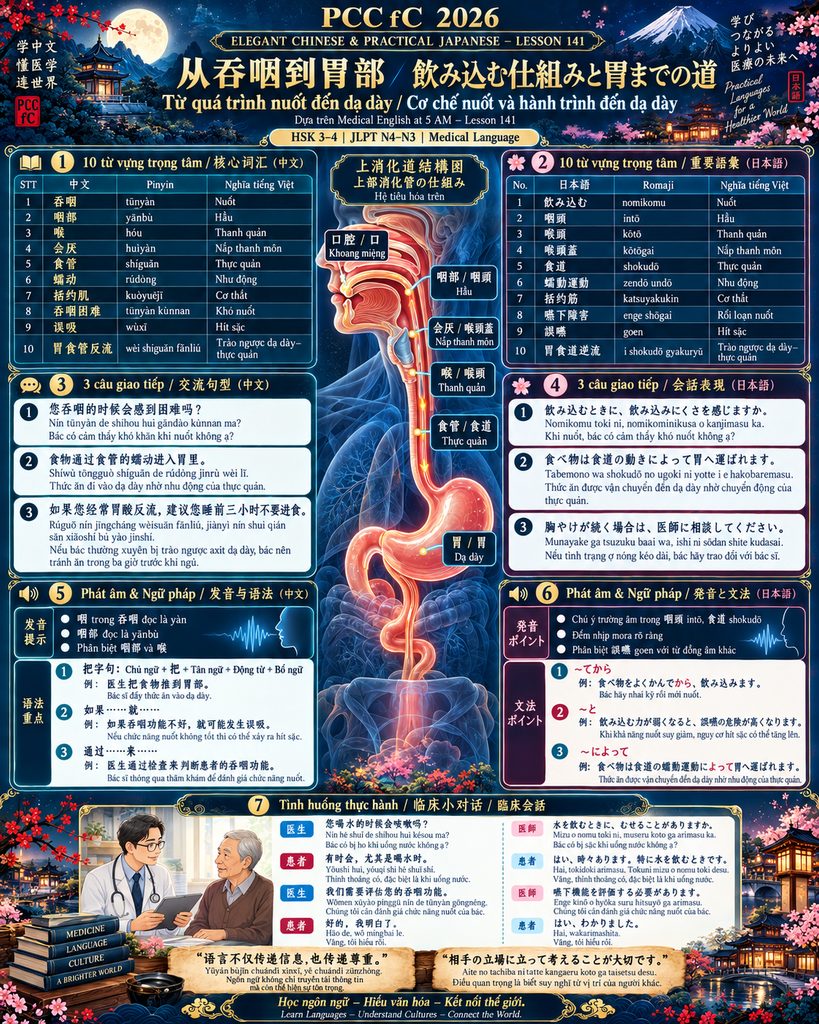
01. 吞咽 – tūnyàn
Âm Hán Việt: Thôn yết.
Nghĩa: Nuốt, động tác nuốt.
Ví dụ: 吞咽时,呼吸道需要受到保护。
Pinyin: Tūnyàn shí, hūxīdào xūyào shòudào bǎohù.
Dịch: Khi nuốt, đường hô hấp cần được bảo vệ.
Ghi nhớ: 吞 là nuốt; 咽 liên quan đến động tác nuốt hoặc vùng hầu.
02. 咽部 – yānbù
Âm Hán Việt: Yết bộ.
Nghĩa: Vùng hầu, họng.
Ví dụ: 食物从口腔进入咽部。
Pinyin: Shíwù cóng kǒuqiāng jìnrù yānbù.
Dịch: Thức ăn từ khoang miệng đi vào vùng hầu.
Ghi nhớ: 咽 được đọc là yān khi chỉ hầu; trong 吞咽, chữ 咽 đọc là yàn.
03. 喉 – hóu
Âm Hán Việt: Hầu.
Nghĩa: Thanh quản trong ngữ cảnh giải phẫu; 喉部 là vùng thanh quản.
Ví dụ: 喉在呼吸和发声中起重要作用。
Pinyin: Hóu zài hūxī hé fāshēng zhōng qǐ zhòngyào zuòyòng.
Dịch: Thanh quản đóng vai trò quan trọng trong hô hấp và phát âm.
Lưu ý: 咽 và 喉 chỉ hai cấu trúc giải phẫu khác nhau, tương ứng với pharynx và larynx.
04. 会厌 – huìyàn
Âm Hán Việt: Hội yếm.
Nghĩa: Nắp thanh môn.
Ví dụ: 吞咽时,会厌帮助保护呼吸道。
Pinyin: Tūnyàn shí, huìyàn bāngzhù bǎohù hūxīdào.
Dịch: Khi nuốt, nắp thanh môn góp phần bảo vệ đường hô hấp.
Ghi nhớ: Đây là một thành phần trong cơ chế bảo vệ đường thở phối hợp, không phải cấu trúc duy nhất ngăn hít sặc.
05. 食管 – shíguǎn
Âm Hán Việt: Thực quản.
Nghĩa: Thực quản.
Ví dụ: 食管把食物送到胃里。
Pinyin: Shíguǎn bǎ shíwù sòng dào wèi lǐ.
Dịch: Thực quản đưa thức ăn đến dạ dày.
06. 蠕动 – rúdòng
Âm Hán Việt: Nhuyễn động.
Nghĩa: Nhu động.
Ví dụ: 食管通过蠕动将食物送入胃中。
Pinyin: Shíguǎn tōngguò rúdòng jiāng shíwù sòng rù wèi zhōng.
Dịch: Thực quản thông qua nhu động đưa thức ăn vào dạ dày.
07. 括约肌 – kuòyuējī
Âm Hán Việt: Quát ước cơ.
Nghĩa: Cơ thắt.
Ví dụ: 食管下括约肌有助于防止胃内容物反流。
Pinyin: Shíguǎn xià kuòyuējī yǒuzhù yú fángzhǐ wèi nèiróngwù fǎnliú.
Dịch: Cơ thắt thực quản dưới giúp ngăn các chất trong dạ dày trào ngược.
08. 吞咽困难 – tūnyàn kùnnan
Âm Hán Việt: Thôn yết khốn nan.
Nghĩa: Khó nuốt, rối loạn nuốt.
Ví dụ: 中风后,有些患者会出现吞咽困难。
Pinyin: Zhòngfēng hòu, yǒuxiē huànzhě huì chūxiàn tūnyàn kùnnan.
Dịch: Sau đột quỵ, một số người bệnh có thể xuất hiện khó nuốt.
09. 误吸 – wùxī
Âm Hán Việt: Ngộ hấp.
Nghĩa: Hít sặc, đưa nhầm chất vào đường thở dưới dây thanh.
Ví dụ: 吞咽功能异常可能增加误吸的风险。
Pinyin: Tūnyàn gōngnéng yìcháng kěnéng zēngjiā wùxī de fēngxiǎn.
Dịch: Rối loạn chức năng nuốt có thể làm tăng nguy cơ hít sặc.
10. 胃食管反流 – wèi shíguǎn fǎnliú
Âm Hán Việt: Vị thực quản phản lưu.
Nghĩa: Trào ngược dạ dày–thực quản.
Ví dụ: 胃食管反流可能引起烧心。
Pinyin: Wèi shíguǎn fǎnliú kěnéng yǐnqǐ shāoxīn.
Dịch: Trào ngược dạ dày–thực quản có thể gây chứng ợ nóng.
Từ bổ sung: 烧心 – shāoxīn – cảm giác nóng rát sau xương ức, ợ nóng.
Mẹo ghi nhớ: 吞咽 → 咽部 → 食管 → 胃: Nuốt → Hầu → Thực quản → Dạ dày.
2. THREE ESSENTIAL COMMUNICATION SENTENCES – 3 CÂU GIAO TIẾP
Sentence 1 – Hỏi triệu chứng
中文: 您吞咽的时候会感到困难吗?
Pinyin: Nín tūnyàn de shíhou huì gǎndào kùnnan ma?
Tiếng Việt: Bác có cảm thấy khó khăn khi nuốt không ạ?
Ứng dụng: Hỏi bệnh sử rối loạn nuốt.
Sentence 2 – Giải thích cơ chế sinh lý
中文: 食物通过食管的蠕动进入胃里。
Pinyin: Shíwù tōngguò shíguǎn de rúdòng jìnrù wèi lǐ.
Tiếng Việt: Thức ăn đi vào dạ dày nhờ nhu động của thực quản.
Ứng dụng: Giải thích chức năng vận chuyển thức ăn.
Sentence 3 – Lời khuyên sức khỏe
中文: 如果您经常胃酸反流,建议您睡前三小时不要进食。
Pinyin: Rúguǒ nín jīngcháng wèisuān fǎnliú, jiànyì nín shuì qián sān xiǎoshí bú yào jìnshí.
Tiếng Việt: Nếu bác thường xuyên bị trào ngược axit dạ dày, bác nên tránh ăn trong ba giờ trước khi ngủ.
Ứng dụng: Giao tiếp tư vấn sức khỏe theo cách lịch sự, rõ ràng.
3. THREE GRAMMAR STRUCTURES – 3 CẤU TRÚC NGỮ PHÁP
Grammar 1. 把字句 – Câu chữ 把
Công thức: Chủ ngữ + 把 + Tân ngữ + Động từ + Bổ ngữ kết quả hoặc hướng.
Ví dụ: 舌头把食物推到咽部。
Pinyin: Shétou bǎ shíwù tuī dào yānbù.
Dịch: Lưỡi đẩy thức ăn vào vùng hầu.
Giải thích: 把 làm nổi bật đối tượng chịu tác động và kết quả của hành động. Trong câu này, thức ăn được đẩy đến một vị trí xác định.
Ứng dụng: Mô tả đường đi của thức ăn và các thao tác lâm sàng.
Grammar 2. 如果……就…… – Nếu… thì…
Công thức: 如果 + Điều kiện, 就 + Kết quả.
Ví dụ: 如果吞咽功能不好,就可能发生误吸。
Pinyin: Rúguǒ tūnyàn gōngnéng bù hǎo, jiù kěnéng fāshēng wùxī.
Dịch: Nếu chức năng nuốt không tốt thì có thể xảy ra hít sặc.
Giải thích: 如果 nêu điều kiện; 就 giới thiệu kết quả. Kết hợp 可能 để diễn đạt khả năng thay vì khẳng định chắc chắn.
Grammar 3. 通过……来…… – Thông qua… để…
Công thức: Chủ ngữ + 通过 + Phương tiện/cơ chế + 来 + Động từ.
Ví dụ: 医生通过检查来判断患者的吞咽功能。
Pinyin: Yīshēng tōngguò jiǎnchá lái pànduàn huànzhě de tūnyàn gōngnéng.
Dịch: Bác sĩ thông qua thăm khám để đánh giá chức năng nuốt của người bệnh.
Giải thích: 通过……来…… mô tả phương pháp được sử dụng nhằm đạt một mục tiêu, thường gặp trong giao tiếp chuyên môn.
4. PRONUNCIATION FOCUS – HƯỚNG DẪN PHÁT ÂM
A. Thanh điệu dễ nhầm
吞咽 – tūnyàn: Thanh 1 + thanh 4.
蠕动 – rúdòng: Thanh 2 + thanh 4.
食管 – shíguǎn: Thanh 2 + thanh 3.
误吸 – wùxī: Thanh 4 + thanh 1.
反流 – fǎnliú: Thanh 3 + thanh 2.
Lưu ý: Âm tiết thanh 3 đứng trước thanh 3 thường biến điệu khi phát âm liên tục. Ví dụ: 口腔 kǒuqiāng không thuộc trường hợp này vì thanh 3 đứng trước thanh 1.
B. Phân biệt âm đầu
sh – 食 shí: Âm xát đầu lưỡi cuộn, không đọc giống âm xát đầu lưỡi không cuộn.
r – 蠕 rú: Âm đầu tiếng Trung phổ thông khác với âm “r” tiếng Việt; cần luyện nghe và bắt chước khẩu hình.
x – 吸 xī: Âm xát mặt lưỡi, không phát âm giống “x” tiếng Việt.
C. Hai lỗi thường gặp
Lỗi 1: Đọc 咽 trong 吞咽 thành yān. Cách đọc đúng trong từ này là yàn.
Lỗi 2: Nhầm 咽部 (pharynx) với 喉 (larynx), dẫn đến hiểu sai vị trí giải phẫu.
D. Luyện đọc 30 giây
吞咽 – 咽部 – 食管 – 蠕动 – 胃。
Tūnyàn – yānbù – shíguǎn – rúdòng – wèi.
Nuốt – Hầu – Thực quản – Nhu động – Dạ dày.
Đọc ba lần: chậm, tốc độ tự nhiên và không nhìn phiên âm.
5. PRACTICAL CLINICAL DIALOGUE – HỘI THOẠI THỰC HÀNH
情景:吞咽困难的患者
Tình huống: Người bệnh có biểu hiện khó nuốt.
医生: 您喝水的时候会咳嗽吗?
Pinyin: Nín hē shuǐ de shíhou huì késou ma?
Dịch: Bác có bị ho khi uống nước không ạ?
患者: 会,有时候喝水就会咳嗽。
Pinyin: Huì, yǒu shíhou hē shuǐ jiù huì késou.
Dịch: Có, đôi khi vừa uống nước là tôi bị ho.
医生: 您有没有感觉吞咽困难?
Pinyin: Nín yǒu méiyǒu gǎnjué tūnyàn kùnnan?
Dịch: Bác có cảm thấy khó nuốt không?
患者: 有,特别是喝水的时候。
Pinyin: Yǒu, tèbié shì hē shuǐ de shíhou.
Dịch: Có, đặc biệt là khi uống nước.
医生: 我们需要先评估您的吞咽功能,再决定是否可以安全进食和饮水。
Pinyin: Wǒmen xūyào xiān pínggū nín de tūnyàn gōngnéng, zài juédìng shìfǒu kěyǐ ānquán jìnshí hé yǐnshuǐ.
Dịch: Chúng tôi cần đánh giá chức năng nuốt của bác trước, sau đó mới quyết định bác có thể ăn uống an toàn hay không.
患者: 好的,谢谢医生。
Pinyin: Hǎo de, xièxie yīshēng.
Dịch: Vâng, cảm ơn bác sĩ.
Clinical communication note: Trong tiếng Trung, 您 (nín) là đại từ xưng hô lịch sự, phù hợp khi giao tiếp với người bệnh, đặc biệt là người cao tuổi.
6. QUICK TEST, ANSWERS AND CULTURAL MESSAGE – KIỂM TRA VÀ THÔNG ĐIỆP VĂN HÓA
Quick test
Question 1: 食管 có nghĩa là gì?
A. Thanh quản.
B. Thực quản.
C. Dạ dày.
Question 2: Điền từ thích hợp:
如果吞咽功能不好,______可能发生误吸。
A. 就.
B. 把.
C. 从.
Question 3: Dịch sang tiếng Việt:
您吞咽的时候会感到困难吗?
Answer key
1. B. Thực quản.
2. A. 就.
3. Bác có cảm thấy khó khăn khi nuốt không ạ?
Cultural insight – Nét tinh tế trong văn hóa giao tiếp Trung Hoa
Trong giao tiếp y tế bằng tiếng Trung, cách lựa chọn đại từ và mức độ trực tiếp của lời nói ảnh hưởng đến cảm nhận của người bệnh.
Thay vì đưa ra mệnh lệnh cứng nhắc, có thể sử dụng 请 (xin mời/vui lòng), 建议 (đề nghị/khuyến nghị) và 您 (ngài, bác, ông/bà theo ngữ cảnh).
语言不仅传递信息,也传递尊重。
Pinyin: Yǔyán bùjǐn chuándì xìnxī, yě chuándì zūnzhòng.
Dịch: Ngôn ngữ không chỉ truyền tải thông tin mà còn thể hiện sự tôn trọng.
PHẦN B. TIẾNG NHẬT THỰC HÀNH – PRACTICAL JAPANESE
実践日本語:飲み込む仕組みと胃までの道
Jissen Nihongo: Nomikomu shikumi to i made no michi
Tiếng Nhật thực hành: Cơ chế nuốt và hành trình đến dạ dày
1. TEN KEY VOCABULARY ITEMS – 10 TỪ VỰNG TRỌNG TÂM
01. 飲み込む(のみこむ)– nomikomu
Âm Hán Việt: 飲 (ẩm), 込 là chữ Hán dùng trong tiếng Nhật với nghĩa đi vào/đưa vào; không có âm Hán Việt thông dụng cho toàn từ.
Nghĩa: Nuốt.
Ví dụ: 食べ物をよくかんでから飲み込みます。
Romaji: Tabemono o yoku kande kara nomikomimasu.
Dịch: Nhai kỹ thức ăn rồi mới nuốt.
Ghi nhớ: 飲み込む là động từ thường dùng; 嚥下(えんげ, enge)là thuật ngữ y khoa chỉ quá trình nuốt.
02. 咽頭(いんとう)– intō
Âm Hán Việt: Yết đầu.
Nghĩa: Hầu, họng; pharynx.
Ví dụ: 食べ物は口から咽頭へ進みます。
Romaji: Tabemono wa kuchi kara intō e susumimasu.
Dịch: Thức ăn đi từ miệng đến vùng hầu.
03. 喉頭(こうとう)– kōtō
Âm Hán Việt: Hầu đầu.
Nghĩa: Thanh quản.
Ví dụ: 喉頭は呼吸と発声に重要です。
Romaji: Kōtō wa kokyū to hassei ni jūyō desu.
Dịch: Thanh quản rất quan trọng đối với hô hấp và phát âm.
04. 喉頭蓋(こうとうがい)– kōtōgai
Âm Hán Việt: Hầu đầu cái.
Nghĩa: Nắp thanh môn.
Ví dụ: 喉頭蓋は飲み込むときに気道を守る働きを助けます。
Romaji: Kōtōgai wa nomikomu toki ni kidō o mamoru hataraki o tasukemasu.
Dịch: Nắp thanh môn góp phần hỗ trợ bảo vệ đường thở khi nuốt.
05. 食道(しょくどう)– shokudō
Âm Hán Việt: Thực đạo.
Nghĩa: Thực quản.
Ví dụ: 食べ物は食道を通って胃に入ります。
Romaji: Tabemono wa shokudō o tōtte i ni hairimasu.
Dịch: Thức ăn đi qua thực quản và vào dạ dày.
06. 蠕動運動(ぜんどううんどう)– zendō undō
Âm Hán Việt: Nhuyễn động vận động.
Nghĩa: Nhu động.
Ví dụ: 食道の蠕動運動が食べ物を胃へ運びます。
Romaji: Shokudō no zendō undō ga tabemono o i e hakobimasu.
Dịch: Nhu động thực quản vận chuyển thức ăn đến dạ dày.
07. 括約筋(かつやくきん)– katsuyakukin
Âm Hán Việt: Quát ước cân.
Nghĩa: Cơ thắt.
Ví dụ: 下部食道括約筋は胃の内容物が逆流するのを防ぐ働きがあります。
Romaji: Kabu shokudō katsuyakukin wa i no naiyōbutsu ga gyakuryū suru no o fusegu hataraki ga arimasu.
Dịch: Cơ thắt thực quản dưới có chức năng góp phần ngăn các chất trong dạ dày trào ngược.
08. 嚥下障害(えんげしょうがい)– enge shōgai
Âm Hán Việt: Yết hạ chướng ngại.
Nghĩa: Rối loạn nuốt.
Ví dụ: 脳卒中のあとに嚥下障害が起こることがあります。
Romaji: Nōsotchū no ato ni enge shōgai ga okoru koto ga arimasu.
Dịch: Rối loạn nuốt có thể xuất hiện sau đột quỵ.
09. 誤嚥(ごえん)– goen
Âm Hán Việt: Ngộ yết.
Nghĩa: Hít sặc.
Ví dụ: 飲み込む力が弱いと、誤嚥の危険が高くなることがあります。
Romaji: Nomikomu chikara ga yowai to, goen no kiken ga takaku naru koto ga arimasu.
Dịch: Khi khả năng nuốt bị suy giảm, nguy cơ hít sặc có thể tăng lên.
10. 胃食道逆流(いしょくどうぎゃくりゅう)– i shokudō gyakuryū
Âm Hán Việt: Vị thực đạo nghịch lưu.
Nghĩa: Trào ngược dạ dày–thực quản.
Ví dụ: 胃食道逆流によって胸やけが起こることがあります。
Romaji: I shokudō gyakuryū ni yotte munayake ga okoru koto ga arimasu.
Dịch: Trào ngược dạ dày–thực quản đôi khi gây ợ nóng.
Từ bổ sung: 胸やけ(むねやけ, munayake)– ợ nóng, cảm giác nóng rát sau xương ức.
Mẹo ghi nhớ: 口 → 咽頭 → 食道 → 胃: Miệng → Hầu → Thực quản → Dạ dày.
2. THREE ESSENTIAL COMMUNICATION SENTENCES – 3 CÂU GIAO TIẾP
Sentence 1 – Hỏi về khó nuốt
日本語: 飲み込むときに、飲み込みにくさを感じますか。
Romaji: Nomikomu toki ni, nomikominikusa o kanjimasu ka.
Tiếng Việt: Khi nuốt, bác có cảm thấy khó nuốt không ạ?
Ứng dụng: Hỏi triệu chứng bằng mẫu câu lịch sự.
Sentence 2 – Giải thích sinh lý
日本語: 食べ物は食道の動きによって胃へ運ばれます。
Romaji: Tabemono wa shokudō no ugoki ni yotte i e hakobaremasu.
Tiếng Việt: Thức ăn được vận chuyển đến dạ dày nhờ chuyển động của thực quản.
Ứng dụng: Giải thích một cơ chế sinh lý bằng câu bị động.
Sentence 3 – Tư vấn sức khỏe
日本語: 胸やけが続く場合は、医師に相談してください。
Romaji: Munayake ga tsuzuku baai wa, ishi ni sōdan shite kudasai.
Tiếng Việt: Nếu tình trạng ợ nóng kéo dài, bác hãy trao đổi với bác sĩ.
Ứng dụng: Đưa ra lời khuyên lịch sự, tránh diễn đạt gây lo lắng không cần thiết.
3. THREE GRAMMAR STRUCTURES – 3 CẤU TRÚC NGỮ PHÁP
Grammar 1. ~てから – Sau khi… thì…
Công thức: Động từ dạng て + から + Mệnh đề tiếp theo.
Ví dụ: 食べ物をよくかんでから、飲み込みます。
Romaji: Tabemono o yoku kande kara, nomikomimasu.
Dịch: Sau khi nhai kỹ thức ăn thì nuốt.
Giải thích: ~てから nhấn mạnh một hành động diễn ra sau khi hành động khác đã hoàn thành.
Ứng dụng: Mô tả trình tự hoạt động sinh lý hoặc các bước thực hiện một thao tác.
Grammar 2. ~と – Khi/Nếu… thì… (kết quả có tính quy luật)
Công thức: Động từ dạng thông thường + と + Kết quả.
Ví dụ: 飲み込む力が弱くなると、誤嚥の危険が高くなることがあります。
Romaji: Nomikomu chikara ga yowaku naru to, goen no kiken ga takaku naru koto ga arimasu.
Dịch: Khi khả năng nuốt suy giảm, nguy cơ hít sặc có thể tăng lên.
Giải thích: ~と được dùng để diễn tả mối liên hệ điều kiện – kết quả hoặc hiện tượng thường xảy ra.
Lưu ý: Trong ngữ cảnh y khoa, thêm ことがあります để tránh khẳng định tuyệt đối một nguy cơ không phải lúc nào cũng xảy ra.
Grammar 3. ~によって – Nhờ/Do/Bởi…
Công thức: Danh từ + によって + Mệnh đề.
Ví dụ: 食べ物は食道の蠕動運動によって胃へ運ばれます。
Romaji: Tabemono wa shokudō no zendō undō ni yotte i e hakobaremasu.
Dịch: Thức ăn được vận chuyển đến dạ dày nhờ nhu động thực quản.
Giải thích: ~によって diễn đạt cơ chế, nguyên nhân hoặc tác nhân gây ra một quá trình.
Điểm ngữ pháp nâng cao: 運ばれます là thể bị động lịch sự của 運ぶ (vận chuyển).
4. PRONUNCIATION FOCUS – HƯỚNG DẪN PHÁT ÂM
A. Trường âm – Long vowels
咽頭 – intō: Kéo dài âm ō cuối.
喉頭 – kōtō: Có hai nguyên âm dài.
食道 – shokudō: Kéo dài âm ō cuối.
蠕動 – zendō: Kéo dài âm ō cuối.
Trong tiếng Nhật, trường âm làm tăng thời lượng phát âm và có thể tạo ra khác biệt về từ vựng.
B. Nhịp mora
Tiếng Nhật được tổ chức theo các đơn vị thời lượng gọi là mora, không vận hành giống trọng âm của tiếng Anh.
飲み込む – nomikomu: no-mi-ko-mu, bốn mora.
食道 – shokudō: sho-ku-do-o, năm mora.
誤嚥 – goen: go-e-n, ba mora.
Luyện đếm nhịp chậm, không thêm nguyên âm giữa các âm tiết.
C. Hai lỗi thường gặp
Lỗi 1: Đọc ngắn nguyên âm dài trong 食道, 咽頭 hoặc 喉頭.
Lỗi 2: Đọc 誤嚥 (goen) giống ご縁 (goen) về nghĩa. Hai cách viết có thể cùng phát âm nhưng nghĩa hoàn toàn khác nhau: 誤嚥 là hít sặc; ご縁 là duyên hoặc mối liên hệ.
D. Luyện đọc 30 giây
飲み込む – 咽頭 – 食道 – 蠕動運動 – 胃。
Nomikomu – intō – shokudō – zendō undō – i.
Nuốt – Hầu – Thực quản – Nhu động – Dạ dày.
Đọc ba lần: chú ý trường âm, nhịp mora và tốc độ tự nhiên.
Lưu ý: Romaji giúp người mới học nhận diện cách đọc; khi đã quen, nên ưu tiên đọc trực tiếp Hiragana, Katakana và Kanji.
5. PRACTICAL CLINICAL DIALOGUE – HỘI THOẠI THỰC HÀNH
場面:飲み込みにくい患者さんへの対応
Tình huống: Giao tiếp với người bệnh có biểu hiện khó nuốt.
医師: 水を飲むときに、むせることがありますか。
Romaji: Mizu o nomu toki ni, museru koto ga arimasu ka.
Dịch: Khi uống nước, bác có khi nào bị sặc hoặc ho sặc không ạ?
患者: はい、ときどきむせます。
Romaji: Hai, tokidoki musemasu.
Dịch: Có, đôi khi tôi bị sặc.
医師: 食べ物も飲み込みにくいですか。
Romaji: Tabemono mo nomikominikui desu ka.
Dịch: Bác có thấy khó nuốt cả thức ăn không?
患者: はい。特に水を飲むときが心配です。
Romaji: Hai. Toku ni mizu o nomu toki ga shinpai desu.
Dịch: Có. Tôi đặc biệt lo khi uống nước.
医師: 安全に飲み込めるか確認するために、まず嚥下機能を評価しましょう。評価が終わるまでは、飲食を控えてください。
Romaji: Anzen ni nomikomeru ka kakunin suru tame ni, mazu enge kinō o hyōka shimashō. Hyōka ga owaru made wa, inshoku o hikaete kudasai.
Dịch: Để kiểm tra xem bác có thể nuốt an toàn hay không, trước tiên chúng tôi sẽ đánh giá chức năng nuốt. Trong lúc chờ đánh giá, bác vui lòng tạm thời không ăn uống.
患者: わかりました。よろしくお願いします。
Romaji: Wakarimashita. Yoroshiku onegai shimasu.
Dịch: Tôi hiểu rồi. Mong bác sĩ giúp đỡ.
Clinical communication note
Trong giao tiếp y tế Nhật Bản, sự lịch sự thường được thể hiện bằng:
~ます/~です: Cách nói lịch sự tiêu chuẩn.
~してください: Đưa ra lời hướng dẫn lịch sự.
~ましょう: Đề xuất cùng thực hiện một hành động.
よろしくお願いします: Cách diễn đạt sự tin tưởng, mong được hỗ trợ hoặc hợp tác, tùy hoàn cảnh.
Một câu nói đúng ngữ pháp nhưng quá trực tiếp vẫn có thể tạo cảm giác thiếu tinh tế. Trong thực hành, điều quan trọng là cân bằng giữa sự rõ ràng của chỉ dẫn y tế và thái độ tôn trọng người bệnh.
6. QUICK TEST, ANSWERS AND CULTURAL MESSAGE – KIỂM TRA VÀ THÔNG ĐIỆP VĂN HÓA
Quick test
Question 1: 食道(しょくどう)có nghĩa là gì?
A. Khí quản.
B. Thực quản.
C. Thanh quản.
Question 2: Chọn mẫu ngữ pháp đúng:
食べ物をよくかんで______、飲み込みます。
A. から.
B. まで.
C. より.
Question 3: Dịch sang tiếng Việt:
水を飲むときに、むせることがありますか。
Answer key
1. B. Thực quản.
2. A. から.
3. Khi uống nước, bác có khi nào bị sặc hoặc ho sặc không ạ?
Cultural insight – Tinh thần giao tiếp trong văn hóa Nhật Bản
Trong văn hóa giao tiếp Nhật Bản, sự tinh tế không chỉ thể hiện ở lựa chọn từ ngữ mà còn ở khả năng lắng nghe, cân nhắc ngữ cảnh và tránh gây áp lực không cần thiết cho người đối thoại.
Trong môi trường y tế, nhân viên y tế cần giải thích dễ hiểu, xác nhận sự đồng thuận và kiểm tra lại mức độ hiểu của người bệnh.
相手の立場に立って考えることが大切です。
Romaji: Aite no tachiba ni tatte kangaeru koto ga taisetsu desu.
Dịch: Điều quan trọng là biết suy nghĩ từ vị trí và hoàn cảnh của người khác.
PCC fC – INTEGRATED LEARNING SUMMARY
TỔNG KẾT BÀI HỌC TÍCH HỢP BA NGÔN NGỮ
Core medical concepts – Kiến thức y khoa cốt lõi
1. Swallowing – Nuốt
English: Swallowing.
Chinese: 吞咽 – tūnyàn.
Japanese: 嚥下 – enge.
Vietnamese: Nuốt, quá trình nuốt.
2. Pharynx – Hầu
English: Pharynx.
Chinese: 咽部 – yānbù.
Japanese: 咽頭 – intō.
Vietnamese: Hầu.
3. Esophagus – Thực quản
English: Esophagus.
Chinese: 食管 – shíguǎn.
Japanese: 食道 – shokudō.
Vietnamese: Thực quản.
4. Peristalsis – Nhu động
English: Peristalsis.
Chinese: 蠕动 – rúdòng.
Japanese: 蠕動運動 – zendō undō.
Vietnamese: Nhu động.
5. Aspiration – Hít sặc
English: Aspiration.
Chinese: 误吸 – wùxī.
Japanese: 誤嚥 – goen.
Vietnamese: Hít sặc.
6. Gastroesophageal reflux – Trào ngược dạ dày–thực quản
English: Gastroesophageal reflux.
Chinese: 胃食管反流 – wèi shíguǎn fǎnliú.
Japanese: 胃食道逆流 – i shokudō gyakuryū.
Vietnamese: Trào ngược dạ dày–thực quản.
Medical accuracy – Lưu ý khoa học
Nuốt là quá trình phối hợp giữa các cấu trúc vùng miệng, hầu, thanh quản và thực quản. Cơ chế bảo vệ đường thở không phụ thuộc riêng vào nắp thanh môn.
Nhu động thực quản vận chuyển thức ăn về phía dạ dày, trong khi cơ thắt thực quản dưới cùng các cấu trúc vùng nối thực quản–dạ dày góp phần hạn chế trào ngược.
Hít sặc và trào ngược là hai hiện tượng khác nhau. Hít sặc được xác định khi chất đi vào đường thở phía dưới dây thanh; trào ngược là sự di chuyển ngược của dịch hoặc các chất trong dạ dày lên thực quản.
Trong giao tiếp y khoa, cần sử dụng từ ngữ phù hợp với người bệnh, không đồng nhất triệu chứng với chẩn đoán xác định và tránh khẳng định chắc chắn những nguy cơ chỉ có tính xác suất.
Suggested daily learning routine – Phương pháp luyện tập PCC fC
Step 1 – Vocabulary: Đọc 10 từ vựng của mỗi ngôn ngữ, kết hợp nhìn chữ, nghe âm và giải thích nghĩa.
Step 2 – Sentence practice: Lặp lại ba mẫu câu giao tiếp, thay thế từ vựng để tạo câu mới.
Step 3 – Grammar: Tự viết một câu mô tả sinh lý và một câu diễn đạt tình huống lâm sàng.
Step 4 – Role-play: Một người đóng vai bác sĩ, một người đóng vai người bệnh; thực hành hội thoại bằng tiếng Trung hoặc tiếng Nhật.
Step 5 – Reflection: Chọn một cách diễn đạt thể hiện sự tôn trọng và giải thích vì sao nó phù hợp với văn hóa của ngôn ngữ đang học.
FINAL EDUCATIONAL MESSAGE – THÔNG ĐIỆP GIÁO DỤC
中文:学习语言,理解文化,连接世界。
Pinyin: Xuéxí yǔyán, lǐjiě wénhuà, liánjiē shìjiè.
日本語:言葉を学び、文化を理解し、世界とつながる。
Romaji: Kotoba o manabi, bunka o rikai shi, sekai to tsunagaru.
Tiếng Việt: Học ngôn ngữ – Hiểu văn hóa – Kết nối thế giới.
Mỗi ngôn ngữ mở ra một cách nhìn mới về con người và thế giới. Với người làm y khoa, học ngoại ngữ không chỉ giúp tiếp cận tri thức quốc tế mà còn tạo thêm cơ hội lắng nghe, thấu hiểu và chăm sóc người bệnh đến từ những nền văn hóa khác nhau.
Hãy bắt đầu từ mười từ mới, ba câu giao tiếp và một cuộc hội thoại nhỏ. Sự tiến bộ bền vững được xây dựng bằng việc học đều đặn, chủ động và có mục tiêu mỗi ngày.
PCC fC 2026 – Elegant Chinese & Practical Japanese
Learn Languages. Understand Cultures. Connect the World.
Học ngôn ngữ – Hiểu văn hóa – Kết nối thế giới.