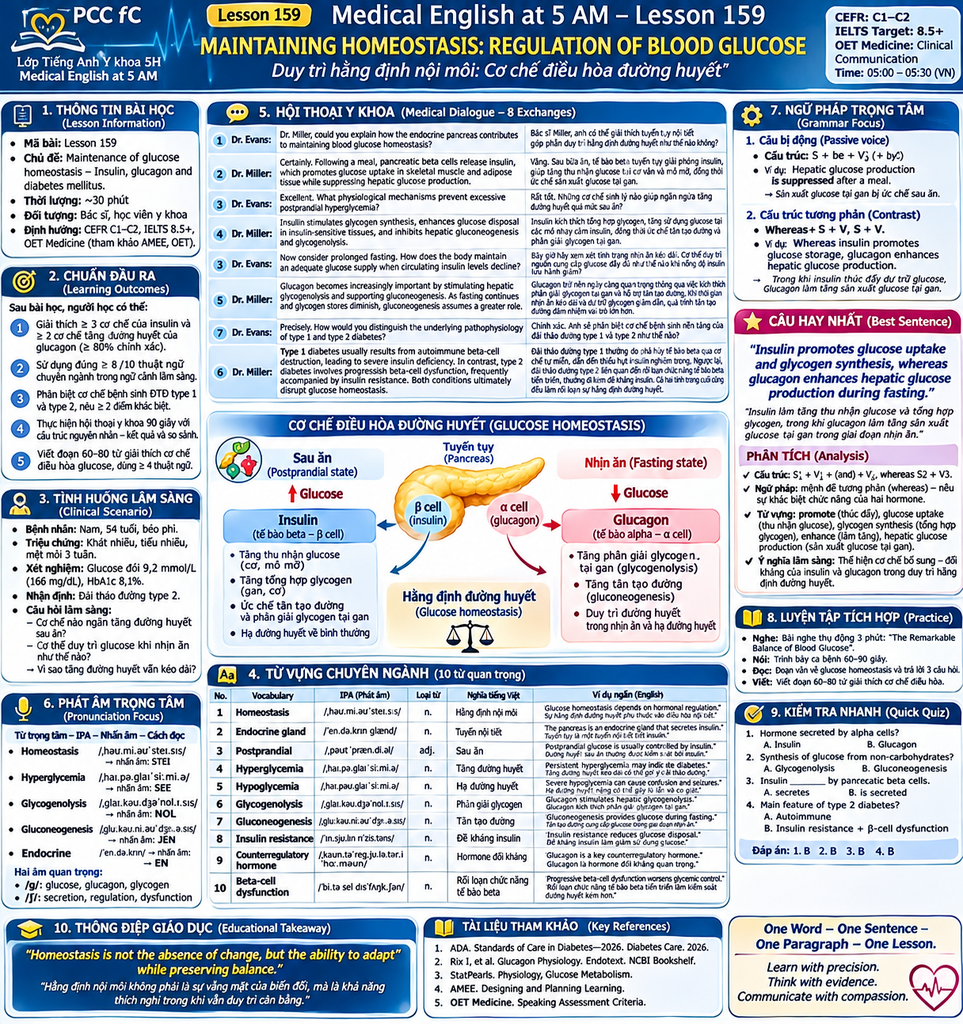
Bài 158 – Tiếng Anh Y Khoa: Ngộ độc opioid kèm tổn thương đa cơ quan * Acute Opioid Poisoning with Multiorgan Injury: From Clinical Reasoning to Critical Care Management
PCC Language – Thăng Long, ngày 9/11/2026, Trong hồi sức cấp cứu và chống độc, một kết quả xét nghiệm bất thường không phải lúc nào cũng đồng nghĩa với một chẩn đoán xác định. Đằng sau những biến đổi phức tạp về ý thức, tuần hoàn, chuyển hóa và chức năng các cơ quan có thể là sự tương tác của nhiều cơ chế bệnh sinh, đòi hỏi người thầy thuốc phải có tư duy phản biện, khả năng tổng hợp thông tin và quyết định xử trí kịp thời. Bài 158 – Medical English at 5 AM đưa học viên tiếp cận một tình huống lâm sàng thực tế về bệnh nhân nghi ngờ ngộ độc opioid cấp, có toan lactic rất nặng lúc nhập viện, tổn thương cơ tim, rối loạn chức năng gan và hạ phosphat máu nghiêm trọng. Thông qua hội thoại chuyên sâu gồm tám lượt trao đổi giữa bác sĩ nội trú và bác sĩ chuyên khoa Chống độc, học viên sẽ rèn luyện khả năng trình bày ca bệnh, phân tích xét nghiệm, xây dựng chẩn đoán phân biệt, xác định mức độ ưu tiên trong điều trị và diễn đạt sự chưa chắc chắn trong chẩn đoán bằng tiếng Anh y khoa chính xác, tự nhiên. Bài học được thiết kế theo định hướng CEFR C1–C2, IELTS 8.5, tham khảo phương pháp giáo dục y khoa của AMEE và các kỹ năng giao tiếp chuyên môn trong OET Medicine. Nội dung tích hợp 15 thuật ngữ chuyên sâu, phát âm, ngữ pháp nâng cao, luyện nghe – nói – đọc – viết, bài nghe thụ động ba phút và đánh giá cuối bài. Đặc biệt, bài học nhấn mạnh một nguyên tắc quan trọng: Điều trị người bệnh, không chỉ điều trị những con số xét nghiệm; phân biệt điều đã biết với điều còn chưa chắc chắn; và luôn ưu tiên những biến chứng có thể hồi phục nếu được can thiệp đúng thời điểm.
LESSON INTRODUCTION – ENGLISH
In critical care and clinical toxicology, an abnormal laboratory result does not necessarily establish a definitive diagnosis. Behind complex disturbances in consciousness, circulation, metabolism, and organ function may lie multiple interacting pathophysiological mechanisms. Understanding these mechanisms requires critical thinking, sound clinical judgement, and timely decision-making.
Lesson 158 – Medical English at 5 AM introduces learners to a real-world clinical scenario involving suspected acute opioid poisoning complicated by profound lactic acidosis at presentation, acute myocardial injury, hepatic biochemical abnormalities, and severe hypophosphataemia.
Through an advanced eight-turn dialogue between a resident doctor and a toxicologist, learners will develop the ability to present complex cases, interpret laboratory findings, formulate differential diagnoses, prioritise clinical interventions, and communicate diagnostic uncertainty with clarity and precision.
Designed for CEFR C1–C2 and IELTS Band 8.5, the lesson incorporates AMEE-informed educational principles and professional communication skills relevant to OET Medicine. It integrates 15 advanced medical terms, pronunciation practice, sophisticated grammatical structures, listening, speaking, reading, writing, a three-minute passive listening exercise, and structured assessment.
Above all, this lesson reinforces a fundamental principle of clinical excellence: Treat the patient, not merely the laboratory results; distinguish established evidence from diagnostic assumptions; and recognise reversible complications before they progress to irreversible harm.
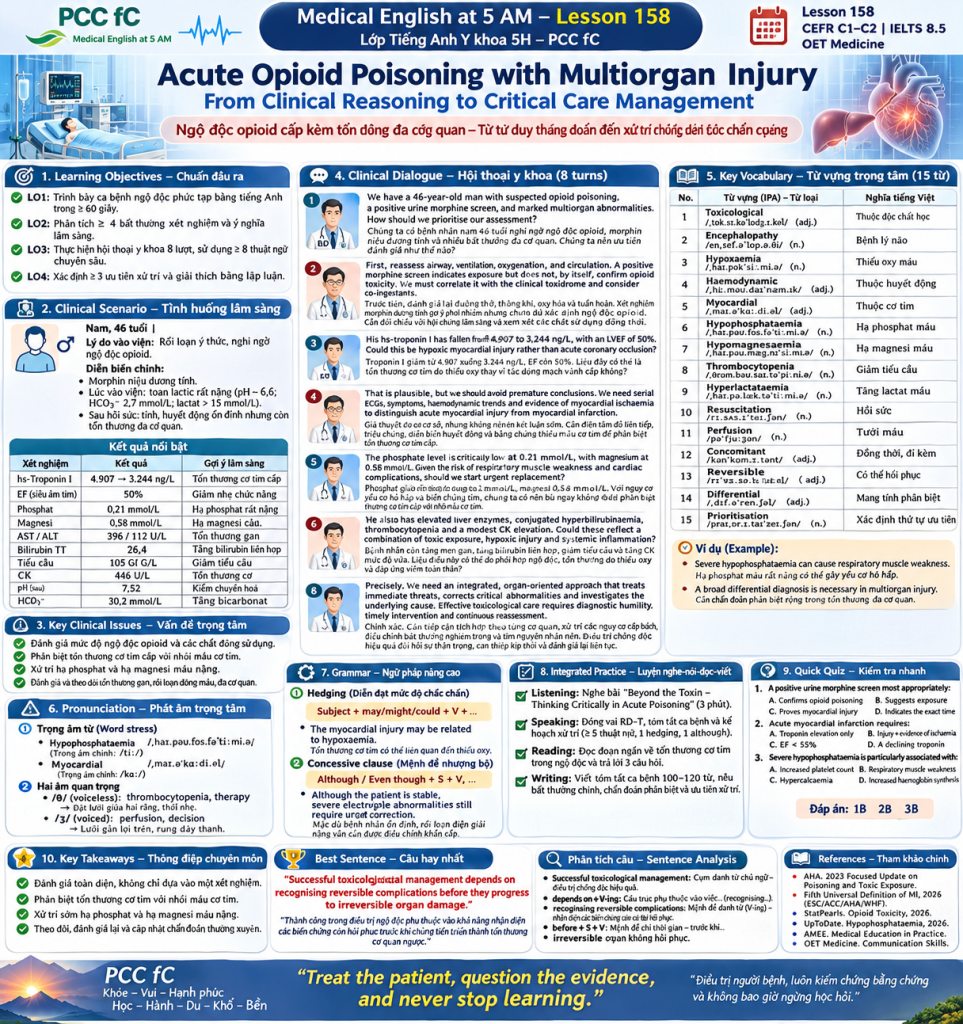
MEDICAL ENGLISH AT 5 AM – LESSON 158
PCC fC | LỚP TIẾNG ANH Y KHOA 5H
Topic: Acute Opioid Poisoning with Multiorgan Injury: From Clinical Reasoning to Critical Care Management
Chủ đề: Ngộ độc opioid cấp kèm tổn thương đa cơ quan – Từ tư duy chẩn đoán đến xử trí hồi sức tích cực
Level: CEFR C1–C2 | IELTS 8.5 | OET Medicine Duration: 30 minutes Teaching approach: Case-based learning – Clinical reasoning – Interactive dialogue – Reflective practice
PART 1. LESSON INFORMATION – THÔNG TIN BÀI HỌC
1.1. Lesson overview – Tổng quan
This lesson explores the clinical assessment and management of a critically ill patient with suspected opioid poisoning, myocardial injury, severe hypophosphataemia, hepatic dysfunction, and associated metabolic disturbances.
Bài học tập trung vào đánh giá và xử trí bệnh nhân nặng nghi ngờ ngộ độc opioid, có tổn thương cơ tim, hạ phosphat máu nghiêm trọng, rối loạn chức năng gan và các bất thường chuyển hóa đi kèm.
1.2. Target learners – Đối tượng
Resident doctors, intensive care physicians, emergency physicians, toxicologists, and healthcare professionals seeking advanced medical English proficiency.
Bác sĩ nội trú, bác sĩ hồi sức cấp cứu, bác sĩ chuyên khoa Chống độc và nhân viên y tế muốn nâng cao năng lực tiếng Anh y khoa chuyên sâu.
1.3. Educational framework – Khung đào tạo
- CEFR C1–C2: Sử dụng tiếng Anh chính xác, linh hoạt và có sắc thái trong các tình huống chuyên môn phức tạp.
- IELTS 8.5: Phát triển khả năng diễn đạt mạch lạc, vốn từ nâng cao, ngữ pháp đa dạng và phát âm rõ ràng.
- OET Medicine: Rèn luyện trình bày ca bệnh, trao đổi chuyên môn, đặt câu hỏi làm rõ và bàn giao lâm sàng.
- AMEE-informed approach: Dạy học dựa trên tình huống, chuẩn đầu ra đo lường được, phản hồi có cấu trúc và thực hành phản tư.
1.4. Teaching schedule – Phân bổ thời gian
| Activity | Duration |
|---|---|
| Case introduction and learning outcomes | 4 minutes |
| Advanced vocabulary and pronunciation | 6 minutes |
| Eight-turn clinical dialogue | 7 minutes |
| Grammar and integrated language practice | 5 minutes |
| Assessment, feedback and reflection | 8 minutes |
| Total | 30 minutes |
Bài nghe thụ động 3 phút được thiết kế để luyện tập thêm ngoài giờ học chính thức.
PART 2. LEARNING OUTCOMES – CHUẨN ĐẦU RA
By the end of this lesson, learners will be able to:
LO1. Present a complex toxicology case.
Deliver a structured 60-second case presentation incorporating at least five relevant clinical findings.
Trình bày ca bệnh ngộ độc phức tạp trong 60 giây, bao gồm ít nhất năm dữ kiện lâm sàng quan trọng.
LO2. Interpret critical laboratory abnormalities.
Accurately interpret at least four major abnormalities and distinguish established findings from diagnostic hypotheses.
Phân tích chính xác ít nhất bốn bất thường xét nghiệm và phân biệt dữ kiện đã xác định với giả thuyết chẩn đoán.
LO3. Demonstrate advanced clinical communication.
Perform an eight-turn resident–toxicologist dialogue using at least eight advanced medical terms and two complex grammatical structures.
Thực hiện hội thoại tám lượt giữa bác sĩ nội trú và bác sĩ Chống độc, sử dụng ít nhất tám thuật ngữ chuyên sâu và hai cấu trúc ngữ pháp phức hợp.
LO4. Prioritise evidence-informed management.
Identify at least three immediate clinical priorities and justify each using appropriate medical reasoning.
Xác định ít nhất ba ưu tiên xử trí và giải thích bằng lập luận y khoa phù hợp.
LO5. Communicate with clarity and precision.
Produce a 100–120-word clinical summary with logical organisation, appropriate terminology and explicit diagnostic uncertainty.
Viết đoạn tóm tắt lâm sàng 100–120 từ, có cấu trúc logic, thuật ngữ chính xác và thể hiện rõ những điểm chưa chắc chắn trong chẩn đoán.
PART 3. CLINICAL SCENARIO – TÌNH HUỐNG LÂM SÀNG
3.1. Case presentation
A 46-year-old man was admitted to an intensive care unit following an episode of altered consciousness and suspected toxic exposure. His urine immunoassay was positive for morphine. Initial records documented severe metabolic acidosis, with a pH of approximately 6.6, bicarbonate of 2.7 mmol/L, and lactate exceeding 15 mmol/L.
Following resuscitation, the patient became alert and haemodynamically stable. However, subsequent investigations revealed marked myocardial injury, hepatic biochemical abnormalities, thrombocytopenia, and profound electrolyte disturbances.
Bản dịch tiếng Việt
Bệnh nhân nam 46 tuổi được nhập khoa hồi sức tích cực sau một đợt rối loạn ý thức và nghi ngờ phơi nhiễm độc chất. Xét nghiệm sàng lọc miễn dịch nước tiểu dương tính với morphin. Hồ sơ ban đầu ghi nhận toan chuyển hóa rất nặng, pH khoảng 6,6, bicarbonat 2,7 mmol/L và lactat trên 15 mmol/L.
Sau hồi sức, bệnh nhân tỉnh và huyết động ổn định. Tuy nhiên, các xét nghiệm tiếp theo cho thấy tổn thương cơ tim rõ rệt, bất thường sinh hóa gan, giảm tiểu cầu và rối loạn điện giải nghiêm trọng.
3.2. Key clinical findings
| Parameter | Result | Clinical significance |
|---|---|---|
| Urine morphine screen | Positive | Suggests exposure; not proof of opioid overdose |
| Initial lactate | >15 mmol/L | Severe hyperlactataemia |
| Initial pH | Approximately 6.6 | Profound acidaemia |
| hs-Troponin I | 4,907.3 → 3,244 ng/L | Acute myocardial injury |
| Left ventricular EF | 50% | Mildly reduced systolic function |
| Phosphate | 0.21 mmol/L | Severe hypophosphataemia |
| Magnesium | 0.58 mmol/L | Hypomagnesaemia |
| AST / ALT | 396 / 112 U/L | Hepatocellular enzyme elevation |
| Platelet count | 105 × 10⁹/L | Thrombocytopenia |
| Creatinine | 92 µmol/L | No marked elevation at sampling |
| Subsequent blood pH | 7.52 | Alkalemia |
| Subsequent HCO₃⁻ | 30.2 mmol/L | Suggests metabolic alkalosis |
3.3. Clinical reasoning questions
Question 1: Does a positive urine morphine screen establish the diagnosis of opioid poisoning?
Xét nghiệm morphin niệu dương tính có đủ để chẩn đoán ngộ độc opioid không?
Question 2: How can clinicians distinguish acute myocardial injury from myocardial infarction?
Làm thế nào để phân biệt tổn thương cơ tim cấp với nhồi máu cơ tim?
Question 3: Why does profound hypophosphataemia require urgent attention?
Tại sao hạ phosphat máu rất nặng cần được xử trí khẩn cấp?
Question 4: What additional information is necessary to determine the underlying mechanism of multiorgan injury?
Cần bổ sung những thông tin nào để xác định cơ chế tổn thương đa cơ quan?
Clinical safety note: The initial acidosis and later alkalemia occurred at different time points. They should not be interpreted as a single simultaneous acid–base disorder. The reported ethanol value of 26.1% also requires verification of specimen type and reporting units before clinical interpretation.
PART 4. ADVANCED MEDICAL VOCABULARY – 15 TỪ VỰNG CHUYÊN SÂU
IPA theo cách phát âm Anh–Anh; n. = noun, adj. = adjective, v. = verb.
| No. | Vocabulary / IPA / Word class | Meaning and example |
|---|---|---|
| 1 | Toxicological /ˌtɒk.sɪ.kəˈlɒdʒ.ɪ.kəl/ (adj.) | Thuộc độc chất học. A toxicological assessment should consider possible co-ingestants. |
| 2 | Encephalopathy /enˌsef.əˈlɒp.ə.θi/ (n.) | Bệnh lý não. Toxic or hypoxic encephalopathy should be considered. |
| 3 | Hypoxaemia /ˌhaɪ.pɒkˈsiː.mi.ə/ (n.) | Thiếu oxy máu. Prolonged hypoxaemia may contribute to myocardial injury. |
| 4 | Haemodynamic /ˌhiː.məʊ.daɪˈnæm.ɪk/ (adj.) | Thuộc huyết động. The patient is currently haemodynamically stable. |
| 5 | Myocardial /ˌmaɪ.əˈkɑː.di.əl/ (adj.) | Thuộc cơ tim. Serial troponin measurements indicate acute myocardial injury. |
| 6 | Hypophosphataemia /ˌhaɪ.pəʊ.fɒs.fəˈtiː.mi.ə/ (n.) | Hạ phosphat máu. Severe hypophosphataemia can impair respiratory muscle function. |
| 7 | Hypomagnesaemia /ˌhaɪ.pəʊ.mæɡ.nɪˈsiː.mi.ə/ (n.) | Hạ magnesi máu. Hypomagnesaemia may increase the risk of arrhythmias. |
| 8 | Thrombocytopenia /ˌθrɒm.bəʊ.saɪ.təˈpiː.ni.ə/ (n.) | Giảm tiểu cầu. Thrombocytopenia warrants evaluation of its underlying cause. |
| 9 | Hyperlactataemia /ˌhaɪ.pə.læk.təˈtiː.mi.ə/ (n.) | Tăng lactat máu. Severe hyperlactataemia may accompany tissue hypoperfusion. |
| 10 | Resuscitation /rɪˌsʌs.ɪˈteɪ.ʃən/ (n.) | Hồi sức. Timely resuscitation is essential in critically ill patients. |
| 11 | Perfusion /pəˈfjuː.ʒən/ (n.) | Tưới máu. Adequate tissue perfusion must be maintained. |
| 12 | Concomitant /kənˈkɒm.ɪ.tənt/ (adj.) | Đồng thời, đi kèm. Concomitant substance exposure cannot be excluded. |
| 13 | Reversible /rɪˈvɜː.sə.bəl/ (adj.) | Có thể hồi phục. Early treatment may prevent reversible injury from progressing. |
| 14 | Differential /ˌdɪf.əˈren.ʃəl/ (adj.) | Mang tính phân biệt. A broad differential diagnosis is necessary. |
| 15 | Prioritisation /praɪˌɒr.ɪ.taɪˈzeɪ.ʃən/ (n.) | Sự xác định thứ tự ưu tiên. Clinical prioritisation should reflect immediate threats to life. |
Vocabulary challenge: Choose five terms and construct a concise clinical handover without reading the examples.
PART 5. CLINICAL DIALOGUE – HỘI THOẠI Y KHOA 8 LƯỢT
Participants: Resident Doctor (RD) and Toxicologist (T)
Turn 1 – Resident Doctor: Case presentation
English: “We have a 46-year-old man with suspected opioid poisoning, a positive urine morphine screen, and a history of profound lactic acidosis. Subsequent tests reveal myocardial injury and severe electrolyte depletion. What should be our immediate priorities?”
Vietnamese: “Chúng ta có một bệnh nhân nam 46 tuổi nghi ngờ ngộ độc opioid, xét nghiệm morphin niệu dương tính và có tiền sử toan lactic rất nặng. Các xét nghiệm sau đó cho thấy tổn thương cơ tim và thiếu hụt điện giải nghiêm trọng. Chúng ta nên ưu tiên xử trí những vấn đề nào trước?”
Turn 2 – Toxicologist: Initial assessment
English: “First, reassess airway protection, ventilation, oxygenation, and circulation. A positive morphine screen indicates possible exposure but does not independently confirm opioid toxicity. We must correlate it with the clinical toxidrome and consider co-ingestants.”
Vietnamese: “Trước tiên, cần đánh giá lại khả năng bảo vệ đường thở, thông khí, oxy hóa máu và tuần hoàn. Xét nghiệm morphin dương tính gợi ý phơi nhiễm nhưng không tự khẳng định ngộ độc opioid. Chúng ta phải đối chiếu với hội chứng ngộ độc trên lâm sàng và xem xét các chất sử dụng đồng thời.”
Turn 3 – Resident Doctor: Myocardial injury
English: “His high-sensitivity troponin I has fallen from approximately 4,907 to 3,244 ng/L, while echocardiography shows a left ventricular ejection fraction of 50%. Could this reflect hypoxic myocardial injury rather than acute coronary thrombosis?”
Vietnamese: “Troponin I độ nhạy cao giảm từ khoảng 4.907 xuống 3.244 ng/L, trong khi siêu âm tim cho thấy phân suất tống máu thất trái 50%. Liệu đây có thể là tổn thương cơ tim do thiếu oxy thay vì huyết khối động mạch vành cấp không?”
Turn 4 – Toxicologist: Diagnostic differentiation
English: “That is plausible, but we should avoid premature conclusions. Serial electrocardiograms, clinical symptoms, haemodynamic trends, and evidence of myocardial ischaemia are essential for distinguishing acute myocardial injury from myocardial infarction.”
Vietnamese: “Giả thuyết đó có cơ sở, nhưng chúng ta cần tránh kết luận quá sớm. Điện tâm đồ liên tiếp, triệu chứng lâm sàng, diễn biến huyết động và bằng chứng thiếu máu cơ tim là những yếu tố thiết yếu để phân biệt tổn thương cơ tim cấp với nhồi máu cơ tim.”
Turn 5 – Resident Doctor: Electrolyte abnormalities
English: “The phosphate concentration is critically low at 0.21 mmol/L, accompanied by a magnesium level of 0.58 mmol/L. Given the risk of respiratory muscle weakness and cardiac complications, should we initiate urgent replacement?”
Vietnamese: “Nồng độ phosphat giảm nghiêm trọng còn 0,21 mmol/L, kèm magnesi 0,58 mmol/L. Với nguy cơ yếu cơ hô hấp và biến chứng tim mạch, chúng ta có nên bắt đầu bù điện giải khẩn cấp không?”
Turn 6 – Toxicologist: Targeted intervention
English: “Yes. Intravenous phosphate replacement is indicated, with careful monitoring of calcium, potassium, renal function, and cardiac rhythm. Magnesium should also be corrected. We must investigate possible intracellular shifts and treatment-related contributors.”
Vietnamese: “Có. Cần bù phosphat đường tĩnh mạch, theo dõi chặt chẽ calci, kali, chức năng thận và nhịp tim. Đồng thời phải điều chỉnh magnesi và tìm hiểu các yếu tố gây dịch chuyển phosphat vào nội bào hoặc liên quan đến điều trị.”
Turn 7 – Resident Doctor: Multiorgan involvement
English: “The patient also has elevated liver enzymes, predominantly conjugated hyperbilirubinaemia, thrombocytopenia, and a modest CK elevation. Could these findings reflect systemic hypoxic injury or concomitant pathology rather than direct opioid toxicity alone?”
Vietnamese: “Bệnh nhân còn tăng men gan, tăng bilirubin chủ yếu dạng liên hợp, giảm tiểu cầu và tăng CK mức độ vừa. Liệu các bất thường này có thể phản ánh tổn thương toàn thân do thiếu oxy hoặc bệnh lý đồng mắc thay vì chỉ do độc tính trực tiếp của opioid?”
Turn 8 – Toxicologist: Clinical conclusion
English: “Precisely. We need an integrated, organ-oriented approach that addresses immediate physiological threats while investigating the underlying cause. Effective toxicological care requires diagnostic humility, timely intervention, and continuous reassessment.”
Vietnamese: “Chính xác. Chúng ta cần tiếp cận tích hợp theo từng cơ quan, xử trí các nguy cơ sinh lý cấp bách đồng thời tìm kiếm nguyên nhân nền. Điều trị chống độc hiệu quả đòi hỏi sự thận trọng trong chẩn đoán, can thiệp kịp thời và đánh giá lại liên tục.”
PART 6. PRONUNCIATION FOCUS – PHÁT ÂM TRỌNG TÂM
6.1. Word stress – Trọng âm từ
1. Hypophosphataemia
IPA: /ˌhaɪ.pəʊ.fɒs.fəˈtiː.mi.ə/
- Primary stress: /tiː/
- Secondary stress: /haɪ/
- Common difficulty: Nhiều học viên đặt trọng âm sai ở phần phosphate.
- Practice: “Severe hypophosphataemia requires prompt correction.”
2. Myocardial
IPA: /ˌmaɪ.əˈkɑː.di.əl/
- Primary stress: /kɑː/
- Practice: “The patient has acute myocardial injury.”
6.2. Two key phonemes – Hai âm trọng tâm
Phoneme 1: /θ/ – Voiceless dental fricative
Examples: thrombocytopenia, therapy, three.
Cách phát âm: Đặt đầu lưỡi nhẹ giữa hai hàm răng, đẩy luồng hơi ra ngoài, không rung dây thanh.
Practice sentence: “Three critical threats require immediate attention.”
Phoneme 2: /ʒ/ – Voiced postalveolar fricative
Examples: perfusion, decision, measure.
Cách phát âm: Đưa lưỡi gần vùng sau lợi, tạo âm xát có rung dây thanh.
Practice sentence: “Adequate perfusion is essential for organ recovery.”
6.3. Connected speech – Nối âm trong giao tiếp lâm sàng
Practice these three expressions:
- “Acute myocardial injury”
- “Severe electrolyte disturbances”
- “Continuous clinical reassessment”
Speaking task: Read each expression twice, first slowly and then at a natural clinical handover pace. Focus on clarity rather than speed.
PART 7. ADVANCED GRAMMAR – HAI CẤU TRÚC NGỮ PHÁP C1–C2
Structure 1. Hedging and diagnostic uncertainty
Cấu trúc diễn đạt giả thuyết và mức độ chắc chắn trong chẩn đoán
Formula:
Subject + may / might / could + base verb + complement.
Example 1:
“The elevated troponin level may reflect hypoxic myocardial injury.”
Nồng độ troponin tăng có thể phản ánh tổn thương cơ tim do thiếu oxy.
Example 2:
“These abnormalities could be attributable to multiple interacting mechanisms.”
Những bất thường này có thể do nhiều cơ chế tương tác với nhau.
Advanced comparison:
- “The patient has a myocardial infarction.” – Khẳng định chẩn đoán, đòi hỏi đủ tiêu chuẩn.
- “The patient has acute myocardial injury.” – Mô tả tình trạng có bằng chứng xét nghiệm.
- “The myocardial injury may be related to hypoxaemia.” – Nêu giả thuyết cơ chế, chưa khẳng định nguyên nhân.
Clinical application: Hedging is not a sign of uncertainty in clinical competence; it is a sign of diagnostic precision.
Diễn đạt thận trọng không thể hiện sự thiếu năng lực chuyên môn mà phản ánh tư duy chẩn đoán chính xác.
Structure 2. Concessive clauses – Mệnh đề nhượng bộ
Formula:
Although / Even though + subject + verb, main clause.
Example 1:
“Although the patient is haemodynamically stable, severe electrolyte abnormalities still require urgent correction.”
Mặc dù bệnh nhân ổn định huyết động, các rối loạn điện giải nghiêm trọng vẫn cần được điều chỉnh khẩn cấp.
Example 2:
“Even though troponin levels are declining, the underlying mechanism of myocardial injury remains uncertain.”
Mặc dù nồng độ troponin đang giảm, cơ chế gây tổn thương cơ tim vẫn chưa được xác định.
Advanced writing task:
Combine these two statements into one complex sentence:
“The patient is conscious. He remains at risk of serious complications.”
Suggested answer:
“Although the patient has regained consciousness, he remains at risk of serious complications.”
IELTS 8.5 application: Combine concessive clauses with precise clinical vocabulary to demonstrate grammatical range and logical reasoning. In OET, prioritise clarity and appropriateness over unnecessary grammatical complexity.
PART 8. INTEGRATED SKILLS – LISTENING, SPEAKING, READING AND WRITING
8.1. Listening – Nghe hiểu lâm sàng
Task: Listen to the eight-turn dialogue and answer the following questions.
- What evidence suggests acute myocardial injury?
- Why is a positive urine morphine screen insufficient to confirm opioid poisoning?
- Which electrolyte abnormality requires particularly urgent correction?
- What investigations are needed to assess possible myocardial ischaemia?
Listening strategy: Identify key clinical findings, diagnostic uncertainty, and management priorities rather than attempting to memorise every word.
8.2. Speaking – Thực hành hội thoại
Role A – Resident Doctor
Present the case, highlight the major abnormalities, and ask for a management plan.
Role B – Toxicologist
Clarify diagnostic uncertainty, explain the differential diagnosis, and prioritise interventions.
Requirements:
- Use at least five advanced medical terms.
- Include one hedging expression.
- Include one concessive clause.
- Conclude with a concise management summary.
Suggested closing statement:
“Our immediate priorities are to maintain physiological stability, correct critical electrolyte disturbances, and investigate the mechanism of myocardial injury.”
8.3. Reading – Đọc hiểu chuyên môn
Reading passage
Acute opioid poisoning is primarily associated with central nervous system depression and respiratory compromise. However, critically ill patients may develop additional complications, including hypoxic injury, aspiration, metabolic disturbances, and myocardial injury. A positive urine opioid screen must be interpreted cautiously because it does not establish the severity or timing of intoxication.
Marked troponin elevation indicates myocardial injury but does not necessarily imply acute coronary thrombosis. Clinical evaluation should integrate serial electrocardiograms, biomarker trends, echocardiographic findings, and evidence of myocardial ischaemia.
Severe hypophosphataemia may impair cellular energy metabolism and neuromuscular function. Prompt recognition, appropriate replacement, and careful biochemical monitoring are essential components of management.
Reading comprehension
- What is the principal life-threatening mechanism of opioid overdose?
- Why should troponin elevation not automatically be interpreted as myocardial infarction?
- How can severe hypophosphataemia affect respiratory function?
8.4. Writing – Viết tóm tắt lâm sàng
Task: Write a 100–120-word clinical handover.
Include the presenting problem, major abnormalities, diagnostic uncertainty, and immediate priorities.
Model answer – 111 words
A 46-year-old man was admitted following altered consciousness and suspected opioid exposure. His urine screen was positive for morphine, although this finding alone does not confirm opioid toxicity. Initial investigations documented profound lactic acidosis. Subsequent tests revealed acute myocardial injury, with high-sensitivity troponin I decreasing from approximately 4,907 to 3,244 ng/L, and mildly reduced left ventricular systolic function. Severe hypophosphataemia and hypomagnesaemia were also identified, alongside hepatic biochemical abnormalities and thrombocytopenia. Immediate priorities include reassessing respiratory and haemodynamic stability, correcting critical electrolyte disturbances, and monitoring cardiac function. Further investigation is required to distinguish ischaemic from non-ischaemic myocardial injury and identify possible concomitant causes.
8.5. Three-minute passive listening – BÀI NGHE THỤ ĐỘNG 3 PHÚT
Title: Beyond the Toxin – Thinking Critically in Acute Poisoning
Instructions: Listen once without reading. Listen again while following the transcript. During the final repetition, focus on clinical terminology and sentence rhythm.
English listening script – Approximately 3 minutes at a measured pace
In critical care medicine, every patient tells a story. Sometimes that story is straightforward. At other times, it is hidden beneath complex laboratory abnormalities, uncertain exposure histories, and rapidly changing physiological conditions.
Today, we are discussing a forty-six-year-old man admitted to an intensive care unit following altered consciousness and suspected opioid exposure.
His urine toxicology screen was positive for morphine. However, an important principle must be emphasised: a positive screening result does not necessarily establish the cause of the patient’s clinical deterioration.
Clinical reasoning requires us to integrate the exposure history, physical examination, physiological findings, and laboratory investigations.
At presentation, the patient had profound metabolic acidosis and markedly elevated lactate. Such findings should prompt careful consideration of tissue hypoperfusion, impaired oxygen delivery, and other potential causes of severe lactic acidosis.
Following resuscitation, the patient’s condition improved. Nevertheless, further investigations revealed significant abnormalities.
His high-sensitivity troponin I was markedly elevated, although subsequent measurements showed a downward trend. Echocardiography demonstrated mildly reduced left ventricular systolic function.
Does this mean the patient experienced a myocardial infarction?
Not necessarily.
Acute myocardial injury and acute myocardial infarction are related but distinct concepts. A diagnosis of myocardial infarction requires evidence that the myocardial injury is attributable to ischaemia.
Therefore, serial electrocardiograms, clinical findings, and appropriate cardiac imaging remain essential.
Another important abnormality was profound hypophosphataemia.
Phosphate plays a crucial role in cellular energy metabolism, muscular function, and numerous biochemical processes. Severe phosphate depletion can contribute to respiratory muscle weakness and cardiac complications.
For this reason, timely recognition and carefully monitored replacement are essential.
The patient also demonstrated hypomagnesaemia, elevated liver enzymes, and thrombocytopenia.
Rather than assuming that a single toxic substance explains every abnormality, clinicians should maintain a broad differential diagnosis.
The most effective approach combines immediate physiological stabilisation with continuous diagnostic reassessment.
As clinicians, we must learn to recognise what is established, acknowledge what remains uncertain, and act decisively when potentially reversible complications threaten a patient’s life.
Remember this principle:
Good clinical reasoning is not simply about finding the right diagnosis. It is about asking the right questions, identifying the most urgent threats, and making the safest decisions with the evidence available.
In toxicology, knowledge guides our decisions, vigilance protects our patients, and humility keeps our reasoning open to new evidence.
Key listening sentence:
“Recognise what is established, acknowledge what remains uncertain, and act decisively.”
Dịch:
“Nhận diện những điều đã được xác định, thừa nhận những vấn đề còn chưa chắc chắn và hành động quyết đoán.”
PART 9. ASSESSMENT, ANSWERS AND FEEDBACK – KIỂM TRA, ĐÁP ÁN VÀ PHẢN HỒI
Assessment format: Five multiple-choice questions and one clinical communication task.
Duration: 5 minutes for assessment and 3 minutes for feedback and reflection.
9.1. Multiple-choice questions
Question 1. Which statement most accurately interprets a positive urine morphine immunoassay?
A. It confirms severe opioid poisoning. B. It establishes the precise time of exposure. C. It suggests opioid exposure but requires clinical correlation. D. It proves that morphine caused myocardial injury.
Question 2. According to contemporary definitions, acute myocardial infarction requires:
A. Elevated troponin alone. B. Acute myocardial injury accompanied by evidence of myocardial ischaemia. C. An ejection fraction below 55%. D. A declining troponin concentration without other findings.
Question 3. Which complication is particularly associated with profound hypophosphataemia?
A. Increased platelet production. B. Respiratory muscle weakness. C. Persistent hypercalcaemia in every patient. D. Increased haemoglobin synthesis.
Question 4. Which sentence demonstrates appropriate diagnostic uncertainty?
A. “The patient definitely has coronary thrombosis.” B. “Morphine exposure explains every abnormality.” C. “The myocardial injury may be related to previous hypoxaemia.” D. “Further investigation is unnecessary.”
Question 5. Which management approach is most appropriate?
A. Focus exclusively on the urine toxicology result. B. Treat elevated troponin as definitive proof of type 1 myocardial infarction. C. Delay electrolyte correction until all diagnoses are confirmed. D. Stabilise vital functions, correct critical abnormalities, and reassess the differential diagnosis.
9.2. Clinical communication challenge
Task: Complete the following statement using professional medical English.
“Although the patient’s troponin level is declining, …”
Suggested response:
“Although the patient’s troponin level is declining, further assessment is required to determine the underlying mechanism of myocardial injury.”
Vietnamese:
“Mặc dù nồng độ troponin của bệnh nhân đang giảm, vẫn cần đánh giá thêm để xác định cơ chế gây tổn thương cơ tim.”
9.3. Answer key – Đáp án
| Question | Answer | Explanation |
|---|---|---|
| 1 | C | A positive screening test requires clinical interpretation. |
| 2 | B | Myocardial infarction requires acute myocardial injury plus evidence of ischaemia. |
| 3 | B | Severe phosphate depletion may impair respiratory muscle function. |
| 4 | C | “May be related to” expresses a plausible but unconfirmed mechanism. |
| 5 | D | Management should prioritise physiological stabilisation and ongoing reassessment. |
9.4. Scoring and feedback
Knowledge assessment: 5 points, one point per correct answer.
Clinical communication: 5 points, assessed according to:
- Clinical accuracy: 2 points.
- Advanced medical vocabulary: 1 point.
- Grammatical accuracy: 1 point.
- Clarity and logical organisation: 1 point.
Total: 10 points
| Score | Performance | Feedback |
|---|---|---|
| 9–10 | Excellent | Strong clinical reasoning and advanced communication |
| 7–8 | Good | Sound understanding; refine precision and fluency |
| 5–6 | Developing | Review clinical terminology and diagnostic reasoning |
| Below 5 | Needs improvement | Repeat the dialogue and revisit the core concepts |
Reflection question:
“What is the most important clinical lesson you have learned from this case?”
“Bài học lâm sàng quan trọng nhất bạn rút ra từ ca bệnh này là gì?”
PART 10. EVIDENCE-BASED MEDICINE AND EDUCATIONAL REFERENCES – CƠ SỞ KHOA HỌC VÀ GIÁO DỤC
10.1. Acute opioid poisoning
Clinical principle: The management of life-threatening opioid poisoning prioritises airway protection, effective ventilation, oxygenation and circulatory support. Naloxone is indicated when clinically significant opioid-induced respiratory depression is suspected, while monitoring for recurrent respiratory depression remains essential.
Nguyên tắc: Ưu tiên bảo vệ đường thở, bảo đảm thông khí, oxy hóa máu và hỗ trợ tuần hoàn. Naloxone được sử dụng khi nghi ngờ ức chế hô hấp có ý nghĩa do opioid; cần tiếp tục theo dõi nguy cơ tái ức chế hô hấp.
Reference: American Heart Association, 2023 Focused Update on the Management of Patients With Cardiac Arrest or Life-Threatening Toxicity Due to Poisoning.
PubMed+1
10.2. Acute myocardial injury versus myocardial infarction
Clinical principle: Acute myocardial injury is characterised by a rise and/or fall in cardiac troponin, with at least one value above the assay-specific 99th percentile threshold. Myocardial infarction additionally requires evidence of acute myocardial ischaemia.
Nguyên tắc: Tổn thương cơ tim cấp được xác định bằng biến thiên tăng hoặc giảm troponin, với ít nhất một giá trị vượt ngưỡng bách phân vị thứ 99. Chẩn đoán nhồi máu cơ tim cần thêm bằng chứng thiếu máu cơ tim cấp.
Updated reference: Fifth Universal Definition of Myocardial Infarction, 2026, ESC/ACC/AHA/WHF.
DOI+1
Clinical application: In this case, the available data establish acute myocardial injury but do not independently establish type 1 or type 2 myocardial infarction.
10.3. Severe hypophosphataemia and electrolyte management
Clinical principle: Profound hypophosphataemia can cause neuromuscular weakness, impaired respiratory function, and cardiovascular complications. Intravenous phosphate replacement may be required in severe cases, with dose and infusion rate determined by local protocols, renal function, and concurrent electrolyte abnormalities.
Nguyên tắc: Hạ phosphat máu rất nặng có thể gây yếu cơ, suy giảm chức năng hô hấp và biến chứng tim mạch. Bù phosphat tĩnh mạch cần dựa trên phác đồ, chức năng thận và các rối loạn điện giải đi kèm; theo dõi phosphat, calci, kali, magnesi và điện tâm đồ khi thích hợp.
Clinical application: A phosphate concentration of 0.21 mmol/L represents a critical abnormality requiring urgent clinical assessment and correction.
10.4. AMEE-informed medical education
Educational principle: Effective medical education should connect clinical experience with structured reasoning, active participation, feedback, and reflective practice.
Ứng dụng: Bài học sử dụng ca bệnh thực tế đã lược bỏ thông tin định danh trong nội dung giảng dạy, hội thoại đóng vai, câu hỏi tư duy lâm sàng, đánh giá năng lực và phản hồi.
10.5. OET Medicine and CEFR C1–C2
Communication principle: Advanced medical English requires more than sophisticated vocabulary. Effective clinical communication must be accurate, concise, coherent, empathetic and appropriate to the intended audience.
Ứng dụng: Học viên luyện trình bày ca bệnh, trao đổi giữa đồng nghiệp, giải thích mức độ chắc chắn của chẩn đoán, bàn giao và tóm tắt kế hoạch xử trí.
The lesson is aligned with relevant OET communication skills and CEFR C1–C2 descriptors; it is not an official OET examination or an AMEE-accredited course.
10.6. Five evidence-based clinical takeaways
- A positive toxicology screen is not a complete diagnosis. Xét nghiệm độc chất dương tính không thay thế đánh giá lâm sàng toàn diện.
- Myocardial injury is not synonymous with myocardial infarction. Tổn thương cơ tim không đồng nghĩa với nhồi máu cơ tim.
- Correct life-threatening physiological disturbances promptly. Cần xử trí kịp thời các rối loạn sinh lý đe dọa tính mạng.
- Distinguish observed findings from proposed mechanisms. Phân biệt dữ kiện khách quan với giả thuyết cơ chế bệnh sinh.
- Reassess continuously as new evidence emerges. Liên tục đánh giá lại khi có thông tin mới.
FINAL MESSAGE – THÔNG ĐIỆP GIÁO DỤC
One Word – One Sentence – One Paragraph – One Lesson
One Word: Vigilance /ˈvɪdʒ.ɪ.ləns/ (n.) – Sự cảnh giác, theo dõi và nhận diện nguy cơ.
One Sentence:
“Clinical excellence begins with careful observation, grows through critical thinking, and is sustained by compassionate action.”
Sự xuất sắc trong thực hành lâm sàng bắt đầu từ quan sát cẩn trọng, phát triển nhờ tư duy phản biện và được duy trì bằng hành động tận tâm.
One Paragraph:
In critical care, the most valuable skill is not merely recognising an abnormal laboratory result, but understanding its significance in the context of the whole patient. A competent clinician identifies immediate threats, questions assumptions, acknowledges uncertainty, and acts with both urgency and precision. Every challenging case is an opportunity to improve our knowledge, strengthen our judgement, and provide safer care.
Trong hồi sức tích cực, kỹ năng quý giá nhất không chỉ là nhận diện một xét nghiệm bất thường mà còn là hiểu được ý nghĩa của nó trong toàn cảnh người bệnh. Một bác sĩ có năng lực phải nhận diện các nguy cơ cấp bách, xem xét lại những giả định, thừa nhận điều chưa chắc chắn và hành động vừa khẩn trương vừa chính xác. Mỗi ca bệnh khó là cơ hội để nâng cao kiến thức, rèn luyện khả năng phán đoán và mang đến sự chăm sóc an toàn hơn.
One Lesson:
“Treat the patient, question the evidence, and never stop learning.”
“Điều trị người bệnh, luôn kiểm chứng bằng chứng và không bao giờ ngừng học hỏi.”
PCC fC – Medical English at 5 AM
Learn deeply – Think critically – Act wisely – Care compassionately.
Học sâu sắc – Tư duy phản biện – Hành động sáng suốt – Chăm sóc tận tâm.
Vì một đam mê Khỏe Vui Hạnh phúc