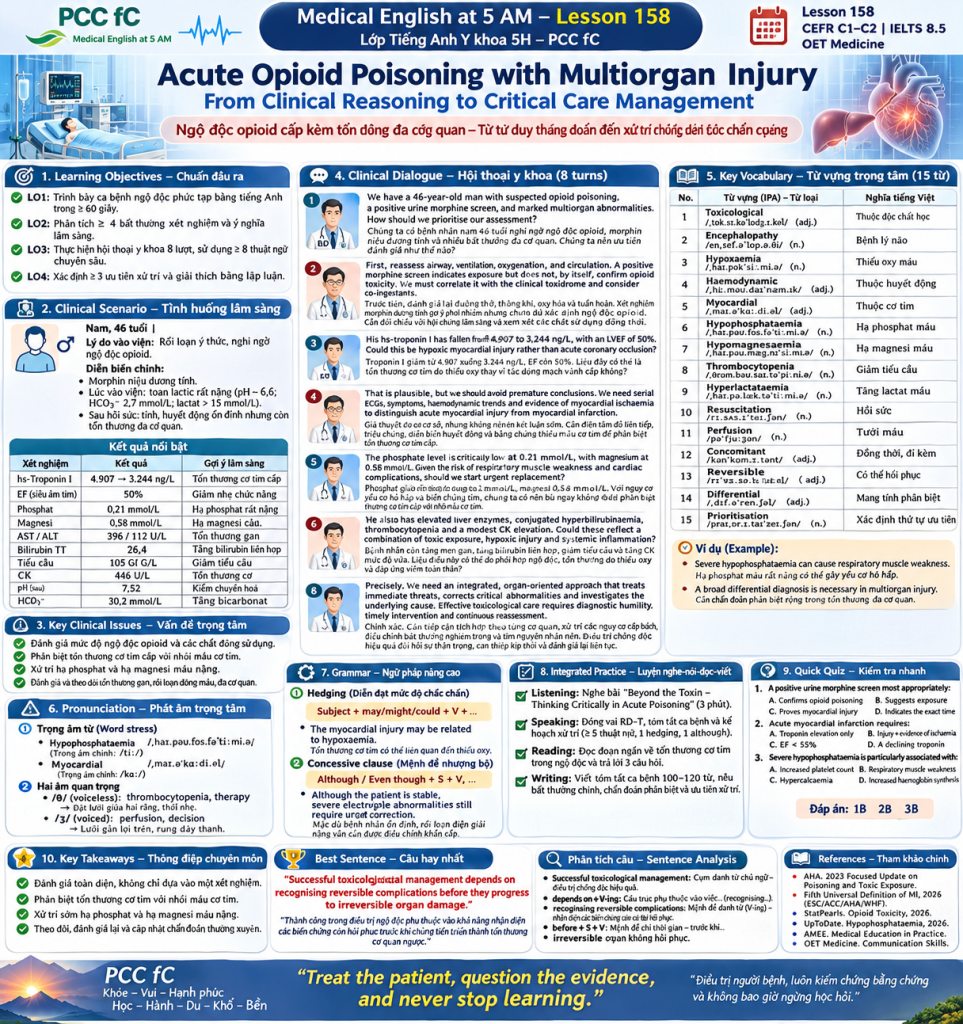
Bài 159 – Tiếng Anh Y Khoa: Duy trì hằng định nội môi & cơ chế điều hoà đường huyết * Maintaining homeostasis: regulation of blood glucose
PCC Language – Thăng Long, ngày 10/11/2026, Mỗi giây phút trong cuộc sống, cơ thể chúng ta đều thực hiện một nhiệm vụ kỳ diệu: duy trì sự cân bằng của môi trường bên trong, bất chấp những thay đổi không ngừng từ bên ngoài. Một trong những ví dụ điển hình nhất chính là cơ chế điều hòa đường huyết (Glucose Homeostasis). Điều gì xảy ra sau mỗi bữa ăn khi lượng glucose trong máu tăng lên? Tại sao cơ thể vẫn duy trì được nguồn năng lượng cho não và các cơ quan trong thời gian nhịn ăn? Và khi sự phối hợp giữa insulin và glucagon bị rối loạn, điều gì dẫn đến tăng đường huyết và bệnh đái tháo đường? Trong Bài học 159 của Lớp Tiếng Anh Y khoa 5H – PCC fC, chúng ta sẽ khám phá những cơ chế sinh lý quan trọng ấy thông qua một tình huống lâm sàng thực tế và cuộc hội thoại chuyên môn giữa Dr. Evans và Dr. Miller. Bài học không chỉ giúp học viên làm chủ các thuật ngữ như homeostasis, hyperglycemia, glycogenolysis, gluconeogenesis và insulin resistance, mà còn rèn luyện khả năng giải thích cơ chế bệnh sinh, sử dụng ngữ pháp học thuật và giao tiếp y khoa tự nhiên, chính xác theo định hướng CEFR C1–C2 và OET Medicine. Đặc biệt, chúng ta sẽ tiếp tục phương pháp học tập “1 Từ – 1 Câu – 1 Đoạn – 1 Bài”, biến từng kiến thức nhỏ thành khả năng tư duy và diễn đạt chuyên môn có giá trị trong thực hành lâm sàng.
How does the human body maintain balance in a constantly changing environment?
One of the most remarkable examples is blood glucose homeostasis — a sophisticated physiological process that ensures a continuous supply of energy while preventing excessive fluctuations in blood glucose levels.
In Lesson 159 of Medical English at 5 AM – PCC fC, we explore how insulin and glucagon coordinate glucose metabolism during feeding and fasting, and how disruptions in these regulatory mechanisms contribute to diabetes mellitus.
Through a clinically relevant case, an engaging dialogue between Dr. Evans and Dr. Miller, advanced medical vocabulary, pronunciation practice, and evidence-based clinical reasoning, learners will strengthen both their scientific understanding and professional communication skills.
Guided by CEFR C1–C2 competencies and OET Medicine principles, this lesson encourages us to move beyond memorizing medical terminology toward explaining complex physiological concepts with clarity, precision, and confidence.
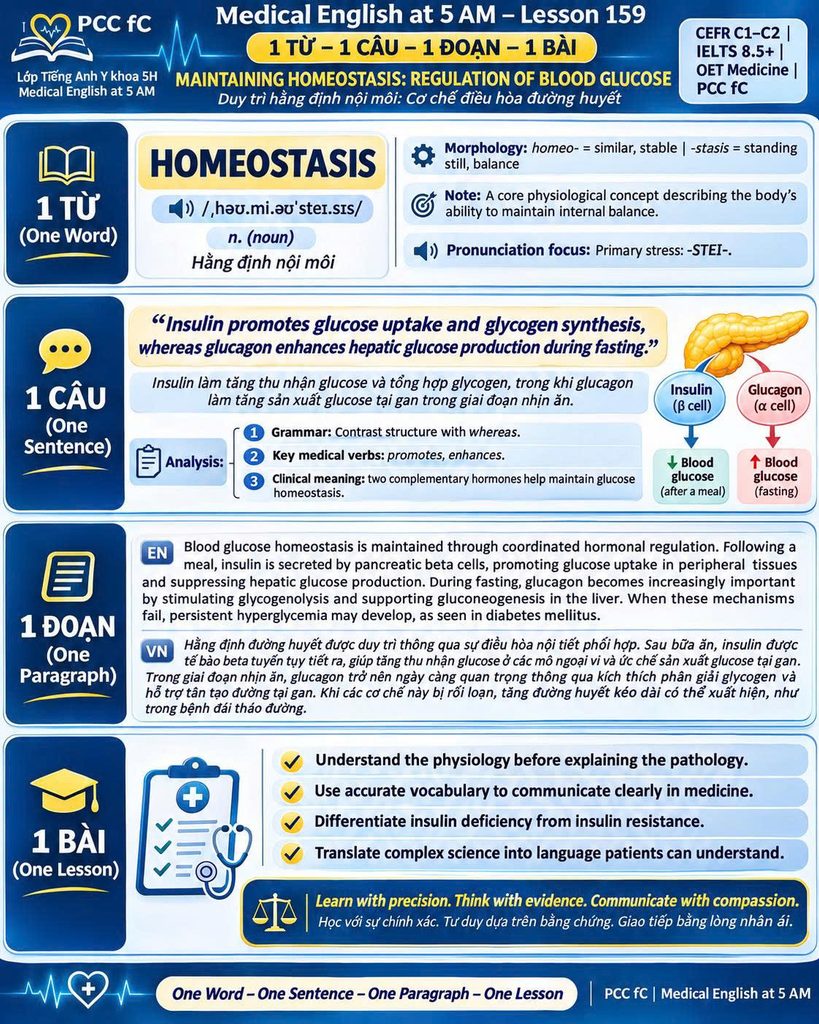
One Word – One Sentence – One Paragraph – One Lesson.
🌟 THÔNG ĐIỆP BÀI HỌC – TAKE-HOME MESSAGE
“Homeostasis is not the absence of change, but the ability to adapt while preserving balance.”
Hằng định nội môi không phải là sự vắng mặt của biến đổi, mà là khả năng thích nghi trong khi vẫn duy trì sự cân bằng.
MEDICAL ENGLISH AT 5 AM – LESSON 159
MAINTAINING HOMEOSTASIS: REGULATION OF BLOOD GLUCOSE
Duy trì hằng định nội môi: Cơ chế điều hòa đường huyết
LỚP TIẾNG ANH Y KHOA 5H – PCC fC
Ngày học: 11/11/2026 (Thứ Tư)
Thời gian: 05:00–05:30 (Giờ Việt Nam)
Trình độ định hướng: CEFR C1–C2 | IELTS 8.5 | OET Medicine
Đối tượng: Bác sĩ nội trú, bác sĩ điều trị, bác sĩ hồi sức, học viên y khoa nâng cao.
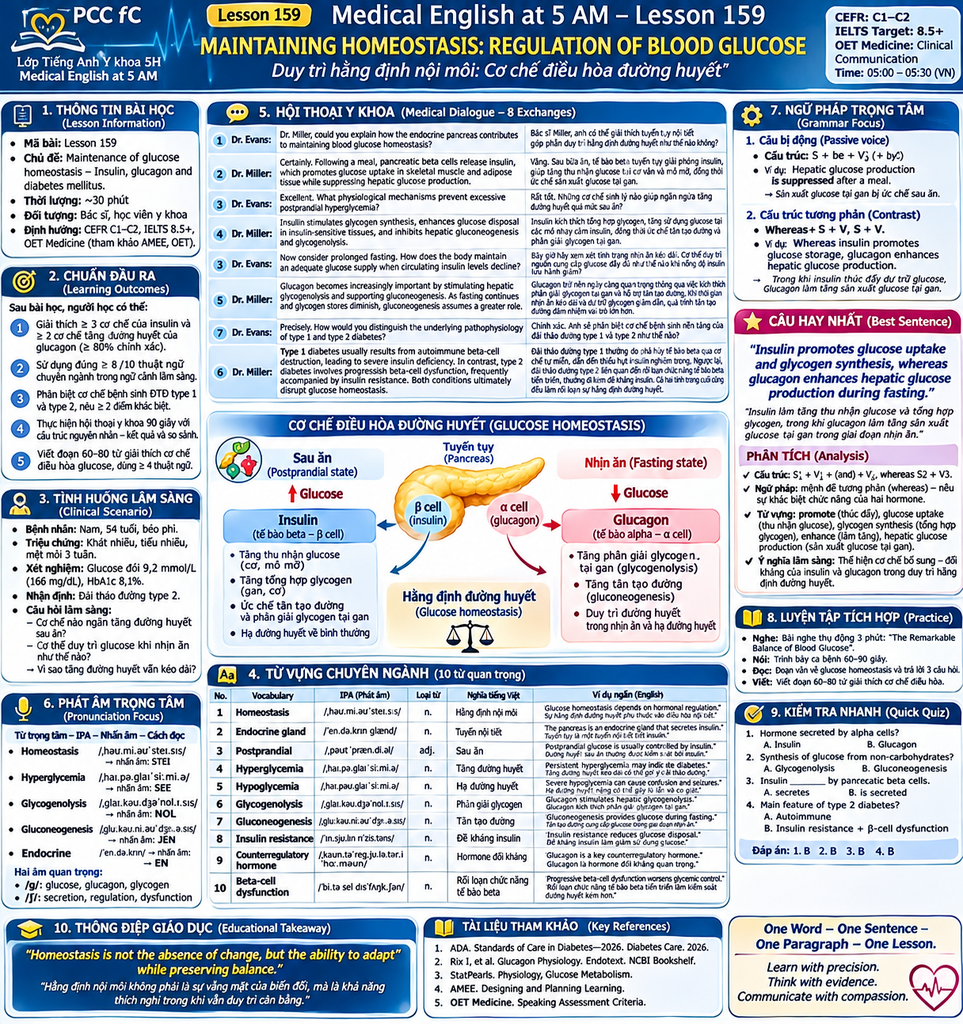
PHẦN 1. THÔNG TIN BÀI HỌC (LESSON INFORMATION)
1.1. Chủ đề trung tâm
How does the human body maintain blood glucose homeostasis, and what happens when this regulatory system fails?
Cơ thể duy trì hằng định đường huyết như thế nào và điều gì xảy ra khi hệ thống điều hòa này bị rối loạn?
Bài học kết hợp ba lĩnh vực:
- Medical Science: Sinh lý nội tiết, chuyển hóa glucose, vai trò của insulin và glucagon.
- Clinical Reasoning: Phân tích cơ chế tăng đường huyết, hạ đường huyết và đái tháo đường.
- Medical Communication: Giải thích cơ chế bệnh sinh, trình bày ca bệnh và giao tiếp y khoa chuyên nghiệp.
1.2. Định hướng giáo dục
Bài giảng được phát triển từ tài liệu Maintaining Homeostasis: Regulation of Blood Sugar (5 trang), kết hợp nguyên tắc giáo dục dựa trên chuẩn đầu ra của AMEE, các kỹ năng giao tiếp lâm sàng của OET Medicine và thực hành ngôn ngữ học thuật trình độ C1–C2.
Chuẩn IELTS 8.5 được sử dụng như mục tiêu nâng cao độ chính xác, tính mạch lạc, vốn từ và khả năng diễn đạt, không phải mức điểm được bảo đảm sau bài học.
1.3. Phân bổ thời gian 30 phút
05:00–05:03: Giới thiệu và chuẩn đầu ra.
05:03–05:07: Tình huống lâm sàng.
05:07–05:12: Mười từ vựng chuyên ngành.
05:12–05:17: Hội thoại song ngữ tám lượt.
05:17–05:20: Phát âm và ngữ pháp.
05:20–05:26: Nghe, nói, đọc, viết và thực hành.
05:26–05:29: Kiểm tra, chữa bài và phản hồi.
05:29–05:30: Tổng kết và thông điệp giáo dục.
Bài nghe thụ động 3 phút được cung cấp để học viên sử dụng ngoài giờ học chính.
PHẦN 2. CHUẨN ĐẦU RA ĐO LƯỜNG ĐƯỢC (MEASURABLE LEARNING OUTCOMES)
Sau bài học, học viên có khả năng:
LO1 – Explain: Giải thích bằng tiếng Anh trong 60 giây ít nhất ba cơ chế chính của insulin và hai cơ chế tăng đường huyết do glucagon, với độ chính xác chuyên môn tối thiểu 80%.
LO2 – Apply: Sử dụng chính xác tối thiểu 8/10 thuật ngữ chuyên ngành trong ngữ cảnh lâm sàng và phát âm đúng trọng âm tối thiểu 4/5 thuật ngữ được lựa chọn.
LO3 – Communicate: Thực hiện hội thoại bác sĩ–bác sĩ trong 90 giây, sử dụng tối thiểu hai cấu trúc diễn đạt nguyên nhân–kết quả và một câu giải thích phù hợp giao tiếp lâm sàng.
LO4 – Differentiate: Phân biệt cơ chế bệnh sinh đái tháo đường type 1 và type 2, nêu tối thiểu hai điểm khác biệt mà không đồng nhất bệnh với độ tuổi khởi phát.
LO5 – Synthesize: Viết một đoạn tiếng Anh 60–80 từ giải thích cơ chế điều hòa glucose, sử dụng ít nhất bốn thuật ngữ chuyên môn và một cấu trúc ngữ pháp đã học.
PHẦN 3. TÌNH HUỐNG LÂM SÀNG (CLINICAL SCENARIO)
3.1. Case presentation – English
A 54-year-old man with obesity and a family history of type 2 diabetes presents with increased thirst, frequent urination, and fatigue over the past three weeks.
His fasting plasma glucose is 9.2 mmol/L (166 mg/dL), and his HbA1c is 8.1%.
He is alert, hemodynamically stable, and has no clinical features suggesting an acute hyperglycemic crisis.
During the morning ward round, a medical resident is asked to explain how insulin and glucagon normally regulate blood glucose and why this patient’s glucose level remains elevated.
3.2. Bản dịch tiếng Việt
Một bệnh nhân nam 54 tuổi, có béo phì và tiền sử gia đình mắc đái tháo đường type 2, đến khám vì khát nhiều, tiểu nhiều và mệt mỏi trong ba tuần gần đây.
Glucose huyết tương lúc đói là 9,2 mmol/L (166 mg/dL), HbA1c 8,1%.
Bệnh nhân tỉnh táo, huyết động ổn định và không có biểu hiện lâm sàng gợi ý một tình trạng tăng đường huyết cấp cứu.
Trong buổi giao ban sáng, bác sĩ nội trú được yêu cầu giải thích cách insulin và glucagon điều hòa đường huyết bình thường và tại sao đường huyết của người bệnh vẫn tăng cao.
3.3. Clinical reasoning questions
Question 1: What mechanisms normally prevent excessive postprandial hyperglycemia?
Cơ chế nào giúp ngăn chặn tăng đường huyết quá mức sau ăn?
Question 2: How does the body maintain glucose availability during fasting?
Cơ thể duy trì nguồn glucose trong giai đoạn nhịn ăn như thế nào?
Question 3: Why can hyperglycemia persist despite endogenous insulin production?
Tại sao tăng đường huyết vẫn kéo dài dù cơ thể còn sản xuất insulin nội sinh?
3.4. Clinical interpretation
Ở trạng thái sau ăn, tăng glucose kích thích tế bào beta tuyến tụy tiết insulin. Insulin thúc đẩy thu nhận glucose tại cơ và mô mỡ, tăng tổng hợp glycogen, đồng thời giảm sản xuất glucose tại gan.
Khi nhịn ăn, nồng độ insulin giảm tương đối và tác dụng của glucagon góp phần duy trì glucose huyết tương thông qua phân giải glycogen tại gan và tân tạo đường.
Trong đái tháo đường type 2, sự phối hợp giữa đề kháng insulin và suy giảm chức năng tế bào beta khiến glucose máu tăng kéo dài.
Với bệnh nhân này, HbA1c 8,1% và glucose lúc đói 9,2 mmol/L đều vượt ngưỡng chẩn đoán đái tháo đường theo ADA 2026, với điều kiện các xét nghiệm đạt tiêu chuẩn kỹ thuật. Chẩn đoán type 2 phù hợp về mặt lâm sàng nhưng vẫn cần đánh giá toàn diện để phân loại chính xác. Diabetes Journals+1
PHẦN 4. TỪ VỰNG CHUYÊN NGÀNH (TEN ESSENTIAL MEDICAL TERMS)
Vocabulary 1. Homeostasis
IPA: /ˌhəʊ.mi.əʊˈsteɪ.sɪs/
Part of speech: Noun (n.)
Vietnamese: Sự hằng định nội môi.
Morphology: homeo- (tương tự, ổn định) + -stasis (trạng thái cân bằng).
Example: Glucose homeostasis depends on coordinated hormonal and metabolic responses.
Dịch: Sự hằng định đường huyết phụ thuộc vào các đáp ứng nội tiết và chuyển hóa phối hợp.
Vocabulary 2. Endocrine gland
IPA: /ˈen.də.krɪn ɡlænd/
Part of speech: Noun phrase (n. phr.)
Vietnamese: Tuyến nội tiết.
Morphology: endo- (bên trong) + -crine (tiết).
Example: The pancreas functions as both an endocrine and an exocrine gland.
Dịch: Tuyến tụy đảm nhiệm cả chức năng nội tiết và ngoại tiết.
Vocabulary 3. Postprandial
IPA: /ˌpəʊstˈpræn.di.əl/
Part of speech: Adjective (adj.)
Vietnamese: Sau ăn.
Morphology: post- (sau) + prandial (liên quan bữa ăn).
Example: Postprandial glucose levels are regulated partly through insulin secretion.
Dịch: Đường huyết sau ăn được điều hòa một phần thông qua sự bài tiết insulin.
Vocabulary 4. Hyperglycemia
IPA: /ˌhaɪ.pə.ɡlaɪˈsiː.mi.ə/
Part of speech: Noun (n.)
Vietnamese: Tăng đường huyết.
Morphology: hyper- (tăng, vượt mức) + glyc- (đường) + -emia (tình trạng máu).
Example: Persistent hyperglycemia may indicate impaired insulin action, inadequate insulin secretion, or both.
Dịch: Tăng đường huyết kéo dài có thể phản ánh giảm tác dụng insulin, bài tiết insulin không đủ hoặc phối hợp cả hai.
Vocabulary 5. Hypoglycemia
IPA: /ˌhaɪ.pəʊ.ɡlaɪˈsiː.mi.ə/
Part of speech: Noun (n.)
Vietnamese: Hạ đường huyết.
Morphology: hypo- (giảm) + glyc- (đường) + -emia (tình trạng máu).
Example: Severe hypoglycemia can cause neuroglycopenia, seizures, and loss of consciousness.
Dịch: Hạ đường huyết nặng có thể gây thiếu glucose ở não, co giật và mất ý thức.
Vocabulary 6. Glycogenolysis
IPA: /ˌɡlaɪ.kəʊ.dʒəˈnɒl.ɪ.sɪs/
Part of speech: Noun (n.)
Vietnamese: Quá trình phân giải glycogen.
Morphology: glycogen (dạng dự trữ glucose) + -lysis (phân giải).
Example: Glucagon promotes hepatic glycogenolysis during fasting.
Dịch: Glucagon thúc đẩy phân giải glycogen tại gan trong giai đoạn nhịn ăn.
Vocabulary 7. Gluconeogenesis
IPA: /ˌɡluː.kəʊ.niː.əʊˈdʒen.ə.sɪs/
Part of speech: Noun (n.)
Vietnamese: Quá trình tân tạo đường.
Morphology: gluco- (glucose) + neo- (mới) + -genesis (sự hình thành).
Example: Gluconeogenesis generates glucose from substrates such as lactate, glycerol, and glucogenic amino acids.
Dịch: Quá trình tân tạo đường tạo glucose từ các cơ chất như lactate, glycerol và các acid amin sinh đường.
Vocabulary 8. Insulin resistance
IPA: /ˈɪn.sjʊ.lɪn rɪˈzɪs.təns/
Part of speech: Noun phrase (n. phr.)
Vietnamese: Đề kháng insulin.
Example: Insulin resistance reduces the effectiveness of insulin-mediated glucose disposal.
Dịch: Đề kháng insulin làm giảm hiệu quả sử dụng glucose qua các cơ chế phụ thuộc insulin.
Vocabulary 9. Counterregulatory hormone
IPA: /ˌkaʊn.təˈreɡ.jʊ.lə.tər.i ˈhɔː.məʊn/
Part of speech: Noun phrase (n. phr.)
Vietnamese: Hormone điều hòa đối kháng.
Example: Glucagon is a key counterregulatory hormone that helps restore blood glucose during hypoglycemia.
Dịch: Glucagon là hormone điều hòa đối kháng quan trọng, giúp phục hồi đường huyết khi xảy ra hạ đường huyết.
Vocabulary 10. Beta-cell dysfunction
IPA: /ˈbiː.tə sel dɪsˈfʌŋk.ʃən/
Part of speech: Noun phrase (n. phr.)
Vietnamese: Rối loạn chức năng tế bào beta tuyến tụy.
Example: Progressive beta-cell dysfunction contributes to worsening glycemic control in type 2 diabetes.
Dịch: Rối loạn chức năng tế bào beta tiến triển góp phần làm kiểm soát đường huyết ngày càng kém trong đái tháo đường type 2.
Vocabulary challenge – C1/C2
Explain the difference between glycogenolysis and gluconeogenesis without using the words “breakdown” or “production”.
Gợi ý: mobilization of stored carbohydrate; synthesis from non-carbohydrate precursors.
PHẦN 5. HỘI THOẠI Y KHOA SONG NGỮ – 8 LƯỢT (CLINICAL DIALOGUE)
Context: Morning ward round – Discussion between Dr. Evans (Attending Physician) and Dr. Miller (Medical Resident).
Đoạn hội thoại được biên soạn nâng cao từ hội thoại gốc trong tài liệu, giữ cấu trúc hỏi–đáp và chủ đề sinh lý nội tiết nhưng hiệu đính những điểm chưa chính xác về cơ chế glucagon và phân loại đái tháo đường.
Turn 1 – Dr. Evans
English: Dr. Miller, could you explain how the endocrine pancreas contributes to maintaining blood glucose homeostasis?
Vietnamese: Bác sĩ Miller, anh có thể giải thích tuyến tụy nội tiết góp phần duy trì hằng định đường huyết như thế nào không?
Turn 2 – Dr. Miller
English: Certainly. Following a meal, pancreatic beta cells release insulin, which promotes glucose uptake in skeletal muscle and adipose tissue while suppressing hepatic glucose production.
Vietnamese: Vâng. Sau bữa ăn, tế bào beta tuyến tụy giải phóng insulin, giúp tăng thu nhận glucose tại cơ vân và mô mỡ, đồng thời ức chế sản xuất glucose tại gan.
Turn 3 – Dr. Evans
English: Excellent. What physiological mechanisms prevent excessive postprandial hyperglycemia?
Vietnamese: Rất tốt. Những cơ chế sinh lý nào giúp ngăn ngừa tăng đường huyết quá mức sau ăn?
Turn 4 – Dr. Miller
English: Insulin stimulates glycogen synthesis, enhances glucose disposal in insulin-sensitive tissues, and inhibits hepatic gluconeogenesis and glycogenolysis.
Vietnamese: Insulin kích thích tổng hợp glycogen, tăng sử dụng glucose tại các mô nhạy cảm insulin, đồng thời ức chế tân tạo đường và phân giải glycogen tại gan.
Turn 5 – Dr. Evans
English: Now consider prolonged fasting. How does the body maintain an adequate glucose supply when circulating insulin levels decline?
Vietnamese: Bây giờ hãy xem xét tình trạng nhịn ăn kéo dài. Cơ thể duy trì nguồn cung cấp glucose đầy đủ như thế nào khi nồng độ insulin lưu hành giảm?
Turn 6 – Dr. Miller
English: Glucagon becomes increasingly important by stimulating hepatic glycogenolysis and supporting gluconeogenesis. As fasting continues and glycogen stores diminish, gluconeogenesis assumes a greater role.
Vietnamese: Glucagon trở nên ngày càng quan trọng thông qua việc kích thích phân giải glycogen tại gan và hỗ trợ tân tạo đường. Khi thời gian nhịn ăn kéo dài và dự trữ glycogen giảm dần, quá trình tân tạo đường đảm nhiệm vai trò lớn hơn.
Turn 7 – Dr. Evans
English: Precisely. How would you distinguish the underlying pathophysiology of type 1 and type 2 diabetes?
Vietnamese: Chính xác. Anh sẽ phân biệt cơ chế bệnh sinh nền tảng của đái tháo đường type 1 và type 2 như thế nào?
Turn 8 – Dr. Miller
English: Type 1 diabetes usually results from autoimmune beta-cell destruction, leading to severe insulin deficiency. In contrast, type 2 diabetes involves progressive beta-cell dysfunction, frequently accompanied by insulin resistance. Both conditions ultimately disrupt glucose homeostasis.
Vietnamese: Đái tháo đường type 1 thường do phá hủy tế bào beta qua cơ chế tự miễn, dẫn đến thiếu hụt insulin nghiêm trọng. Ngược lại, đái tháo đường type 2 liên quan đến rối loạn chức năng tế bào beta tiến triển, thường đi kèm đề kháng insulin. Cả hai tình trạng cuối cùng đều làm rối loạn sự hằng định đường huyết.
Communication focus
Đối với hội thoại bác sĩ–bác sĩ, học viên luyện cách giải thích ngắn gọn, chính xác, theo trình tự cơ chế → hậu quả → ý nghĩa lâm sàng.
Đối với OET Medicine, cần chuyển đổi từ ngôn ngữ chuyên môn sang ngôn ngữ dễ hiểu cho người bệnh:
Technical: “Insulin resistance impairs peripheral glucose disposal.”
Patient-friendly: “Your body is still making insulin, but it is not responding to it as effectively as it should.”
Dịch: “Cơ thể bác vẫn sản xuất insulin, nhưng các tế bào không còn đáp ứng với insulin hiệu quả như bình thường.”
Check understanding: “Does that explanation make sense, or would you like me to go over any part again?”
Dịch: “Bác thấy cách giải thích này dễ hiểu không, hay bác muốn tôi giải thích lại phần nào?”
Đây là cách tiếp cận phù hợp với nguyên tắc giải thích thông tin, khuyến khích phản hồi và kiểm tra sự hiểu biết của người bệnh trong OET.
PHẦN 6. PHÁT ÂM TRỌNG TÂM (PRONUNCIATION FOCUS)
6.1. Trọng âm trong từ đa âm tiết
Term 1: Homeostasis – /ˌhəʊ.mi.əʊˈsteɪ.sɪs/
Primary stress: STEI.
Term 2: Hyperglycemia – /ˌhaɪ.pə.ɡlaɪˈsiː.mi.ə/
Primary stress: SEE.
Term 3: Glycogenolysis – /ˌɡlaɪ.kəʊ.dʒəˈnɒl.ɪ.sɪs/
Primary stress: NOL.
Term 4: Gluconeogenesis – /ˌɡluː.kəʊ.niː.əʊˈdʒen.ə.sɪs/
Primary stress: JEN.
Term 5: Endocrine – /ˈen.də.krɪn/
Primary stress: EN (British English); /ˈen.də.krɪn/ cũng được dùng phổ biến trong ngữ cảnh y khoa.
6.2. Hai âm trọng tâm
Sound A: /ɡ/ – Voiced velar plosive
Examples: glucose, glucagon, glycogen.
Cách phát âm: Phần sau lưỡi chạm ngạc mềm, tạo lực cản, sau đó bật hơi với rung dây thanh.
Practice: Glucagon increases glucose availability.
Sound B: /ʃ/ – Voiceless postalveolar fricative
Examples: secretion, regulation, dysfunction.
Cách phát âm: Đưa phần trước lưỡi gần vùng sau lợi, tạo luồng hơi ma sát, không rung dây thanh.
Practice: Insulin secretion is impaired in beta-cell dysfunction.
6.3. Sentence stress and intonation
Sentence: “Insulin promotes glucose UPTAKE, whereas glucagon increases hepatic glucose OUTPUT.”
Nhấn mạnh UPTAKE và OUTPUT để thể hiện sự đối lập về chức năng sinh lý.
Task: Đọc câu hai lần, lần đầu với tốc độ chậm để bảo đảm độ rõ ràng; lần thứ hai với ngữ điệu giao ban lâm sàng tự nhiên.
PHẦN 7. PHÂN TÍCH HAI CẤU TRÚC NGỮ PHÁP (ADVANCED MEDICAL GRAMMAR)
Structure 1. Passive voice in physiological descriptions
Formula: Subject + be + past participle + optional agent.
Example 1: Insulin is secreted by pancreatic beta cells.
Dịch: Insulin được bài tiết bởi tế bào beta tuyến tụy.
Example 2: Hepatic glucose production is suppressed following a meal.
Dịch: Sự sản xuất glucose tại gan bị ức chế sau bữa ăn.
Example 3: Glucose homeostasis is maintained through coordinated hormonal responses.
Dịch: Sự hằng định đường huyết được duy trì thông qua các đáp ứng nội tiết phối hợp.
Clinical application: Câu bị động hữu ích khi muốn nhấn mạnh quá trình sinh lý, kết quả xét nghiệm hoặc tác động của điều trị thay vì chủ thể thực hiện.
Advanced transformation:
Active: “Glucagon stimulates hepatic glycogenolysis.”
Passive: “Hepatic glycogenolysis is stimulated by glucagon.”
Cả hai đều đúng, nhưng câu chủ động thường trực tiếp và dễ hiểu hơn khi giao tiếp với người bệnh.
Structure 2. Contrast and causal relationships
Formula A: Whereas + clause, clause.
Example: “Whereas insulin promotes glucose storage, glucagon enhances hepatic glucose availability during fasting.”
Dịch: Trong khi insulin thúc đẩy dự trữ glucose, glucagon làm tăng khả năng cung cấp glucose từ gan trong giai đoạn nhịn ăn.
Formula B: Given that + clause, main clause.
Example: “Given that insulin resistance reduces glucose disposal, blood glucose may remain elevated despite ongoing insulin secretion.”
Dịch: Do đề kháng insulin làm giảm khả năng sử dụng glucose, đường huyết có thể vẫn tăng dù insulin tiếp tục được bài tiết.
Formula C: Not only … but also …
Example: “Insulin not only facilitates glucose uptake in skeletal muscle but also suppresses hepatic glucose production.”
Dịch: Insulin không chỉ tạo thuận lợi cho thu nhận glucose tại cơ vân mà còn ức chế sản xuất glucose tại gan.
Common error correction
Incorrect: “Glucagon converts stored fat directly into glucose.”
Correct: “Glucagon promotes hepatic glucose production through glycogenolysis and gluconeogenesis.”
Explanation: Acid béo chuỗi chẵn không thể được chuyển thành glucose ròng ở người; glycerol từ triglyceride có thể tham gia quá trình tân tạo đường.
IELTS 8.5 language challenge
Rewrite: “Insulin goes down. Glucagon helps. Blood sugar stays normal.”
Suggested advanced version:
“As circulating insulin levels decline during fasting, glucagon-mediated hepatic glucose production becomes increasingly important in preserving glycemic stability.”
Điểm nâng cao: Mệnh đề thời gian, cách diễn đạt cơ chế sinh lý và danh hóa học thuật chính xác.
PHẦN 8. LUYỆN NGHE – NÓI – ĐỌC – VIẾT (INTEGRATED SKILLS PRACTICE)
8.1. Listening – Active listening
Instruction: Listen to Turns 5–8 of the clinical dialogue.
Answer the following questions:
Q1. Which hormone becomes increasingly important during fasting?
Q2. What happens when hepatic glycogen stores become depleted?
Q3. What are the two major pathophysiological features frequently involved in type 2 diabetes?
Objective: Identify at least three key scientific facts without relying on the Vietnamese translation.
8.2. Speaking – Clinical handover
Role-play: You are a medical resident presenting the case of the 54-year-old patient.
Task: Explain in 60–90 seconds why the patient has persistent hyperglycemia.
Suggested opening:
“This patient has biochemical evidence of diabetes, most likely type 2. The underlying pathophysiology probably involves both insulin resistance and impaired beta-cell function.”
OET-inspired communication task: Explain the same mechanism to the patient in 30 seconds using accessible language. Avoid unnecessary jargon and confirm understanding.
Assessment focus: Accuracy, fluency, logical sequencing, clarity, empathy, and patient-centred language.
8.3. Reading – Critical reading
Read the following passage:
“Blood glucose homeostasis is maintained through coordinated interactions among the pancreas, liver, skeletal muscle, adipose tissue, and other organs. Following food intake, insulin secretion increases, promoting glucose disposal and storage while suppressing hepatic glucose production. During fasting, lower insulin levels and counterregulatory hormonal responses help sustain glucose availability. Disruption of these mechanisms may result in persistent hyperglycemia, as observed in diabetes mellitus.”
Reading questions:
R1. Identify the two opposing metabolic states described in the passage.
R2. Which organs contribute to glucose homeostasis?
R3. Identify one sentence containing a cause-and-effect relationship.
8.4. Writing – Academic medical writing
Write a paragraph of 60–80 words addressing the question:
“How do insulin and glucagon maintain glucose homeostasis, and why does this balance become disrupted in diabetes mellitus?”
Requirements: Use at least four technical terms, one contrastive structure, and one causal structure.
Model paragraph:
“Blood glucose homeostasis relies on coordinated insulin and glucagon responses. Following meals, insulin promotes glucose uptake and glycogen synthesis while suppressing hepatic glucose production. During fasting, glucagon supports hepatic glycogenolysis and gluconeogenesis to preserve glucose availability. Whereas type 1 diabetes is associated with autoimmune beta-cell destruction and insulin deficiency, type 2 diabetes commonly involves insulin resistance and progressive beta-cell dysfunction. Consequently, impaired hormonal regulation can result in persistent hyperglycemia.”
8.5. Passive listening – Three-minute script
Title: THE REMARKABLE BALANCE OF BLOOD GLUCOSE
Level: CEFR C1–C2
Format: Continuous English listening
Suggested delivery: Natural, clear medical English at approximately 115–125 words per minute, with brief pauses.
Full listening script
Every moment of our lives, the human body performs a remarkable task: maintaining a stable internal environment despite constant changes in the external world.
One of the most important examples of this process is blood glucose homeostasis.
Glucose is an essential metabolic fuel, particularly for the brain and other glucose-dependent tissues. However, maintaining an appropriate blood glucose concentration requires a sophisticated network of hormonal responses.
At the center of this system is the pancreas.
After a meal, blood glucose concentrations typically rise. In response, pancreatic beta cells release insulin into the bloodstream.
Insulin facilitates glucose uptake in skeletal muscle and adipose tissue, promotes glycogen synthesis, and suppresses glucose production by the liver.
These coordinated actions help prevent excessive postprandial hyperglycemia.
Now imagine what happens when a person has not eaten for several hours.
As circulating glucose levels decline, insulin secretion decreases. Meanwhile, glucagon helps maintain glucose availability by promoting hepatic glycogenolysis and supporting gluconeogenesis.
During the early stages of fasting, the liver can mobilize stored glycogen. As fasting continues, gluconeogenesis assumes a progressively greater role in maintaining blood glucose.
This dynamic interaction illustrates a fundamental physiological principle: stability does not mean inactivity. Instead, homeostasis requires continuous adaptation.
But what happens when this regulatory system fails?
In type 1 diabetes, autoimmune destruction of pancreatic beta cells usually causes severe insulin deficiency.
In type 2 diabetes, insulin resistance commonly develops alongside progressive impairment of beta-cell function.
Despite their different underlying mechanisms, both conditions may lead to persistent hyperglycemia and long-term metabolic complications.
For clinicians, understanding these mechanisms is more than an academic exercise.
It allows us to interpret laboratory findings, recognize metabolic disturbances, and explain complex diseases to patients in language they can understand.
A skilled physician must know not only which hormone is involved, but also where it acts, how it changes metabolism, and why its dysfunction matters.
As we continue learning medical English, we are developing more than vocabulary.
We are strengthening our ability to reason scientifically, communicate clearly, and care for patients across linguistic and cultural boundaries.
Remember this principle:
The better we understand physiology, the more precisely we can explain disease.
And the more clearly we communicate, the more effectively we can support our patients.
PHẦN 9. KIỂM TRA – ĐÁP ÁN – PHẢN HỒI (ASSESSMENT AND FEEDBACK)
9.1. Quick knowledge assessment – Five questions
Question 1. Which pancreatic cells primarily secrete glucagon?
A. Alpha cells
B. Beta cells
C. Delta cells
D. Acinar cells
Question 2. Which process describes the synthesis of glucose from non-carbohydrate precursors?
A. Glycolysis
B. Glycogenesis
C. Gluconeogenesis
D. Glycogenolysis
Question 3. Complete the sentence:
“Insulin ______ by pancreatic beta cells.”
A. secretes
B. is secreted
C. has secreting
D. is secreting
Question 4. Which statement most accurately describes type 2 diabetes?
A. It always begins after the age of 50.
B. It is caused exclusively by insulin resistance.
C. It commonly involves insulin resistance and progressive beta-cell dysfunction.
D. It always requires insulin replacement at diagnosis.
Question 5. Rewrite the following sentence using “whereas”:
“Insulin promotes glucose storage. Glucagon supports hepatic glucose production during fasting.”
9.2. Answer key
Answer 1: A. Alpha cells.
Feedback: Pancreatic alpha cells produce glucagon, whereas beta cells produce insulin.
Answer 2: C. Gluconeogenesis.
Feedback: Gluconeogenesis generates glucose from non-carbohydrate substrates; glycogenolysis mobilizes glucose from stored glycogen.
Answer 3: B. Is secreted.
Feedback: The passive structure emphasizes insulin as the substance being secreted.
Answer 4: C. Insulin resistance and progressive beta-cell dysfunction.
Feedback: Type 2 diabetes is heterogeneous and can occur in younger individuals. Insulin production is not necessarily normal or adequate.
Answer 5:
“Insulin promotes glucose storage, whereas glucagon supports hepatic glucose production during fasting.”
Feedback: “Whereas” expresses contrast between two related physiological mechanisms.
9.3. Skills assessment
Total score: 20 points.
Knowledge and physiology: 5 points.
Medical vocabulary: 5 points.
Speaking and pronunciation: 5 points.
Clinical writing and grammar: 5 points.
Suggested interpretation:
18–20 points: Excellent – Advanced clinical communication performance.
16–17 points: Very good – Strong understanding with minor inaccuracies.
13–15 points: Satisfactory – Further practice needed.
Below 13 points: Targeted review recommended.
Đây là thang đánh giá nội bộ của bài học, không tương đương điểm thi chính thức IELTS, CEFR hoặc OET.
9.4. Feedback framework
Positive feedback:
“You explained the relationship between insulin and glucagon clearly and used appropriate clinical terminology.”
Corrective feedback:
“Your explanation was coherent, but remember that glucagon primarily increases hepatic glucose production rather than directly converting fatty acids into glucose.”
Developmental feedback:
“Try to strengthen your answer by linking each physiological mechanism to its clinical consequences.”
9.5. Exit ticket – One-minute challenge
Before leaving the class, every learner completes three statements:
“One new word I learned today is …”
“One physiological mechanism I can now explain is …”
“One sentence I will use in clinical practice is …”
PHẦN 10. CẬP NHẬT Y KHOA VÀ TÀI LIỆU THAM KHẢO (EVIDENCE-BASED MEDICINE AND REFERENCES)
10.1. Five essential clinical messages
Message 1. Homeostasis is dynamic, not static.
Glucose homeostasis is maintained by continuous adjustments in hormone secretion, hepatic glucose production, and peripheral glucose utilization.
Hằng định nội môi không phải là trạng thái bất biến mà là sự điều chỉnh liên tục của nhiều cơ chế sinh lý.
Message 2. Insulin and glucagon have complementary regulatory roles.
Insulin promotes glucose storage and utilization, whereas glucagon contributes to the maintenance of hepatic glucose output during fasting and hypoglycemia.
Tác động của hai hormone mang tính phối hợp điều hòa, không nên hiểu đơn giản rằng cả hai luôn hoạt động đối lập tuyệt đối trong mọi điều kiện sinh lý. NCBI+1
Message 3. Glucagon does not directly convert fatty acids into glucose.
Glucagon increases hepatic glucose production mainly through glycogenolysis and gluconeogenesis. Glycerol can serve as a gluconeogenic substrate, while fatty-acid oxidation contributes energy and ketone-body production.
Đây là nội dung cần hiệu đính quan trọng so với cách diễn đạt trong tài liệu gốc. NCBI+1
Message 4. Type 1 and type 2 diabetes cannot be classified by age alone.
Type 1 diabetes is generally associated with autoimmune beta-cell destruction and severe insulin deficiency. Type 2 diabetes involves progressive beta-cell dysfunction, frequently accompanied by insulin resistance.
Cả hai loại đái tháo đường đều có thể xuất hiện ở nhiều nhóm tuổi. Phân loại phải dựa trên các đặc điểm lâm sàng, xét nghiệm và bệnh sinh khi cần thiết, phù hợp ADA Standards of Care 2026. DOI+1
Message 5. Effective clinical communication requires both scientific accuracy and patient understanding.
A technically correct explanation is not sufficient unless the listener can understand its clinical relevance.
Giải thích chính xác về khoa học cần đi đôi với việc điều chỉnh cách diễn đạt cho phù hợp đối tượng tiếp nhận, nhất là người bệnh và gia đình. Đây cũng là trọng tâm của các tiêu chí giao tiếp lâm sàng OET. cdn-aus.aglty.io+1
10.2. References
Reference 1. American Diabetes Association Professional Practice Committee. Diagnosis and Classification of Diabetes: Standards of Care in Diabetes—2026. Diabetes Care. 2026;49(Suppl 1). DOI: 10.2337/dc26-S002.
https://doi.org/10.2337/dc26-S002
Reference 2. Rix I, Nexøe-Larsen C, Bergmann NC, Lund A, Knop FK. Glucagon Physiology. Endotext. NCBI Bookshelf.
https://www.ncbi.nlm.nih.gov/books/NBK279127/
Reference 3. Physiology, Glucose Metabolism. StatPearls. NCBI Bookshelf.
https://www.ncbi.nlm.nih.gov/books/NBK560599/
Reference 4. Association for Medical Education in Europe (AMEE). Designing and Planning Learning. Nội dung về outcome-based education, curriculum alignment và measurable learning outcomes.
https://amee.org/education/courses/designing-and-planning-learning/
Reference 5. Occupational English Test (OET). Speaking Assessment Criteria and Level Descriptors. Clinical Communication Criteria: relationship building, understanding the patient’s perspective, providing structure, information gathering and information giving.
https://cdn-aus.aglty.io/oet/pdf-files/Speaking%20assessment%20criteria%20and%20level%20descriptors.pdf
Reference 6. Medical English – Glucose Homeostasis. Tài liệu 5 trang do người học cung cấp. Nguồn chủ đề, hội thoại nền tảng, phân tích hình thái từ và cấu trúc ngữ pháp.
10.3. Educational alignment
AMEE: Chuẩn đầu ra có thể đo lường, hoạt động học tập phù hợp mục tiêu và đánh giá có phản hồi. AMEE+1
OET Medicine: Diễn đạt rõ ràng, mạch lạc, thấu cảm, giải thích thông tin và kiểm tra mức độ hiểu của người bệnh.
CEFR C1–C2: Diễn đạt tự nhiên, chính xác về sắc thái nghĩa, có khả năng tổng hợp kiến thức phức tạp và điều chỉnh ngôn ngữ theo ngữ cảnh.
IELTS 8.5 orientation: Phát triển fluency, lexical precision, grammatical range, coherence và khả năng lập luận học thuật.
FINAL EDUCATIONAL MESSAGE – THÔNG ĐIỆP GIÁO DỤC
“Homeostasis is not the absence of change, but the ability to adapt while preserving balance.”
Hằng định nội môi không phải là sự vắng mặt của biến đổi, mà là khả năng thích nghi trong khi vẫn duy trì trạng thái cân bằng.
“A great physician does not merely understand the science of disease; they transform that understanding into clear explanations, sound decisions, and compassionate care.”
Một người thầy thuốc giỏi không chỉ thấu hiểu khoa học của bệnh tật mà còn biết chuyển hóa sự hiểu biết ấy thành những lời giải thích rõ ràng, quyết định đúng đắn và sự chăm sóc đầy nhân ái.
One Word – One Sentence – One Paragraph – One Lesson.
Learn with precision. Think with evidence. Communicate with compassion.
PCC fC | Medical English at 5 AM | Lesson 159 | 11 November 2026