Bài tổng ôn tập tuần 27: Tiếng Anh Y Khoa: từ tri thức tới tư duy lâm sàng * From knowledge to clinical wisdom
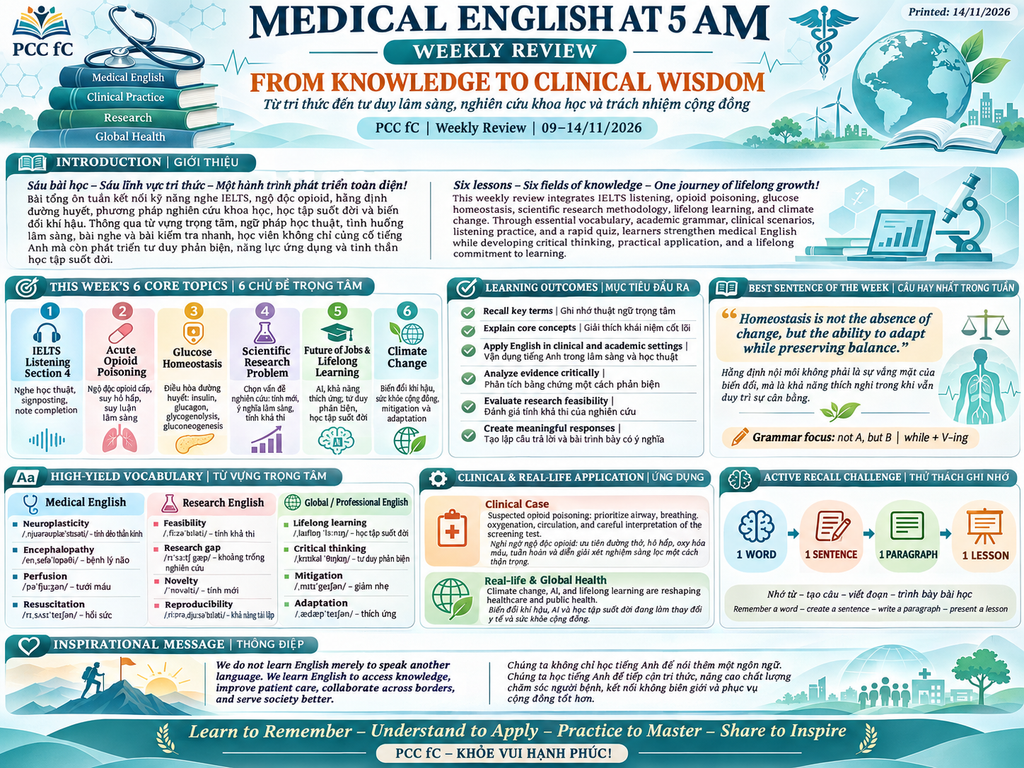
PCC Language – Thăng Long, Hà Nội, ngày 14/11/2026, Sáu bài học – Sáu lĩnh vực tri thức – Một hành trình phát triển toàn diện! Chương trình tổng ôn tuần của Lớp Tiếng Anh Y khoa 5H – PCC fC kết nối kỹ năng nghe IELTS, ngộ độc opioid, hằng định đường huyết, phương pháp nghiên cứu khoa học, học tập suốt đời và biến đổi khí hậu. Thông qua 30 từ vựng trọng tâm, ngữ pháp học thuật, tình huống lâm sàng, bài nghe và 20 câu hỏi kiểm tra, học viên không chỉ củng cố tiếng Anh mà còn phát triển tư duy phản biện, năng lực ứng dụng và tinh thần học tập suốt đời.
Six lessons – Six fields of knowledge – One journey of lifelong growth! This week’s review of Medical English at 5 AM – PCC fC integrates IELTS listening, opioid poisoning, glucose homeostasis, scientific research methodology, lifelong learning, and climate change. Through 30 essential vocabulary items, academic grammar, clinical scenarios, listening practice, and a 20-question quiz, learners will strengthen their medical English while developing critical thinking, practical application skills, and a lifelong commitment to learning.
MEDICAL ENGLISH AT 5 AM
WEEKLY COMPREHENSIVE REVIEW – LESSONS 157–162
TỔNG ÔN TẬP TIẾNG ANH Y KHOA TUẦN 27
PCC fC – Medical English Learning Community
Review period: 09–14 November 2026
Lessons: 157–162
Target proficiency: CEFR B2–C2, with advanced learning objectives at C1–C2
Duration: 30-minute interactive session + guided self-study
Educational approach: Evidence-based learning, clinical reasoning, academic communication and lifelong learning
Central theme: FROM KNOWLEDGE TO CLINICAL WISDOM
Từ tri thức đến tư duy lâm sàng, nghiên cứu khoa học và trách nhiệm với cộng đồng.
Learning philosophy:
Learn to Remember – Understand to Apply – Practice to Master – Share to Inspire.
Học để nhớ – Hiểu để vận dụng – Luyện để thành thạo – Chia sẻ để truyền cảm hứng.
PART I. WEEKLY LEARNING OVERVIEW
TỔNG QUAN KIẾN THỨC TRONG TUẦN
1.1. Six Lessons – Six Essential Competencies
| Lesson | Main topic | Core knowledge | Target competencies |
|---|---|---|---|
| 157 | IELTS Listening Section 4: Academic Lecture & Note Completion | Neuroplasticity; signposting; identifying key information | Listening comprehension, information processing |
| 158 | Acute Opioid Poisoning with Multiorgan Injury | Respiratory depression; myocardial injury; toxicological assessment | Clinical reasoning, emergency communication |
| 159 | Maintaining Homeostasis: Regulation of Blood Glucose | Insulin; glucagon; glycogenolysis; gluconeogenesis | Physiological explanation, scientific terminology |
| 160 | How to Choose a Good Scientific Research Problem | Research gaps; novelty; clinical relevance; feasibility | Research thinking, academic writing |
| 161 | Future of Jobs & Lifelong Learning | Artificial intelligence; adaptability; critical thinking | Professional communication, lifelong learning |
| 162 | Climate Change | Climate mechanisms; health effects; mitigation; adaptation | Public health communication, critical discussion |
1.2. Integrated Learning Framework
The six lessons are connected through a progressive educational pathway:
Listening → Understanding → Clinical Reasoning → Scientific Investigation → Professional Adaptation → Social Responsibility
Lắng nghe → Thấu hiểu → Suy luận lâm sàng → Nghiên cứu khoa học → Thích ứng nghề nghiệp → Trách nhiệm xã hội.
Each lesson develops a different competency, but all six contribute to the same ultimate goal: improving the ability to understand, communicate, evaluate and apply knowledge.
1.3. Learning Outcomes
By the end of the weekly review, learners should be able to:
- Recall at least 20 of 30 essential terms from the six lessons.
- Explain major physiological and clinical concepts in accurate medical English.
- Apply appropriate academic vocabulary and grammatical structures to professional communication.
- Analyze clinical information without confusing observations, associations and causal conclusions.
- Evaluate the novelty, feasibility and relevance of scientific research questions.
- Discuss the implications of artificial intelligence and climate change for healthcare.
- Create a coherent spoken or written response integrating knowledge from multiple lessons.
1.4. Cognitive Levels
The learning activities follow Bloom’s Revised Taxonomy:
| Cognitive level | Educational objective | Example activity |
|---|---|---|
| Remember | Recall terminology | Identify neuroplasticity |
| Understand | Explain mechanisms | Describe insulin–glucagon regulation |
| Apply | Use knowledge | Present a patient case in English |
| Analyze | Identify relationships | Interpret troponin elevation in poisoning |
| Evaluate | Make justified judgments | Assess research feasibility |
| Create | Produce new responses | Design a research question or clinical presentation |
Educational principle: A successful review does not merely measure how much information learners remember. It assesses what they can understand, explain, apply and communicate.
PART II. VOCABULARY MASTERY
30 ESSENTIAL WORDS AND EXPRESSIONS
The vocabulary is organized into three complementary categories: medical English, scientific research English, and professional or global communication English.
The IPA transcriptions mainly follow British English pronunciation. Example sentences are newly constructed for educational use.
2.1. Group A – Medical and Clinical English
1. Neuroplasticity
- IPA: /ˌnjʊərəʊplæˈstɪsəti/
- Part of speech: noun (n.)
- Meaning: Tính dẻo thần kinh.
- Collocation: experience-dependent neuroplasticity.
- Example: Rehabilitation may promote neuroplasticity after stroke.
- Vietnamese: Phục hồi chức năng có thể thúc đẩy tính dẻo thần kinh sau đột quỵ.
- Clinical note: Neuroplasticity involves the nervous system’s capacity to reorganize its structure or function in response to experience, learning or injury.
2. Pharmacological
- IPA: /ˌfɑːməkəˈlɒdʒɪkəl/
- Part of speech: adjective (adj.)
- Meaning: Thuộc dược lý, liên quan đến tác dụng của thuốc.
- Collocation: pharmacological intervention.
- Example: Pharmacological interventions should be evaluated for efficacy and safety.
- Vietnamese: Các can thiệp bằng thuốc cần được đánh giá về hiệu quả và tính an toàn.
3. Encephalopathy
- IPA: /enˌsefəˈlɒpəθi/
- Part of speech: noun (n.)
- Meaning: Bệnh lý não.
- Collocation: toxic encephalopathy.
- Example: Toxic encephalopathy may manifest as altered mental status.
- Vietnamese: Bệnh lý não do độc chất có thể biểu hiện bằng rối loạn trạng thái tâm thần hoặc ý thức.
4. Hypoxaemia
- IPA: /ˌhaɪpɒkˈsiːmiə/
- Part of speech: noun (n.)
- Meaning: Thiếu oxy máu.
- Collocation: severe hypoxaemia.
- Example: Severe hypoxaemia requires immediate assessment and appropriate respiratory support.
- Vietnamese: Thiếu oxy máu nặng cần được đánh giá ngay và hỗ trợ hô hấp phù hợp.
5. Perfusion
- IPA: /pəˈfjuːʒən/
- Part of speech: noun (n.)
- Meaning: Sự tưới máu.
- Collocation: tissue perfusion.
- Example: Inadequate tissue perfusion can contribute to elevated lactate.
- Vietnamese: Tưới máu mô không đầy đủ có thể góp phần làm tăng lactat.
6. Hypophosphataemia
- IPA: /ˌhaɪpəʊfɒsfəˈtiːmiə/
- Part of speech: noun (n.)
- Meaning: Hạ phosphat máu.
- Collocation: severe hypophosphataemia.
- Example: Severe hypophosphataemia may impair respiratory muscle function.
- Vietnamese: Hạ phosphat máu nặng có thể ảnh hưởng đến chức năng cơ hô hấp.
7. Myocardial
- IPA: /ˌmaɪəˈkɑːdiəl/
- Part of speech: adjective (adj.)
- Meaning: Thuộc cơ tim.
- Collocation: myocardial injury.
- Example: Elevated cardiac troponin may indicate myocardial injury.
- Vietnamese: Troponin tim tăng có thể cho thấy có tổn thương cơ tim.
Clinical distinction: Myocardial injury is not synonymous with myocardial infarction. Myocardial infarction requires evidence of acute myocardial injury together with clinical evidence of myocardial ischaemia.
8. Homeostasis
- IPA: /ˌhəʊmiəʊˈsteɪsɪs/
- Part of speech: noun (n.)
- Meaning: Hằng định nội môi.
- Collocation: glucose homeostasis.
- Example: Multiple hormonal mechanisms contribute to glucose homeostasis.
- Vietnamese: Nhiều cơ chế nội tiết phối hợp góp phần duy trì hằng định đường huyết.
9. Glycogenolysis
- IPA: /ˌɡlaɪkəʊdʒəˈnɒlɪsɪs/
- Part of speech: noun (n.)
- Meaning: Sự phân giải glycogen.
- Collocation: hepatic glycogenolysis.
- Example: During early fasting, hepatic glycogenolysis helps maintain blood glucose.
- Vietnamese: Trong giai đoạn đầu nhịn ăn, quá trình phân giải glycogen ở gan giúp duy trì đường huyết.
10. Gluconeogenesis
- IPA: /ˌɡluːkəʊˌniːəʊˈdʒenəsɪs/
- Part of speech: noun (n.)
- Meaning: Sự tân tạo glucose.
- Collocation: hepatic gluconeogenesis.
- Example: Gluconeogenesis produces glucose from non-carbohydrate precursors.
- Vietnamese: Tân tạo glucose tạo ra glucose từ các tiền chất không phải carbohydrate.
11. Insulin resistance
- IPA: /ˈɪnsjʊlɪn rɪˈzɪstəns/
- Part of speech: noun phrase (n. phr.)
- Meaning: Tình trạng đề kháng insulin.
- Collocation: peripheral insulin resistance.
- Example: Insulin resistance contributes to the pathophysiology of type 2 diabetes.
- Vietnamese: Đề kháng insulin góp phần vào cơ chế bệnh sinh của đái tháo đường type 2.
12. Resuscitation
- IPA: /rɪˌsʌsɪˈteɪʃən/
- Part of speech: noun (n.)
- Meaning: Hồi sức.
- Collocation: initial resuscitation.
- Example: Initial resuscitation prioritizes immediately life-threatening problems.
- Vietnamese: Hồi sức ban đầu ưu tiên xử trí các vấn đề đe dọa tính mạng tức thời.
2.2. Group B – Scientific Research and Academic English
13. Feasibility
- IPA: /ˌfiːzəˈbɪləti/
- Part of speech: noun (n.)
- Meaning: Tính khả thi.
- Collocation: feasibility assessment.
- Example: Researchers must assess feasibility before initiating a study.
- Vietnamese: Các nhà nghiên cứu cần đánh giá tính khả thi trước khi bắt đầu nghiên cứu.
14. Research gap
- IPA: /rɪˈsɜːtʃ ɡæp/
- Part of speech: noun phrase (n. phr.)
- Meaning: Khoảng trống nghiên cứu.
- Collocation: identify a research gap.
- Example: A systematic literature review may reveal important research gaps.
- Vietnamese: Tổng quan tài liệu có hệ thống có thể giúp phát hiện những khoảng trống nghiên cứu quan trọng.
15. Hypothesis
- IPA: /haɪˈpɒθəsɪs/
- Part of speech: noun (n.)
- Meaning: Giả thuyết.
- Collocation: test a hypothesis.
- Example: The investigators formulated a hypothesis before collecting data.
- Vietnamese: Các nhà nghiên cứu xây dựng giả thuyết trước khi thu thập dữ liệu.
16. Novelty
- IPA: /ˈnɒvəlti/
- Part of speech: noun (n.)
- Meaning: Tính mới.
- Collocation: scientific novelty.
- Example: Scientific novelty should be considered alongside clinical relevance.
- Vietnamese: Tính mới khoa học cần được xem xét cùng với ý nghĩa lâm sàng.
17. Confounding
- IPA: /kənˈfaʊndɪŋ/
- Part of speech: noun (n.)
- Meaning: Sự nhiễu trong nghiên cứu.
- Collocation: control for confounding.
- Example: Researchers should consider confounding when interpreting observational data.
- Vietnamese: Nhà nghiên cứu cần cân nhắc yếu tố nhiễu khi diễn giải dữ liệu quan sát.
18. Reproducibility
- IPA: /ˌriːprəˌdjuːsəˈbɪləti/
- Part of speech: noun (n.)
- Meaning: Khả năng tái lập.
- Collocation: research reproducibility.
- Example: Transparent research methods can improve reproducibility.
- Vietnamese: Phương pháp nghiên cứu minh bạch có thể cải thiện khả năng tái lập.
19. Primary outcome
- IPA: /ˈpraɪməri ˈaʊtkʌm/
- Part of speech: noun phrase (n. phr.)
- Meaning: Kết cục chính.
- Collocation: prespecified primary outcome.
- Example: The primary outcome should be defined before data analysis.
- Vietnamese: Kết cục chính nên được xác định trước khi phân tích dữ liệu.
20. Clinical relevance
- IPA: /ˈklɪnɪkəl ˈreləvəns/
- Part of speech: noun phrase (n. phr.)
- Meaning: Ý nghĩa hoặc tính liên quan lâm sàng.
- Collocation: establish clinical relevance.
- Example: Statistical significance does not necessarily imply clinical relevance.
- Vietnamese: Ý nghĩa thống kê không nhất thiết đồng nghĩa với ý nghĩa lâm sàng.
2.3. Group C – Future, Society and Global Health English
21. Automation
- IPA: /ˌɔːtəˈmeɪʃən/
- Part of speech: noun (n.)
- Meaning: Sự tự động hóa.
- Collocation: workplace automation.
- Example: Automation may reduce the burden of repetitive administrative tasks.
- Vietnamese: Tự động hóa có thể giảm gánh nặng công việc hành chính lặp lại.
22. Adaptability
- IPA: /əˌdæptəˈbɪləti/
- Part of speech: noun (n.)
- Meaning: Khả năng thích ứng.
- Collocation: professional adaptability.
- Example: Adaptability is essential in a rapidly changing healthcare environment.
- Vietnamese: Khả năng thích ứng rất quan trọng trong môi trường y tế thay đổi nhanh chóng.
23. Lifelong learning
- IPA: /ˌlaɪflɒŋ ˈlɜːnɪŋ/
- Part of speech: noun phrase (n. phr.)
- Meaning: Học tập suốt đời.
- Collocation: commitment to lifelong learning.
- Example: Lifelong learning is fundamental to maintaining professional competence.
- Vietnamese: Học tập suốt đời là nền tảng để duy trì năng lực chuyên môn.
24. Critical thinking
- IPA: /ˌkrɪtɪkəl ˈθɪŋkɪŋ/
- Part of speech: noun phrase (n. phr.)
- Meaning: Tư duy phản biện.
- Collocation: apply critical thinking.
- Example: Critical thinking is indispensable when interpreting AI-generated recommendations.
- Vietnamese: Tư duy phản biện là điều không thể thiếu khi diễn giải các khuyến nghị do AI tạo ra.
25. Resilience
- IPA: /rɪˈzɪliəns/
- Part of speech: noun (n.)
- Meaning: Khả năng chống chịu và phục hồi.
- Collocation: climate resilience.
- Example: Healthcare systems must strengthen their resilience to climate-related hazards.
- Vietnamese: Hệ thống y tế cần tăng cường khả năng chống chịu trước các hiểm họa liên quan đến khí hậu.
26. Anthropogenic
- IPA: /ˌænθrəpəˈdʒenɪk/
- Part of speech: adjective (adj.)
- Meaning: Do hoạt động của con người gây ra.
- Collocation: anthropogenic greenhouse gas emissions.
- Example: Anthropogenic greenhouse gas emissions are the principal driver of recent global warming.
- Vietnamese: Phát thải khí nhà kính do con người gây ra là động lực chính của hiện tượng nóng lên toàn cầu gần đây.
27. Mitigation
- IPA: /ˌmɪtɪˈɡeɪʃən/
- Part of speech: noun (n.)
- Meaning: Sự giảm nhẹ.
- Collocation: climate change mitigation.
- Example: Climate mitigation requires substantial reductions in greenhouse gas emissions.
- Vietnamese: Giảm nhẹ biến đổi khí hậu đòi hỏi cắt giảm đáng kể phát thải khí nhà kính.
28. Adaptation
- IPA: /ˌædæpˈteɪʃən/
- Part of speech: noun (n.)
- Meaning: Sự thích ứng.
- Collocation: climate adaptation.
- Example: Heat-health action plans represent an important adaptation strategy.
- Vietnamese: Các kế hoạch hành động bảo vệ sức khỏe trước nắng nóng là chiến lược thích ứng quan trọng.
29. Sustainability
- IPA: /səˌsteɪnəˈbɪləti/
- Part of speech: noun (n.)
- Meaning: Tính bền vững.
- Collocation: environmental sustainability.
- Example: Sustainable healthcare requires responsible resource management.
- Vietnamese: Y tế bền vững đòi hỏi quản lý nguồn lực có trách nhiệm.
30. Biodiversity
- IPA: /ˌbaɪəʊdaɪˈvɜːsəti/
- Part of speech: noun (n.)
- Meaning: Đa dạng sinh học.
- Collocation: biodiversity loss.
- Example: Climate change and habitat destruction contribute to biodiversity loss.
- Vietnamese: Biến đổi khí hậu và phá hủy môi trường sống góp phần làm suy giảm đa dạng sinh học.
2.4. High-Yield Vocabulary Distinctions
| Term A | Term B | Key distinction |
|---|---|---|
| Hypoxaemia | Hypoxia | Reduced arterial oxygenation vs inadequate oxygen availability or utilisation at the tissue level |
| Glycogenolysis | Gluconeogenesis | Breakdown of glycogen vs generation of glucose from non-carbohydrate precursors |
| Hyperglycaemia | Hypoglycaemia | High vs low blood glucose |
| Myocardial injury | Myocardial infarction | Troponin-defined myocardial injury vs acute injury with evidence of myocardial ischaemia |
| Novelty | Feasibility | Originality of a question vs practicality of investigating it |
| Association | Causation | Statistical relationship vs causal effect |
| Mitigation | Adaptation | Addressing causes of climate change vs adjusting to its effects |
| Discrimination | Calibration | Distinguishing higher-risk individuals vs agreement between predicted and observed risks |
Active Recall Exercise
Without consulting the vocabulary list:
- Define five medical terms in English.
- Explain three research terms.
- Compare mitigation and adaptation.
- Construct three sentences integrating terminology from different lessons.
PART III. GRAMMAR AND BEST SENTENCES
SIX KEY ACADEMIC AND CLINICAL STRUCTURES
The following sentences represent the key language structures introduced across the six lessons. Their grammatical analysis and applications are organized for review.
Sentence 1. Academic Signposting – Lesson 157
“Turning now to the underlying mechanism…”
Bây giờ, chúng ta chuyển sang cơ chế nền tảng…
Grammar: Present-participle phrase used as a discourse marker.
Function: Indicates a transition to a new section of a lecture.
Useful alternatives:
- Moving on to…
- Let us now consider…
- With regard to…
- Another important aspect is…
Application:
“Turning now to the pathophysiology, we should consider the mechanisms of respiratory depression.”
Chuyển sang cơ chế bệnh sinh, chúng ta cần xem xét các cơ chế gây giảm thông khí.
Common mistake: Treating signposting expressions as irrelevant filler rather than essential cues for lecture structure.
Sentence 2. Clinical Uncertainty – Lesson 158
“A positive morphine screen indicates possible exposure but does not independently confirm opioid toxicity.”
Xét nghiệm sàng lọc morphin dương tính gợi ý khả năng phơi nhiễm nhưng tự nó không xác nhận ngộ độc opioid.
Subject: A positive morphine screen.
Compound predicate: indicates possible exposure / does not independently confirm opioid toxicity.
Tense: Present simple.
Structure: A but B – contrasting evidence and inference.
Scientific function: Avoiding unjustified diagnostic certainty.
Paraphrase:
“Although the morphine screen is positive, a diagnosis of opioid toxicity still requires clinical correlation.”
Mặc dù xét nghiệm sàng lọc morphin dương tính, chẩn đoán ngộ độc opioid vẫn cần đối chiếu với biểu hiện lâm sàng.
Sentence 3. Scientific Definition – Lesson 159
“Homeostasis is not the absence of change, but the ability to adapt while preserving balance.”
Hằng định nội môi không phải là sự vắng mặt của biến đổi, mà là khả năng thích nghi trong khi vẫn duy trì cân bằng.
Subject: Homeostasis.
Main verb: is.
Pattern: not A, but B.
Additional structure: while + V-ing.
Application:
“Clinical stability is not merely the absence of symptoms, but the maintenance of adequate physiological function.”
Ổn định lâm sàng không chỉ là không có triệu chứng, mà còn là duy trì chức năng sinh lý đầy đủ.
Sentence 4. Research Feasibility – Lesson 160
“A good scientific problem should be sufficiently challenging to advance knowledge, yet realistic enough to investigate with available resources.”
Một vấn đề nghiên cứu khoa học tốt phải đủ thách thức để phát triển tri thức nhưng cũng đủ thực tế để có thể nghiên cứu bằng những nguồn lực hiện có.
Subject: A good scientific problem.
Modal verb: should.
Patterns:
- sufficiently + adjective + to-infinitive
- adjective + enough + to-infinitive
- yet = nevertheless / but
Application:
“A clinically relevant research question should be sufficiently focused to allow reliable investigation.”
Một câu hỏi nghiên cứu có ý nghĩa lâm sàng cần đủ tập trung để có thể được khảo sát một cách đáng tin cậy.
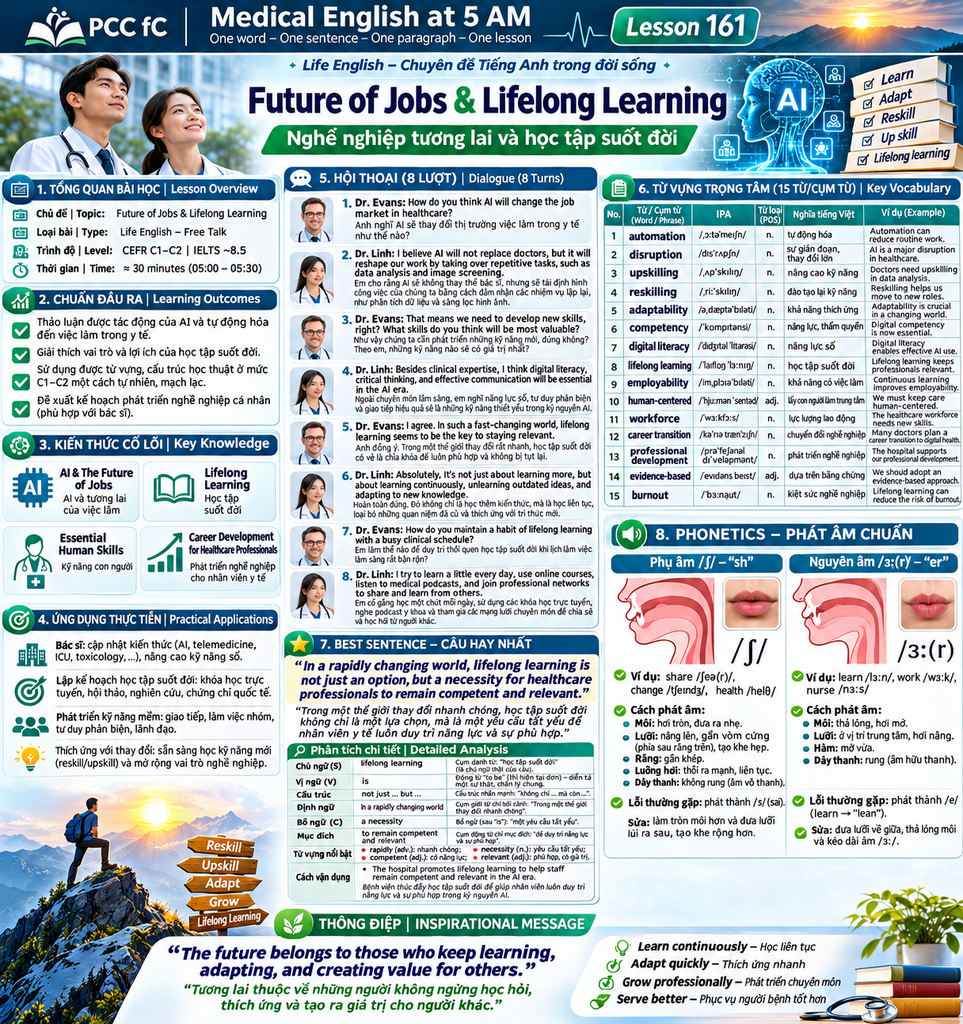
Sentence 5. Future and Lifelong Learning – Lesson 161
“The future will not simply reward those who possess the most knowledge today.”
Tương lai sẽ không chỉ ưu ái những người sở hữu nhiều kiến thức nhất hiện nay.
Subject: The future.
Verb phrase: will not simply reward.
Relative clause: who possess the most knowledge today.
Tense: Future simple.
Application:
“Healthcare systems will increasingly value professionals who can evaluate evidence and adapt to technological change.”
Các hệ thống y tế sẽ ngày càng coi trọng những chuyên gia có khả năng đánh giá bằng chứng và thích ứng với thay đổi công nghệ.
Sentence 6. Global Health – Lesson 162
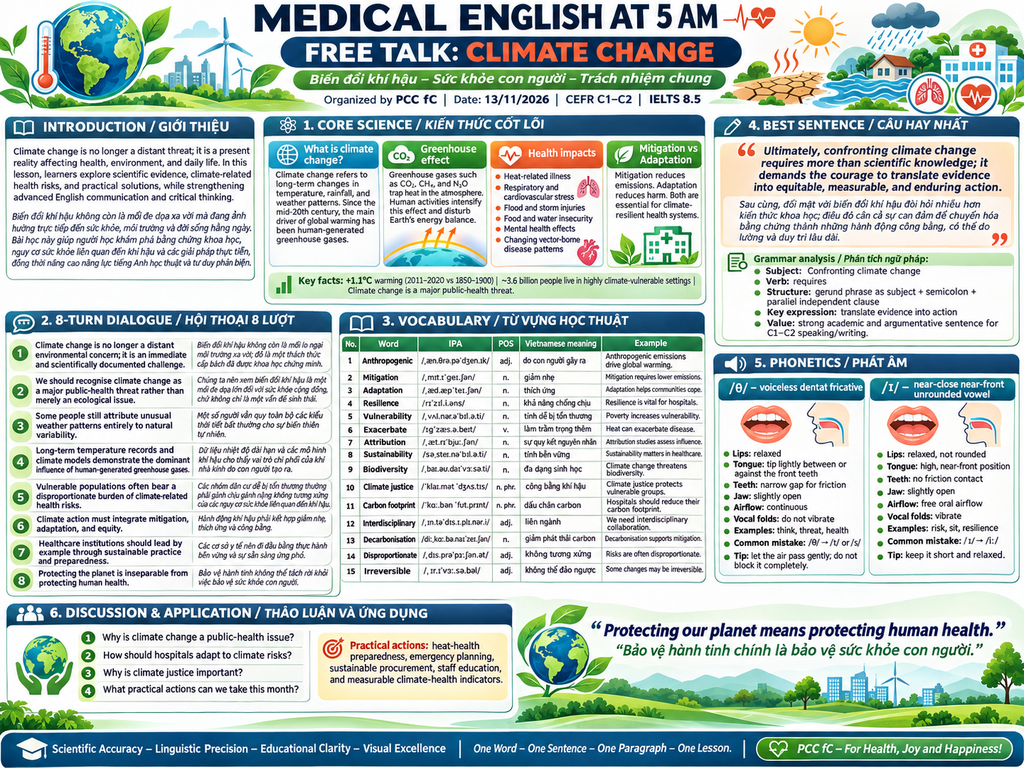
“Climate change is no longer a distant threat; it is a present reality affecting our health, environment, and future.”
Biến đổi khí hậu không còn là mối đe dọa xa vời; đó là thực tế hiện hữu đang ảnh hưởng đến sức khỏe, môi trường và tương lai của chúng ta.
Subjects: Climate change / it.
Main verbs: is / is.
Grammar: Two independent clauses joined by a semicolon.
Participle phrase: affecting our health, environment, and future.
Application:
“Antimicrobial resistance is no longer a distant concern; it is an immediate threat to patient safety.”
Kháng kháng sinh không còn là mối lo xa vời; đó là mối đe dọa trực tiếp đối với an toàn người bệnh.
3.1. Common Grammar Errors
| Incorrect | Correct | Explanation |
|---|---|---|
| Discuss about climate change | Discuss climate change | Discuss is transitive |
| Researchs show… | Research shows… / Studies show… | Research is generally uncountable |
| An important informations | Important information | Information is uncountable |
| Despite of the evidence | Despite the evidence | Despite does not take of |
| The patient was diagnosed opioid poisoning | The patient was diagnosed with opioid poisoning | Diagnose someone with a condition |
| A more feasible research | A more feasible study | Research is generally uncountable |
3.2. Sentence Transformation Exercises
Rewrite each sentence without changing its meaning.
- The study is clinically relevant, but its feasibility remains uncertain.
Use: Although. - The prediction model requires validation before routine clinical use.
Use: passive voice with must. - AI supports documentation. AI also supports clinical data analysis.
Use: not only … but also.
Suggested answers:
- Although the study is clinically relevant, its feasibility remains uncertain.
- The prediction model must be validated before it is used in routine clinical practice.
- AI supports not only documentation but also clinical data analysis.
PART IV. PHONETICS AND LISTENING
PHÁT ÂM VÀ KỸ NĂNG NGHE HỌC THUẬT
4.1. Ten Challenging Words
| Word | IPA | Main stress |
|---|---|---|
| Neuroplasticity | /ˌnjʊərəʊplæˈstɪsəti/ | STIS |
| Encephalopathy | /enˌsefəˈlɒpəθi/ | LOP |
| Hypophosphataemia | /ˌhaɪpəʊfɒsfəˈtiːmiə/ | TEE |
| Gluconeogenesis | /ˌɡluːkəʊˌniːəʊˈdʒenəsɪs/ | GEN |
| Homeostasis | /ˌhəʊmiəʊˈsteɪsɪs/ | STAY |
| Feasibility | /ˌfiːzəˈbɪləti/ | BIL |
| Reproducibility | /ˌriːprəˌdjuːsəˈbɪləti/ | BIL |
| Anthropogenic | /ˌænθrəpəˈdʒenɪk/ | GEN |
| Sustainability | /səˌsteɪnəˈbɪləti/ | BIL |
| Resilience | /rɪˈzɪliəns/ | ZIL |
4.2. Consonant Contrast: /θ/ and /ð/
/θ/: Voiceless dental fricative – Phụ âm xát răng vô thanh
- Tongue: Tip or blade close to the upper teeth or gently between the teeth.
- Lips: Relaxed.
- Airflow: Continuous through a narrow gap.
- Vocal folds: No vibration.
- Examples: think, hypothesis, anthropogenic.
/ð/: Voiced dental fricative – Phụ âm xát răng hữu thanh
- Tongue: Similar placement.
- Lips: Relaxed.
- Airflow: Continuous.
- Vocal folds: Vibrating.
- Examples: this, those, although.
Minimal-pair practice:
- thin /θɪn/ – then /ðen/
- thigh /θaɪ/ – thy /ðaɪ/
Practice sentence:
“Think through the theory, although the evidence is incomplete.”
Hãy suy xét kỹ lý thuyết, mặc dù bằng chứng chưa đầy đủ.
4.3. Academic Listening – Integrated Medical Lecture
Title: The Connected Future of Medicine
Duration: Approximately 2.5–3 minutes, depending on speaking rate.
Transcript
Good morning, everyone. Today, we will explore how scientific thinking connects clinical medicine, research, technology, and global health.
First, consider neuroplasticity. Following a stroke, the brain may reorganize some neural connections through experience and rehabilitation. However, recovery varies, and pharmacological interventions require careful evaluation.
Moving on to clinical toxicology, patients with suspected opioid poisoning may present with impaired consciousness and respiratory depression. The first priority is to assess and support breathing and circulation. A positive urine drug screen may indicate exposure, but it does not independently establish the cause of illness. Clinical reasoning must integrate symptoms, examinations, and laboratory findings.
Turning now to glucose homeostasis, insulin and glucagon play complementary roles. After a meal, insulin promotes glucose uptake in insulin-sensitive tissues and supports energy storage. During fasting, glucagon helps the liver maintain blood glucose through glycogenolysis and gluconeogenesis.
How can these clinical observations become meaningful research? An effective research question should address a genuine knowledge gap, have clinical relevance, and remain feasible within available resources. Researchers must consider methodological rigor, reproducibility, and ethical responsibilities.
Meanwhile, artificial intelligence is transforming healthcare. It may support documentation, data analysis, and clinical decision-making, but its outputs require validation and human oversight. Lifelong learning and critical thinking are therefore essential.
Finally, climate change reminds us that medicine extends beyond hospital walls. Extreme heat can threaten vulnerable populations, while mitigation and adaptation can reduce risks. Healthcare professionals have an important role in preparedness, education, and evidence-based advocacy.
In summary, good medicine requires more than memorizing facts. We must listen critically, interpret evidence, communicate clearly, and act responsibly. Continuous learning helps us connect individual patient care with the health of our communities and the future of our planet.
4.4. Listening Note Completion
Instructions: Write ONE WORD ONLY in each gap.
- Stroke rehabilitation may promote __________.
- In suspected opioid poisoning, clinicians must assess and support __________.
- During fasting, __________ helps maintain blood glucose.
- A useful research question should be clinically relevant and __________.
- Climate mitigation and __________ are complementary strategies.
Answer key:
- neuroplasticity
- breathing
- glucagon
- feasible
- adaptation
Listening strategy: Identify signposting expressions such as first, moving on to, turning now to, meanwhile, finally, and in summary. These expressions help listeners anticipate changes in lecture structure and locate information.
PART V. CLINICAL AND REAL-LIFE ENGLISH
INTEGRATED CASE-BASED LEARNING
Case 1. Suspected Opioid Poisoning with Multiorgan Injury
Clinical Scenario
A 46-year-old man is admitted with reduced consciousness, slow breathing, hypotension, elevated serum lactate and elevated cardiac troponin. A urine morphine immunoassay is positive.
Nam bệnh nhân 46 tuổi nhập viện với giảm ý thức, thở chậm, tụt huyết áp, lactat máu tăng và troponin tim tăng. Xét nghiệm miễn dịch sàng lọc morphin niệu dương tính.
Clinical Reasoning Dialogue – Eight Turns
1. Resident:
“The patient has respiratory depression and altered consciousness. Could this be opioid poisoning?”
Bệnh nhân giảm thông khí và rối loạn ý thức. Đây có thể là ngộ độc opioid không?
2. Toxicologist:
“It is possible, but we must prioritize airway protection, ventilation, oxygenation, and circulation.”
Có thể, nhưng chúng ta phải ưu tiên bảo vệ đường thở, thông khí, oxy hóa máu và tuần hoàn.
3. Resident:
“His urine morphine screen is positive. Does that establish the diagnosis?”
Xét nghiệm sàng lọc morphin niệu dương tính. Như vậy đã đủ xác định chẩn đoán chưa?
4. Toxicologist:
“No. A screening result alone cannot establish the cause of his clinical condition.”
Chưa. Chỉ riêng kết quả sàng lọc không thể xác định nguyên nhân tình trạng lâm sàng.
5. Resident:
“Could the elevated lactate and troponin be related to hypoxia or poor tissue perfusion?”
Lactat và troponin tăng có thể liên quan đến thiếu oxy mô hoặc giảm tưới máu mô không?
6. Toxicologist:
“Yes, but we should evaluate other possible causes and examine the trends over time.”
Đúng, nhưng chúng ta cần đánh giá các nguyên nhân khác và theo dõi diễn biến các chỉ số theo thời gian.
7. Resident:
“Should we consider naloxone while supporting ventilation?”
Chúng ta có nên cân nhắc naloxone đồng thời hỗ trợ thông khí không?
8. Toxicologist:
“Yes, when clinically indicated. Restore adequate ventilation, monitor the response, and reassess for recurrent respiratory depression and other complications.”
Có, khi có chỉ định lâm sàng. Cần khôi phục thông khí đầy đủ, theo dõi đáp ứng và đánh giá lại nguy cơ tái diễn giảm thông khí cùng các biến chứng khác.
Clinical Discussion
Question 1: Why is a positive urine morphine screen insufficient to establish opioid toxicity?
Suggested explanation: A screening immunoassay may detect exposure or cross-reacting substances, but its result must be interpreted alongside the clinical presentation, assay characteristics and differential diagnosis. It cannot independently establish the cause or severity of the current illness.
Question 2: What is the difference between myocardial injury and myocardial infarction?
Suggested explanation: Myocardial injury is defined by cardiac troponin above the 99th percentile upper reference limit. Acute injury involves a rise and/or fall in troponin. Myocardial infarction additionally requires evidence of acute myocardial ischaemia.
Question 3: What are the immediate management priorities?
Suggested explanation: Assess and stabilize airway, breathing and circulation; provide appropriate ventilatory support; administer naloxone when indicated; and monitor for recurrent respiratory depression, aspiration and other complications. Do not delay emergency treatment while awaiting toxicology screening results.
Clinical Safety Principle:
Treat the patient, not the screening test.
Điều trị dựa trên tình trạng người bệnh, không chỉ dựa vào xét nghiệm sàng lọc.
Case 2. Climate Change, Artificial Intelligence and Lifelong Learning
Scenario
A hospital has observed increasing emergency visits during periods of extreme heat. Its management team is considering an AI-assisted warning system.
Một bệnh viện nhận thấy số lượt cấp cứu tăng trong các đợt nắng nóng cực đoan. Ban quản lý đang xem xét hệ thống cảnh báo có hỗ trợ AI.
Professional Dialogue – Eight Turns
1. Physician:
“Our emergency department is seeing more patients with heat-related illnesses.”
Khoa cấp cứu của chúng ta đang tiếp nhận nhiều bệnh nhân mắc bệnh liên quan đến nắng nóng hơn.
2. Researcher:
“We should investigate whether extreme heat is associated with increased emergency admissions.”
Chúng ta nên nghiên cứu liệu nắng nóng cực đoan có liên quan đến sự gia tăng số ca nhập cấp cứu hay không.
3. Physician:
“Could artificial intelligence help us identify high-risk periods?”
Trí tuệ nhân tạo có thể giúp chúng ta xác định các giai đoạn nguy cơ cao không?
4. Researcher:
“Potentially, but any prediction model requires robust validation and careful monitoring.”
Có thể, nhưng mọi mô hình dự báo đều cần được xác thực chặt chẽ và giám sát cẩn thận.
5. Physician:
“We also need practical adaptation strategies for vulnerable patients.”
Chúng ta cũng cần các chiến lược thích ứng thiết thực cho người bệnh dễ bị tổn thương.
6. Researcher:
“Agreed. Public education, heat-health alerts, and appropriate cooling measures may reduce health risks.”
Tôi đồng ý. Giáo dục cộng đồng, cảnh báo sức khỏe do nắng nóng và các biện pháp làm mát phù hợp có thể giảm nguy cơ sức khỏe.
7. Physician:
“How can our staff prepare for these new challenges?”
Nhân viên của chúng ta có thể chuẩn bị như thế nào trước những thách thức mới?
8. Researcher:
“Through lifelong learning, interdisciplinary teamwork, and evidence-based decision-making.”
Thông qua học tập suốt đời, phối hợp liên chuyên ngành và ra quyết định dựa trên bằng chứng.
Discussion Questions
- How can hospitals distinguish associations with extreme heat from seasonal and other confounding effects?
- Why must AI prediction models be validated before routine clinical deployment?
- How do climate mitigation and climate adaptation differ?
- What responsibilities do healthcare professionals have in community preparedness?
Integrated Learning Task
Work in pairs. Design a brief heat-health preparedness plan and explain it in English using at least five terms from the vocabulary list.
Assessment criteria: Accuracy, clarity, scientific reasoning and feasibility.
PART VI. WEEKLY KNOWLEDGE ASSESSMENT
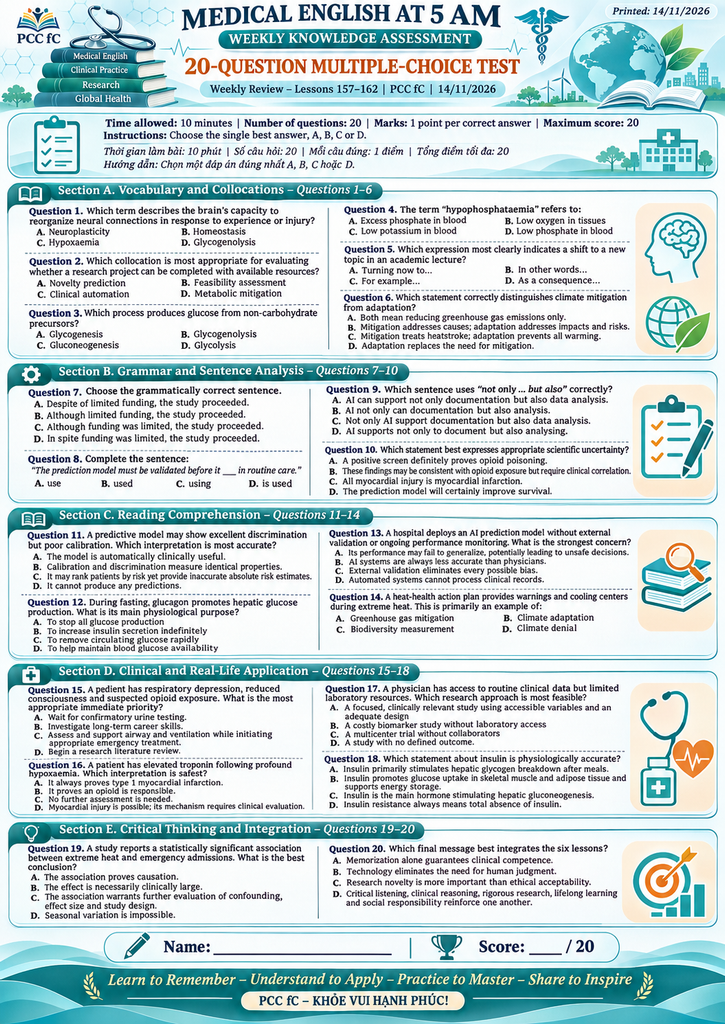
20-QUESTION MULTIPLE-CHOICE TEST
Time allowed: 10 minutes
Number of questions: 20
Marks: 1 point per correct answer
Maximum score: 20 points
Instructions: Choose the single best answer, A, B, C or D.
Section A. Vocabulary and Collocations – Questions 1–6
Question 1. Which term describes the brain’s capacity to reorganize neural connections in response to experience or injury?
A. Neuroplasticity
B. Homeostasis
C. Hypoxaemia
D. Glycogenolysis
Question 2. Which collocation is most appropriate for evaluating whether a research project can be completed with available resources?
A. Novelty prediction
B. Feasibility assessment
C. Clinical automation
D. Metabolic mitigation
Question 3. Which process produces glucose from non-carbohydrate precursors?
A. Glycogenesis
B. Glycogenolysis
C. Gluconeogenesis
D. Glycolysis
Question 4. The term “hypophosphataemia” refers to:
A. Excess phosphate in blood
B. Low oxygen in tissues
C. Low potassium in blood
D. Low phosphate in blood
Question 5. Which expression most clearly indicates a shift to a new topic in an academic lecture?
A. Turning now to…
B. In other words…
C. For example…
D. As a consequence…
Question 6. Which statement correctly distinguishes climate mitigation from adaptation?
A. Both mean reducing greenhouse gas emissions only.
B. Mitigation addresses causes; adaptation addresses impacts and risks.
C. Mitigation treats heatstroke; adaptation prevents all warming.
D. Adaptation replaces the need for mitigation.
Section B. Grammar and Sentence Analysis – Questions 7–10
Question 7. Choose the grammatically correct sentence.
A. Despite of limited funding, the study proceeded.
B. Although limited funding, the study proceeded.
C. Although funding was limited, the study proceeded.
D. In spite funding was limited, the study proceeded.
Question 8. Complete the sentence:
“The prediction model must be validated before it ___ in routine care.”
A. use
B. used
C. using
D. is used
Question 9. Which sentence uses “not only … but also” correctly?
A. AI can support not only documentation but also data analysis.
B. AI not only can documentation but also analysis.
C. Not only AI support documentation but also data analysis.
D. AI supports not only to document but also analysing.
Question 10. Which statement best expresses appropriate scientific uncertainty?
A. A positive screen definitely proves opioid poisoning.
B. These findings may be consistent with opioid exposure but require clinical correlation.
C. All myocardial injury is myocardial infarction.
D. The prediction model will certainly improve survival.
Section C. Reading Comprehension – Questions 11–14
Question 11. A predictive model may show excellent discrimination but poor calibration. Which interpretation is most accurate?
A. The model is automatically clinically useful.
B. Calibration and discrimination measure identical properties.
C. It may rank patients by risk yet provide inaccurate absolute risk estimates.
D. It cannot produce any predictions.
Question 12. During fasting, glucagon promotes hepatic glucose production. What is its main physiological purpose?
A. To stop all glucose production
B. To increase insulin secretion indefinitely
C. To remove circulating glucose rapidly
D. To help maintain blood glucose availability
Question 13. A hospital deploys an AI prediction model without external validation or ongoing performance monitoring. What is the strongest concern?
A. Its performance may fail to generalize, potentially leading to unsafe decisions.
B. AI systems are always less accurate than physicians.
C. External validation eliminates every possible bias.
D. Automated systems cannot process clinical records.
Question 14. A heat-health action plan provides warnings and cooling centers during extreme heat. This is primarily an example of:
A. Greenhouse gas mitigation
B. Climate adaptation
C. Biodiversity measurement
D. Climate denial
Section D. Clinical and Real-Life Application – Questions 15–18
Question 15. A patient has respiratory depression, reduced consciousness and suspected opioid exposure. What is the most appropriate immediate priority?
A. Wait for confirmatory urine testing.
B. Investigate long-term career skills.
C. Assess and support airway and ventilation while initiating appropriate emergency treatment.
D. Begin a research literature review.
Question 16. A patient has elevated troponin following profound hypoxaemia. Which interpretation is safest?
A. It always proves type 1 myocardial infarction.
B. It proves an opioid is responsible.
C. No further assessment is needed.
D. Myocardial injury is possible; its mechanism requires clinical evaluation.
Question 17. A physician has access to routine clinical data but limited laboratory resources. Which research approach is most feasible?
A. A focused, clinically relevant study using accessible variables and an adequate design
B. A costly biomarker study without laboratory access
C. A multicenter trial without collaborators
D. A study with no defined outcome
Question 18. Which statement about insulin is physiologically accurate?
A. Insulin primarily stimulates hepatic glycogen breakdown after meals.
B. Insulin promotes glucose uptake in skeletal muscle and adipose tissue and supports energy storage.
C. Insulin is the main hormone stimulating hepatic gluconeogenesis.
D. Insulin resistance always means total absence of insulin.
Section E. Critical Thinking and Integration – Questions 19–20
Question 19. A study reports a statistically significant association between extreme heat and emergency admissions. What is the best conclusion?
A. The association proves causation.
B. The effect is necessarily clinically large.
C. The association warrants further evaluation of confounding, effect size and study design.
D. Seasonal variation is impossible.
Question 20. Which final message best integrates the six lessons?
A. Memorization alone guarantees clinical competence.
B. Technology eliminates the need for human judgment.
C. Research novelty is more important than ethical acceptability.
D. Critical listening, clinical reasoning, rigorous research, lifelong learning and social responsibility reinforce one another.
PART VII. ANSWER KEY AND EXPLANATIONS
ĐÁP ÁN VÀ GIẢI THÍCH KHOA HỌC
Answer distribution
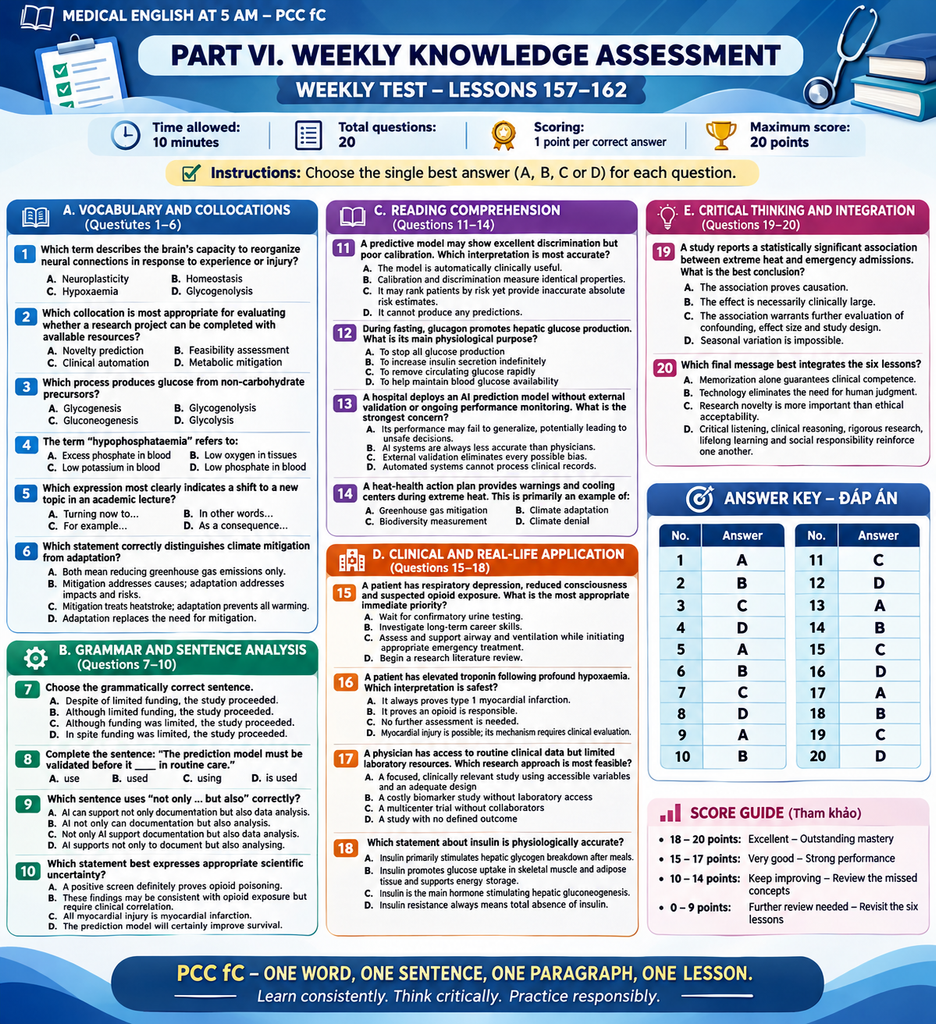
| Question | Answer | Question | Answer |
|---|---|---|---|
| 1 | A | 11 | C |
| 2 | B | 12 | D |
| 3 | C | 13 | A |
| 4 | D | 14 | B |
| 5 | A | 15 | C |
| 6 | B | 16 | D |
| 7 | C | 17 | A |
| 8 | D | 18 | B |
| 9 | A | 19 | C |
| 10 | B | 20 | D |
Detailed Explanations
Q1 – A. Neuroplasticity
Neuroplasticity refers to structural or functional changes in the nervous system associated with learning, experience or injury.
Tính dẻo thần kinh là khả năng thay đổi về cấu trúc hoặc chức năng của hệ thần kinh liên quan đến học tập, trải nghiệm hoặc tổn thương.
Q2 – B. Feasibility assessment
Feasibility involves available resources, time, personnel, methodological requirements and the ability to complete the proposed project.
Tính khả thi liên quan đến nguồn lực, thời gian, nhân sự, phương pháp và khả năng hoàn thành nghiên cứu.
Q3 – C. Gluconeogenesis
Gluconeogenesis produces glucose from non-carbohydrate precursors, including lactate, glycerol and glucogenic amino acids.
Tân tạo glucose tạo glucose từ các tiền chất không phải carbohydrate.
Q4 – D. Low phosphate in blood
Hypophosphataemia is a reduction in blood phosphate concentration. Severe cases can impair muscle and neurological function.
Hạ phosphat máu là tình trạng nồng độ phosphat máu giảm; trường hợp nặng có thể ảnh hưởng cơ và thần kinh.
Q5 – A. Turning now to…
This is a signposting expression used to indicate a shift in an academic lecture.
Đây là cấu trúc báo hiệu chuyển chủ đề trong bài giảng học thuật.
Q6 – B. Mitigation addresses causes; adaptation addresses impacts and risks.
Mitigation reduces greenhouse gas emissions or enhances sinks, whereas adaptation involves adjustment to actual or expected climate effects.
Giảm nhẹ tác động lên các nguyên nhân gây biến đổi khí hậu; thích ứng giúp giảm thiệt hại và rủi ro do tác động khí hậu.
Q7 – C. Although funding was limited, the study proceeded.
Although introduces a finite clause. Despite and in spite of are followed by a noun, noun phrase or gerund construction.
Q8 – D. is used
Passive voice is required: before it is used.
Q9 – A. AI can support not only documentation but also data analysis.
The sentence maintains parallel grammatical structure between two noun phrases.
Q10 – B. These findings may be consistent with opioid exposure but require clinical correlation.
Appropriate scientific language distinguishes possible findings from diagnostic certainty.
Q11 – C. It may rank patients by risk yet provide inaccurate absolute risk estimates.
Discrimination and calibration are different dimensions of predictive model performance.
Q12 – D. To help maintain blood glucose availability
Glucagon stimulates hepatic glycogenolysis and gluconeogenesis, contributing to the maintenance of blood glucose during fasting.
Q13 – A. Its performance may fail to generalize, potentially leading to unsafe decisions.
External validation and ongoing monitoring are essential considerations for clinical prediction models.
Q14 – B. Climate adaptation
Early warnings and cooling measures reduce the health impacts of extreme heat.
Q15 – C. Assess and support airway and ventilation while initiating appropriate emergency treatment.
Suspected opioid-related respiratory depression is a clinical emergency. Appropriate airway and ventilatory support are immediate priorities; naloxone is considered according to the clinical situation.
Q16 – D. Myocardial injury is possible; its mechanism requires clinical evaluation.
Elevated cardiac troponin is evidence of myocardial injury when above the assay-specific 99th percentile upper reference limit. It is not sufficient, by itself, to diagnose myocardial infarction.
Q17 – A. A focused, clinically relevant study using accessible variables and an adequate design
A useful research project must balance originality, clinical importance, methodological rigor, ethical acceptability and feasibility.
Q18 – B. Insulin promotes glucose uptake in skeletal muscle and adipose tissue and supports energy storage.
Insulin facilitates glucose uptake through insulin-responsive pathways in these tissues and promotes anabolic processes.
Q19 – C. The association warrants further evaluation of confounding, effect size and study design.
Statistical significance does not establish causality or clinical importance.
Q20 – D. Critical listening, clinical reasoning, rigorous research, lifelong learning and social responsibility reinforce one another.
This statement integrates the key competencies developed across the six lessons.
Performance Interpretation
| Score | Interpretation | Recommended action |
|---|---|---|
| 18–20 | Excellent knowledge mastery | Advanced application and discussion |
| 15–17 | Good achievement | Review selected weak areas |
| 12–14 | Developing competence | Targeted revision and practice |
| 8–11 | Substantial knowledge gaps | Structured review with feedback |
| 0–7 | Foundational revision needed | Revisit core terminology and concepts |
These are suggested educational bands for the class, not validated CEFR or IELTS score conversions.
PART VIII. ACTIVE RECALL CHALLENGE
ONE WORD – ONE SENTENCE – ONE PARAGRAPH – ONE LESSON
8.1. One Word
Feasibility /ˌfiːzəˈbɪləti/ (n.) – Tính khả thi.
Task: Define the word in English and identify one practical factor determining research feasibility.
Example: Research feasibility depends partly on whether the required participants, data and resources are available.
8.2. One Sentence
“Meaningful research should combine scientific novelty with clinical relevance and practical feasibility.”
Nghiên cứu có ý nghĩa cần kết hợp tính mới khoa học, giá trị lâm sàng và tính khả thi thực tiễn.
Task: Construct a new sentence using the same grammatical structure but a different topic from the week.
8.3. One Paragraph
Modern medicine requires more than scientific knowledge. Clinicians must integrate critical thinking, effective communication and evidence-based practice. Artificial intelligence can support decision-making, but human judgment remains essential. Through lifelong learning, healthcare professionals can adapt to new challenges and improve patient care.
Y học hiện đại đòi hỏi nhiều hơn kiến thức khoa học. Các bác sĩ cần kết hợp tư duy phản biện, giao tiếp hiệu quả và thực hành dựa trên bằng chứng. Trí tuệ nhân tạo có thể hỗ trợ ra quyết định, nhưng phán đoán của con người vẫn rất quan trọng. Thông qua học tập suốt đời, nhân viên y tế có thể thích ứng với những thách thức mới và nâng cao chất lượng chăm sóc người bệnh.
Task: Rewrite the paragraph using at least five vocabulary items from the six lessons.
8.4. One Lesson
Speaking prompt:
“How can continuous learning transform clinical knowledge into better patient care and a healthier society?”
Làm thế nào học tập liên tục có thể chuyển hóa kiến thức lâm sàng thành chăm sóc người bệnh tốt hơn và một xã hội khỏe mạnh hơn?
Task: Prepare a 30–60-second English presentation.
Suggested structure:
- Introduce the main argument.
- Provide one clinical example.
- Explain how research or technology can contribute.
- Conclude with a practical lesson.
8.5. Speaking Assessment Rubric
| Criterion | Maximum score |
|---|---|
| Scientific and linguistic accuracy | 5 |
| Pronunciation and fluency | 5 |
| Vocabulary and grammatical range | 5 |
| Organization and independent expression | 5 |
| Total | 20 |
A score of 1–5 should reflect performance within each criterion. This rubric is intended for formative learning rather than formal language certification.
PART IX. THIRTY-MINUTE TEACHING PLAN
KỊCH BẢN GIẢNG DẠY TRỰC TUYẾN
Session: 05:00–05:30, Vietnam time.
| Time | Activity | Teacher’s role | Learner’s activity |
|---|---|---|---|
| 05:00–05:03 | Learning overview | Introduce six competencies | Recall main lesson themes |
| 05:03–05:07 | Vocabulary & grammar | Facilitate retrieval practice | Answer without notes |
| 05:07–05:10 | Clinical reasoning | Present clinical case | Identify priorities and uncertainty |
| 05:10–05:20 | Weekly quiz | Supervise assessment | Complete 20 MCQs |
| 05:20–05:26 | Feedback | Explain common errors | Analyze and correct mistakes |
| 05:26–05:29 | Active Recall | Guide four-level exercise | Produce short responses |
| 05:29–05:30 | Reflection | Summarize learning objectives | State one next action |
Before class: Learners review the vocabulary, listen to the academic transcript and practise the clinical dialogues.
During class: Prioritize retrieval, clinical interpretation, assessment and feedback.
After class: Complete the extended writing and speaking tasks and follow the spaced-repetition plan.
Pedagogical note: Twenty multiple-choice questions in ten minutes assess rapid knowledge retrieval. Complex clinical reasoning and advanced academic speaking require additional time and should not be judged solely by this test.
PART X. SPACED REPETITION AND LONG-TERM RETENTION
KẾ HOẠCH GHI NHỚ DÀI HẠN
Day 1 – 15 November 2026
Objective: Immediate retrieval and correction.
- Recall 15 vocabulary items without notes.
- Review incorrect quiz answers.
- Explain three clinical concepts in English.
Day 3 – 17 November 2026
Objective: Interleaved retrieval.
- Mix medical, research and climate-related questions.
- Practise five difficult pronunciations.
- Rewrite two Best Sentences.
Day 7 – 21 November 2026
Objective: Application and consolidation.
- Repeat previously incorrect questions.
- Present one clinical or research scenario.
- Construct a 100-word academic paragraph.
Day 14 – 28 November 2026
Objective: Evaluate retention and transfer.
- Complete a parallel knowledge test.
- Compare performance with the original assessment.
- Identify remaining weaknesses.
- Develop a personal learning plan.
Reflection Questions
- What was the most valuable concept I learned this week?
Kiến thức giá trị nhất tôi học được trong tuần là gì? - Which concept can I apply immediately to my clinical practice, research or daily life?
Kiến thức nào tôi có thể áp dụng ngay trong lâm sàng, nghiên cứu hoặc đời sống? - What will I do differently next week to become a better learner?
Tôi sẽ thay đổi điều gì trong tuần tới để học tốt hơn?
Continuous Improvement Principle
Assessment → Feedback → Reflection → Deliberate Practice → Reassessment
Đánh giá → Phản hồi → Tự suy ngẫm → Luyện tập có chủ đích → Đánh giá lại.
PART XI. FINAL INSPIRATIONAL MESSAGE
SIX LESSONS – ONE SHARED MISSION
English
Six lessons have taught us six essential abilities: to listen critically, reason clinically, understand physiology, question scientifically, adapt continuously and act responsibly.
In Lesson 157, we learned how to listen for meaning.
In Lesson 158, we learned that clinical decisions require careful interpretation of evidence.
In Lesson 159, we explored how physiological balance depends on continuous regulation.
In Lesson 160, we discovered how meaningful research begins with a relevant and answerable question.
In Lesson 161, we recognized that professional excellence requires adaptability and lifelong learning.
In Lesson 162, we understood that human health is closely connected to the health of our planet.
Together, these lessons remind us that knowledge becomes valuable when it improves our decisions, protects our patients, advances science and benefits society.
We do not learn English merely to speak another language. We learn English to access knowledge, communicate across borders, collaborate with others and contribute to better healthcare.
Learn better. Think deeper. Care more.
Tiếng Việt
Sáu bài học đã giúp chúng ta phát triển sáu năng lực cốt lõi: lắng nghe có tư duy phản biện, suy luận lâm sàng, thấu hiểu sinh lý, đặt câu hỏi khoa học, không ngừng thích ứng và hành động có trách nhiệm.
Bài 157 giúp chúng ta biết lắng nghe để hiểu bản chất thông tin.
Bài 158 nhắc nhở rằng mọi quyết định lâm sàng cần dựa trên việc diễn giải bằng chứng một cách thận trọng.
Bài 159 giúp chúng ta thấu hiểu sự cân bằng sinh lý là kết quả của quá trình điều hòa liên tục.
Bài 160 khẳng định rằng nghiên cứu có ý nghĩa bắt đầu từ một câu hỏi quan trọng và có khả năng trả lời.
Bài 161 cho thấy năng lực nghề nghiệp đòi hỏi khả năng thích ứng và học tập suốt đời.
Bài 162 nhấn mạnh rằng sức khỏe con người gắn liền với sức khỏe của hành tinh.
Sáu bài học cùng hướng tới một thông điệp: Tri thức chỉ thực sự có giá trị khi giúp chúng ta đưa ra quyết định tốt hơn, bảo vệ người bệnh, phát triển khoa học và mang lại lợi ích cho cộng đồng.
Chúng ta không chỉ học tiếng Anh để nói thêm một ngôn ngữ. Chúng ta học tiếng Anh để tiếp cận tri thức, giao tiếp không biên giới, hợp tác với đồng nghiệp và đóng góp vào sự phát triển của y học.
HỌC TỐT HƠN – NGHĨ SÂU HƠN – CHĂM SÓC TẬN TÂM HƠN.
SELECTED REFERENCES AND FURTHER READING
Original learning materials:
- PCC fC. Lesson 157 – IELTS Listening Section 4: Academic Lectures and Note Completion.
- PCC fC. Lesson 158 – Acute Opioid Poisoning with Multiorgan Injury.
- PCC fC. Lesson 159 – Maintaining Homeostasis: Regulation of Blood Glucose.
- PCC fC. Lesson 160 – How to Choose a Good Scientific Research Problem.
- PCC fC. Lesson 161 – Future of Jobs & Lifelong Learning.
- PCC fC. Lesson 162 – Climate Change.
Scientific and educational reference frameworks:
- Anderson LW, Krathwohl DR, editors. A Taxonomy for Learning, Teaching, and Assessing. 2001.
- Dunlosky J, et al. Improving Students’ Learning With Effective Learning Techniques. Psychological Science in the Public Interest. 2013;14(1):4–58.
- Kram B, et al. Relevant clinical toxicology and opioid poisoning guidance from established toxicology and emergency care references.
- Thygesen K, et al. Fourth Universal Definition of Myocardial Infarction (2018). European Heart Journal. 2019;40:237–269.
- WHO. Climate Change and Health – authoritative public health guidance.
- IPCC. Climate Change 2023: Synthesis Report.
Scientific reference note: The references provide a framework for further study. Clinical recommendations must be checked against current guidelines, local protocols and the patient’s condition. The educational dialogues, examples and assessment items in this review are newly synthesized teaching materials.
PCC fC – MEDICAL ENGLISH AT 5 AM
One Word – One Sentence – One Paragraph – One Lesson
Learn to Remember – Understand to Apply – Practice to Master – Share to Inspire.
VÌ MỘT ĐAM MÊ KHỎE VUI HẠNH PHÚC!