Bài 165 – Tiếng Anh Y khoa: Sinh lý hệ tiêu hoá, hấp thu đến cơ chế bệnh sinh của tiêu chảy * Gastrointestinal physiology: from digestion to diarrhea.
PCC Language – Thăng Long, Hà Nội, ngày 18/11/2026, Hệ tiêu hóa không chỉ thực hiện chức năng tiêu hóa thức ăn và hấp thu chất dinh dưỡng mà còn đóng vai trò quan trọng trong duy trì cân bằng nước, điện giải và chuyển hóa của cơ thể. Hiểu rõ các quá trình sinh lý này là nền tảng để giải thích cơ chế bệnh sinh, nhận diện rối loạn và đưa ra quyết định lâm sàng chính xác.
Trong Bài 165 của Lớp Tiếng Anh Y khoa 5H, chúng ta sẽ tham gia một buổi Morning Rounds thông qua cuộc hội thoại giữa bác sĩ Evans và bác sĩ nội trú Miller. Từ hành trình hấp thu chất dinh dưỡng tại ruột non, vai trò của tuần hoàn cửa và chức năng chuyển hóa của gan đến nhu động ruột và cơ chế hình thành tiêu chảy, bài học giúp kết nối kiến thức sinh lý với thực hành lâm sàng.
Bài học được xây dựng theo chuẩn CEFR C1–C2, IELTS 8.5, kết hợp hội thoại y khoa song ngữ, 15 thuật ngữ chuyên ngành, phân tích ngữ pháp học thuật, luyện phát âm chuẩn IPA và bài nghe thụ động 3 phút. Đặc biệt, học viên sẽ rèn luyện khả năng giải thích mối quan hệ nguyên nhân – cơ chế bệnh sinh – biểu hiện lâm sàng (Cause – Pathophysiology – Clinical Manifestation) bằng tiếng Anh khoa học, chính xác và tự nhiên.
Thông điệp của bài học:
“Every word we master strengthens our communication; every mechanism we understand sharpens our clinical judgment.”
Mỗi từ ngữ chúng ta làm chủ giúp giao tiếp tốt hơn; mỗi cơ chế bệnh sinh chúng ta thấu hiểu giúp tư duy lâm sàng sắc bén hơn.
One Word – One Sentence – One Paragraph – One Lesson.
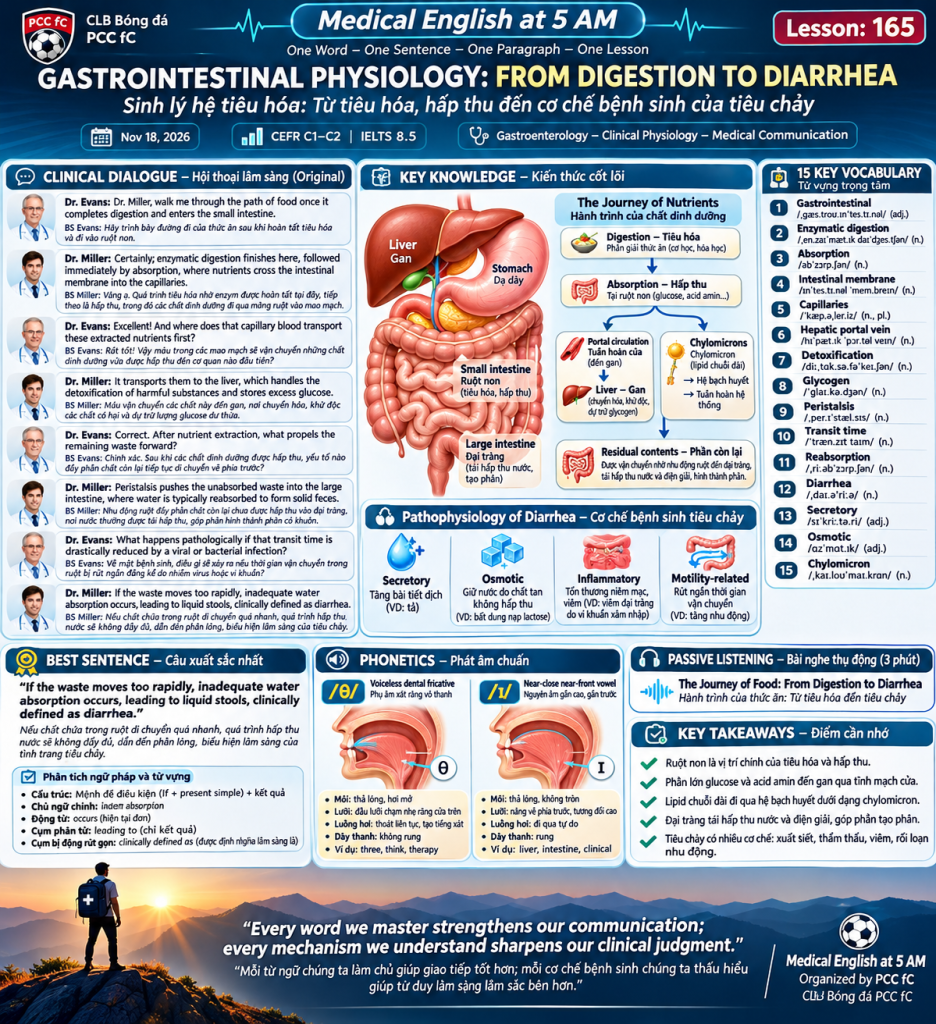
MEDICAL ENGLISH AT 5 AM – LESSON 165
GASTROINTESTINAL PHYSIOLOGY: FROM DIGESTION TO DIARRHEA
SINH LÝ HỆ TIÊU HÓA: TỪ TIÊU HÓA, HẤP THU ĐẾN CƠ CHẾ BỆNH SINH CỦA TIÊU CHẢY
Date: November 18, 2026
Level: CEFR C1–C2 | IELTS 8.5
Field: Gastroenterology – Clinical Physiology – Medical Communication
Program: Medical English at 5 AM
Organized by: PCC fC Football Club – CLB Bóng đá PCC fC
Educational Philosophy: One Word – One Sentence – One Paragraph – One Lesson.
PART I. INTRODUCTION – GIỚI THIỆU BÀI HỌC
1. English Introduction
The gastrointestinal tract is a highly coordinated physiological system responsible for digestion, nutrient absorption, fluid and electrolyte regulation, and waste elimination.
Understanding gastrointestinal physiology is essential for recognizing the mechanisms underlying common clinical conditions, particularly diarrhea, dehydration, malabsorption, and electrolyte disturbances.
In this lesson, learners will follow a clinical dialogue between an attending physician and a medical resident during morning rounds. The discussion explores the journey of nutrients through the digestive system, the role of the liver in metabolism and detoxification, intestinal peristalsis, and the pathophysiology of diarrhea.
Beyond medical terminology, this lesson emphasizes clinical reasoning, cause-and-effect relationships, advanced grammatical structures, and precise medical communication.
2. Giới thiệu tiếng Việt
Hệ tiêu hóa là một hệ thống sinh lý có sự phối hợp chặt chẽ giữa các cơ quan, đảm nhiệm những chức năng thiết yếu như tiêu hóa thức ăn, hấp thu chất dinh dưỡng, điều hòa nước và điện giải, đồng thời đào thải các chất cặn bã.
Hiểu rõ sinh lý hệ tiêu hóa giúp bác sĩ giải thích cơ chế bệnh sinh của nhiều tình trạng thường gặp, đặc biệt là tiêu chảy, mất nước, rối loạn điện giải và hội chứng kém hấp thu.
Trong bài học 165, học viên sẽ theo dõi cuộc hội thoại giữa một bác sĩ điều trị phụ trách và một bác sĩ nội trú trong buổi đi buồng sáng. Từ những câu hỏi lâm sàng ngắn gọn, người học từng bước khám phá hành trình của chất dinh dưỡng, chức năng chuyển hóa của gan, hoạt động nhu động ruột và cơ chế hình thành tiêu chảy.
Bài học kết hợp kiến thức y khoa với tiếng Anh học thuật ở trình độ CEFR C1–C2, hướng tới mục tiêu không chỉ giao tiếp chính xác mà còn phát triển khả năng lập luận khoa học và tư duy lâm sàng.
3. Learning Objectives – Mục tiêu học tập
By the end of this lesson, learners will be able to:
- Describe the physiological sequence of digestion, absorption, and intestinal transit.
- Explain the role of intestinal capillaries, portal circulation, and hepatic metabolism.
- Distinguish major mechanisms of diarrhea, including secretory, osmotic, inflammatory, and motility-related disturbances.
- Apply 15 advanced gastrointestinal terms accurately in clinical communication.
- Analyze conditional clauses, passive constructions, and cause-and-effect expressions.
- Pronounce the consonant /θ/ and vowel /ɪ/ accurately.
- Present gastrointestinal physiology in fluent, structured, evidence-informed medical English.
PART II. ORIGINAL CLINICAL DIALOGUE – HỘI THOẠI LÂM SÀNG NGUYÊN BẢN
Source: Gastrointestinal Medical English, page 1 of the original PDF.
Clinical Setting: Morning Rounds
Participants:
- Dr. Evans – Attending Physician
- Dr. Miller – Medical Resident
The English dialogue below is reproduced from the original teaching material without shortening or rewriting. Vietnamese translations are provided immediately below each turn.
Dialogue 1
Dr. Evans:
Dr. Miller, walk me through the path of food once it completes digestion and enters the small intestine.
Dịch tiếng Việt:
BS Evans: Bác sĩ Miller, hãy trình bày đường đi của thức ăn sau khi hoàn tất quá trình tiêu hóa và đi vào ruột non.
Dialogue 2
Dr. Miller:
Certainly; enzymatic digestion finishes here, followed immediately by absorption, where nutrients cross the intestinal membrane into the capillaries.
Dịch tiếng Việt:
BS Miller: Vâng ạ. Quá trình tiêu hóa nhờ enzym được hoàn tất tại đây, tiếp theo là quá trình hấp thu, trong đó các chất dinh dưỡng đi qua màng ruột để vào các mao mạch.
Dialogue 3
Dr. Evans:
Excellent! And where does that capillary blood transport these extracted nutrients first?
Dịch tiếng Việt:
BS Evans: Rất tốt! Vậy máu trong các mao mạch sẽ vận chuyển những chất dinh dưỡng vừa được hấp thu đến cơ quan nào đầu tiên?
Dialogue 4
Dr. Miller:
It transports them to the liver, which handles the detoxification of harmful substances and stores excess glucose.
Dịch tiếng Việt:
BS Miller: Máu vận chuyển các chất này đến gan, nơi đảm nhiệm việc chuyển hóa, khử độc các chất có hại và dự trữ lượng glucose dư thừa.
Dialogue 5
Dr. Evans:
Correct. After nutrient extraction, what propels the remaining waste forward?
Dịch tiếng Việt:
BS Evans: Chính xác. Sau khi các chất dinh dưỡng được hấp thu, yếu tố nào đẩy phần chất còn lại tiếp tục di chuyển về phía trước?
Dialogue 6
Dr. Miller:
Peristalsis pushes the unabsorbed waste into the large intestine, where water is typically reabsorbed to form solid feces.
Dịch tiếng Việt:
BS Miller: Nhu động ruột đẩy phần chất còn lại chưa được hấp thu vào đại tràng, nơi nước thường được tái hấp thu, góp phần hình thành phân có khuôn.
Dialogue 7
Dr. Evans:
What happens pathologically if that transit time is drastically reduced by a viral or bacterial infection?
Dịch tiếng Việt:
BS Evans: Về mặt bệnh sinh, điều gì sẽ xảy ra nếu thời gian vận chuyển trong ruột bị rút ngắn đáng kể do nhiễm virus hoặc vi khuẩn?
Dialogue 8
Dr. Miller:
If the waste moves too rapidly, inadequate water absorption occurs, leading to liquid stools, clinically defined as diarrhea.
Dịch tiếng Việt:
BS Miller: Nếu chất chứa trong ruột di chuyển quá nhanh, quá trình hấp thu nước sẽ không đầy đủ, dẫn đến phân lỏng, biểu hiện lâm sàng của tình trạng tiêu chảy.
Clinical Communication Notes
Walk me through…
Đây là một cấu trúc giao tiếp chuyên nghiệp, thường được bác sĩ hướng dẫn sử dụng trong giảng dạy lâm sàng.
Ý nghĩa: Hãy trình bày hoặc giải thích từng bước một quá trình.
Example:
“Walk me through your diagnostic reasoning.”
Dịch: Hãy trình bày từng bước quá trình lập luận chẩn đoán của bạn.
What happens pathologically if…?
Cấu trúc dùng để yêu cầu giải thích hậu quả bệnh sinh của một thay đổi sinh lý hoặc tác nhân gây bệnh.
Example:
“What happens pathologically if intestinal perfusion is severely compromised?”
Dịch: Về mặt bệnh sinh, điều gì xảy ra nếu tưới máu ruột bị suy giảm nghiêm trọng?
Leading to…
Cấu trúc diễn đạt mối liên hệ nguyên nhân – kết quả.
Example:
“Persistent diarrhea may cause substantial fluid loss, leading to hypovolemia and acute kidney injury.”
Dịch: Tiêu chảy kéo dài có thể gây mất dịch đáng kể, dẫn đến giảm thể tích tuần hoàn và tổn thương thận cấp.
PART III. CORE MEDICAL KNOWLEDGE – KIẾN THỨC Y KHOA CỐT LÕI
1. Digestion – Quá trình tiêu hóa
English
Digestion is the mechanical and chemical breakdown of food into smaller molecules that can be absorbed by the gastrointestinal tract.
Mechanical digestion begins in the oral cavity through mastication, whereas chemical digestion involves digestive enzymes and other gastrointestinal secretions.
Although digestion begins in the mouth and continues in the stomach, the small intestine is the principal site of enzymatic digestion and nutrient absorption.
Pancreatic enzymes, bile salts, and intestinal brush-border enzymes work together to facilitate the digestion of carbohydrates, proteins, and lipids.
Tiếng Việt
Tiêu hóa là quá trình phân giải thức ăn bằng các hoạt động cơ học và hóa học thành những phân tử nhỏ có thể được hấp thu qua đường tiêu hóa.
Tiêu hóa cơ học bắt đầu tại khoang miệng thông qua hoạt động nhai. Tiêu hóa hóa học diễn ra nhờ các enzym và dịch tiết tiêu hóa.
Mặc dù quá trình tiêu hóa bắt đầu ở miệng và tiếp tục tại dạ dày, ruột non mới là vị trí chính của quá trình tiêu hóa nhờ enzym và hấp thu chất dinh dưỡng.
Enzym tụy, muối mật và các enzym tại bờ bàn chải của ruột phối hợp để hỗ trợ tiêu hóa carbohydrate, protein và lipid.
2. Nutrient Absorption – Hấp thu chất dinh dưỡng
English
The small intestinal mucosa contains villi and microvilli that substantially increase the surface area available for absorption.
Monosaccharides and amino acids are absorbed through specific epithelial transport mechanisms and subsequently enter the portal circulation.
However, long-chain dietary lipids follow a different pathway. They are incorporated into chylomicrons within enterocytes and predominantly enter the intestinal lymphatic vessels before reaching the systemic circulation.
Tiếng Việt
Niêm mạc ruột non có các nhung mao và vi nhung mao, giúp tăng đáng kể diện tích bề mặt hấp thu.
Các đường đơn và acid amin được hấp thu qua những cơ chế vận chuyển đặc hiệu của biểu mô ruột, sau đó đi vào tuần hoàn tĩnh mạch cửa.
Tuy nhiên, lipid chuỗi dài trong thức ăn có con đường vận chuyển khác. Chúng được đóng gói thành các chylomicron trong tế bào biểu mô ruột, chủ yếu đi vào hệ bạch huyết trước khi đến tuần hoàn hệ thống.
Clinical Pearl
Not all absorbed nutrients reach the liver directly through the portal vein.
Không phải tất cả các chất dinh dưỡng sau hấp thu đều đi trực tiếp đến gan qua hệ tĩnh mạch cửa.
3. Hepatic Metabolism and Detoxification – Chuyển hóa và khử độc tại gan
English
The liver plays a central role in nutrient metabolism, glycogen storage, bile production, and the biotransformation of endogenous and exogenous substances.
After a carbohydrate-rich meal, insulin promotes hepatic glycogen synthesis, allowing the liver to store a portion of the absorbed glucose.
Hepatic detoxification involves numerous enzymatic pathways, including phase I and phase II metabolic reactions.
Importantly, hepatic biotransformation does not always reduce toxicity. Certain substances may become more toxic after metabolic activation.
Tiếng Việt
Gan giữ vai trò trung tâm trong chuyển hóa chất dinh dưỡng, dự trữ glycogen, sản xuất mật và chuyển hóa các chất nội sinh cũng như ngoại sinh.
Sau bữa ăn giàu carbohydrate, insulin thúc đẩy quá trình tổng hợp glycogen tại gan, giúp dự trữ một phần glucose được hấp thu.
Quá trình chuyển hóa, khử độc tại gan liên quan đến nhiều hệ thống enzym, bao gồm các phản ứng chuyển hóa pha I và pha II.
Đặc biệt, không phải mọi quá trình chuyển hóa tại gan đều làm giảm độc tính. Một số chất có thể tạo thành các chất chuyển hóa độc hơn sau khi được hoạt hóa.
Toxicology Connection
Paracetamol overdose is a classical example of toxic metabolic activation, in which excessive formation of N-acetyl-p-benzoquinone imine (NAPQI) contributes to hepatocellular injury.
Quá liều paracetamol là một ví dụ điển hình về hoạt hóa chuyển hóa gây độc, trong đó sự hình thành quá mức NAPQI góp phần gây tổn thương tế bào gan.
4. Intestinal Peristalsis – Nhu động ruột
English
Peristalsis consists of coordinated contractions and relaxations of gastrointestinal smooth muscle that propel luminal contents along the digestive tract.
Intestinal motility is regulated by the enteric nervous system and influenced by autonomic, hormonal, and local signaling mechanisms.
Abnormal motility may alter intestinal transit time and affect nutrient and fluid absorption.
Tiếng Việt
Nhu động ruột là sự phối hợp giữa các hoạt động co và giãn của cơ trơn đường tiêu hóa nhằm vận chuyển các chất chứa trong lòng ruột.
Hoạt động này được điều hòa bởi hệ thần kinh ruột và chịu ảnh hưởng của hệ thần kinh tự chủ, hormon và các tín hiệu tại chỗ.
Rối loạn nhu động có thể làm thay đổi thời gian vận chuyển trong ruột và ảnh hưởng đến khả năng hấp thu chất dinh dưỡng cũng như dịch.
5. Water and Electrolyte Absorption – Hấp thu nước và điện giải
English
Fluid absorption occurs throughout the intestine, with the small intestine accounting for the majority of physiological water absorption.
The colon subsequently absorbs additional water and electrolytes, contributing to stool concentration and consistency.
Normal stool formation depends on a balance between intestinal secretion, absorption, and transit.
Tiếng Việt
Quá trình hấp thu nước diễn ra ở nhiều đoạn ruột, trong đó ruột non đảm nhiệm phần lớn lượng nước được hấp thu trong điều kiện sinh lý bình thường.
Đại tràng tiếp tục hấp thu thêm nước và điện giải, góp phần làm cô đặc phân và quyết định tính chất của phân.
Sự hình thành phân bình thường phụ thuộc vào cân bằng giữa bài tiết, hấp thu và vận chuyển các chất trong lòng ruột.
6. Pathophysiology of Diarrhea – Sinh lý bệnh tiêu chảy
English
Diarrhea is commonly characterized by the passage of loose or watery stools, usually accompanied by increased stool frequency or volume.
Its pathophysiology is multifactorial and cannot be explained solely by increased intestinal peristalsis.
Major mechanisms include:
Secretory diarrhea: Excessive intestinal fluid secretion or impaired electrolyte absorption.
Osmotic diarrhea: Retention of poorly absorbed osmotically active substances within the intestinal lumen.
Inflammatory diarrhea: Mucosal injury, inflammation, and exudation of fluid or inflammatory products.
Motility-related diarrhea: Altered transit time that reduces the opportunity for normal fluid absorption.
These mechanisms may overlap in a single patient.
Tiếng Việt
Tiêu chảy thường biểu hiện bằng tình trạng đi ngoài phân lỏng hoặc phân nước, thường kèm tăng số lần đại tiện hoặc lượng phân.
Cơ chế bệnh sinh của tiêu chảy rất đa dạng và không thể giải thích chỉ bằng hiện tượng tăng nhu động ruột.
Các cơ chế quan trọng bao gồm:
Tiêu chảy xuất tiết: Tăng bài tiết dịch hoặc giảm hấp thu điện giải qua biểu mô ruột.
Tiêu chảy thẩm thấu: Các chất có hoạt tính thẩm thấu không được hấp thu đầy đủ, làm giữ nước trong lòng ruột.
Tiêu chảy do viêm: Tổn thương niêm mạc, phản ứng viêm và xuất tiết dịch hoặc các thành phần viêm.
Tiêu chảy liên quan đến rối loạn nhu động: Thay đổi thời gian vận chuyển trong ruột, làm giảm cơ hội hấp thu dịch bình thường.
Các cơ chế này có thể xuất hiện đồng thời trên cùng một bệnh nhân.
7. Clinical Application – Ứng dụng lâm sàng
Clinical Scenario
A 45-year-old patient presents with a two-day history of profuse watery diarrhea, dizziness, reduced urine output, and generalized weakness.
Questions for Clinical Reasoning
- What mechanisms may contribute to this patient’s diarrhea?
- How would you assess the severity of dehydration?
- Which laboratory abnormalities should be considered?
- What are the priorities in initial management?
Suggested Clinical Approach
The initial assessment should focus on hemodynamic stability, hydration status, urine output, and potential electrolyte disturbances.
Laboratory evaluation may include serum electrolytes, urea, creatinine, and additional investigations depending on disease severity and suspected etiology.
Rehydration is a central component of treatment. Oral rehydration is preferred when appropriate, while intravenous fluid therapy may be required in patients with severe dehydration, shock, or inability to tolerate oral intake.
Antimicrobial therapy should be guided by the suspected or confirmed cause rather than prescribed routinely for every patient with acute diarrhea.
Bài học lâm sàng
Đối với bệnh nhân tiêu chảy cấp, ưu tiên hàng đầu là đánh giá huyết động, mức độ mất nước, lượng nước tiểu và các rối loạn điện giải có thể xảy ra.
Việc lựa chọn xét nghiệm, bù dịch và điều trị nguyên nhân phải dựa trên tình trạng lâm sàng cụ thể. Không phải mọi bệnh nhân tiêu chảy nhiễm trùng đều cần sử dụng kháng sinh.
PART IV. ADVANCED MEDICAL VOCABULARY – 15 THUẬT NGỮ TIẾNG ANH Y KHOA
Pronunciation standard: General American English.
1. Gastrointestinal
IPA: /ˌɡæs.troʊ.ɪnˈtes.tɪ.nəl/
Part of Speech: Adjective (adj.)
Vietnamese Meaning: Thuộc đường tiêu hóa.
Example: The patient presented with severe gastrointestinal symptoms.
Translation: Bệnh nhân nhập viện với các triệu chứng tiêu hóa nghiêm trọng.
2. Enzymatic Digestion
IPA: /ˌen.zaɪˈmæt.ɪk daɪˈdʒes.tʃən/
Part of Speech: Noun phrase (n. phr.)
Vietnamese Meaning: Quá trình tiêu hóa nhờ enzym.
Example: Enzymatic digestion breaks complex nutrients into smaller molecules.
Translation: Quá trình tiêu hóa nhờ enzym phân giải các chất dinh dưỡng phức tạp thành những phân tử nhỏ hơn.
3. Absorption
IPA: /əbˈzɔrp.ʃən/
Part of Speech: Noun (n.)
Vietnamese Meaning: Sự hấp thu.
Example: Intestinal inflammation may impair nutrient absorption.
Translation: Viêm ruột có thể làm suy giảm khả năng hấp thu chất dinh dưỡng.
4. Intestinal Membrane
IPA: /ɪnˈtes.tɪ.nəl ˈmem.breɪn/
Part of Speech: Noun phrase (n. phr.)
Vietnamese Meaning: Màng ruột.
Example: Nutrients cross the intestinal membrane through several transport mechanisms.
Translation: Các chất dinh dưỡng đi qua màng ruột bằng nhiều cơ chế vận chuyển.
5. Capillaries
IPA: /ˈkæp.əˌler.iz/
Part of Speech: Plural noun (n., pl.)
Vietnamese Meaning: Các mao mạch.
Example: Absorbed glucose enters the capillaries within the intestinal villi.
Translation: Glucose sau hấp thu đi vào các mao mạch trong nhung mao ruột.
6. Hepatic Portal Vein
IPA: /hɪˈpæt.ɪk ˈpɔr.təl veɪn/
Part of Speech: Noun phrase (n. phr.)
Vietnamese Meaning: Tĩnh mạch cửa gan.
Example: The hepatic portal vein carries nutrient-rich blood from the gastrointestinal tract to the liver.
Translation: Tĩnh mạch cửa gan vận chuyển máu giàu chất dinh dưỡng từ đường tiêu hóa đến gan.
7. Detoxification
IPA: /diːˌtɑk.sə.fəˈkeɪ.ʃən/
Part of Speech: Noun (n.)
Vietnamese Meaning: Sự khử độc, quá trình chuyển hóa chất độc.
Example: Hepatic detoxification involves several metabolic pathways.
Translation: Quá trình khử độc tại gan liên quan đến nhiều con đường chuyển hóa.
8. Glycogen
IPA: /ˈɡlaɪ.kə.dʒən/
Part of Speech: Noun (n.)
Vietnamese Meaning: Glycogen – dạng dự trữ glucose.
Example: The liver stores glucose in the form of glycogen.
Translation: Gan dự trữ glucose dưới dạng glycogen.
9. Peristalsis
IPA: /ˌper.ɪˈstæl.sɪs/
Part of Speech: Noun (n.)
Vietnamese Meaning: Nhu động ruột.
Example: Coordinated peristalsis propels intestinal contents toward the colon.
Translation: Nhu động ruột phối hợp đẩy các chất chứa trong ruột về phía đại tràng.
10. Transit Time
IPA: /ˈtræn.zɪt taɪm/
Part of Speech: Noun phrase (n. phr.)
Vietnamese Meaning: Thời gian vận chuyển trong ruột.
Example: A shortened intestinal transit time may reduce the opportunity for fluid absorption.
Translation: Thời gian vận chuyển trong ruột bị rút ngắn có thể làm giảm cơ hội hấp thu dịch.
11. Reabsorption
IPA: /ˌriː.əbˈzɔrp.ʃən/
Part of Speech: Noun (n.)
Vietnamese Meaning: Sự tái hấp thu.
Example: Colonic reabsorption of water contributes to normal stool consistency.
Translation: Sự tái hấp thu nước tại đại tràng góp phần duy trì tính chất bình thường của phân.
12. Diarrhea
IPA: /ˌdaɪ.əˈriː.ə/
Part of Speech: Noun (n.)
Vietnamese Meaning: Tiêu chảy.
Example: Severe diarrhea may cause dehydration and electrolyte disturbances.
Translation: Tiêu chảy nặng có thể gây mất nước và rối loạn điện giải.
13. Secretory
IPA: /sɪˈkriː.tə.ri/
Part of Speech: Adjective (adj.)
Vietnamese Meaning: Thuộc quá trình bài tiết.
Example: Cholera may produce severe secretory diarrhea.
Translation: Bệnh tả có thể gây tiêu chảy xuất tiết nghiêm trọng.
14. Osmotic
IPA: /ɑzˈmɑt.ɪk/
Part of Speech: Adjective (adj.)
Vietnamese Meaning: Thuộc áp lực thẩm thấu.
Example: Lactose malabsorption may cause osmotic diarrhea.
Translation: Kém hấp thu lactose có thể gây tiêu chảy thẩm thấu.
15. Chylomicron
IPA: /ˌkaɪ.loʊˈmaɪ.krɑn/
Part of Speech: Noun (n.)
Vietnamese Meaning: Chylomicron – hạt lipoprotein vận chuyển lipid hấp thu tại ruột.
Example: Chylomicrons transport absorbed long-chain dietary lipids through the intestinal lymphatic system.
Translation: Các chylomicron vận chuyển lipid chuỗi dài đã được hấp thu qua hệ bạch huyết ruột.
PART V. BEST SENTENCE – PHÂN TÍCH CÂU TIẾNG ANH XUẤT SẮC
1. Original Best Sentence
“If the waste moves too rapidly, inadequate water absorption occurs, leading to liquid stools, clinically defined as diarrhea.”
Vietnamese Translation:
Nếu chất chứa trong ruột di chuyển quá nhanh, quá trình hấp thu nước sẽ không đầy đủ, dẫn đến phân lỏng, biểu hiện lâm sàng của tình trạng tiêu chảy.
2. Why This Sentence Matters
Câu này kết hợp nhiều cấu trúc thường được sử dụng trong tiếng Anh y khoa để mô tả một chuỗi cơ chế bệnh sinh.
Điểm nổi bật là khả năng liên kết:
Condition → Physiological Disturbance → Clinical Consequence
Điều kiện → Rối loạn sinh lý → Hậu quả lâm sàng
3. Detailed Grammatical Analysis
A. Conditional Clause
“If the waste moves too rapidly”
- If: Subordinating conjunction – Liên từ phụ thuộc.
- The waste: Subject – Chủ ngữ.
- Moves: Main verb – Động từ chính.
- Too rapidly: Adverbial phrase – Cụm trạng từ chỉ mức độ và cách thức.
Grammar: If + Subject + Present Simple.
Đây là mệnh đề điều kiện diễn đạt quan hệ nhân quả có tính khái quát.
B. Main Clause
“Inadequate water absorption occurs”
- Inadequate: Adjective – Tính từ.
- Water absorption: Noun phrase – Cụm danh từ.
- Inadequate water absorption: Subject – Chủ ngữ của mệnh đề chính.
- Occurs: Main verb – Động từ chính.
Tense: Simple Present.
C. Resultative Participial Phrase
“Leading to liquid stools”
- Leading: Present participle – Phân từ hiện tại.
- To: Preposition – Giới từ.
- Liquid stools: Noun phrase – Cụm danh từ.
Function: Expressing consequence.
D. Reduced Passive Participial Phrase
“Clinically defined as diarrhea”
- Clinically: Adverb – Trạng từ.
- Defined: Past participle – Phân từ quá khứ.
- As diarrhea: Prepositional phrase – Cụm giới từ.
Function: Providing a clinical description through a reduced passive construction.
4. Advanced Academic Version
Original:
“If the waste moves too rapidly, inadequate water absorption occurs, leading to liquid stools, clinically defined as diarrhea.”
Upgraded C1–C2 Version:
“Accelerated intestinal transit may reduce the time available for fluid absorption, thereby contributing to increased stool water content and the development of diarrhea.”
Vietnamese Translation:
Thời gian vận chuyển trong ruột bị rút ngắn có thể làm giảm khoảng thời gian dành cho quá trình hấp thu dịch, qua đó góp phần làm tăng lượng nước trong phân và gây tiêu chảy.
Advanced Structures
- Accelerated intestinal transit: Cụm danh từ chuyên ngành.
- May reduce: Động từ tình thái thể hiện khả năng.
- The time available for fluid absorption: Cấu trúc danh từ mở rộng.
- Thereby contributing to: Cụm phân từ diễn đạt hậu quả.
- The development of diarrhea: Cấu trúc danh hóa thường gặp trong văn phong học thuật.
5. Application in Medical Writing
Clinical Presentation
“The patient’s diarrhea may be associated with accelerated intestinal transit and impaired fluid absorption.”
Dịch: Tiêu chảy của bệnh nhân có thể liên quan đến tình trạng tăng tốc độ vận chuyển trong ruột và suy giảm hấp thu dịch.
Scientific Discussion
“Although accelerated intestinal transit may contribute to diarrhea, infection-induced changes in epithelial ion transport and intestinal secretion should also be considered.”
Dịch: Mặc dù tăng tốc độ vận chuyển trong ruột có thể góp phần gây tiêu chảy, cần đồng thời xem xét những thay đổi do nhiễm trùng gây ra đối với quá trình vận chuyển ion qua biểu mô và bài tiết dịch ruột.
PART VI. PHONETICS – ARTICULATORY PHONETICS
Pronunciation Training: One Consonant and One Vowel
A. Consonant /θ/ – Voiceless Dental Fricative
Loại âm: Phụ âm xát răng vô thanh.
Examples: Three, Think, Through, Therapy, Healthy.
1. Articulatory Description
Lips – Môi: Relaxed and slightly parted. Môi thả lỏng, hơi mở.
Tongue – Lưỡi: The tongue tip is placed gently against the upper front teeth or slightly between the front teeth. Đầu lưỡi chạm nhẹ răng cửa trên hoặc hơi đưa ra giữa hai hàm răng.
Teeth – Răng: Slightly separated. Hai hàm răng hơi tách nhau.
Jaw – Hàm: Slightly lowered. Hàm dưới hạ nhẹ.
Airflow – Luồng hơi: Air passes continuously through a narrow opening near the teeth, producing friction. Luồng hơi thoát liên tục qua khe hẹp vùng răng, tạo tiếng xát.
Vocal Folds – Dây thanh: No vibration occurs during the consonant. Dây thanh không rung.
2. Pronunciation Practice
- Think /θɪŋk/
- Three /θriː/
- Through /θruː/
- Therapy /ˈθer.ə.pi/
Practice Sentence:
“Three physicians discussed the therapy.”
Dịch: Ba bác sĩ đã thảo luận về phương pháp điều trị.
3. Common Pronunciation Errors
Error 1: Replacing /θ/ with /t/.
Example: Pronouncing three like tree.
Error 2: Replacing /θ/ with /s/.
Correction: Position the tongue correctly, maintain continuous airflow, and avoid vocal-fold vibration.
B. Vowel /ɪ/ – Near-Close Near-Front Unrounded Vowel
Loại âm: Nguyên âm gần cao, gần trước, không tròn môi.
Examples: Liver, Clinical, Intestine, Sit.
1. Articulatory Description
Lips – Môi: Relaxed and unrounded. Môi thả lỏng, không tròn.
Tongue – Lưỡi: Raised toward a near-front, near-close position without excessive muscular tension. Thân lưỡi được nâng tương đối cao về phía trước, không căng quá mức.
Teeth – Răng: Slightly separated. Hai hàm răng hơi tách.
Jaw – Hàm: Slightly open and relaxed. Hàm hơi mở, thả lỏng.
Airflow – Luồng hơi: Unobstructed airflow through the oral cavity. Luồng hơi đi qua khoang miệng không bị cản trở đáng kể.
Vocal Folds – Dây thanh: Vibrating. Dây thanh rung.
2. Minimal Pair Practice
| /ɪ/ | /iː/ |
|---|---|
| Sit /sɪt/ | Seat /siːt/ |
| Ship /ʃɪp/ | Sheep /ʃiːp/ |
| Live /lɪv/ | Leave /liːv/ |
| Bit /bɪt/ | Beat /biːt/ |
3. Practice Sentence
“The liver is involved in several important metabolic processes.”
Dịch: Gan tham gia vào nhiều quá trình chuyển hóa quan trọng.
4. Common Pronunciation Error
Error: Pronouncing /ɪ/ as the longer, closer vowel /iː/.
Correction: Keep the tongue relaxed and slightly lower than the position used for /iː/. Produce a short, clear vowel without excessive muscular tension.
C. Articulatory Illustration – Hướng dẫn thiết kế hai hình cấu âm
Figure 1 – /θ/: Sơ đồ cắt dọc vùng đầu – miệng, thể hiện đầu lưỡi tiếp xúc nhẹ răng cửa trên, luồng hơi liên tục đi qua khe hẹp vùng răng, hàm hơi mở và dây thanh không rung.
Figure 2 – /ɪ/: Sơ đồ cắt dọc vùng đầu – miệng, thể hiện thân lưỡi nâng về phía trước và lên tương đối cao, môi không tròn, hàm hơi mở, luồng hơi không bị cản trở và dây thanh rung.
Hai hình cần được đặt cạnh nhau để so sánh trực quan giữa một phụ âm xát vô thanh và một nguyên âm hữu thanh.
PART VII. THREE-MINUTE PASSIVE LISTENING – BÀI NGHE THỤ ĐỘNG 3 PHÚT
Topic: The Journey of Food – From Digestion to Diarrhea
Level: CEFR C1–C2
Listening Style: Medical Storytelling – Clinical Explanation
Duration: Approximately 3 minutes with a moderate reading pace and natural pauses.
English Listening Script
Good morning, everyone, and welcome to Medical English at 5 AM.
Today, we will explore one of the most important physiological systems in the human body: the gastrointestinal tract.
Every meal begins a remarkable journey. Food is mechanically broken down in the mouth, mixed with digestive secretions, and transported through the esophagus into the stomach.
In the stomach, acid and digestive enzymes initiate or continue the breakdown of nutrients. The partially digested food then enters the small intestine, where enzymatic digestion and nutrient absorption take place.
The small intestine contains millions of microscopic structures called villi, which increase the surface area available for absorption. Glucose, amino acids, and many other nutrients enter the blood capillaries and travel through the hepatic portal circulation to the liver.
However, not all nutrients follow the same pathway. Much of the absorbed long-chain dietary fat is packaged into chylomicrons and transported through the lymphatic system before entering the bloodstream.
The liver plays a central role in nutrient metabolism, glucose storage, bile production, and the transformation of many potentially harmful substances.
Meanwhile, intestinal peristalsis moves the remaining contents toward the large intestine. Here, additional water and electrolytes are absorbed, helping transform liquid intestinal contents into formed stool.
But what happens when normal gastrointestinal function is disrupted?
In some patients, intestinal transit becomes excessively rapid, reducing the time available for fluid absorption.
In others, infection alters epithelial transport, increases intestinal fluid secretion, or damages the intestinal mucosa.
These disturbances may result in diarrhea, a condition characterized by an increase in stool water content and often by more frequent, loose or watery bowel movements.
Severe diarrhea may cause dehydration, electrolyte abnormalities, and impaired kidney function, particularly in vulnerable patients.
Therefore, when assessing a patient with diarrhea, clinicians must go beyond the symptom itself. They should evaluate hydration, hemodynamic stability, potential causes, and the possibility of systemic complications.
Now, remember today’s essential sentence:
“If the waste moves too rapidly, inadequate water absorption occurs, leading to liquid stools, clinically defined as diarrhea.”
This sentence demonstrates how medical English can connect a physiological process with a clinical manifestation.
Yet, scientific reasoning requires us to recognize that diarrhea may develop through several different mechanisms.
Learning medical English is not simply about memorizing terminology. It is about explaining physiology, communicating clinical reasoning, and making better decisions for patients.
One word. One sentence. One paragraph. One lesson.
Thank you for learning with Medical English at 5 AM. Keep learning, keep questioning, and keep improving.
Vietnamese Listening Summary – Tóm tắt tiếng Việt
Bài nghe đưa người học theo hành trình của thức ăn từ khoang miệng, dạ dày đến ruột non và đại tràng.
Ruột non là vị trí chính của quá trình tiêu hóa nhờ enzym và hấp thu chất dinh dưỡng. Phần lớn glucose và acid amin sau hấp thu được vận chuyển đến gan qua tuần hoàn cửa, trong khi nhiều lipid chuỗi dài đi qua hệ bạch huyết dưới dạng chylomicron.
Gan tham gia chuyển hóa chất dinh dưỡng, dự trữ glycogen, tổng hợp mật và chuyển hóa nhiều chất có khả năng gây độc.
Nhu động ruột vận chuyển các chất còn lại về phía đại tràng, nơi tiếp tục hấp thu nước và điện giải.
Khi quá trình hấp thu, bài tiết hoặc nhu động bị rối loạn, tiêu chảy có thể xuất hiện.
Đối với bác sĩ lâm sàng, đánh giá bệnh nhân tiêu chảy cần chú ý mức độ mất nước, huyết động, rối loạn điện giải, chức năng thận và nguyên nhân gây bệnh.
Thông điệp cốt lõi: Học tiếng Anh y khoa không chỉ để ghi nhớ thuật ngữ mà còn để nâng cao năng lực giải thích sinh lý bệnh, lập luận lâm sàng và chăm sóc người bệnh.
Listening Practice
First Listening: Focus on understanding the overall message.
Second Listening: Identify the key medical terms: digestion, absorption, capillaries, liver, peristalsis, and diarrhea.
Third Listening: Pay attention to cause-and-effect structures such as leading to, resulting in, and contributing to.
PART VIII. KNOWLEDGE CHECK – KIỂM TRA KIẾN THỨC
Exercise 1. Medical Terminology Matching
Match each term with its correct definition.
Terms
- Digestion
- Capillaries
- Diarrhea
- Peristalsis
- Absorption
Definitions
A. Microscopic blood vessels that facilitate the exchange of substances.
B. The process by which nutrients move across intestinal epithelial cells into the circulation.
C. The mechanical and chemical breakdown of food into absorbable components.
D. Coordinated muscular contractions that propel gastrointestinal contents.
E. Passage of loose or watery stools, usually with increased frequency or volume.
Answers: 1–C; 2–A; 3–E; 4–D; 5–B.
Exercise 2. Clinical Gap-Filling
Complete the paragraph using the following words:
Peristalsis – Absorption – Large – Diarrhea
“When a patient suffers from a severe gastrointestinal viral infection, intestinal (1) ______ may increase. Because intestinal contents move too rapidly, the (2) ______ of water may be reduced. As these contents enter the (3) ______ intestine, excessive water may remain in the stool, ultimately contributing to (4) ______.”
Answers
- Peristalsis
- Absorption
- Large
- Diarrhea
Clinical Note: This exercise illustrates rapid transit as one possible mechanism. Infectious diarrhea may also involve secretion, epithelial injury, and altered ion transport.
Exercise 3. Clinical Reasoning Questions
Question 1: Why is the small intestine the principal site of nutrient absorption?
Suggested Answer:
Because it has a large absorptive surface area created by villi and microvilli, specialized transport mechanisms, and an extensive vascular and lymphatic network.
Question 2: Why do most absorbed long-chain dietary lipids enter the lymphatic system?
Suggested Answer:
Because they are packaged into chylomicrons within enterocytes, which primarily enter intestinal lacteals rather than blood capillaries.
Question 3: Why is accelerated intestinal transit not sufficient to explain all cases of diarrhea?
Suggested Answer:
Because diarrhea may also result from excessive fluid secretion, osmotic retention of water, impaired epithelial absorption, inflammation, and mucosal injury.
Question 4: What should clinicians prioritize when assessing severe acute diarrhea?
Suggested Answer:
Hemodynamic stability, hydration, electrolyte abnormalities, urine output, kidney function, and identification of potentially serious causes.
PART IX. ONE WORD – ONE SENTENCE – ONE PARAGRAPH – ONE LESSON
ONE WORD – MỘT TỪ
Absorption
/əbˈzɔrp.ʃən/
Sự hấp thu.
ONE SENTENCE – MỘT CÂU
The small intestine plays a central role in nutrient absorption.
Ruột non đóng vai trò trung tâm trong quá trình hấp thu chất dinh dưỡng.
ONE PARAGRAPH – MỘT ĐOẠN
English
Efficient nutrient absorption requires intact intestinal epithelial function, adequate digestive activity, and coordinated intestinal motility. Disruption of these physiological processes may lead to malabsorption, diarrhea, nutritional deficiencies, and systemic complications.
Tiếng Việt
Sự hấp thu chất dinh dưỡng hiệu quả đòi hỏi chức năng biểu mô ruột nguyên vẹn, hoạt động tiêu hóa đầy đủ và sự phối hợp nhịp nhàng của nhu động ruột. Rối loạn những quá trình sinh lý này có thể dẫn đến kém hấp thu, tiêu chảy, thiếu hụt dinh dưỡng và các biến chứng toàn thân.
ONE LESSON – MỘT BÀI HỌC
Understanding physiology is the foundation of clinical reasoning.
Hiểu đúng sinh lý học là nền tảng của tư duy lâm sàng.
PART X. INSPIRATIONAL MESSAGE – THÔNG ĐIỆP TRUYỀN CẢM HỨNG
“Every word we master strengthens our communication; every mechanism we understand sharpens our clinical judgment.”
“Mỗi từ ngữ chúng ta làm chủ giúp giao tiếp tốt hơn; mỗi cơ chế bệnh sinh chúng ta thấu hiểu giúp tư duy lâm sàng sắc bén hơn.”
Học tiếng Anh y khoa không chỉ là hành trình phát triển năng lực ngôn ngữ mà còn là quá trình rèn luyện tư duy khoa học, khả năng suy luận và tinh thần học tập suốt đời.
Mỗi buổi sáng thức dậy đúng giờ là một lần thực hành tính kỷ luật.
Mỗi thuật ngữ được hiểu sâu là một bước tiến trong hành trình làm chủ kiến thức.
Mỗi cuộc hội thoại lâm sàng được thực hành nghiêm túc là một cơ hội nâng cao năng lực giao tiếp và chăm sóc người bệnh.
One Word – One Sentence – One Paragraph – One Lesson.
Learn with Discipline. Think with Science. Care with Compassion.
Học bằng kỷ luật. Tư duy bằng khoa học. Chăm sóc bằng lòng nhân ái.
PART XI. SCIENTIFIC REFERENCES – TÀI LIỆU THAM KHẢO
1. Original Teaching Material
Gastrointestinal Medical English. Original four-page teaching document supplied for Lesson 165.
2. Gastrointestinal Physiology
StatPearls. Physiology, Nutrient Absorption. National Center for Biotechnology Information.
3. Small Intestinal Physiology
StatPearls. Physiology, Small Bowel. National Center for Biotechnology Information.
4. Clinical Evaluation of Diarrhea
Merck Manual Professional Edition. Diarrhea.
5. Intestinal Secretory Mechanisms
Intestinal Secretory Mechanisms and Diarrhea.
Editorial and Scientific Notes
The eight English dialogue turns in Part II are preserved from the original PDF. Additional explanations, clinical applications, vocabulary, phonetics, exercises, and listening materials have been developed for this lesson.
The original dialogue presents a simplified relationship between intestinal transit, fluid absorption, and diarrhea. The scientific discussion expands this framework to acknowledge secretory, osmotic, inflammatory, and motility-related mechanisms.
For academic and clinical use, diarrhea should not be defined solely by the presence of liquid stool. Stool consistency, frequency, volume, and changes from normal bowel habits should be considered.
IPA transcriptions follow a General American pronunciation model. Minor phonetic differences may occur across recognized accents.
MEDICAL ENGLISH AT 5 AM
LESSON 165 – GASTROINTESTINAL PHYSIOLOGY: FROM DIGESTION TO DIARRHEA
CEFR C1–C2 | IELTS 8.5
Organized by PCC fC Football Club – CLB Bóng đá PCC fC
November 18, 2026
ONE WORD – ONE SENTENCE – ONE PARAGRAPH – ONE LESSON
Knowledge Builds Competence. Discipline Builds Excellence. Compassion Gives Medicine Its Meaning.