Bài 170 – Tiếng Anh Y Khoa: Hạ đường huyết do tăng insulin * Hyperinsulinemic Hypoglycemia
PCC Language – Thăng Long, Hà Nội, ngày 24/11/2025, Trong thực hành cấp cứu, hạ đường huyết không chỉ là một rối loạn chuyển hóa mà còn là một thách thức về tư duy chẩn đoán, đặc biệt ở người cao tuổi mắc đái tháo đường. Khi một bệnh nhân xuất hiện nói khó đột ngột, mệt mỏi và có nồng độ insulin cùng C-peptide tăng cao, câu hỏi quan trọng được đặt ra là: Liệu đây có phải là insulinoma, hay tình trạng hạ đường huyết do thuốc kích thích tiết insulin như sulfonylurea?
Một kết quả xét nghiệm bất thường không đồng nghĩa với một chẩn đoán xác định. Việc diễn giải insulin và C-peptide đòi hỏi phải xem xét nồng độ glucose huyết tương tại cùng thời điểm, tiền sử sử dụng thuốc, chức năng thận và toàn bộ bối cảnh lâm sàng. Phân biệt chính xác các nguyên nhân không chỉ giúp tránh những thăm dò không cần thiết mà còn định hướng điều trị kịp thời, phòng ngừa hạ đường huyết tái diễn và bảo đảm an toàn người bệnh.
Trong Medical English at 5 AM – Lesson 169, chúng ta sẽ cùng bác sĩ nội trú Moli và bác sĩ chuyên khoa Navo phân tích một ca lâm sàng thực tế, khám phá cơ chế sinh lý bệnh, tiếp cận chẩn đoán phân biệt giữa insulinoma và hạ đường huyết do sulfonylurea, đồng thời thảo luận vai trò của xét nghiệm sinh hóa, đối chiếu thuốc và octreotide trong điều trị.
Thông qua hội thoại song ngữ, 15 thuật ngữ y khoa chuyên sâu, phân tích ngữ pháp học thuật và bài nghe thụ động 3 phút, học viên không chỉ nâng cao năng lực tiếng Anh theo định hướng CEFR C1–C2, IELTS 8.5 và OET Medicine, mà còn rèn luyện khả năng lập luận lâm sàng dựa trên bằng chứng.
Thông điệp xuyên suốt bài học:
“A laboratory result is not a diagnosis. Its true meaning emerges from clinical context and scientific reasoning.”
“Một kết quả xét nghiệm không phải là một chẩn đoán. Ý nghĩa thực sự của nó chỉ được làm sáng tỏ thông qua bối cảnh lâm sàng và tư duy khoa học.”
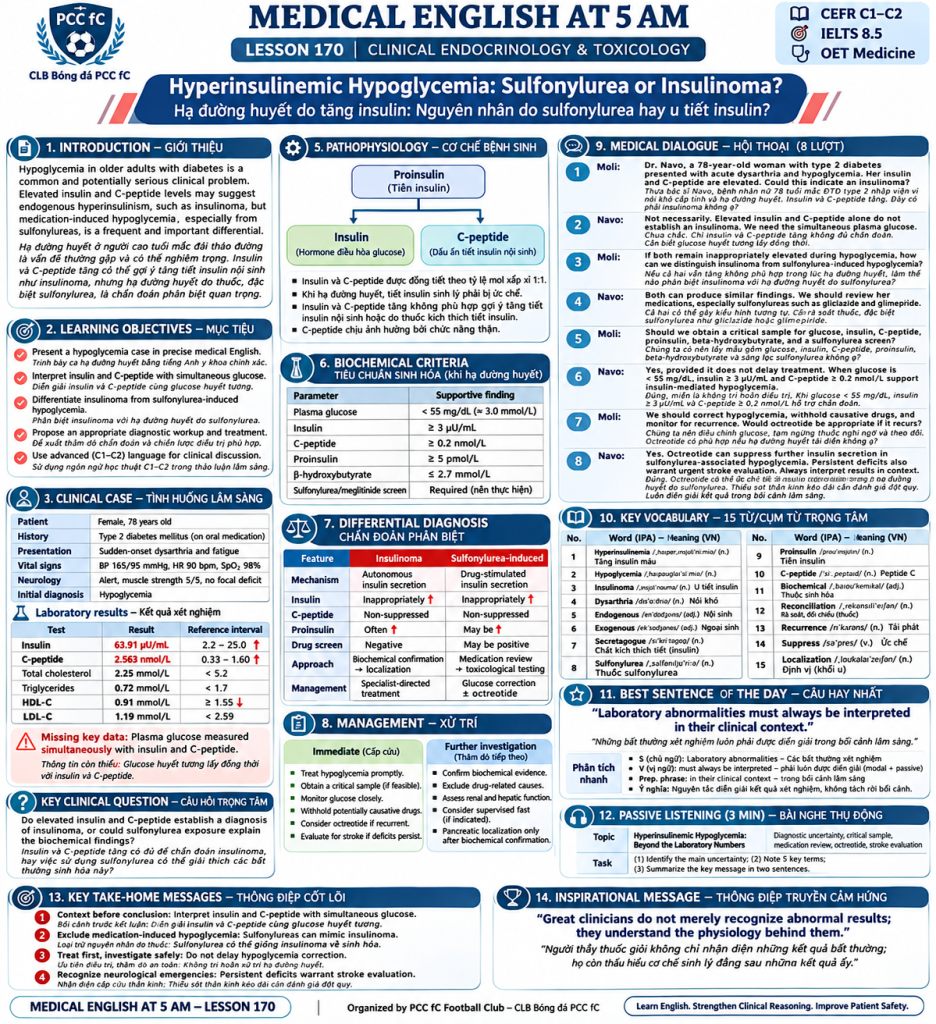
Medical English at 5 AM – Chương trình học tiếng Anh y khoa do CLB Bóng đá PCC fC tổ chức, kết nối tri thức, ngoại ngữ và tư duy lâm sàng vì sự an toàn của người bệnh.
MEDICAL ENGLISH AT 5 AM
LESSON 169 | CLINICAL ENDOCRINOLOGY & TOXICOLOGY
Hyperinsulinemic Hypoglycemia: Sulfonylurea or Insulinoma?
Hạ đường huyết do tăng insulin: Nguyên nhân do sulfonylurea hay u tiết insulin?
Level: CEFR C1–C2 | IELTS 8.5 | OET Medicine
Format: Case-Based Learning · Clinical Reasoning · Bilingual Medical Communication
Duration: 30 minutes of active learning + 3 minutes of passive listening
Medical English at 5 AM – Organized by PCC fC Football Club (CLB Bóng đá PCC fC).
1. LESSON OVERVIEW – TỔNG QUAN BÀI HỌC
1.1. Background – Bối cảnh
Hypoglycemia is a potentially life-threatening condition that requires immediate recognition and treatment. In patients with diabetes, medication-related hypoglycemia is an important consideration. However, elevated insulin and C-peptide concentrations may also raise concern for endogenous hyperinsulinemic disorders, including insulinoma.
Hạ đường huyết là tình trạng có thể đe dọa tính mạng, đòi hỏi nhận diện và điều trị kịp thời. Ở bệnh nhân đái tháo đường, hạ đường huyết liên quan đến thuốc là một nguyên nhân quan trọng. Tuy nhiên, insulin và C-peptide tăng cũng có thể gợi ý các rối loạn tăng tiết insulin nội sinh, bao gồm insulinoma.
The diagnostic challenge is not simply to identify elevated hormone concentrations but to determine whether insulin secretion is inappropriate for the prevailing plasma glucose concentration.
Thách thức chẩn đoán không chỉ là phát hiện nồng độ hormone tăng mà còn phải xác định liệu sự tiết insulin có không phù hợp với nồng độ glucose huyết tương tại thời điểm xét nghiệm hay không.
1.2. Learning objectives – Mục tiêu học tập
By the end of this lesson, learners will be able to:
- Present a complex hypoglycemia case using precise, professional medical English.
- Interpret insulin and C-peptide concentrations in relation to simultaneous plasma glucose.
- Differentiate insulinoma from sulfonylurea-induced hypoglycemia using clinical and biochemical evidence.
- Propose a rational diagnostic workup and an evidence-based management strategy.
- Communicate diagnostic uncertainty and clinical decisions using advanced C1–C2 structures.
2. CLINICAL CASE – TÌNH HUỐNG LÂM SÀNG
2.1. Patient presentation
A 78-year-old woman with type 2 diabetes mellitus, treated with oral glucose-lowering medications, presented to the emergency department with sudden-onset dysarthria and fatigue.
Bệnh nhân nữ 78 tuổi, có tiền sử đái tháo đường type 2 đang điều trị thuốc uống, nhập viện vì nói khó đột ngột và mệt mỏi.
Initial clinical findings
| Parameter | Finding |
|---|---|
| Age / Sex | 78 years / Female |
| Medical history | Type 2 diabetes mellitus |
| Presenting symptoms | Acute dysarthria and fatigue |
| Consciousness | Alert and responsive |
| Muscle strength | 5/5 bilaterally |
| Blood pressure | 165/95 mmHg |
| Heart rate | 90 beats/min |
| SpO₂ | 98% |
| Initial diagnosis | Hypoglycemia |
2.2. Laboratory findings
| Investigation | Result | Reference interval |
|---|---|---|
| Serum insulin | 63.91 µU/mL | 2.2–25.0 |
| C-peptide | 2.563 nmol/L | 0.33–1.60 |
| Total cholesterol | 2.25 mmol/L | <5.2 |
| Triglycerides | 0.72 mmol/L | <1.7 |
| HDL cholesterol | 0.91 mmol/L | ≥1.55 |
| LDL cholesterol | 1.19 mmol/L | <2.59 |
Critical missing information: The plasma glucose concentration measured simultaneously with insulin and C-peptide was not provided.
Thông tin còn thiếu mang tính quyết định là nồng độ glucose huyết tương được lấy đồng thời với insulin và C-peptide.
2.3. Central clinical question
Do elevated insulin and C-peptide concentrations establish a diagnosis of insulinoma, or could sulfonylurea exposure explain the biochemical findings?
Insulin và C-peptide tăng có đủ để chẩn đoán insulinoma hay việc sử dụng sulfonylurea có thể giải thích các bất thường sinh hóa này?
3. CORE MEDICAL KNOWLEDGE – KIẾN THỨC Y KHOA CỐT LÕI
3.1. Physiology of insulin and C-peptide
Insulin and C-peptide are generated during the processing of proinsulin in pancreatic beta cells and are secreted in approximately equimolar amounts.
Insulin và C-peptide được tạo thành trong quá trình xử lý proinsulin tại tế bào beta tuyến tụy và được đồng tiết với tỷ lệ mol xấp xỉ 1:1.
C-peptide is therefore useful for assessing endogenous insulin secretion. However, its circulating concentration is also influenced by renal clearance.
C-peptide có giá trị đánh giá sự tiết insulin nội sinh, nhưng nồng độ trong máu còn chịu ảnh hưởng của quá trình thanh thải qua thận.
During hypoglycemia, physiological insulin secretion should be suppressed. Detectable or elevated insulin concentrations may therefore be inappropriate, depending on the simultaneous plasma glucose concentration.
Trong tình trạng hạ đường huyết, sự tiết insulin sinh lý phải được ức chế. Vì vậy, insulin vẫn hiện diện hoặc tăng có thể là bất thường, tùy thuộc nồng độ glucose huyết tương tại thời điểm lấy mẫu.
3.2. Biochemical assessment of insulin-mediated hypoglycemia
When plasma glucose is below 55 mg/dL (approximately 3.0 mmol/L), the following findings support insulin-mediated hypoglycemia.
| Biochemical marker | Supportive finding |
|---|---|
| Plasma glucose | <55 mg/dL |
| Insulin | ≥3 µU/mL |
| C-peptide | ≥0.2 nmol/L |
| Proinsulin | ≥5 pmol/L |
| β-hydroxybutyrate | ≤2.7 mmol/L |
| Sulfonylurea/meglitinide screen | Used to investigate secretagogue exposure |
These thresholds are interpreted collectively, rather than as independent diagnostic criteria for insulinoma.
Clinical interpretation: Insulin and C-peptide must be assessed using samples collected during the same hypoglycemic episode. Measurements obtained after glucose administration or after a meal may be misleading.
3.3. Differential diagnosis
| Feature | Insulinoma | Sulfonylurea-induced hypoglycemia |
|---|---|---|
| Underlying mechanism | Autonomous insulin secretion | Pharmacologically stimulated insulin secretion |
| Insulin during hypoglycemia | Inappropriately elevated | Inappropriately elevated |
| C-peptide | Non-suppressed | Non-suppressed |
| Proinsulin | Often elevated | May be elevated |
| Sulfonylurea screen | Negative | May be positive |
| Diagnostic approach | Biochemical confirmation followed by localization | Medication review and toxicological testing |
| Management | Specialist-directed treatment | Glucose correction; octreotide when indicated |
Important distinction: Both insulinoma and sulfonylurea exposure can produce endogenous hyperinsulinemic hypoglycemia. Elevated C-peptide alone cannot distinguish between them.
3.4. Evidence-based clinical management
Immediate management
- Confirm and promptly correct hypoglycemia.
- Obtain a critical sample when feasible without delaying treatment.
- Monitor capillary or plasma glucose closely.
- Review and temporarily withhold potentially causative glucose-lowering medications.
- Assess renal and hepatic function.
- Consider octreotide in recurrent or persistent sulfonylurea-associated hypoglycemia.
- Arrange urgent stroke evaluation if focal neurological deficits persist or stroke remains clinically suspected.
Further investigation
If recurrent hypoglycemia remains unexplained after medication-related causes have been excluded, consider specialist-supervised biochemical evaluation, including a supervised fast when appropriate.
Pancreatic localization studies should follow biochemical confirmation rather than precede it.
4. MEDICAL DIALOGUE – HỘI THOẠI Y KHOA 8 LƯỢT
Participants
- Dr. Moli: Internal Medicine Resident – Bác sĩ nội trú Nội khoa.
- Dr. Navo: Endocrinology and Clinical Toxicology Specialist – Bác sĩ chuyên khoa Nội tiết và Chống độc.
Turn 1 – Case presentation
Dr. Moli:
“Dr. Navo, a 78-year-old woman with type 2 diabetes presented with acute dysarthria and hypoglycemia. Her insulin and C-peptide levels are elevated. Could this indicate an insulinoma?”
Dịch: Thưa bác sĩ Navo, bệnh nhân nữ 78 tuổi mắc đái tháo đường type 2 nhập viện vì nói khó cấp tính và hạ đường huyết. Insulin và C-peptide đều tăng. Liệu đây có phải là insulinoma không ạ?
Turn 2 – Interpretation of laboratory findings
Dr. Navo:
“Not necessarily. Elevated insulin and C-peptide alone do not establish an insulinoma. Their interpretation depends on the plasma glucose concentration measured at the same time.”
Dịch: Chưa chắc. Chỉ riêng insulin và C-peptide tăng không đủ để chẩn đoán insulinoma. Việc diễn giải phụ thuộc vào nồng độ glucose huyết tương được đo đồng thời.
Turn 3 – Differential diagnosis
Dr. Moli:
“If both markers remain inappropriately elevated during hypoglycemia, how can we distinguish insulinoma from sulfonylurea-induced hypoglycemia?”
Dịch: Nếu cả hai dấu ấn đều tăng không phù hợp trong lúc hạ đường huyết, làm thế nào để phân biệt insulinoma với hạ đường huyết do sulfonylurea?
Turn 4 – Medication reconciliation
Dr. Navo:
“Both conditions can produce similar biochemical findings. We should first review her medications, particularly sulfonylureas such as gliclazide and glimepiride.”
Dịch: Cả hai tình trạng có thể gây ra những bất thường sinh hóa tương tự. Trước tiên, chúng ta cần rà soát thuốc đang sử dụng, đặc biệt sulfonylurea như gliclazide và glimepiride.
Turn 5 – Diagnostic investigations
Dr. Moli:
“Should we obtain a critical sample for plasma glucose, insulin, C-peptide, proinsulin, beta-hydroxybutyrate, and a sulfonylurea screen during a spontaneous hypoglycemic episode?”
Dịch: Chúng ta có nên lấy bộ mẫu xét nghiệm gồm glucose huyết tương, insulin, C-peptide, proinsulin, beta-hydroxybutyrate và sàng lọc sulfonylurea trong một đợt hạ đường huyết tự phát không ạ?
Turn 6 – Biochemical confirmation
Dr. Navo:
“Yes, provided sampling does not delay treatment. During plasma glucose below 55 mg/dL, insulin of at least 3 µU/mL and C-peptide of at least 0.2 nmol/L support insulin-mediated hypoglycemia.”
Dịch: Đúng, với điều kiện việc lấy mẫu không trì hoãn điều trị. Khi glucose huyết tương dưới 55 mg/dL, insulin ≥3 µU/mL và C-peptide ≥0,2 nmol/L hỗ trợ chẩn đoán hạ đường huyết qua trung gian insulin.
Turn 7 – Therapeutic decision-making
Dr. Moli:
“We should correct hypoglycemia promptly, withhold potentially causative medications, and monitor for recurrence. Would octreotide be appropriate if sulfonylurea-associated hypoglycemia recurs?”
Dịch: Chúng ta cần điều chỉnh glucose kịp thời, tạm ngừng các thuốc nghi ngờ gây hạ đường huyết và theo dõi tái phát. Octreotide có phù hợp nếu hạ đường huyết do sulfonylurea tái diễn không ạ?
Turn 8 – Clinical conclusion
Dr. Navo:
“Yes. Octreotide can suppress further insulin secretion in sulfonylurea-associated hypoglycemia. Persistent neurological deficits also warrant urgent stroke evaluation. Always interpret laboratory findings in their clinical context.”
Dịch: Đúng. Octreotide có thể ức chế sự tiết insulin tiếp diễn trong hạ đường huyết do sulfonylurea. Các thiếu sót thần kinh kéo dài cũng cần được đánh giá đột quỵ khẩn cấp. Hãy luôn diễn giải kết quả xét nghiệm trong bối cảnh lâm sàng.
5. ADVANCED MEDICAL VOCABULARY – 15 TỪ VỰNG CHUYÊN SÂU
IPA theo cách phát âm Anh–Anh, với một số biến thể thuật ngữ y khoa được chấp nhận.
01. Hyperinsulinemia
- IPA: /ˌhaɪpərˌɪnsjʊlɪˈniːmiə/
- Part of speech: Noun (n.)
- Meaning: Tăng insulin máu.
- Example: Hyperinsulinemia must be interpreted in relation to plasma glucose.
- Dịch: Tăng insulin máu phải được diễn giải trong mối liên hệ với glucose huyết tương.
02. Hypoglycemia
- IPA: /ˌhaɪpəʊɡlaɪˈsiːmiə/
- Part of speech: Noun (n.)
- Meaning: Hạ đường huyết.
- Example: Severe hypoglycemia may mimic an acute stroke.
- Dịch: Hạ đường huyết nặng có thể biểu hiện giống đột quỵ cấp.
03. Insulinoma
- IPA: /ˌɪnsjʊlɪˈnəʊmə/
- Part of speech: Noun (n.)
- Meaning: U tiết insulin.
- Example: Insulinoma is an uncommon cause of endogenous hyperinsulinemic hypoglycemia.
- Dịch: Insulinoma là nguyên nhân không thường gặp của hạ đường huyết do tăng insulin nội sinh.
04. Dysarthria
- IPA: /dɪsˈɑːθriə/
- Part of speech: Noun (n.)
- Meaning: Nói khó do rối loạn vận động phát âm.
- Example: The patient developed sudden-onset dysarthria.
- Dịch: Bệnh nhân xuất hiện nói khó đột ngột.
05. Endogenous
- IPA: /enˈdɒdʒənəs/
- Part of speech: Adjective (adj.)
- Meaning: Nội sinh.
- Example: C-peptide helps assess endogenous insulin secretion.
- Dịch: C-peptide giúp đánh giá sự tiết insulin nội sinh.
06. Exogenous
- IPA: /ekˈsɒdʒənəs/
- Part of speech: Adjective (adj.)
- Meaning: Ngoại sinh.
- Example: Exogenous insulin administration generally suppresses endogenous C-peptide secretion.
- Dịch: Sử dụng insulin ngoại sinh thường ức chế sự tiết C-peptide nội sinh.
07. Secretagogue
- IPA: /sɪˈkriːtəɡɒɡ/
- Part of speech: Noun (n.)
- Meaning: Chất kích thích bài tiết.
- Example: Sulfonylureas act as insulin secretagogues.
- Dịch: Sulfonylurea hoạt động như các thuốc kích thích tiết insulin.
08. Sulfonylurea
- IPA: /ˌsʌlfənɪljʊˈriːə/
- Part of speech: Noun (n.)
- Meaning: Thuốc thuộc nhóm sulfonylurea.
- Example: Sulfonylurea exposure may cause prolonged hypoglycemia.
- Dịch: Phơi nhiễm sulfonylurea có thể gây hạ đường huyết kéo dài.
09. Proinsulin
- IPA: /prəʊˈɪnsjʊlɪn/
- Part of speech: Noun (n.)
- Meaning: Tiền insulin.
- Example: Proinsulin measurement may support the biochemical assessment.
- Dịch: Định lượng proinsulin có thể hỗ trợ đánh giá sinh hóa.
10. C-peptide
- IPA: /ˈsiː ˌpeptaɪd/
- Part of speech: Noun (n.)
- Meaning: Peptide C.
- Example: Elevated C-peptide may indicate endogenous insulin secretion.
- Dịch: C-peptide tăng có thể phản ánh sự tiết insulin nội sinh.
11. Biochemical
- IPA: /ˌbaɪəʊˈkemɪkəl/
- Part of speech: Adjective (adj.)
- Meaning: Thuộc sinh hóa.
- Example: Biochemical confirmation should precede pancreatic tumor localization.
- Dịch: Xác nhận bằng xét nghiệm sinh hóa cần được thực hiện trước khi định vị khối u tụy.
12. Reconciliation
- IPA: /ˌrekənsɪliˈeɪʃən/
- Part of speech: Noun (n.)
- Meaning: Sự đối chiếu, rà soát và xác minh.
- Example: Medication reconciliation is essential in unexplained hypoglycemia.
- Dịch: Đối chiếu thuốc là bước thiết yếu trong hạ đường huyết chưa rõ nguyên nhân.
13. Recurrence
- IPA: /rɪˈkʌrəns/
- Part of speech: Noun (n.)
- Meaning: Sự tái phát.
- Example: Frequent glucose monitoring helps detect recurrence.
- Dịch: Theo dõi glucose thường xuyên giúp phát hiện hạ đường huyết tái phát.
14. Suppress
- IPA: /səˈpres/
- Part of speech: Verb (v.)
- Meaning: Ức chế.
- Example: Octreotide can suppress insulin secretion.
- Dịch: Octreotide có thể ức chế sự tiết insulin.
15. Localization
- IPA: /ˌləʊkəlaɪˈzeɪʃən/
- Part of speech: Noun (n.)
- Meaning: Sự định vị.
- Example: Tumor localization should follow biochemical confirmation.
- Dịch: Việc định vị khối u cần được tiến hành sau khi xác nhận chẩn đoán bằng xét nghiệm sinh hóa.
6. BEST SENTENCE OF THE DAY – PHÂN TÍCH CÂU HAY NHẤT
Selected sentence
“Laboratory abnormalities must always be interpreted in their clinical context.”
Dịch: Những bất thường xét nghiệm luôn phải được diễn giải trong bối cảnh lâm sàng của chúng.
6.1. Sentence structure – Cấu trúc câu
| Component | Expression | Grammatical function |
|---|---|---|
| Subject | Laboratory abnormalities | Cụm danh từ số nhiều làm chủ ngữ |
| Modal verb | must | Động từ khuyết thiếu diễn đạt sự cần thiết |
| Adverb | always | Trạng từ tần suất |
| Passive construction | be interpreted | Động từ nguyên mẫu bị động |
| Adverbial phrase | in their clinical context | Cụm giới từ chỉ bối cảnh |
6.2. Grammatical analysis – Phân tích ngữ pháp
Cấu trúc:
Subject + must + always + be + past participle + adverbial phrase.
Voice – Thể: Passive voice (bị động).
Verb form – Dạng động từ: Modal passive construction.
Tense and meaning – Thì và ý nghĩa: Động từ khuyết thiếu must không tự mang dấu hiệu thì hiện tại đơn như động từ thường. Trong câu này, cấu trúc diễn đạt một nguyên tắc chuyên môn có giá trị chung.
Vocabulary analysis:
- Laboratory abnormalities: Các bất thường xét nghiệm.
- Must: Diễn đạt yêu cầu bắt buộc hoặc sự cần thiết mạnh.
- Be interpreted: Được diễn giải.
- Clinical context: Bối cảnh lâm sàng.
6.3. Advanced applications – Ứng dụng nâng cao
Clinical interpretation:
“Elevated troponin levels must be interpreted alongside clinical symptoms and ECG findings.”
Troponin tăng phải được diễn giải cùng triệu chứng lâm sàng và kết quả điện tâm đồ.
Clinical toxicology:
“Toxicological findings must be interpreted in conjunction with the exposure history.”
Kết quả xét nghiệm độc chất phải được diễn giải kết hợp với tiền sử phơi nhiễm.
Scientific writing:
“These findings should be interpreted cautiously because of the limited sample size.”
Các kết quả này cần được diễn giải thận trọng do cỡ mẫu nghiên cứu còn hạn chế.
IELTS 8.5 application:
“The available evidence should be interpreted within a broader clinical and methodological framework.”
Các bằng chứng hiện có cần được diễn giải trong một khuôn khổ lâm sàng và phương pháp luận rộng hơn.
7. THREE-MINUTE PASSIVE LISTENING – BÀI NGHE THỤ ĐỘNG 3 PHÚT
Title: Hyperinsulinemic Hypoglycemia: Beyond the Laboratory Numbers
Duration: Approximately 3 minutes
Recommended speaking rate: 125–135 words per minute
Accent: Standard British English
Listening focus: Clinical reasoning, diagnostic uncertainty and patient safety.
Listening script
Imagine a 78-year-old woman with type 2 diabetes arriving at the emergency department with sudden-onset dysarthria and fatigue. Her initial assessment documents hypoglycemia. Subsequent laboratory testing reveals an insulin concentration of 63.91 micro-units per milliliter and a C-peptide concentration of 2.563 nanomoles per liter.
At first glance, these elevated values may raise suspicion of an insulinoma. However, one crucial piece of information is missing: the plasma glucose concentration measured at the same time as insulin and C-peptide.
Why does this matter?
Under normal physiological conditions, insulin secretion should be suppressed when blood glucose falls. Therefore, an elevated insulin concentration during normal glucose levels has a different clinical meaning from an inappropriately elevated concentration during documented hypoglycemia.
When evaluating suspected insulin-mediated hypoglycemia, clinicians should obtain a critical sample whenever feasible, without delaying emergency treatment. This sample may include plasma glucose, insulin, C-peptide, proinsulin, beta-hydroxybutyrate, and testing for insulin secretagogues.
In this patient, medication history is particularly important.
Sulfonylureas, including gliclazide and glimepiride, stimulate pancreatic beta cells to release insulin. Consequently, both insulin and C-peptide may remain elevated, producing a biochemical pattern that resembles an insulinoma.
A careful medication reconciliation, assessment of renal function, and an appropriately timed sulfonylurea screen can help clarify the diagnosis.
Pancreatic imaging should not be the first diagnostic step before biochemical confirmation and exclusion of medication-related causes.
Meanwhile, patient safety remains the immediate priority.
Hypoglycemia must be corrected promptly, followed by close glucose monitoring. Recurrent sulfonylurea-associated hypoglycemia may require octreotide to suppress further insulin secretion.
Finally, remember that hypoglycemia can mimic acute stroke.
If dysarthria or other focal neurological deficits persist after glucose correction, urgent stroke evaluation is essential.
The central lesson is simple but powerful:
A laboratory result is not a diagnosis. Its meaning depends on timing, physiology, medication exposure, and the overall clinical picture.
Think critically. Interpret carefully. Treat safely.
Listening activities – Hoạt động luyện nghe
First listening – Global comprehension
Identify the main diagnostic uncertainty.
Xác định vấn đề chẩn đoán chưa được giải quyết.
Second listening – Focused listening
Listen for five key expressions: simultaneous plasma glucose, endogenous insulin secretion, medication reconciliation, biochemical confirmation, recurrent hypoglycemia.
Nghe và nhận diện năm cụm từ chuyên môn trọng tâm.
Third listening – Shadowing and summarization
Repeat the final paragraph and summarize the clinical message in two English sentences.
Luyện nói đuổi theo đoạn cuối và tóm tắt thông điệp lâm sàng bằng hai câu tiếng Anh.
8. CLINICAL APPLICATION – ỨNG DỤNG THỰC TIỄN
Clinical reasoning questions
Question 1. Why is simultaneous plasma glucose measurement essential when interpreting insulin and C-peptide?
Suggested answer: Because insulin secretion is glucose-dependent, and hormone concentrations cannot establish inappropriate insulin secretion without knowing the corresponding plasma glucose level.
Vì sự tiết insulin phụ thuộc vào glucose, nên không thể xác định tình trạng tiết insulin không phù hợp nếu thiếu glucose huyết tương tương ứng.
Question 2. Why can sulfonylurea exposure mimic insulinoma?
Suggested answer: Because sulfonylureas stimulate endogenous insulin secretion, potentially producing elevated insulin, C-peptide, and proinsulin during hypoglycemia.
Vì sulfonylurea kích thích tiết insulin nội sinh, có thể làm tăng insulin, C-peptide và proinsulin trong lúc hạ đường huyết.
Question 3. When should octreotide be considered?
Suggested answer: Octreotide should be considered in recurrent or persistent sulfonylurea-associated hypoglycemia, together with appropriate glucose correction and monitoring.
Octreotide nên được cân nhắc khi hạ đường huyết do sulfonylurea tái diễn hoặc kéo dài, kết hợp điều chỉnh glucose và theo dõi phù hợp.
Clinical communication practice
Expressing uncertainty:
“The available evidence does not yet establish a definitive diagnosis.”
Bằng chứng hiện có chưa đủ để xác lập chẩn đoán xác định.
Prioritizing investigations:
“We should exclude medication-related causes before pursuing pancreatic tumor localization.”
Chúng ta cần loại trừ nguyên nhân liên quan đến thuốc trước khi tiến hành định vị khối u tụy.
Communicating clinical decisions:
“Further investigations should be guided by the biochemical findings and the patient’s clinical course.”
Các thăm dò tiếp theo cần được định hướng bởi kết quả sinh hóa và diễn biến lâm sàng của bệnh nhân.
9. KEY TAKE-HOME MESSAGES – NHỮNG ĐIỂM CẦN GHI NHỚ
1. Context before conclusion.
Elevated insulin and C-peptide require interpretation alongside simultaneous plasma glucose.
Bối cảnh trước kết luận: Insulin và C-peptide tăng phải được diễn giải cùng glucose huyết tương đồng thời.
2. Exclude medication-induced hypoglycemia.
Sulfonylureas can mimic the biochemical profile of insulinoma.
Loại trừ nguyên nhân do thuốc: Sulfonylurea có thể tạo ra kiểu hình sinh hóa giống insulinoma.
3. Treat first, investigate safely.
Critical sampling should never delay emergency correction of hypoglycemia.
Ưu tiên điều trị, thăm dò an toàn: Không trì hoãn điều trị hạ đường huyết cấp cứu để lấy mẫu xét nghiệm.
4. Recognize neurological emergencies.
Persistent focal neurological deficits require urgent evaluation for stroke.
Nhận diện cấp cứu thần kinh: Thiếu sót thần kinh khu trú kéo dài đòi hỏi đánh giá đột quỵ khẩn cấp.
5. Confirm before localization.
Biochemical confirmation and exclusion of medication-related causes should precede pancreatic tumor localization.
Xác nhận trước khi định vị: Cần xác nhận bằng xét nghiệm sinh hóa và loại trừ nguyên nhân do thuốc trước khi tiến hành định vị khối u tụy.
10. INSPIRATIONAL MESSAGE – THÔNG ĐIỆP TRUYỀN CẢM HỨNG
“Great clinicians do not merely recognize abnormal results; they understand the physiology behind them.”
“Người thầy thuốc giỏi không chỉ nhận diện những kết quả bất thường; họ còn thấu hiểu cơ chế sinh lý đằng sau những kết quả ấy.”
Scientific thinking begins with curiosity, develops through critical questioning, and matures through evidence-based decision-making.
Tư duy khoa học bắt đầu từ sự tò mò, phát triển qua những câu hỏi phản biện và trưởng thành nhờ những quyết định dựa trên bằng chứng.
MEDICAL ENGLISH AT 5 AM – PCC fC
Organized by PCC fC Football Club – CLB Bóng đá PCC fC.
Learn English. Strengthen Clinical Reasoning. Improve Patient Safety.
Học tiếng Anh – Phát triển tư duy lâm sàng – Nâng cao an toàn người bệnh.
Do you like this personality?