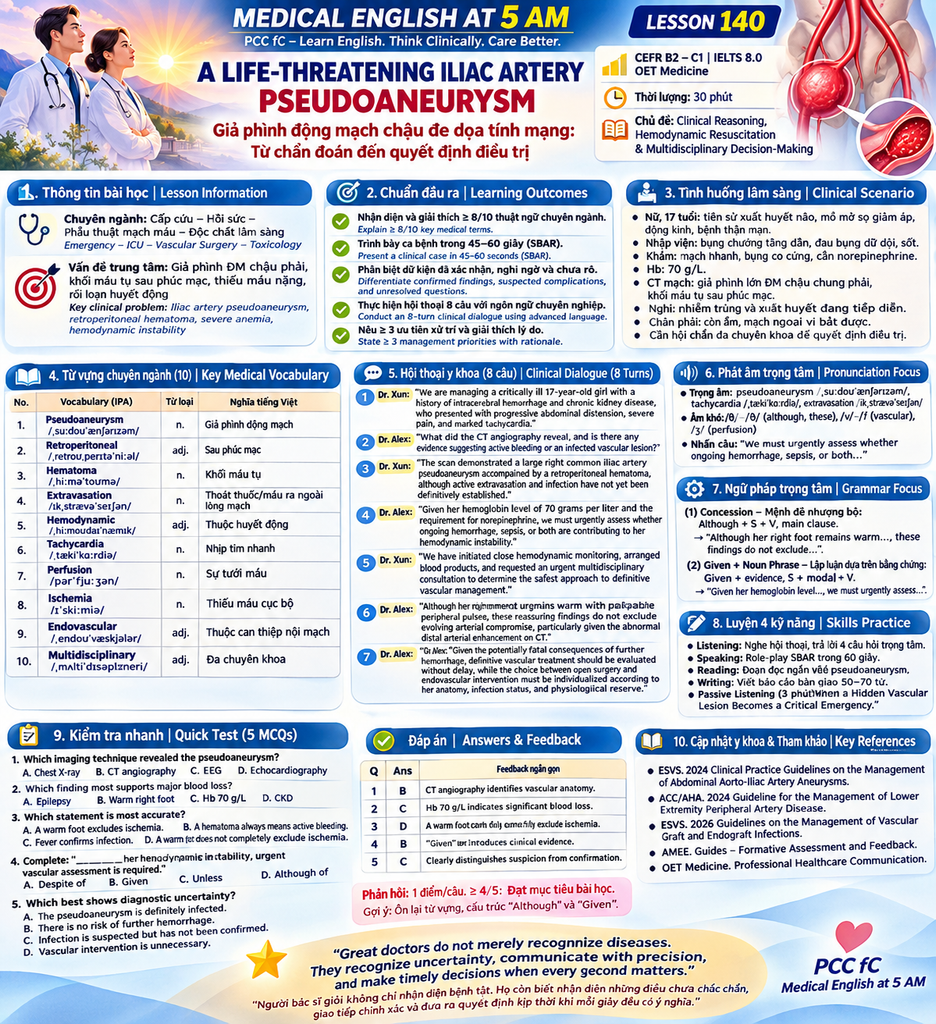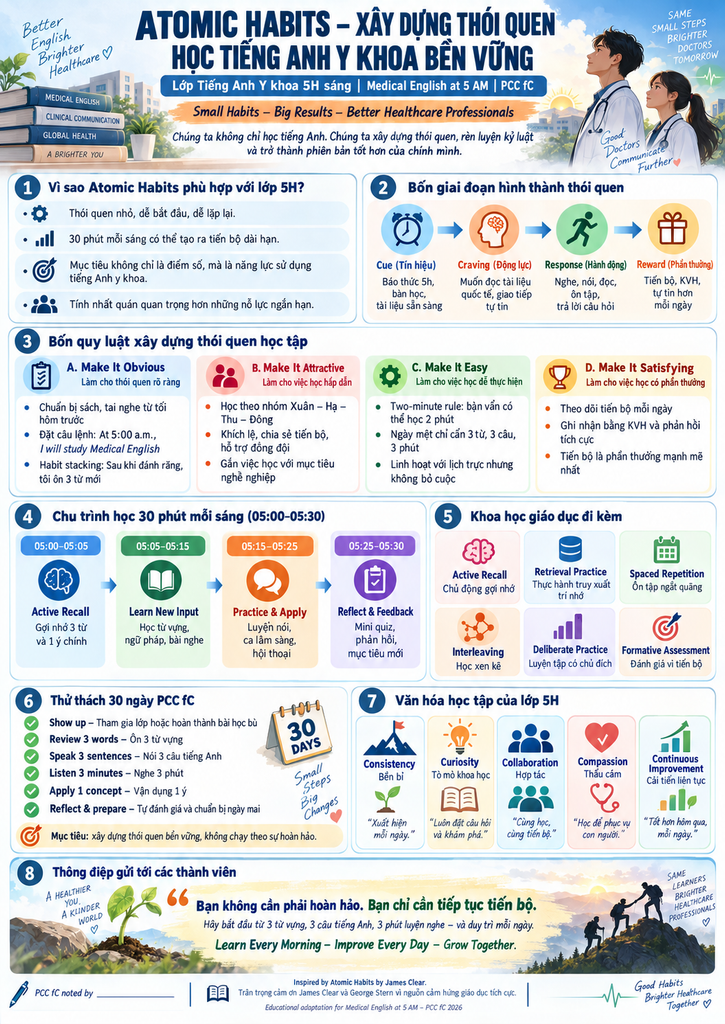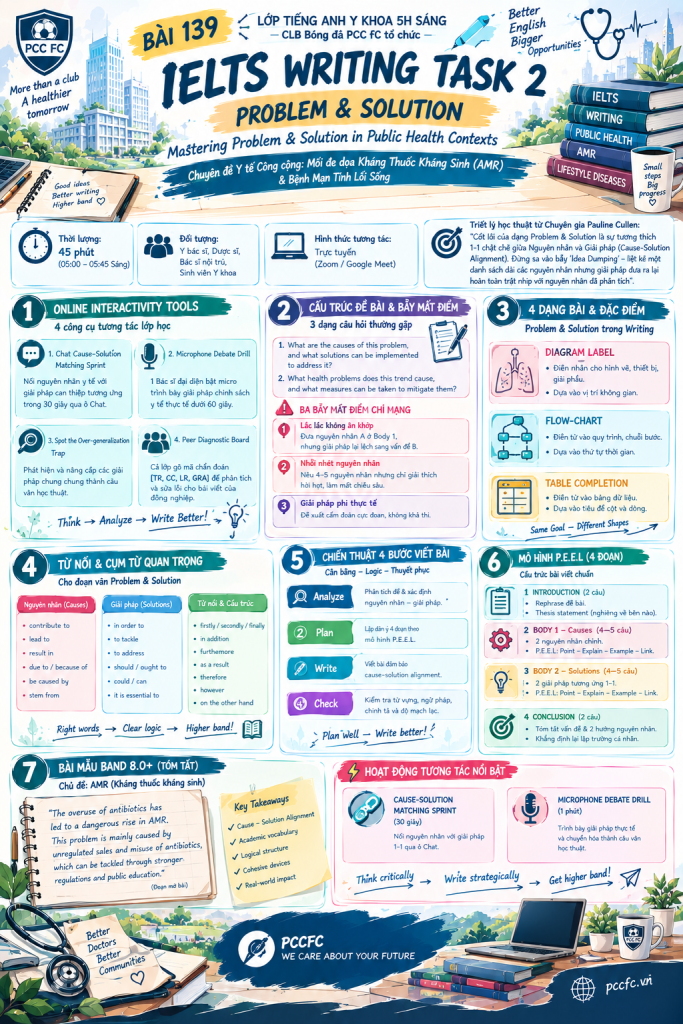
Bài 142 – Tiếng Anh Y Khoa: Co giật do rối loạn điện giải: Thách thức hồi sức và hội chẩn đa chuyên khoa * When electrolyte imbalance triggers seizures: a multidisciplinary critical care challenge
PCC Language – Thăng Long, Hà Nội, ngày 22/10/2026, Một bệnh nhân nam 72 tuổi, tiêu chảy kéo dài, hạ kali và magnesi máu nghiêm trọng, rối loạn đông máu nặng, bất ngờ xuất hiện co giật toàn thể. Liệu đây là bệnh lý thần kinh nguyên phát, hậu quả của rối loạn chuyển hóa hay biểu hiện của một tình trạng bệnh lý phức tạp hơn? Bài học số 142 đưa chúng ta vào một cuộc hội chẩn đa chuyên khoa đầy thử thách, nơi mỗi chỉ số xét nghiệm đều mang một ý nghĩa lâm sàng, mỗi quyết định đều cần tư duy khoa học và sự phối hợp chặt chẽ. Thông qua ca bệnh thực tế, học viên không chỉ nâng cao khả năng sử dụng tiếng Anh y khoa ở trình độ B2–C1, hướng tới IELTS 8.0 và OET Medicine, mà còn rèn luyện kỹ năng phân tích bệnh án, giao tiếp hội chẩn và xác định các ưu tiên hồi sức.
💙 “A great physician does not simply treat abnormal numbers; a great physician understands the patient behind those numbers.”
Người thầy thuốc giỏi không chỉ điều trị những con số bất thường, mà còn thấu hiểu người bệnh phía sau những con số ấy.
🌱 PCC fC – Học tiếng Anh mỗi sáng, rèn tư duy lâm sàng mỗi ngày, để trở thành những người thầy thuốc tốt hơn!
MEDICAL ENGLISH AT 5 AM – LESSON 142
WHEN ELECTROLYTE IMBALANCE TRIGGERS SEIZURES: A MULTIDISCIPLINARY CRITICAL CARE CHALLENGE
Co giật do rối loạn điện giải: Thách thức hồi sức và hội chẩn đa chuyên khoa
PCC fC – Medical English at 5 AM | 2026
PART 1. LESSON INFORMATION – THÔNG TIN BÀI HỌC
- Lesson: 142
- Topic: Acute Symptomatic Seizures, Severe Electrolyte Disturbances, and Multidisciplinary Critical Care
- Level: CEFR B2–C1 | IELTS 8.0-oriented | OET Medicine
- Duration: 30 minutes
- Teaching approach: Case-based learning, clinical reasoning, structured handover, and interactive speaking.
- Clinical context: Intensive Care Medicine – Neurology – Gastroenterology – Infectious Diseases – Clinical Toxicology.
- Case source: Multidisciplinary clinical consultation, Bach Mai Hospital, October 20, 2026.
- Teaching note: The case has been anonymised and adapted for educational purposes. Diagnostic uncertainties have been retained.
Time allocation:
- Parts 1–2: 2 minutes
- Part 3: 4 minutes
- Part 4: 5 minutes
- Part 5: 5 minutes
- Parts 6–7: 4 minutes
- Part 8: 6 minutes
- Part 9: 3 minutes
- Part 10 and final message: 1 minute
PART 2. LEARNING OUTCOMES – CHUẨN ĐẦU RA
By the end of this lesson, learners will be able to:
- Summarise a complex critically ill patient’s presentation in 60–90 seconds using at least five relevant clinical facts. (Tóm tắt một ca bệnh nặng, phức tạp trong 60–90 giây với ít nhất năm dữ kiện lâm sàng quan trọng.)
- Identify and correctly use at least eight out of ten advanced medical terms related to electrolyte disturbances, seizures, and critical care. (Nhận diện và sử dụng chính xác ít nhất 8/10 thuật ngữ chuyên ngành.)
- Explain at least three plausible mechanisms linking prolonged diarrhoea, electrolyte depletion, and acute symptomatic seizures. (Giải thích ít nhất ba cơ chế có thể liên kết tiêu chảy kéo dài, mất điện giải và co giật cấp triệu chứng.)
- Conduct an eight-turn multidisciplinary discussion using structured recommendations, appropriate clinical uncertainty, and professional communication. (Thực hiện hội thoại hội chẩn tám lượt, có khuyến nghị rõ ràng và thể hiện mức độ chắc chắn phù hợp.)
- Achieve at least 80% on a short case-based assessment and provide a coherent, evidence-informed management summary. (Đạt ít nhất 80% bài đánh giá và trình bày được định hướng xử trí dựa trên bằng chứng.)
PART 3. CLINICAL SCENARIO – TÌNH HUỐNG LÂM SÀNG
Case title: When Persistent Diarrhoea Becomes a Neurological Emergency
English clinical presentation
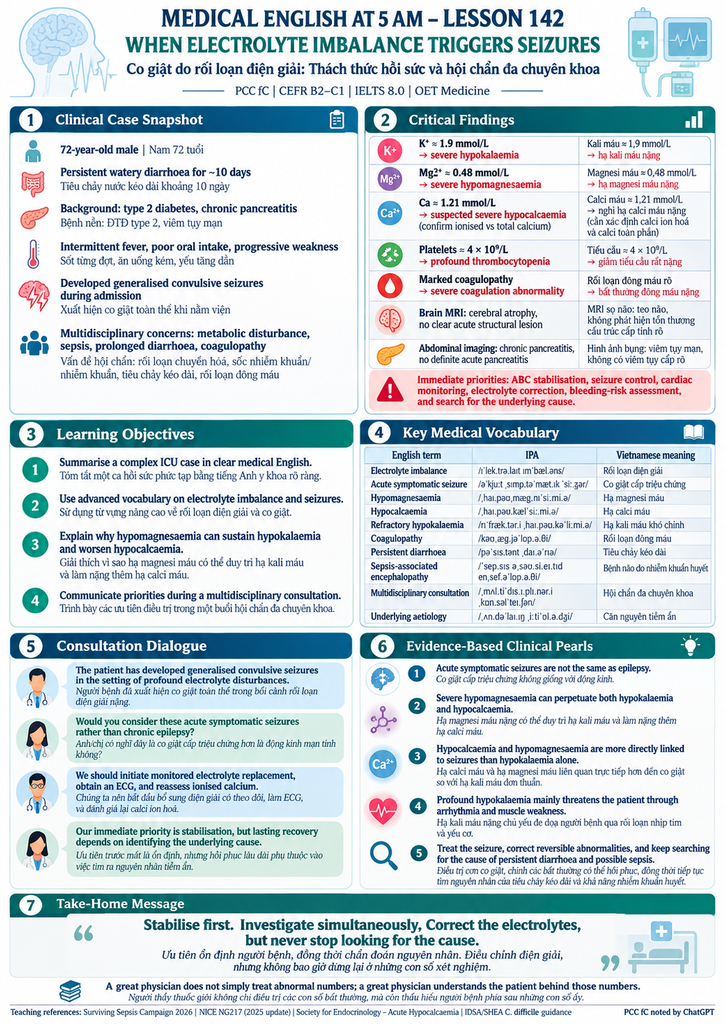
A 72-year-old man with type 2 diabetes mellitus and a history of chronic pancreatitis was admitted to hospital following approximately ten days of persistent watery diarrhoea.
Initially, he experienced several episodes of loose stools each day, accompanied by intermittent fever, fatigue, and poor oral intake.
Despite receiving treatment, his diarrhoea persisted and his clinical condition deteriorated.
Subsequent investigations revealed profound electrolyte abnormalities, including severe hypokalaemia, hypomagnesaemia, and hypocalcaemia.
Reported laboratory findings included:
- Serum potassium: approximately 1.9 mmol/L.
- Serum magnesium: approximately 0.48 mmol/L.
- Reported calcium concentration: approximately 1.21 mmol/L, requiring confirmation of whether this represented total or ionised calcium.
- Severe thrombocytopenia, with a reported platelet count of approximately 4 × 10⁹/L.
- Markedly prolonged coagulation parameters, raising concern for severe coagulopathy.
During hospitalisation, the patient developed generalised convulsive seizures, prompting an urgent neurological assessment and escalation of critical care.
Brain MRI demonstrated cerebral atrophy without a clearly identified acute structural lesion.
Abdominal imaging showed chronic pancreatitis without convincing evidence of acute pancreatitis.
The multidisciplinary team considered several overlapping problems: acute symptomatic seizures secondary to metabolic disturbances, possible sepsis, prolonged diarrhoea of uncertain aetiology, and severe coagulation abnormalities.
The immediate clinical priorities were stabilisation, seizure control, correction of potentially life-threatening electrolyte disturbances, assessment of bleeding risk, and identification of the underlying causes.
Vietnamese translation – Tóm tắt bệnh cảnh
Bệnh nhân nam 72 tuổi, có tiền sử đái tháo đường type 2 và viêm tụy mạn, nhập viện sau khoảng mười ngày tiêu chảy phân lỏng nhiều nước, kèm sốt từng đợt, mệt mỏi và ăn uống kém.
Bệnh nhân xuất hiện rối loạn điện giải nghiêm trọng, nổi bật là hạ kali máu, hạ magnesi máu và hạ calci máu.
Các xét nghiệm được ghi nhận cho thấy kali khoảng 1,9 mmol/L, magnesi khoảng 0,48 mmol/L và calci khoảng 1,21 mmol/L. Cần xác minh loại xét nghiệm calci trước khi diễn giải chính xác.
Bệnh nhân còn có giảm tiểu cầu rất nặng và rối loạn đông máu nghiêm trọng.
Trong quá trình điều trị, bệnh nhân xuất hiện co giật toàn thể, cần được đánh giá thần kinh khẩn cấp và hồi sức tích cực.
MRI sọ não cho thấy hình ảnh teo não nhưng chưa xác định được tổn thương cấu trúc cấp tính giải thích tình trạng co giật.
Các chuyên khoa phải phối hợp đánh giá đồng thời ba nhóm vấn đề chính: rối loạn chuyển hóa, căn nguyên tiêu chảy và khả năng nhiễm khuẩn huyết, cùng với nguy cơ xuất huyết do rối loạn đông máu.
Clinical reasoning – Tư duy lâm sàng
The key question is not simply, “Why is this patient having seizures?”
It is:
“Which reversible abnormalities are threatening this patient’s life, and what underlying processes are driving them?”
Câu hỏi trọng tâm không chỉ là: “Vì sao bệnh nhân co giật?”
Mà là:
“Những rối loạn có thể đảo ngược nào đang đe dọa tính mạng bệnh nhân, và cơ chế bệnh sinh nào đang duy trì các rối loạn đó?”
PART 4. ADVANCED MEDICAL VOCABULARY – 10 TỪ VỰNG TRỌNG TÂM
1. Electrolyte imbalance /ɪˈlek.trə.laɪt ɪmˈbæl.əns/
- Part of speech: Noun phrase
- Vietnamese: Rối loạn cân bằng điện giải
- Example: Severe electrolyte imbalance may precipitate life-threatening neurological and cardiac complications.
- Dịch: Rối loạn điện giải nặng có thể gây ra các biến chứng thần kinh và tim mạch đe dọa tính mạng.
2. Acute symptomatic seizure /əˈkjuːt ˌsɪmp.təˈmæt.ɪk ˈsiː.ʒər/
- Part of speech: Noun phrase
- Vietnamese: Co giật cấp triệu chứng
- Example: An acute symptomatic seizure may occur in the setting of severe metabolic disturbances.
- Dịch: Co giật cấp triệu chứng có thể xuất hiện trong bối cảnh rối loạn chuyển hóa nghiêm trọng.
3. Hypomagnesaemia /ˌhaɪ.pəʊˌmæɡ.nɪˈsiː.mi.ə/
- Part of speech: Noun
- Vietnamese: Hạ magnesi máu
- Example: Hypomagnesaemia can contribute to refractory hypokalaemia and impaired calcium regulation.
- Dịch: Hạ magnesi máu có thể góp phần gây hạ kali máu khó điều chỉnh và rối loạn điều hòa calci.
4. Hypocalcaemia /ˌhaɪ.pəʊ.kælˈsiː.mi.ə/
- Part of speech: Noun
- Vietnamese: Hạ calci máu
- Example: Severe hypocalcaemia may cause tetany, seizures, and QT prolongation.
- Dịch: Hạ calci máu nặng có thể gây co cứng cơ, co giật và kéo dài khoảng QT.
5. Refractory hypokalaemia /rɪˈfræk.tər.i ˌhaɪ.pəʊ.kəˈliː.mi.ə/
- Part of speech: Noun phrase
- Vietnamese: Hạ kali máu khó điều chỉnh
- Example: Refractory hypokalaemia should prompt clinicians to investigate concurrent magnesium deficiency.
- Dịch: Hạ kali máu khó điều chỉnh cần khiến bác sĩ tìm kiếm tình trạng thiếu magnesi đồng thời.
6. Coagulopathy /kəʊˌæɡ.jəˈlɒp.ə.θi/
- Part of speech: Noun
- Vietnamese: Rối loạn đông máu
- Example: Severe coagulopathy increases the risk of major bleeding and complicates invasive procedures.
- Dịch: Rối loạn đông máu nặng làm tăng nguy cơ xuất huyết nghiêm trọng và gây khó khăn cho các thủ thuật xâm lấn.
7. Persistent diarrhoea /pəˈsɪs.tənt ˌdaɪ.əˈrɪə/
- Part of speech: Noun phrase
- Vietnamese: Tiêu chảy kéo dài
- Example: Persistent diarrhoea may lead to dehydration, malnutrition, and substantial electrolyte losses.
- Dịch: Tiêu chảy kéo dài có thể gây mất nước, suy dinh dưỡng và mất điện giải đáng kể.
8. Sepsis-associated encephalopathy /ˈsep.sɪs əˌsəʊ.si.eɪ.tɪd enˌsef.əˈlɒp.ə.θi/
- Part of speech: Noun phrase
- Vietnamese: Bệnh não liên quan nhiễm khuẩn huyết
- Example: Sepsis-associated encephalopathy may contribute to altered consciousness, but other causes must be excluded.
- Dịch: Bệnh não liên quan nhiễm khuẩn huyết có thể góp phần gây rối loạn ý thức, nhưng cần loại trừ các nguyên nhân khác.
9. Multidisciplinary consultation /ˌmʌl.tiˈdɪs.ɪ.plɪ.nər.i ˌkɒn.səlˈteɪ.ʃən/
- Part of speech: Noun phrase
- Vietnamese: Hội chẩn đa chuyên khoa
- Example: Multidisciplinary consultation was essential because the patient had several interacting life-threatening conditions.
- Dịch: Hội chẩn đa chuyên khoa có vai trò thiết yếu vì bệnh nhân có nhiều tình trạng đe dọa tính mạng tương tác với nhau.
10. Underlying aetiology /ˌʌn.dəˈlaɪ.ɪŋ ˌiː.tiˈɒl.ə.dʒi/
- Part of speech: Noun phrase
- Vietnamese: Căn nguyên tiềm ẩn
- Example: Correcting electrolyte abnormalities is necessary, but identifying the underlying aetiology is equally important.
- Dịch: Điều chỉnh rối loạn điện giải là cần thiết, nhưng xác định căn nguyên tiềm ẩn cũng quan trọng không kém.
PART 5. MEDICAL DIALOGUE – HỘI THOẠI Y KHOA 8 CÂU SONG NGỮ
Setting: An intensive care specialist and a neurology resident are discussing a critically ill patient during a multidisciplinary consultation.
Characters:
- Dr. Anna – Intensive Care Consultant
- Dr. James – Neurology Resident
1. Dr. James:
“The patient has developed generalised convulsive seizures in the setting of profound hypokalaemia, hypomagnesaemia, and suspected hypocalcaemia.”
Dịch: Bệnh nhân đã xuất hiện co giật toàn thể trong bối cảnh hạ kali máu, hạ magnesi máu rất nặng và nghi ngờ hạ calci máu.
2. Dr. Anna:
“Given these findings, would you consider the seizures acute symptomatic events rather than evidence of an underlying epilepsy syndrome?”
Dịch: Với những dữ kiện này, bác sĩ có cho rằng đây là các cơn co giật cấp triệu chứng thay vì bằng chứng của một hội chứng động kinh nền không?
3. Dr. James:
“That seems more likely, although we must exclude other causes, particularly ongoing intracranial pathology, central nervous system infection, and medication-related neurotoxicity.”
Dịch: Khả năng đó có vẻ cao hơn, tuy nhiên chúng ta vẫn cần loại trừ các nguyên nhân khác, đặc biệt là bệnh lý nội sọ đang tiến triển, nhiễm trùng hệ thần kinh trung ương và độc tính thần kinh liên quan thuốc.
4. Dr. Anna:
“His potassium is approximately 1.9 mmol/L and magnesium is 0.48 mmol/L; how should we prioritise correction while minimising cardiac complications?”
Dịch: Kali của bệnh nhân khoảng 1,9 mmol/L và magnesi 0,48 mmol/L; chúng ta nên ưu tiên điều chỉnh như thế nào để giảm thiểu các biến chứng tim mạch?
5. Dr. James:
“We should initiate closely monitored electrolyte replacement, obtain an ECG, reassess ionised calcium, and check for further seizures or persistent encephalopathy.”
Dịch: Chúng ta cần bắt đầu bù điện giải dưới theo dõi chặt chẽ, ghi điện tâm đồ, đánh giá lại calci ion hóa và theo dõi các cơn co giật tiếp diễn hoặc bệnh não kéo dài.
6. Dr. Anna:
“Agreed. His severe thrombocytopenia and coagulopathy also require urgent investigation before any non-essential invasive procedure is considered.”
Dịch: Tôi đồng ý. Tình trạng giảm tiểu cầu rất nặng và rối loạn đông máu cũng cần được đánh giá khẩn cấp trước khi cân nhắc bất kỳ thủ thuật xâm lấn nào không thật sự cần thiết.
7. Dr. James:
“Meanwhile, we should investigate the persistent diarrhoea, review antimicrobial exposure, and determine whether infection, malabsorption, or another gastrointestinal disorder is contributing to the electrolyte losses.”
Dịch: Đồng thời, chúng ta cần tìm nguyên nhân tiêu chảy kéo dài, xem xét tiền sử sử dụng kháng sinh và xác định liệu nhiễm trùng, kém hấp thu hay bệnh lý tiêu hóa khác có góp phần gây mất điện giải hay không.
8. Dr. Anna:
“Exactly. Our immediate priority is to stabilise the patient, but lasting recovery depends on identifying and treating the processes responsible for these interconnected complications.”
Dịch: Chính xác. Ưu tiên trước mắt là ổn định người bệnh, nhưng khả năng hồi phục bền vững phụ thuộc vào việc xác định và điều trị những cơ chế gây ra các biến chứng có liên quan chặt chẽ với nhau này.
Clinical communication highlights – Những điểm giao tiếp nổi bật
- “Given these findings…” – Dựa trên những dữ kiện này…
- “Would you consider…?” – Bác sĩ có cân nhắc khả năng…?
- “That seems more likely, although…” – Khả năng đó có vẻ cao hơn, tuy nhiên…
- “How should we prioritise…?” – Chúng ta nên sắp xếp thứ tự ưu tiên như thế nào…?
- “Meanwhile, we should…” – Đồng thời, chúng ta cần…
- “Our immediate priority is…” – Ưu tiên trước mắt của chúng ta là…
OET Medicine principle:
Effective clinical communication requires accurate information, respectful questioning, clear prioritisation, and appropriate acknowledgement of uncertainty.
PART 6. PRONUNCIATION FOCUS – TRỌNG TÂM PHÁT ÂM
A. Word stress – Trọng âm từ
- Electrolyte /ɪˈlek.trə.laɪt/ – nhấn âm tiết thứ hai.
- Hypokalaemia /ˌhaɪ.pəʊ.kəˈliː.mi.ə/ – trọng âm chính ở âm tiết chứa /liː/.
- Hypomagnesaemia /ˌhaɪ.pəʊˌmæɡ.nɪˈsiː.mi.ə/ – trọng âm chính ở /siː/.
- Coagulopathy /kəʊˌæɡ.jəˈlɒp.ə.θi/ – trọng âm chính ở /lɒp/.
- Aetiology /ˌiː.tiˈɒl.ə.dʒi/ – trọng âm chính ở /ɒl/.
B. Connected speech – Nối âm tự nhiên
Practise:
“Severe electrolyte imbalance may trigger acute symptomatic seizures.”
Pay attention to the natural rhythm:
- Severe electrolyte imbalance
- May trigger
- Acute symptomatic seizures
C. Professional intonation – Ngữ điệu chuyên nghiệp
Sentence:
“Would you consider the seizures acute symptomatic events?”
Use a polite, inquisitive tone to invite discussion rather than challenge a colleague.
Mini-practice:
Read aloud three times:
“Correction of the electrolyte abnormalities is essential, but identifying the underlying cause is equally important.”
Aim for clarity, natural rhythm, and appropriate emphasis on “essential” and “underlying cause”.
PART 7. GRAMMAR IN CLINICAL COMMUNICATION – PHÂN TÍCH 2 CẤU TRÚC NGỮ PHÁP
GRAMMAR 1. HEDGING – DIỄN ĐẠT MỨC ĐỘ KHÔNG CHẮC CHẮN TRONG Y KHOA
Structure:
Subject + may / might / could + base verb
Clinical examples:
“The seizures may be related to severe electrolyte disturbances.”
“Persistent diarrhoea could have contributed to the patient’s magnesium depletion.”
“Sepsis-associated encephalopathy might explain part of the altered mental status.”
Vietnamese explanation:
Trong giao tiếp học thuật và lâm sàng, hedging giúp thể hiện mức độ chắc chắn phù hợp với bằng chứng.
Các từ “may”, “might”, “could” không có nghĩa bác sĩ thiếu tự tin mà thể hiện tư duy khoa học, tránh khẳng định quan hệ nhân quả khi chưa đủ chứng cứ.
Compare:
Less appropriate:
“The low potassium caused the seizures.”
More appropriate:
“The seizures may be related to the combined metabolic disturbances, particularly hypocalcaemia and hypomagnesaemia.”
Clinical note:
Hạ kali máu đơn độc hiếm khi trực tiếp gây co giật. Hạ calci và hạ magnesi máu là những nguyên nhân có cơ chế gây co giật trực tiếp rõ ràng hơn. Hạ kali nặng chủ yếu đe dọa bệnh nhân qua rối loạn nhịp tim và yếu cơ.
GRAMMAR 2. CONDITIONAL SENTENCES FOR CLINICAL DECISION-MAKING – CÂU ĐIỀU KIỆN TRONG QUYẾT ĐỊNH LÂM SÀNG
Structure:
If + present simple, subject + should / must / may + base verb
Example 1:
“If seizures persist despite correction of metabolic abnormalities, we must investigate alternative neurological causes.”
Dịch: Nếu các cơn co giật tiếp diễn mặc dù đã điều chỉnh rối loạn chuyển hóa, chúng ta phải tìm kiếm những nguyên nhân thần kinh khác.
Example 2:
“If the patient develops significant ECG abnormalities, cardiac monitoring and urgent correction become even more critical.”
Dịch: Nếu bệnh nhân xuất hiện các bất thường điện tâm đồ đáng kể, việc theo dõi tim và điều chỉnh điện giải khẩn cấp càng trở nên quan trọng.
Example 3:
“If severe thrombocytopenia persists, invasive investigations should be carefully assessed against the bleeding risk.”
Dịch: Nếu tình trạng giảm tiểu cầu rất nặng vẫn tiếp diễn, các thăm dò xâm lấn cần được cân nhắc kỹ lưỡng với nguy cơ xuất huyết.
IELTS 8.0 and OET application:
These conditional structures enable clinicians to explain contingency plans, anticipate complications, and communicate clinical decisions logically.
PART 8. INTEGRATED SKILLS PRACTICE – LUYỆN NGHE, NÓI, ĐỌC, VIẾT
A. LISTENING – THREE-MINUTE PASSIVE LISTENING
Title: When Electrolyte Disturbances Become a Neurological Emergency
Level: B2–C1
Estimated duration: Approximately 3 minutes at a moderate speaking pace.
English Listening Script
In intensive care medicine, seemingly unrelated symptoms may sometimes be connected by a single underlying physiological disturbance.
Consider an elderly patient admitted with persistent diarrhoea, intermittent fever, poor oral intake, and progressive weakness.
Initially, the clinical team focuses on dehydration and possible gastrointestinal infection.
However, the patient’s condition deteriorates.
Laboratory investigations reveal profound hypokalaemia, hypomagnesaemia, and hypocalcaemia.
These abnormalities are particularly concerning because electrolytes play essential roles in maintaining normal cellular activity, neuromuscular function, and cardiac electrical stability.
Magnesium deficiency deserves special attention.
Severe hypomagnesaemia may cause neurological hyperexcitability and seizures.
It can also increase renal potassium loss and interfere with calcium regulation, making other electrolyte disturbances more difficult to correct.
Hypocalcaemia may further increase neuronal excitability, potentially leading to tetany, seizures, and cardiac conduction abnormalities.
In contrast, severe hypokalaemia primarily threatens cardiac rhythm and muscle function rather than directly triggering epileptic seizures.
When the patient develops generalised convulsive seizures, the clinical team faces an immediate emergency.
The first priorities are airway protection, oxygenation, circulation, bedside glucose assessment, and rapid seizure management.
At the same time, clinicians must identify and correct reversible metabolic abnormalities.
If convulsive activity continues for five minutes or longer, the patient requires emergency treatment for convulsive status epilepticus.
Once the immediate danger is controlled, attention turns to the underlying causes.
Persistent diarrhoea may result from infection, medication-related complications, malabsorption, or other gastrointestinal diseases.
In a patient with chronic pancreatitis, pancreatic exocrine insufficiency should be considered, although its presence cannot be assumed.
Sepsis must also be assessed carefully because infection and organ dysfunction can coexist with metabolic complications.
Severe thrombocytopenia and coagulopathy introduce another layer of complexity by increasing bleeding risk and influencing decisions about invasive investigations.
This is where multidisciplinary collaboration becomes essential.
Intensive care specialists, neurologists, gastroenterologists, infectious disease physicians, haematologists, and toxicologists may each contribute important perspectives.
However, effective collaboration requires more than specialist knowledge.
It demands clear communication, accurate prioritisation, and a willingness to reconsider the initial diagnosis.
The central lesson is that treating a seizure is not the same as treating the cause of the seizure.
Likewise, correcting an electrolyte abnormality without identifying why it developed may provide only temporary improvement.
In critical care, clinical excellence comes from recognising patterns, addressing reversible threats, and understanding how different organ systems influence one another.
Listening comprehension questions:
- Why can magnesium deficiency make potassium depletion difficult to correct?
- Which electrolyte abnormalities are more directly associated with seizures?
- Why should clinicians continue investigating the cause after seizure control?
B. SPEAKING – CLINICAL HANDOVER
Task:
Deliver a 60-second patient handover using the SBAR framework.
S – Situation
“We are managing a critically ill elderly patient who has developed generalised seizures in the context of profound electrolyte disturbances.”
B – Background
“He has a history of chronic pancreatitis, type 2 diabetes, and approximately ten days of persistent diarrhoea.”
A – Assessment
“Our main concerns are acute symptomatic seizures, severe potassium and magnesium depletion, hypocalcaemia, possible sepsis, and major coagulation abnormalities.”
R – Recommendation
“I recommend urgent stabilisation, continuous cardiac monitoring, controlled electrolyte replacement, reassessment of the neurological status, and further investigation of the underlying causes.”
Speaking challenge:
Present the case without reading the script. Maintain a calm, concise, and professional tone.
C. READING – CRITICAL READING
Read the following statement:
“Although electrolyte replacement may resolve acute metabolic complications, sustained clinical improvement depends on identifying and treating the underlying mechanism responsible for electrolyte depletion.”
Question:
What is the main idea?
A. Electrolyte replacement is unnecessary.
B. All seizures require long-term antiseizure treatment.
C. Correcting laboratory abnormalities alone may not prevent recurrence.
D. Chronic pancreatitis always causes severe electrolyte disturbances.
D. WRITING – OET-STYLE CLINICAL SUMMARY
Task:
Write a 60–80-word clinical summary to a senior intensive care consultant.
Model answer:
Dear Consultant,
I am writing to summarise the condition of a 72-year-old man with persistent diarrhoea and chronic pancreatitis who subsequently developed generalised convulsive seizures. Investigations revealed profound hypokalaemia, hypomagnesaemia, suspected severe hypocalcaemia, thrombocytopenia, and coagulopathy. Acute symptomatic seizures due to metabolic disturbances are strongly suspected, although alternative causes remain under investigation. Immediate priorities include seizure control, monitored electrolyte correction, bleeding-risk assessment, and investigation of possible infection and gastrointestinal electrolyte losses.
PART 9. ASSESSMENT, ANSWERS AND FEEDBACK – KIỂM TRA, ĐÁP ÁN VÀ PHẢN HỒI
Question 1. Vocabulary
Which term refers to an abnormality of blood clotting?
A. Encephalopathy
B. Coagulopathy
C. Hypomagnesaemia
D. Aetiology
Question 2. Clinical reasoning
Which electrolyte disturbance is particularly associated with both seizures and difficulty correcting hypokalaemia?
A. Hypernatraemia
B. Hyperchloraemia
C. Hypomagnesaemia
D. Hyperkalaemia
Question 3. Clinical priorities
Which action is most appropriate during an ongoing generalised convulsive seizure?
A. Wait for repeat routine laboratory results.
B. Prioritise resuscitation, bedside glucose assessment, seizure management, and correction of reversible abnormalities.
C. Perform lumbar puncture immediately regardless of coagulation status.
D. Assume that cerebral atrophy is the definitive cause.
Question 4. Grammar
Choose the most scientifically appropriate sentence.
A. Hypokalaemia definitely caused the seizure.
B. The seizure could be related to the patient’s severe metabolic disturbances.
C. All electrolyte abnormalities cause epilepsy.
D. Chronic pancreatitis always results in hypocalcaemia.
Question 5. Clinical communication
Complete the sentence:
“If the patient continues to have seizures despite correcting metabolic abnormalities, we ______ investigate other neurological causes.”
A. should
B. would have
C. had
D. having
ANSWER KEY – ĐÁP ÁN VÀ GIẢI THÍCH
1. B – Coagulopathy
Coagulopathy refers to impaired haemostasis or abnormalities affecting normal blood coagulation.
2. C – Hypomagnesaemia
Magnesium deficiency can promote renal potassium wasting and may contribute to calcium dysregulation. Severe deficiency can also cause neurological manifestations, including seizures.
3. B – Immediate resuscitation and seizure management
Ongoing convulsive seizures demand prompt emergency management. Diagnostic investigations should proceed alongside, rather than delay, stabilisation.
4. B – The seizure could be related to the patient’s severe metabolic disturbances.
This statement appropriately expresses clinical uncertainty and avoids claiming an unproven causal relationship.
5. A – Should
“If + present simple, subject + should + base verb” is suitable for expressing a clinical recommendation under a defined condition.
Assessment scale:
- 5/5: Excellent – Advanced clinical English proficiency.
- 4/5: Very good – Minor improvement needed.
- 3/5: Developing – Review key concepts and clinical language.
- 0–2/5: Further practice recommended.
Target: At least 4/5 correct answers.
Feedback questions:
- Did I describe the patient’s condition accurately?
- Did I distinguish confirmed findings from possible diagnoses?
- Did I communicate the immediate clinical priorities?
- Did I use professional expressions and appropriate clinical uncertainty?
PART 10. EVIDENCE-BASED CLINICAL PEARLS – KIẾN THỨC Y KHOA CẬP NHẬT
CLINICAL PEARL 1. Acute symptomatic seizures are not synonymous with epilepsy.
A seizure occurring in close temporal association with a severe metabolic disturbance may be classified as an acute symptomatic seizure.
Co giật liên quan trực tiếp đến rối loạn chuyển hóa cấp không đồng nghĩa với việc người bệnh đã mắc động kinh mạn tính.
Clinical implication:
Correcting the provoking disturbance is fundamental. The need for ongoing antiseizure medication must be assessed individually.
CLINICAL PEARL 2. Not all electrolyte disturbances cause seizures through the same mechanism.
Severe hypocalcaemia and hypomagnesaemia may increase neuronal excitability and directly provoke seizures.
Profound hypokalaemia is more strongly associated with arrhythmias, muscular weakness, and potentially respiratory muscle dysfunction.
Clinical implication:
Electrolyte disturbances should not be treated as interchangeable explanations for neurological symptoms.
CLINICAL PEARL 3. Severe symptomatic hypocalcaemia is a medical emergency.
Symptomatic hypocalcaemia may require intravenous calcium administration with ECG monitoring.
Serum ionised calcium should be evaluated whenever possible, particularly in critically ill patients with abnormalities of albumin or acid–base balance.
Clinical implication:
Treatment intensity depends on symptoms, the actual calcium measurement, ECG findings, and the overall clinical context.
CLINICAL PEARL 4. Magnesium deficiency can perpetuate both hypokalaemia and hypocalcaemia.
Magnesium depletion increases urinary potassium loss and may impair parathyroid hormone secretion or action.
Clinical implication:
Potassium and calcium replacement may be less effective unless associated magnesium deficiency is corrected.
CLINICAL PEARL 5. Convulsive status epilepticus requires immediate recognition.
A generalised convulsive seizure lasting five minutes or longer should be managed as convulsive status epilepticus.
Immediate treatment includes emergency resuscitation and an appropriate benzodiazepine, followed by escalation according to the treatment algorithm if seizures continue.
Clinical implication:
Do not delay emergency seizure treatment while waiting for laboratory investigations or imaging.
CLINICAL PEARL 6. Sepsis requires continuous diagnostic reassessment.
Sepsis is life-threatening organ dysfunction caused by a dysregulated host response to infection.
The presence of fever, diarrhoea, or elevated inflammatory markers alone does not establish the diagnosis.
The Surviving Sepsis Campaign 2026 emphasises timely assessment, appropriate antimicrobial therapy, identification of the infectious source, source control when indicated, and antimicrobial stewardship.
Clinical implication:
The possibility of sepsis must be evaluated promptly without overlooking noninfectious causes of organ dysfunction.
CLINICAL PEARL 7. Chronic pancreatitis may contribute to malabsorption, but causation must be demonstrated.
Pancreatic exocrine insufficiency can cause maldigestion, steatorrhoea, nutritional deficiencies, and weight loss.
However, persistent watery diarrhoea in a hospitalised patient may have infectious, medication-related, inflammatory, or other metabolic causes.
Clinical implication:
Investigations should be guided by the clinical presentation, stool characteristics, nutritional status, and previous antimicrobial exposure.
CLINICAL PEARL 8. Severe thrombocytopenia and coagulopathy demand urgent risk assessment.
Markedly reduced platelet counts and abnormal coagulation parameters increase the risk of spontaneous or procedure-related bleeding.
Potential causes may include disseminated intravascular coagulation, bone marrow disorders, medication effects, severe infection, liver dysfunction, and other haematological diseases.
Clinical implication:
Unexpected critical results should be confirmed promptly, while necessary emergency treatment and bleeding precautions proceed without delay.
CLINICAL PEARL 9. Medication-related neurotoxicity belongs in the differential diagnosis.
Some antimicrobial agents and other medications may lower the seizure threshold, especially in vulnerable patients or those with impaired renal function.
Clinical implication:
A structured medication review is essential whenever unexplained seizures or encephalopathy develop during hospitalisation.
CLINICAL PEARL 10. Multidisciplinary care succeeds when recommendations are integrated.
Different specialists may identify different pieces of the same clinical problem.
The intensivist focuses on stabilisation, the neurologist on seizure mechanisms, the gastroenterologist on gastrointestinal losses, and the haematologist on bleeding and coagulation abnormalities.
The clinical toxicologist contributes to the evaluation of potential exposure-related and medication-related causes.
Clinical implication:
Effective multidisciplinary care requires shared priorities, clear documentation, timely reassessment, and one coordinated treatment plan.
KEY TAKE-HOME MESSAGES – THÔNG ĐIỆP GHI NHỚ
- Stabilise first, investigate simultaneously. – Ưu tiên ổn định người bệnh, đồng thời triển khai chẩn đoán.
- Treat the seizure and identify its cause. – Điều trị cơn co giật đồng thời xác định nguyên nhân.
- Correct magnesium alongside other electrolyte deficits. – Điều chỉnh thiếu magnesi cùng với các rối loạn điện giải khác.
- Distinguish clinical evidence from diagnostic assumptions. – Phân biệt bằng chứng lâm sàng với giả thuyết chẩn đoán.
- Communicate clearly, collaborate effectively, and reassess continuously. – Giao tiếp rõ ràng, phối hợp hiệu quả và đánh giá lại liên tục.
FINAL EDUCATIONAL MESSAGE – THÔNG ĐIỆP GIÁO DỤC
“In critical care, the most important skill is not merely recognising what is abnormal, but understanding why it happened, how it threatens the patient, and what must be done next.”
“Trong hồi sức cấp cứu, kỹ năng quan trọng nhất không chỉ là nhận ra điều gì đang bất thường, mà còn là hiểu vì sao bất thường đó xảy ra, nó đe dọa người bệnh như thế nào và chúng ta cần làm gì tiếp theo.”
A great physician does not simply treat abnormal numbers; a great physician understands the patient behind those numbers.
Một người thầy thuốc giỏi không chỉ điều trị những chỉ số xét nghiệm bất thường, mà còn thấu hiểu người bệnh phía sau những con số ấy.
KEEP LEARNING. KEEP QUESTIONING. KEEP SAVING LIVES.
Medical English at 5 AM – PCC fC
Every morning, we learn a language. Every day, we become better physicians.
Mỗi buổi sáng, chúng ta học thêm một ngôn ngữ. Mỗi ngày, chúng ta trở thành những người thầy thuốc tốt hơn.
PCC fC 2026 – MULTILINGUAL MEDICAL EDUCATION
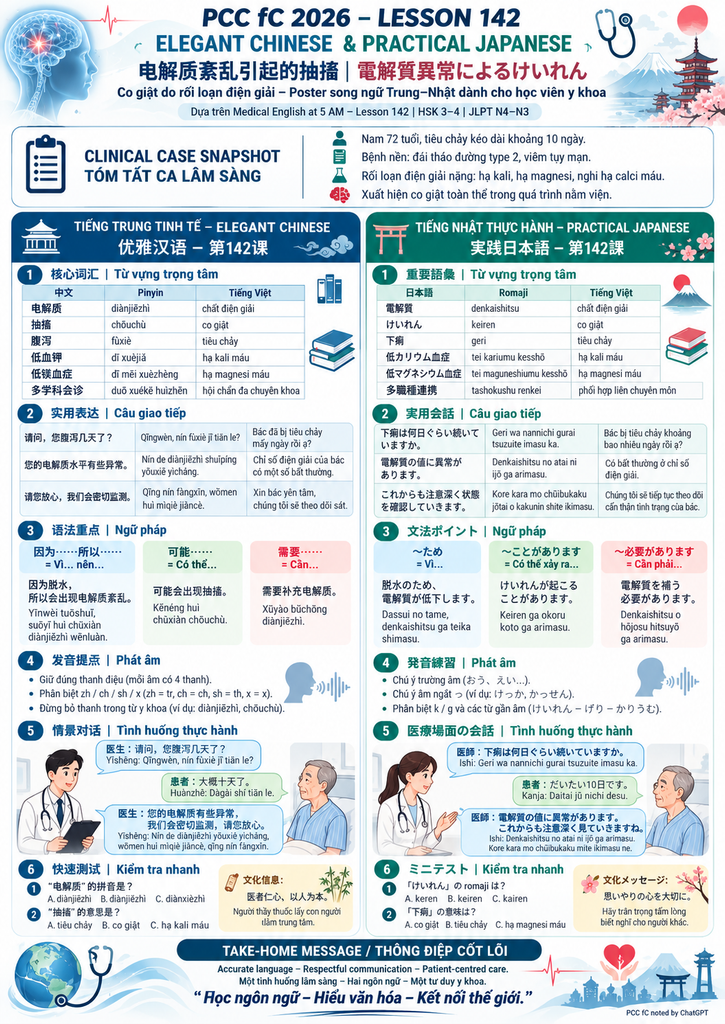
LESSON 142: WHEN ELECTROLYTE IMBALANCE TRIGGERS SEIZURES
Chủ đề: Co giật do rối loạn điện giải – Hồi sức cấp cứu và hội chẩn đa chuyên khoa
TIẾNG TRUNG TINH TẾ – ELEGANT CHINESE (HSK 3–4)
TIẾNG NHẬT THỰC HÀNH – PRACTICAL JAPANESE (JLPT N4–N3)
Medical English at 5 AM – Lesson 142 | PCC fC 2026
MỤC TIÊU CHUNG
Sau bài học, học viên có thể nhận biết 20 từ vựng Trung–Nhật, sử dụng sáu mẫu câu giao tiếp, vận dụng sáu cấu trúc ngữ pháp cơ bản và thực hành hội thoại trong môi trường bệnh viện.
Nội dung được xây dựng từ tình huống bệnh nhân cao tuổi bị tiêu chảy kéo dài, rối loạn điện giải nghiêm trọng và xuất hiện co giật, nhấn mạnh giao tiếp chính xác, lịch sự và an toàn.
Lưu ý trình độ: Các mẫu câu được thiết kế ở mức HSK 3–4 và JLPT N4–N3. Một số thuật ngữ y khoa chuyên sâu vượt trình độ thông thường của các kỳ thi này nhưng được đưa vào để học viên làm quen với giao tiếp chuyên ngành.
PHẦN A. TIẾNG TRUNG TINH TẾ – ELEGANT CHINESE
优雅汉语 – 第142课
主题:电解质紊乱引起的抽搐
Pinyin: Diànjiězhì wěnluàn yǐnqǐ de chōuchù.
Tiếng Việt: Co giật do rối loạn điện giải.
1. 核心词汇 – 10 TỪ VỰNG TRỌNG TÂM
1. 电解质 (diànjiězhì)
- Âm Hán Việt: Điện giải chất.
- Từ loại: Danh từ.
- Nghĩa: Chất điện giải.
- Ví dụ: 医生需要检查患者的电解质水平。
- Pinyin: Yīshēng xūyào jiǎnchá huànzhě de diànjiězhì shuǐpíng.
- Dịch: Bác sĩ cần kiểm tra nồng độ các chất điện giải của người bệnh.
2. 抽搐 (chōuchù)
- Âm Hán Việt: Trừu súc.
- Từ loại: Danh từ/động từ.
- Nghĩa: Co giật.
- Ví dụ: 患者突然出现了抽搐。
- Pinyin: Huànzhě tūrán chūxiàn le chōuchù.
- Dịch: Bệnh nhân đột ngột xuất hiện co giật.
3. 腹泻 (fùxiè)
- Âm Hán Việt: Phúc tả.
- Từ loại: Danh từ/động từ.
- Nghĩa: Tiêu chảy.
- Ví dụ: 患者已经腹泻十天了。
- Pinyin: Huànzhě yǐjīng fùxiè shí tiān le.
- Dịch: Bệnh nhân đã tiêu chảy mười ngày.
4. 低血钾 (dī xuèjiǎ)
- Âm Hán Việt: Đê huyết giáp (钾: giáp, chỉ nguyên tố kali).
- Từ loại: Danh từ.
- Nghĩa: Hạ kali máu.
- Ví dụ: 严重低血钾可能引起心律失常。
- Pinyin: Yánzhòng dī xuèjiǎ kěnéng yǐnqǐ xīnlǜ shīcháng.
- Dịch: Hạ kali máu nặng có thể gây rối loạn nhịp tim.
5. 低镁血症 (dī měi xuèzhèng)
- Âm Hán Việt: Đê mỹ huyết chứng (镁: mỹ, chỉ magnesi).
- Từ loại: Danh từ.
- Nghĩa: Hạ magnesi máu.
- Ví dụ: 低镁血症可能增加抽搐的风险。
- Pinyin: Dī měi xuèzhèng kěnéng zēngjiā chōuchù de fēngxiǎn.
- Dịch: Hạ magnesi máu có thể làm tăng nguy cơ co giật.
6. 低钙血症 (dī gài xuèzhèng)
- Âm Hán Việt: Đê cái huyết chứng (钙: cái, chỉ calci).
- Từ loại: Danh từ.
- Nghĩa: Hạ calci máu.
- Ví dụ: 严重低钙血症可能引起抽搐。
- Pinyin: Yánzhòng dī gài xuèzhèng kěnéng yǐnqǐ chōuchù.
- Dịch: Hạ calci máu nặng có thể gây co giật.
7. 感染 (gǎnrǎn)
- Âm Hán Việt: Cảm nhiễm.
- Từ loại: Danh từ/động từ.
- Nghĩa: Nhiễm trùng.
- Ví dụ: 我们需要检查患者是否有感染。
- Pinyin: Wǒmen xūyào jiǎnchá huànzhě shìfǒu yǒu gǎnrǎn.
- Dịch: Chúng ta cần kiểm tra xem bệnh nhân có nhiễm trùng hay không.
8. 治疗 (zhìliáo)
- Âm Hán Việt: Trị liệu.
- Từ loại: Danh từ/động từ.
- Nghĩa: Điều trị.
- Ví dụ: 医生正在为患者制定治疗方案。
- Pinyin: Yīshēng zhèngzài wèi huànzhě zhìdìng zhìliáo fāng’àn.
- Dịch: Bác sĩ đang xây dựng phương án điều trị cho bệnh nhân.
9. 监测 (jiāncè)
- Âm Hán Việt: Giám trắc.
- Từ loại: Động từ.
- Nghĩa: Theo dõi, giám sát.
- Ví dụ: 我们必须密切监测患者的心率。
- Pinyin: Wǒmen bìxū mìqiè jiāncè huànzhě de xīnlǜ.
- Dịch: Chúng ta phải theo dõi chặt chẽ nhịp tim của bệnh nhân.
10. 多学科会诊 (duō xuékē huìzhěn)
- Âm Hán Việt: Đa học khoa hội chẩn.
- Từ loại: Danh từ.
- Nghĩa: Hội chẩn đa chuyên khoa.
- Ví dụ: 这个复杂病例需要多学科会诊。
- Pinyin: Zhège fùzá bìnglì xūyào duō xuékē huìzhěn.
- Dịch: Ca bệnh phức tạp này cần hội chẩn đa chuyên khoa.
Mẹo ghi nhớ: 电 (điện), 血 (máu), 低 (thấp), 症 (chứng/bệnh), 医 (y), 治 (điều trị) là những chữ Hán xuất hiện thường xuyên trong thuật ngữ y khoa.
Âm Hán Việt giúp nhận diện chữ Hán, không thay thế cách phát âm Pinyin của tiếng Trung hiện đại.
2. 实用表达 – 3 CÂU GIAO TIẾP
Câu 1. Hỏi về triệu chứng
请问,您腹泻几天了?
Pinyin: Qǐngwèn, nín fùxiè jǐ tiān le?
Dịch: Xin hỏi, bác/cô/chú đã bị tiêu chảy mấy ngày rồi ạ?
Câu 2. Giải thích tình trạng bệnh
您的电解质水平有些异常,我们需要进一步检查。
Pinyin: Nín de diànjiězhì shuǐpíng yǒuxiē yìcháng, wǒmen xūyào jìnyíbù jiǎnchá.
Dịch: Các chỉ số điện giải của bác có một số bất thường, chúng tôi cần kiểm tra thêm.
Câu 3. Trấn an người bệnh
请您放心,我们会密切监测您的情况。
Pinyin: Qǐng nín fàngxīn, wǒmen huì mìqiè jiāncè nín de qíngkuàng.
Dịch: Xin bác yên tâm, chúng tôi sẽ theo dõi sát tình trạng của bác.
Lưu ý: Câu trấn an không có nghĩa bảo đảm kết quả điều trị; khi giao tiếp thực tế, bác sĩ vẫn cần giải thích trung thực về nguy cơ và kế hoạch chăm sóc.
3. 语法重点 – 3 CẤU TRÚC NGỮ PHÁP
Ngữ pháp 1. 因为……所以…… – Vì… nên…
Công thức:
因为 + nguyên nhân, 所以 + kết quả.
Ví dụ:
因为患者腹泻严重,所以出现了电解质紊乱。
Pinyin: Yīnwèi huànzhě fùxiè yánzhòng, suǒyǐ chūxiàn le diànjiězhì wěnluàn.
Dịch: Vì bệnh nhân tiêu chảy nặng nên đã xuất hiện rối loạn điện giải.
Ứng dụng: Diễn đạt quan hệ nguyên nhân–kết quả trong bệnh sử và giải thích bệnh.
Ngữ pháp 2. 可能…… – Có thể…
Công thức:
Chủ ngữ + 可能 + động từ/cụm động từ.
Ví dụ:
低镁血症可能引起抽搐。
Pinyin: Dī měi xuèzhèng kěnéng yǐnqǐ chōuchù.
Dịch: Hạ magnesi máu có thể gây co giật.
Ứng dụng: Trình bày giả thuyết chẩn đoán mà không khẳng định chắc chắn khi chưa đủ bằng chứng.
Ngữ pháp 3. 需要…… – Cần…
Công thức:
Chủ ngữ + 需要 + động từ/cụm động từ.
Ví dụ:
我们需要尽快检查患者的血钾和血镁水平。
Pinyin: Wǒmen xūyào jǐnkuài jiǎnchá huànzhě de xuèjiǎ hé xuèměi shuǐpíng.
Dịch: Chúng ta cần nhanh chóng kiểm tra nồng độ kali và magnesi máu của bệnh nhân.
Ứng dụng: Đề xuất hành động trong hội chẩn.
4. 发音训练 – HƯỚNG DẪN PHÁT ÂM
Trọng tâm 1. Phân biệt thanh điệu
- 医生 – yīshēng: thanh 1 + thanh 1.
- 患者 – huànzhě: thanh 4 + thanh 3.
- 治疗 – zhìliáo: thanh 4 + thanh 2.
- 感染 – gǎnrǎn: thanh 3 + thanh 3, âm tiết đầu thường chuyển thành thanh 2 trong lời nói liên tục.
Trọng tâm 2. Phân biệt các phụ âm dễ nhầm
- zh /ʈʂ/: âm quặt lưỡi, ví dụ 治 zhì.
- ch /ʈʂʰ/: âm quặt lưỡi bật hơi, ví dụ 抽 chōu.
- sh /ʂ/: âm xát quặt lưỡi, ví dụ 是 shì.
- x /ɕ/: âm xát mặt lưỡi, ví dụ 血 xuè.
Trọng tâm 3. Lỗi thường gặp
- Không đọc chōuchù thành “châu chú” theo âm tiếng Việt.
- Không đọc xuè theo mặt chữ tiếng Anh.
- Không bỏ thanh điệu trong các thuật ngữ quan trọng.
- Không nhầm 低 (dī – thấp) với 高 (gāo – cao).
Bài tập phát âm
Đọc ba lần:
严重低镁血症可能引起抽搐。
Yánzhòng dī měi xuèzhèng kěnéng yǐnqǐ chōuchù.
Hạ magnesi máu nặng có thể gây co giật.
5. 情景对话 – HỘI THOẠI THỰC HÀNH
Tình huống: Bác sĩ giải thích với người bệnh sau khi phát hiện rối loạn điện giải.
医生 (Yīshēng – Bác sĩ):
您好,请问您最近还有腹泻吗?
Nínhǎo, qǐngwèn nín zuìjìn hái yǒu fùxiè ma?
Xin chào bác, gần đây bác còn bị tiêu chảy không ạ?
患者 (Huànzhě – Bệnh nhân):
有,我已经腹泻十天了。
Yǒu, wǒ yǐjīng fùxiè shí tiān le.
Có, tôi đã bị tiêu chảy mười ngày rồi.
医生:
您的检查结果显示电解质紊乱比较严重。
Nín de jiǎnchá jiéguǒ xiǎnshì diànjiězhì wěnluàn bǐjiào yánzhòng.
Kết quả xét nghiệm cho thấy tình trạng rối loạn điện giải của bác khá nghiêm trọng.
患者:
这种情况危险吗?
Zhè zhǒng qíngkuàng wēixiǎn ma?
Tình trạng này có nguy hiểm không bác sĩ?
医生:
有一定的风险,我们会及时治疗并密切监测您的情况。
Yǒu yídìng de fēngxiǎn, wǒmen huì jíshí zhìliáo bìng mìqiè jiāncè nín de qíngkuàng.
Có những nguy cơ nhất định. Chúng tôi sẽ điều trị kịp thời và theo dõi sát tình trạng của bác.
患者:
谢谢医生。
Xièxie yīshēng.
Cảm ơn bác sĩ.
Ghi nhớ giao tiếp văn hóa Trung Quốc:
Dùng 您 (nín) thay cho 你 (nǐ) khi nói chuyện với người cao tuổi hoặc trong bối cảnh trang trọng. Kết hợp 请问 (qǐngwèn – xin hỏi) để thể hiện sự tôn trọng. Khi giải thích bệnh nặng, cần nói rõ ràng, tránh gây hoang mang nhưng không che giấu nguy cơ.
6. 快速测试 – KIỂM TRA NHANH
Câu 1. Từ nào có nghĩa “co giật”?
A. 腹泻
B. 抽搐
C. 治疗
Câu 2. Hoàn thành câu:
因为患者腹泻严重,______出现了电解质紊乱。
A. 所以
B. 但是
C. 或者
Câu 3. Dịch sang tiếng Việt:
我们需要密切监测患者的情况。
ĐÁP ÁN
- B – 抽搐 (chōuchù): Co giật.
- A – 所以 (suǒyǐ): Vì… nên…
- Chúng ta cần theo dõi chặt chẽ tình trạng của bệnh nhân.
THÔNG ĐIỆP VĂN HÓA TRUNG HOA
医者仁心,以人为本。
Yī zhě rén xīn, yǐ rén wéi běn.
Người thầy thuốc lấy lòng nhân ái làm gốc, lấy con người làm trung tâm.
Trong giao tiếp y khoa, ngôn ngữ không chỉ truyền đạt thông tin mà còn thể hiện sự tôn trọng, trách nhiệm và lòng nhân ái.
PHẦN B. TIẾNG NHẬT THỰC HÀNH – PRACTICAL JAPANESE
実践日本語 – 第142課
テーマ:電解質異常によるけいれん
Romaji: Denkaishitsu ijō ni yoru keiren.
Tiếng Việt: Co giật do rối loạn điện giải.
1. 重要語彙 – 10 TỪ VỰNG TRỌNG TÂM
1. 電解質 (でんかいしつ – denkaishitsu)
- Âm Hán Việt: Điện giải chất.
- Từ loại: Danh từ.
- Nghĩa: Chất điện giải.
- Ví dụ: 電解質の値を確認します。
- Romaji: Denkaishitsu no atai o kakunin shimasu.
- Dịch: Chúng tôi sẽ kiểm tra các chỉ số điện giải.
2. けいれん (keiren / 痙攣)
- Âm Hán Việt của 痙攣: Kính loan (cách đọc Hán Việt ít dùng).
- Từ loại: Danh từ; dùng với する để tạo động từ.
- Nghĩa: Co giật.
- Ví dụ: 患者さんにけいれんが起きました。
- Romaji: Kanja-san ni keiren ga okimashita.
- Dịch: Bệnh nhân đã xuất hiện co giật.
3. 下痢 (げり – geri)
- Âm Hán Việt: Hạ lị.
- Từ loại: Danh từ.
- Nghĩa: Tiêu chảy.
- Ví dụ: 下痢が十日間続いています。
- Romaji: Geri ga tōkakan tsuzuite imasu.
- Dịch: Tình trạng tiêu chảy đã kéo dài mười ngày.
4. 低カリウム血症 (ていカリウムけっしょう – tei kariumu kesshō)
- Âm Hán Việt: 低 – đê; 血症 – huyết chứng; カリウム là từ vay mượn chỉ kali.
- Từ loại: Danh từ.
- Nghĩa: Hạ kali máu.
- Ví dụ: 重度の低カリウム血症は不整脈を引き起こすことがあります。
- Romaji: Jūdo no tei kariumu kesshō wa fuseimyaku o hikiokosu koto ga arimasu.
- Dịch: Hạ kali máu nặng có thể gây rối loạn nhịp tim.
5. 低マグネシウム血症 (ていマグネシウムけっしょう – tei maguneshiumu kesshō)
- Âm Hán Việt: Đê + huyết chứng (マグネシウム là từ vay mượn chỉ magnesi).
- Từ loại: Danh từ.
- Nghĩa: Hạ magnesi máu.
- Ví dụ: 低マグネシウム血症はけいれんの原因になることがあります。
- Romaji: Tei maguneshiumu kesshō wa keiren no gen’in ni naru koto ga arimasu.
- Dịch: Hạ magnesi máu có thể là nguyên nhân gây co giật.
6. 低カルシウム血症 (ていカルシウムけっしょう – tei karushiumu kesshō)
- Âm Hán Việt: Đê + huyết chứng (カルシウム là từ vay mượn chỉ calci).
- Từ loại: Danh từ.
- Nghĩa: Hạ calci máu.
- Ví dụ: 重度の低カルシウム血症でもけいれんが起こることがあります。
- Romaji: Jūdo no tei karushiumu kesshō demo keiren ga okoru koto ga arimasu.
- Dịch: Hạ calci máu nặng cũng có thể gây co giật.
7. 感染 (かんせん – kansen)
- Âm Hán Việt: Cảm nhiễm.
- Từ loại: Danh từ; động từ khi kết hợp する.
- Nghĩa: Nhiễm trùng.
- Ví dụ: 感染の可能性も調べます。
- Romaji: Kansen no kanōsei mo shirabemasu.
- Dịch: Chúng tôi cũng sẽ kiểm tra khả năng nhiễm trùng.
8. 治療 (ちりょう – chiryō)
- Âm Hán Việt: Trị liệu.
- Từ loại: Danh từ; động từ khi kết hợp する.
- Nghĩa: Điều trị.
- Ví dụ: すぐに治療を始めます。
- Romaji: Sugu ni chiryō o hajimemasu.
- Dịch: Chúng tôi sẽ bắt đầu điều trị ngay.
9. 観察 (かんさつ – kansatsu)
- Âm Hán Việt: Quan sát.
- Từ loại: Danh từ; động từ khi kết hợp する.
- Nghĩa: Quan sát, theo dõi.
- Ví dụ: 患者さんの状態を注意深く観察します。
- Romaji: Kanja-san no jōtai o chūibukaku kansatsu shimasu.
- Dịch: Chúng tôi sẽ theo dõi cẩn thận tình trạng của bệnh nhân.
10. 多職種連携 (たしょくしゅれんけい – tashokushu renkei)
- Âm Hán Việt: Đa chức chủng liên huề.
- Từ loại: Danh từ.
- Nghĩa: Phối hợp liên chuyên môn.
- Ví dụ: 重症患者の治療には多職種連携が重要です。
- Romaji: Jūshō kanja no chiryō ni wa tashokushu renkei ga jūyō desu.
- Dịch: Phối hợp liên chuyên môn rất quan trọng trong điều trị bệnh nhân nặng.
Ghi chú chuyên ngành: 多職種連携 nhấn mạnh phối hợp giữa các nhóm nghề nghiệp y tế, chẳng hạn bác sĩ, điều dưỡng và dược sĩ. Khi muốn nói riêng “hội chẩn đa chuyên khoa giữa các bác sĩ”, có thể sử dụng 多診療科による合同カンファレンス (ta shinryōka ni yoru gōdō kanfarensu).
2. 実用会話 – 3 CÂU GIAO TIẾP
Câu 1. Hỏi triệu chứng
下痢は何日ぐらい続いていますか。
Romaji: Geri wa nannichi gurai tsuzuite imasu ka.
Dịch: Bác đã bị tiêu chảy khoảng bao nhiêu ngày rồi ạ?
Câu 2. Giải thích kết quả xét nghiệm
電解質の値に異常があるため、詳しく調べる必要があります。
Romaji: Denkaishitsu no atai ni ijō ga aru tame, kuwashiku shiraberu hitsuyō ga arimasu.
Dịch: Vì các chỉ số điện giải có bất thường nên chúng tôi cần kiểm tra kỹ hơn.
Câu 3. Thông báo kế hoạch theo dõi
これからも注意深く状態を確認していきます。
Romaji: Kore kara mo chūibukaku jōtai o kakunin shite ikimasu.
Dịch: Từ bây giờ, chúng tôi sẽ tiếp tục theo dõi cẩn thận tình trạng của bác.
3. 文法ポイント – 3 CẤU TRÚC NGỮ PHÁP
Ngữ pháp 1. ~ため(に)– Vì, do…
Công thức:
- Động từ thể thông thường + ため(に)
- Tính từ -い + ため(に)
- Danh từ + のため(に)
- Tính từ -な + なため(に)
Ví dụ:
電解質の異常があるため、詳しい検査が必要です。
Romaji: Denkaishitsu no ijō ga aru tame, kuwashii kensa ga hitsuyō desu.
Dịch: Vì có bất thường điện giải nên cần kiểm tra chuyên sâu.
Giải thích: ~ため thường dùng trong văn phong trang trọng, thông báo y khoa hoặc giải thích nguyên nhân một cách khách quan.
Ngữ pháp 2. ~ことがあります – Có khi, có thể xảy ra…
Công thức:
Động từ thể từ điển + ことがあります。
Ví dụ:
低カルシウム血症では、けいれんが起こることがあります。
Romaji: Tei karushiumu kesshō de wa, keiren ga okoru koto ga arimasu.
Dịch: Trong hạ calci máu, đôi khi có thể xảy ra co giật.
Giải thích: Mẫu câu diễn đạt một khả năng có thể xảy ra, không khẳng định chắc chắn.
Chú ý phân biệt:
- 起こることがあります: Đôi khi có thể xảy ra.
- 起こったことがあります: Đã từng xảy ra.
Ngữ pháp 3. ~必要があります – Cần phải…
Công thức:
Động từ thể từ điển + 必要があります。
Ví dụ:
血液検査の結果を確認する必要があります。
Romaji: Ketsueki kensa no kekka o kakunin suru hitsuyō ga arimasu.
Dịch: Cần phải kiểm tra kết quả xét nghiệm máu.
Ứng dụng: Đưa ra một khuyến nghị chuyên môn hoặc giải thích lý do cần làm xét nghiệm.
4. 発音練習 – HƯỚNG DẪN PHÁT ÂM
Trọng tâm 1. Trường âm – 長音 (chōon)
Tiếng Nhật có sự phân biệt độ dài của nguyên âm.
Ví dụ:
- 治療 – ちりょう – chiryō.
- 重症 – じゅうしょう – jūshō.
- 状態 – じょうたい – jōtai.
Lỗi thường gặp: Đọc quá ngắn nguyên âm dài, khiến phát âm thiếu tự nhiên hoặc có thể làm thay đổi nghĩa.
Trọng tâm 2. Âm ngắt – 促音 (sokuon)
Ví dụ:
- 結果 – けっか – kekka: Kết quả.
- 血管 – けっかん – kekkan: Mạch máu.
Khi phát âm っ, giữ một nhịp ngắt ngắn trước phụ âm kế tiếp. Không đọc っ thành một âm tiết “tsu” riêng.
Trọng tâm 3. Phân biệt các âm dễ nhầm
- けいれん (keiren): Co giật.
- げり (geri): Tiêu chảy.
- けっしょう (kesshō): Hậu tố “huyết chứng” trong các thuật ngữ y khoa.
Chú ý sự khác nhau giữa k và g, cũng như giữa âm ngắt っ và nguyên âm dài.
Bài tập phát âm
Đọc ba lần với tốc độ tăng dần:
電解質の異常があるため、詳しく調べる必要があります。
Denkaishitsu no ijō ga aru tame, kuwashiku shiraberu hitsuyō ga arimasu.
Vì các chỉ số điện giải có bất thường nên cần kiểm tra kỹ hơn.
5. 医療場面の会話 – HỘI THOẠI THỰC HÀNH Y KHOA
Tình huống: Bác sĩ thông báo kết quả xét nghiệm và giải thích kế hoạch theo dõi.
医師 (いし – Ishi – Bác sĩ):
こんにちは。下痢はまだ続いていますか。
Konnichiwa. Geri wa mada tsuzuite imasu ka.
Xin chào bác. Tình trạng tiêu chảy vẫn còn tiếp diễn phải không ạ?
患者 (かんじゃ – Kanja – Bệnh nhân):
はい、もう十日ぐらい続いています。
Hai, mō tōka gurai tsuzuite imasu.
Vâng, tình trạng này đã kéo dài khoảng mười ngày rồi.
医師:
血液検査で電解質の異常が見つかりました。
Ketsueki kensa de denkaishitsu no ijō ga mitsukarimashita.
Xét nghiệm máu đã phát hiện bất thường điện giải.
患者:
それは危険ですか。
Sore wa kiken desu ka.
Tình trạng đó có nguy hiểm không ạ?
医師:
重い異常がありますので、注意深く治療する必要があります。
Omoi ijō ga arimasu node, chūibukaku chiryō suru hitsuyō ga arimasu.
Vì có những bất thường nghiêm trọng nên cần điều trị và theo dõi hết sức cẩn thận.
患者:
わかりました。よろしくお願いします。
Wakarimashita. Yoroshiku onegai shimasu.
Tôi hiểu rồi. Mong bác sĩ giúp đỡ.
医師:
ご不安なことがあれば、いつでもお知らせください。
Gofuan na koto ga areba, itsu demo oshirase kudasai.
Nếu bác có điều gì lo lắng, xin hãy cho chúng tôi biết bất cứ lúc nào.
Ghi nhớ giao tiếp văn hóa Nhật Bản:
Trong môi trường bệnh viện Nhật Bản, giao tiếp cần lịch sự, rõ ràng, tránh tạo cảm giác áp đặt.
- Dùng 患者さん (kanja-san) khi nhắc đến người bệnh theo cách lịch sự.
- Dùng ~ます/~です trong giao tiếp thông thường với bệnh nhân.
- Dùng お知らせください (oshirase kudasai) thay cho các mệnh lệnh trực tiếp.
- Khi thông báo bệnh nặng, cần giải thích từng bước, xác nhận người bệnh đã hiểu và tạo cơ hội để họ đặt câu hỏi.
Nguyên tắc quan trọng: Lịch sự không có nghĩa là nói vòng vo đến mức người bệnh không hiểu nguy cơ. Sự rõ ràng và trung thực vẫn là ưu tiên trong giao tiếp y khoa.
6. ミニテスト – KIỂM TRA NHANH
Câu 1. けいれん có nghĩa là gì?
A. Tiêu chảy
B. Co giật
C. Điều trị
Câu 2. Chọn từ hoàn thành câu:
電解質の異常がある ______、詳しい検査が必要です。
A. ため
B. まで
C. だけ
Câu 3. Dịch sang tiếng Việt:
患者さんの状態を注意深く観察します。
ĐÁP ÁN
- B – Co giật.
- A – ため: Vì, do.
- Chúng tôi sẽ theo dõi cẩn thận tình trạng của bệnh nhân.
THÔNG ĐIỆP VĂN HÓA NHẬT BẢN
思いやりの心を大切に。
Romaji: Omoiyari no kokoro o taisetsu ni.
Hãy trân trọng tấm lòng biết nghĩ cho người khác.
Trong văn hóa Nhật Bản, 思いやり (omoiyari) là sự quan tâm, thấu cảm và chủ động nghĩ đến cảm xúc, nhu cầu của người đối diện.
Đối với nhân viên y tế, đây là nền tảng của giao tiếp nhân văn và chăm sóc lấy người bệnh làm trung tâm.
TỔNG KẾT BÀI HỌC 142 – PCC fC 2026
Một tình huống lâm sàng – Ba ngôn ngữ – Một tư duy y khoa
| Nội dung | Tiếng Trung | Tiếng Nhật |
|---|---|---|
| Co giật | 抽搐 – chōuchù | けいれん – keiren |
| Tiêu chảy | 腹泻 – fùxiè | 下痢 – geri |
| Điện giải | 电解质 – diànjiězhì | 電解質 – denkaishitsu |
| Điều trị | 治疗 – zhìliáo | 治療 – chiryō |
| Nhiễm trùng | 感染 – gǎnrǎn | 感染 – kansen |
| Theo dõi | 监测 – jiāncè | 観察 – kansatsu |
| Cần thiết | 需要 – xūyào | 必要があります – hitsuyō ga arimasu |
BA NGUYÊN TẮC GIAO TIẾP Y KHOA ĐA NGÔN NGỮ
1. Accurate language – Ngôn ngữ chính xác
Sử dụng đúng thuật ngữ, tránh dịch máy móc, phân biệt chẩn đoán đã xác định với chẩn đoán nghi ngờ.
2. Respectful communication – Giao tiếp tôn trọng
Hiểu sự khác biệt về cách xưng hô, mức độ lịch sự và cách giải thích bệnh giữa các nền văn hóa.
3. Patient-centred care – Chăm sóc lấy người bệnh làm trung tâm
Dù sử dụng tiếng Anh, tiếng Trung hay tiếng Nhật, mục tiêu cuối cùng là giúp người bệnh hiểu tình trạng sức khỏe, tham gia quyết định điều trị và cảm thấy được tôn trọng.
THÔNG ĐIỆP KẾT THÚC
学习语言,理解文化,连接世界。
Xuéxí yǔyán, lǐjiě wénhuà, liánjiē shìjiè.
言葉を学び、文化を理解し、世界とつながる。
Kotoba o manabi, bunka o rikai shi, sekai to tsunagaru.
“Học ngôn ngữ – Hiểu văn hóa – Kết nối thế giới.”
PCC fC – Medical English at 5 AM | Elegant Chinese | Practical Japanese
Mỗi ngày một chút tiến bộ về ngôn ngữ, một bước trưởng thành về tư duy và một cơ hội mới để kết nối, sẻ chia và chăm sóc người bệnh tốt hơn.