Bài 152 – Tiếng Anh Y Khoa: Nhiễm Clostridium difficile – Clostridioides difficile infection
PCC Language – Thăng Long Hà Nội, ngày 03/11/2026, Trong y học hiện đại, một kết quả xét nghiệm dương tính không phải lúc nào cũng đồng nghĩa với một chẩn đoán chắc chắn. Giá trị đích thực của người thầy thuốc không chỉ nằm ở khả năng phát hiện bất thường, mà còn ở tư duy phản biện, phân tích bằng chứng và đưa ra quyết định điều trị chính xác, an toàn, phù hợp với từng người bệnh. Bài 152 – Lớp Tiếng Anh Y khoa 5H – PCC fC đưa học viên tiếp cận một tình huống lâm sàng thực tiễn về nhiễm Clostridioides difficile (CDI), tập trung vào phân biệt nhiễm trùng thực sự với tình trạng mang vi khuẩn, đánh giá mức độ nặng, tối ưu hóa sử dụng kháng sinh và phòng ngừa biến chứng. Thông qua hội thoại chuyên sâu giữa bác sĩ nội trú và bác sĩ chính, học viên được rèn luyện khả năng trình bày bệnh án, lập luận khoa học và giao tiếp chuyên nghiệp bằng tiếng Anh theo định hướng CEFR B2–C1, IELTS 8.0 và OET Medicine. Bài học không chỉ giúp nâng cao năng lực tiếng Anh y khoa mà còn lan tỏa một triết lý quan trọng: Hãy điều trị người bệnh, không chỉ điều trị kết quả xét nghiệm. Mỗi buổi học lúc 5 giờ sáng là một cơ hội để tích lũy tri thức, hoàn thiện tư duy lâm sàng và trở thành người thầy thuốc tốt hơn mỗi ngày.
In modern medicine, a positive laboratory result does not necessarily establish a definitive diagnosis. True clinical excellence extends beyond detecting abnormalities; it requires critical thinking, careful interpretation of evidence, and the ability to make accurate, safe, and individualized treatment decisions.
Lesson 152 of Medical English at 5 AM – PCC fC explores a real-world clinical scenario involving Clostridioides difficile infection (CDI), highlighting the challenges of distinguishing active infection from colonization, assessing disease severity, optimizing antimicrobial therapy, and preventing complications. Through an advanced dialogue between a resident doctor and an attending physician, learners will strengthen their clinical reasoning, case-presentation skills, and professional communication, targeting CEFR B2–C1, IELTS Band 8.0-level proficiency, and OET Medicine communication standards.
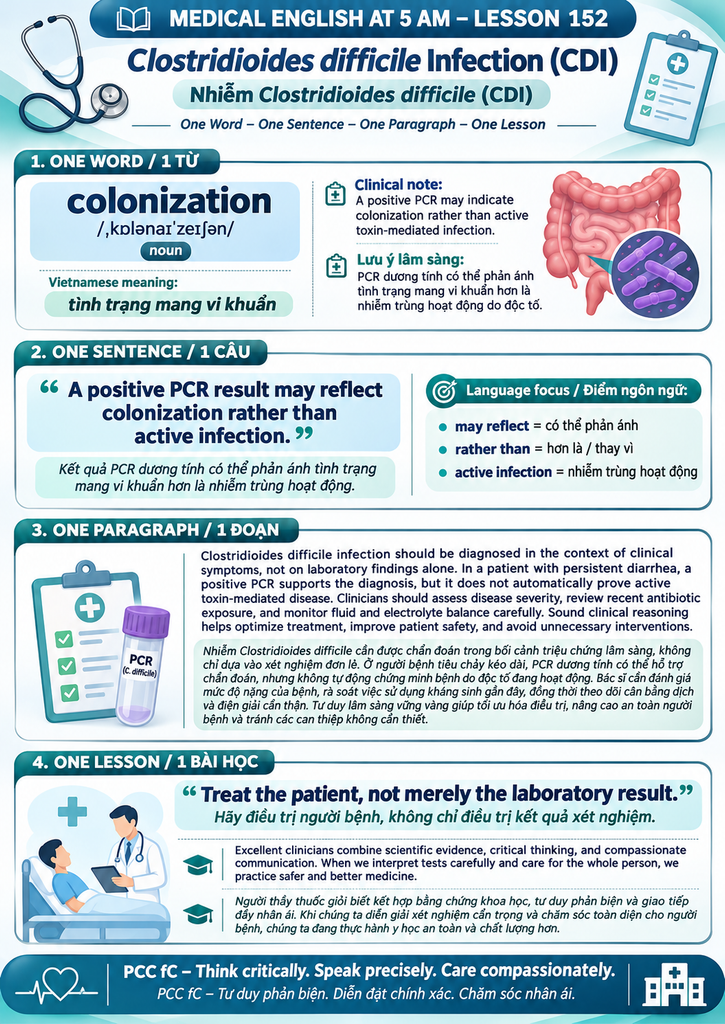
Beyond medical vocabulary and language proficiency, this lesson reinforces a fundamental principle of evidence-based practice: “Treat the patient, not merely the laboratory result.” Every morning at 5 AM offers an opportunity to deepen our knowledge, sharpen our clinical judgment, and become more thoughtful, competent, and compassionate healthcare professionals.
THÔNG ĐIỆP – TAKE-HOME MESSAGE
“Be confident in your knowledge, humble in your judgment, precise in your communication, and compassionate in your care.”
Vững vàng về kiến thức – Khiêm nhường trong nhận định – Chính xác trong giao tiếp – Nhân ái trong chăm sóc.
PCC fC – Vì một đam mê Khỏe Vui Hạnh phúc!
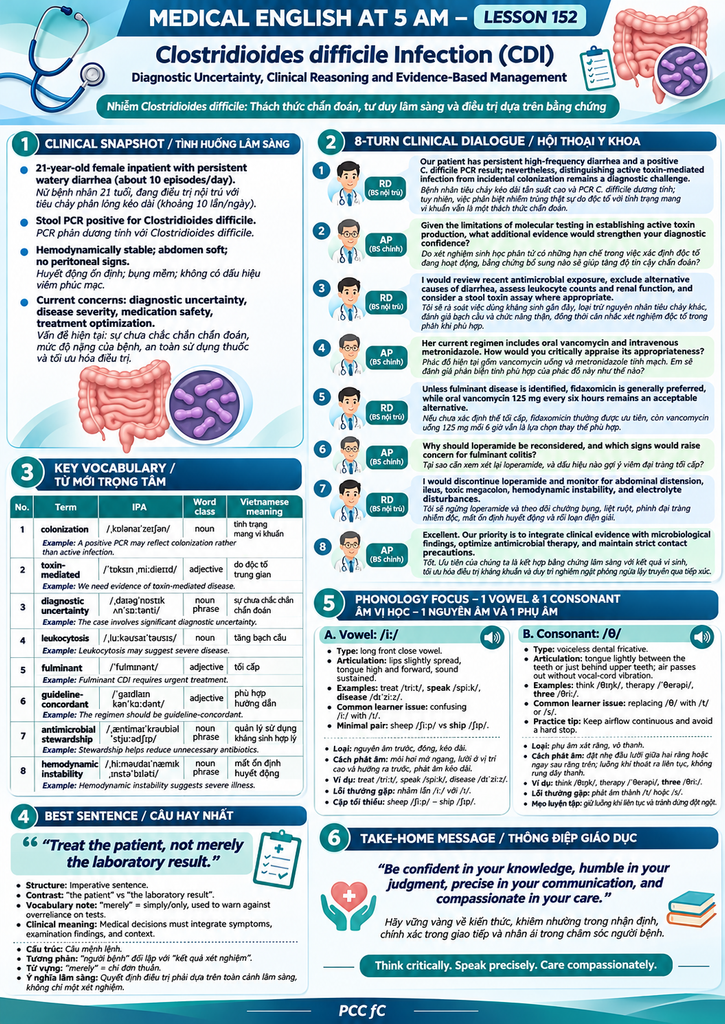
MEDICAL ENGLISH AT 5 AM – LESSON 152
CLOSTRIDIOIDES DIFFICILE INFECTION (CDI)
Diagnostic Uncertainty, Clinical Reasoning and Evidence-Based Management
Nhiễm Clostridioides difficile: Thách thức chẩn đoán, tư duy lâm sàng và điều trị dựa trên bằng chứng
PCC fC – Vì một đam mê Khỏe Vui Hạnh phúc!
PART 1. LESSON INFORMATION – THÔNG TIN BÀI HỌC
- Lesson: 152
- Date: Tuesday, November 3, 2026
- Time: 05:00–05:30 AM (Vietnam time)
- Duration: 30 minutes
- Target level: CEFR B2–C1, aiming for IELTS 8.0-level academic communication
- Professional orientation: OET Medicine
- Educational framework: AMEE-informed outcome-based education
- Teaching methods: Case-based learning, clinical reasoning, role-play, active recall and formative assessment
- Participants: Resident doctors, physicians and medical English learners
Central question – Câu hỏi trọng tâm:
Does a positive molecular test necessarily establish an active infection?
Liệu xét nghiệm sinh học phân tử dương tính có nhất thiết xác nhận một nhiễm trùng đang hoạt động?
30-minute teaching schedule:
- 05:00–05:02: Introduction and learning outcomes
- 05:02–05:05: Clinical case and diagnostic reasoning
- 05:05–05:09: Medical vocabulary
- 05:09–05:15: Clinical dialogue and role-play
- 05:15–05:18: Pronunciation and grammar
- 05:18–05:25: Listening, speaking, reading and writing
- 05:25–05:29: Assessment and feedback
- 05:29–05:30: Take-home message
PART 2. LEARNING OUTCOMES – CHUẨN ĐẦU RA
By the end of this lesson, learners will be able to:
LO1 – Clinical vocabulary: Accurately define and apply at least 8 out of 10 advanced medical terms related to CDI.
Giải thích và sử dụng chính xác ít nhất 8/10 thuật ngữ y khoa nâng cao liên quan đến CDI.
LO2 – Clinical reasoning: Explain, in 45–60 seconds, at least two reasons why a positive PCR result alone does not establish active toxin-mediated disease.
Giải thích trong 45–60 giây ít nhất hai lý do vì sao PCR dương tính đơn độc chưa đủ xác định bệnh do độc tố đang hoạt động.
LO3 – Professional communication: Perform an eight-turn doctor-to-doctor discussion with clinically appropriate terminology, clear prioritization and no critical safety errors.
Thực hiện hội thoại tám lượt giữa hai bác sĩ với thuật ngữ phù hợp, thứ tự ưu tiên rõ ràng và không mắc lỗi nghiêm trọng về an toàn người bệnh.
LO4 – Evidence-based decision-making: Identify at least three treatment or monitoring priorities, distinguishing non-fulminant from fulminant CDI.
Nêu ít nhất ba ưu tiên điều trị hoặc theo dõi và phân biệt CDI không tối cấp với CDI tối cấp.
LO5 – Integrated communication: Produce a 60–80-word clinical handover with at least four essential elements: patient status, diagnostic uncertainty, treatment concern and next action.
Viết đoạn bàn giao lâm sàng 60–80 từ có đủ bốn thành phần: tình trạng bệnh nhân, điểm chưa chắc chắn trong chẩn đoán, vấn đề điều trị và hành động tiếp theo.
Success criteria: At least 80% on the knowledge assessment and satisfactory performance in the clinical communication activity.
PART 3. CLINICAL SCENARIO – TÌNH HUỐNG LÂM SÀNG
Case presentation
A 21-year-old woman, hospitalized for approximately 20 days, presents with persistent watery diarrhea, approximately ten episodes per day, accompanied by intermittent periumbilical abdominal pain.
Her stool PCR is positive for Clostridioides difficile. She remains afebrile and hemodynamically stable, with a blood pressure of 110/60 mmHg and a heart rate of 85 beats per minute.
Her abdomen is soft, with no documented signs of peritoneal irritation.
Her prescribed medications include oral vancomycin 500 mg twice daily, intravenous metronidazole 500 mg every eight hours, and loperamide.
Laboratory data regarding leukocyte count, serum creatinine and electrolyte concentrations are not currently available.
Bản dịch:
Bệnh nhân nữ 21 tuổi, nằm viện khoảng 20 ngày, tiêu chảy phân lỏng kéo dài khoảng 10 lần/ngày, kèm đau bụng quanh rốn từng cơn.
PCR phân dương tính với C. difficile. Bệnh nhân không sốt, huyết động ổn định, huyết áp 110/60 mmHg, mạch 85 lần/phút.
Bụng mềm, chưa ghi nhận dấu hiệu kích thích phúc mạc.
Y lệnh gồm vancomycin uống 500 mg hai lần/ngày, metronidazole tĩnh mạch 500 mg mỗi tám giờ và loperamide.
Chưa có dữ liệu bạch cầu, creatinine và điện giải để đánh giá đầy đủ.
Clinical reasoning questions:
- Does positive PCR confirm toxin-mediated CDI?
- What additional information is needed to determine disease severity?
- Is the current antimicrobial regimen guideline-concordant?
- Which prescribed medication raises a patient-safety concern?
- What should be prioritized over the next 24 hours?
Clinical teaching note:
A positive PCR indicates the presence of a potentially toxigenic organism but does not independently establish active toxin-mediated disease.
In symptomatic patients, clinical assessment and an appropriate testing strategy are essential.
For an initial non-fulminant episode, IDSA/SHEA suggests fidaxomicin 200 mg orally twice daily for 10 days; oral vancomycin 125 mg four times daily for 10 days is an acceptable alternative.
Fulminant CDI, characterized by features such as hypotension or shock, ileus or megacolon, requires a different treatment approach: oral or nasogastric vancomycin 500 mg every six hours plus intravenous metronidazole 500 mg every eight hours, with rectal vancomycin considered in ileus.
Antimotility drugs such as loperamide should not be offered in suspected or confirmed CDI according to NICE.
Key principle: Laboratory results must be interpreted within the clinical context.
PART 4. ADVANCED MEDICAL VOCABULARY – 10 TỪ VỰNG CHUYÊN NGÀNH
1. Colonization (noun)
IPA: /ˌkɒlənaɪˈzeɪʃən/
Meaning: Tình trạng mang hoặc cư trú của vi sinh vật mà không nhất thiết gây bệnh.
Example: A positive PCR result may reflect colonization rather than active infection.
Dịch: PCR dương tính có thể phản ánh tình trạng mang vi khuẩn thay vì nhiễm trùng hoạt động.
2. Toxin-mediated (adjective)
IPA: /ˈtɒksɪn ˌmiːdieɪtɪd/
Meaning: Qua trung gian độc tố.
Example: Clinical symptoms and appropriate testing help establish whether toxin-mediated disease is likely.
Dịch: Triệu chứng lâm sàng và xét nghiệm phù hợp giúp xác định khả năng mắc bệnh do độc tố.
3. Diagnostic uncertainty (noun phrase)
IPA: /ˌdaɪəɡˈnɒstɪk ʌnˈsɜːtənti/
Meaning: Sự chưa chắc chắn trong chẩn đoán.
Example: Diagnostic uncertainty should prompt further assessment rather than premature conclusions.
Dịch: Sự chưa chắc chắn trong chẩn đoán cần thúc đẩy đánh giá thêm thay vì kết luận vội vàng.
4. Leukocytosis (noun)
IPA: /ˌluːkəʊsaɪˈtəʊsɪs/
Meaning: Tăng số lượng bạch cầu.
Example: Marked leukocytosis may indicate severe CDI.
Dịch: Tăng bạch cầu rõ có thể gợi ý CDI nặng.
5. Renal impairment (noun phrase)
IPA: /ˈriːnəl ɪmˈpeəmənt/
Meaning: Suy giảm chức năng thận.
Example: Renal impairment may influence disease severity assessment and fluid management.
Dịch: Suy giảm chức năng thận có thể ảnh hưởng đến đánh giá mức độ nặng và điều chỉnh dịch truyền.
6. Fulminant (adjective)
IPA: /ˈfʊlmɪnənt/
Meaning: Tối cấp, diễn biến nghiêm trọng.
Example: Fulminant CDI may present with shock, ileus or toxic megacolon.
Dịch: CDI tối cấp có thể biểu hiện bằng sốc, liệt ruột hoặc phình đại tràng nhiễm độc.
7. Guideline-concordant (adjective)
IPA: /ˈɡaɪdlaɪn kənˈkɔːdənt/
Meaning: Phù hợp với hướng dẫn chuyên môn.
Example: Guideline-concordant treatment requires the correct drug, dose, route and dosing interval.
Dịch: Điều trị phù hợp hướng dẫn cần đúng thuốc, liều, đường dùng và khoảng cách liều.
8. Antimicrobial stewardship (noun phrase)
IPA: /ˌæntimaɪˈkrəʊbiəl ˈstjuːədʃɪp/
Meaning: Quản lý sử dụng thuốc kháng vi sinh vật hợp lý.
Example: Antimicrobial stewardship involves reviewing unnecessary antibiotics and optimizing treatment.
Dịch: Quản lý sử dụng kháng sinh hợp lý bao gồm rà soát thuốc không cần thiết và tối ưu hóa điều trị.
9. Hemodynamic deterioration (noun phrase)
IPA: /ˌhiːməʊdaɪˈnæmɪk dɪˌtɪəriəˈreɪʃən/
Meaning: Diễn biến xấu về huyết động.
Example: Hemodynamic deterioration warrants urgent reassessment.
Dịch: Huyết động xấu đi đòi hỏi đánh giá lại khẩn cấp.
10. Serial reassessment (noun phrase)
IPA: /ˈsɪəriəl ˌriːəˈsesmənt/
Meaning: Đánh giá lại liên tục theo diễn biến.
Example: Serial reassessment is essential for detecting complications and evaluating treatment response.
Dịch: Đánh giá lại liên tục rất quan trọng để phát hiện biến chứng và xác định đáp ứng điều trị.
Vocabulary challenge:
Use at least three terms in a single sentence describing the patient’s clinical management.
PART 5. EIGHT-TURN CLINICAL DIALOGUE – HỘI THOẠI Y KHOA 8 CÂU
Participants:
- AP: Attending Physician – Bác sĩ chính
- RD: Resident Doctor – Bác sĩ nội trú
1. RD:
Our patient has persistent high-frequency diarrhea and a positive C. difficile PCR result; nevertheless, distinguishing active toxin-mediated infection from incidental colonization remains a diagnostic challenge.
Bệnh nhân tiêu chảy kéo dài với tần suất cao và PCR C. difficile dương tính; tuy nhiên, việc phân biệt nhiễm trùng thực sự do độc tố với tình trạng mang vi khuẩn tình cờ vẫn là một thách thức chẩn đoán.
2. AP:
Given the limitations of molecular testing in establishing active toxin production, what additional evidence would strengthen your diagnostic confidence?
Do xét nghiệm sinh học phân tử có những hạn chế trong việc xác định tình trạng sản xuất độc tố đang hoạt động, những bằng chứng bổ sung nào sẽ giúp em tăng độ tin cậy của chẩn đoán?
3. RD:
I would review recent antimicrobial exposure, exclude alternative causes of diarrhea, assess leukocyte counts and renal function, and consider a stool toxin assay where appropriate.
Tôi sẽ rà soát tiền sử sử dụng kháng sinh gần đây, loại trừ các nguyên nhân tiêu chảy khác, đánh giá bạch cầu và chức năng thận, đồng thời cân nhắc xét nghiệm độc tố phân khi phù hợp.
4. AP:
Her current regimen includes oral vancomycin at 500 milligrams twice daily alongside intravenous metronidazole. How would you critically appraise its appropriateness?
Phác đồ hiện tại gồm vancomycin uống 500 mg hai lần/ngày phối hợp metronidazole tĩnh mạch. Em sẽ đánh giá phản biện tính phù hợp của phác đồ này như thế nào?
5. RD:
The vancomycin dosing interval is not guideline-concordant. Unless fulminant disease is identified, fidaxomicin is generally preferred, while oral vancomycin at 125 milligrams every six hours remains an acceptable alternative.
Khoảng cách liều vancomycin chưa phù hợp hướng dẫn. Nếu chưa xác định CDI tối cấp, fidaxomicin thường được ưu tiên, trong khi vancomycin uống 125 mg mỗi sáu giờ vẫn là lựa chọn thay thế phù hợp.
6. AP:
Why should loperamide be reconsidered, and which clinical features would raise concern for progression towards fulminant colitis?
Tại sao cần xem xét lại loperamide, và những biểu hiện lâm sàng nào khiến em lo ngại bệnh tiến triển thành viêm đại tràng tối cấp?
7. RD:
I would discontinue loperamide, monitor for abdominal distension, ileus, toxic megacolon and hemodynamic instability, and reassess fluid balance, electrolyte disturbances and the ongoing need for intravenous metronidazole.
Tôi sẽ ngừng loperamide, theo dõi chướng bụng, liệt ruột, phình đại tràng nhiễm độc và mất ổn định huyết động; đồng thời đánh giá lại cân bằng dịch, rối loạn điện giải và chỉ định tiếp tục metronidazole tĩnh mạch.
8. AP:
Excellent. Our priority is to integrate clinical evidence with microbiological findings, optimize antimicrobial therapy, maintain contact precautions and communicate a clear, individualized management plan.
Tốt. Ưu tiên của chúng ta là kết hợp bằng chứng lâm sàng với kết quả vi sinh, tối ưu hóa điều trị kháng khuẩn, duy trì phòng ngừa lây truyền qua tiếp xúc và truyền đạt kế hoạch điều trị rõ ràng, cá thể hóa.
OET-inspired communication practice:
Learners should demonstrate clear information exchange, appropriate clarification, clinically accurate language and structured summarization.
Extension challenge:
Explain the same management plan to the patient in plain English, avoiding unexplained technical terminology.
PART 6. PRONUNCIATION FOCUS – TRỌNG TÂM PHÁT ÂM
A. Consonant focus: /θ/ versus /ð/
/θ/: Voiceless dental fricative – phụ âm xát răng vô thanh.
Examples:
- Therapy /ˈθerəpi/
- Pathogen /ˈpæθədʒən/
- Three /θriː/
/ð/: Voiced dental fricative – phụ âm xát răng hữu thanh.
Examples:
- The /ðə/
- This /ðɪs/
- Rather /ˈrɑːðə/
Practice sentence:
The physician considered three therapeutic alternatives.
Bác sĩ cân nhắc ba phương án điều trị.
Focus on the tongue position and the contrast between voiced and voiceless sounds.
B. Vowel focus: /ɪ/ versus /iː/
- Sick /sɪk/ – ốm
- Seek /siːk/ – tìm kiếm
- Live /lɪv/ – sống
- Leave /liːv/ – rời đi
Practice:
We seek evidence before making a clinical decision.
Chúng ta tìm kiếm bằng chứng trước khi đưa ra quyết định lâm sàng.
C. Word stress – Trọng âm
- DI-agnostic: /ˌdaɪəɡˈnɒstɪk/ – trọng âm chính ở âm tiết NOST
- co-lo-ni-ZA-tion: /ˌkɒlənaɪˈzeɪʃən/
- de-TER-io-RA-tion: /dɪˌtɪəriəˈreɪʃən/
D. Sentence stress and intonation
We must distinguish COLONIZATION from ACTIVE INFECTION.
Nhấn mạnh COLONIZATION và ACTIVE INFECTION để làm nổi bật sự tương phản về ý nghĩa.
Pronunciation task (30 seconds):
Read the sentence twice: first slowly for accuracy, then naturally with appropriate word stress and rhythm.
PART 7. ADVANCED GRAMMAR – HAI CẤU TRÚC NGỮ PHÁP
Structure 1. CONCESSION AND CONTRAST
Although / Even though + clause, main clause.
Use: Acknowledge one fact while emphasizing a contrasting clinical conclusion.
Công dụng: Thừa nhận một sự thật nhưng nhấn mạnh một kết luận lâm sàng tương phản.
Example 1:
Although the PCR result is positive, active CDI cannot be established from this result alone.
Mặc dù PCR dương tính, không thể xác định CDI hoạt động chỉ dựa vào kết quả này.
Example 2:
Even though the patient is hemodynamically stable, clinically significant fluid and electrolyte losses may still occur.
Mặc dù bệnh nhân ổn định huyết động, tình trạng mất dịch và điện giải đáng kể vẫn có thể xảy ra.
IELTS 8.0 application:
Concessive clauses help learners express balanced reasoning rather than oversimplified conclusions.
Common error:
Incorrect: Although the PCR is positive, but CDI is uncertain.
Correct: Although the PCR is positive, CDI remains uncertain.
Do not combine although and but in this structure.
Structure 2. HYPOTHETICAL CLINICAL REASONING
If + past simple, would + base verb.
Use: Discuss a hypothetical situation or decision.
Công dụng: Diễn đạt tình huống giả định hoặc lựa chọn xử trí.
Example 1:
If the patient developed hypotension or ileus, I would urgently reassess her for fulminant CDI.
Nếu bệnh nhân xuất hiện tụt huyết áp hoặc liệt ruột, tôi sẽ khẩn trương đánh giá lại nguy cơ CDI tối cấp.
Example 2:
If the patient had fulminant CDI, I would recommend high-dose enteral vancomycin combined with intravenous metronidazole.
Nếu bệnh nhân mắc CDI tối cấp, tôi sẽ đề xuất vancomycin đường tiêu hóa liều cao phối hợp metronidazole tĩnh mạch.
Clinical language tip:
Use would for hypothetical situations and will when describing a definite action in a likely future scenario.
Grammar challenge:
Rewrite:
The PCR is positive. The diagnosis is not necessarily confirmed.
Suggested answer:
Although the PCR is positive, the diagnosis is not necessarily confirmed.
PART 8. INTEGRATED SKILLS – LISTENING, SPEAKING, READING AND WRITING
A. LISTENING – BÀI NGHE THỤ ĐỘNG 3 PHÚT
Title: Beyond a Positive Test – Clinical Reasoning in CDI
Suggested listening speed: Approximately 125–135 words per minute.
English listening script
Good morning, everyone.
Today, we are going to discuss an important principle in clinical medicine: a positive laboratory result does not always establish a definitive diagnosis.
Imagine a young woman who has been hospitalized for nearly three weeks. She develops persistent watery diarrhea, approximately ten episodes per day, accompanied by intermittent abdominal discomfort.
Her stool PCR is positive for Clostridioides difficile.
Does this automatically confirm active infection?
Not necessarily.
Molecular testing is highly sensitive, but it detects genetic material associated with toxin-producing organisms. It does not directly demonstrate that toxins are actively causing the patient’s symptoms.
Therefore, we must interpret the result in the appropriate clinical context.
First, review the patient’s recent antibiotic exposure. Consider alternative causes of diarrhea, including medications, enteral feeding and other gastrointestinal conditions.
Second, assess disease severity.
Is the patient hypotensive? Is there evidence of ileus or toxic megacolon? What are the leukocyte count and serum creatinine concentration?
These questions are essential because management depends on the severity of illness.
For an initial episode of non-fulminant CDI, fidaxomicin is generally preferred under IDSA and SHEA guidance, while standard-dose oral vancomycin remains an acceptable alternative.
Fulminant CDI requires a different therapeutic strategy, including high-dose enteral vancomycin and intravenous metronidazole.
Another important consideration is medication safety.
Antimotility agents such as loperamide should not be offered in CDI. Fluid replacement, electrolyte monitoring and regular reassessment are also essential.
In addition, appropriate contact precautions help prevent transmission within healthcare facilities.
However, good clinical care involves more than selecting the correct medication.
We must communicate clearly, acknowledge uncertainty and explain our reasoning to colleagues and patients.
Consider the difference between these two statements:
“The test is positive, so the diagnosis is certain.”
And:
“The positive test supports our clinical suspicion, but further assessment is required to establish its significance and determine disease severity.”
The second statement demonstrates greater diagnostic precision and professional responsibility.
As healthcare professionals, we should avoid premature conclusions, reassess our decisions when new evidence emerges and remain attentive to patient safety.
Ultimately, excellent medical practice requires scientific knowledge, critical thinking and compassionate communication.
Remember:
Treat the patient, not merely the laboratory result.
Thank you, and have a meaningful learning day.
B. LISTENING COMPREHENSION
Answer after listening:
- Why does a positive PCR not always establish active CDI?
- Which two laboratory parameters are relevant to severity assessment?
- Which two medications are commonly used together in fulminant CDI?
C. SPEAKING – OET-INSPIRED ROLE-PLAY
Task (60 seconds):
You are a resident doctor presenting this case to your attending physician.
Include:
- Clinical presentation
- Interpretation of PCR
- Severity assessment
- Medication safety concern
- Immediate management priorities
Suggested opening:
I would like to present a patient with suspected C. difficile infection and discuss several concerns regarding diagnostic certainty and treatment optimization.
Communication checklist:
- Clear opening
- Relevant clinical information
- Appropriate acknowledgment of uncertainty
- Logical clinical reasoning
- Concise summary and actionable recommendation
D. READING – CRITICAL APPRAISAL
Read the statement:
“Molecular detection of a potentially toxigenic organism should not be interpreted in isolation, particularly when alternative explanations for gastrointestinal symptoms remain plausible.”
Questions:
- What does “in isolation” mean?
- Why are alternative explanations important?
Suggested answers:
- Without considering other clinical information.
- Because a positive molecular test can coexist with a different cause of diarrhea.
E. WRITING – CLINICAL HANDOVER
Task:
Write a 60–80-word clinical handover summarizing the case and proposing immediate management priorities.
Model answer (74 words):
A 21-year-old woman with prolonged hospitalization presents with persistent watery diarrhea and a positive C. difficile PCR result. Although CDI is clinically suspected, disease severity remains uncertain because key laboratory results are unavailable. I recommend reviewing recent antibiotic exposure, obtaining leukocyte counts, renal function and electrolytes, and reassessing the antimicrobial regimen. Loperamide should be discontinued, fluid balance monitored closely, and contact precautions maintained. The patient requires ongoing reassessment for complications.
PART 9. FORMATIVE ASSESSMENT – KIỂM TRA, ĐÁP ÁN VÀ PHẢN HỒI
Quick assessment: 5 questions – 4 minutes
Question 1. Multiple choice
A positive C. difficile PCR result:
A. Always confirms active toxin-mediated disease
B. Excludes asymptomatic colonization
C. Must be interpreted alongside clinical findings
D. Confirms fulminant CDI
Question 2. Clinical decision
Which finding most strongly suggests fulminant CDI?
A. Mild abdominal discomfort
B. Positive PCR alone
C. Hypotension with ileus
D. Ten stools per day without other severity data
Question 3. Medication safety
Which medication should not be offered to patients with suspected or confirmed CDI according to NICE?
A. Oral vancomycin
B. Fidaxomicin
C. Loperamide
D. Intravenous fluids when indicated
Question 4. Grammar
Complete the sentence:
“Although the PCR result is positive, __________.”
A. but colonization remains possible
B. colonization remains possible
C. therefore the diagnosis is certain
D. because the patient has diarrhea
Question 5. Critical thinking
In one or two English sentences, explain why reviewing the patient’s antimicrobial history is clinically important.
ANSWER KEY – ĐÁP ÁN
1. C
PCR phải được diễn giải cùng biểu hiện lâm sàng.
Feedback: Avoid equating molecular detection with definite toxin-mediated disease.
2. C
Tụt huyết áp và liệt ruột là những dấu hiệu cảnh báo CDI tối cấp.
Feedback: Frequent diarrhea alone does not establish fulminant disease.
3. C
NICE khuyến cáo không sử dụng thuốc giảm nhu động như loperamide trong CDI.
Feedback: Review medication safety alongside antimicrobial selection.
4. B
Correct sentence:
Although the PCR result is positive, colonization remains possible.
Feedback: Do not use “although” and “but” together in this construction.
5. Model answer:
Recent antimicrobial exposure may increase the likelihood of CDI and help identify potentially unnecessary antibiotics that should be discontinued or modified.
Feedback: A strong response connects clinical risk assessment with antimicrobial stewardship.
SCORING RUBRIC – THANG ĐIỂM
- Questions 1–4: 1 point each
- Question 5: 1 point for accurate clinical reasoning
- Maximum: 5 points
Interpretation:
- 5/5: Excellent
- 4/5: Achieved
- 3/5: Developing
- 0–2/5: Review required
Speaking feedback – OET-inspired:
Assess learners in five domains:
- Intelligibility and pronunciation
- Fluency and coherence
- Appropriate professional language
- Clinical accuracy
- Clear and structured information exchange
Each domain may be rated from 0 to 2, giving a maximum of 10 points.
This is an internal formative rubric, not an official OET score.
Reflective question:
What is one clinical assumption you would reconsider after today’s lesson?
PART 10. EVIDENCE-BASED REFERENCES AND EDUCATIONAL MESSAGE
A. CLINICAL EVIDENCE – TÀI LIỆU Y KHOA
1. IDSA/SHEA (2021)
Johnson S, et al. Clinical Practice Guideline by IDSA and SHEA: 2021 Focused Update on Management of Clostridioides difficile Infection in Adults.
Clinical Infectious Diseases. 2021;73–e1044.
DOI: https://doi.org/10.1093/cid/ciab549
Key relevance:
- Fidaxomicin preferred for initial CDI when available
- Oral vancomycin remains an acceptable alternative
- Distinct management for fulminant CDI
2. NICE Guideline NG199 (2021)
Clostridioides difficile infection: antimicrobial prescribing.
Key relevance:
- Review unnecessary antibiotics and gastrointestinal medications
- Avoid antimotility agents such as loperamide
- Ensure appropriate hydration and clinical monitoring
3. CDC – Clinical Testing and Diagnosis (2024)
Key relevance:
- Limitations of molecular testing
- Distinguishing colonization from clinical infection
- Appropriate diagnostic testing strategies
4. CDC – Clinical Guidance for C. diff Infection Prevention (2026)
Key relevance:
- Contact precautions
- Appropriate specimen selection
- Environmental infection prevention
- Avoiding unnecessary repeat testing to document cure
B. MEDICAL EDUCATION REFERENCES – TÀI LIỆU GIÁO DỤC
5. AMEE – Designing and Planning Learning
Applied principles:
- Outcome-based education
- Constructive curriculum alignment
- Measurable learning outcomes
- Alignment of teaching activities and assessment
6. AMEE Guides – Health Professions Education
Applied principles:
- Case-based learning
- Feedback and reflection
- Clinical educational assessment
7. Occupational English Test – OET Preparation Resources
Applied principles:
- Professional healthcare communication
- Linguistic intelligibility
- Fluency and appropriate language
- Information gathering and information giving
- Clear, patient-centred clinical explanations
Evidence note:
The clinical content reflects the referenced guidelines and CDC material reviewed for this lesson. The case is adapted for educational purposes. The lesson is informed by AMEE and OET principles but is not an officially endorsed AMEE or OET course. Clinical recommendations require individual patient assessment and consideration of local institutional guidance.
C. ONE WORD – ONE SENTENCE – ONE PARAGRAPH – ONE LESSON
ONE WORD – MỘT TỪ
Discernment (n.) /dɪˈsɜːnmənt/
Meaning: Khả năng nhận định sáng suốt, phân biệt tinh tế.
ONE SENTENCE – MỘT CÂU
Clinical excellence begins with the ability to distinguish evidence from assumption.
Sự xuất sắc trong lâm sàng bắt đầu từ khả năng phân biệt bằng chứng với giả định.
ONE PARAGRAPH – MỘT ĐOẠN
Good doctors recognize patterns. Excellent doctors question assumptions, acknowledge uncertainty, and continually reassess their decisions. True clinical expertise is not measured by how quickly we reach a diagnosis, but by how carefully we integrate evidence, communicate uncertainty, and protect our patients from avoidable harm.
Bác sĩ giỏi nhận diện được các mô hình bệnh lý. Bác sĩ xuất sắc biết đặt câu hỏi trước những giả định, thừa nhận điều chưa chắc chắn và liên tục đánh giá lại quyết định của mình. Năng lực lâm sàng đích thực không được đo bằng tốc độ đưa ra chẩn đoán, mà bằng sự thận trọng trong tổng hợp bằng chứng, giao tiếp về những điều chưa chắc chắn và bảo vệ người bệnh khỏi các nguy cơ có thể phòng tránh.
ONE LESSON – MỘT BÀI HỌC
“Be confident in your knowledge, humble in your judgment, precise in your communication, and compassionate in your care.”
Hãy vững vàng về kiến thức, khiêm nhường trong nhận định, chính xác trong giao tiếp và nhân ái trong chăm sóc người bệnh.
MEDICAL ENGLISH AT 5 AM – PCC fC
“Think critically. Speak precisely. Care compassionately. Learn consistently.”
Tư duy phản biện – Diễn đạt chính xác – Chăm sóc nhân ái – Học tập bền bỉ.
PCC fC – VÌ MỘT ĐAM MÊ KHỎE VUI HẠNH PHÚC!