Bài 160 – Tiếng Anh Y Khoa: Làm thế nào để lựa chọn một vấn đề nghiên cứu khoa học tốt * How to choose a good scientific research problem
PCC Language – Thăng Long, Hà Nội, ngày 12/11/2026, Một nghiên cứu khoa học có giá trị không bắt đầu từ những kỹ thuật phức tạp, mà từ một câu hỏi đúng và có ý nghĩa. Bài học 160, lấy cảm hứng từ công trình của Uri Alon đăng trên Molecular Cell (2009), giúp chúng ta hiểu cách lựa chọn đề tài dựa trên hai yếu tố cốt lõi: giá trị khoa học và tính khả thi. Thông qua tình huống lâm sàng, hội thoại song ngữ và tiếng Anh học thuật nâng cao, bài học hướng tới việc chuyển hóa những trăn trở trong thực hành y khoa thành câu hỏi nghiên cứu thiết thực, góp phần nâng cao chất lượng chăm sóc người bệnh.
🇬🇧 English Introduction
Great scientific research begins not with sophisticated technology, but with a meaningful question. Inspired by Uri Alon’s influential 2009 article in Molecular Cell, Lesson 160 explores two essential dimensions of choosing a research problem: scientific interest and feasibility. Through clinical scenarios, bilingual dialogue, and advanced academic English, learners will discover how to transform everyday clinical uncertainties into focused, meaningful research questions that may ultimately improve patient care.
“Ask better questions. Pursue meaningful discoveries. Improve human lives.”
Đặt câu hỏi tốt hơn – Theo đuổi những khám phá có ý nghĩa – Góp phần cải thiện cuộc sống con người.
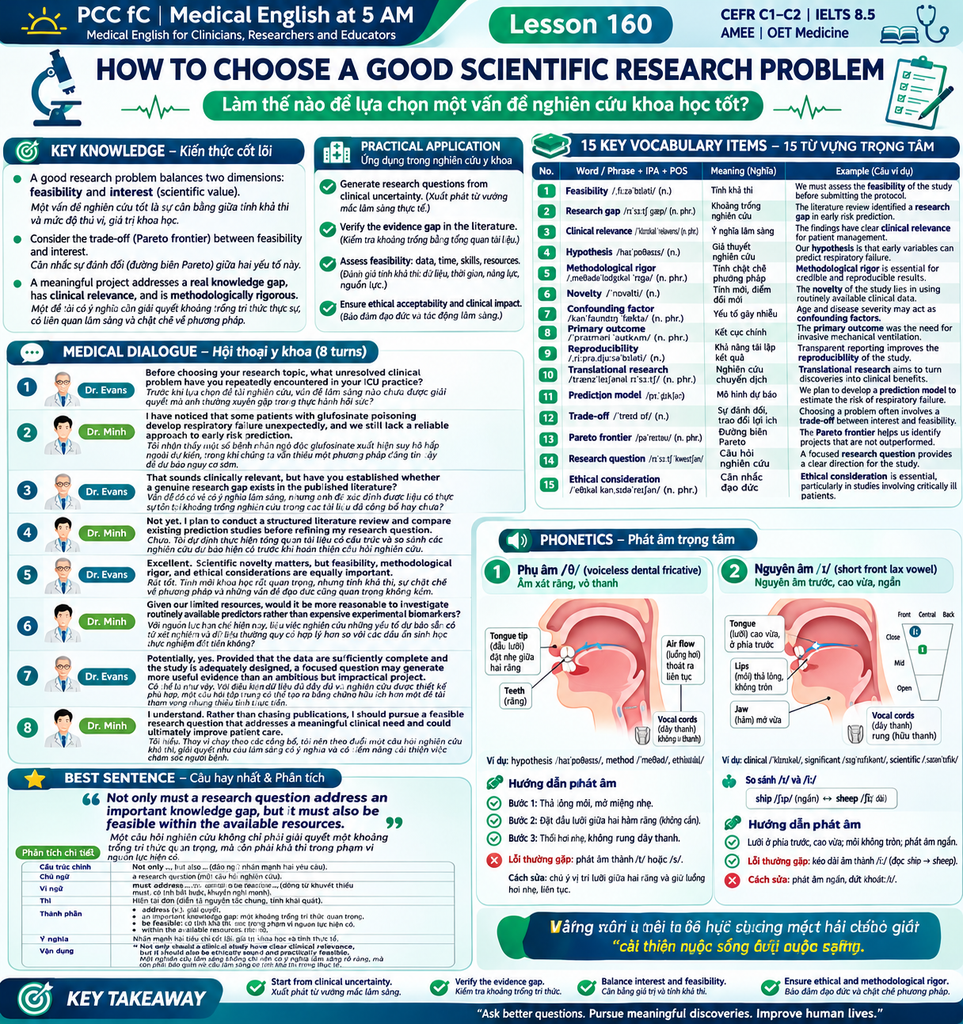
MEDICAL ENGLISH AT 5 AM – LESSON 160
HOW TO CHOOSE A GOOD SCIENTIFIC RESEARCH PROBLEM
LÀM THẾ NÀO ĐỂ LỰA CHỌN MỘT VẤN ĐỀ NGHIÊN CỨU KHOA HỌC TỐT?
From Clinical Curiosity to Meaningful Scientific Discovery
Từ những trăn trở lâm sàng đến khám phá khoa học có giá trị
PCC fC | Medical English at 5 AM
Date: 11 November 2026
Time: 05:00–05:30 (Vietnam Time)
Level: CEFR C1–C2 | IELTS 8.5-oriented
Educational references: AMEE | OET Medicine
Scientific foundation: Uri Alon, Molecular Cell, 2009
Learning approach: Evidence-Based Medicine – Clinical Reasoning – Research Communication
Core message: A meaningful research project begins with a question worth answering.
PART 1. LESSON INFORMATION – THÔNG TIN BÀI HỌC
1.1. Introduction – Giới thiệu
English
Every major scientific discovery begins with a question. However, not every question deserves the same investment of time, effort, and resources.
In clinical medicine, physicians encounter unanswered questions every day. Some arise from unexpected treatment responses, others from diagnostic uncertainty, unusual complications, or limitations in existing evidence.
The challenge is not simply to identify a knowledge gap, but to transform it into a scientifically important, clinically relevant, and feasible research question.
In his influential 2009 essay, How To Choose a Good Scientific Problem, Uri Alon proposed two fundamental dimensions for selecting research problems: feasibility and interest.
A good scientific problem should be sufficiently challenging to advance knowledge, yet realistic enough to investigate with available resources.
For clinician-scientists, the ultimate goal extends beyond publication. Research should contribute to better clinical decisions, safer healthcare, and improved patient outcomes.
1.2. Bản dịch tiếng Việt
Mọi khám phá khoa học quan trọng đều bắt đầu từ một câu hỏi. Tuy nhiên, không phải câu hỏi nào cũng xứng đáng được đầu tư thời gian, công sức và nguồn lực như nhau.
Trong thực hành y khoa, bác sĩ thường xuyên gặp những vấn đề chưa có lời giải đáp. Chúng có thể xuất phát từ đáp ứng điều trị bất thường, sự chưa chắc chắn trong chẩn đoán, các biến chứng hiếm gặp hoặc những hạn chế của bằng chứng hiện có.
Thách thức không chỉ là xác định khoảng trống tri thức, mà còn là chuyển hóa khoảng trống ấy thành một câu hỏi nghiên cứu có giá trị khoa học, ý nghĩa lâm sàng và khả năng thực hiện.
Trong bài luận có ảnh hưởng năm 2009, How To Choose a Good Scientific Problem, Uri Alon đề xuất hai chiều quan trọng khi lựa chọn vấn đề nghiên cứu: tính khả thi và mức độ thú vị, giá trị khoa học.
Một vấn đề nghiên cứu tốt cần đủ thách thức để mở rộng tri thức, nhưng cũng đủ thực tế để có thể triển khai với nguồn lực hiện có.
Đối với bác sĩ làm nghiên cứu, mục tiêu cuối cùng không chỉ dừng lại ở công bố khoa học. Nghiên cứu cần đóng góp vào các quyết định lâm sàng tốt hơn, chăm sóc y tế an toàn hơn và cải thiện kết cục người bệnh.
1.3. Scientific framework – Khung tư duy khoa học
Two dimensions proposed by Uri Alon:
Dimension 1 – Feasibility (Tính khả thi)
Can the research question be investigated successfully within the available time, skills, technology, and resources?
Dimension 2 – Interest (Giá trị và sức hấp dẫn khoa học)
How much meaningful new knowledge could the research generate?
The Pareto frontier – Đường biên Pareto
When comparing candidate research problems, a problem lies on the Pareto frontier if no alternative is better in both feasibility and interest simultaneously.
Therefore, the most appropriate problem is not necessarily the easiest or the most ambitious. It is a problem that offers a worthwhile balance for a particular researcher and stage of scientific development.
Clinical application:
Good research problem = Important knowledge gap + Clinical relevance + Scientific rigor + Ethical acceptability + Practical feasibility.
This final formulation is an educational synthesis extending Alon’s original two-dimensional model, not a formula proposed verbatim by the author.
1.4. Thirty-minute lesson plan
- 05:00–05:03: Introduction and learning outcomes.
- 05:03–05:07: Clinical scenario and research question.
- 05:07–05:12: Ten advanced vocabulary items.
- 05:12–05:17: Eight-turn bilingual dialogue.
- 05:17–05:20: Pronunciation and grammar.
- 05:20–05:26: Integrated language practice.
- 05:26–05:29: Assessment and feedback.
- 05:29–05:30: Reflection and educational message.
The three-minute passive listening activity is designed for additional practice outside the 30-minute live class.
PART 2. MEASURABLE LEARNING OUTCOMES – CHUẨN ĐẦU RA ĐO LƯỜNG ĐƯỢC
By the end of this lesson, learners will be able to:
Outcome 1 – Explain
Explain at least three criteria for selecting a meaningful scientific research problem, including feasibility, scientific value, and clinical relevance.
Giải thích được ít nhất ba tiêu chí lựa chọn vấn đề nghiên cứu có ý nghĩa, bao gồm tính khả thi, giá trị khoa học và ý nghĩa lâm sàng.
Outcome 2 – Apply
Use at least eight of the ten target vocabulary items accurately when discussing a potential medical research project.
Sử dụng chính xác ít nhất tám trong mười từ vựng trọng tâm khi thảo luận về một đề tài nghiên cứu y học.
Outcome 3 – Analyze
Compare two research proposals and justify the preferred option using at least three evidence-based arguments.
So sánh hai đề xuất nghiên cứu và bảo vệ lựa chọn của mình bằng ít nhất ba lập luận dựa trên bằng chứng.
Outcome 4 – Communicate
Deliver a structured 60-second research pitch using advanced academic English and appropriate professional communication.
Trình bày một ý tưởng nghiên cứu trong 60 giây bằng tiếng Anh học thuật, có cấu trúc rõ ràng và phong cách giao tiếp chuyên nghiệp.
Outcome 5 – Formulate
Write one focused research question using the Population, Exposure or Intervention, Comparator, and Outcome framework when applicable.
Viết một câu hỏi nghiên cứu cụ thể dựa trên các thành phần quần thể, yếu tố phơi nhiễm hoặc can thiệp, nhóm so sánh và kết cục khi phù hợp.
Expected performance: At least 80% achievement on the lesson assessment, alongside satisfactory participation in the research discussion.
PART 3. CLINICAL SCENARIO – TÌNH HUỐNG LÂM SÀNG
3.1. Case presentation
English
Dr. Minh is an intensive care physician working at a tertiary poisoning treatment center.
Over the past year, he has managed several patients with severe glufosinate poisoning. Some developed respiratory failure, prolonged neurological complications, and required mechanical ventilation.
Despite standard supportive care, predicting which patients will deteriorate remains challenging.
Dr. Minh is considering two potential research projects.
Project A:
A descriptive study of the clinical characteristics of patients with acute glufosinate poisoning.
Project B:
A study evaluating whether early clinical and laboratory indicators can predict respiratory failure in patients with acute glufosinate poisoning.
He has access to routinely collected clinical records but has limited research funding and no dedicated laboratory for advanced biomarker testing.
His supervisor asks:
“Which project is more likely to generate clinically meaningful evidence without exceeding our available resources?”
3.2. Bản dịch tiếng Việt
Bác sĩ Minh là bác sĩ hồi sức đang làm việc tại một trung tâm điều trị ngộ độc tuyến cuối.
Trong năm qua, anh đã điều trị một số bệnh nhân ngộ độc glufosinate nặng. Một số người bệnh xuất hiện suy hô hấp, biến chứng thần kinh kéo dài và cần thở máy.
Mặc dù đã được điều trị hỗ trợ theo thực hành hiện hành, việc dự đoán bệnh nhân nào sẽ diễn biến nặng vẫn là một thách thức.
Bác sĩ Minh đang cân nhắc hai hướng nghiên cứu.
Đề tài A:
Nghiên cứu mô tả đặc điểm lâm sàng của bệnh nhân ngộ độc glufosinate cấp.
Đề tài B:
Nghiên cứu đánh giá khả năng dự báo suy hô hấp của các chỉ dấu lâm sàng và xét nghiệm sớm ở bệnh nhân ngộ độc glufosinate cấp.
Anh có thể tiếp cận dữ liệu bệnh án thường quy nhưng kinh phí nghiên cứu hạn chế và chưa có phòng xét nghiệm chuyên biệt cho các dấu ấn sinh học tiên tiến.
Người hướng dẫn đặt câu hỏi:
“Đề tài nào có khả năng tạo ra bằng chứng có ý nghĩa lâm sàng mà không vượt quá nguồn lực hiện có?”
3.3. Clinical and research reasoning
Question 1: Which project has greater potential clinical relevance?
Suggested answer:
Project B may offer greater clinical relevance because it addresses early risk assessment and could potentially inform monitoring decisions.
However, this potential benefit depends on whether the proposed predictors are sufficiently informative and the findings are reproducible.
Question 2: Which project is more feasible?
Suggested answer:
Project A may be methodologically simpler. Project B could also be feasible if sufficiently complete retrospective data, adequate outcome events, and appropriate statistical expertise are available.
Question 3: What must be clarified before selecting Project B?
Suggested answer:
The research team should establish the existing evidence gap, define the target population, prespecify the primary outcome, assess data completeness, estimate sample-size requirements, address missing data, and obtain appropriate ethical approval.
If the objective is clinical prediction, model development or validation must be distinguished from a simple analysis of associations.
3.4. Research question
Proposed research question:
“Among adults admitted with acute glufosinate poisoning, how accurately do clinical and routinely available laboratory variables measured within the first six hours predict subsequent respiratory failure requiring invasive mechanical ventilation?”
Dịch:
Ở người trưởng thành nhập viện do ngộ độc glufosinate cấp, các biến số lâm sàng và xét nghiệm thường quy được ghi nhận trong sáu giờ đầu có khả năng dự báo chính xác đến mức nào nguy cơ suy hô hấp sau đó cần thở máy xâm nhập?
Methodological note:
The six-hour window is a proposed study design choice, not an established clinical threshold. The study must define the time of prediction, prediction horizon, and outcome criteria to avoid data leakage and inconsistent outcome classification.
Predictive performance should be evaluated using discrimination, calibration, and, when appropriate, clinical utility and external validation.
Discussion challenge:
If Project B is more clinically interesting but the available sample is inadequate, should the research team proceed immediately, collaborate with other centers, simplify the question, or select a different research problem?
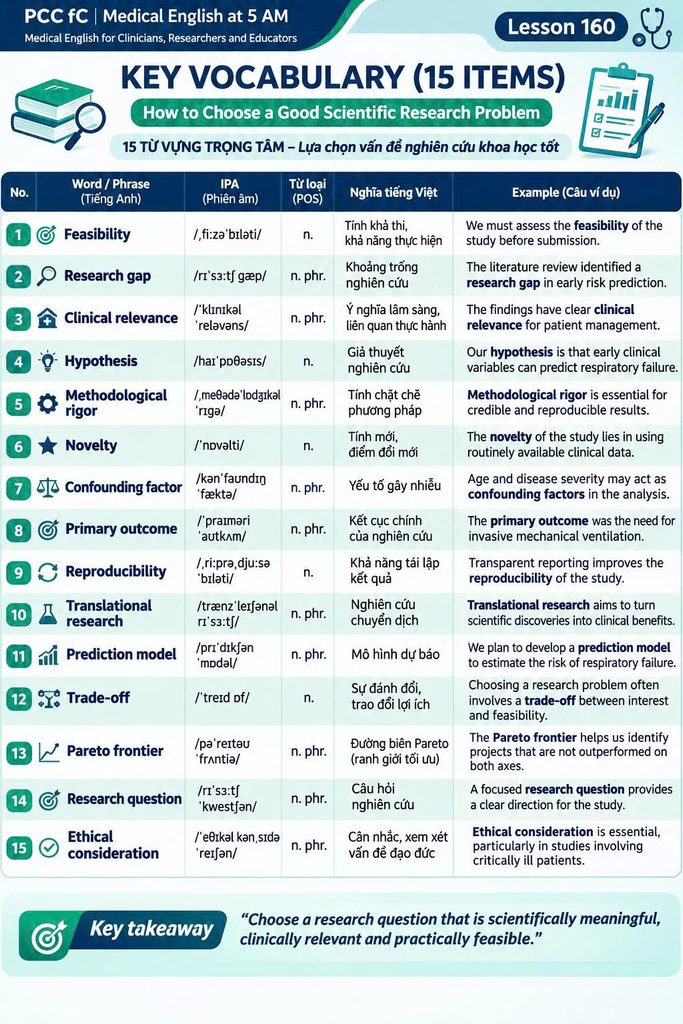
PART 4. ADVANCED MEDICAL AND RESEARCH VOCABULARY – 10 TỪ VỰNG CHUYÊN SÂU
Vocabulary 1. Feasibility
IPA: /ˌfiːzəˈbɪləti/
Part of speech: Noun (n.)
Meaning: Tính khả thi.
Example: “We must assess the feasibility of the study before submitting the research protocol.”
Translation: Chúng ta phải đánh giá tính khả thi của nghiên cứu trước khi trình đề cương.
Collocation: Feasibility assessment – Đánh giá tính khả thi.
Vocabulary 2. Research gap
IPA: /rɪˈsɜːtʃ ɡæp/
Part of speech: Noun phrase (n. phr.)
Meaning: Khoảng trống nghiên cứu hoặc khoảng trống tri thức khoa học.
Example: “Our literature review identified a research gap in the early prediction of respiratory failure after glufosinate poisoning.”
Translation: Tổng quan tài liệu đã xác định một khoảng trống nghiên cứu trong việc dự báo sớm suy hô hấp sau ngộ độc glufosinate.
Collocation: Identify a research gap – Xác định khoảng trống nghiên cứu.
Vocabulary 3. Clinical relevance
IPA: /ˈklɪnɪkəl ˈreləvəns/
Part of speech: Noun phrase (n. phr.)
Meaning: Ý nghĩa hoặc mức độ liên quan đối với thực hành lâm sàng.
Example: “A statistically significant result does not necessarily imply clinical relevance.”
Translation: Một kết quả có ý nghĩa thống kê không nhất thiết đồng nghĩa với giá trị trong thực hành lâm sàng.
Collocation: Establish clinical relevance – Xác lập ý nghĩa lâm sàng.
Vocabulary 4. Hypothesis
IPA: /haɪˈpɒθəsɪs/
Part of speech: Noun (n.); plural: hypotheses /haɪˈpɒθəsiːz/
Meaning: Giả thuyết nghiên cứu.
Example: “Our hypothesis is that selected early clinical variables may help predict subsequent respiratory failure.”
Translation: Giả thuyết của chúng tôi là một số biến số lâm sàng sớm có thể giúp dự báo suy hô hấp xuất hiện sau đó.
Collocation: Test a hypothesis – Kiểm định giả thuyết.
Vocabulary 5. Methodological rigor
IPA: /ˌmeθədəˈlɒdʒɪkəl ˈrɪɡə/
Part of speech: Noun phrase (n. phr.)
Meaning: Tính chặt chẽ về phương pháp nghiên cứu.
Example: “Methodological rigor is essential for producing credible and reproducible findings.”
Translation: Sự chặt chẽ về phương pháp là điều thiết yếu để tạo ra những kết quả đáng tin cậy và có thể tái lập.
Collocation: Ensure methodological rigor – Bảo đảm tính chặt chẽ về phương pháp.
Vocabulary 6. Novelty
IPA: /ˈnɒvəlti/
Part of speech: Noun (n.)
Meaning: Tính mới của nghiên cứu.
Example: “The novelty of a study should be evaluated in relation to existing international evidence.”
Translation: Tính mới của nghiên cứu cần được đánh giá trong mối liên hệ với những bằng chứng quốc tế hiện có.
Collocation: Scientific novelty – Tính mới khoa học.
Vocabulary 7. Confounding factor
IPA: /kənˈfaʊndɪŋ ˈfæktə/
Part of speech: Noun phrase (n. phr.)
Meaning: Yếu tố gây nhiễu.
Example: “Age and disease severity may act as confounding factors in an observational study of treatment outcomes.”
Translation: Tuổi và mức độ nặng của bệnh có thể đóng vai trò là các yếu tố gây nhiễu trong nghiên cứu quan sát về kết quả điều trị.
Collocation: Control for confounding factors – Kiểm soát các yếu tố gây nhiễu.
Scientific note: Confounding is primarily a causal-inference concern. Prediction studies require a different framework emphasizing predictor availability, overfitting, data leakage, and validation.
Vocabulary 8. Primary outcome
IPA: /ˈpraɪməri ˈaʊtkʌm/
Part of speech: Noun phrase (n. phr.)
Meaning: Kết cục chính của nghiên cứu.
Example: “The primary outcome was the requirement for invasive mechanical ventilation during hospitalization.”
Translation: Kết cục chính là nhu cầu thở máy xâm nhập trong thời gian nằm viện.
Collocation: Prespecify the primary outcome – Xác định trước kết cục chính.
Vocabulary 9. Reproducibility
IPA: /ˌriːprəˌdjuːsəˈbɪləti/
Part of speech: Noun (n.)
Meaning: Khả năng tái lập kết quả nghiên cứu.
Example: “Transparent reporting and well-documented methods support research reproducibility.”
Translation: Báo cáo minh bạch và mô tả phương pháp đầy đủ góp phần bảo đảm khả năng tái lập nghiên cứu.
Collocation: Improve reproducibility – Cải thiện khả năng tái lập.
Vocabulary 10. Translational research
IPA: /trænzˈleɪʃənəl rɪˈsɜːtʃ/
Part of speech: Noun phrase (n. phr.)
Meaning: Nghiên cứu chuyển dịch, kết nối khám phá khoa học với ứng dụng thực tiễn trong y học.
Example: “Translational research seeks to convert scientific discoveries into practical improvements in patient care.”
Translation: Nghiên cứu chuyển dịch hướng tới chuyển hóa các khám phá khoa học thành những cải thiện thực tiễn trong chăm sóc người bệnh.
Collocation: Translational research pathway – Lộ trình nghiên cứu chuyển dịch.
Vocabulary challenge:
Create a 40-word explanation of your own research interest using at least five of the ten target expressions.
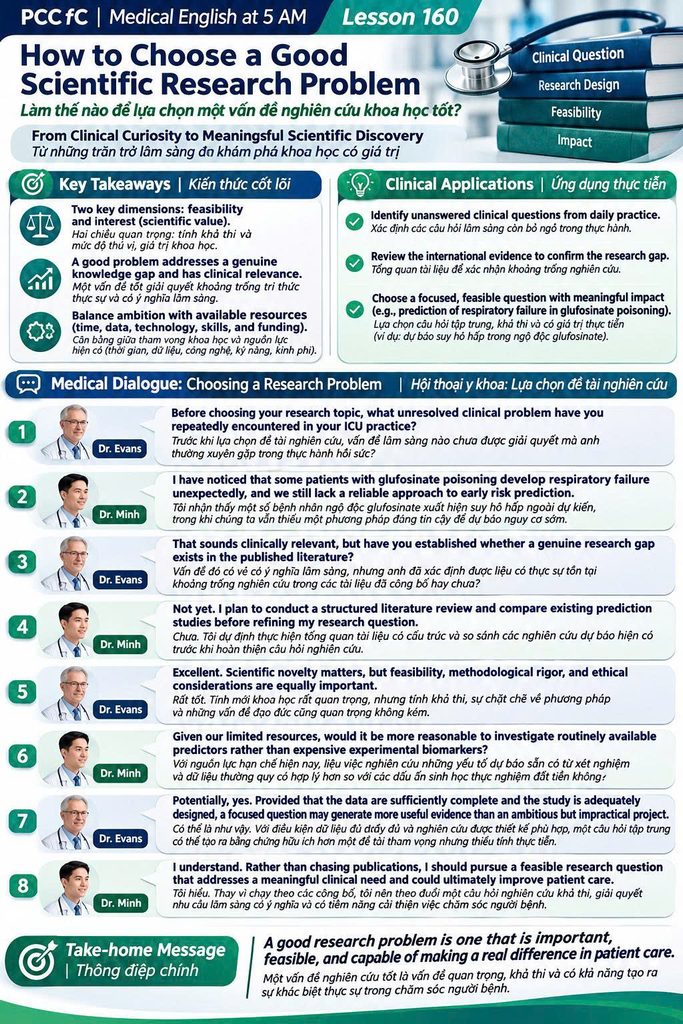
PART 5. EIGHT-TURN MEDICAL DIALOGUE – HỘI THOẠI Y KHOA SONG NGỮ 8 LƯỢT
Context: A research mentor and an intensive care physician are discussing how to select a meaningful research project.
Characters:
Dr. Evans – Senior Clinical Research Mentor.
Dr. Minh – Intensive Care Physician.
Turn 1 – Dr. Evans
English: “Before choosing your research topic, what unresolved clinical problem have you repeatedly encountered in your ICU practice?”
Vietnamese: “Trước khi lựa chọn đề tài nghiên cứu, vấn đề lâm sàng nào chưa được giải quyết mà anh thường xuyên gặp trong thực hành hồi sức?”
Turn 2 – Dr. Minh
English: “I have noticed that some patients with glufosinate poisoning develop respiratory failure unexpectedly, and we still lack a reliable approach to early risk prediction.”
Vietnamese: “Tôi nhận thấy một số bệnh nhân ngộ độc glufosinate xuất hiện suy hô hấp ngoài dự kiến, trong khi chúng ta vẫn thiếu một phương pháp đáng tin cậy để dự báo nguy cơ sớm.”
Turn 3 – Dr. Evans
English: “That sounds clinically relevant, but have you established whether a genuine research gap exists in the published literature?”
Vietnamese: “Vấn đề đó có vẻ có ý nghĩa lâm sàng, nhưng anh đã xác định được liệu có thực sự tồn tại khoảng trống nghiên cứu trong các tài liệu đã công bố hay chưa?”
Turn 4 – Dr. Minh
English: “Not yet. I plan to conduct a structured literature review and compare existing prediction studies before refining my research question.”
Vietnamese: “Chưa. Tôi dự định thực hiện tổng quan tài liệu có cấu trúc và so sánh các nghiên cứu dự báo hiện có trước khi hoàn thiện câu hỏi nghiên cứu.”
Turn 5 – Dr. Evans
English: “Excellent. Scientific novelty matters, but feasibility, methodological rigor, and ethical considerations are equally important.”
Vietnamese: “Rất tốt. Tính mới khoa học rất quan trọng, nhưng tính khả thi, sự chặt chẽ về phương pháp và những vấn đề đạo đức cũng quan trọng không kém.”
Turn 6 – Dr. Minh
English: “Given our limited resources, would it be more reasonable to investigate routinely available predictors rather than expensive experimental biomarkers?”
Vietnamese: “Với nguồn lực hạn chế hiện nay, liệu việc nghiên cứu những yếu tố dự báo sẵn có từ xét nghiệm và dữ liệu thường quy có hợp lý hơn so với các dấu ấn sinh học thực nghiệm đắt tiền không?”
Turn 7 – Dr. Evans
English: “Potentially, yes. Provided that the data are sufficiently complete and the study is adequately designed, a focused question may generate more useful evidence than an ambitious but impractical project.”
Vietnamese: “Có thể là như vậy. Với điều kiện dữ liệu đủ đầy đủ và nghiên cứu được thiết kế phù hợp, một câu hỏi tập trung có thể tạo ra bằng chứng hữu ích hơn một đề tài tham vọng nhưng thiếu tính thực tiễn.”
Turn 8 – Dr. Minh
English: “I understand. Rather than chasing publications, I should pursue a feasible research question that addresses a meaningful clinical need and could ultimately improve patient care.”
Vietnamese: “Tôi hiểu. Thay vì chạy theo các công bố, tôi nên theo đuổi một câu hỏi nghiên cứu khả thi, giải quyết nhu cầu lâm sàng có ý nghĩa và có tiềm năng cải thiện việc chăm sóc người bệnh.”
Dialogue comprehension
- What clinical uncertainty motivates Dr. Minh’s research?
- Why does Dr. Evans recommend reviewing the published literature?
- What factors influence the feasibility of the proposed study?
- Why might a focused research question be preferable to an overly ambitious project?
Model summary:
“The dialogue illustrates that a meaningful scientific problem should emerge from genuine clinical uncertainty, address a verified knowledge gap, and be investigated through ethically sound and methodologically rigorous research.”
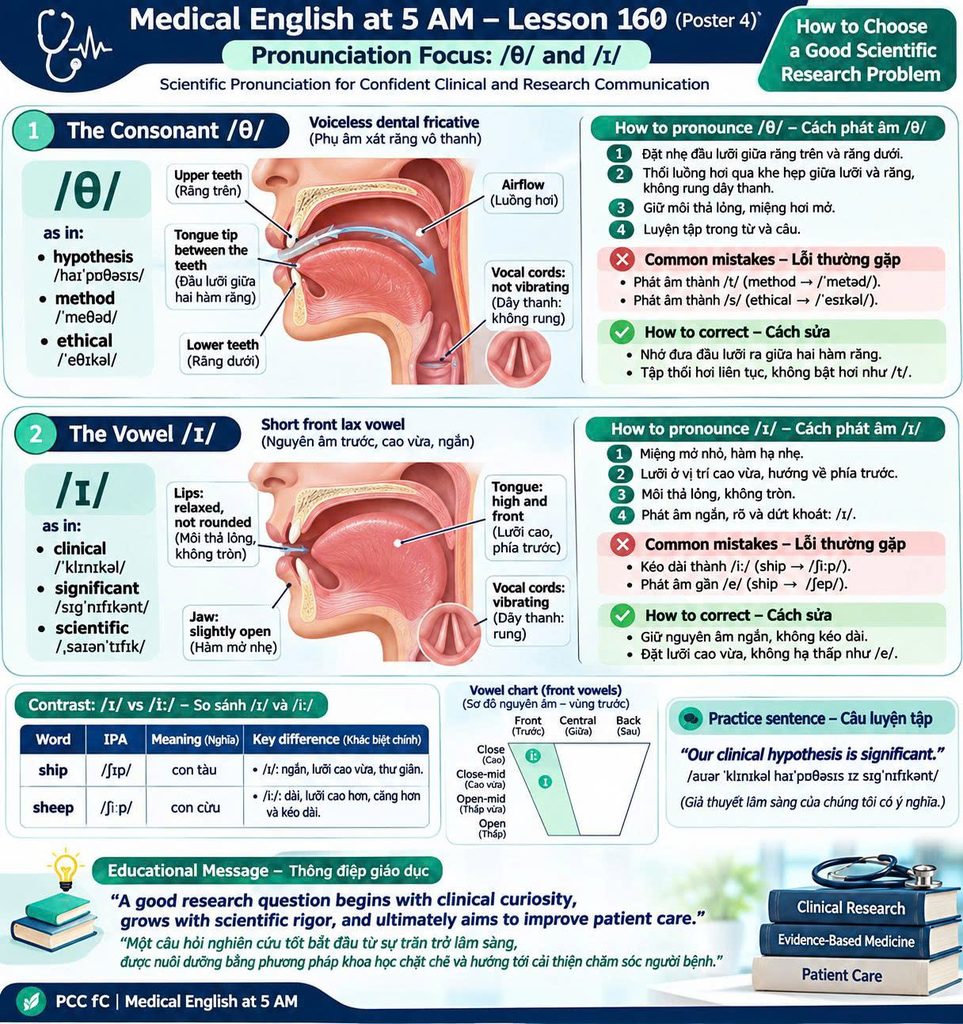
PART 6. PRONUNCIATION FOCUS – PHÁT ÂM TRỌNG TÂM
6.1. Target sound 1: /θ/
Type: Voiceless dental fricative – Phụ âm xát răng vô thanh.
Examples:
- Hypothesis /haɪˈpɒθəsɪs/
- Theory /ˈθɪəri/
- Method /ˈmeθəd/
- Ethical /ˈeθɪkəl/
Technique:
Place the tip of the tongue gently between the upper and lower teeth. Allow air to flow through without vibrating the vocal cords.
Đặt nhẹ đầu lưỡi giữa hai hàm răng, để luồng hơi thoát ra mà không rung dây thanh.
Common mistake: Replacing /θ/ with /t/ or /s/.
Practice sentence:
“Our hypothesis requires a thorough methodological assessment.”
Translation: Giả thuyết của chúng tôi cần được đánh giá kỹ lưỡng về phương pháp.
6.2. Target sound 2: /dʒ/
Type: Voiced postalveolar affricate – Phụ âm tắc-xát sau lợi hữu thanh.
Examples:
- Methodology /ˌmeθəˈdɒlədʒi/
- Judgment /ˈdʒʌdʒmənt/
- Generate /ˈdʒenəreɪt/
- Objective /əbˈdʒektɪv/
Technique:
Begin with a brief closure similar to /d/, then release into the voiced fricative /ʒ/. Maintain vocal-fold vibration.
Bắt đầu bằng động tác chặn luồng hơi ngắn tương tự /d/, sau đó chuyển sang âm xát hữu thanh /ʒ/, đồng thời duy trì sự rung của dây thanh.
Common mistake: Pronouncing /dʒ/ as /z/ or /ʒ/ alone.
Practice sentence:
“Rigorous methodology helps generate objective scientific evidence.”
Translation: Phương pháp nghiên cứu chặt chẽ giúp tạo ra bằng chứng khoa học khách quan.
6.3. Word stress – Trọng âm từ
- feasiBILity – Nhấn âm tiết thứ tư.
- hypoTHESis – Nhấn âm tiết thứ ba.
- methodoLOGical – Nhấn vào âm tiết chứa /lɒdʒ/.
- reproDUCibility – Nhấn vào âm tiết chứa /djuːs/.
6.4. Sentence stress and intonation
Sentence:
“A good research question must be both SCIENTIFICALLY MEANINGFUL and PRACTICALLY FEASIBLE.”
Nhấn mạnh các cụm từ thể hiện hai tiêu chí lựa chọn đề tài.
Speaking exercise:
Read the sentence three times:
- Slowly, with accurate pronunciation.
- At natural conversational speed.
- With emphasis on scientific meaning and feasibility.
PART 7. ADVANCED GRAMMAR – PHÂN TÍCH 2 CẤU TRÚC NGỮ PHÁP
Grammar 1. Inversion with “Not only … but also …”
Purpose: Emphasizing two complementary requirements in formal academic English.
Structure:
Not only + auxiliary verb + subject + main verb …, but + subject + also + verb …
Example:
“Not only must a research question address an important knowledge gap, but it must also be feasible within the available resources.”
Translation:
Một câu hỏi nghiên cứu không chỉ phải giải quyết khoảng trống tri thức quan trọng mà còn phải khả thi trong phạm vi nguồn lực hiện có.
Analysis:
- “Not only” at the beginning triggers subject–auxiliary inversion in the first clause.
- “Must a research question address” demonstrates inversion.
- The second clause uses standard word order.
- This structure is useful in academic discussions and IELTS Writing Task 2.
Compare:
Basic: “A research question must be important and feasible.”
Advanced: “Not only must a research question be scientifically important, but it must also be realistically achievable.”
Practice:
Rewrite:
“Clinical research should generate new evidence and improve patient care.”
Suggested answer:
“Not only should clinical research generate new evidence, but it should also contribute to better patient care.”
Grammar 2. Conditional clause with “Provided that”
Purpose: Expressing conditions that must be satisfied before a conclusion or recommendation is justified.
Structure:
Provided that + subject + verb, main clause.
Example:
“Provided that the study is adequately powered and the data are reliable, the proposed research may generate meaningful clinical evidence.”
Translation:
Với điều kiện nghiên cứu có đủ công suất thống kê và dữ liệu đáng tin cậy, đề tài được đề xuất có thể tạo ra bằng chứng lâm sàng có ý nghĩa.
Analysis:
- “Provided that” means “only if” or “on the condition that”.
- It expresses a necessary condition rather than an established fact.
- The modal “may” conveys scientific uncertainty and avoids overstatement.
- This construction is particularly appropriate for research proposals and academic discussions.
Compare:
Overconfident: “Our study will improve patient outcomes.”
More appropriate: “Provided that the findings are robust and clinically applicable, the study may help inform future improvements in patient care.”
Practice:
Complete:
“Provided that the research question is clearly defined and ____________, the project may be suitable for a postgraduate thesis.”
Suggested answer:
“the required data are available”
IELTS 8.5 language tip:
Advanced writing is characterized not merely by complex grammatical structures, but also by precise reasoning, appropriate qualification, coherence, and accuracy.
PART 8. INTEGRATED LISTENING, SPEAKING, READING AND WRITING – LUYỆN 4 KỸ NĂNG
8.1. Listening – Nghe hiểu
Task:
Listen to the eight-turn dialogue in Part 5 without looking at the text.
Answer:
- What is the main research problem?
- Which two dimensions are central to Uri Alon’s framework?
- Why should the researcher avoid an overly ambitious project?
Listening strategy:
Identify the speaker’s main claim, supporting justification, and qualifying language.
Suggested answers:
- Predicting respiratory failure after acute glufosinate poisoning.
- Feasibility and interest.
- Because limited resources, inadequate data, or methodological weaknesses may prevent the project from producing reliable evidence.
8.2. Speaking – Nói học thuật
Task: One-minute research pitch
Prepare a 60-second presentation using the following framework.
Opening:
“In my clinical practice, I have repeatedly encountered…”
Knowledge gap:
“Although previous studies have investigated…, an important gap remains…”
Research question:
“My proposed study aims to determine whether…”
Feasibility:
“This project is potentially feasible because…”
Expected contribution:
“If validated, the findings could help…”
Model response:
“In my clinical practice, I have repeatedly encountered patients with acute poisoning whose condition deteriorates unexpectedly. Although several studies have explored clinical predictors of poor outcomes, important uncertainties remain regarding their reliability in specific patient populations.
My proposed research aims to evaluate the predictive performance of routinely available clinical and laboratory variables. The project appears feasible because relevant data are collected during routine clinical care.
However, sample size, data completeness, and methodological quality must be assessed before implementation.
If the findings are validated, they could support earlier risk identification and help clinicians make more informed monitoring decisions.”
Speaking evaluation:
Assess organization, pronunciation, fluency, lexical precision, scientific accuracy, and appropriate expression of uncertainty.
OET-related communication note:
This is an academic clinician-to-clinician speaking exercise inspired by professional communication principles. It is not an official OET Medicine Speaking role-play, which assesses communication with a simulated patient or caregiver.
8.3. Reading – Đọc hiểu học thuật
Reading passage:
Choosing Research Problems That Matter
Scientific research is not simply a process of collecting data and publishing findings. It is a disciplined attempt to resolve uncertainty and expand knowledge.
In clinical medicine, the best research questions often arise from problems encountered repeatedly during patient care.
Nevertheless, clinical curiosity alone is insufficient. Researchers must determine whether a genuine knowledge gap exists, whether the question is ethically acceptable, and whether the available methods can produce credible evidence.
Feasibility is particularly important in resource-limited settings. A sophisticated study requiring expensive technology may be less valuable in practice than a carefully designed investigation using routinely available clinical information.
At the same time, feasibility should not become an excuse for choosing trivial questions.
The challenge is to balance intellectual ambition with methodological realism.
A successful research project is one that addresses an important question through a scientifically defensible approach and produces findings that others can critically evaluate, reproduce, or build upon.
Reading questions:
- Why is clinical curiosity alone insufficient?
- What are the potential advantages of routinely collected clinical data?
- Why should feasibility not be the only criterion?
- What makes research findings scientifically credible?
Suggested answers:
- Because researchers must also verify the knowledge gap, ethical acceptability, and methodological suitability.
- They may improve feasibility and reduce additional data-collection costs, although data quality must be evaluated.
- Because an easily completed project may have limited scientific or clinical value.
- Appropriate design, reliable data, transparent methods, and rigorous analysis contribute to credibility.
8.4. Writing – Viết học thuật
Task: Academic paragraph (100–120 words)
Topic:
“What makes a medical research question scientifically meaningful and practically feasible?”
Model paragraph:
“A meaningful medical research question should address an important knowledge gap while remaining feasible within the available resources. Scientific novelty alone is insufficient unless the proposed study has clear clinical relevance and a methodologically sound design. Researchers must evaluate existing evidence, define measurable outcomes, and consider ethical implications before initiating a project. Furthermore, the availability and quality of data should be assessed to minimize avoidable methodological weaknesses. Not only should a research question advance scientific understanding, but it should also offer a realistic opportunity to generate credible evidence. Ultimately, the value of clinical research lies in its potential to inform future decisions and contribute to better patient care.”
Writing feedback criteria:
- Task achievement: Clearly answers the question.
- Coherence: Presents a logical progression of ideas.
- Lexical resource: Uses academic terminology accurately.
- Grammar: Employs complex structures without sacrificing clarity.
- Scientific accuracy: Avoids unsupported causal claims or exaggerated clinical benefits.
8.5. THREE-MINUTE PASSIVE LISTENING
Title: The Art of Choosing the Right Research Question
Recommended duration: Approximately 3 minutes at a natural educational narration pace, with brief pauses.
Instructions:
Listen without taking notes during your commute, morning walk, or other suitable activity.
First listening: Focus on the main message.
Second listening: Identify five key academic expressions.
Third listening: Repeat the sentence you find most meaningful.
Full English listening script:
Every important scientific discovery begins with a question. Yet one of the most difficult decisions in research is determining which question deserves our attention.
In medicine, unanswered questions are everywhere. Why do patients with apparently similar conditions experience different outcomes? Why does one treatment work well for some individuals but not for others? Can early clinical indicators help us recognize deterioration before it becomes life-threatening?
These questions may inspire research, but inspiration alone is not enough.
A scientifically meaningful problem must address a genuine gap in existing knowledge. It should also have sufficient clinical relevance to justify the investment of time, effort, and resources.
In his influential essay, How To Choose a Good Scientific Problem, Uri Alon introduced two essential dimensions of problem selection: feasibility and interest.
Feasibility concerns whether a research project can realistically be completed. Interest concerns the potential value of the knowledge that the project might generate.
An ambitious question may appear intellectually exciting, but without appropriate methods, sufficient data, or adequate resources, it may be impossible to answer reliably.
Conversely, a simple project may be easy to complete but contribute little new understanding.
The challenge is to find a productive balance between scientific ambition and practical limitations.
Consider a physician working in an intensive care unit. Every day, this physician encounters critically ill patients whose clinical courses are difficult to predict.
Rather than conducting a purely descriptive study, the physician may ask whether routinely available clinical information can improve early risk assessment.
Before proceeding, however, the research team must review the literature, define the target population, evaluate data quality, and determine whether the proposed analysis is methodologically appropriate.
They must also distinguish between identifying associations, estimating causal effects, and developing prediction models. These objectives require different research designs and analytical approaches.
Good clinical research does not begin with sophisticated statistical software. It begins with clear reasoning.
It requires intellectual curiosity, methodological discipline, ethical responsibility, and the willingness to revise an initial idea when the evidence demands it.
Researchers should also recognize that uncertainty and unexpected findings are natural parts of scientific discovery.
A negative result does not necessarily mean that a project has failed. When a study is well designed and transparently reported, its findings can still make an important contribution.
Most importantly, scientific success should not be measured only by the number of publications.
A good research project can develop the judgment of a young physician, strengthen collaboration, and contribute to a culture of critical thinking.
The most meaningful question is not always the most complicated one.
Sometimes, a carefully chosen question arising from everyday clinical practice can open the door to a major scientific advance.
So, before beginning your next research project, ask yourself three questions.
Is this question important?
Can it be answered rigorously?
And could the knowledge gained ultimately make a difference?
Choose your question with care, pursue it with integrity, and allow scientific curiosity to guide you toward meaningful discovery.
8.6. Key listening sentences – Câu nghe trọng tâm
Sentence 1:
“Good clinical research does not begin with sophisticated statistical software. It begins with clear reasoning.”
Dịch: Nghiên cứu lâm sàng tốt không bắt đầu từ phần mềm thống kê phức tạp. Nó bắt đầu từ tư duy rõ ràng.
Sentence 2:
“The challenge is to find a productive balance between scientific ambition and practical limitations.”
Dịch: Thách thức là tìm được sự cân bằng hiệu quả giữa tham vọng khoa học và những giới hạn thực tế.
Sentence 3:
“The most meaningful question is not always the most complicated one.”
Dịch: Câu hỏi có ý nghĩa nhất không phải lúc nào cũng là câu hỏi phức tạp nhất.
PART 9. ASSESSMENT, ANSWERS AND FEEDBACK – KIỂM TRA, ĐÁP ÁN VÀ PHẢN HỒI
Assessment duration: 3 minutes in class.
Format: Five short questions.
Total score: 10 points.
Passing target: 8/10.
Question 1 – Vocabulary (2 points)
Choose the correct answer.
“The research team must assess the __________ of the proposed study before committing substantial resources.”
A. Novelty
B. Feasibility
C. Confounding
D. Outcome
Question 2 – Scientific reasoning (2 points)
Which statement best reflects Uri Alon’s two-dimensional framework?
A. The easiest project is always the best choice.
B. Scientific novelty should outweigh all practical considerations.
C. Research selection should consider both feasibility and the potential interest of the problem.
D. A project is valuable only when it is published in a high-impact journal.
Question 3 – Grammar (2 points)
Choose the grammatically correct sentence.
A. Not only a study must be relevant, but it also must be feasible.
B. Not only must a study be relevant, but it must also be feasible.
C. Not only must be a study relevant, but it feasible also.
D. Not only a study is relevant, but also feasible.
Question 4 – Research methodology (2 points)
A research team wishes to develop a model predicting respiratory failure using clinical data.
Which reporting guideline is particularly relevant?
A. PRISMA 2020
B. CONSORT 2025
C. TRIPOD+AI
D. CARE
Question 5 – Critical thinking (2 points)
A physician proposes an expensive biomarker study despite having insufficient funding and limited access to specialized testing.
What is the most appropriate initial response?
A. Begin immediately because novelty guarantees scientific value.
B. Abandon all research activities.
C. Reassess feasibility, review available evidence, and consider an appropriately designed alternative.
D. Collect as much data as possible without defining a research question.
ANSWER KEY – ĐÁP ÁN
Question 1: B – Feasibility.
Explanation: Feasibility describes whether a project can realistically be carried out with available resources.
Question 2: C – Feasibility and interest.
Explanation: Uri Alon’s framework emphasizes evaluating both dimensions and their trade-offs rather than maximizing only one.
Question 3: B – Not only must a study be relevant, but it must also be feasible.
Explanation: The initial negative-focus expression “Not only” requires subject–auxiliary inversion.
Question 4: C – TRIPOD+AI.
Explanation: TRIPOD+AI provides reporting guidance for studies developing or evaluating clinical prediction models using regression or machine-learning approaches. It is not a substitute for appropriate study design, sample-size planning, or risk-of-bias assessment.
Question 5: C – Reassess feasibility and consider alternatives.
Explanation: Research ambition must be balanced with available resources, ethical considerations, and methodological rigor.
PERFORMANCE FEEDBACK
9–10 points – Excellent
You demonstrate strong command of advanced scientific English and research reasoning.
Continue refining your ability to discuss methodological limitations and defend research decisions.
8 points – Very good
You have achieved the lesson’s core objectives.
Focus on improving precision in academic expression and the distinction between scientific importance and practical feasibility.
6–7 points – Developing competence
You understand the main concepts but need additional practice with research terminology, grammar, and methodological reasoning.
Review Parts 4, 5, and 7.
0–5 points – Further practice recommended
Revisit the two-dimensional framework and complete the vocabulary and dialogue exercises again.
Focus on understanding before memorizing.
FORMATIVE FEEDBACK – PHẢN HỒI PHÁT TRIỂN NĂNG LỰC
Strength: “Your research question addresses a clinically relevant problem.”
Area for improvement: “The outcome definition and available sample size need further clarification.”
Actionable next step: “Refine the research question, verify the evidence gap, and conduct a preliminary feasibility assessment.”
Reflective question: “What would make this project scientifically worthwhile even if the initial hypothesis were not supported?”
PART 10. EVIDENCE-BASED SCIENTIFIC REFERENCES AND EDUCATIONAL TAKEAWAYS – TÀI LIỆU THAM KHẢO VÀ TỔNG KẾT
10.1. Primary scientific foundation
Reference 1. Uri Alon – Choosing a Good Scientific Problem
Alon U. How To Choose a Good Scientific Problem. Molecular Cell. 2009;35(6):726–728.
DOI: https://doi.org/10.1016/j.molcel.2009.09.013
Key contributions:
- Research selection involves feasibility and interest.
- The Pareto frontier provides a framework for understanding trade-offs between research options.
- Scientists at different career stages may appropriately choose different types of projects.
- Mentorship should support creativity, exploration, and intellectual development.
- Research involves uncertainty and unexpected discoveries.
10.2. Medical education – AMEE
Reference 2. AMEE Guide No. 189 (2025)
Formative Assessment and Feedback in Medical Education: A Practical Guide.
DOI: https://doi.org/10.1080/0142159X.2025.2569623
Application to Lesson 160:
- Define measurable learning outcomes.
- Align teaching activities with assessment.
- Provide timely and constructive feedback.
- Encourage self-assessment and reflection.
- Support progressive development of professional competence.
This lesson uses these principles through outcome-based teaching, clinical discussion, short formative assessment, and targeted feedback.
10.3. OET Medicine – Professional communication
Reference 3. Occupational English Test
Official website: https://oet.com
Relevant principles:
- Clear communication between healthcare professionals.
- Appropriate professional vocabulary.
- Accurate and intelligible pronunciation.
- Well-organized explanations.
- Context-sensitive communication.
- Effective expression of clinical reasoning.
Lesson 160 draws on healthcare communication principles but does not reproduce an official OET test. OET Medicine Speaking principally evaluates communication with simulated patients or caregivers; this lesson additionally develops advanced academic communication between clinicians.
10.4. Reporting standards for medical research
Reference 4. EQUATOR Network
Website: https://www.equator-network.org
Relevant frameworks include:
STROBE: Reporting observational research, including cohort, case-control, and cross-sectional studies.
TRIPOD+AI (2024): Reporting studies that develop or evaluate multivariable clinical prediction models using regression or machine-learning methods.
CONSORT 2025: Reporting randomized clinical trials.
PRISMA 2020: Reporting systematic reviews.
SQUIRE 2.0: Reporting healthcare quality-improvement studies.
Important distinction:
Reporting guidelines improve transparency and completeness of research reports. They do not, by themselves, guarantee appropriate study design, eliminate bias, or establish the validity of study findings.
10.5. Application to clinical toxicology research
Research topic A: Methanol poisoning
Potential question:
“Which early clinical and laboratory variables are associated with poor neurological outcomes after acute methanol poisoning?”
Research consideration:
A study of association should not automatically be presented as a validated prediction model.
Research topic B: Glufosinate poisoning
Potential question:
“Can routinely available clinical variables improve early prediction of respiratory failure following acute glufosinate poisoning?”
Research consideration:
Carefully define predictor timing, outcome definitions, model performance, and validation requirements.
Research topic C: Snakebite-related wound infections
Potential question:
“What microorganisms are isolated from infected snakebite wounds, and what are their antimicrobial susceptibility patterns?”
Research consideration:
Define wound infection consistently, distinguish colonization from infection, and account for specimen-collection methods and prior antimicrobial exposure.
Research topic D: Hemoperfusion anticoagulation
Potential question:
“In patients with acute poisoning undergoing hemoperfusion, how do different anticoagulation strategies compare regarding circuit clotting and bleeding outcomes?”
Research consideration:
Address indication bias, confounding by illness severity, anticoagulant eligibility, and the suitability of the comparative study design.
These topics are educational examples, not claims that the corresponding research gaps remain unaddressed. Each requires a current literature review and local feasibility assessment before protocol development.
10.6. Five practical principles for choosing research problems
Principle 1 – Start with clinical uncertainty.
Begin with an unresolved problem encountered in real clinical practice.
Principle 2 – Verify the knowledge gap.
Review the best available evidence before claiming scientific novelty.
Principle 3 – Balance interest and feasibility.
Aim for meaningful scientific contribution without disregarding available resources.
Principle 4 – Protect methodological integrity.
Select an appropriate design, define outcomes, anticipate bias, and ensure ethical acceptability.
Principle 5 – Think beyond publication.
Consider how the findings could contribute to knowledge, clinical decision-making, future research, or patient care.
10.7. One word – One sentence – One paragraph – One lesson
ONE WORD – MỘT TỪ
Feasibility /ˌfiːzəˈbɪləti/ (n.)
Tính khả thi: Khả năng triển khai một công việc hoặc nghiên cứu thành công với điều kiện và nguồn lực thực tế.
ONE SENTENCE – MỘT CÂU
“A meaningful research question must be both scientifically important and practically feasible.”
Một câu hỏi nghiên cứu có ý nghĩa phải vừa quan trọng về mặt khoa học, vừa khả thi trong thực tế.
ONE PARAGRAPH – MỘT ĐOẠN
“Choosing a good scientific problem requires more than intellectual curiosity. Researchers must identify a genuine knowledge gap, evaluate clinical relevance, and assess whether the proposed study can be conducted rigorously with available resources. A well-defined research question provides a foundation for appropriate methodology, transparent reporting, and meaningful scientific contribution. Ultimately, successful research should advance knowledge while supporting the development of responsible, reflective, and clinically engaged scientists.”
Dịch:
Lựa chọn một vấn đề khoa học tốt đòi hỏi nhiều hơn sự tò mò trí tuệ. Nhà nghiên cứu phải xác định khoảng trống tri thức thực sự, đánh giá ý nghĩa lâm sàng và xem xét liệu nghiên cứu có thể được thực hiện một cách chặt chẽ với nguồn lực hiện có hay không. Một câu hỏi nghiên cứu được xác định rõ ràng tạo nền tảng cho phương pháp phù hợp, báo cáo minh bạch và đóng góp khoa học có ý nghĩa. Cuối cùng, nghiên cứu thành công phải mở rộng tri thức, đồng thời góp phần phát triển những nhà khoa học có trách nhiệm, biết phản tư và gắn bó với thực hành lâm sàng.
ONE LESSON – MỘT BÀI HỌC
English:
“Do not choose a research problem merely because it is easy to complete or likely to be published. Choose a question that matters, one that you can investigate rigorously and that offers an opportunity to generate meaningful knowledge.”
Vietnamese:
Đừng lựa chọn một vấn đề nghiên cứu chỉ vì nó dễ hoàn thành hoặc có khả năng được công bố. Hãy lựa chọn một câu hỏi thực sự có ý nghĩa, có thể được nghiên cứu một cách chặt chẽ và mang đến cơ hội tạo ra tri thức có giá trị.
FINAL EDUCATIONAL MESSAGE – THÔNG ĐIỆP GIÁO DỤC
THE BEST SCIENTISTS DO NOT SIMPLY FIND ANSWERS. THEY LEARN TO ASK QUESTIONS THAT MATTER.
Những nhà khoa học xuất sắc không chỉ tìm kiếm câu trả lời. Họ học cách đặt ra những câu hỏi thực sự có ý nghĩa.
English
A good physician learns from every patient.
A good researcher transforms uncertainty into a meaningful question.
A great clinician-scientist connects scientific curiosity with methodological integrity and a commitment to improving human health.
Science is not a race to publish the greatest number of papers. It is a lifelong journey of asking better questions, challenging assumptions, learning from uncertainty, and creating knowledge that matters.
Vietnamese
Một bác sĩ giỏi học hỏi từ mỗi người bệnh.
Một nhà nghiên cứu giỏi biết chuyển hóa những điều chưa rõ thành câu hỏi khoa học có ý nghĩa.
Một bác sĩ – nhà khoa học xuất sắc biết kết nối khát vọng khám phá với sự trung thực trong nghiên cứu và trách nhiệm cải thiện sức khỏe con người.
Khoa học không phải cuộc đua xem ai công bố nhiều bài báo nhất. Đó là hành trình suốt đời để đặt ra những câu hỏi tốt hơn, xem xét lại các giả định, học hỏi từ những điều chưa chắc chắn và tạo nên tri thức thực sự có giá trị.
“ASK BETTER QUESTIONS. PURSUE MEANINGFUL DISCOVERIES. IMPROVE HUMAN LIVES.”
“ĐẶT CÂU HỎI TỐT HƠN – THEO ĐUỔI KHÁM PHÁ CÓ Ý NGHĨA – GÓP PHẦN CẢI THIỆN CUỘC SỐNG CON NGƯỜI.”
PCC fC | Medical English at 5 AM – Lesson 160
Learn English. Think Scientifically. Practice Compassionately.
Học tiếng Anh – Tư duy khoa học – Thực hành y khoa bằng sự tận tâm.