Bài 171 – Tiếng Anh Y khoa: từ cân bằng nội môi sinh lý đến sinh lý bệnh lâm sàng * From physiological homestasis to clinical pathophysiology
PCC Language – Thăng Long, Hà Nội, ngày 24/11/2026, Cơ thể con người là một hệ thống điều hòa kỳ diệu, trong đó các cơ quan không ngừng phối hợp để duy trì cân bằng nội môi (homeostasis). Từ hoạt động chuyển hóa tế bào dưới sự điều hòa của hormone tuyến giáp đến quá trình hấp thu nước, điện giải và kiểm soát đại tiện, mỗi cơ chế sinh lý đều mang ý nghĩa quan trọng trong thực hành lâm sàng.
Trong Bài 171 – From Physiological Homeostasis to Clinical Pathophysiology, chúng ta sẽ khám phá mối liên hệ giữa hệ nội tiết và hệ tiêu hóa thông qua cuộc đối thoại chuyên môn giữa bác sĩ hướng dẫn và bác sĩ nội trú. Bài học giúp học viên củng cố kiến thức sinh lý – sinh lý bệnh, làm chủ 15 thuật ngữ y khoa chuyên sâu, nâng cao kỹ năng sử dụng tiếng Anh học thuật và phát triển tư duy lâm sàng dựa trên bằng chứng.
Học tiếng Anh y khoa không chỉ là học thêm một ngôn ngữ, mà còn là cơ hội để hiểu sâu hơn về cơ thể con người, rèn luyện tư duy phản biện và từng bước hoàn thiện năng lực chuyên môn.
“Learn the language of medicine, understand the mechanisms of life, and develop the mindset of a scientist.”
Học ngôn ngữ của y học, thấu hiểu cơ chế của sự sống và phát triển tư duy của một nhà khoa học.
Medical English at 5 AM – PCC fC
Khởi đầu ngày mới bằng tri thức, kỷ luật và niềm đam mê học tập.
HEALTH – JOY – HAPPINESS | KHỎE – VUI – HẠNH PHÚC
MEDICAL ENGLISH AT 5 AM – LESSON 171
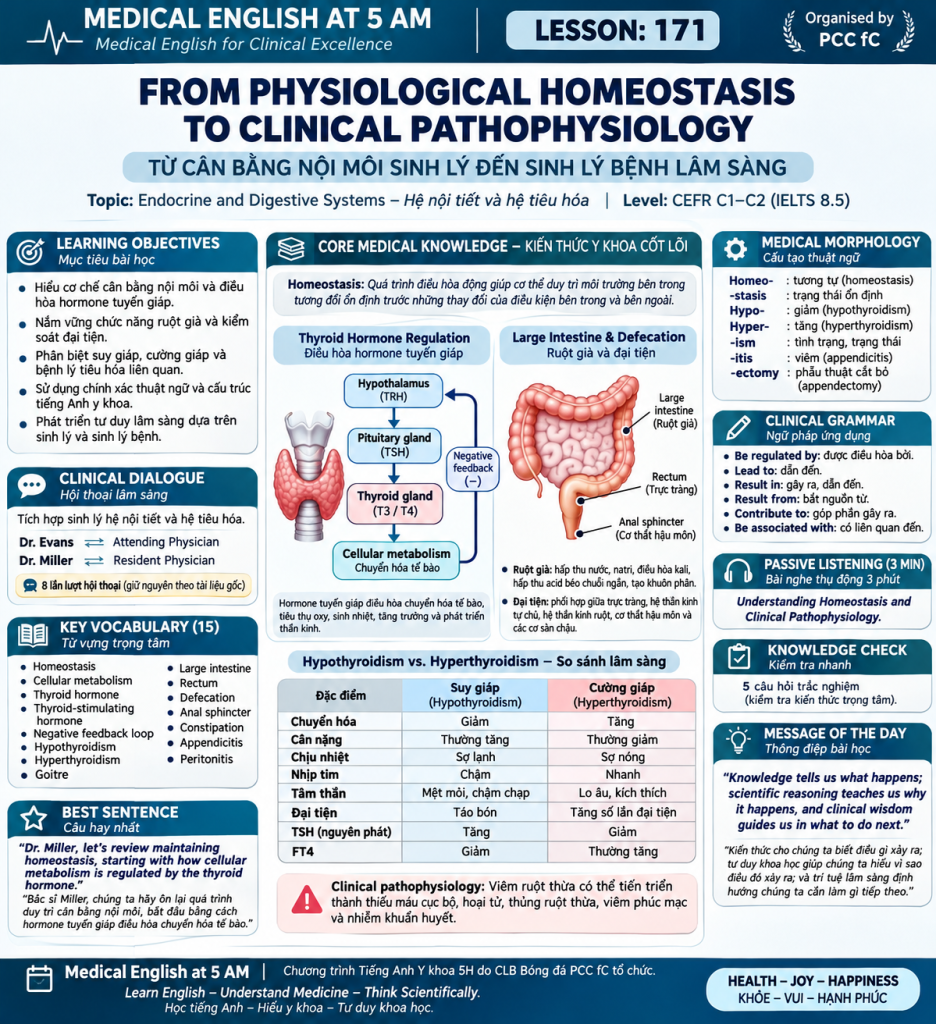
FROM PHYSIOLOGICAL HOMEOSTASIS TO CLINICAL PATHOPHYSIOLOGY
TỪ CÂN BẰNG NỘI MÔI SINH LÝ ĐẾN SINH LÝ BỆNH LÂM SÀNG
Chủ đề: Endocrine and Digestive Systems – Hệ nội tiết và hệ tiêu hóa.
Trình độ: CEFR C1–C2 | IELTS 8.5.
Thời lượng: 30 phút.
Medical English at 5 AM – Chương trình Tiếng Anh Y khoa 5H do CLB Bóng đá PCC fC tổ chức.
1. LEARNING OBJECTIVES – MỤC TIÊU BÀI HỌC
- Hiểu cơ chế cân bằng nội môi và điều hòa chuyển hóa tế bào của hormone tuyến giáp.
- Nắm vững chức năng sinh lý của ruột già và cơ chế kiểm soát đại tiện.
- Phân biệt suy giáp, cường giáp và các bệnh lý tiêu hóa liên quan.
- Sử dụng chính xác thuật ngữ y khoa, câu bị động và cấu trúc nguyên nhân – kết quả.
- Phát triển tư duy lâm sàng dựa trên kiến thức sinh lý và sinh lý bệnh.
2. CORE MEDICAL KNOWLEDGE – KIẾN THỨC Y KHOA CỐT LÕI
Homeostasis – Cân bằng nội môi: Quá trình điều hòa động giúp cơ thể duy trì môi trường bên trong tương đối ổn định trước những thay đổi của điều kiện bên trong và bên ngoài.
Thyroid hormone regulation – Điều hòa hormone tuyến giáp: Trục vùng dưới đồi – tuyến yên – tuyến giáp hoạt động thông qua cơ chế phản hồi âm tính:
Hypothalamus → TRH → Pituitary gland → TSH → Thyroid gland → T3/T4 → Cellular metabolism.
Hormone tuyến giáp tham gia điều hòa chuyển hóa tế bào, tiêu thụ oxy, sinh nhiệt, tăng trưởng và phát triển thần kinh.
| Đặc điểm | Hypothyroidism – Suy giáp | Hyperthyroidism – Cường giáp |
|---|---|---|
| Metabolic rate | Giảm chuyển hóa | Tăng chuyển hóa |
| Body weight | Thường tăng cân | Thường giảm cân |
| Temperature tolerance | Sợ lạnh | Sợ nóng |
| Heart rate | Nhịp tim chậm | Nhịp tim nhanh |
| Mental status | Mệt mỏi, chậm chạp | Lo âu, kích thích |
| Bowel movements | Táo bón | Tăng số lần đại tiện |
| TSH trong bệnh lý nguyên phát rõ | Tăng | Giảm |
| FT4 | Giảm | Thường tăng |
Large intestine – Ruột già: Hấp thu nước, natri, điều hòa vận chuyển kali, hấp thu acid béo chuỗi ngắn, tạo khuôn phân và vận chuyển chất thải.
Defecation – Đại tiện: Đòi hỏi sự phối hợp giữa trực tràng, hệ thần kinh tự chủ, hệ thần kinh ruột, cơ thắt hậu môn và các cơ sàn chậu.
Clinical pathophysiology – Sinh lý bệnh lâm sàng: Viêm ruột thừa có thể tiến triển thành thiếu máu cục bộ, hoại tử, thủng ruột thừa, viêm phúc mạc và nhiễm khuẩn huyết.
3. CLINICAL DIALOGUE – HỘI THOẠI LÂM SÀNG
Topic: Integrating Endocrine and Gastrointestinal Physiology – Tích hợp sinh lý hệ nội tiết và hệ tiêu hóa.
Dr. Evans: Attending Physician – Bác sĩ hướng dẫn.
Dr. Miller: Resident Physician – Bác sĩ nội trú.
Giữ nguyên đầy đủ 8 lượt hội thoại tiếng Anh trong tài liệu gốc.
01. Dr. Evans:
Dr. Miller, let’s review maintaining homeostasis, starting with how cellular metabolism is regulated by the thyroid hormone.
Bác sĩ Miller, chúng ta hãy ôn lại quá trình duy trì cân bằng nội môi, bắt đầu bằng cách hormone tuyến giáp điều hòa chuyển hóa tế bào.
02. Dr. Miller:
Certainly. When levels drop, the pituitary releases Thyroid Stimulating Hormone (TSH), creating a negative feedback loop to return conditions to normal.
Vâng. Khi nồng độ hormone tuyến giáp giảm, tuyến yên giải phóng hormone kích thích tuyến giáp (TSH), tạo thành vòng phản hồi âm tính nhằm đưa các điều kiện sinh lý trở về bình thường.
03. Dr. Evans:
Excellent. Now moving to the lower GI tract, what is the physiological role of the large intestine?
Rất tốt. Bây giờ chuyển sang đường tiêu hóa dưới, vai trò sinh lý của ruột già là gì?
04. Dr. Miller:
Its primary job is the absorption of water, sodium, and potassium, leaving behind feces that are squeezed into the rectum.
Chức năng chính của nó là hấp thu nước, natri và kali, để lại phân được đẩy vào trực tràng.
05. Dr. Evans:
And how is the process of defecation neurologically and muscularly controlled?
Vậy quá trình đại tiện được kiểm soát như thế nào về mặt thần kinh và cơ?
06. Dr. Miller:
It relies on two structures: the involuntary internal anal sphincter controlled by the spinal cord, and the voluntary external anal sphincter.
Quá trình này dựa vào hai cấu trúc: cơ thắt hậu môn trong hoạt động không tự chủ, được kiểm soát bởi tủy sống, và cơ thắt hậu môn ngoài hoạt động có chủ ý.
07. Dr. Evans:
Precisely. Clinically, what complications arise if feces remain in the colon for too long?
Chính xác. Về mặt lâm sàng, những biến chứng nào có thể xuất hiện nếu phân tồn tại trong đại tràng quá lâu?
08. Dr. Miller:
Excessive water absorption causes constipation, which can push feces backward to block the appendix causing appendicitis; if it bursts, it results in a life-threatening peritonitis.
Hấp thu nước quá mức gây táo bón, tình trạng này có thể đẩy phân ngược trở lại làm tắc ruột thừa và gây viêm ruột thừa; nếu ruột thừa vỡ, nó gây viêm phúc mạc đe dọa tính mạng.
Scientific clarification – Hiệu đính khoa học:
Hội thoại được giữ nguyên theo tài liệu gốc. Tuy nhiên, cần lưu ý đại tràng có thể hấp thu hoặc bài tiết kali; cơ thắt hậu môn trong chịu sự điều hòa của hệ thần kinh tự chủ và hệ thần kinh ruột. Táo bón có nhiều cơ chế bệnh sinh và chưa có cơ sở để khẳng định táo bón đẩy phân ngược vào ruột thừa gây viêm ruột thừa. Thủng ruột thừa có thể dẫn đến viêm phúc mạc nhưng không phải là diễn tiến tất yếu.
4. MEDICAL VOCABULARY – 15 THUẬT NGỮ Y KHOA
Phiên âm IPA theo tiếng Anh – Anh.
| STT | Từ vựng và phiên âm IPA | Từ loại | Nghĩa tiếng Việt |
|---|---|---|---|
| 1 | Homeostasis /ˌhəʊ.mi.əʊˈsteɪ.sɪs/ | Noun | Cân bằng nội môi |
| 2 | Cellular metabolism /ˈsel.jə.lə məˈtæb.əl.ɪ.zəm/ | Noun phrase | Chuyển hóa tế bào |
| 3 | Thyroid hormone /ˈθaɪ.rɔɪd ˈhɔː.məʊn/ | Noun phrase | Hormone tuyến giáp |
| 4 | Thyroid-stimulating hormone /ˈθaɪ.rɔɪd ˈstɪm.jə.leɪ.tɪŋ ˈhɔː.məʊn/ | Noun phrase | Hormone kích thích tuyến giáp |
| 5 | Negative feedback loop /ˈneɡ.ə.tɪv ˈfiːd.bæk luːp/ | Noun phrase | Vòng phản hồi âm tính |
| 6 | Hypothyroidism /ˌhaɪ.pəʊˈθaɪ.rɔɪ.dɪ.zəm/ | Noun | Suy giáp |
| 7 | Hyperthyroidism /ˌhaɪ.pəˈθaɪ.rɔɪ.dɪ.zəm/ | Noun | Cường giáp |
| 8 | Goitre /ˈɡɔɪ.tə/ | Noun | Bướu giáp |
| 9 | Large intestine /lɑːdʒ ɪnˈtes.tɪn/ | Noun phrase | Ruột già |
| 10 | Rectum /ˈrek.təm/ | Noun | Trực tràng |
| 11 | Defecation /ˌdef.əˈkeɪ.ʃən/ | Noun | Sự đại tiện |
| 12 | Anal sphincter /ˈeɪ.nəl ˈsfɪŋk.tə/ | Noun phrase | Cơ thắt hậu môn |
| 13 | Constipation /ˌkɒn.stɪˈpeɪ.ʃən/ | Noun | Táo bón |
| 14 | Appendicitis /əˌpen.dɪˈsaɪ.tɪs/ | Noun | Viêm ruột thừa |
| 15 | Peritonitis /ˌper.ɪ.təˈnaɪ.tɪs/ | Noun | Viêm phúc mạc |
Clinical examples – Ví dụ ứng dụng
1. Homeostasis: The kidneys maintain fluid and electrolyte homeostasis.
Thận duy trì cân bằng nội môi về dịch và điện giải.
2. Cellular metabolism: Thyroid hormones regulate cellular metabolism.
Hormone tuyến giáp điều hòa chuyển hóa tế bào.
3. Thyroid hormone: Thyroid hormone deficiency may impair neurological development.
Thiếu hormone tuyến giáp có thể ảnh hưởng đến sự phát triển thần kinh.
4. Thyroid-stimulating hormone: Elevated TSH and reduced FT4 suggest primary hypothyroidism.
TSH tăng và FT4 giảm gợi ý suy giáp nguyên phát.
5. Negative feedback loop: A negative feedback loop maintains hormonal balance.
Vòng phản hồi âm tính duy trì cân bằng hormone.
6. Hypothyroidism: Hypothyroidism may cause fatigue and constipation.
Suy giáp có thể gây mệt mỏi và táo bón.
7. Hyperthyroidism: Hyperthyroidism increases the risk of atrial fibrillation.
Cường giáp làm tăng nguy cơ rung nhĩ.
8. Goitre: Iodine deficiency may lead to goitre.
Thiếu iod có thể dẫn đến bướu giáp.
9. Large intestine: The large intestine absorbs water and sodium.
Ruột già hấp thu nước và natri.
10. Rectum: Rectal distension initiates the defecation reflex.
Sự căng giãn trực tràng khởi phát phản xạ đại tiện.
11. Defecation: Defecation requires coordinated neuromuscular activity.
Đại tiện đòi hỏi sự phối hợp hoạt động thần kinh cơ.
12. Anal sphincter: The external anal sphincter allows voluntary control of defecation.
Cơ thắt hậu môn ngoài cho phép kiểm soát chủ động quá trình đại tiện.
13. Constipation: Persistent constipation warrants clinical evaluation.
Táo bón kéo dài cần được đánh giá lâm sàng.
14. Appendicitis: Acute appendicitis may present with right lower quadrant abdominal pain.
Viêm ruột thừa cấp có thể biểu hiện bằng đau bụng hố chậu phải.
15. Peritonitis: Appendiceal perforation may result in peritonitis.
Thủng ruột thừa có thể dẫn đến viêm phúc mạc.
5. MEDICAL MORPHOLOGY – CẤU TẠO THUẬT NGỮ Y KHOA
| Thành phần | Ý nghĩa | Ví dụ |
|---|---|---|
| Homeo- | Tương tự | Homeostasis |
| -stasis | Trạng thái ổn định, duy trì | Homeostasis |
| Hypo- | Giảm, dưới mức bình thường | Hypothyroidism |
| Hyper- | Tăng, trên mức bình thường | Hyperthyroidism |
| -ism | Tình trạng, trạng thái | Hyperthyroidism |
| -itis | Viêm | Appendicitis, peritonitis |
| -ectomy | Phẫu thuật cắt bỏ | Appendectomy, thyroidectomy |
Lưu ý: Hậu tố -itis biểu thị tình trạng viêm, không đồng nghĩa với nhiễm trùng.
6. BEST SENTENCE – CÂU HAY NHẤT BÀI HỌC
“Dr. Miller, let’s review maintaining homeostasis, starting with how cellular metabolism is regulated by the thyroid hormone.”
Bác sĩ Miller, chúng ta hãy ôn lại quá trình duy trì cân bằng nội môi, bắt đầu bằng cách hormone tuyến giáp điều hòa chuyển hóa tế bào.
Grammatical analysis – Phân tích ngữ pháp
| Thành phần | Phân tích |
|---|---|
| Vocative | Dr. Miller – Thành phần gọi đáp |
| Implied subject | Người nói và người nghe, được bao hàm trong let’s |
| Main construction | Let’s review – Cấu trúc đề nghị |
| Main verb | Review – Ôn tập, xem xét lại |
| Object | Maintaining homeostasis – Cụm danh động từ làm tân ngữ |
| Participial clause | Starting with… – Mệnh đề phân từ bổ sung |
| Embedded interrogative clause | How cellular metabolism is regulated by the thyroid hormone |
| Embedded subject | Cellular metabolism |
| Embedded predicate | Is regulated by the thyroid hormone |
| Tense and voice | Hiện tại đơn, thể bị động trong mệnh đề phụ |
Key grammatical structures – Cấu trúc trọng tâm
Let’s + V: Đề nghị cùng thực hiện một hành động.
S + am/is/are + V3: Câu bị động ở thì hiện tại đơn, thường dùng khi mô tả cơ chế sinh lý.
How + S + V: Mệnh đề nghi vấn gián tiếp, không đảo trợ động từ.
Starting with + noun/V-ing/clause: Bắt đầu bằng một nội dung hoặc hoạt động cụ thể.
Clinical application – Vận dụng
Let’s discuss how mitochondrial dysfunction contributes to cellular injury in acute poisoning.
Chúng ta hãy thảo luận về cách rối loạn chức năng ty thể góp phần gây tổn thương tế bào trong ngộ độc cấp.
Understanding how physiological processes are regulated is fundamental to clinical reasoning.
Hiểu cách các quá trình sinh lý được điều hòa là nền tảng của tư duy lâm sàng.
7. CLINICAL GRAMMAR – NGỮ PHÁP Y KHOA ỨNG DỤNG
| Cấu trúc | Ý nghĩa | Ví dụ |
|---|---|---|
| Be regulated by | Được điều hòa bởi | Metabolism is regulated by thyroid hormones. |
| Lead to | Dẫn đến | Hypothyroidism may lead to constipation. |
| Result in | Gây ra, dẫn đến | Perforation may result in peritonitis. |
| Result from | Bắt nguồn từ | Constipation may result from reduced intestinal motility. |
| Contribute to | Góp phần gây ra | Neurological dysfunction may contribute to constipation. |
| Be associated with | Có liên quan đến | Hyperthyroidism is associated with atrial fibrillation. |
Clinical conditional – Câu điều kiện lâm sàng:
If the appendix perforates, peritonitis may develop.
Nếu ruột thừa bị thủng, viêm phúc mạc có thể xuất hiện.
Trong tiếng Anh y khoa, sử dụng may, can, potentially và contribute to giúp diễn đạt tính xác suất và tránh khẳng định quá mức mối quan hệ nhân quả.
8. THREE-MINUTE PASSIVE LISTENING – BÀI NGHE THỤ ĐỘNG 3 PHÚT
Topic: Understanding Homeostasis and Clinical Pathophysiology
Thời lượng khoảng 3 phút, đọc chậm, rõ ràng, tốc độ khoảng 115–125 từ/phút.
Good morning, everyone, and welcome to Medical English at Five AM.
Today, we will explore the relationship between physiological homeostasis, thyroid hormone regulation and gastrointestinal function.
Homeostasis is the dynamic process by which the human body maintains a relatively stable internal environment despite continuous changes in internal and external conditions. The endocrine system plays an essential role in this process.
Thyroid hormones regulate cellular metabolism, oxygen consumption, energy expenditure and heat production. When circulating thyroid hormone levels decrease, an intact hypothalamic–pituitary–thyroid axis responds by increasing thyroid-stimulating hormone secretion. This stimulates the thyroid gland to produce more hormones. Negative feedback subsequently helps restore hormonal balance.
Disruption of thyroid function may result in various clinical manifestations. Hypothyroidism is commonly associated with fatigue, weight gain, cold intolerance and constipation. Conversely, hyperthyroidism may present with weight loss, palpitations, heat intolerance and increased bowel frequency.
The digestive system also contributes to maintaining homeostasis. The large intestine absorbs water and sodium, regulates electrolyte transport and facilitates stool formation.
When stool reaches the rectum, rectal distension activates the defecation reflex. The internal anal sphincter functions involuntarily, whereas the external anal sphincter allows voluntary control. Normal defecation requires coordination between the nervous system and pelvic floor muscles.
Disturbances in gastrointestinal motility or neuromuscular coordination may contribute to constipation.
Acute appendicitis, however, is a distinct pathological condition. It may develop through several mechanisms, including appendiceal obstruction. If inflammation progresses to necrosis and perforation, peritonitis and sepsis may develop.
Understanding these mechanisms enables healthcare professionals to interpret clinical manifestations, recognise potential complications and make appropriate clinical decisions.
Medicine is not merely about memorising symptoms or diagnostic criteria. It is about understanding the relationship between physiological processes and pathological changes.
Scientific reasoning requires us to distinguish association from causation and support our clinical decisions with reliable evidence.
Every new medical term provides an opportunity to deepen our understanding of medicine. Every clinical question encourages us to think more critically.
Keep learning, keep questioning and keep improving. Through consistent practice, we can develop both linguistic competence and clinical excellence.
Thank you for joining Medical English at Five AM, organised by PCC fC.
Have a wonderful and productive day.
9. KNOWLEDGE ASSESSMENT – KIỂM TRA KIẾN THỨC
Question 1: What mechanism primarily regulates thyroid hormone secretion?
A. Positive feedback
B. Negative feedback
C. Voluntary muscular control
D. Osmotic filtration
Question 2: Which laboratory pattern suggests primary hypothyroidism?
A. Low TSH and high FT4
B. High TSH and high FT4
C. High TSH and low FT4
D. Low TSH and high T3
Question 3: Which structure allows voluntary control of defecation?
A. Internal anal sphincter
B. Thyroid gland
C. Colonic mucosa
D. External anal sphincter
Question 4: What does the medical suffix “-itis” indicate?
A. Inflammation
B. Surgical removal
C. Malignancy
D. Hormone deficiency
Question 5: Which complication may follow appendiceal perforation?
A. Hypothyroidism
B. Goitre
C. Peritonitis
D. Hypoglycaemia
Answer key – Đáp án: 1B – 2C – 3D – 4A – 5C.
10. REFERENCES – TÀI LIỆU THAM KHẢO VÀ ĐỌC THÊM
- Applied Clinical Medical English – Tài liệu bài học gốc.
- Guyton and Hall Textbook of Medical Physiology.
- Harrison’s Principles of Internal Medicine.
- StatPearls. Physiology, Defecation.
- Merck Manual Professional Edition. Appendicitis.
11. MESSAGE OF THE DAY – THÔNG ĐIỆP BÀI HỌC
“Knowledge tells us what happens; scientific reasoning teaches us why it happens, and clinical wisdom guides us in what to do next.”
Kiến thức cho chúng ta biết điều gì xảy ra; tư duy khoa học giúp chúng ta hiểu vì sao điều đó xảy ra; và trí tuệ lâm sàng định hướng chúng ta cần làm gì tiếp theo.
MEDICAL ENGLISH AT 5 AM – PCC fC
Learn English – Understand Medicine – Think Scientifically.
Học tiếng Anh – Hiểu y khoa – Tư duy khoa học.
Chương trình Tiếng Anh Y khoa 5H do CLB Bóng đá PCC fC tổ chức.
HEALTH – JOY – HAPPINESS | KHỎE – VUI – HẠNH PHÚC