Tiếng Anh Y Khoa: Bài tổng ôn tuần 25
PCC Language – Thăng Long, Hà Nội, ngày 01/11/2026, Một tuần học nữa đã khép lại, đánh dấu hành trình 25 tuần kiên trì cùng Lớp Tiếng Anh Y khoa 5H – PCC fC. Từ những tình huống lâm sàng phức tạp như hôn mê chưa rõ nguyên nhân, nhịp nhanh thất, sốc nhiễm khuẩn và rối loạn đông máu, đến kiến thức về cơ chế bảo vệ dạ dày, thói quen tích cực và nghệ thuật lựa chọn những điều thực sự quan trọng, mỗi bài học đều mang đến những giá trị thiết thực cho chuyên môn và cuộc sống. Bài tổng ôn Tuần 25 được thiết kế ngắn gọn, khoa học, kết hợp từ vựng – phát âm – ngữ pháp – hội thoại – đọc hiểu và 10 câu hỏi kiểm tra, giúp học viên củng cố kiến thức, rèn luyện tư duy lâm sàng và nâng cao khả năng giao tiếp tiếng Anh y khoa. Điều quan trọng không phải là chúng ta đã học được bao nhiêu từ, mà là chúng ta có thể vận dụng những gì đã học để trở thành người thầy thuốc tốt hơn mỗi ngày như thế nào.
🇬🇧 ENGLISH – INTRODUCTION
Another week of learning has come to an end, marking 25 weeks of dedication and continuous progress with Medical English at 5 AM – PCC fC.
From challenging clinical cases involving unexplained coma, ventricular tachycardia, septic shock, and coagulopathy to gastric protection, positive habits, and the importance of choosing what truly matters, each lesson has offered valuable insights for both medical practice and personal growth. This Week 25 Review provides a concise and structured learning experience, integrating medical vocabulary, pronunciation, grammar, clinical dialogue, reading comprehension, and a 10-question assessment to reinforce knowledge, strengthen clinical reasoning, and improve professional English communication. What truly matters is not how many words we have learned, but how effectively we apply our knowledge to become better healthcare professionals every day.
MEDICAL ENGLISH AT 5 AM – PCC fC
WEEKLY REVIEW – WEEK 25
TỔNG ÔN TIẾNG ANH Y KHOA 5H (26/10–31/10/2026)
Level: CEFR B2–C1 | IELTS 8.0 Orientation | OET Medicine
Theme: Think Critically – Communicate Clearly – Improve Consistently
Thời lượng ôn tập: 20–30 phút
Thông điệp: Một từ – Một câu – Một đoạn – Một bài học.

PART 1. FIVE LESSONS – FIVE KEY MESSAGES
Lesson 146 – Unexplained Coma, Ventricular Tachycardia and Recurrent Myoclonus
- Vocabulary: Coma /ˈkəʊmə/ (n.) – hôn mê; Myoclonus /ˌmaɪˈɒklənəs/ (n.) – giật cơ.
- Key sentence: “Clinical reasoning requires careful assessment and consideration of alternative diagnoses.”
- Take-home message: Avoid premature conclusions. – Tránh kết luận vội vàng.
Lesson 147 – The Stomach: Protection, Digestion and Peptic Ulcers
- Vocabulary: Mucosa /mjuːˈkəʊzə/ (n.) – niêm mạc; Ulcer /ˈʌlsə/ (n.) – ổ loét.
- Key sentence: “The gastric mucosal barrier protects the stomach from acid-related injury.”
- Take-home message: Understand the mechanisms, not just the symptoms. – Hiểu cơ chế, không chỉ triệu chứng.
Lesson 148 – Septic Shock, Coagulopathy and Clinical Reasoning
- Vocabulary: Perfusion /pəˈfjuːʒən/ (n.) – tưới máu; Coagulopathy /kəʊˌæɡjʊˈlɒpəθi/ (n.) – rối loạn đông máu.
- Key sentence: “Early treatment, source control and repeated reassessment are essential in septic shock.”
- Take-home message: Treat promptly and reassess continuously. – Điều trị kịp thời và đánh giá liên tục.
Lesson 149 – Small Habits, Remarkable Change
- Vocabulary: Habit /ˈhæbɪt/ (n.) – thói quen; Consistency /kənˈsɪstənsi/ (n.) – tính đều đặn.
- Key sentence: “Small, consistent actions can lead to meaningful progress.”
- Take-home message: Progress matters more than perfection. – Tiến bộ quan trọng hơn sự hoàn hảo.
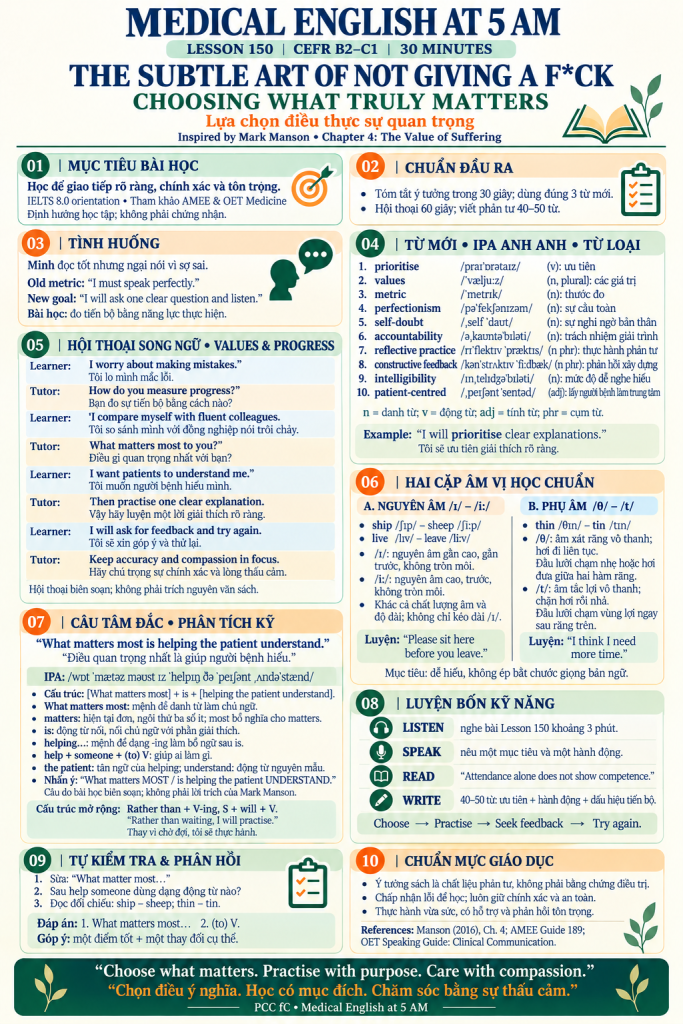
Lesson 150 – The Subtle Art of Not Giving a F*ck
- Vocabulary: Priority /praɪˈɒrəti/ (n.) – sự ưu tiên; Resilience /rɪˈzɪliəns/ (n.) – khả năng thích ứng, phục hồi sau khó khăn.
- Key sentence: “Focus your energy on what truly matters.”
- Take-home message: Choose your priorities wisely. – Lựa chọn ưu tiên một cách khôn ngoan.
PART 2. PRONUNCIATION & GRAMMAR
A. Pronunciation – Phát âm trọng tâm
- /ə/ – Schwa: âm nhẹ, thường xuất hiện trong âm tiết không mang trọng âm. Ví dụ: support, consistency.
- /θ/ – Phụ âm xát răng vô thanh. Ví dụ: therapy, thoughtful.
Pronunciation challenge:
“Thoughtful therapy requires thorough assessment.”
Điều trị thận trọng đòi hỏi đánh giá đầy đủ.
B. Three useful grammar structures
1. Although + clause, main clause
“Although the patient’s condition improved, the diagnosis remained uncertain.”
Mặc dù tình trạng người bệnh cải thiện, chẩn đoán vẫn chưa chắc chắn.
2. Rather than + V-ing
“Rather than memorising everything, focus on understanding key concepts.”
Thay vì ghi nhớ tất cả, hãy tập trung hiểu những khái niệm quan trọng.
3. What matters most is + clause
“What matters most is how we apply knowledge to patient care.”
Điều quan trọng nhất là cách chúng ta vận dụng kiến thức vào chăm sóc người bệnh.
PART 3. SHORT MEDICAL DIALOGUE
Consultant: What have you learned this week?
Tuần này em đã học được những gì?
Resident: I have learned to approach clinical problems more systematically.
Em đã học cách tiếp cận các vấn đề lâm sàng có hệ thống hơn.
Consultant: What is particularly important in septic shock?
Điều gì đặc biệt quan trọng trong sốc nhiễm khuẩn?
Resident: Timely treatment, source control and continuous reassessment of tissue perfusion.
Điều trị kịp thời, kiểm soát ổ nhiễm và đánh giá liên tục tưới máu mô.
Consultant: And how will you improve your medical English?
Vậy em sẽ cải thiện tiếng Anh y khoa như thế nào?
Resident: By practising a little every day and learning from feedback.
Bằng cách luyện tập một chút mỗi ngày và học hỏi từ những phản hồi.
PART 4. READING PRACTICE – ONE SHORT PARAGRAPH
Small Habits, Better Clinical Decisions
“Good medical practice requires knowledge, critical thinking and effective communication. Doctors must recognise emergencies, evaluate uncertain findings and reassess patients regularly. Similarly, learning medical English requires consistent practice. Reviewing a few words, speaking one meaningful sentence and reflecting on feedback every day can gradually improve professional communication. Small actions, repeated over time, can create meaningful progress.”
Dịch nghĩa:
Thực hành y khoa tốt đòi hỏi kiến thức, tư duy phản biện và giao tiếp hiệu quả. Bác sĩ cần nhận diện tình huống cấp cứu, đánh giá những dấu hiệu chưa rõ ràng và thường xuyên đánh giá lại người bệnh. Tương tự, học tiếng Anh y khoa đòi hỏi luyện tập đều đặn. Ôn vài từ, nói một câu có ý nghĩa và suy ngẫm về phản hồi mỗi ngày có thể từng bước cải thiện giao tiếp chuyên môn. Những hành động nhỏ, được lặp lại theo thời gian, có thể tạo nên sự tiến bộ có ý nghĩa.
Reading question: What three qualities are essential for good medical practice?
PART 5. QUICK REVIEW TEST – 10 QUESTIONS
Choose the best answer (A, B, C or D).
Question 1. Myoclonus refers to:
A. Persistent hypotension
B. Sudden, brief involuntary muscle jerks
C. Gastric bleeding
D. Slow heart rate
Question 2. Which statement reflects good clinical reasoning?
A. Make immediate conclusions without evidence.
B. Ignore alternative diagnoses.
C. Reassess evidence and consider differential diagnoses.
D. Avoid further investigations.
Question 3. Which factor commonly contributes to peptic ulcers?
A. Helicobacter pylori infection
B. Regular physical activity
C. Adequate sleep
D. Drinking water
Question 4. The gastric mucosal barrier mainly:
A. Controls heart rate
B. Prevents all infections
C. Protects the stomach lining
D. Regulates blood pressure
Question 5. The first-line vasopressor commonly recommended for septic shock is:
A. Dopamine
B. Norepinephrine
C. Omeprazole
D. Acyclovir
Question 6. Source control means:
A. Lowering body temperature only
B. Identifying and controlling the focus of infection
C. Increasing fluid intake without assessment
D. Monitoring blood pressure only
Question 7. Consistency means:
A. Practising regularly
B. Studying only before examinations
C. Avoiding difficult tasks
D. Never changing a routine
Question 8. Choose the grammatically correct sentence:
A. Rather than to wait, I practise.
B. Rather than waiting, I will practise.
C. Rather than waited, I practise.
D. Rather than waiting, I practising.
Question 9. Constructive feedback helps learners:
A. Avoid responsibility
B. Ignore their weaknesses
C. Identify opportunities for improvement
D. Stop asking questions
Question 10. What is the central message of this week’s lessons?
A. Memorisation is sufficient for professional competence.
B. Perfection is the only goal.
C. Critical thinking, communication and consistency support professional development.
D. Clinical experience makes continuous learning unnecessary.
ANSWER KEY & BRIEF EXPLANATIONS
| Question | Answer | Explanation |
|---|---|---|
| 1 | B | Myoclonus = giật cơ ngắn, đột ngột |
| 2 | C | Tư duy lâm sàng cần xem xét chẩn đoán phân biệt |
| 3 | A | H. pylori là nguyên nhân quan trọng của loét dạ dày–tá tràng |
| 4 | C | Hàng rào niêm mạc bảo vệ dạ dày |
| 5 | B | Norepinephrine là thuốc vận mạch đầu tay thường được khuyến cáo |
| 6 | B | Source control = kiểm soát ổ nhiễm |
| 7 | A | Consistency = luyện tập đều đặn |
| 8 | B | Rather than + V-ing |
| 9 | C | Phản hồi xây dựng giúp cải thiện |
| 10 | C | Tư duy, giao tiếp và sự đều đặn |
Self-assessment:
- 9–10/10: Excellent – Xuất sắc
- 7–8/10: Very good – Rất tốt
- 5–6/10: Keep improving – Tiếp tục cải thiện
- 0–4/10: Review and practise again – Ôn tập và luyện tập lại
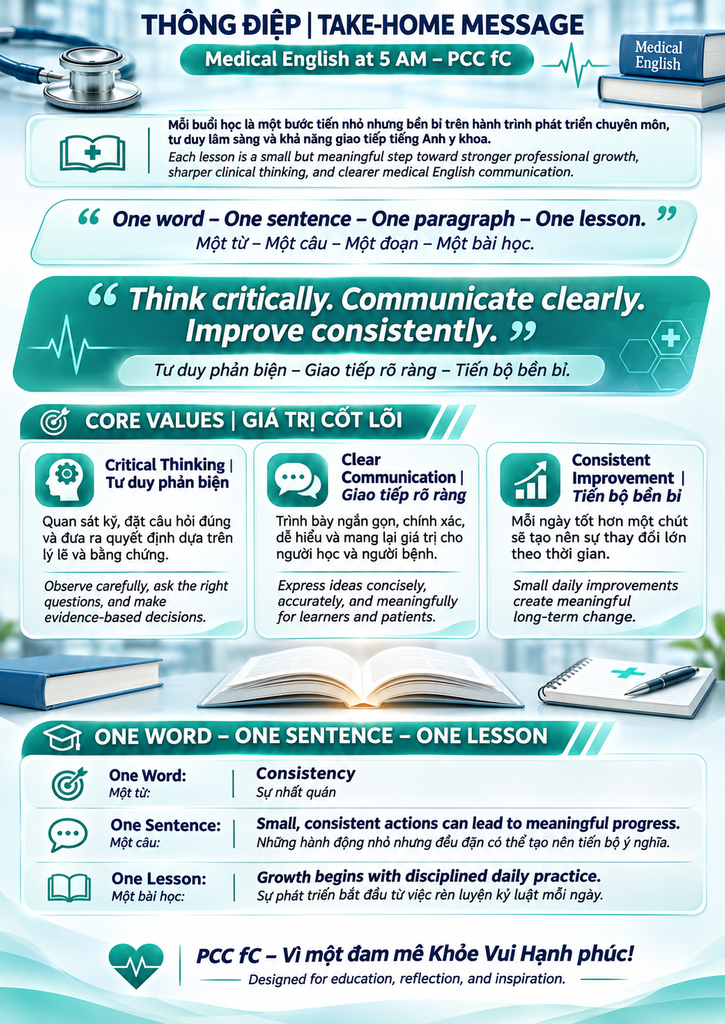
PART 6. ONE WORD – ONE SENTENCE – ONE PARAGRAPH – ONE LESSON
ONE WORD: Consistency /kənˈsɪstənsi/ (n.) – Sự đều đặn.
ONE SENTENCE:
“Small, consistent actions can lead to meaningful progress.”
Những hành động nhỏ, đều đặn có thể tạo nên sự tiến bộ có ý nghĩa.
ONE PARAGRAPH:
“Every morning, I practise medical English to become a better healthcare professional. I learn new vocabulary, improve my pronunciation and practise clinical communication. My goal is not perfection, but continuous improvement.”
Mỗi sáng, tôi luyện tập tiếng Anh y khoa để trở thành một nhân viên y tế tốt hơn. Tôi học từ vựng mới, cải thiện phát âm và thực hành giao tiếp lâm sàng. Mục tiêu của tôi không phải sự hoàn hảo, mà là tiến bộ không ngừng.
ONE LESSON:
“Think critically. Communicate clearly. Improve consistently.”
Tư duy phản biện – Giao tiếp rõ ràng – Tiến bộ bền bỉ.
FINAL MESSAGE – THÔNG ĐIỆP TUẦN 25
“You do not have to be perfect. You just have to keep improving.”
Bạn không cần hoàn hảo. Bạn chỉ cần không ngừng tiến bộ.
Mỗi ngày 5 giờ sáng là một cơ hội để học thêm một từ, hiểu sâu một vấn đề, nói tốt hơn một câu và tiến gần hơn tới mục tiêu trở thành người thầy thuốc có năng lực, nhân văn và hạnh phúc.
Medical English at 5 AM – PCC fC
Vì một đam mê Khỏe Vui Hạnh phúc!
Nguồn học tập: PCC fC – Medical English at 5 AM, Lessons 146–150, 26–31/10/2026.
Bài tổng ôn được biên soạn với sự hỗ trợ của trí tuệ nhân tạo (AI), nhằm giúp học viên hệ thống hóa kiến thức, luyện tập kỹ năng ngôn ngữ và phát triển tư duy lâm sàng. Nội dung cần được đối chiếu với tài liệu chuyên môn khi ứng dụng vào thực hành y khoa.