Bài 45 – Tiếng Anh Y Khoa: Mỏ neo sinh học của làn da * The dermis – The master anchor!
PCC fC Language – Thăng Long, Hà Nội, ngày 7/4/2026, Chào buổi sáng cả lớp. Hôm nay, chúng ta đến với Bài 45 của Lớp Tiếng Anh Y khoa do PCC fC tổ chức. Trong bài học này, chúng ta sẽ khám phá lớp bì — “mỏ neo sống” của làn da. Lớp bì không chỉ là một lớp nằm dưới biểu bì, mà là một hệ thống sống động gồm mô liên kết, mạch máu, thần kinh, tuyến và nang lông. Nó giúp da có sức bền, cảm giác, dinh dưỡng và khả năng bảo vệ. Khi “mỏ neo” này bị tổn thương do ma sát cấp tính, phỏng rộp có thể hình thành; khi ma sát kéo dài, da thích nghi bằng cách tạo vết chai. Qua chủ đề này, chúng ta không chỉ học giải phẫu – sinh lý, mà còn học cách mô tả cơ chế lâm sàng rõ ràng bằng tiếng Anh qua câu bị động và mệnh đề quan hệ. Làm chủ ngôn ngữ về lớp bì là thêm một bước làm chủ bản thiết kế của cơ thể con người.
BÀI 45 – LỚP TIẾNG ANH Y KHOA
THE DERMIS – THE MASTER ANCHOR
Lớp bì: “Mỏ neo sinh học” của làn da
Tổ chức: CLB Bóng đá PCC fC
Thời lượng: 05:00–05:25
Nguồn bài: The Dermis Blueprint
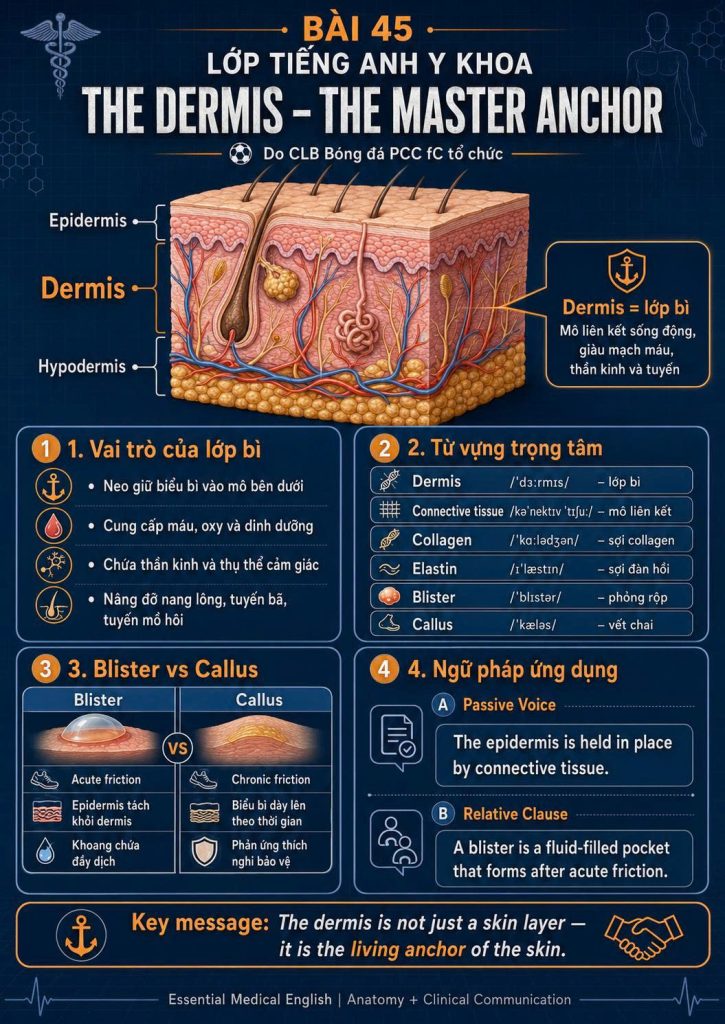
1. Mục tiêu bài học
Sau bài học, học viên có thể:
- Gọi tên được các cấu trúc chính của dermis: connective tissue, blood vessels, nerves, glands, follicles.
- Giải thích bằng tiếng Anh cơ chế hình thành blister và callus.
- Dùng được câu bị động để mô tả giải phẫu – sinh lý.
- Dùng được mệnh đề quan hệ that/which để định nghĩa thuật ngữ y khoa.
- Thực hành hội thoại lâm sàng ngắn giữa bác sĩ hướng dẫn và sinh viên y khoa.
2. Từ vựng trọng tâm
| Từ | Phiên âm | Nghĩa | Câu mẫu |
| Dermis | /ˈdɜːrmɪs/ | Lớp bì | The dermis lies beneath the epidermis. |
| Epidermis | /ˌepɪˈdɜːrmɪs/ | Lớp biểu bì | The epidermis is the outer layer of the skin. |
| Connective tissue | /kəˈnektɪv ˈtɪʃuː/ | Mô liên kết | Connective tissue anchors the skin. |
| Collagen | /ˈkɑːlədʒən/ | Collagen | Collagen provides strength and flexibility. |
| Elastin | /ɪˈlæstɪn/ | Sợi đàn hồi | Elastin allows the skin to stretch. |
| Vascularized | /ˈvæskjələraɪzd/ | Được mạch máu hóa | The dermis is highly vascularized. |
| Blister | /ˈblɪstər/ | Phỏng rộp | A blister is a fluid-filled pocket. |
| Callus | /ˈkæləs/ | Vết chai | Chronic friction may form a callus. |
| Sebum | /ˈsiːbəm/ | Bã nhờn | Sebum softens the skin. |
| Follicle | /ˈfɑːlɪkəl/ | Nang lông | Hair grows from follicles. |
| Mycosis | /maɪˈkoʊsɪs/ | Nhiễm nấm | Mycosis can be difficult to treat. |
3. Dẫn nhập bài học
Good morning, everyone. Today, we will explore the dermis — not just as a layer of skin, but as the biological anchor of the human body. The dermis holds the epidermis in place, supplies blood, senses pain and temperature, supports hair follicles, and protects the body through glands and connective tissue. When this anchor fails, we may see blisters; when friction becomes chronic, the skin adapts and forms calluses. So today, mastering the dermis means mastering both anatomy and clinical English.
4. Nội dung chính của bài
A. The Dermis – The Master Anchor
Key sentence:
The dermis is the connective tissue layer that lies beneath the epidermis.
Lớp bì là lớp mô liên kết nằm ngay dưới lớp biểu bì.
Vai trò chính:
- Anchoring: giữ biểu bì gắn với mô bên dưới.
- Supplying: chứa mạch máu để cung cấp oxy và dinh dưỡng.
- Sensing: chứa thần kinh và thụ thể cảm giác.
- Supporting: nâng đỡ tuyến mồ hôi, tuyến bã, nang lông.
- Protecting: giúp da chống tổn thương cơ học.
B. Blister vs Callus
| Tình huống | Cơ chế | Kết quả |
| Acute friction | Dermis separates from epidermis | Blister |
| Chronic friction | Epidermis thickens over time | Callus |
Clinical explanation:
A blister forms when acute friction separates the epidermis from the dermis, creating a fluid-filled space.
Một phỏng rộp hình thành khi ma sát cấp tính làm biểu bì tách khỏi lớp bì, tạo ra khoang chứa dịch.
A callus forms when chronic friction causes the epidermis to thicken.
Vết chai hình thành khi ma sát kéo dài làm lớp biểu bì dày lên.
C. The Dermis Ecosystem
1. Connective tissue
- Collagen fibers: strength and flexibility.
- Elastin fibers: stretchability.
- Reticular fibers: structural stability.
2. Glands
- Sebaceous glands produce sebum.
- Sweat glands excrete sweat and help thermoregulation.
3. Blood vessels
- Supply oxygen and nutrients.
- Remove waste.
- Help regulate temperature.
4. Nerves and sensory receptors
- Detect heat, pain, pressure.
- Send electrical signals to the brain.
5. Hair follicles
- Hair grows from follicles in the dermis.
- Follicles may contain sensory receptors.
5. Hội thoại thực hành
Clinical Dialogue: Severe Friction Blister
Senior Attending:
Let’s look at this severe friction blister. What is the structural mechanism here?
Medical Student:
The damage occurred in the dermis. The friction caused the epidermis to separate from the dermis, and the space filled with fluid.
Senior Attending:
Excellent. What would happen if the friction was chronic rather than acute?
Medical Student:
The epidermis would thicken over time, forming a callus.
Senior Attending:
Good. Why is the dermis important in this case?
Medical Student:
Because the dermis acts as an anchor. It contains connective tissue, blood vessels, nerves, and glands.
Senior Attending:
Very good. Now summarize the case in one clinical sentence.
Medical Student:
The patient has a friction blister caused by acute mechanical separation between the epidermis and dermis.
6. Ngữ pháp ứng dụng
A. Passive Voice in Anatomy
Cấu trúc:
[Anatomical structure] + is/are + V3/ed + by + agent/location
Ví dụ:
- The epidermis is held in place by connective tissue.
Lớp biểu bì được giữ đúng vị trí bởi mô liên kết. - Waste molecules are excreted by sweat glands.
Các phân tử chất thải được bài tiết bởi tuyến mồ hôi. - Electrical signals are sent to the brain by sensory receptors.
Tín hiệu điện được gửi tới não bởi các thụ thể cảm giác.
B. Relative Clauses: that / which
Cấu trúc:
[Medical term] + is/are + [category] + that/which + [function]
Ví dụ:
- Sebum is an oily substance which softens the skin and kills bacteria.
Bã nhờn là chất dầu giúp làm mềm da và diệt khuẩn. - Follicles are little pockets in the dermis that hair grows out of.
Nang lông là các túi nhỏ trong lớp bì nơi tóc mọc ra. - A blister is a fluid-filled pocket that forms after acute friction.
Phỏng rộp là túi chứa dịch hình thành sau ma sát cấp tính.
7. Bài tập nhanh trên lớp
Exercise 1: Fill in the blanks
- The patient presented with a severe fluid-filled ______ on the heel.
- Unlike the epidermis, the dermis has high ______, containing blood vessels.
- Due to chronic rubbing, the epidermis thickened, resulting in multiple ______.
- Acne involves inflammation of sebaceous glands located near hair ______.
Đáp án:
- blister
- vascularity
- calluses
- follicles
Exercise 2: Match the terms
| Term | Function |
| 1. Sebum | A. Detects heat, pain, pressure |
| 2. Sweat glands | B. Oily secretion protecting the skin |
| 3. Sensory receptors | C. Thermoregulation and waste excretion |
| 4. Reticular fibers | D. Structural stability |
Đáp án:
1-B, 2-C, 3-A, 4-D
8. Mini speaking task
Mỗi học viên chọn 1 cấu trúc và nói 1 câu:
Mẫu 1 – Passive voice:
The dermis is supplied by blood vessels.
Mẫu 2 – Relative clause:
Collagen is a protein fiber that provides strength and flexibility.
Mẫu 3 – Clinical sentence:
A callus forms when chronic friction causes the epidermis to thicken.
9. Tổng kết bài học
Key message:
The dermis is not just a skin layer. It is a living, vascularized, sensory, protective, and connective system.
Thông điệp tiếng Việt:
Lớp bì không chỉ là một “lớp da”, mà là hệ thống sống giúp da được nuôi dưỡng, cảm nhận, bảo vệ và gắn kết với cơ thể.
Câu truyền cảm hứng:
Mastering the language of anatomy is mastering the blueprint of the human body.
Làm chủ ngôn ngữ giải phẫu là làm chủ bản thiết kế của cơ thể con người.
PCC fC