Bài 55 – Tiếng Anh Y Khoa: Chấn thương khớp vai cấp * Acute shouder injury
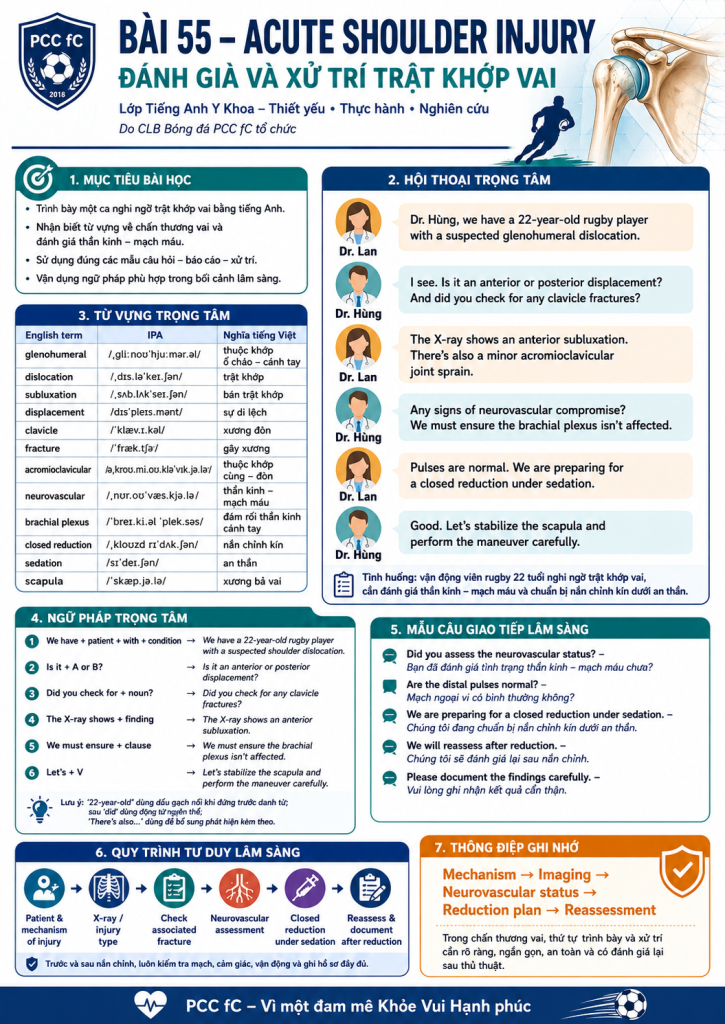
BÀI 55 – ACUTE SHOULDER INJURY
ĐÁNH GIÁ VÀ XỬ TRÍ TRẬT KHỚP VAI
Lớp Tiếng Anh Y Khoa – Thiết yếu • Thực hành • Nghiên cứu
Do CLB Bóng đá PCC fC tổ chức
Chủ đề: Assessment of a Suspected Glenohumeral Dislocation
I. Mục tiêu bài học
Sau bài học, học viên có thể:
- Trình bày ngắn gọn một trường hợp nghi ngờ trật khớp vai.
- Phân biệt các thuật ngữ: dislocation, subluxation, displacement, sprain, fracture.
- Hỏi và báo cáo về:
- Hướng di lệch của khớp;
- Kết quả X-quang;
- Tình trạng mạch máu – thần kinh;
- Kế hoạch nắn chỉnh khớp.
- Sử dụng đúng các cấu trúc:
- Is it…?
- Did you check for…?
- The X-ray shows…
- There is/There are…
- We must ensure…
- We are preparing for…
- Let’s + động từ nguyên thể.
- Thực hành hội thoại bàn giao và phối hợp xử trí chấn thương vai.
II. Clinical scenario – Tình huống lâm sàng
Một vận động viên bóng bầu dục 22 tuổi bị chấn thương vai trong khi thi đấu. Người bệnh được nghi ngờ trật khớp ổ chảo – cánh tay. Hai bác sĩ trao đổi về hình ảnh X-quang, tổn thương phối hợp, tình trạng thần kinh – mạch máu và kế hoạch nắn chỉnh khớp.
III. Hội thoại trọng tâm
Dr. Lan
Dr. Hùng, we have a 22-year-old rugby player with a suspected glenohumeral dislocation.
Dịch:
Bác sĩ Hùng, chúng ta có một vận động viên bóng bầu dục 22 tuổi, nghi ngờ bị trật khớp ổ chảo – cánh tay.
Dr. Hùng
I see. Is it an anterior or posterior displacement? And did you check for any clavicle fractures?
Dịch:
Tôi hiểu. Đây là di lệch ra trước hay ra sau? Và bác sĩ đã kiểm tra xem có gãy xương đòn hay không chưa?
Dr. Lan
The X-ray shows an anterior subluxation. There’s also a minor acromioclavicular joint sprain.
Dịch:
X-quang cho thấy bán trật khớp ra trước. Ngoài ra còn có bong gân nhẹ khớp cùng – đòn.
Dr. Hùng
Any signs of neurovascular compromise? We must ensure the brachial plexus isn’t affected.
Dịch:
Có dấu hiệu tổn thương thần kinh – mạch máu nào không? Chúng ta phải bảo đảm rằng đám rối thần kinh cánh tay không bị ảnh hưởng.
Dr. Lan
Pulses are normal. We are preparing for a closed reduction under sedation.
Dịch:
Mạch ngoại vi bình thường. Chúng tôi đang chuẩn bị nắn chỉnh kín dưới an thần.
Dr. Hùng
Good. Let’s stabilize the scapula and perform the maneuver carefully.
Dịch:
Tốt. Chúng ta hãy cố định xương bả vai và thực hiện thủ thuật một cách cẩn thận.
IV. Từ vựng trọng tâm
Phiên âm dưới đây sử dụng cách phát âm Anh–Mỹ.
| Từ/Cụm từ | Phiên âm IPA | Nghĩa |
| rugby player | /ˈrʌɡ.bi ˌpleɪ.ɚ/ | vận động viên bóng bầu dục |
| suspected | /səˈspek.tɪd/ | được nghi ngờ |
| glenohumeral | /ˌɡliː.noʊˈhjuː.mɚ.əl/ | thuộc khớp ổ chảo – cánh tay |
| dislocation | /ˌdɪs.ləˈkeɪ.ʃən/ | trật khớp hoàn toàn |
| subluxation | /ˌsʌb.lʌkˈseɪ.ʃən/ | bán trật khớp |
| displacement | /dɪsˈpleɪs.mənt/ | sự di lệch |
| anterior | /ænˈtɪr.i.ɚ/ | phía trước, ra trước |
| posterior | /pɑːˈstɪr.i.ɚ/ | phía sau, ra sau |
| clavicle | /ˈklæv.ɪ.kəl/ | xương đòn |
| fracture | /ˈfræk.tʃɚ/ | gãy xương |
| X-ray | /ˈeks.reɪ/ | phim hoặc kỹ thuật X-quang |
| acromioclavicular | /əˌkroʊ.mi.oʊ.kləˈvɪk.jə.lɚ/ | thuộc khớp cùng – đòn |
| joint sprain | /dʒɔɪnt spreɪn/ | bong gân khớp |
| neurovascular | /ˌnʊr.oʊˈvæs.kjə.lɚ/ | thuộc thần kinh – mạch máu |
| compromise | /ˈkɑːm.prə.maɪz/ | suy giảm hoặc tổn thương chức năng |
| brachial plexus | /ˈbreɪ.ki.əl ˈplek.səs/ | đám rối thần kinh cánh tay |
| pulse | /pʌls/ | mạch |
| closed reduction | /ˌkloʊzd rɪˈdʌk.ʃən/ | nắn chỉnh kín |
| sedation | /sɪˈdeɪ.ʃən/ | an thần |
| stabilize | /ˈsteɪ.bə.laɪz/ | làm vững, cố định |
| scapula | /ˈskæp.jə.lə/ | xương bả vai |
| maneuver | /məˈnuː.vɚ/ | thao tác, thủ thuật |
| affected | /əˈfek.tɪd/ | bị ảnh hưởng |
V. Phân biệt các thuật ngữ dễ nhầm
1. Dislocation và subluxation
- Dislocation: Các mặt khớp mất tiếp xúc hoàn toàn.
- Subluxation: Các mặt khớp mất tiếp xúc một phần.
Ví dụ:
The patient has an anterior shoulder dislocation.
Người bệnh bị trật khớp vai ra trước.
The X-ray shows a mild anterior subluxation.
X-quang cho thấy bán trật khớp nhẹ ra trước.
2. Fracture và sprain
- Fracture: Gãy hoặc nứt xương.
- Sprain: Tổn thương hoặc giãn dây chằng quanh khớp.
There is no clavicle fracture.
Không có gãy xương đòn.
He has a minor acromioclavicular joint sprain.
Người bệnh bị bong gân nhẹ khớp cùng – đòn.
3. Reduction
Trong chấn thương chỉnh hình, reduction không mang nghĩa “giảm bớt” mà có nghĩa là đưa cấu trúc xương hoặc khớp trở lại vị trí giải phẫu.
- Closed reduction: Nắn chỉnh kín, không phẫu thuật mở.
- Open reduction: Nắn chỉnh bằng phẫu thuật mở.
Lưu ý phát âm:
closed reduction: /kloʊzd rɪˈdʌk.ʃən/
Từ closed được phát âm với âm cuối /d/.
VI. Collocations – Cụm từ chuyên ngành
| Cụm từ | Nghĩa |
| suspect a dislocation | nghi ngờ trật khớp |
| sustain a shoulder injury | bị chấn thương vai |
| check for fractures | kiểm tra tình trạng gãy xương |
| show an anterior displacement | cho thấy di lệch ra trước |
| assess neurovascular status | đánh giá tình trạng thần kinh – mạch máu |
| check distal pulses | kiểm tra mạch ngoại vi |
| assess sensation and motor function | đánh giá cảm giác và vận động |
| rule out a fracture | loại trừ gãy xương |
| perform a closed reduction | thực hiện nắn chỉnh kín |
| administer sedation | sử dụng thuốc an thần |
| stabilize the scapula | cố định xương bả vai |
| perform the maneuver carefully | thực hiện thủ thuật cẩn thận |
| reassess after reduction | đánh giá lại sau nắn chỉnh |
VII. Trọng tâm ngữ pháp
1. Cấu trúc trình bày ca bệnh
We have + người bệnh + with + tình trạng
We have a 22-year-old rugby player with a suspected glenohumeral dislocation.
Cấu trúc này thường được sử dụng khi:
- Báo cáo ca bệnh;
- Bàn giao người bệnh;
- Xin hội chẩn;
- Trình bày tình huống cấp cứu.
Quy tắc viết tuổi
Khi tuổi đứng trước danh từ, dùng dạng:
a 22-year-old rugby player
Không viết:
a 22-years-old rugby player
Khi đứng sau động từ to be:
The patient is 22 years old.
2. Câu hỏi với động từ “to be”
Is it + danh từ/tính từ A + or + danh từ/tính từ B?
Is it an anterior or posterior displacement?
Đây là câu hỏi lựa chọn giữa hai khả năng.
Ví dụ:
Is the dislocation anterior or posterior?
Is the injury acute or chronic?
Is the arm numb or painful?
3. Câu hỏi về hành động đã thực hiện
Did + chủ ngữ + động từ nguyên thể…?
Did you check for any clavicle fractures?
Công thức:
Did + subject + base verb + object?
Sau did, động từ trở về nguyên thể:
- Đúng: Did you check…?
- Sai: Did you checked…?
Ví dụ:
Did you assess the distal pulses?
Did you examine the axillary nerve?
Did you obtain an X-ray?
4. “Check” và “check for”
Check + bộ phận hoặc thông số
Check the patient’s pulses.
Kiểm tra mạch của người bệnh.
Check for + bệnh lý hoặc dấu hiệu bất thường
Check for clavicle fractures.
Kiểm tra xem có gãy xương đòn hay không.
Check for neurovascular compromise.
Kiểm tra dấu hiệu tổn thương thần kinh – mạch máu.
5. Thì hiện tại đơn để báo cáo kết quả
The X-ray shows…
The X-ray shows an anterior subluxation.
Hiện tại đơn được dùng để mô tả:
- Kết quả xét nghiệm;
- Kết quả hình ảnh;
- Dấu hiệu hiện tại;
- Thông tin khách quan.
Ví dụ:
The X-ray shows no fracture.
The examination reveals reduced sensation.
The patient has a normal radial pulse.
6. Cấu trúc “There is/There are”
There’s also a minor acromioclavicular joint sprain.
- There is/There’s + danh từ số ít
- There are + danh từ số nhiều
Ví dụ:
There is no obvious fracture.
There are no signs of vascular injury.
There is mild swelling around the shoulder.
7. Câu hỏi rút gọn trong giao tiếp lâm sàng
Any signs of neurovascular compromise?
Đây là dạng rút gọn của:
Are there any signs of neurovascular compromise?
Trong hội thoại giữa các nhân viên y tế, dạng rút gọn giúp trao đổi nhanh và tự nhiên. Trong văn bản trang trọng, nên sử dụng câu đầy đủ.
8. Động từ khuyết thiếu “must”
Must + động từ nguyên thể
We must ensure the brachial plexus isn’t affected.
Must diễn đạt:
- Yêu cầu bắt buộc;
- Ưu tiên an toàn;
- Nghĩa vụ chuyên môn;
- Hành động không được bỏ sót.
Ví dụ:
We must assess neurovascular status before reduction.
We must document the findings.
We must reassess the patient afterward.
Sau must, không dùng to:
- Đúng: must ensure
- Sai: must to ensure
9. “Ensure + mệnh đề”
We must ensure the brachial plexus isn’t affected.
Cấu trúc:
ensure + subject + verb
Ví dụ:
Ensure the patient is properly monitored.
Ensure the distal pulse remains palpable.
We need to ensure that consent has been obtained.
Từ that có thể được sử dụng hoặc lược bỏ trong hội thoại.
10. Thì hiện tại tiếp diễn
We are preparing for a closed reduction under sedation.
Công thức:
am/is/are + V-ing
Dùng để diễn tả hành động đang diễn ra hoặc đang được chuẩn bị tại thời điểm nói.
Ví dụ:
We are preparing the patient for sedation.
The nurse is monitoring the vital signs.
The orthopedic team is reviewing the X-ray.
11. “Prepare for” và “prepare someone for”
Prepare for + danh từ
We are preparing for a closed reduction.
Prepare + người bệnh + for + thủ thuật
We are preparing the patient for a closed reduction.
Prepare to + động từ
We are preparing to perform a closed reduction.
12. “Under + phương pháp vô cảm/an thần”
under sedation
dưới an thần
Một số cụm từ tương tự:
- under local anesthesia: dưới gây tê tại chỗ
- under regional anesthesia: dưới gây tê vùng
- under general anesthesia: dưới gây mê toàn thân
- under ultrasound guidance: dưới hướng dẫn siêu âm
13. Cấu trúc đề nghị phối hợp “Let’s”
Let’s + động từ nguyên thể
Let’s stabilize the scapula.
Let’s perform the maneuver carefully.
Cấu trúc này thể hiện đề nghị cùng phối hợp thực hiện một hành động.
- Đúng: Let’s stabilize…
- Sai: Let’s to stabilize…
- Sai: Let’s stabilizing…
Ví dụ:
Let’s reassess the distal pulse.
Let’s review the X-ray together.
Let’s proceed carefully.
VIII. Functional language – Ngôn ngữ giao tiếp lâm sàng
1. Báo cáo người bệnh
We have a 22-year-old patient with a suspected shoulder dislocation.
The patient injured his shoulder while playing rugby.
He is unable to move the affected arm.
2. Hỏi về loại tổn thương
Is the displacement anterior or posterior?
Is it a complete dislocation or a subluxation?
Are there any associated fractures?
3. Hỏi về thần kinh – mạch máu
Have you assessed the neurovascular status?
Are the distal pulses palpable?
Is there any numbness or weakness?
Is sensation over the lateral shoulder intact?
4. Báo cáo kết quả
The radial pulse is palpable.
Distal perfusion is normal.
Sensation and motor function are intact.
There are no signs of neurovascular compromise.
5. Thông báo kế hoạch
We are preparing the patient for a closed reduction.
The procedure will be performed under sedation.
We will reassess the neurovascular status after reduction.
IX. Clinical communication framework
Khi trình bày một ca nghi ngờ trật khớp vai, có thể sử dụng trình tự:
1. Patient – Người bệnh
We have a 22-year-old rugby player.
2. Mechanism – Cơ chế chấn thương
He fell onto his outstretched arm during a match.
3. Suspected injury – Tổn thương nghi ngờ
We suspect an anterior glenohumeral dislocation.
4. Imaging – Chẩn đoán hình ảnh
The X-ray shows an anterior displacement without an associated fracture.
5. Neurovascular assessment – Đánh giá thần kinh, mạch máu
Distal pulses are palpable, and sensation is intact.
6. Management plan – Kế hoạch xử trí
We are preparing for a closed reduction under appropriate monitoring and sedation.
7. Reassessment – Đánh giá lại
We will reassess and document the neurovascular status after the procedure.
X. Pronunciation focus – Luyện phát âm
1. Từ có trọng âm quan trọng
- disloCAtion
/ˌdɪs.ləˈkeɪ.ʃən/ - subluxAtion
/ˌsʌb.lʌkˈseɪ.ʃən/ - disPLACEment
/dɪsˈpleɪs.mənt/ - neuroVAScular
/ˌnʊr.oʊˈvæs.kjə.lɚ/ - seDAtion
/sɪˈdeɪ.ʃən/ - maNEUver
/məˈnuː.vɚ/
2. Luyện đọc theo cụm
Không nên đọc từng từ rời rạc. Hãy chia câu thành các nhóm ý:
We have a 22-year-old rugby player /
with a suspected glenohumeral dislocation.
Did you check /
for any clavicle fractures?
We must ensure /
the brachial plexus isn’t affected.
We are preparing /
for a closed reduction /
under sedation.
XI. Bài tập thực hành
Bài tập 1: Điền từ
Sử dụng các từ:
subluxation – fractures – compromise – sedation – scapula – displacement
- Is it an anterior or posterior __________?
- Did you check for any clavicle __________?
- The X-ray shows an anterior __________.
- Are there any signs of neurovascular __________?
- We are preparing for a closed reduction under __________.
- Let’s stabilize the __________.
Bài tập 2: Chọn đáp án đúng
- We have a 22-__________ rugby player.
a. years old
b. year-old
c. years-old - Did you __________ for any fractures?
a. checked
b. checking
c. check - The X-ray __________ an anterior subluxation.
a. show
b. shows
c. showing - We must __________ the neurovascular status.
a. assess
b. to assess
c. assessing - We are preparing __________ a closed reduction.
a. at
b. for
c. on - Let’s __________ the maneuver carefully.
a. perform
b. to perform
c. performing
Bài tập 3: Viết lại câu đầy đủ
- Any signs of neurovascular compromise?
- Any associated fractures?
- Pulses normal?
- Preparing for reduction?
Bài tập 4: Dịch sang tiếng Anh
- Chúng ta có một người bệnh 22 tuổi nghi ngờ trật khớp vai.
- Đây là di lệch ra trước hay ra sau?
- Bác sĩ đã kiểm tra xem có gãy xương đòn hay chưa?
- Không có dấu hiệu tổn thương thần kinh – mạch máu.
- Chúng tôi đang chuẩn bị nắn chỉnh kín dưới an thần.
- Hãy đánh giá lại mạch ngoại vi sau thủ thuật.
Bài tập 5: Role-play
Vai A – Bác sĩ cấp cứu
Báo cáo:
- Người bệnh nam, 22 tuổi;
- Chấn thương khi chơi thể thao;
- Nghi ngờ trật khớp vai ra trước;
- Đau và hạn chế vận động;
- Đã chụp X-quang;
- Mạch quay bắt rõ.
Vai B – Bác sĩ chấn thương chỉnh hình
Hỏi về:
- Cơ chế chấn thương;
- Hướng di lệch;
- Gãy xương phối hợp;
- Cảm giác và vận động;
- Mạch ngoại vi;
- Kế hoạch nắn chỉnh;
- Đánh giá lại sau thủ thuật.
XII. Đáp án
Bài tập 1
- displacement
- fractures
- subluxation
- compromise
- sedation
- scapula
Bài tập 2
- b
- c
- b
- a
- b
- a
Bài tập 3
- Are there any signs of neurovascular compromise?
- Are there any associated fractures?
- Are the pulses normal?
- Are you preparing for reduction?
Bài tập 4 – Đáp án tham khảo
- We have a 22-year-old patient with a suspected shoulder dislocation.
- Is it an anterior or posterior displacement?
- Did you check for any clavicle fractures?
- There are no signs of neurovascular compromise.
- We are preparing for a closed reduction under sedation.
- Let’s reassess the distal pulses after the procedure.
XIII. Hội thoại mở rộng
Emergency physician
Dr. Hùng, we have a 22-year-old rugby player who injured his right shoulder during a match. We suspect an anterior glenohumeral dislocation.
Orthopedic physician
How did the injury occur? Did he fall onto an outstretched arm?
Emergency physician
Yes. He has severe shoulder pain, visible deformity, and limited movement.
Orthopedic physician
What does the X-ray show? Are there any associated fractures?
Emergency physician
The X-ray shows an anterior displacement. There is no obvious clavicle or humeral fracture.
Orthopedic physician
Have you assessed his neurovascular status?
Emergency physician
Yes. The radial pulse is palpable, capillary refill is normal, and distal sensation is intact.
Orthopedic physician
Good. Let’s prepare for a closed reduction under sedation. We must reassess and document the neurovascular findings afterward.
XIV. Kế hoạch giảng dạy 20–25 phút
| Thời gian | Nội dung |
| 2 phút | Giới thiệu tình huống và mục tiêu bài học |
| 4 phút | Nghe hoặc đọc hội thoại mẫu |
| 5 phút | Từ vựng và phát âm trọng tâm |
| 5 phút | Ngữ pháp trong văn cảnh |
| 4 phút | Luyện hội thoại theo cặp |
| 3 phút | Bài tập nhanh |
| 2 phút | Tổng kết và thông điệp ghi nhớ |
XV. Take-home messages
Language
We have a patient with…
Did you check for…?
The X-ray shows…
We must ensure…
We are preparing for…
Let’s perform the maneuver carefully.
Clinical communication
Trong trao đổi về chấn thương vai, cần trình bày theo thứ tự:
Mechanism → Injury → Imaging → Neurovascular status → Reduction plan → Reassessment
Câu ghi nhớ của bài
Before and after reduction, always reassess and document the neurovascular status.
Trước và sau nắn chỉnh, luôn đánh giá lại và ghi nhận tình trạng thần kinh – mạch máu.
PCC fC – Lớp Tiếng Anh Y Khoa
Học từ tình huống thực tế – Nói đúng chuyên môn – Giao tiếp an toàn – Phối hợp hiệu quả.
PCC fC