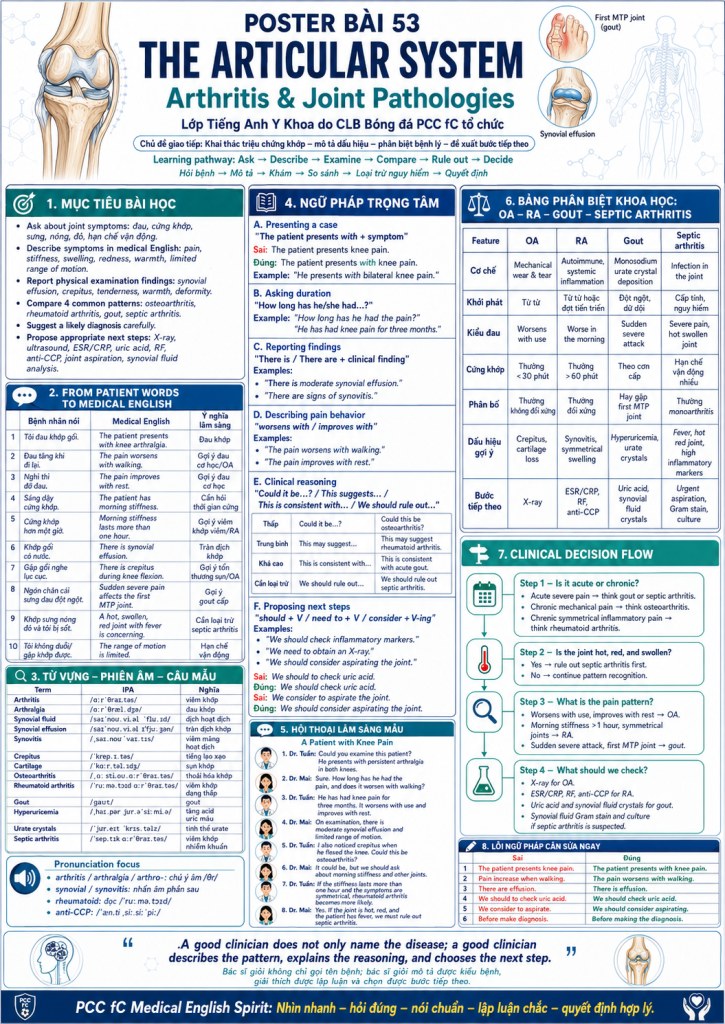
Bài 53 – Tiếng Anh Y Khoa: Viêm khớp & Bệnh học khớp * Arthritis & Joint Pathologies.
BÀI 53 – MEDICAL ENGLISH CLASS
THE ARTICULAR SYSTEM: ARTHRITIS & JOINT PATHOLOGIES
Lớp Tiếng Anh Y Khoa do CLB Bóng đá PCC fC tổ chức
Chủ đề giao tiếp: Khai thác – mô tả – lập luận chẩn đoán bệnh lý khớp
Trọng tâm ngữ pháp:
“Describe → Report → Compare → Suggest → Decide”
Mô tả triệu chứng → báo cáo dấu hiệu → so sánh bệnh cảnh → gợi ý chẩn đoán → quyết định bước tiếp theo.
1. Mục tiêu bài học
Sau bài này, học viên có thể nói được 5 nhiệm vụ lâm sàng bằng tiếng Anh:
- Describe symptoms – mô tả triệu chứng khớp.
- Report clinical findings – báo cáo dấu hiệu thăm khám.
- Compare diagnostic patterns – so sánh OA, RA và gout.
- Suggest a differential diagnosis – đưa ra chẩn đoán phân biệt.
- Propose the next step – đề xuất xét nghiệm, chọc dịch khớp, X-quang.
2. Tư duy bài học: từ lời bệnh nhân đến ngôn ngữ bác sĩ
Patient language → Medical English
| Bệnh nhân nói | Bác sĩ ghi nhận |
| “Tôi đau khớp gối.” | The patient has knee arthralgia. |
| “Khớp gối như có nước.” | There is synovial effusion. |
| “Đi lại nghe lục cục.” | There is crepitus during movement. |
| “Đau tăng khi đi lại.” | The pain worsens with use. |
| “Sáng ngủ dậy cứng khớp.” | The patient has morning stiffness. |
| “Ngón chân cái sưng đau đột ngột.” | This suggests acute gout. |
Thông điệp sư phạm:
Không học từ vựng đơn lẻ. Mỗi từ phải đi cùng một mẫu câu lâm sàng.
3. Từ vựng trọng tâm và phát âm chuẩn
Phiên âm dưới đây ưu tiên giọng Mỹ, phù hợp thực hành giao tiếp y khoa. Merriam-Webster định nghĩa arthralgia là đau ở một hoặc nhiều khớp, và arthritis là tình trạng viêm khớp do nhiều nguyên nhân như nhiễm trùng, chuyển hóa hoặc bệnh lý toàn thân. Cambridge mô tả rheumatoid arthritis là bệnh gây cứng, sưng và đau khớp.
| Thuật ngữ | Phiên âm thực hành | Nghĩa | Mẫu câu chuẩn |
| Arthritis | /ɑːrˈθraɪ.t̬əs/ | viêm khớp | Arthritis may cause pain, swelling, and stiffness. |
| Arthralgia | /ɑːrˈθræl.dʒə/ | đau khớp | He presents with bilateral knee arthralgia. |
| Synovial | /saɪˈnoʊ.vi.əl/ | thuộc hoạt dịch | Synovial fluid lubricates the joint. |
| Effusion | /ɪˈfjuː.ʒən/ | tràn dịch | There is significant joint effusion. |
| Synovial effusion | /saɪˈnoʊ.vi.əl ɪˈfjuː.ʒən/ | tràn dịch khớp | Ultrasound shows synovial effusion. |
| Crepitus | /ˈkrep.ɪ.təs/ | tiếng lạo xạo | Crepitus is felt during knee flexion. |
| Cartilage | /ˈkɑːr.t̬əl.ɪdʒ/ | sụn khớp | Cartilage loss suggests osteoarthritis. |
| Osteoarthritis | /ˌɑː.sti.oʊ.ɑːrˈθraɪ.t̬əs/ | thoái hóa khớp | OA pain often worsens with use. |
| Rheumatoid arthritis | /ˈruː.mə.tɔɪd ɑːrˈθraɪ.t̬əs/ | viêm khớp dạng thấp | RA often presents with morning stiffness. |
| Gout | /ɡaʊt/ | bệnh gout | Gout can cause sudden severe joint pain. |
| Hyperuricemia | /ˌhaɪ.pərˌjʊr.əˈsiː.mi.ə/ | tăng acid uric máu | Hyperuricemia supports the diagnosis of gout. |
4. Giải phẫu từ vựng – Word Anatomy
4.1. Arthr/o = joint – khớp
| Từ | Cấu tạo | Nghĩa |
| Arthritis | arthr/o + -itis | viêm khớp |
| Arthralgia | arthr/o + -algia | đau khớp |
| Polyarthritis | poly- + arthritis | viêm nhiều khớp |
| Polyarthralgia | poly- + arthralgia | đau nhiều khớp |
4.2. Chondr/o = cartilage – sụn
| Từ | Nghĩa |
| Cartilage | sụn |
| Chondrocyte | tế bào sụn |
| Chondropathy | bệnh lý sụn |
| Chondromalacia | mềm sụn |
4.3. Synov/o = synovium – màng hoạt dịch
| Từ | Nghĩa |
| Synovium | màng hoạt dịch |
| Synovial fluid | dịch hoạt dịch |
| Synovitis | viêm màng hoạt dịch |
| Synovial effusion | tràn dịch khớp |
5. Ngữ pháp trọng tâm theo dòng tư duy lâm sàng
Đây là phần quan trọng nhất của bài. Ngữ pháp không học rời rạc, mà đặt trong mối tương quan với hội thoại y khoa.
5.1. Khi giới thiệu ca bệnh
Pattern 1: The patient presents with + symptom
Dùng khi bác sĩ báo cáo bệnh cảnh lúc bệnh nhân đến khám.
Cấu trúc:
The patient presents with + noun phrase.
Ví dụ:
- The patient presents with bilateral knee pain.
- He presents with persistent arthralgia.
- She presents with morning stiffness and joint swelling.
Lỗi hay gặp:
Sai: The patient presents knee pain.
Đúng: The patient presents with knee pain.
5.2. Khi báo cáo dấu hiệu thăm khám
Pattern 2: There is / There are + clinical finding
Dùng để mô tả điều bác sĩ thấy, sờ thấy, nghe thấy, hoặc phát hiện qua siêu âm/X-quang.
Cấu trúc:
There is + singular/uncountable finding.
There are + plural findings.
Ví dụ:
- There is significant synovial effusion.
- There is crepitus during knee flexion.
- There are signs of synovitis.
- There are urate crystals in the synovial fluid.
Lỗi hay gặp:
Sai: The knee has effusion very much.
Đúng: There is significant knee effusion.
5.3. Khi mô tả triệu chứng thay đổi theo hoạt động
Pattern 3: Pain worsens with use / improves with rest
Dùng rất phù hợp khi phân biệt osteoarthritis.
Cấu trúc:
Pain worsens with + noun.
Pain improves with + noun.
Ví dụ:
- The pain worsens with walking.
- The pain worsens with use and improves with rest.
- This pattern is consistent with osteoarthritis.
Lỗi hay gặp:
Sai: Pain is increased when walk.
Đúng: The pain worsens when he walks.
Đúng hơn trong văn cảnh y khoa: The pain worsens with use.
5.4. Khi so sánh hai khả năng chẩn đoán
Pattern 4: whereas / while / but
Dùng để đối chiếu OA, RA và gout.
Ví dụ:
- OA is usually mechanical, whereas RA is autoimmune.
- OA pain worsens with use, whereas RA often causes morning stiffness.
- Gout is usually sudden and severe, while OA is more gradual.
Cách dùng trong hội thoại:
It could be OA, but the symmetrical involvement and morning stiffness suggest RA.
Câu này rất hay vì có đủ 3 tầng:
Possibility – could be OA
Contrast – but
Reasoning – suggest RA
5.5. Khi đưa ra chẩn đoán phân biệt
Pattern 5: Could it be…? / It could be… / It suggests…
Dùng để lập luận mềm, chuyên nghiệp, không khẳng định quá sớm.
| Mức độ chắc chắn | Cấu trúc | Ví dụ |
| Thấp | Could it be…? | Could it be osteoarthritis? |
| Trung bình | It may suggest… | This may suggest rheumatoid arthritis. |
| Khá cao | It is consistent with… | This pattern is consistent with gout. |
| Cao hơn | It is most likely… | It is most likely an acute gout attack. |
Lỗi hay gặp:
Sai: It is gout 100%.
Đúng hơn: This pattern is consistent with gout.
Chuẩn hơn nữa: We should confirm it with synovial fluid analysis.
5.6. Khi đề xuất bước tiếp theo
Pattern 6: should / need to / consider + V-ing
| Cấu trúc | Vai trò | Ví dụ |
| should + V | nên làm | We should check inflammatory markers. |
| need to + V | cần làm | We need to aspirate the joint. |
| consider + V-ing | cân nhắc làm | We should consider joint aspiration. |
| before + V-ing | trước khi làm | Before making the final diagnosis, we should review the imaging. |
Lỗi hay gặp:
Sai: We should to check uric acid.
Đúng: We should check uric acid.
Sai: We consider to aspirate the joint.
Đúng: We should consider aspirating the joint.
6. Hội thoại chuẩn – Clinical Dialogue 53
Title: A Patient with Bilateral Knee Pain
1. Dr. Tuấn
Dr. Mai, could you examine this patient? He presents with persistent arthralgia in both knees.
Bác sĩ Mai, chị khám giúp bệnh nhân này được không? Bệnh nhân có đau khớp dai dẳng ở cả hai gối.
Grammar focus:
Could you…? = lời mời/đề nghị lịch sự.
presents with = cấu trúc báo cáo ca bệnh.
2. Dr. Mai
Sure. How long has he had the pain, and does it worsen with walking?
Được. Bệnh nhân đau bao lâu rồi, và đau có tăng khi đi lại không?
Grammar focus:
How long has he had…? = Present Perfect, hỏi thời gian kéo dài đến hiện tại.
Does it worsen with…? = hỏi yếu tố làm nặng.
3. Dr. Tuấn
He has had knee pain for three months. It worsens with use and improves with rest.
Bệnh nhân đau gối 3 tháng nay. Đau tăng khi vận động và giảm khi nghỉ.
Grammar focus:
has had… for three months = triệu chứng kéo dài.
worsens with / improves with = mô tả kiểu đau cơ học.
4. Dr. Mai
On examination, there is moderate synovial effusion and limited range of motion.
Khi thăm khám, có tràn dịch khớp mức độ vừa và hạn chế tầm vận động.
Grammar focus:
On examination, there is… = báo cáo dấu hiệu khách quan.
5. Dr. Tuấn
I also noticed crepitus when he flexed the knee. Could this be osteoarthritis?
Tôi cũng nhận thấy tiếng lạo xạo khi bệnh nhân gấp gối. Liệu có phải thoái hóa khớp không?
Grammar focus:
noticed… when… = Past Simple để mô tả phát hiện lúc khám.
Could this be…? = đặt chẩn đoán phân biệt lịch sự.
6. Dr. Mai
It could be, because the pain worsens with use. However, we should ask about morning stiffness and other joints.
Có thể, vì đau tăng khi vận động. Tuy nhiên, chúng ta nên hỏi thêm về cứng khớp buổi sáng và các khớp khác.
Grammar focus:
It could be, because… = khả năng + lý do.
However = chuyển hướng lập luận, tránh kết luận vội.
7. Dr. Tuấn
If the stiffness lasts more than one hour and the symptoms are symmetrical, rheumatoid arthritis becomes more likely.
Nếu cứng khớp kéo dài hơn một giờ và triệu chứng đối xứng, viêm khớp dạng thấp sẽ có khả năng hơn.
Grammar focus:
If + Present Simple, S + becomes/is… = điều kiện lâm sàng.
becomes more likely = tăng khả năng chẩn đoán.
8. Dr. Mai
Exactly. But if the pain is sudden, severe, and affects the big toe, we should suspect gout.
Đúng vậy. Nhưng nếu đau đột ngột, dữ dội và ảnh hưởng ngón chân cái, chúng ta nên nghĩ đến gout.
Grammar focus:
if + symptoms, we should suspect… = triệu chứng định hướng chẩn đoán.
9. Dr. Tuấn
Should we check inflammatory markers, uric acid, and obtain an X-ray?
Chúng ta có nên kiểm tra marker viêm, acid uric và chụp X-quang không?
Grammar focus:
Should we + V…? = đề xuất kế hoạch.
10. Dr. Mai
Yes. If the effusion is significant, we should consider aspirating the joint to analyze the synovial fluid.
Có. Nếu tràn dịch nhiều, chúng ta nên cân nhắc chọc hút khớp để phân tích dịch khớp.
Grammar focus:
consider + V-ing = cân nhắc làm gì.
to analyze… = mục đích.
11. Dr. Tuấn
If we suspect gout, we need to look for urate crystals in the synovial fluid.
Nếu nghi gout, chúng ta cần tìm tinh thể urate trong dịch khớp.
Grammar focus:
need to + V = việc cần làm.
look for = tìm kiếm dấu hiệu/chất/chứng cứ.
12. Dr. Mai
Good. Let’s combine the history, physical examination, laboratory tests, and imaging before making the final diagnosis.
Tốt. Hãy kết hợp bệnh sử, thăm khám, xét nghiệm và hình ảnh học trước khi đưa ra chẩn đoán cuối cùng.
Grammar focus:
Let’s + V = đề xuất hành động nhóm.
before + V-ing = trước khi làm gì.
7. Bản đồ ngữ pháp trong hội thoại
| Giai đoạn lâm sàng | Câu mẫu | Ngữ pháp |
| Mở ca bệnh | He presents with… | Present Simple |
| Hỏi thời gian bệnh | How long has he had…? | Present Perfect |
| Mô tả kiểu đau | It worsens with use. | Verb pattern |
| Báo cáo khám | There is effusion. | There is / are |
| Gợi ý chẩn đoán | Could this be OA? | Modal verb |
| So sánh bệnh | OA…, whereas RA… | Contrast |
| Lập luận | This suggests RA. | suggest + noun |
| Đề xuất xử trí | We should check… | should + V |
| Cân nhắc thủ thuật | consider aspirating… | consider + V-ing |
| Kết luận an toàn | before making… | before + V-ing |
8. Bảng phân biệt OA – RA – Gout bằng tiếng Anh lâm sàng
| Feature | Osteoarthritis | Rheumatoid arthritis | Gout |
| Mechanism | Mechanical wear and tear | Autoimmune and systemic | Metabolic crystal disease |
| Pain pattern | Worsens with use | Worse in the morning | Sudden and severe |
| Distribution | Often asymmetrical | Often symmetrical | Often first MTP joint |
| Key phrase | “Pain worsens with walking.” | “Morning stiffness lasts more than one hour.” | “The big toe became swollen overnight.” |
| Clinical term | Cartilage loss | Synovitis | Urate crystals |
| Grammar pattern | worsens with… | lasts more than… | sudden, severe, affecting… |
9. Những lỗi ngữ pháp học viên Việt Nam dễ mắc
| Sai | Đúng | Giải thích |
| The patient presents knee pain. | The patient presents with knee pain. | “present with” là cụm cố định. |
| Pain increase when walking. | The pain worsens with walking. | Chủ ngữ số ít cần “worsens”. |
| There are effusion. | There is effusion. | Effusion thường dùng như danh từ không đếm được trong ngữ cảnh này. |
| We should to check uric acid. | We should check uric acid. | Sau should dùng động từ nguyên thể không “to”. |
| We consider to aspirate. | We consider aspirating. | Sau consider dùng V-ing. |
| The pain is in two knees. | The pain is in both knees. | “both knees” tự nhiên hơn. |
| Check crystal in fluid. | Look for urate crystals in the synovial fluid. | Cần danh từ số nhiều và cụm danh từ y khoa đầy đủ. |
| It is gout surely. | This pattern is consistent with gout. | Văn phong y khoa tránh khẳng định tuyệt đối khi chưa đủ bằng chứng. |
10. Phần luyện nói 5 phút
Drill 1 – Describe symptoms
Học viên thay từ vào chỗ trống:
- The patient presents with ________.
- The pain has lasted for ________.
- The pain worsens with ________.
- The pain improves with ________.
- The stiffness lasts for ________.
Ví dụ hoàn chỉnh:
The patient presents with bilateral knee pain. The pain has lasted for three months. It worsens with walking and improves with rest.
Drill 2 – Report findings
- On examination, there is ________.
- I noticed ________ during knee flexion.
- The range of motion is ________.
- There are signs of ________.
- The X-ray may show ________.
Ví dụ hoàn chỉnh:
On examination, there is moderate synovial effusion. I noticed crepitus during knee flexion. The range of motion is limited.
Drill 3 – Suggest diagnosis
- This pattern suggests ________.
- This is consistent with ________.
- We should rule out ________.
- It could be ________, but ________.
- If ________, we should suspect ________.
Ví dụ hoàn chỉnh:
It could be osteoarthritis, but if the symptoms are symmetrical and morning stiffness lasts more than one hour, we should suspect rheumatoid arthritis.
11. Mini-case chuẩn hóa hội thoại
Case 1 – Osteoarthritis pattern
Vietnamese prompt:
Bệnh nhân nam 68 tuổi, đau gối phải 6 tháng, đau tăng khi đi bộ, giảm khi nghỉ, có tiếng lạo xạo khi gấp gối.
English answer:
The patient presents with chronic right knee pain. The pain worsens with walking and improves with rest. On examination, there is crepitus during knee flexion. This pattern is consistent with osteoarthritis.
Case 2 – Rheumatoid arthritis pattern
Vietnamese prompt:
Bệnh nhân nữ 45 tuổi, đau hai bàn tay đối xứng, cứng khớp buổi sáng kéo dài hơn một giờ.
English answer:
The patient presents with symmetrical pain in both hands. The morning stiffness lasts more than one hour. This pattern suggests rheumatoid arthritis. We should check inflammatory markers and rheumatoid factor.
Case 3 – Gout pattern
Vietnamese prompt:
Bệnh nhân nam 55 tuổi, đau dữ dội ngón chân cái, sưng nóng đỏ, khởi phát đột ngột trong đêm.
English answer:
The patient presents with sudden severe pain, redness, and swelling in the big toe. This pattern is consistent with acute gout. We should check uric acid and consider synovial fluid analysis for urate crystals.
12. Kịch bản giảng 20–25 phút
| Thời gian | Hoạt động | Mục tiêu |
| 0–3 phút | Khởi động: “water on the knee” nghĩa là gì? | Kích hoạt từ vựng |
| 3–7 phút | Học từ: arthralgia, effusion, crepitus, cartilage | Chuẩn hóa phát âm |
| 7–12 phút | Grammar map: presents with → there is → suggests → should | Nắm cấu trúc |
| 12–17 phút | Hội thoại 12 câu | Ngữ pháp trong văn cảnh |
| 17–21 phút | Mini-cases OA, RA, gout | Lập luận chẩn đoán |
| 21–25 phút | Speaking drill + sửa lỗi | Nói chuẩn, dùng được ngay |
13. Câu chốt bài
A good clinician does not only name the disease;
a good clinician describes the pattern, explains the reasoning, and chooses the next step.
Dịch:
Một bác sĩ giỏi không chỉ gọi tên bệnh; bác sĩ giỏi mô tả được kiểu bệnh, giải thích được lập luận và chọn được bước tiếp theo.
Tinh thần PCC fC:
Học tiếng Anh y khoa như đá bóng:
nhìn nhanh – chuyền đúng – nói chuẩn – quyết định hợp lý.
CLB Bóng đá PCC fC