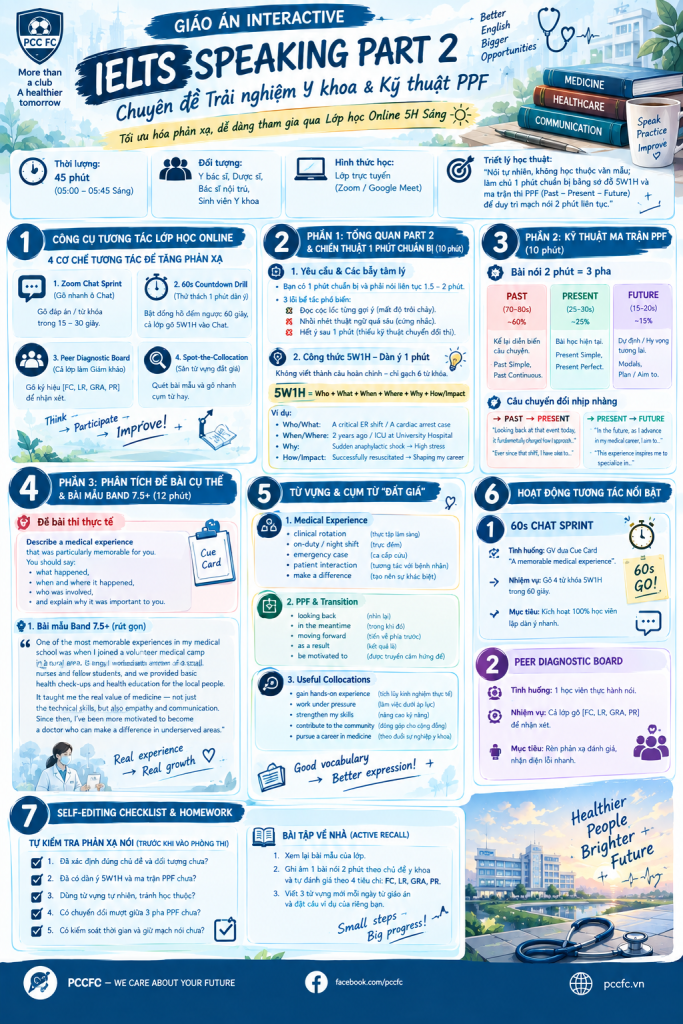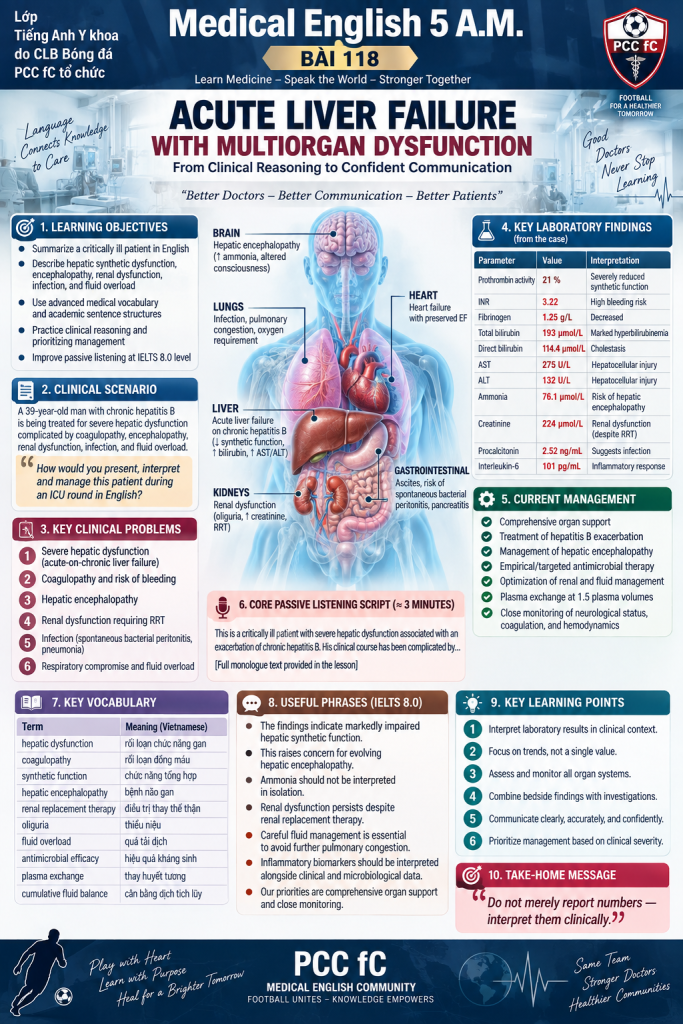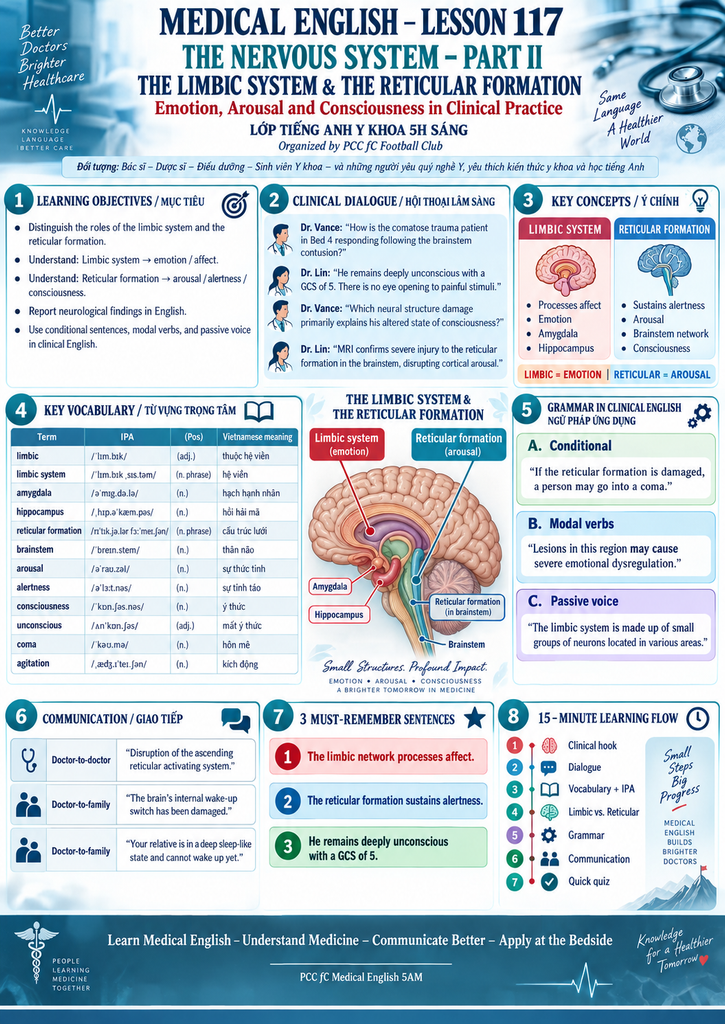
Bài 64 – Tiếng Anh Y Khoa: Liệu pháp insulin trong viêm tuỵ cấp do tăng triglyceride * Insulin therapy in hypertriglyceridemia-induced acute pancreatitis
PCC Language – Thăng Long, Hà Nội, ngày 23/7/2026, Viêm tụy cấp do tăng triglyceride máu là một tình trạng có thể diễn biến nhanh và gây suy đa cơ quan nếu không được nhận diện, theo dõi và xử trí kịp thời. Trong thực hành hồi sức, insulin truyền tĩnh mạch có thể được sử dụng nhằm thúc đẩy quá trình thanh thải triglyceride, đặc biệt ở những bệnh nhân có tăng đường huyết hoặc đái tháo đường đi kèm. Tuy nhiên, hiệu quả điều trị luôn phải song hành với an toàn: đường máu, kali, magnesi và phosphat cần được theo dõi chặt chẽ trong suốt quá trình truyền insulin.
Trong PCC fC Medical English – Lesson 64, chúng ta sẽ học cách trao đổi ngắn gọn, chính xác và có hệ thống về chỉ định truyền insulin, liều khởi đầu, thời điểm bổ sung glucose, mục tiêu đường máu, theo dõi điện giải, vai trò của thay huyết tương và tiêu chuẩn dừng điều trị. Qua tám câu hội thoại lâm sàng, người học không chỉ củng cố kiến thức chuyên môn mà còn rèn luyện cách đọc liều, trình bày quyết định điều trị và giải thích lý do chuyên môn bằng tiếng Anh.
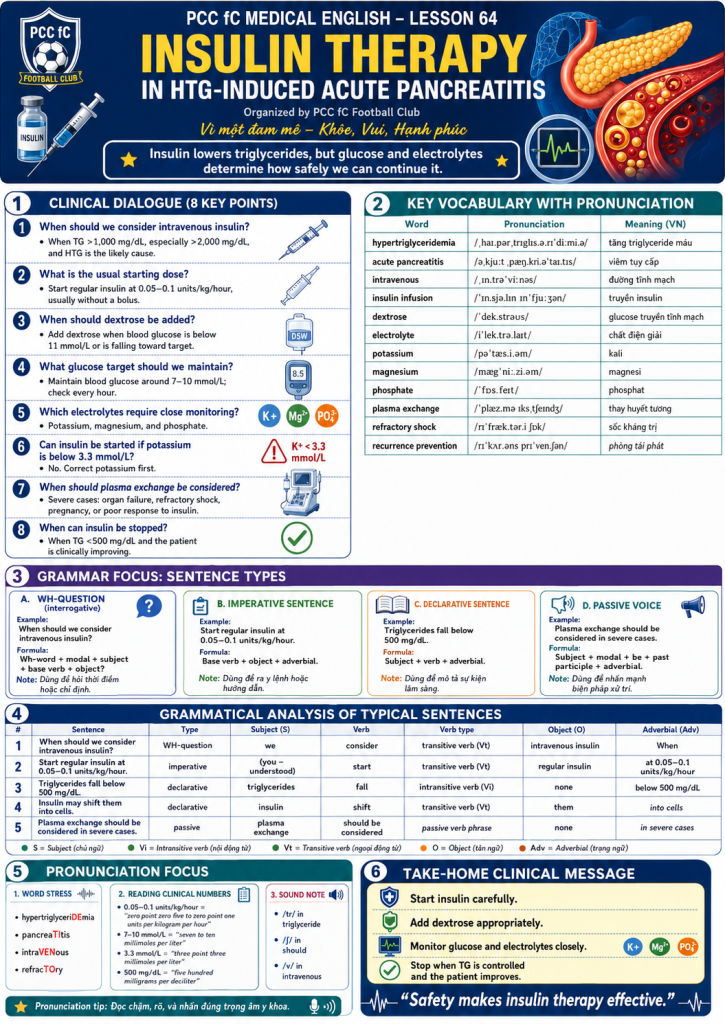
Thông điệp xuyên suốt của bài học: Insulin giúp hạ triglyceride, nhưng đường máu, điện giải và tình trạng lâm sàng của người bệnh mới quyết định chúng ta có thể tiếp tục điều trị an toàn đến đâu.
PCC fC MEDICAL ENGLISH – LESSON 64
INSULIN THERAPY IN HYPERTRIGLYCERIDEMIA-INDUCED ACUTE PANCREATITIS
Liệu pháp insulin trong viêm tụy cấp do tăng triglyceride
Organized by PCC fC Football Club
Vì một đam mê – Khỏe, Vui, Hạnh phúc
I. LEARNING OBJECTIVES
After this lesson, learners will be able to:
- Discuss the indications for intravenous insulin in HTG-induced acute pancreatitis.
- State the usual starting dose of an insulin infusion.
- Describe glucose and electrolyte monitoring.
- Explain when dextrose should be administered.
- Discuss the selective role of plasma exchange.
- Read common doses and laboratory values accurately in English.
II. WARM-UP QUESTION
A patient presents with acute pancreatitis and a triglyceride level of 2,500 mg/dL.
What are the three most important parameters to monitor during an insulin infusion?
Suggested answer:
Blood glucose, serum potassium, and triglyceride levels.
III. CLINICAL DIALOGUE
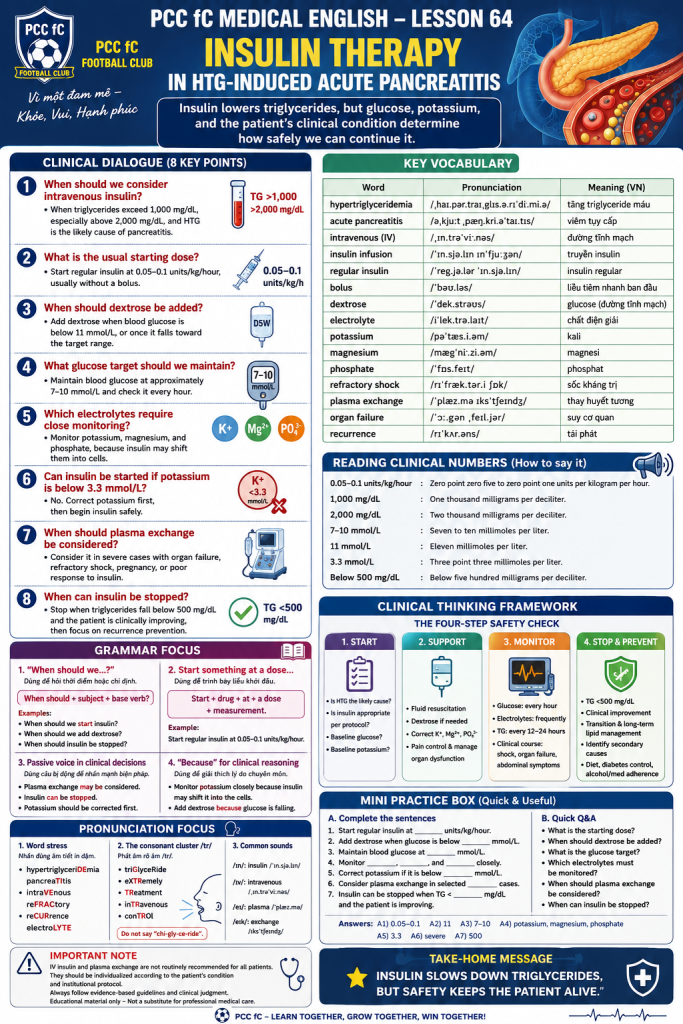
1. Indication for intravenous insulin
Attending Physician
When should we consider intravenous insulin?
Resident
We may consider intravenous insulin when triglycerides exceed 1,000 mg/dL and hypertriglyceridemia is considered the likely cause of pancreatitis, particularly in patients with uncontrolled diabetes or according to the institutional treatment protocol.
Ý chính: Cân nhắc insulin truyền tĩnh mạch khi triglyceride tăng rất cao và được xác định là nguyên nhân có khả năng gây viêm tụy.
2. Starting dose
Attending Physician
What is the usual starting dose?
Resident
Start regular insulin at 0.05 to 0.1 units per kilogram per hour, usually without an initial bolus.
Ý chính: Insulin regular thường được bắt đầu với liều 0,05–0,1 đơn vị/kg/giờ và thường không cần tiêm bolus.
3. Dextrose administration
Attending Physician
When should dextrose be added?
Resident
Start or titrate dextrose when blood glucose is below 11 mmol/L or when it is falling toward the target range. In a normoglycemic patient, dextrose may need to be started early to allow insulin therapy to continue safely.
Ý chính: Truyền hoặc điều chỉnh glucose nhằm phòng hạ đường huyết nhưng vẫn duy trì được tác dụng hạ triglyceride của insulin.
4. Glucose target
Attending Physician
What glucose target should we maintain?
Resident
Maintain blood glucose at approximately 7 to 10 mmol/L and check it every hour during the initial phase of treatment.
Ý chính: Theo dõi đường máu sát, đặc biệt trong giai đoạn đầu và khi thay đổi tốc độ insulin hoặc glucose.
5. Electrolyte monitoring
Attending Physician
Which electrolytes require close monitoring?
Resident
Monitor potassium, magnesium, and phosphate closely because insulin can shift these electrolytes into the cells.
Ý chính: Insulin có thể làm giảm nồng độ kali, magnesi và phosphat trong máu do dịch chuyển các chất điện giải vào nội bào.
6. Hypokalemia
Attending Physician
Can insulin be started if potassium is below 3.3 mmol/L?
Resident
No. Correct the potassium deficit first and begin insulin only after the potassium level has reached a safe range.
Ý chính: Không nên bắt đầu insulin khi hạ kali máu nặng; cần bù kali và theo dõi điện tim, điện giải.
7. Plasma exchange
Attending Physician
When should plasma exchange be considered?
Resident
Plasma exchange should not be used routinely as first-line therapy. It may be considered on an individualized basis in selected severe cases, such as persistent organ failure, refractory shock, pregnancy with extremely high triglycerides, or an inadequate response to conventional treatment.
Ý chính: Thay huyết tương là phương pháp lựa chọn cho từng trường hợp, không phải điều trị thường quy cho mọi bệnh nhân.
8. Stopping insulin
Attending Physician
When can insulin be stopped?
Resident
Insulin can usually be stopped or transitioned when triglycerides fall below 500 mg/dL, the patient is clinically improving, and oral or subcutaneous long-term therapy can be initiated safely.
Ý chính: Không chỉ dựa vào triglyceride; cần đánh giá đồng thời diễn biến lâm sàng, khả năng ăn uống và kế hoạch phòng tái phát.
IV. MEMORABLE CLINICAL MESSAGE
Insulin lowers triglycerides, but glucose, potassium, and the patient’s clinical condition determine how safely we can continue it.
Thông điệp ghi nhớ
Insulin giúp hạ triglyceride, nhưng đường máu, kali máu và tình trạng lâm sàng quyết định mức độ an toàn của quá trình điều trị.
V. KEY VOCABULARY
| Term | Pronunciation | Meaning |
| hypertriglyceridemia | /ˌhaɪ.pər.traɪˌɡlɪs.ə.rɪˈdiː.mi.ə/ | tăng triglyceride máu |
| acute pancreatitis | /əˌkjuːt ˌpæŋ.kri.əˈtaɪ.tɪs/ | viêm tụy cấp |
| intravenous | /ˌɪn.trəˈviː.nəs/ | đường tĩnh mạch |
| insulin infusion | /ˈɪn.sjə.lɪn ɪnˌfjuː.ʒən/ | truyền insulin |
| regular insulin | /ˈreɡ.jə.lər ˈɪn.sjə.lɪn/ | insulin regular |
| bolus | /ˈbəʊ.ləs/ | liều tiêm nhanh ban đầu |
| dextrose | /ˈdek.strəʊs/ | glucose dùng đường tĩnh mạch |
| electrolyte | /iˈlek.trə.laɪt/ | chất điện giải |
| potassium | /pəˈtæs.i.əm/ | kali |
| phosphate | /ˈfɒs.feɪt/ | phosphat |
| refractory shock | /rɪˈfræk.tər.i ʃɒk/ | sốc kháng trị |
| plasma exchange | /ˈplæz.mə ɪksˌtʃeɪndʒ/ | thay huyết tương |
| organ failure | /ˈɔː.ɡən ˌfeɪl.jər/ | suy cơ quan |
| recurrence | /rɪˈkʌr.əns/ | tái phát |
VI. PRONUNCIATION FOCUS
1. Word stress
Nhấn đúng âm tiết được viết hoa:
- hypertriglyceriDEmia
- pancreaTItis
- intraVEnous
- reFRACtory
- reCURrence
- electroLYTE
2. The consonant cluster /tr/
Luyện phát âm rõ âm /tr/ trong:
- triglyceride
- extremely
- treatment
- intravenous
- control
Không đọc triglyceride thành “chi-gly-ce-ride”.
3. Reading clinical numbers
0.05–0.1 units/kg/hour
Zero point zero five to zero point one units per kilogram per hour.
1,000 mg/dL
One thousand milligrams per deciliter.
2,000 mg/dL
Two thousand milligrams per deciliter.
7–10 mmol/L
Seven to ten millimoles per liter.
3.3 mmol/L
Three point three millimoles per liter.
Below 500 mg/dL
Below five hundred milligrams per deciliter.
VII. GRAMMAR FOCUS
1. “When should we…?”
Dùng để hỏi thời điểm hoặc chỉ định thực hiện một biện pháp.
Structure
When should + subject + base verb?
Examples:
- When should we start insulin?
- When should we add dextrose?
- When should plasma exchange be considered?
- When should insulin be stopped?
2. “Start something at a dose…”
Dùng để trình bày liều khởi đầu.
Start regular insulin at 0.05 units/kg/hour.
Các cách diễn đạt tương tự:
- Begin the infusion at…
- Initiate insulin at…
- Titrate the infusion according to…
- Reduce the rate if…
3. Passive voice in clinical decisions
Plasma exchange may be considered.
Insulin can be stopped.
Potassium should be corrected first.
Câu bị động giúp nhấn mạnh quyết định hoặc biện pháp điều trị thay vì người thực hiện.
4. “Because” for clinical reasoning
Monitor potassium closely because insulin may shift it into the cells.
Add dextrose because the glucose level is falling.
Cấu trúc này giúp người học không chỉ nêu y lệnh mà còn giải thích được lý do chuyên môn.
VIII. CLINICAL THINKING FRAMEWORK
The Four-Step Safety Check
1. START
- Is hypertriglyceridemia the likely cause?
- Is insulin appropriate according to the local protocol?
- What is the baseline glucose?
- What is the baseline potassium?
2. SUPPORT
- Provide appropriate fluid resuscitation.
- Administer dextrose when necessary.
- Correct potassium, magnesium, and phosphate.
- Treat pain and organ dysfunction.
3. MONITOR
- Blood glucose: initially every hour.
- Electrolytes: frequently according to severity.
- Triglycerides: usually every 12–24 hours.
- Clinical course: shock, respiratory failure, renal failure and abdominal symptoms.
4. STOP AND PREVENT
- Assess the triglyceride response.
- Confirm clinical improvement.
- Transition to long-term lipid-lowering treatment.
- Identify secondary causes.
- Counsel regarding diet, diabetes control, alcohol and medication adherence.
IX. SPEAKING PRACTICE
Activity 1 – Rapid questions
The instructor asks; learners answer in one sentence.
- What is the starting insulin dose?
- When should dextrose be added?
- What is the glucose target?
- Which electrolytes should be monitored?
- What should be done if potassium is below 3.3 mmol/L?
- Is plasma exchange routine first-line therapy?
- When can insulin be stopped?
Activity 2 – Complete the sentences
- Start regular insulin at ______ units/kg/hour.
- Maintain blood glucose at approximately ______ mmol/L.
- Monitor potassium because insulin shifts it ______ the cells.
- Correct potassium first, ______ begin insulin.
- Plasma exchange may be considered in selected ______ cases.
- Insulin may be stopped when triglycerides fall below ______ mg/dL and the patient is improving.
Answers
- 0.05–0.1
- 7–10
- into
- then
- severe
- 500
Activity 3 – Mini case discussion
A 42-year-old man presents with severe abdominal pain. His triglyceride level is 2,800 mg/dL, blood glucose is 18 mmol/L, and potassium is 3.0 mmol/L.
Discuss:
- Should insulin be started immediately?
- What must be corrected first?
- What monitoring is required?
- When should dextrose be considered?
- Is plasma exchange automatically indicated?
Suggested clinical response
The patient has severe hypertriglyceridemia with marked hyperglycemia. However, insulin should be temporarily delayed because his potassium level is 3.0 mmol/L. Potassium replacement and close monitoring should be initiated first. Once potassium reaches a safe level, intravenous insulin may be started according to the institutional protocol. Blood glucose and electrolytes must be monitored closely. Plasma exchange is not automatically indicated and should be considered only after evaluating disease severity and the response to conventional treatment.
X. MINI QUIZ
Choose the best answer
1. What is a commonly used starting insulin dose?
A. 0.001 units/kg/hour
B. 0.05–0.1 units/kg/hour
C. 1 unit/kg/hour
D. 10 units/kg/hour
2. Which parameter should initially be checked every hour?
A. Hemoglobin
B. Blood glucose
C. Bilirubin
D. Albumin
3. What should be done when potassium is below 3.3 mmol/L?
A. Increase insulin
B. Stop glucose
C. Correct potassium before starting insulin
D. Begin plasma exchange immediately
4. Which electrolyte can decrease during insulin therapy?
A. Sodium only
B. Calcium only
C. Potassium
D. Chloride only
5. Which statement about plasma exchange is most appropriate?
A. It is mandatory for every patient.
B. It should always precede insulin.
C. It is an individualized option for selected severe cases.
D. It completely prevents recurrence.
Answer key
1B – 2B – 3C – 4C – 5C
XI. TAKE-HOME FORMULA
INSULIN = TG REDUCTION + SAFETY MONITORING
Start carefully – Add dextrose appropriately – Monitor glucose and electrolytes – Stop according to both laboratory and clinical response.
XII. IMPORTANT CLINICAL NOTE
This lesson presents a commonly used protocol-based ICU approach, but intravenous insulin is not universally recommended for every normoglycemic, non-diabetic patient with HTG-induced pancreatitis. The Endocrine Society advises against routine insulin infusion in patients without diabetes and advises against plasma exchange as first-line treatment; both interventions should therefore be individualized and aligned with the hospital protocol.
The 2023 ASFA guidance classifies therapeutic plasma exchange for HTG-associated acute pancreatitis as a Category III indication, meaning that its optimal role is not established and decisions should be individualized.
A randomized study in patients without a predicted severe course found only a modest, statistically nonsignificant advantage in early triglyceride reduction with plasma exchange, without evidence supporting its universal use.
Educational material only. Clinical treatment must follow patient-specific assessment and the approved institutional protocol.
PCC fC