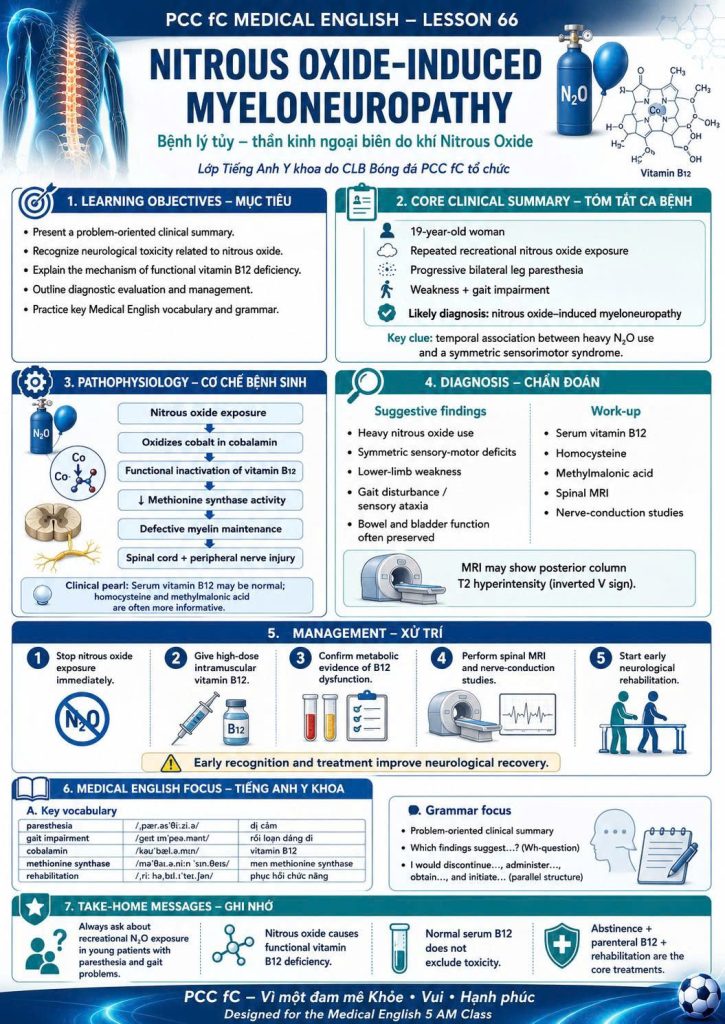
Bài 66 – Tiếng Anh Y Khoa: Bệnh lý tủy thần kinh ngoại biên do khí N2O – Nitrous oxide induced myeloneuropathy.
PCC Language – Thăng Long, Hà Nội, ngày 25/7/2026, Trong Bài 66 của Lớp Tiếng Anh Y khoa do CLB Bóng đá PCC fC tổ chức, chúng ta sẽ cùng tìm hiểu một biến chứng thần kinh ngày càng đáng chú ý do lạm dụng nitrous oxide: bệnh lý tủy – thần kinh ngoại biên. Thông qua một tình huống lâm sàng điển hình ở bệnh nhân trẻ có dị cảm, yếu hai chân và rối loạn dáng đi, bài học giúp học viên rèn luyện kỹ năng trình bày ca bệnh theo định hướng vấn đề, nhận diện dấu hiệu ngộ độc thần kinh, giải thích cơ chế thiếu vitamin B12 chức năng và xây dựng kế hoạch chẩn đoán, điều trị hợp lý. Bên cạnh kiến thức chuyên môn, bài học còn tập trung vào từ vựng, phát âm, cấu trúc câu hỏi lâm sàng và cách diễn đạt kế hoạch xử trí bằng tiếng Anh một cách khoa học, chính xác và chuyên nghiệp.
PCC fC MEDICAL ENGLISH – LESSON 66
NITROUS OXIDE–INDUCED MYELONEUROPATHY
Bệnh lý tủy–thần kinh ngoại biên do khí nitrous oxide
Đơn vị tổ chức: CLB Bóng đá PCC fC
Chương trình: Lớp Tiếng Anh Y khoa – 5 Giờ Sáng Tươi Tốt Đẹp
Chủ đề chuyên môn: Clinical Toxicology – Neurological Toxicity
Thời lượng đề xuất: 25 phút
I. LEARNING OBJECTIVES – MỤC TIÊU BÀI HỌC
Sau bài học, học viên có thể:
- Trình bày một ca bệnh thần kinh theo phương pháp problem-oriented clinical summary.
- Nhận biết các biểu hiện của nitrous oxide–induced myeloneuropathy.
- Giải thích cơ chế thiếu vitamin B12 chức năng do N₂O.
- Lựa chọn các xét nghiệm và thăm dò phù hợp để xác định chẩn đoán.
- Sử dụng chính xác từ vựng về cảm giác, vận động và bệnh lý tủy sống.
- Phân tích câu hỏi lâm sàng, mệnh đề quan hệ, cấu trúc song song và nội–ngoại động từ.
- Thực hành trình bày kế hoạch chẩn đoán và điều trị bằng tiếng Anh chuyên nghiệp.
II. CLINICAL WARM-UP – KHỞI ĐỘNG LÂM SÀNG
Clinical question
A young patient develops progressive numbness, leg weakness, and an unsteady gait after repeatedly inhaling “laughing gas.” What diagnosis should be considered?
Suggested answer
Nitrous oxide–induced functional vitamin B12 deficiency causing myeloneuropathy should be strongly considered.
Key concept
Myeloneuropathy là tình trạng tổn thương đồng thời:
- Myelopathy: tổn thương tủy sống.
- Peripheral neuropathy: tổn thương thần kinh ngoại biên.
Bệnh nhân vì vậy có thể đồng thời biểu hiện:
- Dị cảm và giảm cảm giác.
- Mất cảm giác bản thể.
- Thất điều cảm giác.
- Yếu chi.
- Rối loạn dáng đi.
- Dấu hiệu bó tháp kết hợp với bệnh đa dây thần kinh.
III. CORE DIALOGUE – HỘI THOẠI TRỌNG TÂM
1. Attending Physician
Please present this patient using a problem-oriented clinical summary.
Hãy trình bày bệnh nhân này bằng một bản tóm tắt lâm sàng định hướng vấn đề.
2. Resident
She is a 19-year-old woman with repeated recreational nitrous oxide exposure who developed progressive bilateral leg paresthesia, weakness, and gait impairment.
Đây là một phụ nữ 19 tuổi, nhiều lần sử dụng nitrous oxide với mục đích giải trí, sau đó xuất hiện dị cảm hai chân tăng dần, yếu chi và rối loạn dáng đi.
3. Attending Physician
Which findings suggest that her neurological syndrome is related to nitrous oxide toxicity?
Những dấu hiệu nào gợi ý hội chứng thần kinh của bệnh nhân liên quan đến độc tính của nitrous oxide?
4. Resident
The temporal association with heavy nitrous oxide use, symmetric sensorimotor deficits, preserved bowel and bladder function, and lower-limb weakness strongly suggest nitrous oxide–induced myeloneuropathy.
Mối liên quan về thời gian với việc sử dụng nhiều nitrous oxide, các thiếu hụt cảm giác–vận động đối xứng, chức năng đại tiểu tiện còn bảo tồn và yếu hai chi dưới gợi ý mạnh bệnh lý tủy–thần kinh ngoại biên do nitrous oxide.
Clinical caution
Các dấu hiệu trên phù hợp nhưng không đặc hiệu cho độc tính N₂O. Chẩn đoán cần dựa trên sự kết hợp giữa:
- Tiền sử phơi nhiễm.
- Kiểu hình thần kinh.
- Bằng chứng thiếu vitamin B12 chức năng.
- MRI tủy sống.
- Khảo sát dẫn truyền thần kinh.
Chức năng cơ tròn còn bảo tồn có thể giúp định hướng nhưng không đủ để khẳng định hoặc loại trừ một nguyên nhân cụ thể.
5. Attending Physician
What is the principal pathophysiological mechanism underlying this condition?
Cơ chế bệnh sinh chủ yếu của tình trạng này là gì?
6. Resident
Nitrous oxide oxidizes the cobalt moiety of cobalamin, functionally inactivating vitamin B12 and impairing methionine synthase activity, which results in defective myelin maintenance.
Nitrous oxide oxy hóa thành phần cobalt của cobalamin, làm vitamin B12 mất hoạt tính chức năng và suy giảm hoạt động của methionine synthase, từ đó gây rối loạn duy trì bao myelin.
More precise academic version
Nitrous oxide oxidizes the cobalt ion within cobalamin, thereby functionally inactivating vitamin B12 and reducing methionine synthase activity. The resulting disruption of methionine metabolism impairs myelin maintenance.
Cách viết này chia ý thành hai câu, giúp mối quan hệ nguyên nhân–kết quả rõ ràng hơn.
Nitrous oxide oxy hóa cobalt trong cobalamin và bất hoạt vitamin B12 về mặt chức năng. Điều này làm suy giảm methionine synthase, ảnh hưởng đến chuyển hóa methionine và khả năng duy trì myelin.
7. Attending Physician
How would you confirm the diagnosis and manage the patient?
Bạn sẽ xác định chẩn đoán và xử trí bệnh nhân như thế nào?
8. Resident
I would immediately discontinue nitrous oxide exposure, administer high-dose intramuscular vitamin B12, measure homocysteine and methylmalonic acid, obtain spinal MRI and nerve-conduction studies, and initiate early neurological rehabilitation.
Tôi sẽ lập tức ngừng phơi nhiễm nitrous oxide, sử dụng vitamin B12 liều cao đường tiêm bắp, định lượng homocysteine và methylmalonic acid, chụp MRI tủy sống, khảo sát dẫn truyền thần kinh và tiến hành phục hồi chức năng thần kinh sớm.
Ngừng sử dụng N₂O và bổ sung vitamin B12 đường tiêm là nền tảng điều trị. Tuy nhiên, phác đồ liều lượng và thời gian điều trị chưa hoàn toàn thống nhất giữa các trung tâm; việc điều trị nên tuân theo quy trình chuyên khoa và đáp ứng thần kinh của từng bệnh nhân.
IV. MEDICAL SCIENCE – KIẾN THỨC Y KHOA TRỌNG TÂM
1. Clinical definition
Nitrous oxide–induced myeloneuropathy
Là hội chứng tổn thương tủy sống và thần kinh ngoại biên liên quan đến phơi nhiễm N₂O, thường thông qua cơ chế bất hoạt vitamin B12 chức năng.
Có thể gặp dưới các kiểu hình:
- Subacute combined degeneration of the spinal cord.
- Myelopathy đơn thuần.
- Axonal sensorimotor polyneuropathy.
- Myeloneuropathy phối hợp.
- Hiếm hơn: bệnh thần kinh vận động nặng hoặc biểu hiện tâm thần.
2. Mechanism map – Sơ đồ cơ chế
Repeated N₂O exposure
→ Oxidation of cobalt within cobalamin
→ Functional inactivation of vitamin B12
→ Reduced methionine synthase activity
→ Reduced conversion of homocysteine to methionine
→ Disturbed methylation and myelin maintenance
→ Spinal cord and peripheral nerve injury
→ Paresthesia, sensory ataxia, weakness and gait impairment
Functional deficiency
Điểm đặc biệt là bệnh nhân có thể bị thiếu vitamin B12 về chức năng dù nồng độ vitamin B12 huyết thanh vẫn nằm trong giới hạn tham chiếu.
Do đó:
A normal serum vitamin B12 level does not exclude nitrous oxide–induced neurological toxicity.
Homocysteine và methylmalonic acid có thể giúp phát hiện rối loạn chuyển hóa B12 mà xét nghiệm B12 huyết thanh đơn thuần bỏ sót.
3. Typical clinical manifestations
Sensory manifestations
- Distal paresthesia.
- Numbness.
- Loss of vibration sense.
- Impaired joint-position sense.
- Sensory level, đôi khi không rõ.
- Positive Romberg sign.
- Sensory ataxia.
Motor manifestations
- Symmetric lower-limb weakness.
- Foot drop.
- Difficulty standing or walking.
- Reduced dexterity.
- Severe cases: marked gait dependence or inability to walk.
Reflexes
Phản xạ có thể thay đổi tùy ưu thế tổn thương:
- Hyperreflexia: khi tổn thương bó tháp chiếm ưu thế.
- Hyporeflexia/areflexia: khi bệnh đa dây thần kinh ngoại biên chiếm ưu thế.
- Có thể xuất hiện kiểu phản xạ “hỗn hợp”.
4. Suggested diagnostic evaluation
A. History
Cần hỏi trực tiếp, không phán xét:
- Loại sản phẩm N₂O đã sử dụng.
- Số bình hoặc bóng mỗi lần.
- Tần suất sử dụng.
- Thời gian sử dụng.
- Lần sử dụng gần nhất.
- Triệu chứng xuất hiện trước hay sau khi tăng mức sử dụng.
- Chế độ ăn và nguy cơ thiếu B12 trước đó.
- Sử dụng metformin, thuốc ức chế acid hoặc tiền sử phẫu thuật tiêu hóa.
B. Neurological examination
Đánh giá:
- Muscle strength.
- Muscle tone.
- Deep-tendon reflexes.
- Plantar responses.
- Pain, temperature, vibration and proprioception.
- Romberg test.
- Coordination.
- Gait.
- Bowel and bladder function.
C. Laboratory tests
Nên cân nhắc:
- Complete blood count.
- Mean corpuscular volume.
- Serum vitamin B12.
- Active B12 nếu có.
- Plasma homocysteine.
- Methylmalonic acid.
- Folate.
- Renal and liver function.
- Copper và các xét nghiệm phân biệt khi cần.
Không nên chờ kết quả xét nghiệm mới bắt đầu điều trị khi bệnh cảnh và tiền sử phơi nhiễm rất gợi ý.
D. Spinal MRI
MRI có thể cho thấy:
- Tăng tín hiệu T2 đối xứng ở cột sau tủy sống.
- Thường rõ ở đoạn tủy cổ.
- Hình chữ V ngược – inverted V sign trên lát cắt ngang.
- MRI bình thường không loại trừ hoàn toàn bệnh, nhất là giai đoạn sớm.
Tổn thương cột sau tủy cổ và dấu hiệu chữ V ngược đã được mô tả trong các nghiên cứu hình ảnh về độc tính N₂O.
E. Nerve-conduction studies
Có thể phát hiện:
- Sensorimotor polyneuropathy.
- Giảm biên độ đáp ứng vận động và cảm giác.
- Tổn thương sợi trục thường nổi bật.
- Một số trường hợp có đặc điểm mất myelin hoặc kiểu hỗn hợp.
Khảo sát điện sinh lý giúp xác định thành phần bệnh thần kinh ngoại biên và đánh giá mức độ tổn thương.
5. Differential diagnosis – Chẩn đoán phân biệt
Cần phân biệt với:
- Thiếu vitamin B12 do dinh dưỡng hoặc kém hấp thu.
- Thiếu đồng.
- Guillain–Barré syndrome.
- Transverse myelitis.
- Multiple sclerosis.
- Neuromyelitis optica spectrum disorder.
- Compressive myelopathy.
- HIV hoặc neurosyphilis.
- Diabetic polyneuropathy.
- Hereditary neuropathy.
- Các nguyên nhân độc chất hoặc chuyển hóa khác.
Clinical pearl
Tiền sử sử dụng N₂O phải được hỏi chủ động.
Nhiều người bệnh không tự khai báo vì cho rằng đây chỉ là “khí cười” vô hại hoặc lo ngại bị đánh giá.
6. Management principles
Immediate priorities
- Stop all nitrous oxide exposure.
- Start parenteral vitamin B12 promptly.
- Điều trị các thiếu hụt dinh dưỡng phối hợp.
- Đánh giá nguy cơ huyết khối khi homocysteine tăng cao và có biểu hiện phù hợp.
- Vật lý trị liệu và phục hồi chức năng thần kinh sớm.
- Hỗ trợ tâm lý và điều trị rối loạn sử dụng chất nếu có.
- Theo dõi sức cơ, cảm giác, dáng đi và khả năng sinh hoạt hằng ngày.
Important counselling point
Continuing to use nitrous oxide may prevent neurological recovery even when vitamin B12 is being administered.
Việc tiếp tục sử dụng N₂O có thể làm tổn thương thần kinh tiến triển dù bệnh nhân đang được bổ sung vitamin B12.
Phục hồi có thể xảy ra sau khi ngừng N₂O và điều trị B12, nhưng mức độ hồi phục khác nhau và tổn thương nặng hoặc điều trị muộn có thể để lại di chứng.
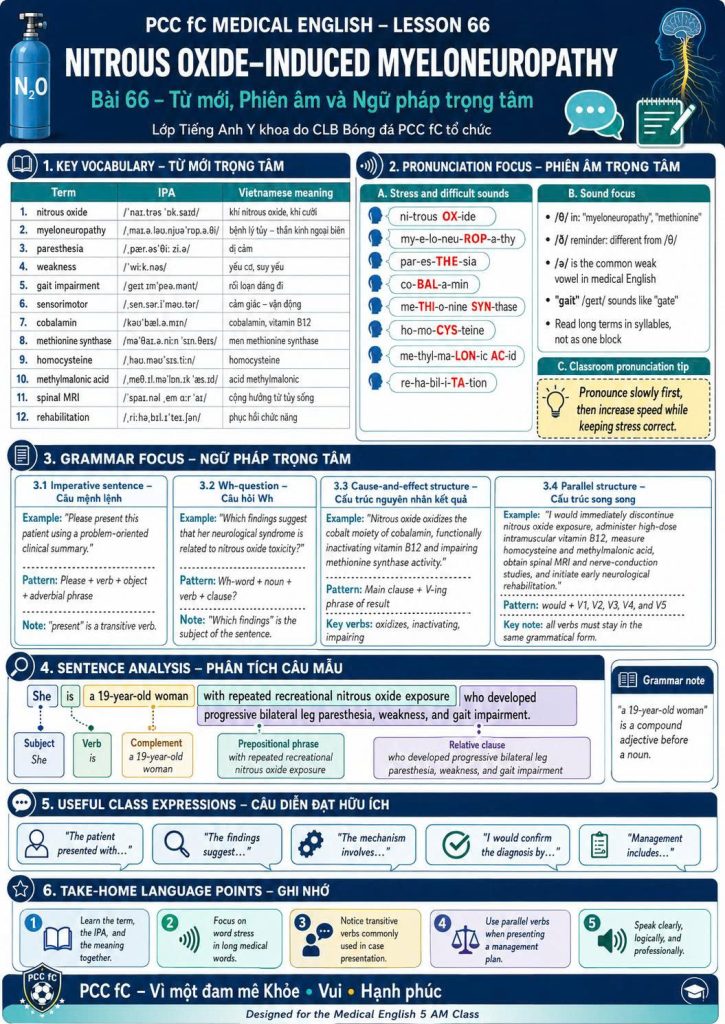
V. KEY VOCABULARY – TỪ VỰNG TRỌNG TÂM
| Vocabulary | IPA | Meaning |
| nitrous oxide | /ˌnaɪ.trəs ˈɒk.saɪd/ | khí nitrous oxide, khí cười |
| myeloneuropathy | /ˌmaɪ.ə.ləʊ.njʊəˈrɒp.ə.θi/ | bệnh lý tủy–thần kinh ngoại biên |
| paresthesia | /ˌpær.əsˈθiː.zi.ə/ | dị cảm |
| bilateral | /baɪˈlæt.ər.əl/ | hai bên |
| progressive | /prəˈɡres.ɪv/ | tiến triển |
| gait impairment | /ɡeɪt ɪmˈpeə.mənt/ | rối loạn dáng đi |
| sensorimotor | /ˌsen.sər.iˈməʊ.tər/ | cảm giác–vận động |
| bowel function | /ˈbaʊ.əl ˌfʌŋk.ʃən/ | chức năng đại tiện |
| bladder function | /ˈblæd.ər ˌfʌŋk.ʃən/ | chức năng bàng quang |
| pathophysiological | /ˌpæθ.əʊˌfɪz.i.əˈlɒdʒ.ɪ.kəl/ | thuộc sinh lý bệnh |
| cobalamin | /kəʊˈbæl.ə.mɪn/ | cobalamin, vitamin B12 |
| cobalt moiety | /ˈkəʊ.bɒlt ˈmɔɪ.ə.ti/ | thành phần cobalt |
| inactivate | /ɪnˈæk.tɪ.veɪt/ | làm mất hoạt tính |
| methionine synthase | /məˈθaɪ.ə.niːn ˈsɪn.θeɪs/ | enzym methionine synthase |
| myelin | /ˈmaɪ.ə.lɪn/ | myelin |
| homocysteine | /ˌhəʊ.məʊˈsɪs.tiːn/ | homocysteine |
| methylmalonic acid | /ˌmeθ.ɪl.məˈlɒn.ɪk ˈæs.ɪd/ | acid methylmalonic |
| nerve conduction | /nɜːv kənˈdʌk.ʃən/ | dẫn truyền thần kinh |
| rehabilitation | /ˌriː.həˌbɪl.ɪˈteɪ.ʃən/ | phục hồi chức năng |
| abstinence | /ˈæb.stɪ.nəns/ | kiêng, ngừng hoàn toàn |
Pronunciation focus
1. Âm /θ/
- myeloneuropaTHy
- meTHionine
- paTHophysiological
Đặt đầu lưỡi nhẹ giữa hai hàm răng và đẩy luồng hơi ra ngoài.
2. Phân biệt
- gait /ɡeɪt/: dáng đi.
- gate /ɡeɪt/: cổng.
Hai từ phát âm giống nhau nhưng nghĩa khác nhau.
3. Trọng âm dài
pathophysiological
/ˌpæθ.əʊˌfɪz.i.əˈlɒdʒ.ɪ.kəl/
Trọng âm chính rơi vào âm tiết LODGE.
VI. GRAMMAR FOCUS – NGỮ PHÁP TRỌNG TÂM
1. Imperative sentence – Câu mệnh lệnh lịch sự
Please present this patient using a problem-oriented clinical summary.
Structure
Please + bare infinitive + object + adverbial phrase
- Please: từ thể hiện sự lịch sự.
- present: ngoại động từ.
- this patient: tân ngữ trực tiếp.
- using a problem-oriented clinical summary: cụm phân từ chỉ phương thức.
Clinical pattern
- Please describe the neurological findings.
- Please summarize the exposure history.
- Please explain your differential diagnosis.
2. Relative clause – Mệnh đề quan hệ
She is a 19-year-old woman with repeated recreational nitrous oxide exposure who developed progressive bilateral leg paresthesia.
Main clause
- She: chủ ngữ.
- is: động từ nối.
- a 19-year-old woman: bổ ngữ chủ ngữ.
Relative clause
- who: đại từ quan hệ, thay cho “woman”.
- developed: ngoại động từ.
- progressive bilateral leg paresthesia, weakness, and gait impairment: tân ngữ ghép.
Important rule
Trong tính từ ghép đứng trước danh từ:
a 19-year-old woman
Không dùng:
a 19-years-old woman
Nhưng có thể nói:
The woman is 19 years old.
3. Subject Wh-question – Câu hỏi Wh hỏi chủ ngữ
Which findings suggest that her neurological syndrome is related to nitrous oxide toxicity?
Trong câu này, which findings chính là chủ ngữ.
Structure
Wh-subject + main verb + object clause?
Không sử dụng trợ động từ do/does.
Đúng:
Which findings suggest the diagnosis?
Không tự nhiên:
Which findings do suggest the diagnosis?
“Do” chỉ được thêm khi cần nhấn mạnh đặc biệt.
4. Complex subject – Chủ ngữ ghép phức tạp
The temporal association with heavy nitrous oxide use, symmetric sensorimotor deficits, preserved bowel and bladder function, and lower-limb weakness strongly suggest nitrous oxide–induced myeloneuropathy.
Subject
Một chuỗi gồm bốn thành phần:
- The temporal association with heavy nitrous oxide use.
- Symmetric sensorimotor deficits.
- Preserved bowel and bladder function.
- Lower-limb weakness.
Predicate
- strongly: trạng từ chỉ mức độ.
- suggest: ngoại động từ.
- nitrous oxide–induced myeloneuropathy: tân ngữ.
Agreement
Do chủ ngữ gồm nhiều thành phần nối bằng and, động từ dùng dạng số nhiều:
findings suggest
Không dùng:
findings suggests
5. Participial clauses – Mệnh đề phân từ
Nitrous oxide oxidizes the cobalt moiety of cobalamin, functionally inactivating vitamin B12 and impairing methionine synthase activity.
Hai cụm V-ing diễn tả kết quả hoặc hệ quả của hành động “oxidizes”:
- functionally inactivating vitamin B12.
- impairing methionine synthase activity.
Academic alternative
Có thể sử dụng thereby + V-ing để thể hiện quan hệ nhân quả rõ hơn:
Nitrous oxide oxidizes the cobalt ion, thereby inactivating vitamin B12.
6. Modal verb “would” – Trình bày kế hoạch xử trí
How would you confirm the diagnosis and manage the patient?
“Would” trong bối cảnh này không đơn thuần diễn tả tương lai. Nó được sử dụng để yêu cầu người học trình bày:
- Kế hoạch giả định.
- Cách tiếp cận lâm sàng.
- Quyết định chuyên môn trong tình huống đã cho.
Answer structure
I would + verb…
- I would discontinue…
- I would administer…
- I would measure…
- I would obtain…
- I would initiate…
7. Parallel structure – Cấu trúc song song
I would immediately discontinue, administer, measure, obtain, and initiate…
Tất cả động từ đều ở dạng nguyên mẫu sau would.
Correct
I would discontinue exposure, administer vitamin B12, obtain MRI, and initiate rehabilitation.
Incorrect
I would discontinue exposure, administering vitamin B12, obtained MRI, and initiate rehabilitation.
Câu sai vì các động từ không cùng hình thức ngữ pháp.
VII. TRANSITIVE AND INTRANSITIVE VERBS
PHÂN TÍCH NỘI ĐỘNG TỪ – NGOẠI ĐỘNG TỪ
| Verb | Type | Object/complement | Example |
| present | ngoại động từ | this patient | Present this patient. |
| develop | ngoại động từ trong câu này | paresthesia and weakness | She developed weakness. |
| suggest | ngoại động từ | myeloneuropathy | The findings suggest toxicity. |
| oxidize | ngoại động từ | the cobalt ion | N₂O oxidizes cobalt. |
| inactivate | ngoại động từ | vitamin B12 | It inactivates vitamin B12. |
| impair | ngoại động từ | enzyme activity | It impairs methionine synthase activity. |
| result | nội động từ | in + noun | This results in myelin damage. |
| discontinue | ngoại động từ | exposure | Discontinue N₂O exposure. |
| administer | ngoại động từ | vitamin B12 | Administer vitamin B12. |
| measure | ngoại động từ | homocysteine | Measure homocysteine. |
| obtain | ngoại động từ | spinal MRI | Obtain spinal MRI. |
| initiate | ngoại động từ | rehabilitation | Initiate rehabilitation. |
| recover | nội động từ | không cần tân ngữ | The patient recovered gradually. |
| improve | nội hoặc ngoại động từ | tùy cấu trúc | Her gait improved. / Therapy improved her gait. |
Clinical grammar pearl
result in + outcome
- Vitamin B12 inactivation results in impaired myelin maintenance.
result from + cause
- Myelin damage results from functional vitamin B12 deficiency.
VIII. SENTENCE ANATOMY – PHÂN TÍCH CẤU TRÚC CÂU
Model sentence
I would immediately discontinue nitrous oxide exposure, administer high-dose intramuscular vitamin B12, measure homocysteine and methylmalonic acid, obtain spinal MRI and nerve-conduction studies, and initiate early neurological rehabilitation.
Subject
I
Modal auxiliary
would
Adverb
immediately
Parallel predicates
- discontinue nitrous oxide exposure.
- administer high-dose intramuscular vitamin B12.
- measure homocysteine and methylmalonic acid.
- obtain spinal MRI and nerve-conduction studies.
- initiate early neurological rehabilitation.
Direct objects
- nitrous oxide exposure.
- high-dose intramuscular vitamin B12.
- homocysteine and methylmalonic acid.
- spinal MRI and nerve-conduction studies.
- early neurological rehabilitation.
Communication value
Cấu trúc này đặc biệt hữu ích trong:
- Trình bày ca bệnh.
- Thi lâm sàng OSCE.
- Hội chẩn.
- Giao ban.
- Báo cáo kế hoạch điều trị.
- Trả lời câu hỏi của giảng viên.
IX. CLINICAL PRESENTATION TEMPLATE
MẪU TRÌNH BÀY CA BỆNH
This is a [age]-year-old [man/woman] with a history of [relevant exposure] who presented with [main symptoms] developing over [duration]. Examination showed [key positive findings], while [important negative findings] were preserved. The temporal relationship and neurological pattern raise concern for [working diagnosis]. I would confirm the diagnosis with [tests] and begin [urgent treatment].
Applied version
This is a 19-year-old woman with repeated recreational nitrous oxide exposure who presented with progressive bilateral leg paresthesia, weakness, and gait instability. Neurological examination demonstrated symmetric sensorimotor deficits without bowel or bladder dysfunction. The exposure history and neurological pattern raise concern for nitrous oxide–induced myeloneuropathy. I would assess functional vitamin B12 status, obtain spinal MRI and nerve-conduction studies, discontinue nitrous oxide exposure, and start parenteral vitamin B12 promptly.
X. MINI PRACTICE – BÀI TẬP NHANH
Exercise 1: Choose the best answer
1. Which laboratory finding most strongly supports functional vitamin B12 deficiency?
A. Normal serum sodium
B. Elevated homocysteine
C. Low serum potassium
D. Elevated bilirubin
Answer: B
2. Which MRI finding is classically associated with this condition?
A. Unilateral basal ganglia infarction
B. Symmetric posterior-column T2 hyperintensity
C. Epidural abscess
D. Lumbar vertebral fracture
Answer: B
3. Which sentence has correct parallel structure?
A. I would discontinue N₂O, administering B12, and MRI was obtained.
B. I would discontinue N₂O, administer B12, and obtain spinal MRI.
C. I discontinued N₂O, administer B12, and obtaining MRI.
D. I would discontinuing N₂O and administered B12.
Answer: B
Exercise 2: Complete the sentences
- Nitrous oxide functionally __________ vitamin B12.
- Vitamin B12 inactivation may result __________ impaired myelin maintenance.
- The patient presented __________ progressive paresthesia.
- I would obtain spinal MRI __________ nerve-conduction studies.
Answers
- inactivates
- in
- with
- and
Exercise 3: Clinical speaking
Trả lời trong 30–45 giây:
Why can a normal serum vitamin B12 level be misleading in a patient who uses nitrous oxide?
Model answer
A normal serum vitamin B12 level can be misleading because nitrous oxide causes functional inactivation of cobalamin rather than simply reducing its measured concentration. Therefore, homocysteine and methylmalonic acid may provide better evidence of impaired vitamin B12–dependent metabolism.
XI. FIVE KEY TAKE-HOME MESSAGES
- Always ask about recreational nitrous oxide exposure in young patients with unexplained paresthesia, weakness, or gait disturbance.
- Nitrous oxide produces functional vitamin B12 deficiency by oxidizing the cobalt component of cobalamin.
- Normal serum vitamin B12 does not exclude nitrous oxide–induced neurological toxicity.
- Homocysteine, methylmalonic acid, spinal MRI, and nerve-conduction studies support the diagnosis.
- Immediate abstinence, parenteral vitamin B12, and early rehabilitation are the central management principles.
XII. 25-MINUTE TEACHING PLAN
| Time | Activity |
| 0–2 minutes | Clinical warm-up and diagnostic question |
| 2–7 minutes | Read and role-play the eight-line dialogue |
| 7–11 minutes | Vocabulary and pronunciation |
| 11–17 minutes | Grammar and sentence analysis |
| 17–22 minutes | Mechanism, diagnosis and management |
| 22–24 minutes | Clinical speaking exercise |
| 24–25 minutes | Five take-home messages |
XIII. PCC fC MESSAGE
LEARN EARLY – RECOGNIZE EARLY – TREAT EARLY
One exposure history can reveal the diagnosis.
One accurate sentence can clarify clinical reasoning.
One early intervention can protect neurological function.
PCC fC
Vì một đam mê – Khỏe, Vui, Hạnh phúc
Medical English for Better Communication and Safer Patient Care