Bài 68 – Tiếng Anh Y Khoa: Bão giáp trạng liên quan cường giáp * Myasthenic crisis associated with hyperthyroidism.
PCC Language – Thăng Long, ngày 28/7/2026, Trong hồi sức cấp cứu, không phải mọi bệnh nhân khó thở đều mắc bệnh lý phổi. Có những trường hợp nguyên nhân nằm ở sự suy yếu của các cơ hô hấp, nơi mà chỉ một vài giờ chậm trễ trong nhận diện cũng có thể dẫn đến suy hô hấp đe dọa tính mạng. Cơn nhược cơ (Myasthenic Crisis) là một trong những tình huống như vậy, đòi hỏi bác sĩ không chỉ nắm vững kiến thức chuyên môn mà còn phải giao tiếp lâm sàng bằng tiếng Anh một cách chính xác và mạch lạc.
Bài học số 68 sẽ đưa học viên tiếp cận một ca bệnh thực tế về nhược cơ kết hợp cường giáp và suy hô hấp, qua đó luyện tập cách trình bày bệnh án, nhận diện các dấu hiệu cảnh báo, đánh giá chức năng hô hấp tại giường, chỉ định bảo vệ đường thở và lựa chọn các phương pháp điều trị đặc hiệu như IVIG và plasma exchange (PLEX). Đồng thời, bài học giúp củng cố những cấu trúc ngữ pháp và thuật ngữ y khoa thường gặp trong giao ban, báo cáo ca bệnh và các kỳ thi chuyên ngành quốc tế.
Hãy học như một bác sĩ đang trực cấp cứu: tư duy có hệ thống, giao tiếp chính xác và luôn đặt sự an toàn của người bệnh lên hàng đầu. Mỗi câu tiếng Anh hôm nay sẽ là một quyết định lâm sàng đúng đắn trong tương lai.
PCC fC Medical English – Lesson 67
Myasthenic Crisis Associated with Hyperthyroidism
Lớp Tiếng Anh Y Khoa do CLB Bóng đá PCC fC tổ chức
Academic Clinical Dialogue (8 Turns)
1. Attending Physician:
Please present this patient using a structured problem-oriented clinical summary.
2. Resident:
He is a 27-year-old man with acetylcholine receptor antibody–positive myasthenia gravis and hyperthyroidism who presented with progressively worsening dyspnea, respiratory muscle weakness, and hypoxemia, consistent with an impending myasthenic crisis.
3. Attending Physician:
Which clinical findings suggest respiratory muscle involvement rather than primary pulmonary disease?
4. Resident:
The use of accessory respiratory muscles, neck flexor weakness, generalized fatigable muscle weakness, preserved lung auscultation, and the absence of significant radiographic abnormalities strongly support neuromuscular respiratory failure.
5. Attending Physician:
What factors may have precipitated this myasthenic crisis?
6. Resident:
Possible precipitating factors include respiratory tract infection, uncontrolled hyperthyroidism, recent airway surgery, and physiological stress, all of which are well-recognized triggers for acute decompensation in myasthenia gravis.
7. Attending Physician:
How would you evaluate and manage this patient?
8. Resident:
Immediate management should include serial assessment of forced vital capacity and negative inspiratory force, early airway protection when indicated, treatment of precipitating factors, optimization of antithyroid therapy, and prompt initiation of plasma exchange or intravenous immunoglobulin together with appropriate supportive intensive care.
Key Medical Vocabulary
| Term | IPA | Meaning |
| Myasthenic crisis | /ˌmaɪəsˈθenɪk ˈkraɪsɪs/ | Cơn nhược cơ |
| Myasthenia gravis | /ˌmaɪəsˈθiːniə ˈɡrævɪs/ | Bệnh nhược cơ |
| Hyperthyroidism | /ˌhaɪpərˈθaɪrɔɪdɪzəm/ | Cường giáp |
| Respiratory muscle weakness | /rɪˈspɪrətɔːri ˈmʌsəl ˈwiːknəs/ | Yếu cơ hô hấp |
| Accessory respiratory muscles | /əkˈsesəri rɪˈspɪrətɔːri ˈmʌsəlz/ | Cơ hô hấp phụ |
| Forced vital capacity (FVC) | /fɔːrst ˈvaɪtl kəˈpæsəti/ | Dung tích sống gắng sức |
| Negative inspiratory force (NIF) | /ˈneɡətɪv ɪnˈspaɪrətɔːri fɔːrs/ | Áp lực hít vào tối đa |
| Plasma exchange (PLEX) | /ˈplæzmə ɪksˈtʃeɪndʒ/ | Thay huyết tương |
| Intravenous immunoglobulin (IVIG) | /ˌɪntrəˈviːnəs ɪˌmjuːnoʊˈɡlɒbjəlɪn/ | Globulin miễn dịch truyền tĩnh mạch |
| Airway protection | /ˈerweɪ prəˈtekʃən/ | Bảo vệ đường thở |
Grammar Focus
- Problem-oriented clinical presentation
- He is a 27-year-old man with… who presented with…
- Present perfect evidence
- Clinical findings suggest…
- Passive structures
- Treatment should be initiated.
- Modal verbs for recommendations
- The patient should undergo…
- Airway protection may be required.
- Academic connectors
- Consistent with, rather than, together with, when indicated, strongly support.
Đây là mẫu hội thoại theo phong cách ward round/ICU teaching thường gặp trong các kỳ thi nội trú, MRCP, USMLE và trong giao ban lâm sàng quốc tế, đồng thời bám sát diễn biến thực tế của bệnh nhân nhược cơ có suy hô hấp và cường giáp.
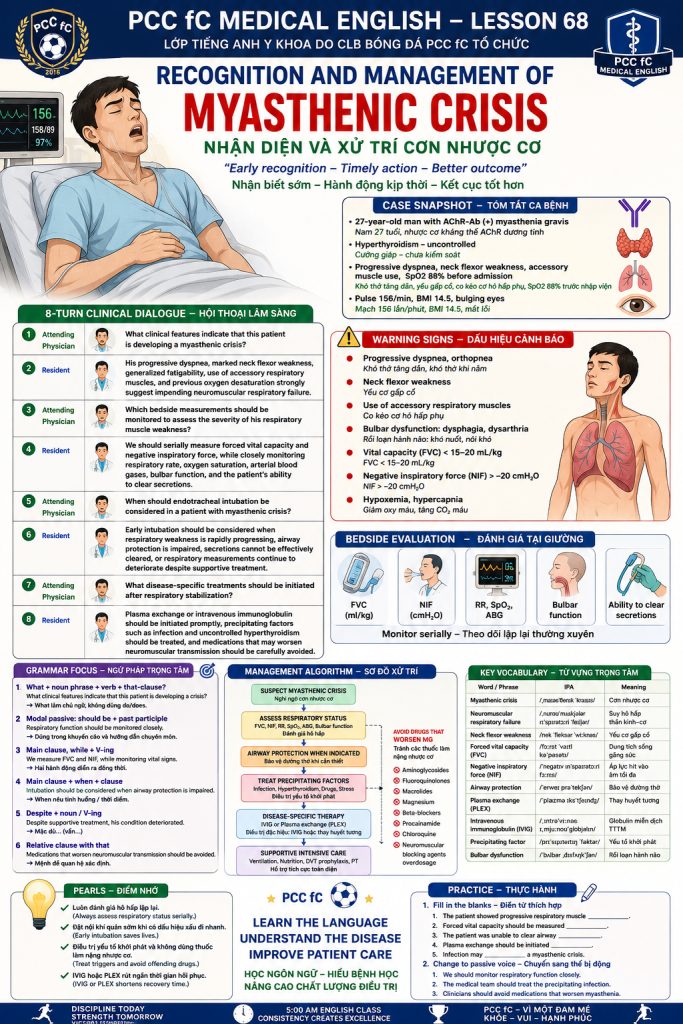
Dựa vào nội dung trên hãy thiết kế bài 68 Lớp Tiếng Anh Y Khoa do CLB Bóng đá PCC fC tổ chức
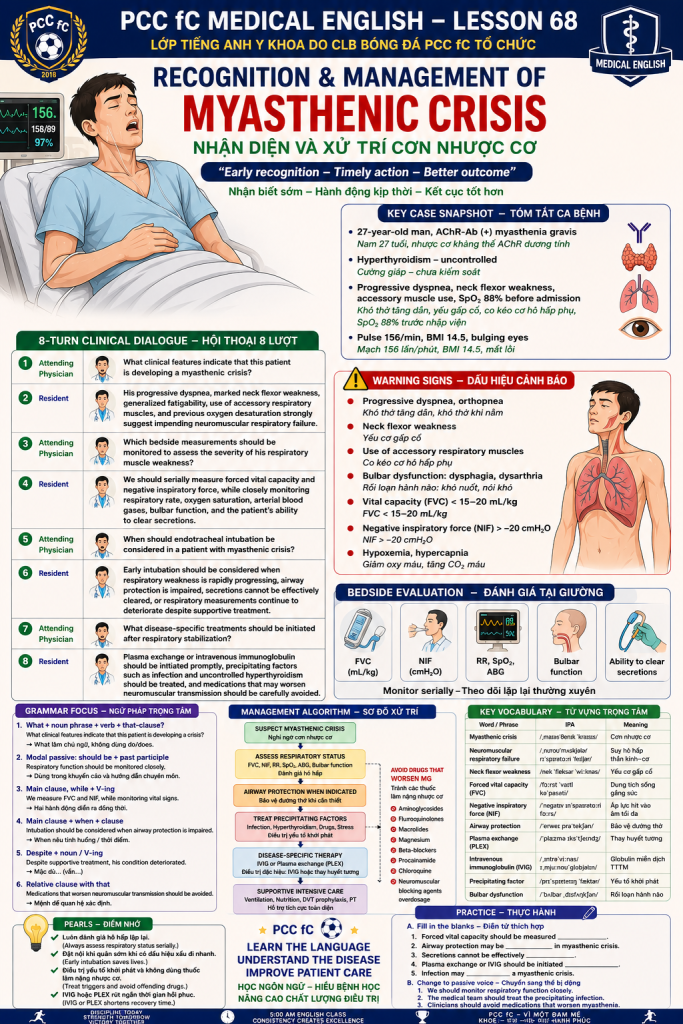
PCC fC MEDICAL ENGLISH – LESSON 68
Recognition and Management of Myasthenic Crisis
Nhận diện và xử trí cơn nhược cơ
Lớp Tiếng Anh Y Khoa do CLB Bóng đá PCC fC tổ chức
Slogan: Learn with discipline – Practice with confidence – Care with compassion.
I. Learning Objectives – Mục tiêu bài học
Sau bài học, học viên có thể:
- Trình bày bệnh nhân nhược cơ có suy hô hấp bằng tiếng Anh y khoa.
- Nhận diện các dấu hiệu cảnh báo của myasthenic crisis.
- Phân biệt suy hô hấp do yếu cơ với bệnh lý phổi nguyên phát.
- Sử dụng đúng các thuật ngữ về đánh giá chức năng hô hấp.
- Trình bày nguyên tắc bảo vệ đường thở, IVIG và thay huyết tương.
II. Clinical Dialogue – Hội thoại lâm sàng 8 lượt
1. Attending Physician
What clinical features indicate that this patient is developing a myasthenic crisis?
Những đặc điểm lâm sàng nào cho thấy bệnh nhân đang tiến triển thành cơn nhược cơ?
2. Resident
His progressive dyspnea, marked neck flexor weakness, generalized fatigability, use of accessory respiratory muscles, and previous oxygen desaturation strongly suggest impending neuromuscular respiratory failure.
Khó thở tăng dần, yếu rõ cơ gấp cổ, yếu cơ tăng khi gắng sức, sử dụng cơ hô hấp phụ và tiền sử giảm bão hòa oxy gợi ý mạnh tình trạng suy hô hấp thần kinh–cơ sắp xảy ra.
3. Attending Physician
Which bedside measurements should be monitored to assess the severity of his respiratory muscle weakness?
Những thông số nào tại giường cần được theo dõi để đánh giá mức độ yếu cơ hô hấp?
4. Resident
We should serially measure forced vital capacity and negative inspiratory force, while closely monitoring respiratory rate, oxygen saturation, arterial blood gases, bulbar function, and the patient’s ability to clear secretions.
Chúng ta cần đo lặp lại dung tích sống gắng sức và áp lực hít vào âm, đồng thời theo dõi sát nhịp thở, độ bão hòa oxy, khí máu động mạch, chức năng hành não và khả năng khạc thải đờm.
5. Attending Physician
When should endotracheal intubation be considered in a patient with myasthenic crisis?
Khi nào cần cân nhắc đặt nội khí quản ở bệnh nhân cơn nhược cơ?
6. Resident
Early intubation should be considered when respiratory weakness is rapidly progressing, airway protection is impaired, secretions cannot be effectively cleared, or respiratory measurements continue to deteriorate despite supportive treatment.
Cần cân nhắc đặt nội khí quản sớm khi yếu cơ hô hấp tiến triển nhanh, khả năng bảo vệ đường thở suy giảm, bệnh nhân không thể khạc thải đờm hiệu quả hoặc các thông số hô hấp tiếp tục xấu đi dù đã điều trị hỗ trợ.
7. Attending Physician
What disease-specific treatments should be initiated after respiratory stabilization?
Sau khi ổn định hô hấp, cần bắt đầu những phương pháp điều trị đặc hiệu nào?
8. Resident
Plasma exchange or intravenous immunoglobulin should be initiated promptly, precipitating factors such as infection and uncontrolled hyperthyroidism should be treated, and medications that may worsen neuromuscular transmission should be carefully avoided.
Cần nhanh chóng thực hiện thay huyết tương hoặc truyền globulin miễn dịch tĩnh mạch, điều trị các yếu tố khởi phát như nhiễm trùng và cường giáp chưa kiểm soát, đồng thời tránh thận trọng những thuốc có thể làm nặng thêm dẫn truyền thần kinh–cơ.
III. Key Medical Vocabulary – Từ vựng trọng tâm
| Từ/Cụm từ | Phiên âm IPA | Nghĩa |
| Myasthenic crisis | /ˌmaɪəsˈθenɪk ˈkraɪsɪs/ | Cơn nhược cơ |
| Neuromuscular respiratory failure | /ˌnʊroʊˈmʌskjələr rɪˈspɪrətɔːri ˈfeɪljər/ | Suy hô hấp thần kinh–cơ |
| Progressive dyspnea | /prəˈɡresɪv dɪspˈniːə/ | Khó thở tăng dần |
| Neck flexor weakness | /nek ˈfleksər ˈwiːknəs/ | Yếu cơ gấp cổ |
| Generalized fatigability | /ˈdʒenərəlaɪzd ˌfætɪɡəˈbɪləti/ | Yếu mỏi cơ toàn thân |
| Bulbar function | /ˈbʌlbər ˈfʌŋkʃən/ | Chức năng hành não |
| Airway protection | /ˈerweɪ prəˈtekʃən/ | Bảo vệ đường thở |
| Clear secretions | /klɪr sɪˈkriːʃənz/ | Khạc, làm sạch dịch tiết |
| Forced vital capacity | /fɔːrst ˈvaɪtl kəˈpæsəti/ | Dung tích sống gắng sức |
| Negative inspiratory force | /ˈneɡətɪv ɪnˈspaɪrətɔːri fɔːrs/ | Áp lực hít vào âm |
| Endotracheal intubation | /ˌendoʊˈtreɪkiəl ˌɪntjuˈbeɪʃən/ | Đặt nội khí quản |
| Respiratory stabilization | /rɪˈspɪrətɔːri ˌsteɪbəlaɪˈzeɪʃən/ | Ổn định hô hấp |
| Plasma exchange | /ˈplæzmə ɪksˈtʃeɪndʒ/ | Thay huyết tương |
| Intravenous immunoglobulin | /ˌɪntrəˈviːnəs ˌɪmjənoʊˈɡlɒbjəlɪn/ | Globulin miễn dịch tĩnh mạch |
| Precipitating factor | /prɪˈsɪpɪteɪtɪŋ ˈfæktər/ | Yếu tố khởi phát |
| Neuromuscular transmission | /ˌnʊroʊˈmʌskjələr trænzˈmɪʃən/ | Dẫn truyền thần kinh–cơ |
IV. Pronunciation Focus – Trọng tâm phát âm
1. Myasthenic
/ˌmaɪ.əsˈθen.ɪk/
Tách âm:
my – as – THEN – ic
Trọng âm rơi vào âm tiết THEN.
2. Dyspnea
/dɪspˈniːə/
Đọc gần giống:
disp-NEE-uh
Chữ p không được phát âm riêng biệt.
3. Respiratory
Anh–Mỹ:
/rɪˈspɪrəˌtɔːri/
Trọng âm chính ở âm tiết SPIR.
4. Intravenous immunoglobulin
Chia thành từng cụm:
in-tra-VE-nous | im-mu-no-GLOB-u-lin
Không nên đọc quá nhanh khi mới luyện tập.
V. Grammar Focus – Ngữ pháp trọng tâm
1. Câu hỏi với What clinical features indicate…?
What clinical features indicate that this patient is developing a myasthenic crisis?
Cấu trúc
What + noun phrase + verb + that-clause?
- What clinical features: chủ ngữ nghi vấn.
- indicate: ngoại động từ.
- that this patient is developing…: mệnh đề danh từ làm tân ngữ.
Điểm cần nhớ
Không dùng trợ động từ do/does, vì what clinical features chính là chủ ngữ.
✅ What findings suggest respiratory failure?
❌ What findings do suggest respiratory failure?
2. Cấu trúc liệt kê triệu chứng
His progressive dyspnea, marked neck flexor weakness, generalized fatigability, use of accessory respiratory muscles, and previous oxygen desaturation strongly suggest…
Đây là cấu trúc:
Multiple noun phrases + plural verb
Chủ ngữ gồm nhiều thành phần nối bằng and, vì vậy động từ dùng dạng số nhiều:
- features suggest
- Không dùng: features suggests
3. Cấu trúc should be monitored
Which bedside measurements should be monitored?
Công thức bị động với động từ khuyết thiếu
Modal verb + be + past participle
- should be monitored
- should be initiated
- should be treated
- should be avoided
Cấu trúc này thường được dùng trong:
- Hướng dẫn điều trị.
- Quy trình chuyên môn.
- Khuyến cáo lâm sàng.
- Thảo luận ca bệnh.
4. Cấu trúc while + V-ing
We should serially measure forced vital capacity and negative inspiratory force, while closely monitoring respiratory rate…
Ý nghĩa
Hai hoạt động được thực hiện đồng thời:
- Đo FVC và NIF.
- Đồng thời theo dõi các dấu hiệu lâm sàng khác.
Công thức
Main clause, while + V-ing
Ví dụ:
The patient was ventilated while receiving plasma exchange.
Bệnh nhân được thông khí nhân tạo trong khi được thay huyết tương.
5. Mệnh đề trạng ngữ với when
Early intubation should be considered when respiratory weakness is rapidly progressing.
Cấu trúc
Main clause + when + subject + verb
Mệnh đề when nêu tình huống hoặc thời điểm cần thực hiện một biện pháp.
Các mẫu tương tự:
- when airway protection is impaired
- when secretions cannot be cleared
- when respiratory parameters deteriorate
6. Cấu trúc despite
Despite supportive treatment
Despite + noun/noun phrase/V-ing
✅ Despite supportive treatment
✅ Despite receiving oxygen therapy
❌ Despite he received oxygen therapy
Khi đi sau một mệnh đề đầy đủ, dùng:
Although he received supportive treatment, his respiratory function deteriorated.
7. Mệnh đề quan hệ với that
Medications that may worsen neuromuscular transmission should be avoided.
Phân tích
- Medications: danh từ được bổ nghĩa.
- that may worsen…: mệnh đề quan hệ xác định.
- should be avoided: vị ngữ bị động.
Nghĩa
Các thuốc có thể làm xấu đi dẫn truyền thần kinh–cơ cần được tránh.
VI. Transitive and Intransitive Verbs
Nội động từ và ngoại động từ
| Động từ | Loại | Ví dụ |
| indicate | Ngoại động từ | The findings indicate respiratory failure. |
| suggest | Ngoại động từ | The symptoms suggest a myasthenic crisis. |
| monitor | Ngoại động từ | We must monitor respiratory function. |
| assess | Ngoại động từ | The physician assessed the patient. |
| clear | Ngoại động từ | He cannot clear secretions. |
| worsen | Nội hoặc ngoại động từ | His weakness worsened. / Infection worsened his weakness. |
| deteriorate | Nội động từ | His respiratory function deteriorated. |
| progress | Nội động từ | Respiratory weakness progressed rapidly. |
| develop | Nội hoặc ngoại động từ | He developed respiratory failure. |
| respond | Nội động từ | He responded to IVIG. |
Lưu ý
Deteriorate thường không nhận tân ngữ trực tiếp:
✅ His condition deteriorated.
❌ The infection deteriorated his condition.
Có thể thay bằng:
The infection worsened his condition.
VII. Clinical Sentence Pattern – Câu mẫu trọng tâm
Early endotracheal intubation should be considered when respiratory muscle weakness is rapidly progressing, airway protection is impaired, or the patient is unable to clear secretions effectively.
Phân tích cấu trúc
- Early endotracheal intubation: chủ ngữ.
- should be considered: động từ khuyết thiếu + bị động.
- when: liên từ chỉ tình huống.
- respiratory muscle weakness is rapidly progressing: mệnh đề 1.
- airway protection is impaired: mệnh đề 2.
- the patient is unable to clear secretions effectively: mệnh đề 3.
- or: liên từ nối các chỉ định thay thế.
Mẫu ứng dụng
Mechanical ventilation should be initiated when respiratory failure progresses, gas exchange deteriorates, or the patient becomes unable to protect the airway.
VIII. Clinical Practice – Bài tập thực hành
Điền từ thích hợp
- The patient showed progressive respiratory muscle ________.
- Forced vital capacity should be measured ________.
- The patient was unable to clear airway ________.
- Plasma exchange should be initiated ________.
- Infection may ________ a myasthenic crisis.
Đáp án
- weakness
- serially
- secretions
- promptly
- precipitate
Chuyển sang thể bị động
1. We should monitor respiratory function closely.
Respiratory function should be monitored closely.
2. The medical team should treat the precipitating infection.
The precipitating infection should be treated by the medical team.
3. Clinicians should avoid medications that worsen myasthenia.
Medications that worsen myasthenia should be avoided.
IX. Take-Home Message
In myasthenic crisis, early recognition of respiratory muscle weakness, repeated bedside assessment, timely airway protection, and prompt disease-specific therapy are essential to prevent life-threatening respiratory failure.
Trong cơn nhược cơ, nhận diện sớm tình trạng yếu cơ hô hấp, đánh giá lặp lại tại giường, bảo vệ đường thở đúng thời điểm và điều trị đặc hiệu kịp thời là những yếu tố thiết yếu để ngăn ngừa suy hô hấp đe dọa tính mạng.
PCC fC Medical English
Learn the language – Understand the disease – Improve patient care.
Học ngôn ngữ – Hiểu bệnh học – Nâng cao chất lượng điều trị.
PCC fC