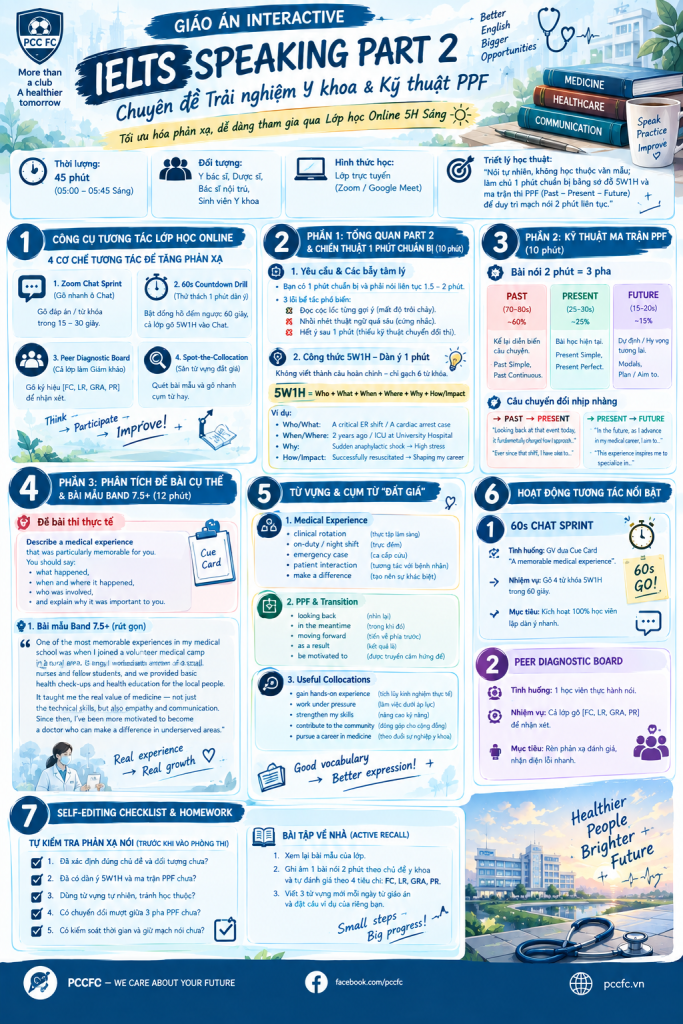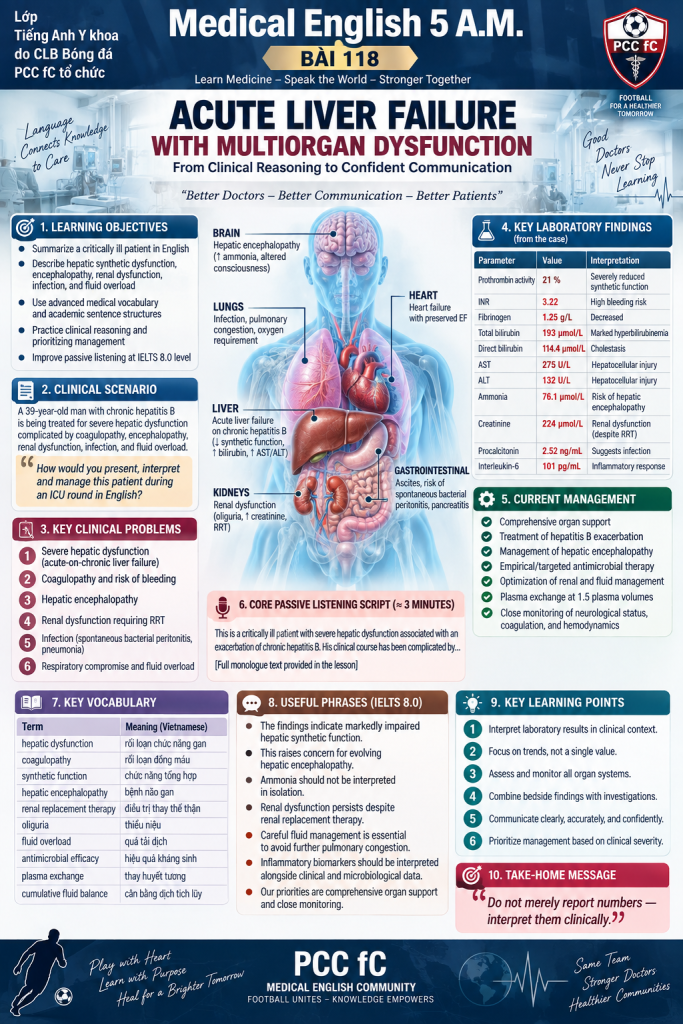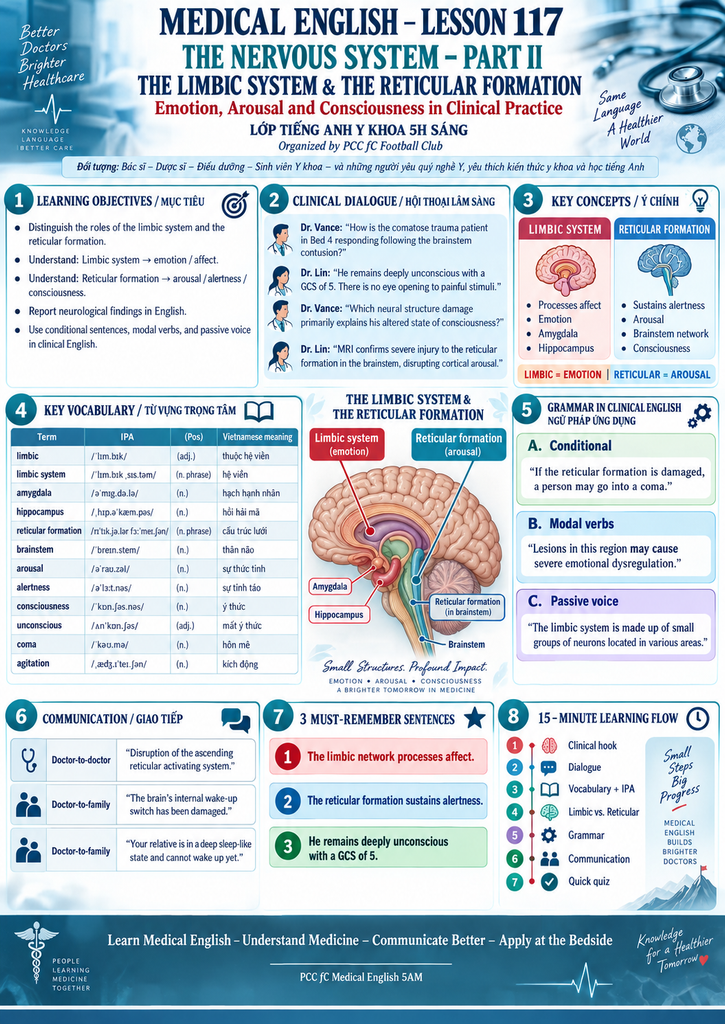
Bài ôn tập 73-78: Tiếng Anh Y Khoa: Từ dấu hiệu lâm sàng đến quyết định chẩn đoán và xử trí * From clinical findings to clinical decisions
PCC Langua – Thăng Long Hà Nội, ngày 09/8/2026, Bước sang Tuần 13, lớp Tiếng Anh Y khoa tiếp tục hành trình rèn luyện đều đặn với các bài học từ 73 đến 78. Đây không chỉ là chặng tiếp theo về số lượng bài học, mà còn là giai đoạn chúng ta nâng dần khả năng sử dụng tiếng Anh trong tư duy lâm sàng, trình bày ca bệnh và trao đổi chuyên môn. Trong tuần này, mỗi bài học tiếp tục được xây dựng theo hướng ngắn gọn nhưng chuyên sâu: từ từ vựng và phát âm y khoa, cấu trúc câu quan trọng, đến những đoạn hội thoại mô phỏng tình huống thực tế tại bệnh viện. Mục tiêu không phải là học thuộc thật nhiều, mà là từng bước hình thành phản xạ: nghe được – hiểu đúng – nói rõ – trình bày có logic bằng tiếng Anh y khoa.
Sau 12 tuần duy trì kỷ luật, bài 73–78 đánh dấu một cột mốc đáng ghi nhận. Mỗi buổi sáng thêm một bài học nhỏ, mỗi ngày thêm một chút tiến bộ, để tiếng Anh dần trở thành một công cụ tự nhiên trong học tập, nghiên cứu và thực hành lâm sàng.
Keep showing up. Keep learning. Keep getting better — one clinical sentence at a time.
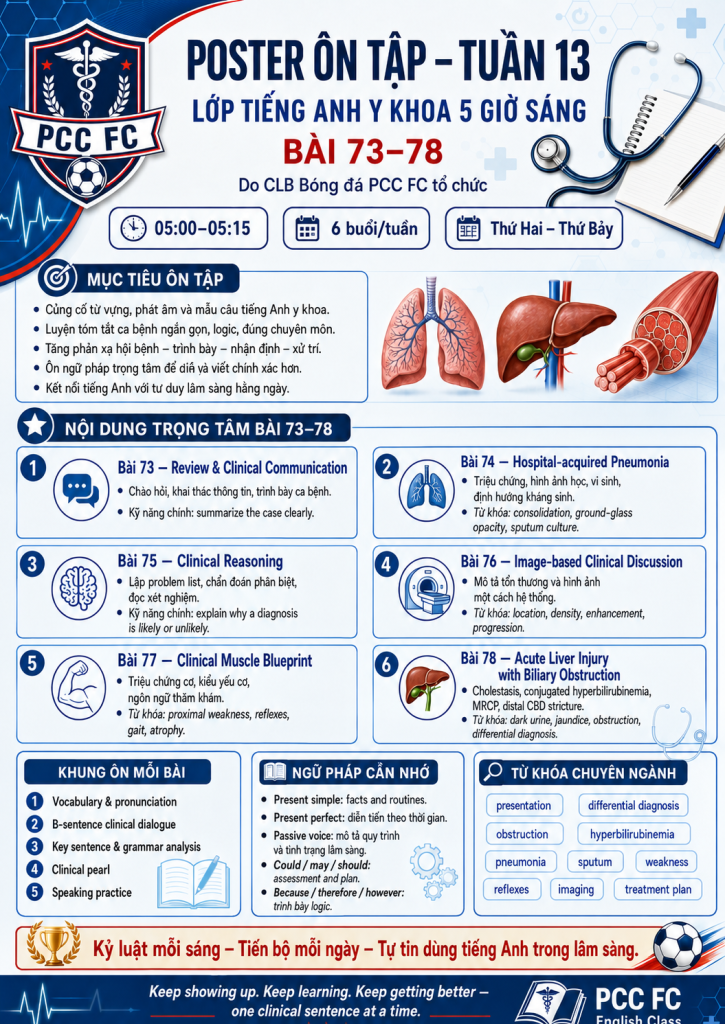
WEEK 13 REVIEW — MEDICAL ENGLISH
LESSONS 73–78: FROM CLINICAL FINDINGS TO CLINICAL DECISIONS
Từ dấu hiệu lâm sàng đến quyết định chẩn đoán và xử trí
LỚP TIẾNG ANH Y KHOA – 5 GIỜ SÁNG TƯƠI TỐT ĐẸP
Do CLB Bóng đá PCC fC tổ chức
Review philosophy:
SEE → SAY → THINK → ACT
Nhìn đúng → Nói đúng → Nghĩ đúng → Hành động đúng
1. LEARNING OBJECTIVES — MỤC TIÊU ÔN TẬP
Sau bài ôn tập, học viên có thể:
- Tóm tắt sáu bài học 73–78 bằng ngôn ngữ lâm sàng ngắn gọn.
- Nhận diện các từ khóa thuộc thần kinh, hô hấp–nhiễm trùng, mắt–xoang, cơ xương và gan mật.
- Mô tả triệu chứng, xét nghiệm và hình ảnh học theo trình tự logic.
- Phân biệt:
- finding — dấu hiệu/phát hiện
- interpretation — diễn giải
- working diagnosis — chẩn đoán định hướng
- management — xử trí
- Sử dụng thành thạo các cấu trúc:
- suggest / indicate / demonstrate
- may / might / could
- should + V
- while / whereas
- with + noun phrase
- câu bị động trong mô tả y khoa.
- Trình bày một ca bệnh trong 30–60 giây bằng tiếng Anh.
2. THE BIG PICTURE — BẢN ĐỒ TUẦN 13
LESSON 73 — ACUTE ISCHEMIC STROKE
Đột quỵ thiếu máu não cấp
Clinical question:
When did the neurological deficit begin?
Trọng tâm:
Onset → Last known well → Neurological deficit → Imaging → Reperfusion decision
Remember:
TIME IS BRAIN.
Câu mẫu:
We need to establish the last-known-well time and obtain urgent brain imaging.
LESSON 74 — HOSPITAL-ACQUIRED PNEUMONIA
Viêm phổi mắc phải tại bệnh viện
Tình huống trọng tâm: bệnh nhân có bệnh nền COPD và suy thượng thận, xuất hiện tổn thương phổi mới; CT cho thấy ground-glass opacities, interstitial fibrotic changes and patchy consolidations.
Clinical pathway:
New respiratory deterioration
→ Examine
→ Imaging
→ Microbiology
→ Empirical antibiotics
→ Reassess
→ De-escalate
Câu mẫu:
The patient was started on intravenous piperacillin–tazobactam, with close monitoring of oxygenation and clinical response.
Remember:
START BROAD → GET CULTURES → REASSESS → NARROW
LESSON 75 — CLINICAL REASONING BRIDGE
FROM FINDINGS TO A WORKING DIAGNOSIS
Từ dữ kiện đến chẩn đoán định hướng
Đây là điểm kết nối quan trọng của Tuần 13:
Do not jump directly from one finding to a final diagnosis.
Thay vào đó:
Finding → Pattern → Interpretation → Differential diagnosis → Working diagnosis → Confirmation
Useful language:
- The findings suggest…
- This pattern is consistent with…
- We are concerned about…
- The leading diagnosis is…
- However, further investigation is required.
- We should also rule out…
Clinical pearl:
Trong tiếng Anh y khoa, khi bằng chứng chưa đủ, nên nói:
This is suggestive of…
thay vì:
This proves…
LESSON 76 — SUSPECTED INVASIVE FUNGAL RHINO-ORBITAL INFECTION
Nghi ngờ nhiễm nấm mũi–xoang–hốc mắt xâm lấn
Red flags:
**Rapidly progressive proptosis
- severe visual impairment
- restricted eye movement
- orbital infiltration
- pansinusitis**
Clinical reasoning:
Eye signs
→ Orbital imaging
→ Sinus imaging
→ Orbital apex involvement
→ Suspected invasive infection
→ Urgent multidisciplinary management
Câu trọng tâm:
We are concerned about orbital apex syndrome caused by a suspected invasive fungal rhino-orbital infection, although microbiological confirmation is still required.
Remember:
EYE + SINUS + RAPID PROGRESSION = EMERGENCY
LESSON 77 — MAJOR SKELETAL MUSCLES IN CLINICAL ASSESSMENT
Các cơ xương chính trong thăm khám lâm sàng
Bài học chuyển từ bệnh lý sang anatomy → function → examination.
Head
Masseter → jaw movement
Neck
Sternocleidomastoid → neck rotation/flexion
Respiration
Intercostals + diaphragm → breathing
Shoulder/back
Trapezius • latissimus dorsi
Upper limbs
Biceps → elbow flexion
Triceps → elbow extension
Lower limbs
Quadriceps → knee extension
Hamstrings → knee flexion
Golden rule:
NAME → LOCATION → ACTION → CLINICAL TEST
Câu mẫu:
The quadriceps extend the knee, while the hamstrings flex it.
Remember:
ANATOMY BECOMES USEFUL WHEN IT EXPLAINS FUNCTION.
LESSON 78 — ACUTE LIVER INJURY WITH BILIARY OBSTRUCTION
From Abnormal Liver Tests to a Distal Common Bile Duct Stricture
Từ bất thường xét nghiệm gan đến hẹp đoạn xa ống mật chủ
Clinical pathway:
Symptoms
→ Liver biochemistry
→ Injury pattern
→ Bilirubin pattern
→ Imaging
→ MRCP
→ Biliary obstruction
→ Differential diagnosis
Các từ khóa:
markedly elevated aminotransferases
conjugated hyperbilirubinemia
cholestasis
common bile duct
distal CBD stricture
Câu mẫu:
MRCP demonstrated a distal common bile duct stricture, raising concern for an obstructive biliary process.
Remember:
LABS SHOW THE PATTERN — IMAGING SHOWS THE PROBLEM.
3. MASTER CLINICAL DIALOGUE — 8 SENTENCES
1. Attending:
What is the first priority when evaluating a patient with a new focal neurological deficit?
2. Resident:
We should determine the exact onset or last-known-well time, assess the neurological deficit, and obtain urgent brain imaging.
3. Attending:
How should we approach a hospitalized patient who develops new fever, hypoxemia, and pulmonary infiltrates?
4. Resident:
We should consider hospital-acquired pneumonia, obtain appropriate microbiological samples, start empirical treatment when indicated, and reassess for de-escalation.
5. Attending:
What should concern us in a patient with rapidly progressive proptosis, visual impairment, and restricted eye movement?
6. Resident:
These findings, particularly when associated with orbital infiltration and pansinusitis, raise concern for an invasive rhino-orbital infection requiring urgent evaluation and treatment.
7. Attending:
What common principle connects muscle assessment and the evaluation of abnormal liver tests?
8. Resident:
In both situations, we should identify the pattern first, interpret its functional or pathological significance, and then use targeted examination or imaging to define the underlying problem.
4. HIGH-YIELD VOCABULARY
| Term | IPA | Nghĩa |
| neurological deficit | /ˌnjʊərəˈlɒdʒɪk ˈdefɪsɪt/ | thiếu hụt thần kinh |
| last known well | /læst nəʊn wel/ | thời điểm cuối còn bình thường |
| thrombolysis | /θrɒmˈbɒləsɪs/ | tiêu sợi huyết |
| hospital-acquired pneumonia | /ˈhɒspɪtəl əˈkwaɪəd njuːˈməʊniə/ | viêm phổi bệnh viện |
| ground-glass opacity | /ˌɡraʊnd ɡlɑːs əʊˈpæsəti/ | kính mờ |
| de-escalate | /ˌdiːˈeskəleɪt/ | xuống thang điều trị |
| working diagnosis | /ˈwɜːkɪŋ ˌdaɪəɡˈnəʊsɪs/ | chẩn đoán định hướng |
| proptosis | /prɒpˈtəʊsɪs/ | lồi mắt |
| pansinusitis | /ˌpænsaɪnəˈsaɪtɪs/ | viêm đa xoang |
| orbital apex | /ˈɔːbɪtəl ˈeɪpeks/ | đỉnh hốc mắt |
| masseter | /ˈmæsɪtər/ | cơ cắn |
| quadriceps | /ˈkwɒdrɪseps/ | cơ tứ đầu |
| hamstrings | /ˈhæmstrɪŋz/ | nhóm cơ gân kheo |
| cholestasis | /ˌkəʊləˈsteɪsɪs/ | ứ mật |
| conjugated bilirubin | /ˈkɒndʒʊɡeɪtɪd ˌbɪlɪˈruːbɪn/ | bilirubin liên hợp |
| common bile duct | /ˌkɒmən ˈbaɪl dʌkt/ | ống mật chủ |
| stricture | /ˈstrɪktʃər/ | chỗ hẹp |
| differential diagnosis | /ˌdɪfəˈrenʃəl ˌdaɪəɡˈnəʊsɪs/ | chẩn đoán phân biệt |
5. GRAMMAR CORE — 6 STRUCTURES TO REMEMBER
1. SHOULD + BASE VERB
Recommendation / clinical action
We should obtain urgent brain imaging.
We should obtain fungal cultures.
Cấu trúc:
Subject + should + V nguyên mẫu
Không dùng:
should to obtain
2. MAY / MIGHT / COULD
Diagnostic uncertainty
The findings may indicate biliary obstruction.
The lesion could represent an invasive infection.
Trong y khoa, modal verbs giúp tránh khẳng định quá mức khi dữ liệu chưa đủ.
3. SUGGEST / INDICATE / DEMONSTRATE
Mức độ diễn đạt khác nhau:
The symptoms suggest…
→ triệu chứng gợi ý
The laboratory pattern indicates…
→ dữ liệu cho thấy/hướng tới
CT demonstrates…
→ CT thể hiện trực tiếp một phát hiện
Golden rule:
Finding → suggest
Data → indicate
Imaging → show/demonstrate
4. WHILE
Hai thông tin song song hoặc tương phản
MRI shows diffuse infiltration of the right orbit, while CT demonstrates pansinusitis.
Cấu trúc:
Clause 1 + while + Clause 2
Không dịch máy móc while thành “trong khi” về thời gian; trong văn phong y khoa nó thường nối hai phát hiện song song.
5. WITH + NOUN PHRASE
Clinical compression
Thay vì viết:
The patient had dark urine. His aminotransferases were elevated. He also had hyperbilirubinemia.
Có thể viết:
The patient presented with dark urine, markedly elevated aminotransferases, and conjugated hyperbilirubinemia.
Đây là cấu trúc cực kỳ hữu ích khi present a case.
6. PASSIVE VOICE
Nhấn mạnh thủ thuật/kết quả hơn người thực hiện
Piperacillin–tazobactam was initiated.
MRCP was performed.
Microbiological samples were obtained.
Cấu trúc:
Subject + be + past participle
6. SENTENCE OF THE WEEK — PHÂN TÍCH CÂU TRỌNG TÂM
“MRI shows diffuse infiltration of the right orbit, while CT demonstrates pansinusitis with suspected disruption of the right ethmoid wall.”
Clause 1
MRI
→ Subject
shows
→ Verb
diffuse infiltration of the right orbit
→ Object
Connector
while
→ nối hai phương tiện hình ảnh và hai nhóm phát hiện.
Clause 2
CT
→ Subject
demonstrates
→ Verb mang sắc thái y khoa trang trọng
pansinusitis
→ Object
with suspected disruption of the right ethmoid wall
→ cụm bổ sung đặc điểm tổn thương.
Điểm cần nhớ:
Không nói:
CT says…
Nên nói:
CT shows…
CT demonstrates…
CT reveals…
7. THE UNIVERSAL CLINICAL ENGLISH FORMULA
Dù gặp stroke, pneumonia, invasive fungal infection, muscle examination hay biliary obstruction, hãy trình bày theo 5 bước:
1 — PROBLEM
What is happening?
“The patient developed progressive visual impairment.”
2 — EVIDENCE
What supports it?
“MRI shows diffuse orbital infiltration.”
3 — INTERPRETATION
What does it mean?
“These findings raise concern for an invasive infection.”
4 — ACTION
What should we do?
“We should obtain microbiological samples and arrange urgent specialist evaluation.”
5 — REASSESSMENT
What happens next?
“We should closely monitor the clinical response and revise the diagnosis as new information becomes available.”
MEMORY CODE:
P–E–I–A–R
Problem
Evidence
Interpretation
Action
Reassessment
8. RAPID RECALL — 60-SECOND CHALLENGE
Hoàn thành bằng một từ/cụm từ:
- Acute stroke: Last known ______.
→ well - New pneumonia after hospitalization:
→ hospital-acquired pneumonia - Antibiotics should be narrowed when possible:
→ de-escalation - Lồi mắt:
→ proptosis - Viêm đa xoang:
→ pansinusitis - Cơ duỗi gối:
→ quadriceps - Cơ gấp gối:
→ hamstrings - Ứ mật:
→ cholestasis - Hẹp ống mật chủ:
→ common bile duct stricture - Chẩn đoán đang được ưu tiên nhưng chưa xác nhận:
→ working diagnosis
9. MINI SPEAKING TEST
Mỗi học viên bốc một trong năm hệ cơ quan và nói trong 30 giây:
BRAIN
Onset → deficit → imaging → reperfusion
LUNG
Symptoms → imaging → microbiology → antibiotics → reassessment
EYE–SINUS
Red flags → MRI/CT → working diagnosis → urgent management
MUSCLE
Name → location → action → examination
LIVER–BILIARY
Symptoms → biochemical pattern → imaging → obstruction → differential diagnosis
Rule:
Không đọc.
Không dịch từng từ.
Think clinically and speak in English.
10. FIVE SENTENCES EVERY LEARNER SHOULD REMEMBER
1.
Could you briefly summarize the patient’s current condition?
2.
What findings support your working diagnosis?
3.
The imaging findings are suggestive of an underlying structural abnormality.
4.
We should initiate appropriate treatment while continuing to investigate the underlying cause.
5.
The diagnosis should be reassessed as new clinical, laboratory, and imaging data become available.
Đây là năm câu có thể tái sử dụng trong rất nhiều buổi giao ban và thảo luận ca bệnh.
11. WEEK 13 TAKE-HOME MESSAGE
SEE
Recognize the key finding.
SAY
Describe it accurately.
THINK
Interpret it cautiously.
ACT
Recommend the next appropriate step.
FINAL MESSAGE
Good Medical English is not about using complicated words.
It is about describing the right finding, making the right connection, and communicating the next clinical step clearly.
Tiếng Anh Y khoa tốt không phải là sử dụng những từ thật phức tạp.
Đó là khả năng mô tả đúng dữ kiện, kết nối đúng ý nghĩa lâm sàng và truyền đạt rõ ràng bước xử trí tiếp theo.
WEEK 13
SEE → SAY → THINK → ACT
Learn clinically. Speak clearly. Remember longer.