Bài 79 – Tiếng Anh Y Khoa: Từ phản xạ rút lui đến định khu tổn thương thần kinh * From Withdrawal Reflex to Neurologic Localization
PCC Language – Thăng Long Hà Nội, ngày 10/8/2026, Trong thực hành lâm sàng thần kinh, một phản xạ tưởng chừng rất đơn giản lại có thể cung cấp nhiều thông tin quan trọng về vị trí tổn thương. Một bệnh nhân bị bỏng nặng ở bàn tay nhưng không cảm nhận đau, trong khi phản xạ rút tay vẫn còn nguyên, đặt ra câu hỏi: tín hiệu cảm giác đã được dẫn truyền đến đâu, đường vận động còn hoạt động như thế nào và tổn thương thực sự nằm ở hệ thần kinh ngoại biên hay trung ương?
Bài 79 – Afferent and Efferent Neural Pathways sẽ giúp chúng ta tiếp cận tình huống này thông qua một đoạn hội thoại lâm sàng ngắn, từ đó ôn lại các khái niệm nền tảng về đường hướng tâm, đường ly tâm, cung phản xạ và cảm nhận đau. Đồng thời, bài học tập trung vào các cấu trúc tiếng Anh thường dùng để diễn đạt nguyên nhân, kết quả, suy luận và định khu tổn thương, đặc biệt là Since, Because, câu chủ động – bị động và mệnh đề rút gọn.
Mục tiêu của bài không chỉ là ghi nhớ từ vựng thần kinh học, mà quan trọng hơn là luyện cách tư duy bằng tiếng Anh theo trình tự: quan sát dấu hiệu – phân tích đường dẫn truyền – giải thích cơ chế – định khu tổn thương – đưa ra bước đánh giá tiếp theo. Đây cũng chính là cách tiếng Anh y khoa trở thành công cụ của tư duy lâm sàng, thay vì chỉ là việc học từ và dịch câu.
AFFERENT AND EFFERENT NEURAL PATHWAYS
From Withdrawal Reflex to Neurologic Localization
LỚP TIẾNG ANH Y KHOA – PCC FC
Clinical English • Neurophysiology • Grammar • Clinical Reasoning
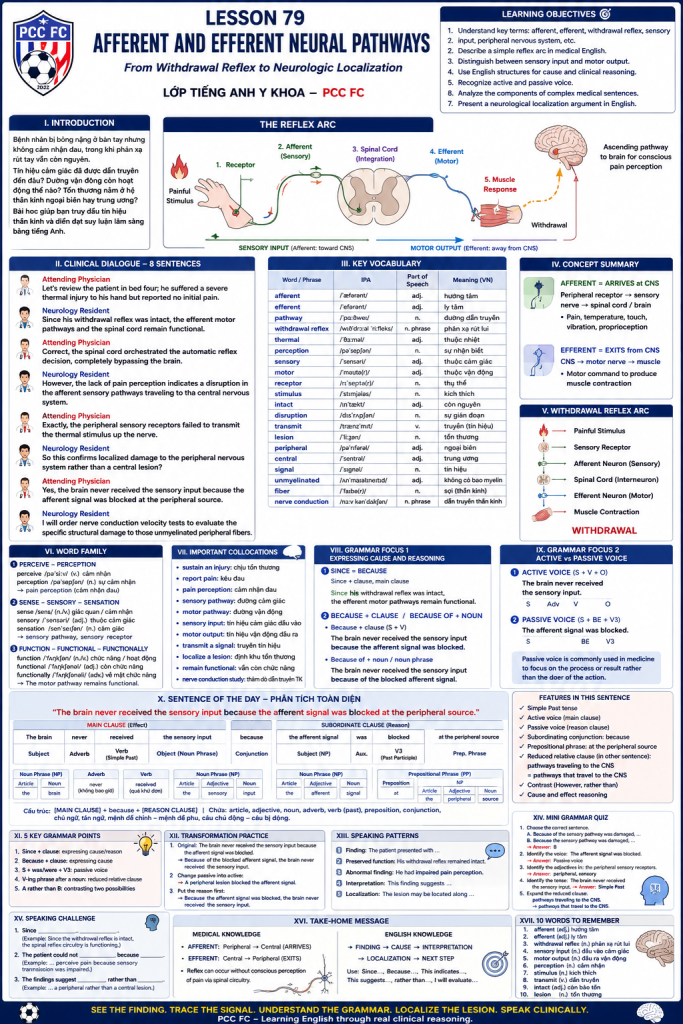
I. INTRODUCTION — DẪN NHẬP
A patient sustains a severe thermal injury to the hand but surprisingly reports no pain. However, when exposed to a painful stimulus, the hand still withdraws automatically.
How can a patient respond to a painful stimulus without consciously perceiving pain?
This apparently simple observation introduces one of the most fundamental concepts in clinical neurophysiology: the distinction between afferent and efferent neural pathways.
To understand the patient’s response, we need to trace the signal step by step:
Stimulus → sensory receptor → afferent pathway → spinal cord → efferent pathway → muscle response
At the same time, another signal travels upward toward the brain, allowing the patient to become consciously aware of pain.
In this lesson, we will use a short clinical dialogue to learn not only the language of neurological examination but also how English grammar can be used to express observation, cause, inference, localization, and clinical decision-making.
Key question of the lesson:
If a reflex is preserved but conscious sensation is abnormal, where might the neurological problem be located?
II. LEARNING OBJECTIVES
By the end of Lesson 79, learners should be able to:
- Understand the terms afferent, efferent, withdrawal reflex, sensory input, peripheral nervous system, and related neurological vocabulary.
- Describe a simple reflex arc in medical English.
- Distinguish between sensory input and motor output.
- Use English structures for cause and clinical reasoning.
- Recognize the difference between active and passive voice.
- Analyze the major components of a complex medical sentence.
- Present a simple neurological localization argument in English.
III. CLINICAL DIALOGUE — 8 SENTENCES
1. Attending Physician
Let’s review the patient in bed four; he suffered a severe thermal injury to his hand but reported no initial pain.
2. Neurology Resident
Since his withdrawal reflex was intact, the efferent motor pathways and the spinal cord remain functional.
3. Attending Physician
Correct, the spinal cord orchestrated the automatic reflex decision, completely bypassing the brain.
4. Neurology Resident
However, the lack of pain perception indicates a disruption in the afferent sensory pathways traveling to the central nervous system.
5. Attending Physician
Exactly, the peripheral sensory receptors failed to transmit the thermal stimulus up the nerve.
6. Neurology Resident
So this confirms localized damage to the peripheral nervous system rather than a central lesion?
7. Attending Physician
Yes, the brain never received the sensory input because the afferent signal was blocked at the peripheral source.
8. Neurology Resident
I will order nerve conduction velocity tests to evaluate the specific structural damage to those unmyelinated peripheral fibers.
IV. CLINICAL CONCEPT — HIỂU Ý CHÍNH TRƯỚC KHI HỌC TIẾNG ANH
1. Afferent pathway
AFFERENT = toward the CNS
A sensory signal travels:
Peripheral receptor → sensory nerve → spinal cord / brain
Ví dụ:
- pain
- temperature
- touch
- vibration
- proprioception
Memory trick
AFFERENT = ARRIVES at the CNS
2. Efferent pathway
EFFERENT = away from the CNS
A motor signal travels:
CNS → peripheral motor nerve → muscle
Memory trick
EFFERENT = EXITS the CNS
3. Withdrawal reflex
A painful stimulus can produce an automatic withdrawal response:
Painful stimulus
↓
Sensory receptor
↓
Afferent neuron
↓
Spinal cord
↓
Interneuron
↓
Efferent motor neuron
↓
Muscle contraction
↓
WITHDRAWAL
The key idea:
A reflex response can occur before conscious perception of pain.
V. KEY VOCABULARY — TỪ MỚI TRỌNG TÂM
| Word / Phrase | IPA | Word class | Nghĩa |
| afferent | /ˈæfərənt/ | adj. | hướng tâm |
| efferent | /ˈefərənt/ | adj. | ly tâm |
| pathway | /ˈpɑːθweɪ/ | n. | đường dẫn truyền |
| withdrawal | /wɪðˈdrɔːəl/ | n. | sự rút lại |
| withdrawal reflex | /wɪðˈdrɔːəl ˈriːfleks/ | n. phrase | phản xạ rút lui |
| reflex | /ˈriːfleks/ | n. | phản xạ |
| thermal | /ˈθɜːməl/ | adj. | thuộc nhiệt |
| injury | /ˈɪndʒəri/ | n. | tổn thương |
| perception | /pəˈsepʃən/ | n. | sự nhận biết/cảm nhận |
| pain perception | /peɪn pəˈsepʃən/ | n. phrase | cảm nhận đau |
| disruption | /dɪsˈrʌpʃən/ | n. | sự gián đoạn |
| sensory | /ˈsensəri/ | adj. | thuộc cảm giác |
| motor | /ˈməʊtə(r)/ | adj. | thuộc vận động |
| receptor | /rɪˈseptə(r)/ | n. | thụ thể |
| stimulus | /ˈstɪmjələs/ | n. | kích thích |
| stimuli | /ˈstɪmjəlaɪ/ | n., plural | các kích thích |
| spinal cord | /ˈspaɪnəl kɔːd/ | n. phrase | tủy sống |
| central nervous system | /ˌsentrəl ˈnɜːvəs ˌsɪstəm/ | n. phrase | hệ thần kinh trung ương |
| peripheral nervous system | /pəˈrɪfərəl ˈnɜːvəs ˌsɪstəm/ | n. phrase | hệ thần kinh ngoại biên |
| lesion | /ˈliːʒən/ | n. | tổn thương |
| localized | /ˈləʊkəlaɪzd/ | adj. | khu trú |
| transmit | /trænzˈmɪt/ | v. | truyền |
| bypass | /ˈbaɪpɑːs/ | v. | đi vòng qua |
| intact | /ɪnˈtækt/ | adj. | còn nguyên, được bảo tồn |
| functional | /ˈfʌŋkʃənəl/ | adj. | còn chức năng |
| structural | /ˈstrʌktʃərəl/ | adj. | thuộc cấu trúc |
| unmyelinated | /ʌnˈmaɪəlɪneɪtɪd/ | adj. | không có bao myelin |
| fiber | /ˈfaɪbə(r)/ | n. | sợi |
| nerve conduction | /nɜːv kənˈdʌkʃən/ | n. phrase | dẫn truyền thần kinh |
VI. WORD FAMILY — HỌC TỪ THEO GIA ĐÌNH
1. PERCEIVE — PERCEPTION
perceive /pəˈsiːv/ — verb
→ cảm nhận, nhận thức
perception /pəˈsepʃən/ — noun
→ sự cảm nhận
pain perception
→ cảm nhận đau
Example:
The patient could not perceive pain.
→ The patient had impaired pain perception.
2. SENSE — SENSORY — SENSATION
sense /sens/ — noun/verb
sensory /ˈsensəri/ — adjective
sensation /senˈseɪʃən/ — noun
Examples:
- sensory pathway
- sensory receptor
- sensory examination
- loss of sensation
3. FUNCTION — FUNCTIONAL — FUNCTIONALLY
function /ˈfʌŋkʃən/ — noun/verb
functional /ˈfʌŋkʃənəl/ — adjective
functionally /ˈfʌŋkʃənəli/ — adverb
Example:
The motor pathway remains functional.
VII. IMPORTANT COLLOCATIONS
Không nên học từ riêng lẻ. Hãy học theo cụm.
sustain an injury
bị/chịu một tổn thương
report pain
ghi nhận/kêu đau
pain perception
cảm nhận đau
sensory pathway
đường cảm giác
motor pathway
đường vận động
sensory input
tín hiệu cảm giác đầu vào
motor output
tín hiệu vận động đầu ra
transmit a signal
truyền tín hiệu
localize a lesion
định khu tổn thương
remain functional
vẫn còn chức năng
nerve conduction study
thăm dò dẫn truyền thần kinh
VIII. GRAMMAR FOCUS
EXPRESSING CAUSE AND CLINICAL REASONING
Một trong những kỹ năng quan trọng nhất của tiếng Anh y khoa là diễn đạt:
FINDING → REASON → INTERPRETATION
Trong hội thoại này có hai cấu trúc đặc biệt quan trọng:
SINCE + CLAUSE
và
BECAUSE + CLAUSE
1. SINCE = BECAUSE
Trong câu:
Since his withdrawal reflex was intact, the efferent motor pathways and the spinal cord remain functional.
Since không mang nghĩa “kể từ khi”.
Ở đây:
Since = because = vì/bởi vì
Cấu trúc:
Since + S + V, S + V.
Ví dụ:
Since the patient is hypotensive, we should assess his circulation immediately.
Vì bệnh nhân tụt huyết áp, chúng ta cần đánh giá tuần hoàn ngay.
2. BECAUSE
Sentence 7:
The brain never received the sensory input because the afferent signal was blocked at the peripheral source.
Cấu trúc:
Main clause + because + subordinate clause
The brain never received the sensory input
= kết quả/hiện tượng
because the afferent signal was blocked…
= nguyên nhân
IX. BECAUSE vs BECAUSE OF
Đây là điểm rất hay nhầm.
BECAUSE + CLAUSE
because the afferent signal was blocked
Sau because phải có:
Subject + Verb
BECAUSE OF + NOUN / NOUN PHRASE
because of the blocked afferent signal
Ví dụ:
The patient could not feel pain because the sensory pathway was damaged.
vs.
The patient could not feel pain because of sensory pathway damage.
X. GRAMMAR FOCUS 2
ACTIVE VOICE vs PASSIVE VOICE
Hai dạng cùng xuất hiện trong câu 7.
Active
The brain never received the sensory input.
Subject:
the brain
Verb:
received
Object:
the sensory input
Cấu trúc:
S + V + O
Passive
The afferent signal was blocked.
Cấu trúc:
S + BE + Past Participle
the afferent signal = subject
was = auxiliary verb
blocked = past participle
Tại sao tiếng Anh y khoa dùng bị động rất nhiều?
Vì người nói thường quan tâm đến:
PROCESS / EVENT / RESULT
hơn là người thực hiện hành động.
Ví dụ:
The nerve was damaged.
The patient was intubated.
A CT scan was performed.
The toxin was absorbed rapidly.
XI. SENTENCE OF THE DAY
PHÂN TÍCH TOÀN DIỆN MỘT CÂU ĐIỂN HÌNH
“The brain never received the sensory input because the afferent signal was blocked at the peripheral source.”
Đây là câu rất tốt để học ngữ pháp đại cương, bởi nó chứa đồng thời:
- chủ ngữ
- động từ
- tân ngữ
- trạng từ
- mạo từ
- tính từ
- liên từ
- mệnh đề chính
- mệnh đề phụ
- câu chủ động
- câu bị động
- thì quá khứ đơn
- giới từ
- cụm danh từ
XII. LEVEL 1 — SENTENCE STRUCTURE
Toàn câu gồm 2 mệnh đề:
MAIN CLAUSE
The brain never received the sensory input
SUBORDINATE CLAUSE OF REASON
because the afferent signal was blocked at the peripheral source
Sơ đồ:
[MAIN CLAUSE] + because + [REASON CLAUSE]
XIII. LEVEL 2 — MAIN CLAUSE
The brain / never / received / the sensory input.
Subject
The brain
brain = noun
the = definite article
Adverb
never
Từ loại:
adverb
Bổ nghĩa cho động từ received.
Ý nghĩa:
không bao giờ / hoàn toàn không trong bối cảnh đang nói đến.
Vị trí thông thường:
Subject + frequency adverb + lexical verb
Ví dụ:
The patient never reported chest pain.
Verb
received
Động từ:
receive
Thì:
Simple Past
receive → received
Tại sao dùng quá khứ?
Vì đang mô tả một sự kiện đã xảy ra:
the brain did not receive the signal.
Object
the sensory input
Đây là một:
noun phrase
Trong đó:
the → article
sensory → adjective
input → head noun
Cấu trúc:
Article + Adjective + Noun
Tương tự:
- the peripheral nerve
- the sensory pathway
- the central nervous system
- the painful stimulus
XIV. LEVEL 3 — “BECAUSE”
because
Từ loại:
subordinating conjunction
Chức năng:
Nối một mệnh đề phụ chỉ nguyên nhân với mệnh đề chính.
Question:
Why did the brain not receive the sensory input?
Answer:
Because the afferent signal was blocked.
Đây chính là logic rất thường gặp trong trình bày ca bệnh:
Observation → because → mechanism
XV. LEVEL 4 — PASSIVE CLAUSE
The afferent signal was blocked.
Cấu trúc:
S + was + V3
Subject:
the afferent signal
Auxiliary:
was
Past participle:
blocked
Đây là:
SIMPLE PAST PASSIVE
Công thức tổng quát:
S + was/were + V3
Ví dụ:
The nerve was damaged.
The patient was intubated.
The toxin was absorbed.
The sample was collected.
XVI. LEVEL 5 — WHY PASSIVE?
So sánh:
Active
The lesion blocked the afferent signal.
Passive
The afferent signal was blocked.
Trong y khoa, dạng bị động đặc biệt hữu ích khi:
- Người thực hiện không quan trọng.
- Nguyên nhân cụ thể chưa biết.
- Muốn nhấn mạnh quá trình hoặc đối tượng chịu tác động.
- Viết theo phong cách khách quan, khoa học.
XVII. LEVEL 6 — PREPOSITIONAL PHRASE
at the peripheral source
at = preposition
the peripheral source = noun phrase
Trong đó:
peripheral = adjective
source = noun
Cả cụm:
prepositional phrase
Nó bổ sung thông tin:
tín hiệu bị chặn ở đâu.
XVIII. LEVEL 7 — ARTICLES
Trong câu có:
the brain
the sensory input
the afferent signal
the peripheral source
Tất cả sử dụng the.
Tại sao?
Vì người nói đang đề cập đến những cấu trúc/tín hiệu cụ thể của bệnh nhân đang được bàn luận.
Không phải một bộ não bất kỳ:
❌ a brain
mà là:
✅ the brain
của bệnh nhân này.
XIX. LEVEL 8 — ADJECTIVES
sensory input
sensory modifies input
afferent signal
afferent modifies signal
peripheral source
peripheral modifies source
Một quy tắc cực kỳ quan trọng:
ADJECTIVE + NOUN
Tính từ tiếng Anh thường đứng trước danh từ.
Ví dụ:
severe injury
thermal injury
sensory pathway
motor neuron
central lesion
peripheral nerve
XX. LEVEL 9 — SENTENCE LOGIC
Câu này không chỉ là ngữ pháp.
Nó thể hiện cấu trúc tư duy:
EFFECT
The brain never received the sensory input.
↓
CAUSE
because
↓
MECHANISM
the afferent signal was blocked.
Đây là cấu trúc cực kỳ hữu ích trong clinical presentation:
FINDING + BECAUSE + PATHOPHYSIOLOGIC EXPLANATION
XXI. TRANSFORMATION PRACTICE
Original
The brain never received the sensory input because the afferent signal was blocked.
Because → Because of
The brain never received the sensory input because of blockage of the afferent signal.
Change passive into active
A peripheral lesion blocked the afferent signal.
Put the reason first
Because the afferent signal was blocked, the brain never received the sensory input.
Lưu ý:
Khi mệnh đề because đứng trước, thường đặt dấu phẩy trước mệnh đề chính.
XXII. ANOTHER IMPORTANT SENTENCE
“However, the lack of pain perception indicates a disruption in the afferent sensory pathways traveling to the central nervous system.”
Cấu trúc:
However
→ linking adverb
the lack of pain perception
→ subject
indicates
→ verb
a disruption
→ object
in the afferent sensory pathways
→ prepositional phrase
traveling to the central nervous system
→ present participial phrase modifying pathways
XXIII. IMPORTANT GRAMMAR
PRESENT PARTICIPLE AS A REDUCED RELATIVE CLAUSE
pathways traveling to the CNS
=
pathways that travel to the CNS
Đây là cách rút gọn rất phổ biến trong văn phong y khoa.
Ví dụ:
patients receiving mechanical ventilation
=
patients who are receiving mechanical ventilation
neurons carrying pain signals
=
neurons that carry pain signals
blood flowing through the artery
=
blood that flows through the artery
XXIV. HOWEVER — CONTRAST
Sentence 4 bắt đầu bằng:
However,
Đây là:
conjunctive adverb / linking adverb
Nghĩa:
tuy nhiên
Nó báo hiệu một thông tin tương phản với ý trước.
Clinical presentation:
Motor function was preserved. However, sensory loss persisted.
The blood pressure improved. However, lactate remained elevated.
Đây là một từ nối rất quan trọng trong trình bày ca bệnh.
XXV. RATHER THAN
Sentence 6:
“…the peripheral nervous system rather than a central lesion.”
rather than = chứ không phải / thay vì
Dùng để đối chiếu hai khả năng:
A rather than B
Ví dụ:
The findings suggest a peripheral rather than a central lesion.
Đây là cấu trúc cực kỳ hữu ích khi làm differential diagnosis.
XXVI. WILL + VERB
Sentence 8:
“I will order nerve conduction velocity tests…”
Cấu trúc:
will + bare infinitive
will order
Trong clinical English, will có thể diễn đạt một quyết định hoặc kế hoạch tiếp theo:
I will order a CT scan.
We will repeat the blood gas.
We will monitor the patient closely.
XXVII. PRONUNCIATION FOCUS
afferent
/ˈæfərənt/
AF-fer-ent
efferent
/ˈefərənt/
EF-fer-ent
Đây là hai từ rất dễ nhầm.
Remember:
A = ARRIVES
Afferent information arrives at the CNS.
E = EXITS
Efferent information exits the CNS.
peripheral
/pəˈrɪfərəl/
Stress:
peri-PHER-al
perception
/pəˈsepʃən/
Stress:
per-CEP-tion
neurological
/ˌnjʊərəˈlɒdʒɪkəl/
Stress chính:
neu-ro-LOG-i-cal
XXVIII. SPEAKING PATTERNS FOR CLINICAL ENGLISH
Hãy học 5 mẫu câu này như các “khung” trình bày lâm sàng.
1. Finding
The patient presented with…
2. Preserved function
His withdrawal reflex remained intact.
3. Abnormal finding
He had impaired pain perception.
4. Interpretation
This finding suggests…
5. Localization
The lesion may be located along…
XXIX. CLINICAL PRESENTATION MODEL
Patient
The patient sustained a severe thermal injury to his hand.
Unexpected finding
Despite the injury, he initially reported no pain.
Examination
His withdrawal reflex remained intact.
Interpretation
This suggests preserved function of at least part of the reflex circuitry.
Next step
Further neurological assessment is required to localize the lesion.
XXX. MINI GRAMMAR QUIZ
1. Choose the correct sentence.
A. Because of the sensory pathway was damaged, the patient felt no pain.
B. Because the sensory pathway was damaged, the patient felt no pain.
Answer:
B
Because + clause.
2. Identify the voice:
The afferent signal was blocked.
Answer:
Passive voice
3. Identify the adjective:
the peripheral sensory receptors
Answer:
peripheral
sensory
Both modify receptors.
4. Identify the tense:
The brain never received the sensory input.
Answer:
Simple Past
5. Expand the reduced clause:
pathways traveling to the CNS
Answer:
pathways that travel to the CNS
XXXI. SPEAKING CHALLENGE
Complete these sentences aloud:
Since ________, ________.
Example:
Since the withdrawal reflex is intact, the spinal reflex circuitry is functioning.
The patient could not ______ because ______.
Example:
The patient could not perceive pain because sensory transmission was impaired.
The findings suggest ______ rather than ______.
Example:
The findings suggest a sensory abnormality rather than isolated motor dysfunction.
XXXII. 5 KEY GRAMMAR POINTS OF LESSON 79
1.
Since + clause
→ expressing cause/reason
2.
Because + clause
→ expressing cause
3.
S + was/were + V3
→ passive voice
4.
V-ing phrase after a noun
→ reduced relative clause
5.
A rather than B
→ contrasting two diagnostic possibilities
XXXIII. 10 WORDS TO REMEMBER
- afferent — hướng tâm
- efferent — ly tâm
- withdrawal reflex — phản xạ rút lui
- sensory input — đầu vào cảm giác
- motor output — đầu ra vận động
- perception — cảm nhận
- stimulus — kích thích
- transmit — dẫn truyền
- intact — còn bảo tồn
- lesion — tổn thương
XXXIV. TAKE-HOME MESSAGE
MEDICAL KNOWLEDGE
AFFERENT
Peripheral → Central
EFFERENT
Central → Peripheral
REFLEX
A sensory stimulus can generate a motor response through spinal circuitry before conscious cortical perception occurs.
ENGLISH KNOWLEDGE
To speak clinically, learn to connect:
FINDING
↓
CAUSE
↓
INTERPRETATION
↓
LOCALIZATION
↓
NEXT STEP
Useful structures:
Since…
Because…
This indicates…
This suggests…
rather than…
I will evaluate…
⭐ SENTENCE OF THE DAY
“The brain never received the sensory input because the afferent signal was blocked at the peripheral source.”
Remember its architecture:
SUBJECT
The brain
ADVERB
never
VERB
received
OBJECT
the sensory input
CONJUNCTION
because
PASSIVE CLAUSE
the afferent signal was blocked
PREPOSITIONAL PHRASE
at the peripheral source
⚽ PCC FC — MEDICAL ENGLISH LESSON 79
AFFERENT & EFFERENT NEURAL PATHWAYS
SEE THE FINDING.
TRACE THE SIGNAL.
UNDERSTAND THE GRAMMAR.
LOCALIZE THE LESION.
SPEAK CLINICALLY.
PCC FC — Learning English through real clinical reasoning.