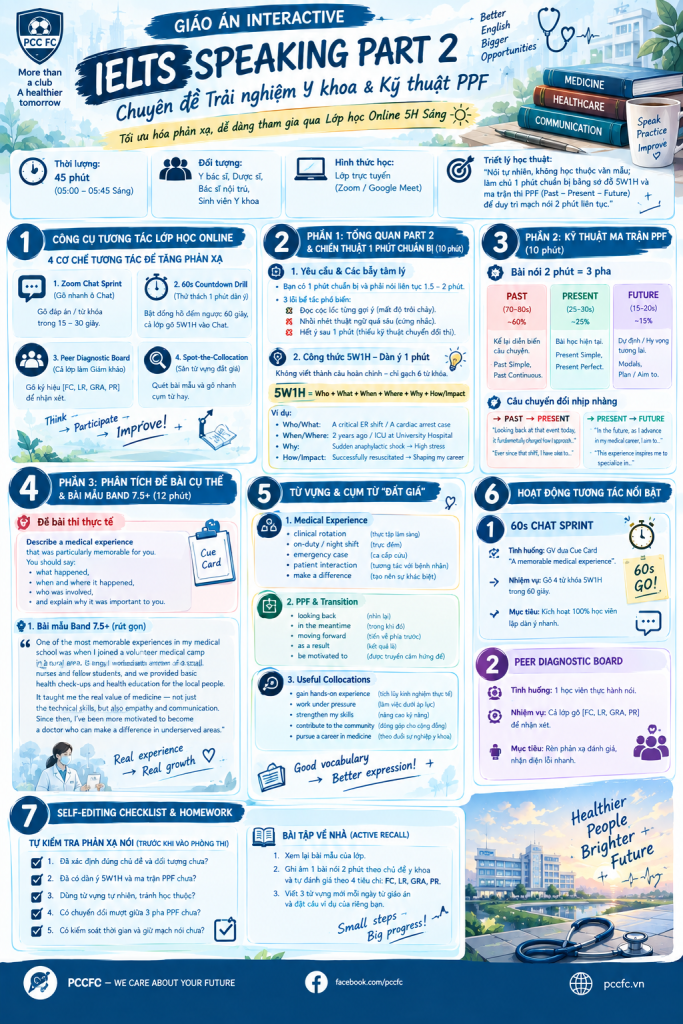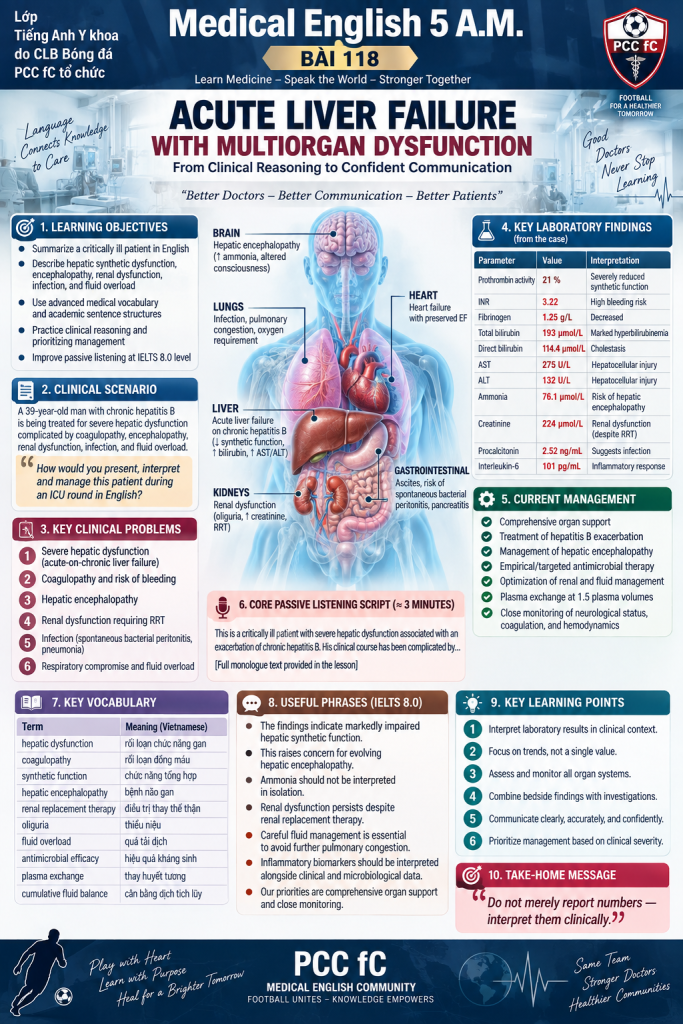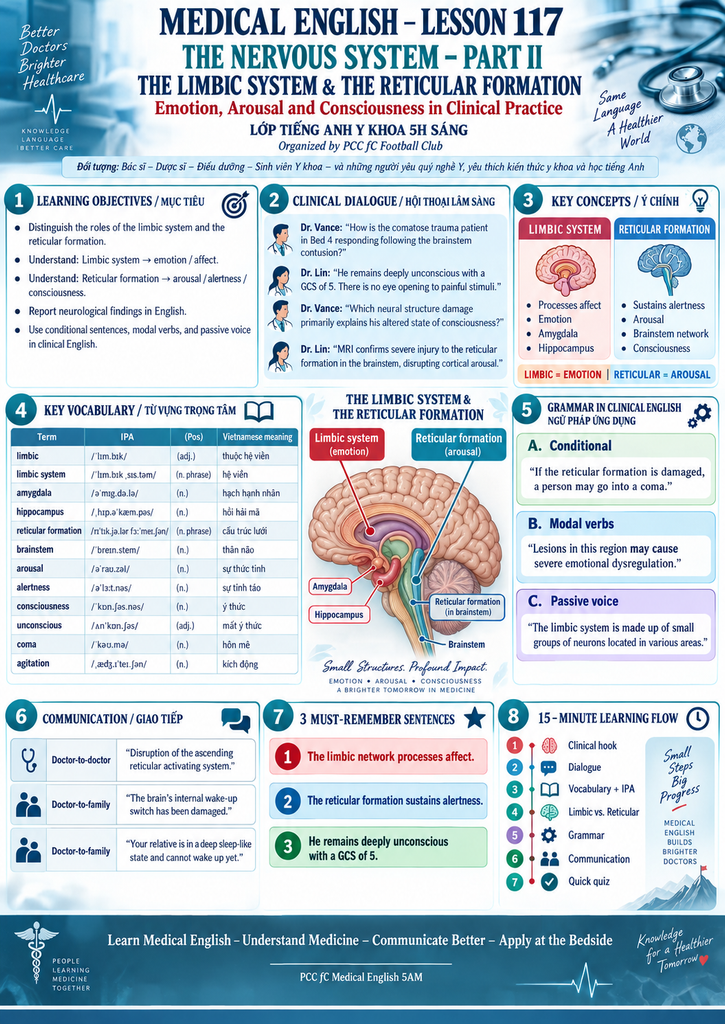
Bài 82 – Tiếng Anh Y Khoa: Acute myeloid leukemia with post-chemotherapy infection * Nhiễm khuẩn sau điều trị hóa chất ở bệnh nhân bạch cầu cấp.
PCC Language – Thăng Long, Hà Nội, ngày 13/8/2026, Trong thực hành lâm sàng, một bệnh nhân lơ-xê-mi cấp dòng tủy sau hóa trị không chỉ đặt ra thách thức trong việc kiểm soát bệnh lý huyết học nền, mà còn đòi hỏi người bác sĩ phải nhanh chóng nhận diện những biến chứng có thể đe dọa tính mạng như giảm bạch cầu, sốt kéo dài, nhiễm trùng nặng và suy hô hấp tiến triển. Bài 82 của Lớp Tiếng Anh Y Khoa do CLB Bóng đá PCC fC tổ chức sẽ đưa chúng ta đến với một tình huống lâm sàng rất thực tế: một bệnh nhân nam 75 tuổi mắc Acute Myeloid Leukemia – FAB M5, sau điều trị bằng phác đồ có decitabine, xuất hiện giảm bạch cầu, sốt kéo dài và khó thở; bệnh nhân cần hỗ trợ oxy qua mask 10 L/phút, đồng thời CT ngực ghi nhận các tổn thương tại phổi.
Giá trị của bài học hôm nay không chỉ nằm ở việc bổ sung thêm một số thuật ngữ về huyết học, nhiễm trùng và hô hấp. Mục tiêu quan trọng hơn là rèn luyện khả năng trình bày một câu chuyện lâm sàng bằng tiếng Anh theo đúng logic tư duy của người bác sĩ: từ chẩn đoán bệnh nền → biến chứng sau điều trị → diễn biến hô hấp → bằng chứng hình ảnh học → quyết định điều trị. Thông qua tám câu hội thoại ngắn gọn nhưng giàu thông tin, người học sẽ thực hành cách mô tả bệnh nhân một cách chính xác, tự nhiên và chuyên nghiệp, đồng thời làm quen với những cấu trúc thường xuyên được sử dụng trong giao ban, hội chẩn, trình bày ca bệnh và trao đổi chuyên môn quốc tế.
Một điểm đặc biệt cần chú ý là cách các thông tin lâm sàng được kết nối thành một chuỗi diễn biến có logic. Cụm “followed by” giúp mô tả một sự kiện xảy ra tiếp sau sự kiện khác; “so” thể hiện mối quan hệ nguyên nhân – hệ quả trong diễn biến lâm sàng; trong khi cấu trúc “while + V-ing” cho phép mô tả những biện pháp xử trí hoặc quá trình đang diễn ra song song. Khi sử dụng thành thạo những cấu trúc này, chúng ta không chỉ nói tiếng Anh Y khoa chính xác hơn, mà quan trọng hơn, còn có thể chuyển hóa tư duy lâm sàng thành ngôn ngữ rõ ràng, mạch lạc và có sức thuyết phục.
English Version
In clinical practice, managing a patient with acute myeloid leukemia after chemotherapy involves far more than treating the underlying hematological malignancy. Physicians must also recognize potentially life-threatening complications at an early stage, including leukopenia, persistent fever, severe infection, and progressive respiratory failure. Lesson 82 of the Medical English Class organized by PCC fC Football Club takes us through a highly realistic clinical scenario: a 75-year-old man with Acute Myeloid Leukemia, FAB M5, who developed leukopenia, persistent fever, and progressive dyspnea after receiving a decitabine-based treatment regimen. He subsequently required oxygen therapy via a face mask at 10 L/min, while chest CT revealed pulmonary abnormalities.
The value of today’s lesson goes beyond learning additional vocabulary in hematology, infectious diseases, and respiratory medicine. More importantly, it aims to develop the ability to present a clinical story in English according to the logical thinking process of a physician: from the underlying diagnosis → post-treatment complications → respiratory deterioration → imaging evidence → treatment decisions. Through eight concise yet information-rich dialogue sentences, learners will practise describing a patient accurately, naturally, and professionally, while becoming familiar with language commonly used during clinical handovers, multidisciplinary discussions, case presentations, and international medical communication.
Particular attention should be paid to the way individual pieces of clinical information are linked together to form a coherent sequence of events. The expression “followed by” is useful for describing one event occurring after another; “so” clearly expresses a clinical cause-and-effect relationship; and “while + V-ing” helps describe interventions or processes taking place simultaneously. By mastering these structures, we are not simply improving our Medical English. More importantly, we are learning how to translate clinical reasoning into language that is clear, logical, coherent, and persuasive.
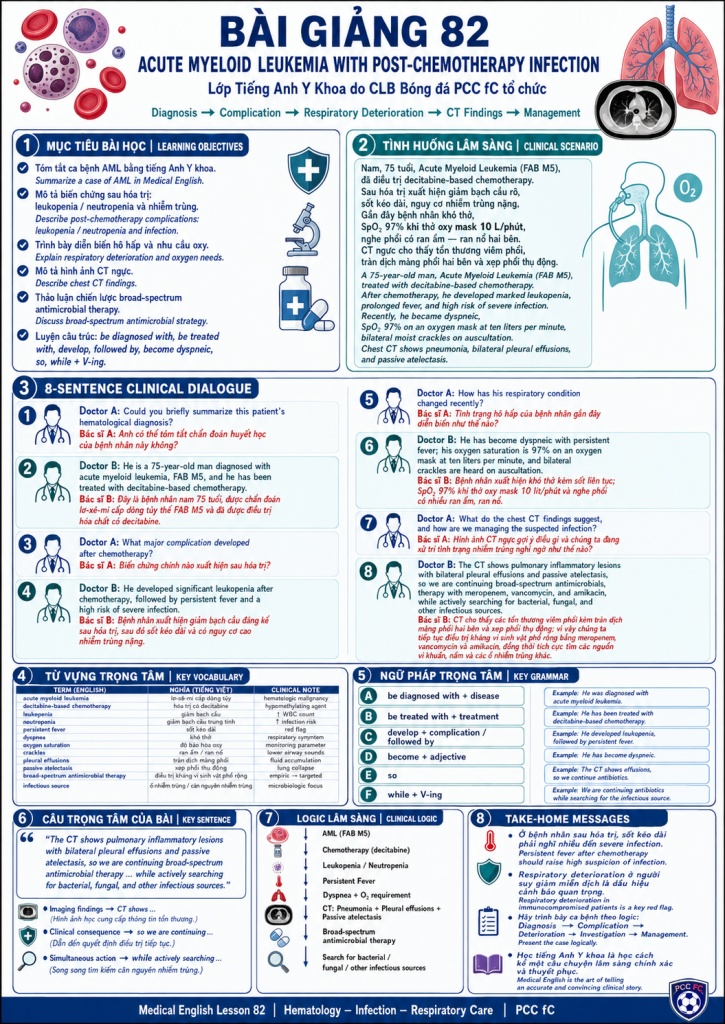
LỚP TIẾNG ANH Y KHOA – BÀI 82
ACUTE MYELOID LEUKEMIA WITH POST-CHEMOTHERAPY INFECTION
Acute Myeloid Leukemia – Febrile Neutropenia – Pulmonary Infection
Lớp Tiếng Anh Y Khoa do CLB Bóng đá PCC fC tổ chức

The Medical English Class organized by PCC fC Football Club would like to extend our warmest welcome to Freya and Molly, two medical students from the University of Glasgow, Scotland, United Kingdom, who are joining us as our Honorary Guest Lecturers.
Your presence gives us a wonderful opportunity not only to listen to authentic English and improve our pronunciation and medical communication skills, but also to build a meaningful bridge between medical learners in Vietnam and the United Kingdom. We are truly excited to hear your perspectives and experiences in medical education, clinical learning, language, and culture, and we believe your participation will bring fresh energy and inspiration to every member of our class.
Thank you, Freya and Molly, for joining us and becoming a special part of our 5 AM Medical English journey. Welcome to PCC fC — where we learn together, connect through medicine, and inspire one another to grow every day!
I. LEARNING OBJECTIVES – MỤC TIÊU BÀI HỌC
Sau bài học này, học viên có thể:
- Trình bày ngắn gọn một trường hợp acute myeloid leukemia – AML bằng tiếng Anh Y khoa.
- Mô tả các biến chứng thường gặp sau hóa trị, đặc biệt là leukopenia/neutropenia và nhiễm trùng.
- Trao đổi về diễn biến hô hấp, nhu cầu oxy và dấu hiệu nghe phổi.
- Mô tả các tổn thương chính trên chest CT.
- Trình bày chiến lược điều trị kháng vi sinh vật kinh nghiệm ở bệnh nhân suy giảm miễn dịch.
- Sử dụng chính xác các cấu trúc:
- be diagnosed with
- be treated with
- develop + complication
- followed by
- become + adjective
- while + V-ing
- so + clause
- Thực hành hội thoại bác sĩ–bác sĩ trong một tình huống huyết học–hồi sức–nhiễm trùng.
II. CLINICAL SCENARIO – TÌNH HUỐNG LÂM SÀNG
A 75-year-old man with acute myeloid leukemia, FAB M5, has received decitabine-based chemotherapy. After chemotherapy, he develops marked leukopenia, persistent fever and progressive respiratory symptoms.
He is currently dyspneic and requires oxygen via face mask at 8 L/min. His SpO₂ is 97%, and bilateral crackles are heard on auscultation.
Chest CT demonstrates pulmonary inflammatory lesions, bilateral pleural effusions and passive atelectasis. Because of the high risk of severe infection in an immunocompromised patient, broad-spectrum antimicrobial therapy is being continued while bacterial, fungal and other infectious causes are actively investigated.
Tóm tắt tiếng Việt
Bệnh nhân nam 75 tuổi mắc lơ-xê-mi cấp dòng tủy thể FAB M5, đã được điều trị hóa chất có decitabine. Sau hóa trị, bệnh nhân xuất hiện giảm bạch cầu rõ, sốt kéo dài và sau đó có biểu hiện suy hô hấp tiến triển.
Hiện bệnh nhân khó thở, thở oxy mask 8 L/phút, SpO₂ 97%, nghe phổi có ran ẩm/ran nổ hai bên. CT ngực cho thấy tổn thương viêm phổi, tràn dịch màng phổi hai bên và xẹp phổi thụ động.
III. 8-SENTENCE CLINICAL DIALOGUE
1. Doctor A
Could you briefly summarize this patient’s hematological diagnosis?
Bác sĩ A: Anh có thể tóm tắt ngắn gọn chẩn đoán huyết học của bệnh nhân này không?
2. Doctor B
He is a 75-year-old man diagnosed with acute myeloid leukemia, FAB M5, and he has been treated with decitabine-based chemotherapy.
Bác sĩ B: Đây là bệnh nhân nam 75 tuổi, được chẩn đoán lơ-xê-mi cấp dòng tủy thể FAB M5 và đã được điều trị hóa chất có decitabine.
3. Doctor A
What major complication developed after chemotherapy?
Bác sĩ A: Biến chứng chính nào xuất hiện sau hóa trị?
4. Doctor B
He developed significant leukopenia after chemotherapy, followed by persistent fever and a high risk of severe infection.
Bác sĩ B: Bệnh nhân xuất hiện giảm bạch cầu đáng kể sau hóa trị, sau đó sốt kéo dài và có nguy cơ cao nhiễm trùng nặng.
5. Doctor A
How has his respiratory condition changed recently?
Bác sĩ A: Tình trạng hô hấp của bệnh nhân gần đây diễn biến như thế nào?
6. Doctor B
He has become dyspneic with persistent fever; his oxygen saturation is 97% on an oxygen mask at eight liters per minute, and bilateral crackles are heard on auscultation.
Bác sĩ B: Bệnh nhân xuất hiện khó thở kèm sốt liên tục; SpO₂ 97% khi thở oxy mask 8 lít/phút và nghe phổi có nhiều ran ẩm, ran nổ hai bên.
7. Doctor A
What do the chest CT findings suggest, and how are we managing the suspected infection?
Bác sĩ A: Hình ảnh CT ngực gợi ý điều gì và chúng ta đang xử trí tình trạng nhiễm trùng nghi ngờ như thế nào?
8. Doctor B
The CT shows pulmonary inflammatory lesions with bilateral pleural effusions and passive atelectasis, so we are continuing broad-spectrum antimicrobial therapy with meropenem, vancomycin, and amikacin, while actively searching for bacterial, fungal, and other infectious sources.
Bác sĩ B: CT cho thấy các tổn thương viêm phổi kèm tràn dịch màng phổi hai bên và xẹp phổi thụ động; vì vậy chúng ta tiếp tục điều trị kháng vi sinh vật phổ rộng bằng meropenem, vancomycin và amikacin, đồng thời tích cực tìm căn nguyên vi khuẩn, nấm và các ổ nhiễm trùng khác.
IV. KEY MEDICAL VOCABULARY
| Vocabulary | IPA | Word class | Meaning |
| acute myeloid leukemia | /əˈkjuːt ˈmaɪəlɔɪd luːˈkiːmiə/ | noun | Lơ-xê-mi cấp dòng tủy |
| hematological | /ˌhiːmətəˈlɒdʒɪkəl/ | adjective | Thuộc huyết học |
| chemotherapy | /ˌkiːməʊˈθerəpi/ | noun | Hóa trị |
| leukopenia | /ˌluːkəˈpiːniə/ | noun | Giảm bạch cầu |
| neutropenia | /ˌnjuːtrəˈpiːniə/ | noun | Giảm bạch cầu trung tính |
| persistent | /pəˈsɪstənt/ | adjective | Kéo dài, dai dẳng |
| infection | /ɪnˈfekʃən/ | noun | Nhiễm trùng |
| immunocompromised | /ˌɪmjʊnəʊˈkɒmprəmaɪzd/ | adjective | Suy giảm miễn dịch |
| dyspneic | /dɪspˈniːɪk/ | adjective | Khó thở |
| oxygen saturation | /ˈɒksɪdʒən ˌsætʃəˈreɪʃən/ | noun | Độ bão hòa oxy |
| crackles | /ˈkrækəlz/ | noun | Ran nổ/ran ẩm |
| auscultation | /ˌɔːskəlˈteɪʃən/ | noun | Nghe bằng ống nghe |
| pulmonary | /ˈpʌlmənəri/ | adjective | Thuộc phổi |
| pleural effusion | /ˈplʊərəl ɪˈfjuːʒən/ | noun | Tràn dịch màng phổi |
| atelectasis | /ˌætəˈlektəsɪs/ | noun | Xẹp phổi |
| broad-spectrum | /ˌbrɔːd ˈspektrəm/ | adjective | Phổ rộng |
| antimicrobial | /ˌæntimaɪˈkrəʊbiəl/ | adjective/noun | Kháng vi sinh vật |
| fungal | /ˈfʌŋɡəl/ | adjective | Thuộc nấm |
| infectious source | /ɪnˈfekʃəs sɔːs/ | noun | Ổ/căn nguyên nhiễm trùng |
V. PRONUNCIATION FOCUS
1. Leukemia
leukemia
/luːˈkiː.mi.ə/
Nhấn vào âm KI:
loo-KEE-mee-uh
2. Leukopenia
/ˌluː.kəˈpiː.ni.ə/
loo-kuh-PEE-nee-uh
3. Neutropenia
/ˌnjuː.trəˈpiː.ni.ə/
new-truh-PEE-nee-uh
4. Atelectasis
/ˌæt.əˈlek.tə.sɪs/
at-uh-LEK-tuh-sis
5. Auscultation
/ˌɔː.skəlˈteɪ.ʃən/
Nhấn vào TA:
aws-kul-TAY-shun
VI. IMPORTANT CLINICAL LANGUAGE
1. “Be diagnosed with…”
Structure
Subject + be + diagnosed with + disease
Ví dụ:
He was diagnosed with acute myeloid leukemia.
→ Bệnh nhân được chẩn đoán lơ-xê-mi cấp dòng tủy.
Không nên nói:
He was diagnosed acute myeloid leukemia.
Phải có with.
2. “Be treated with…”
He has been treated with decitabine-based chemotherapy.
Structure
Subject + have/has been + treated with + treatment
Đây là Present Perfect Passive:
has been treated
Hàm ý: việc điều trị đã diễn ra trước đây nhưng vẫn có liên quan trực tiếp đến tình trạng hiện tại.
VII. GRAMMAR FOCUS 1
“He developed significant leukopenia after chemotherapy, followed by persistent fever…”
Key structure
A, followed by B
= A xảy ra trước, sau đó đến B.
Ví dụ:
The patient developed neutropenia, followed by persistent fever.
= Bệnh nhân giảm bạch cầu trung tính, sau đó xuất hiện sốt kéo dài.
Một số ví dụ ICU
Hypotension was followed by acute kidney injury.
Tụt huyết áp sau đó là tổn thương thận cấp.
The patient developed respiratory distress, followed by progressive hypoxemia.
Bệnh nhân suy hô hấp, sau đó giảm oxy máu tiến triển.
VIII. GRAMMAR FOCUS 2
“He has become dyspneic…”
Structure
become + adjective
become dyspneic
→ trở nên khó thở
become hypotensive
→ xuất hiện tụt huyết áp
become confused
→ trở nên lú lẫn
become tachypneic
→ xuất hiện thở nhanh
Why Present Perfect?
He has become dyspneic.
Diễn tả một thay đổi mới xảy ra và hậu quả vẫn đang tồn tại tại thời điểm hiện tại.
IX. THE KEY SENTENCE OF LESSON 82
“The CT shows pulmonary inflammatory lesions with bilateral pleural effusions and passive atelectasis, so we are continuing broad-spectrum antimicrobial therapy … while actively searching for bacterial, fungal, and other infectious sources.”
Đây là câu quan trọng nhất của bài.
1. Clause 1 – Imaging finding
The CT shows pulmonary inflammatory lesions with bilateral pleural effusions and passive atelectasis.
Structure
Imaging + shows + findings
Các cách diễn đạt tương tự:
- The CT shows…
- The CT demonstrates…
- The CT reveals…
- CT imaging demonstrates…
Trong văn phong học thuật, demonstrates và reveals thường trang trọng hơn shows.
2. “so” – Clinical consequence
…, so we are continuing broad-spectrum antimicrobial therapy.
Structure
Clinical finding → so → clinical action
Ví dụ:
The patient remains febrile, so we are continuing antimicrobial therapy.
Bệnh nhân vẫn còn sốt, vì vậy chúng tôi tiếp tục điều trị kháng vi sinh vật.
X. GRAMMAR FOCUS 3
“while actively searching for…”
Full form
while we are actively searching for bacterial and fungal sources
Có thể rút gọn thành:
while actively searching for bacterial and fungal sources
Structure
Main action + while + V-ing
Dùng khi hai hành động được tiến hành đồng thời.
Ví dụ:
We are continuing antibiotics while awaiting culture results.
Chúng tôi tiếp tục kháng sinh trong khi chờ kết quả cấy.
We are supporting oxygenation while investigating the cause of respiratory deterioration.
Chúng tôi hỗ trợ oxy hóa máu đồng thời tìm nguyên nhân khiến tình trạng hô hấp xấu đi.
XI. MEDICAL ENGLISH: LEUKOPENIA vs NEUTROPENIA
Leukopenia
Leukopenia = giảm tổng số bạch cầu.
Neutropenia
Neutropenia = giảm số lượng bạch cầu trung tính.
Trong bệnh nhân hóa trị, nếu absolute neutrophil count – ANC giảm rõ, thuật ngữ có ý nghĩa lâm sàng hơn thường là:
chemotherapy-induced neutropenia
hoặc:
post-chemotherapy neutropenia
Nếu bệnh nhân có sốt kèm giảm bạch cầu trung tính:
febrile neutropenia
Đây là cụm từ rất quan trọng cần nhớ.
Useful sentence
The patient developed febrile neutropenia after chemotherapy.
Bệnh nhân xuất hiện sốt giảm bạch cầu trung tính sau hóa trị.
XII. HOW TO PRESENT THE RESPIRATORY STATUS
Thay vì chỉ nói:
The patient is dyspneic.
Một bác sĩ có thể trình bày đầy đủ:
The patient has developed progressive dyspnea and requires oxygen via a face mask at eight liters per minute. His SpO₂ is currently 97%, and bilateral crackles are heard on auscultation.
Clinical presentation pattern
Symptoms → Oxygen support → SpO₂ → Physical examination
Đây là cấu trúc rất hữu ích khi trình bày bệnh nhân trong giao ban.
XIII. DESCRIBING CHEST CT FINDINGS
Useful vocabulary
bilateral pulmonary infiltrates
→ thâm nhiễm phổi hai bên
ground-glass opacities
→ đám mờ kính
consolidation
→ đông đặc
pleural effusion
→ tràn dịch màng phổi
passive atelectasis
→ xẹp phổi thụ động
nodular lesions
→ tổn thương dạng nốt
cavitary lesions
→ tổn thương tạo hang
Clinical phrase
The CT findings are suggestive of pulmonary infection.
Hình ảnh CT gợi ý nhiễm trùng phổi.
XIV. ANTIBIOTIC LANGUAGE
Broad-spectrum antimicrobial therapy
Đây là cụm nên học nguyên khối:
broad-spectrum antimicrobial therapy
Không chỉ bao gồm antibiotics mà trong ngữ cảnh rộng hơn còn có thể bao hàm điều trị chống vi khuẩn, nấm hoặc các tác nhân vi sinh khác tùy trường hợp.
Example
Empirical broad-spectrum antimicrobial therapy was initiated because of persistent fever and profound neutropenia.
Điều trị kháng vi sinh vật phổ rộng theo kinh nghiệm được khởi đầu do bệnh nhân sốt kéo dài và giảm bạch cầu trung tính sâu.
XV. IMPORTANT WORD: EMPIRICAL
empirical /ɪmˈpɪrɪkəl/ – tính từ
Trong Y khoa:
empirical antibiotic therapy
= điều trị kháng sinh kinh nghiệm trước khi xác định chính xác tác nhân.
Example
Empirical antibiotics should be initiated promptly in a high-risk patient with febrile neutropenia.
XVI. COMMUNICATION UPGRADE
Basic English
He has fever and shortness of breath.
Better Medical English
He has persistent fever associated with progressive dyspnea.
More professional
He has developed persistent fever with progressive respiratory deterioration following chemotherapy-induced leukopenia.
XVII. USEFUL QUESTIONS DURING MORNING ROUNDS
1.
What is his current neutrophil count?
Số lượng bạch cầu trung tính hiện tại là bao nhiêu?
2.
Has any infectious source been identified?
Đã xác định được ổ nhiễm trùng nào chưa?
3.
Have blood cultures been obtained?
Đã lấy cấy máu chưa?
4.
Is there any microbiological evidence of fungal infection?
Có bằng chứng vi sinh nào của nhiễm nấm không?
5.
Has his oxygen requirement increased?
Nhu cầu oxy của bệnh nhân có tăng lên không?
6.
Are the pulmonary infiltrates progressing?
Các tổn thương thâm nhiễm phổi có tiến triển không?
7.
Should antifungal therapy be considered?
Có nên cân nhắc điều trị kháng nấm không?
8.
Is there any evidence of another infectious focus?
Có bằng chứng của một ổ nhiễm trùng khác không?
XVIII. ROLE-PLAY
Situation
Bạn đang giao ban một bệnh nhân AML sau hóa trị, hiện sốt kéo dài và khó thở.
Doctor A – Senior doctor
Ask about:
- hematological diagnosis
- chemotherapy
- white blood cell/neutrophil count
- duration of fever
- respiratory deterioration
- oxygen requirement
- chest CT
- microbiology
- antimicrobial therapy
Doctor B – Treating doctor
Present:
- AML FAB M5
- decitabine-based chemotherapy
- post-chemotherapy leukopenia/neutropenia
- persistent fever
- progressive dyspnea
- oxygen mask 8 L/min
- bilateral crackles
- pulmonary infection on CT
- bilateral pleural effusion
- passive atelectasis
- antimicrobial treatment
- ongoing search for infection
XIX. 60-SECOND CASE PRESENTATION
Học viên thử trình bày bệnh nhân trong 60 giây:
This is a 75-year-old man with acute myeloid leukemia, FAB M5, who has been treated with decitabine-based chemotherapy. Following chemotherapy, he developed significant leukopenia with persistent fever and a high risk of severe infection. Recently, his respiratory status has deteriorated, with progressive dyspnea requiring oxygen via a face mask at eight liters per minute. His oxygen saturation is currently 97%, and bilateral crackles are heard on auscultation. Chest CT demonstrates pulmonary inflammatory lesions, bilateral pleural effusions, and passive atelectasis. He is currently receiving broad-spectrum antimicrobial therapy while we continue to investigate possible bacterial, fungal, and other infectious sources.
XX. QUICK TRANSLATION PRACTICE
Vietnamese → English
1. Bệnh nhân được chẩn đoán lơ-xê-mi cấp dòng tủy.
→ The patient was diagnosed with acute myeloid leukemia.
2. Sau hóa trị, bệnh nhân xuất hiện giảm bạch cầu trung tính.
→ The patient developed neutropenia after chemotherapy.
3. Bệnh nhân sốt kéo dài và khó thở tăng dần.
→ The patient has persistent fever with progressive dyspnea.
4. Nhu cầu oxy của bệnh nhân đang tăng lên.
→ His oxygen requirement is increasing.
5. CT ngực cho thấy tổn thương viêm phổi hai bên.
→ Chest CT shows bilateral pulmonary inflammatory lesions.
6. Chúng tôi đang tiếp tục kháng sinh phổ rộng trong khi tìm căn nguyên nhiễm trùng.
→ We are continuing broad-spectrum antibiotics while searching for the infectious source.
XXI. MINI QUIZ
Question 1
Which term specifically means a decreased neutrophil count?
A. Leukemia
B. Leukopenia
C. Neutropenia
D. Thrombocytopenia
Answer: C. Neutropenia
Question 2
Complete the sentence:
He was diagnosed ___ acute myeloid leukemia.
A. of
B. from
C. with
D. by
Answer: C. with
Question 3
Which expression best describes two simultaneous clinical actions?
A. because
B. while
C. therefore
D. although
Answer: B. while
Question 4
Translate:
“Bệnh nhân xuất hiện khó thở tăng dần.”
Answer:
The patient has developed progressive dyspnea.
XXII. TAKE-HOME EXPRESSIONS
Hãy nhớ 8 cụm từ quan trọng của Lesson 82:
- acute myeloid leukemia
- decitabine-based chemotherapy
- chemotherapy-induced neutropenia
- persistent fever
- progressive respiratory deterioration
- bilateral pulmonary infiltrates
- broad-spectrum antimicrobial therapy
- actively searching for an infectious source
XXIII. THE CORE MESSAGE OF LESSON 82
In an immunocompromised patient after chemotherapy, persistent fever plus respiratory deterioration should immediately raise concern for severe infection.
Medical English thinking pattern
Underlying disease
→ AML
Treatment
→ Chemotherapy
Complication
→ Leukopenia / neutropenia
Clinical warning sign
→ Persistent fever
Organ deterioration
→ Progressive dyspnea / increasing oxygen requirement
Investigation
→ Chest CT + microbiological testing
Management
→ Broad-spectrum antimicrobial therapy + active search for the infectious source
ONE PATIENT – ONE STORY – ONE LOGICAL PRESENTATION
Diagnosis
AML
↓
Treatment
Chemotherapy
↓
Complication
Neutropenia
↓
Warning sign
Persistent fever
↓
Deterioration
Dyspnea + oxygen requirement
↓
Imaging
Pulmonary lesions + pleural effusions + atelectasis
↓
Action
Antimicrobial therapy + source investigation
PCC fC MEDICAL ENGLISH MESSAGE
Don’t just learn individual medical words.
Learn how to connect them into a clinical story.
Diagnosis → Complication → Deterioration → Investigation → Management
Đó chính là cách biến Tiếng Anh Y khoa từ một môn học thành một công cụ giao tiếp lâm sàng thực sự.
PCC fC