Bài 83 – Tiếng Anh Y Khoa: Từ dẫn truyền qua synap đến mất myelin và chậm dẫn truyền sợi trục * From Synaptic Transmission to Demyelination and Slowed Axonal Conduction
PCC Language – Thăng Long Hà Nội, ngày 14/8/2026, Mỗi cử động của cơ thể, mỗi cảm giác và mỗi phản xạ đều bắt đầu từ những tín hiệu điện – hóa vô cùng tinh tế trong hệ thần kinh. Khi lớp myelin bảo vệ sợi trục bị tổn thương, quá trình dẫn truyền vốn nhanh và chính xác có thể trở nên chậm, gián đoạn hoặc thậm chí bị block. Đây chính là một trong những cơ chế quan trọng giúp chúng ta hiểu về Multiple Sclerosis – bệnh đa xơ cứng.
Trong Bài 83 của Lớp Tiếng Anh Y Khoa do CLB Bóng đá PCC fC tổ chức, chúng ta sẽ cùng theo chân hai bác sĩ trong một tình huống lâm sàng thần kinh, từ khám phản xạ, phân tích MRI đến giải thích cơ chế demyelination – mất myelin và saltatory conduction – dẫn truyền nhảy cóc. Qua bài học, người học không chỉ luyện phát âm và sử dụng chính xác những thuật ngữ như synapse, neurotransmitter, receptor, axon, myelin sheath hay demyelination, mà còn học cách diễn đạt một lập luận thần kinh học chuẩn mực bằng tiếng Anh.
Điểm quan trọng hơn cả là học cách nói đúng vì hiểu đúng: phân biệt dẫn truyền qua synapse với dẫn truyền dọc sợi trục, sử dụng ngôn ngữ thận trọng khi mô tả MRI và xây dựng tư duy chẩn đoán thay vì chỉ ghi nhớ từ vựng. Từ một “neural signal” nhỏ bé đến một chẩn đoán phức tạp như Multiple Sclerosis, chúng ta tiếp tục hành trình biến Medical English thành ngôn ngữ của tư duy lâm sàng.
Understand the mechanism – Speak with precision – Think like a clinician.
PCC fC – Health • Joy • Happiness.
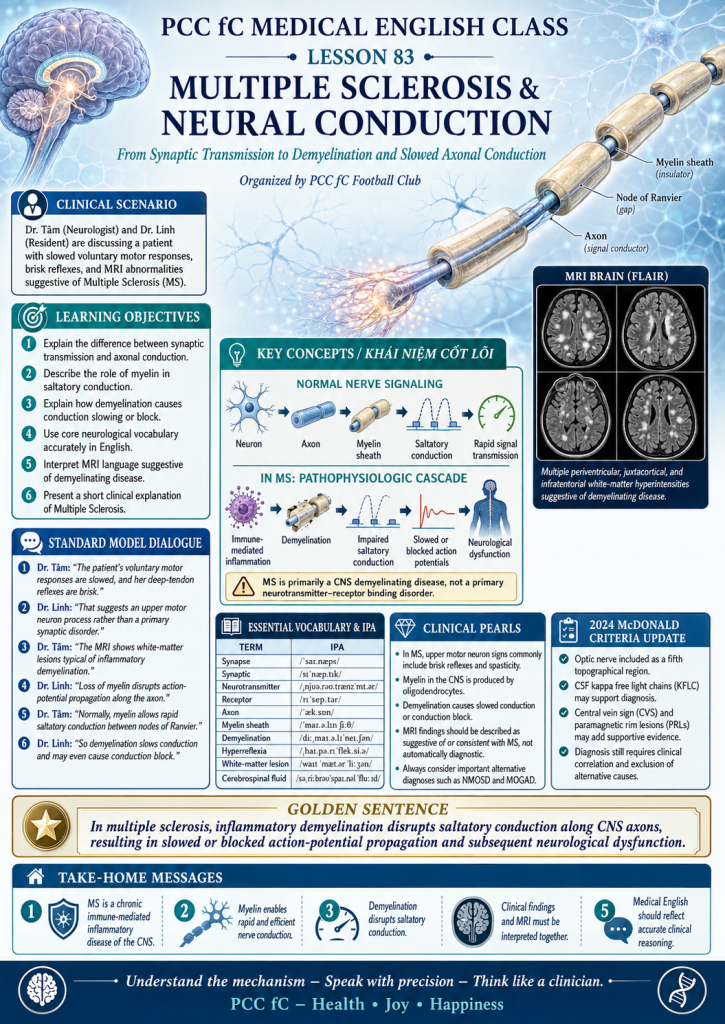
PCC fC MEDICAL ENGLISH CLASS
LESSON 83 – MULTIPLE SCLEROSIS & NEURAL CONDUCTION
From Synaptic Transmission to Demyelination and Slowed Axonal Conduction
Organized by PCC fC Football Club
Clinical theme: Neurology – Multiple Sclerosis (MS)
Language level: Intermediate → Upper-intermediate Medical English
Core skills: Clinical communication • Neurological vocabulary • Pronunciation • Grammar • Clinical reasoning
I. LEARNING OBJECTIVES
By the end of Lesson 83, learners should be able to:
- Describe how a normal nerve impulse travels along a myelinated axon.
- Distinguish synaptic transmission from axonal conduction.
- Explain how demyelination slows or blocks action-potential propagation.
- Use essential neurological vocabulary accurately.
- Discuss MRI findings suggestive of multiple sclerosis.
- Use appropriate clinical expressions such as:
- suggestive of
- consistent with
- due to
- results in
- leads to
- rather than
- Present a short neurological case in professional English.
- Recognize the major concepts of the 2024 revised McDonald diagnostic criteria currently used internationally.
II. IMPORTANT SCIENTIFIC CORRECTION
The original dialogue is educationally useful, but two concepts should be corrected before it is used as a model dialogue.
1. “The patient’s reflexes are delayed.”
In MS, corticospinal tract involvement typically produces upper motor neuron signs, including:
- weakness
- increased muscle tone
- spasticity
- brisk deep-tendon reflexes / hyperreflexia
- clonus
- extensor plantar response
Therefore, a scientifically stronger description is:
“The patient’s voluntary motor responses appear slowed, and her deep-tendon reflexes are brisk.”
MS can cause slowed neural conduction, but this should not automatically be described as “delayed reflexes.”
2. Neurotransmitter–receptor binding is not the primary lesion in MS.
MS primarily involves immune-mediated inflammatory injury, demyelination and varying degrees of axonal damage within the central nervous system. Loss of myelin disrupts saltatory conduction, causing slowed conduction or conduction block along affected axons.
Therefore:
Synapse problem → think about neurotransmitter release, receptors, neuromuscular junction disorders, toxins, etc.
MS problem → think primarily about CNS inflammation, myelin damage and impaired axonal conduction.
III. STANDARDIZED CLINICAL SCENARIO
Scenario
Dr. Tâm, a neurologist, and Dr. Linh, a resident, are assessing a patient with slowed voluntary movements, sensory symptoms and MRI abnormalities suggestive of Multiple Sclerosis (MS).
IV. STANDARD MODEL DIALOGUE
Dr. Tâm:
Dr. Linh, notice that the patient’s voluntary motor responses are somewhat slowed, while her deep-tendon reflexes are brisk. We should assess whether there is impaired conduction within the central nervous system.
Dr. Linh:
I agree. These findings suggest an upper motor neuron process rather than a primary problem with synaptic neurotransmission.
Dr. Tâm:
Exactly. Now look at the MRI. There are several white-matter lesions in locations that are typical of inflammatory demyelination.
Dr. Linh:
That could explain her neurological symptoms. Demyelination disrupts the normal propagation of action potentials along the axon.
Dr. Tâm:
Correct. Normally, the myelin sheath allows impulses to travel rapidly by saltatory conduction from one node of Ranvier to the next.
Dr. Linh:
So when myelin is damaged, conduction becomes slower and may even be blocked in severely affected axons.
Dr. Tâm:
Precisely. That is an important mechanism underlying many neurological deficits in multiple sclerosis.
Dr. Linh:
Should we also assess the optic nerves and spinal cord and consider cerebrospinal-fluid studies?
Dr. Tâm:
Yes. The diagnosis must integrate the clinical presentation with objective evidence from MRI and, when appropriate, additional tests such as CSF biomarkers, visual evoked potentials or optical coherence tomography.
Dr. Linh:
And we should also exclude important alternative diagnoses, particularly other inflammatory demyelinating disorders.
V. VIETNAMESE TRANSLATION
Bác sĩ Tâm:
Bác sĩ Linh, hãy để ý rằng các đáp ứng vận động chủ động của bệnh nhân hơi chậm, trong khi phản xạ gân xương lại tăng. Chúng ta cần đánh giá xem có rối loạn dẫn truyền trong hệ thần kinh trung ương hay không.
Bác sĩ Linh:
Tôi đồng ý. Những dấu hiệu này gợi ý một quá trình tổn thương neuron vận động trung ương hơn là một rối loạn nguyên phát của dẫn truyền qua synapse.
Bác sĩ Tâm:
Chính xác. Bây giờ hãy nhìn MRI. Có nhiều tổn thương chất trắng tại những vị trí điển hình của quá trình mất myelin do viêm.
Bác sĩ Linh:
Điều đó có thể giải thích các triệu chứng thần kinh của bệnh nhân. Mất myelin làm gián đoạn sự lan truyền bình thường của điện thế hoạt động dọc theo sợi trục.
Bác sĩ Tâm:
Đúng. Bình thường, bao myelin cho phép xung thần kinh di chuyển nhanh theo cơ chế dẫn truyền nhảy cóc từ một nút Ranvier sang nút kế tiếp.
Bác sĩ Linh:
Như vậy, khi myelin bị tổn thương, tốc độ dẫn truyền sẽ giảm và thậm chí có thể bị block ở những sợi trục tổn thương nặng.
Bác sĩ Tâm:
Chính xác. Đây là một cơ chế quan trọng gây nên nhiều thiếu hụt thần kinh trong bệnh đa xơ cứng.
Bác sĩ Linh:
Chúng ta có nên đánh giá thêm dây thần kinh thị giác, tủy sống và xem xét xét nghiệm dịch não tủy không?
Bác sĩ Tâm:
Có. Chẩn đoán phải tích hợp biểu hiện lâm sàng với các bằng chứng khách quan từ MRI và, khi phù hợp, những thăm dò bổ sung như các biomarker dịch não tủy, điện thế gợi thị giác hoặc chụp cắt lớp quang học.
Bác sĩ Linh:
Và chúng ta cũng cần loại trừ các chẩn đoán thay thế quan trọng, đặc biệt là các bệnh viêm mất myelin khác.
VI. CORE SCIENCE – FROM SYNAPSE TO MYELIN
1. Normal neural communication
A simplified pathway is:
Neuron → Action potential → Axon → Axon terminal → Neurotransmitter release → Synapse → Receptor → Postsynaptic neuron
There are therefore two related but distinct processes:
A. Axonal conduction
The action potential travels along the axon.
B. Synaptic transmission
Chemical or electrical information passes between neurons at the synapse.
These concepts should not be used interchangeably.
VII. MYELIN AND SALTATORY CONDUCTION
Myelin is a lipid-rich insulating membrane surrounding many axons.
In the central nervous system, myelin is produced by:
oligodendrocytes
In myelinated axons, the action potential effectively travels between:
nodes of Ranvier
This mechanism is called:
saltatory conduction
It allows rapid and energy-efficient propagation of electrical signals.
When demyelination occurs:
Demyelination
↓
Loss of normal electrical insulation
↓
Altered ion-channel organization
↓
Impaired saltatory conduction
↓
Slowed conduction or conduction block
↓
Neurological dysfunction
Segmental demyelination is well established as a cause of both conduction slowing and conduction block in MS.
VIII. MULTIPLE SCLEROSIS – ONE-SENTENCE DEFINITION
Multiple sclerosis is a chronic immune-mediated inflammatory disease of the central nervous system characterized by demyelinating lesions and variable degrees of neuroaxonal injury.
An important language point:
✅ central nervous system
❌ not simply “nerve disease”
MS affects the:
- brain
- spinal cord
- optic pathways
IX. KEY VOCABULARY & PRONUNCIATION
| Term | IPA | Meaning |
| multiple sclerosis | /ˌmʌl.tɪ.pəl skləˈrəʊ.sɪs/ | bệnh đa xơ cứng |
| synapse | /ˈsaɪ.næps/ | synapse, khớp thần kinh |
| synaptic | /sɪˈnæp.tɪk/ | thuộc synapse |
| neurotransmitter | /ˌnjʊə.rəʊ.trænzˈmɪt.ər/ | chất dẫn truyền thần kinh |
| receptor | /rɪˈsep.tər/ | thụ thể |
| axon | /ˈæk.sɒn/ | sợi trục |
| myelin | /ˈmaɪ.ə.lɪn/ | myelin |
| myelin sheath | /ˈmaɪ.ə.lɪn ʃiːθ/ | bao myelin |
| demyelination | /diːˌmaɪ.ə.lɪˈneɪ.ʃən/ | mất myelin |
| conduction | /kənˈdʌk.ʃən/ | sự dẫn truyền |
| action potential | /ˈæk.ʃən pəˌten.ʃəl/ | điện thế hoạt động |
| oligodendrocyte | /ˌɒl.ɪ.ɡəʊˈden.drə.saɪt/ | tế bào ít nhánh |
| hyperreflexia | /ˌhaɪ.pə.rɪˈflek.si.ə/ | tăng phản xạ |
| spasticity | /spæˈstɪs.ə.ti/ | co cứng kiểu tháp |
| white matter | /ˌwaɪt ˈmæt.ər/ | chất trắng |
| cerebrospinal fluid | /səˌriː.brəʊˈspaɪ.nəl ˈfluː.ɪd/ | dịch não tủy |
| lesion | /ˈliː.ʒən/ | tổn thương |
| optic nerve | /ˈɒp.tɪk nɜːv/ | dây thần kinh thị giác |
Important pronunciation correction
The adjective synaptic should be pronounced:
/sɪˈnæp.tɪk/
not /saɪˈnæp.tɪk/.
Compare:
synapse → /ˈsaɪ.næps/
synaptic → /sɪˈnæp.tɪk/
This vowel change is important.
X. HIGH-VALUE CLINICAL COLLOCATIONS
Students should learn words as medical phrases, not isolated vocabulary.
MRI
- brain MRI
- spinal cord MRI
- white-matter lesion
- T2-hyperintense lesion
- demyelinating lesion
- lesion burden
- contrast enhancement
Neurological examination
- brisk reflexes
- deep-tendon reflexes
- increased muscle tone
- pyramidal weakness
- extensor plantar response
- sensory deficit
- visual impairment
Neurophysiology
- nerve conduction
- action-potential propagation
- saltatory conduction
- conduction velocity
- conduction slowing
- conduction block
Diagnosis
- suggestive of MS
- consistent with demyelination
- support the diagnosis
- establish the diagnosis
- exclude alternative diagnoses
- dissemination in space
- dissemination in time
XI. FIVE ESSENTIAL SENTENCE PATTERNS
Pattern 1
“Notice that + clause”
Notice that the patient’s reflexes are brisk.
Meaning:
Hãy lưu ý rằng…
Useful alternatives:
- Notice how…
- Observe that…
- Note that…
Pattern 2
“suggest + noun”
These findings suggest an upper motor neuron lesion.
or
“be suggestive of + noun”
These findings are suggestive of demyelination.
Avoid:
❌ suggest of MS
Correct:
✅ suggest MS
✅ are suggestive of MS
XII. CONSISTENT WITH ≠ DIAGNOSTIC OF
This distinction is extremely important in international medical communication.
“consistent with”
The MRI findings are consistent with demyelination.
= phù hợp với
It does not necessarily mean that the diagnosis has been proven.
“suggestive of”
The lesions are suggestive of multiple sclerosis.
= gợi ý
“diagnostic of”
These findings are diagnostic of…
This is much stronger and should only be used when diagnostic requirements are actually met.
Therefore, when discussing an MRI alone:
✅ MRI findings consistent with MS
✅ MRI findings suggestive of MS
is generally safer than:
❌ MRI proves MS.
XIII. CAUSE–EFFECT LANGUAGE
A clinician must be able to describe mechanisms clearly.
A causes B
Demyelination causes conduction slowing.
A leads to B
Demyelination leads to impaired neural conduction.
A results in B
Loss of myelin results in slower conduction.
B results from A
Conduction slowing results from demyelination.
because of + noun
Neural conduction is impaired because of demyelination.
because + clause
Neural conduction is impaired because the myelin sheath has been damaged.
XIV. THE CONDITIONAL SENTENCE FROM THE ORIGINAL DIALOGUE
Original structure:
If the neurotransmitters aren’t binding properly to the receptors, the signal won’t cross the synapse effectively.
Grammar:
If + present simple → will/won’t + infinitive
This is the First Conditional.
It expresses a realistic possible consequence.
Clinical examples
If demyelination becomes severe, conduction may be blocked.
If the lesion involves the optic nerve, the patient may develop visual symptoms.
If spinal cord pathways are affected, weakness and spasticity may develop.
XV. “WITHOUT + NOUN”
Original structure:
Without the myelin sheath, the electrical signal cannot travel as efficiently along the axon.
Structure:
Without + noun, subject + cannot/may not + verb
Examples:
Without adequate myelination, rapid saltatory conduction cannot occur normally.
Without objective evidence, we should be cautious about establishing the diagnosis.
XVI. WORD CHOICE: “ELECTRICAL CURRENT” OR “ACTION POTENTIAL”?
For introductory English:
electrical signal
is acceptable.
For professional neuroscience:
action potential
or
nerve impulse
is preferable.
Instead of:
The electrical current travels down the axon.
Prefer:
The action potential propagates along the axon.
This is more scientifically precise.
XVII. CLINICAL PEARL – MS IS NOT PRIMARILY A SYNAPTIC DISORDER
A useful conceptual distinction:
Synaptic dysfunction
Think about problems involving:
- neurotransmitter synthesis
- neurotransmitter release
- receptor binding
- receptor blockade
- neuromuscular-junction transmission
Demyelinating disease
Think about:
- myelin injury
- abnormal saltatory conduction
- slowed conduction
- conduction block
- axonal dysfunction
Therefore, in MS:
The major teaching focus should be axonal conduction rather than neurotransmitter–receptor binding.
XVIII. MRI LANGUAGE FOR MEDICAL ENGLISH
Avoid vague descriptions such as:
“There are signs of demyelination.”
Better:
The MRI demonstrates multiple T2/FLAIR hyperintense white-matter lesions in a distribution suggestive of demyelinating disease.
More cautiously:
The MRI findings are compatible with an inflammatory demyelinating process.
Advanced:
The distribution of the lesions raises suspicion for multiple sclerosis, although clinical correlation and exclusion of alternative diagnoses are essential.
XIX. 2026 CLINICAL UPDATE – 2024 McDONALD CRITERIA
The internationally current revision is the 2024 McDonald criteria, completed in 2024 and formally published in The Lancet Neurology in September 2025.
Important changes include:
- the optic nerve as a fifth anatomical location relevant to dissemination in space;
- CSF kappa free light chains (KFLC) as an alternative to oligoclonal bands in appropriate diagnostic pathways;
- incorporation of the central vein sign (CVS) as supportive MRI evidence;
- use of paramagnetic rim lesions (PRLs) in selected diagnostic situations;
- greater flexibility regarding dissemination in time in specific diagnostic pathways;
- additional safeguards for children, older adults and patients in whom alternative causes of white-matter lesions are more likely.
Essential terminology
DIS
= Dissemination in Space
DIT
= Dissemination in Time
OCB
= Oligoclonal Bands
KFLC
= Kappa Free Light Chains
CVS
= Central Vein Sign
PRL
= Paramagnetic Rim Lesion
The revised criteria expand the diagnostic toolkit but still require careful interpretation and exclusion of alternative diagnoses.
XX. IMPORTANT DIFFERENTIAL-DIAGNOSIS LANGUAGE
A physician should never jump directly from:
white-matter lesions → MS
Useful English expressions:
We need to rule out alternative causes.
The findings are suggestive, but not specific.
The clinical presentation must be correlated with the imaging findings.
Other inflammatory demyelinating disorders should be considered.
Important competing diagnoses can include, depending on the clinical context:
- neuromyelitis optica spectrum disorder — NMOSD
- MOG antibody-associated disease — MOGAD
- vascular white-matter disease
- infectious or inflammatory CNS disorders
- metabolic or toxic disorders
- selected genetic or leukodystrophic disorders
XXI. RAPID CLINICAL REASONING FRAMEWORK
Patient with neurological symptoms
1. DEFINE THE SYNDROME
Motor?
Sensory?
Visual?
Brainstem?
Cerebellar?
Spinal?
↓
2. LOCALIZE THE LESION
Central nervous system
vs.
Peripheral nervous system
↓
3. NEUROLOGICAL EXAMINATION
Tone
Power
Reflexes
Plantar responses
Sensation
Coordination
Cranial nerves
↓
4. MRI
Brain ± spinal cord
± dedicated optic-nerve assessment where appropriate
↓
5. ADDITIONAL INVESTIGATIONS WHEN INDICATED
CSF
OCBs/KFLC
VEP
OCT
relevant antibody testing
↓
6. APPLY DIAGNOSTIC CRITERIA
↓
7. EXCLUDE BETTER ALTERNATIVE EXPLANATIONS
↓
FINAL DIAGNOSTIC ASSESSMENT
XXII. PRONUNCIATION DRILL
Read slowly first, then at normal clinical speed.
Drill 1
Demyelination disrupts saltatory conduction.
Drill 2
The MRI demonstrates multiple white-matter lesions.
Drill 3
The findings are suggestive of an inflammatory demyelinating disorder.
Drill 4
Loss of myelin can slow or block action-potential propagation.
Drill 5
We need to correlate the clinical findings with the MRI abnormalities.
XXIII. CLINICAL SPEAKING DRILL
Try to say the entire mechanism in one sequence:
Multiple sclerosis causes inflammatory damage to myelin in the central nervous system. Loss of myelin disrupts saltatory conduction along affected axons, which can slow or block the propagation of action potentials and lead to neurological dysfunction.
Vietnamese concept
Đa xơ cứng gây tổn thương viêm đối với myelin trong hệ thần kinh trung ương. Mất myelin làm rối loạn dẫn truyền nhảy cóc dọc theo các sợi trục bị ảnh hưởng, từ đó có thể làm chậm hoặc block sự lan truyền điện thế hoạt động và gây rối loạn chức năng thần kinh.
XXIV. EXERCISE 1 – FILL IN THE BLANKS
Choose:
axon – demyelination – receptors – hyperreflexia – saltatory – synapse
- Neurotransmitters bind to specific ________.
- Communication between two neurons may occur across a ________.
- Myelin allows rapid ________ conduction.
- Loss of myelin is called ________.
- An action potential travels along the ________.
- An upper motor neuron lesion may produce ________.
XXV. EXERCISE 2 – CORRECT THE SCIENCE
Identify and correct the inaccurate statement.
1.
Multiple sclerosis primarily prevents neurotransmitters from binding to receptors.
2.
MS typically causes absent tendon reflexes because conduction is slower.
3.
Myelin is located inside the synaptic cleft.
4.
MRI abnormalities alone always prove that a patient has MS.
XXVI. EXERCISE 3 – TRANSLATE INTO MEDICAL ENGLISH
1.
MRI cho thấy nhiều tổn thương chất trắng gợi ý quá trình mất myelin.
2.
Mất myelin làm giảm hiệu quả dẫn truyền điện thế hoạt động dọc theo sợi trục.
3.
Những dấu hiệu này phù hợp với tổn thương neuron vận động trung ương.
4.
Chúng ta cần loại trừ các chẩn đoán thay thế trước khi xác lập chẩn đoán đa xơ cứng.
XXVII. ROLE-PLAY
Student A – Neurologist
Explain:
- neurological examination
- MRI abnormalities
- why demyelination affects conduction
- further investigation
Student B – Resident
Ask:
- What do the neurological findings suggest?
- How does demyelination affect nerve conduction?
- Does the MRI establish the diagnosis?
- What additional investigations should we consider?
- What alternative diagnoses should be excluded?
XXVIII. MODEL 60-SECOND CASE PRESENTATION
This patient presents with slowed voluntary motor responses and upper motor neuron signs, including brisk deep-tendon reflexes. Brain MRI demonstrates multiple white-matter lesions in a distribution suggestive of inflammatory demyelination. From a pathophysiological perspective, loss of myelin disrupts saltatory conduction and may cause both slowing and block of action-potential propagation along affected axons. Multiple sclerosis is therefore an important diagnostic consideration. However, the imaging findings must be interpreted together with the clinical syndrome and other objective evidence, and alternative demyelinating disorders should be excluded before establishing the diagnosis.
XXIX. ANSWER KEY
Exercise 1
- receptors
- synapse
- saltatory
- demyelination
- axon
- hyperreflexia
Exercise 2
1. Incorrect.
MS is primarily an inflammatory demyelinating CNS disorder rather than a primary neurotransmitter–receptor binding disorder.
2. Incorrect.
Corticospinal involvement usually produces upper motor neuron signs such as brisk reflexes or hyperreflexia.
3. Incorrect.
Myelin surrounds segments of axons; it is not located within the synaptic cleft.
4. Incorrect.
MRI is a major component of MS diagnosis but must be interpreted in the appropriate clinical and diagnostic context.
Exercise 3 – Suggested answers
1.
The MRI demonstrates multiple white-matter lesions suggestive of demyelination.
2.
Demyelination impairs the propagation of action potentials along the axon.
3.
These findings are consistent with an upper motor neuron lesion.
4.
We need to exclude alternative diagnoses before establishing a diagnosis of multiple sclerosis.
XXX. TAKE-HOME MESSAGES
MEDICINE
1. MS → CNS inflammatory demyelination
2. Myelin loss → impaired saltatory conduction
3. Demyelination → conduction slowing ± conduction block
4. MS commonly produces upper motor neuron signs → brisk reflexes/hyperreflexia
5. Synaptic neurotransmitter–receptor dysfunction is not the primary mechanism of MS
6. MRI findings should be integrated with the clinical syndrome and appropriate paraclinical evidence
7. Always consider important MS mimics
ENGLISH
1. suggest + noun
The findings suggest demyelination.
2. be suggestive of + noun
The MRI is suggestive of MS.
3. be consistent with + noun
The findings are consistent with demyelination.
4. lead to / result in
Demyelination leads to conduction slowing.
5. result from
Conduction slowing results from myelin damage.
XXXI. THE GOLDEN SENTENCE OF LESSON 83
In multiple sclerosis, inflammatory demyelination disrupts saltatory conduction along central nervous system axons, resulting in slowed or blocked action-potential propagation and subsequent neurological dysfunction.
Vietnamese
Trong bệnh đa xơ cứng, quá trình viêm gây mất myelin làm rối loạn dẫn truyền nhảy cóc dọc theo các sợi trục của hệ thần kinh trung ương, dẫn đến chậm hoặc block sự lan truyền điện thế hoạt động và từ đó gây rối loạn chức năng thần kinh.
PCC fC MEDICAL ENGLISH MESSAGE
Understand the mechanism – Speak with precision – Think like a clinician.
PCC fC – Health • Joy • Happiness
Medical English through Clinical Reasoning