Bài 85 – Tiếng Anh Y Khoa: IELTS: Từ bẫy khớp từ đến tư duy đọc phản biện: làm chủ True/False/Not given trong IELTS * From keyword – matching traps to critical reading: mastering true/false/not given in IELSTs reading
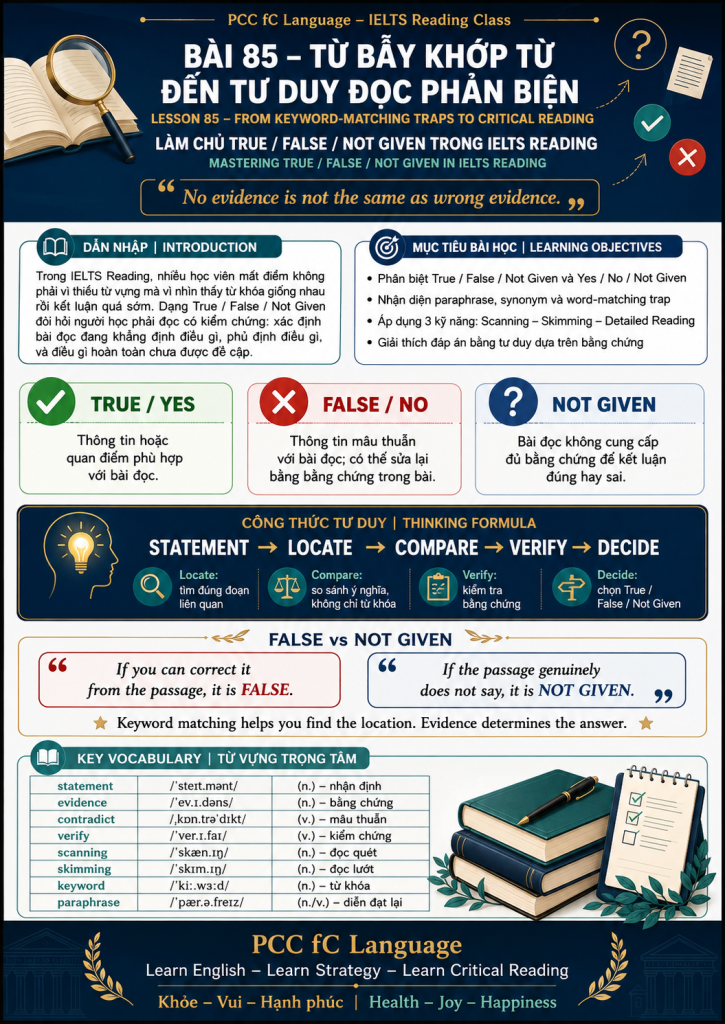
PCC Language – Thăng Long, Hà Nội, ngày 16/8/2026, Trong IELTS Reading, điều khiến nhiều học viên mất điểm không phải vì thiếu từ vựng, mà vì đọc đúng từ nhưng hiểu sai mối quan hệ giữa các ý. Đặc biệt với dạng True/False/Not Given và Yes/No/Not Given, việc nhìn thấy những từ khóa giống nhau trong câu hỏi và bài đọc chưa bao giờ đủ để kết luận. Người học cần xác định chính xác bài đọc đang khẳng định điều gì, đang phủ định điều gì, và điều gì hoàn toàn chưa được đề cập. Bài 85 sẽ giúp chúng ta chuyển từ thói quen keyword-matching sang critical reading – đọc có kiểm chứng, có bằng chứng và có lập luận. Hãy luôn nhớ: “No evidence is not the same as wrong evidence.” Không có bằng chứng không đồng nghĩa với có bằng chứng cho thấy một nhận định là sai. Và chính khả năng phân biệt tinh tế ấy sẽ giúp chúng ta không chỉ làm IELTS Reading chính xác hơn, mà còn rèn luyện một tư duy quan trọng trong học tập, nghiên cứu và thực hành khoa học: đừng kết luận trước khi kiểm chứng bằng chứng.
BÀI 85 – IELTS READING
FROM KEYWORD-MATCHING TO CRITICAL READING
Mastering True / False / Not Given & Yes / No / Not Given
PCC fC Language – Medical English & IELTS 5AM Class
Thăng Long, Hà Nội – 16/08/2026
Core principle: No evidence is not the same as wrong evidence.
Learning philosophy: Reading is a process of verification, not word-matching.
I. INTRODUCTION | DẪN NHẬP
Trong IELTS Reading, True / False / Not Given (T/F/NG) và Yes / No / Not Given (Y/N/NG) là những dạng câu hỏi dễ gây nhầm lẫn vì người học thường bị thu hút bởi những từ khóa giống nhau giữa câu hỏi và bài đọc.
Tuy nhiên, dạng bài này không kiểm tra khả năng “tìm từ giống nhau”. Nó kiểm tra khả năng:
- xác định chính xác thông tin liên quan;
- nhận diện cách diễn đạt lại bằng paraphrase;
- phân biệt thông tin phù hợp, thông tin mâu thuẫn và thông tin không được cung cấp;
- kiểm chứng một nhận định dựa chỉ trên bằng chứng trong bài đọc.
Nói cách khác:
Keyword matching helps you find the location. Evidence determines the answer.
Đây chính là tư duy trung tâm của Bài 85 trong tài liệu gốc: người học phải đi từ định vị → so sánh → kiểm chứng → quyết định, thay vì nhìn thấy từ khóa giống nhau rồi chọn đáp án ngay.
II. LEARNING OBJECTIVES | MỤC TIÊU HỌC TẬP
Sau bài học, học viên có thể:
- Phân biệt True / False / Not Given với Yes / No / Not Given.
- Giải thích chính xác bản chất của:
- TRUE / YES
- FALSE / NO
- NOT GIVEN
- Sử dụng hiệu quả ba kỹ năng:
- Scanning
- Skimming
- Detailed reading
- Nhận diện paraphrase, synonym và reference words.
- Tránh word-matching trap.
- Áp dụng:
- Contradiction Test
- Correction Test
- Evidence Test
- Phân biệt khoa học giữa:
- absence of evidence
- và evidence of contradiction.
- Quản lý thời gian hợp lý trong IELTS Reading.
- Giải thích đáp án bằng ngôn ngữ học thuật tiếng Anh.
- Hình thành quy trình tư duy:
STATEMENT → LOCATE → COMPARE → VERIFY → DECIDE
III. TWO QUESTION TYPES | HAI DẠNG CÂU HỎI
| Đặc điểm | True / False / Not Given | Yes / No / Not Given |
|---|---|---|
| Nội dung kiểm tra | Facts – thông tin/sự kiện | Views, opinions, claims – quan điểm/lập luận |
| TRUE / YES | Phù hợp với bài đọc | Phù hợp với quan điểm tác giả |
| FALSE / NO | Mâu thuẫn với bài đọc | Trái với quan điểm tác giả |
| NOT GIVEN | Không đủ thông tin | Không xác định được quan điểm |
| Kỹ thuật làm | Locate → compare → verify | Locate → compare → verify |
High-yield pearl
TRUE/FALSE/NOT GIVEN = What does the text say?
YES/NO/NOT GIVEN = What does the writer think or claim?
IV. THE THREE ANSWERS | BẢN CHẤT BA LOẠI ĐÁP ÁN
1. TRUE / YES
Chọn TRUE hoặc YES khi ý nghĩa của câu hỏi phù hợp hoàn toàn với thông tin trong bài.
Không yêu cầu câu hỏi phải sử dụng chính xác những từ giống bài đọc.
Passage
The temperature increased steadily.
Statement
There was a gradual rise in temperature.
Answer
TRUE
Vì:
increased steadily ≈ a gradual rise
Đây là semantic equivalence – tương đương về nghĩa.
2. FALSE / NO
Chọn FALSE hoặc NO khi bài đọc cung cấp thông tin trái ngược hoặc mâu thuẫn với nhận định.
Scientific test
Hãy hỏi:
Can I correct the statement using information explicitly provided in the passage?
Nếu có, câu đó rất có khả năng là FALSE / NO.
Passage
The treatment reduced mortality.
Statement
The treatment increased mortality.
Answer
FALSE
Bài đọc cung cấp bằng chứng trực tiếp để sửa:
increased → reduced
3. NOT GIVEN
Chọn NOT GIVEN khi bài đọc không cung cấp đủ bằng chứng để kết luận câu hỏi đúng hay sai.
Điều quan trọng:
NOT GIVEN ≠ I don’t understand.
NOT GIVEN ≠ I cannot find the keyword.
NOT GIVEN = The necessary information is genuinely absent from the passage.
Passage
The treatment reduced mortality.
Statement
The treatment was cheaper than previous treatments.
Answer
NOT GIVEN
Bài đọc nói về mortality, nhưng không cung cấp thông tin về cost.
V. FALSE vs NOT GIVEN – THE CRITICAL DISTINCTION
Đây là phần quan trọng nhất của bài.
FALSE
The passage gives contrary evidence.
Bài đọc cho bạn bằng chứng để nói:
“Nhận định này sai, và đây là thông tin đúng.”
NOT GIVEN
The passage gives insufficient evidence.
Bạn chỉ có thể nói:
“Bài đọc không cho tôi đủ thông tin để quyết định.”
THE CORRECTION RULE
If you can correct it from the passage, it is probably FALSE.
THE NO-EVIDENCE RULE
If the relevant information is genuinely absent, it is NOT GIVEN.
Công thức dễ nhớ
FALSE = Wrong information.
NOT GIVEN = Missing information.
VI. A SCIENTIFIC DECISION ALGORITHM
Khi gặp mỗi statement, không chọn đáp án ngay.
Thực hiện theo 5 bước:
STEP 1 – STATEMENT
Đọc câu hỏi và xác định claim thật sự đang được kiểm tra.
Hãy tách:
Subject + Verb/Relationship + Important qualifier
Ví dụ:
Experts failed to create heat-reflective concrete.
Thông tin trọng tâm không chỉ là:
- experts
- concrete
mà là quan hệ:
experts → attempted creation → failed
STEP 2 – LOCATE
Dùng scanning để tìm vùng chứa:
- tên riêng;
- số liệu;
- thuật ngữ;
- địa danh;
- từ khóa nổi bật;
- hoặc synonym của chúng.
Remember
Keywords locate information; they do not determine the answer.
STEP 3 – COMPARE
So sánh meaning, không chỉ so sánh từ.
Kiểm tra:
- synonym;
- antonym;
- paraphrase;
- comparison;
- cause–effect;
- quantity;
- frequency;
- degree;
- chronology.
STEP 4 – VERIFY
Đặt ba câu hỏi theo thứ tự:
Question A
Does the passage support the statement?
→ YES → TRUE / YES
Nếu không:
Question B
Does the passage contradict the statement?
→ YES → FALSE / NO
Nếu vẫn không:
Question C
Does the passage provide enough information to decide?
→ NO → NOT GIVEN
VII. THE PCC fC DECISION TREE
STATEMENT
↓
Locate the relevant passage
↓
Does the meaning agree?
YES → TRUE / YES
NO ↓
Does the text provide contradictory evidence?
YES → FALSE / NO
NO ↓
Is the information required to judge the statement absent?
YES → NOT GIVEN
VIII. READING SKILLS
1. SCANNING
Scanning = đọc quét để định vị thông tin cụ thể.
Không cần hiểu toàn bộ bài.
Tìm:
- names;
- dates;
- numbers;
- technical terms;
- unusual words.
2. SKIMMING
Skimming = đọc nhanh để hiểu ý chính của đoạn.
Mục tiêu:
“Đoạn này đang nói về vấn đề gì?”
3. DETAILED READING
Sau khi tìm được đoạn liên quan, phải đọc chậm.
Chú ý đặc biệt:
- negation;
- modal verbs;
- reference words;
- quantifiers;
- comparison;
- tense;
- logical relationship.
IX. REFERENCE WORDS – NHỮNG TỪ NHỎ NHƯNG QUAN TRỌNG
Các từ như:
- it
- this
- these
- they
- the phenomenon
- the process
- such methods
có thể quyết định đáp án.
Example
Scientists developed a new coating. This significantly reduced heat absorption.
Muốn hiểu “this” là gì, phải quay lại câu trước:
this = the new coating
Nếu bỏ qua reference word, học viên rất dễ gán sai chủ thể.
X. WORKED EXAMPLE 1 – FALSE
Statement
Luke Howard invented the term “Urban Heat Island.”
Tài liệu bài học cho biết bài đọc đề cập Luke Howard nghiên cứu/viết về hiện tượng nhiệt độ đô thị, trong khi cách gọi Urban Heat Island được trình bày như một thuật ngữ hiện đại.
Analysis
Keyword match:
- Luke Howard ✓
- Urban Heat Island ✓
Nhưng:
Keyword match ≠ semantic match.
Claim cần kiểm chứng là:
Who invented the term?
Bài đọc không quy việc đặt thuật ngữ cho Howard và cung cấp thông tin để bác bỏ cách hiểu đó.
Verdict
FALSE
Explanation pattern
The passage discusses Howard’s description of the phenomenon, but it does not attribute the modern term to him. Therefore, the statement contradicts the passage.
XI. WORKED EXAMPLE 2 – NOT GIVEN
Statement
Experts have failed in their attempts to create heat-reflective concrete and brick.
Bài học gốc chỉ ra rằng các từ như experts, concrete, và brick có thể đều xuất hiện, nhưng thông tin về việc chuyên gia đã cố gắng và đã thất bại lại không được cung cấp.
Logical structure of the statement
Experts
↓
attempted to create something
↓
the attempts failed.
Muốn chọn FALSE hoặc TRUE, bài đọc phải cung cấp bằng chứng về chuỗi quan hệ này.
Nhưng bài chỉ nói đến vật liệu và khả năng giữ nhiệt.
Không có bằng chứng về:
- attempts;
- success;
- failure.
Verdict
NOT GIVEN
Explanation
The keywords appear in the passage, but the specific claim about attempts and failure is not stated. Therefore, the answer is NOT GIVEN.
XII. THE KEYWORD-MATCHING TRAP
Một trong những bẫy lớn nhất của IELTS Reading là:
The question repeats many words from the passage.
Học viên cảm thấy “quen mắt” và chọn TRUE.
Nhưng examiner có thể cố tình giữ nguyên nouns và thay đổi:
- verbs;
- relationships;
- quantity;
- chronology;
- degree;
- cause and effect.
Example
Passage:
Some researchers questioned the hypothesis.
Statement:
All researchers rejected the hypothesis.
Các từ:
- researchers
- hypothesis
đều xuất hiện.
Nhưng:
some ≠ all
questioned ≠ rejected
→ FALSE
XIII. HIGH-RISK WORDS | NHỮNG TỪ CẦN ĐẶC BIỆT CẢNH GIÁC
Quantifiers
- all
- every
- some
- several
- most
- few
- none
Frequency
- always
- usually
- frequently
- occasionally
- never
Degree
- completely
- significantly
- slightly
- mainly
- exclusively
Comparison
- more than
- less than
- the most
- the least
- better
- worse
Causality
- cause
- lead to
- result in
- contribute to
- be associated with
Important
Association is not necessarily causation.
Nếu bài nói:
A is associated with B.
mà statement nói:
A causes B.
thì không được tự động coi là TRUE.
XIV. PARAPHRASE RECOGNITION
IELTS chủ yếu kiểm tra meaning equivalence.
Common paraphrase patterns
| Passage | Question |
| increase | rise |
| decrease | decline |
| approximately | about |
| a large number of | many |
| because of | due to |
| develop | create |
| demonstrate | show |
| prohibit | ban |
| purchase | buy |
| significant | considerable |
Principle
Do not search only for the exact word. Search for the idea.
XV. LANGUAGE PATTERNS FOR EXPLAINING ANSWERS
TRUE
The statement is supported by the passage.
The statement accurately reflects the information given in the text.
Although different words are used, the meanings are equivalent.
FALSE
The passage states that…, whereas the question claims that…
The statement directly contradicts the passage.
The statement can be corrected using information explicitly provided in the text.
NOT GIVEN
There is no evidence in the passage that…
The text does not mention whether…
The passage provides insufficient information to determine whether the statement is true or false.
The keyword appears, but the specific claim does not.
XVI. COMMON ERRORS | LỖI THƯỜNG GẶP
Error 1
❌ Keyword giống nhau → TRUE
✅ Hãy hỏi:
Does the meaning match?
Error 2
❌ Không tìm thấy ngay → NOT GIVEN
✅ Có thể bạn chưa tìm đúng synonym hoặc paraphrase.
NOT GIVEN is an evidence judgement, not a search failure.
Error 3
❌ Dùng kiến thức ngoài bài
Ví dụ bạn biết một thông tin là đúng ngoài đời.
IELTS vẫn yêu cầu:
What does the passage say?
Không phải:
What do I know?
Error 4
❌ Tự suy luận quá xa.
IELTS Reading yêu cầu text-based inference, không phải speculation.
Error 5
❌ Bỏ qua từ nhỏ.
Ví dụ:
- may
- can
- must
- sometimes
- all
- only
Một từ có thể thay đổi hoàn toàn ý nghĩa câu.
XVII. TIME MANAGEMENT
IELTS Academic Reading có tổng thời gian 60 phút.
Vì vậy, mục tiêu không phải giải một câu thật lâu mà là tối ưu total score.
Practical strategy
- Scan nhanh.
- Xác định vùng thông tin.
- Đọc kỹ 1–3 câu liên quan.
- Đưa ra quyết định dựa trên evidence.
- Nếu quá lâu, đánh dấu và chuyển tiếp.
- Quay lại khi còn thời gian.
Principle
Protect the whole test, not one difficult question.
XVIII. MINI PRACTICE
Passage
Coastal cities have recorded a steady rise in average temperatures since the 1990s, prompting several municipalities to trial reflective road surfaces.
Statement 1
Coastal cities have trialled reflective road surfaces for over a decade.
Bài cho biết nhiệt độ tăng từ thập niên 1990 nhưng không nói việc thử nghiệm mặt đường bắt đầu từ khi nào.
Answer
NOT GIVEN
Statement 2
Average temperatures in coastal cities have decreased since the 1990s.
Passage:
a steady rise
Statement:
decreased
Answer
FALSE
Statement 3
All municipalities have found reflective road surfaces effective.
Passage nói:
several municipalities trialled them
Không có thông tin về:
- effectiveness;
- outcome;
- all municipalities.
Answer
NOT GIVEN
XIX. KEY VOCABULARY
TỪ MỚI – PHIÊN ÂM – TỪ LOẠI – NGHĨA
| Word / Phrase | IPA | Part of speech | Nghĩa |
| statement | /ˈsteɪt.mənt/ | noun (n.) | nhận định, phát biểu |
| claim | /kleɪm/ | noun / verb (n./v.) | nhận định; khẳng định |
| evidence | /ˈev.ɪ.dəns/ | noun (n.) | bằng chứng |
| verify | /ˈver.ɪ.faɪ/ | verb (v.) | kiểm chứng, xác minh |
| verification | /ˌver.ɪ.fɪˈkeɪ.ʃən/ | noun (n.) | sự kiểm chứng |
| contradict | /ˌkɒn.trəˈdɪkt/ | verb (v.) | mâu thuẫn với |
| contradiction | /ˌkɒn.trəˈdɪk.ʃən/ | noun (n.) | sự mâu thuẫn |
| contradictory | /ˌkɒn.trəˈdɪk.tər.i/ | adjective (adj.) | mâu thuẫn |
| factual | /ˈfæk.tʃu.əl/ | adjective (adj.) | thuộc sự kiện/thực tế |
| opinion | /əˈpɪn.jən/ | noun (n.) | quan điểm |
| passage | /ˈpæs.ɪdʒ/ | noun (n.) | đoạn văn |
| keyword | /ˈkiː.wɜːd/ | noun (n.) | từ khóa |
| synonym | /ˈsɪn.ə.nɪm/ | noun (n.) | từ đồng nghĩa |
| antonym | /ˈæn.tə.nɪm/ | noun (n.) | từ trái nghĩa |
| paraphrase | /ˈpær.ə.freɪz/ | noun / verb | cách diễn đạt lại; diễn đạt lại |
| scanning | /ˈskæn.ɪŋ/ | noun (n.) | kỹ thuật đọc quét |
| skimming | /ˈskɪm.ɪŋ/ | noun (n.) | kỹ thuật đọc lướt |
| locate | /ləʊˈkeɪt/ | verb (v.) | định vị, tìm vị trí |
| compare | /kəmˈpeə(r)/ | verb (v.) | so sánh |
| comparison | /kəmˈpær.ɪ.sən/ | noun (n.) | sự so sánh |
| specific | /spəˈsɪf.ɪk/ | adjective (adj.) | cụ thể |
| explicit | /ɪkˈsplɪs.ɪt/ | adjective (adj.) | rõ ràng, được nói trực tiếp |
| explicitly | /ɪkˈsplɪs.ɪt.li/ | adverb (adv.) | một cách rõ ràng |
| implicit | /ɪmˈplɪs.ɪt/ | adjective (adj.) | ngầm hiểu |
| infer | /ɪnˈfɜː(r)/ | verb (v.) | suy ra |
| inference | /ˈɪn.fər.əns/ | noun (n.) | sự suy luận |
| absent | /ˈæb.sənt/ | adjective (adj.) | vắng mặt, không có |
| insufficient | /ˌɪn.səˈfɪʃ.ənt/ | adjective (adj.) | không đầy đủ |
| relevant | /ˈrel.ə.vənt/ | adjective (adj.) | liên quan |
| irrelevant | /ɪˈrel.ə.vənt/ | adjective (adj.) | không liên quan |
| accurate | /ˈæk.jə.rət/ | adjective (adj.) | chính xác |
| accuracy | /ˈæk.jə.rə.si/ | noun (n.) | độ chính xác |
| equivalent | /ɪˈkwɪv.əl.ənt/ | adjective / noun | tương đương |
| semantic | /sɪˈmæn.tɪk/ | adjective (adj.) | thuộc về ý nghĩa |
| phenomenon | /fəˈnɒm.ɪ.nən/ | noun (n.) | hiện tượng |
| reference word | /ˈref.ər.əns wɜːd/ | noun phrase | từ quy chiếu/thay thế |
| quantifier | /ˈkwɒn.tɪ.faɪ.ə(r)/ | noun (n.) | từ chỉ số lượng |
| causality | /kɔːˈzæl.ə.ti/ | noun (n.) | quan hệ nhân quả |
| association | /əˌsəʊ.siˈeɪ.ʃən/ | noun (n.) | sự liên quan/liên kết |
| outcome | /ˈaʊt.kʌm/ | noun (n.) | kết quả |
XX. HIGH-YIELD COLLOCATIONS
1. locate relevant information
/ləʊˈkeɪt ˈrel.ə.vənt ˌɪn.fəˈmeɪ.ʃən/
→ định vị thông tin liên quan
2. scan the passage
/skæn ðə ˈpæs.ɪdʒ/
→ đọc quét đoạn văn
3. verify the claim
/ˈver.ɪ.faɪ ðə kleɪm/
→ kiểm chứng nhận định
4. support the statement
/səˈpɔːt ðə ˈsteɪt.mənt/
→ ủng hộ/phù hợp với nhận định
5. contradict the passage
/ˌkɒn.trəˈdɪkt ðə ˈpæs.ɪdʒ/
→ mâu thuẫn với bài đọc
6. provide sufficient evidence
/prəˈvaɪd səˈfɪʃ.ənt ˈev.ɪ.dəns/
→ cung cấp đủ bằng chứng
7. find no evidence
/faɪnd nəʊ ˈev.ɪ.dəns/
→ không tìm thấy bằng chứng
8. correct the statement
/kəˈrekt ðə ˈsteɪt.mənt/
→ sửa nhận định cho đúng
9. semantic equivalence
/sɪˈmæn.tɪk ɪˈkwɪv.əl.əns/
→ sự tương đương về nghĩa
10. fall into the word-matching trap
/fɔːl ˈɪn.tuː ðə wɜːd ˈmætʃ.ɪŋ træp/
→ rơi vào bẫy khớp từ
XXI. USEFUL SENTENCE PATTERNS
Pattern 1 – TRUE
The statement is consistent with the information provided in the passage.
→ Nhận định phù hợp với thông tin trong bài.
Pattern 2 – FALSE
The passage states that X, whereas the statement claims Y.
→ Bài nói X, trong khi câu hỏi lại khẳng định Y.
Pattern 3 – FALSE
The statement directly contradicts the information provided in the text.
→ Nhận định mâu thuẫn trực tiếp với thông tin trong bài.
Pattern 4 – NOT GIVEN
There is no evidence in the passage that + clause.
Ví dụ:
There is no evidence in the passage that the experts failed.
Pattern 5 – NOT GIVEN
The passage does not mention whether + clause.
Ví dụ:
The passage does not mention whether the method was successful.
Pattern 6
The keyword appears, but the specific claim does not.
Đây là một trong những câu quan trọng nhất của toàn bài.
XXII. CLASS DISCUSSION
Question 1
Why is keyword matching unreliable in T/F/NG questions?
Suggested answer
Because the same keywords may appear in both the passage and the statement while the relationship between them is different.
Question 2
What is the main difference between FALSE and NOT GIVEN?
Suggested answer
FALSE requires contradictory evidence, whereas NOT GIVEN means that the passage does not provide enough evidence to make a judgement.
Question 3
Why should we identify the exact claim before scanning?
Suggested answer
Because keywords alone do not tell us which relationship or proposition the question is actually testing.
Question 4
What does “No evidence is not the same as wrong evidence” mean?
Suggested answer
It means that the absence of information cannot be treated as evidence that a statement is false.
XXIII. PCC fC READING FORMULA
SCAN → LOCATE → COMPARE → VERIFY → DECIDE
SCAN
Tìm vùng có thông tin liên quan.
LOCATE
Xác định chính xác câu hoặc đoạn cần đọc.
COMPARE
So sánh meaning, không chỉ từ vựng.
VERIFY
Kiểm tra bằng chứng.
DECIDE
Chọn:
TRUE / FALSE / NOT GIVEN
hoặc
YES / NO / NOT GIVEN
XXIV. SEVEN TAKE-HOME MESSAGES
1. Keywords identify location, not answers.
Từ khóa giúp tìm vị trí, không quyết định đáp án.
2. Meaning matters more than wording.
Ý nghĩa quan trọng hơn việc dùng cùng một từ.
3. TRUE requires supporting evidence.
TRUE cần bằng chứng phù hợp.
4. FALSE requires contradictory evidence.
FALSE cần bằng chứng mâu thuẫn.
5. NOT GIVEN requires absence of sufficient evidence.
NOT GIVEN nghĩa là không đủ thông tin để kết luận.
6. Never use outside knowledge.
Chỉ sử dụng thông tin bài đọc cung cấp.
7. Verify before you decide.
Kiểm chứng trước khi chọn đáp án.
XXV. FINAL MESSAGE
No evidence is not the same as wrong evidence.
Reading is a process of verification, not word-matching.
Một người học IELTS Reading giỏi không chỉ hỏi:
“Can I find the same keyword?”
Mà phải hỏi:
“What exactly does the passage say?”
“Does the evidence support or contradict this statement?”
“Can I prove it is false, or is the necessary information simply absent?”
Đó là bước chuyển từ:
KEYWORD MATCHING
sang
CRITICAL READING
và xa hơn nữa là:
EVIDENCE-BASED THINKING
PCC fC Language
Learn English – Learn Strategy – Learn Critical Thinking