Bài 87 – Tiếng Anh Y Khoa: Mất myelin và tốc độ dẫn truyền thần kinh * Demyelination & neural conduction
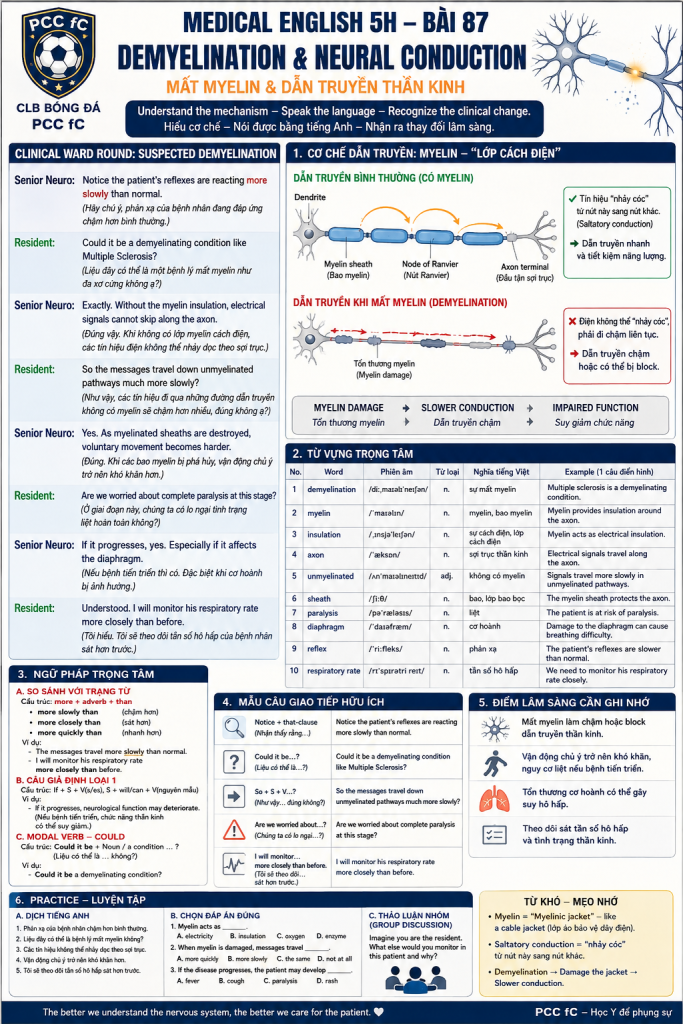
PCC Language – Thăng Long, Hà Nội, ngày 19/8/2026, Một phản xạ chậm hơn bình thường đôi khi không chỉ là một dấu hiệu nhỏ trên thăm khám thần kinh, mà có thể mở ra cả một câu chuyện về cách hệ thần kinh truyền đi những “thông điệp điện” của cơ thể. Trong Bài 87, từ tình huống lâm sàng nghi ngờ demyelination, chúng ta sẽ cùng theo dõi hành trình của tín hiệu thần kinh dọc theo sợi trục, hiểu vì sao myelin giúp dẫn truyền nhanh và hiệu quả, và điều gì xảy ra khi lớp “cách điện” này bị tổn thương. Hội thoại trong bài đưa người học từ một nhận xét rất thực tế — “the patient’s reflexes are reacting more slowly than normal” — đến những vấn đề quan trọng hơn như vận động chủ ý, nguy cơ liệt và theo dõi hô hấp. Qua đó, chúng ta không chỉ học thêm những từ như demyelination, myelin sheath, paralysis, diaphragm, mà còn luyện cách đặt giả thuyết, trao đổi nguy cơ và mô tả thay đổi lâm sàng bằng tiếng Anh một cách ngắn gọn, tự nhiên và chính xác. Bởi học Tiếng Anh Y Khoa không chỉ là học từ vựng — mà là học cách quan sát, tư duy và diễn đạt y khoa bằng một ngôn ngữ chung.
BÀI 87 – MEDICAL ENGLISH 5H
DEMYELINATION & NEURAL CONDUCTION
Mất myelin và tốc độ dẫn truyền thần kinh
Lớp Tiếng Anh Y Khoa – CLB Bóng đá PCC fC
Key message:
When myelin is damaged, neural conduction becomes slower — and clinical function may deteriorate.
Khi myelin bị tổn thương, dẫn truyền thần kinh chậm lại và chức năng lâm sàng có thể suy giảm.
I. LEARNING OBJECTIVES – MỤC TIÊU BÀI HỌC
Sau bài học, học viên có thể:
- Sử dụng các từ vựng cơ bản về myelin, demyelination và neural conduction.
- Hiểu và thực hành một đoạn hội thoại ngắn trong clinical ward round.
- Sử dụng đúng cấu trúc so sánh với trạng từ:
- more slowly than
- more closely than
- Mô tả bằng tiếng Anh mối liên hệ trong bài học:
Myelin damage → slower neural conduction → impaired movement
- Tập trình bày ngắn gọn một nhận định lâm sàng bằng tiếng Anh.
II. WARM-UP – KHỞI ĐỘNG
Question 1
What is the function of myelin?
Myelin có vai trò gì?
Question 2
What may happen when myelin is damaged?
Điều gì có thể xảy ra khi myelin bị tổn thương?
Question 3
Complete the chain:
Demyelination → __________ conduction → impaired __________
Suggested answer:
Demyelination → slower neural conduction → impaired movement
III. CORE CLINICAL DIALOGUE – HỘI THOẠI TRỌNG TÂM
Clinical Ward Round: Suspected Demyelination
Senior Neuro:
Notice the patient’s reflexes are reacting more slowly than normal.
Resident:
Could it be a demyelinating condition like Multiple Sclerosis?
Senior Neuro:
Exactly. Without the myelin insulation, electrical signals cannot skip along the axon.
Resident:
So the messages travel down unmyelinated pathways much more slowly?
Senior Neuro:
Yes. As myelinated sheaths are destroyed, voluntary movement becomes harder.
Resident:
Are we worried about complete paralysis at this stage?
Senior Neuro:
If it progresses, yes. Especially if it affects the diaphragm.
Resident:
Understood. I will monitor his respiratory rate more closely than before.
IV. VIETNAMESE TRANSLATION – DỊCH HỘI THOẠI
Bác sĩ thần kinh:
Hãy chú ý, phản xạ của bệnh nhân đang đáp ứng chậm hơn bình thường.
Bác sĩ nội trú:
Liệu đây có thể là một bệnh lý mất myelin, chẳng hạn như đa xơ cứng không ạ?
Bác sĩ thần kinh:
Đúng vậy. Khi không có lớp myelin cách điện, các tín hiệu điện không thể dẫn truyền theo kiểu nhảy dọc theo sợi trục như bình thường.
Bác sĩ nội trú:
Như vậy, các tín hiệu đi qua những đường dẫn truyền không có myelin sẽ chậm hơn nhiều, đúng không ạ?
Bác sĩ thần kinh:
Đúng. Khi các bao myelin bị phá hủy, vận động chủ ý trở nên khó khăn hơn.
Bác sĩ nội trú:
Ở giai đoạn này chúng ta có lo ngại tình trạng liệt hoàn toàn không?
Bác sĩ thần kinh:
Nếu tình trạng tiến triển thì có. Đặc biệt khi cơ hoành bị ảnh hưởng.
Bác sĩ nội trú:
Tôi hiểu. Tôi sẽ theo dõi tần số hô hấp của bệnh nhân sát hơn trước.
V. KEY VOCABULARY – TỪ VỰNG TRỌNG TÂM
1. demyelination
/diːˌmaɪəlɪˈneɪʃən/ – noun
sự mất myelin
- demyelinating /diːˈmaɪəlɪneɪtɪŋ/ – adjective
gây mất myelin / liên quan đến mất myelin
Example:
Multiple sclerosis is a demyelinating condition.
2. myelin
/ˈmaɪəlɪn/ – noun
myelin, bao myelin
Example:
Myelin provides insulation around the axon.
3. insulation
/ˌɪnsjəˈleɪʃən/ – noun
sự cách điện, lớp cách điện
Example:
Myelin acts as electrical insulation.
4. axon
/ˈæksɒn/ – noun
sợi trục thần kinh
Example:
Electrical signals travel along the axon.
5. unmyelinated
/ʌnˈmaɪəlɪneɪtɪd/ – adjective
không có myelin
Opposite:
myelinated – có myelin
6. sheath
/ʃiːθ/ – noun
bao, lớp bao bọc
Plural: sheaths /ʃiːðz/
myelin sheath = bao myelin
7. paralysis
/pəˈræləsɪs/ – noun
tình trạng liệt
Verb:
paralyze / paralyse – làm liệt
Adjective:
paralyzed / paralysed – bị liệt
8. diaphragm
/ˈdaɪəfræm/ – noun
cơ hoành
Example:
The diaphragm is an important respiratory muscle.
9. reflex
/ˈriːfleks/ – noun
phản xạ
Example:
The patient’s reflexes are slower than normal.
10. respiratory rate
/rɪˈspɪrətri reɪt/
tần số hô hấp
Common abbreviation:
RR = respiratory rate
VI. LANGUAGE FOCUS – COMPARATIVES WITH ADVERBS
Điểm ngữ pháp trọng tâm của bài:
more + adverb + than
slowly → more slowly than
The messages travel more slowly than normal.
→ Các tín hiệu dẫn truyền chậm hơn bình thường.
closely → more closely than
I will monitor his respiratory rate more closely than before.
→ Tôi sẽ theo dõi tần số hô hấp của bệnh nhân sát hơn trước.
quickly → more quickly than
Myelinated signals travel more quickly than unmyelinated signals.
Chú ý
✅ The signals travel more slowly.
Không dùng:
❌ The signals travel more slower.
Vì more và -er không dùng đồng thời trong cấu trúc này.
VII. CLINICAL ENGLISH PATTERNS
1. Notice + noun/clause
Notice the patient’s reflexes are reacting more slowly than normal.
→ Hãy chú ý rằng phản xạ của bệnh nhân chậm hơn bình thường.
2. Could it be…?
Cách đưa ra một chẩn đoán giả định khá tự nhiên:
Could it be a demyelinating condition?
→ Liệu đây có thể là bệnh lý mất myelin không?
3. Are we worried about…?
Dùng khi trao đổi về một biến chứng hoặc nguy cơ:
Are we worried about complete paralysis?
→ Chúng ta có lo ngại tình trạng liệt hoàn toàn không?
4. If it progresses…
If it progresses, neurological function may deteriorate.
→ Nếu bệnh tiến triển, chức năng thần kinh có thể xấu đi.
5. I will monitor… more closely.
Một mẫu câu rất hữu ích trong ICU/ward round:
I will monitor his respiratory rate more closely.
Có thể thay bằng:
- I will monitor his blood pressure more closely.
- I will monitor his neurological status more closely.
- I will monitor his oxygen saturation more closely.
VIII. SPEAKING DRILL – LUYỆN PHẢN XẠ
Giảng viên đọc câu hỏi, học viên trả lời trong 5–10 giây.
Question 1
What happens when myelin is damaged?
Suggested answer:
Neural conduction becomes slower.
Question 2
Why is myelin important?
Suggested answer:
It provides insulation around the axon and helps neural signals travel efficiently.
Question 3
What happens to voluntary movement in the dialogue?
Suggested answer:
Voluntary movement becomes harder as the myelin sheaths are destroyed.
Question 4
What respiratory structure is mentioned?
The diaphragm.
Question 5
What will the resident monitor more closely?
The patient’s respiratory rate.
IX. MINI WARD-ROUND PRACTICE
Senior doctor:
What have you noticed?
Resident:
The patient’s reflexes appear to be reacting more slowly than normal.
Senior doctor:
What could explain this finding?
Resident:
A demyelinating process should be considered.
Senior doctor:
What will you monitor?
Resident:
I will monitor the patient’s neurological status and respiratory rate more closely.
X. ONE-MINUTE CLINICAL PRESENTATION
Học viên thử nói liên tục trong 30–60 giây:
“This patient has slower-than-normal reflex responses. A demyelinating condition is being considered. Myelin normally provides insulation around the axon and facilitates rapid neural conduction. When myelin is damaged, neural signals travel more slowly and voluntary movement may become more difficult. Therefore, neurological and respiratory status should be monitored carefully.”
XI. RAPID QUIZ
1. Myelin mainly provides:
A. Glucose
B. Insulation
C. Oxygen
D. Calcium
Answer: B
2. The opposite of myelinated is:
unmyelinated
3. Translate:
demyelinating condition
→ bệnh lý mất myelin
4. Complete:
The signals travel ______ slowly than normal.
→ more
5. Complete:
I will monitor his respiratory rate more ______ than before.
→ closely
6. What does diaphragm mean?
→ Cơ hoành
XII. TAKE-HOME MESSAGE
MEDICINE
Myelin → efficient neural conduction
Demyelination → slower conduction → functional impairment
ENGLISH
Hãy nhớ ba cụm từ:
more slowly than normal
more closely than before
Could it be a demyelinating condition?
XIII. 5H CHALLENGE
Mỗi học viên nói một câu trong vòng 10 giây, bắt buộc sử dụng một trong các cụm:
- more slowly than
- more quickly than
- more closely than
- Could it be…?
- Are we worried about…?
Final challenge
Trả lời bằng tiếng Anh:
“If neural conduction becomes slower, what clinical consequences would you look for?”
MESSAGE OF LESSON 87
Understand the mechanism.
Speak the language.
Recognize the clinical change.
Hiểu cơ chế – Nói được bằng tiếng Anh – Nhận ra thay đổi trên người bệnh.
BÀI 87 | MEDICAL ENGLISH 5H
Organized by PCC fC