Bài 94 – Tiếng Anh Y Khoa: Các thụ thể cảm giác chuyển thế giới vật lý thành những thông điệp thần kinh * Sensory receptors translate the physical world into neural messages.
PCC Language – Thăng Long, ngày 26/8/2026, Mỗi giây, cơ thể con người liên tục tiếp nhận hàng nghìn tín hiệu từ môi trường: ánh sáng đi vào mắt, âm thanh truyền tới tai, sự thay đổi tư thế được hệ tiền đình ghi nhận và vô số kích thích khác được các thụ thể cảm giác chuyển thành tín hiệu thần kinh. Chính quá trình kỳ diệu ấy tạo nên perception – sự tri giác, giúp chúng ta nhìn, nghe, cảm nhận và giữ thăng bằng để tương tác với thế giới xung quanh. Với chủ đề “Sensory Receptors and Organs – The Gates of Perception”, Bài 94 – Lớp Tiếng Anh Y Khoa 5h sáng do CLB Bóng đá PCC fC tổ chức sẽ đưa người học đi từ những thuật ngữ nền tảng như sensory receptor, stimulus, retina, cochlea, vestibular apparatus đến cách khai thác các triệu chứng thường gặp như dizziness, vertigo, hearing impairment và visual disturbance. Quan trọng hơn, bài học hướng tới một thông điệp: học Medical English không chỉ để nói đúng thuật ngữ, mà còn để mô tả chính xác triệu chứng, định vị tổn thương và hình thành tư duy lâm sàng khoa học bằng tiếng Anh.
BÀI 94 – SENSORY RECEPTORS & ORGANS: THE GATES OF PERCEPTION
LỚP TIẾNG ANH Y KHOA 5H SÁNG
Tổ chức bởi CLB Bóng đá PCC fC
Theme: From Sensation to Clinical Reasoning
Thời lượng: 20–25 phút
Level: Medical English – Clinical Communication
“Sensory receptors translate the physical world into neural messages.”
Các thụ thể cảm giác chuyển thế giới vật lý thành những thông điệp thần kinh.
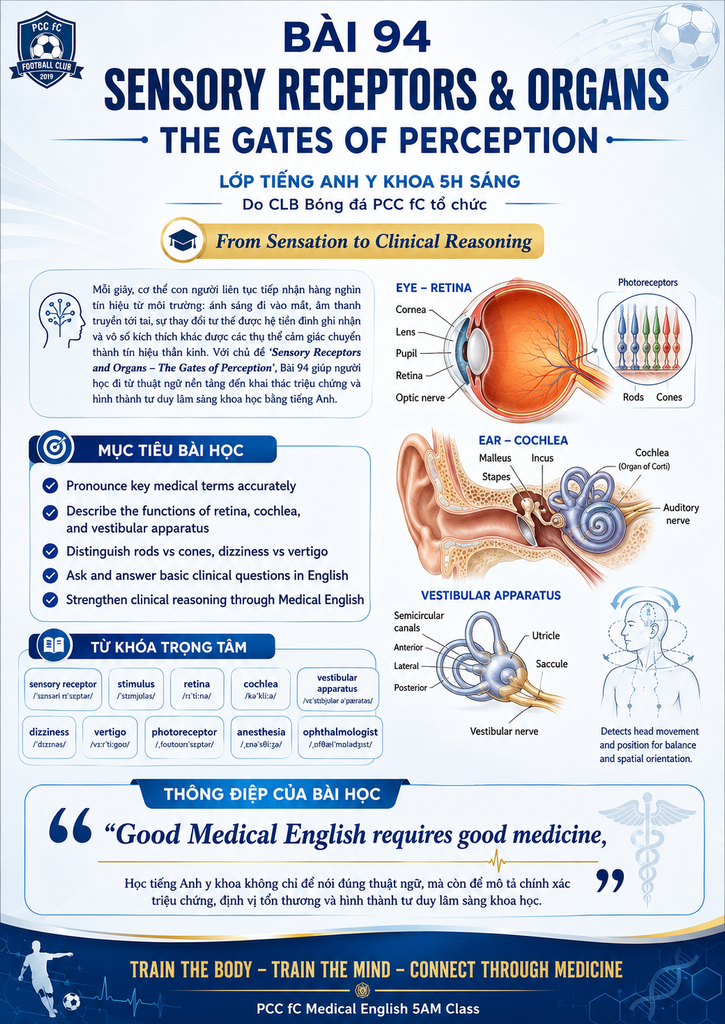
I. LEARNING OBJECTIVES – MỤC TIÊU BÀI HỌC
Sau bài học, học viên có thể:
- Pronounce correctly các thuật ngữ quan trọng về thị giác, thính giác và thăng bằng.
- Describe the basic functions của retina, cochlea và vestibular apparatus bằng tiếng Anh.
- Phân biệt rods vs cones và hearing vs balance.
- Hỏi bệnh một bệnh nhân có dizziness, vertigo, hearing loss hoặc visual disturbance.
- Chuyển cách nói thông thường của bệnh nhân sang medical terminology.
- Nhận diện một chi tiết không hợp lý về mặt lâm sàng trong hội thoại và đề xuất cách tiếp cận phù hợp hơn.
II. WARM-UP – DECODE THE MORNING WARD ROUND
⏱ 2 phút
Giảng viên lần lượt đưa ra các biểu tượng hoặc câu mô tả để học viên đoán thuật ngữ.
👁️ + 🌈 → Cones / Color vision
👂 + ⚖️ → Vestibular apparatus / Balance
👂 + 🔊 → Cochlea / Hearing
💉 + 💤 → General anesthesia
Quick questions
Teacher: Which structure helps us hear?
Students: The cochlea.
Teacher: Which system helps maintain balance?
Students: The vestibular system.
Teacher: Which photoreceptors are responsible for color vision?
Students: Cones.
III. CORE VOCABULARY
| Medical term | IPA | Word class | Vietnamese |
| sensory receptor | /ˈsen.sər.i rɪˈsep.tər/ | noun | thụ thể cảm giác |
| stimulus | /ˈstɪm.jə.ləs/ | noun | kích thích |
| retina | /ˈret.ɪ.nə/ | noun | võng mạc |
| cone | /koʊn/ | noun | tế bào nón |
| rod | /rɒd/ | noun | tế bào que |
| cochlea | /ˈkɒk.li.ə/ | noun | ốc tai |
| vestibular apparatus | /veˈstɪb.jə.lər ˌæp.əˈreɪ.təs/ | noun | cơ quan tiền đình |
| dizziness | /ˈdɪz.i.nəs/ | noun | chóng mặt |
| vertigo | /ˈvɜː.tɪ.ɡəʊ/ | noun | chóng mặt kiểu quay |
| anesthesia | /ˌæn.əsˈθiː.ʒə/ | noun | gây tê/gây mê |
| ophthalmologist | /ˌɒf.θælˈmɒl.ə.dʒɪst/ | noun | bác sĩ nhãn khoa |
| photoreceptor | /ˌfəʊ.təʊ.rɪˈsep.tər/ | noun | thụ thể ánh sáng |
Word roots
esthesi/o → sensation, feeling
→ anesthesia, hyperesthesia
ophthalm/o → eye
→ ophthalmologist, ophthalmoscope
ot/o → ear
→ otoscope, otolaryngology
IV. CLINICAL DIALOGUE
“SENSORY & BALANCE CASE”
⏱ 5 phút
Scenario:
A resident discusses a patient presenting with dizziness and visual disturbance with a senior physician.
1. Dr. Trung
“Dr. Ha, I’m examining a patient who complained of dizziness. Her vestibular apparatus seems to be affected.”
2. Dr. Ha
“Did you check her hearing as well? We should assess cochlear function and look for associated auditory symptoms.”
3. Dr. Trung
“Yes. Her hearing appears intact. However, she reports difficulty distinguishing colors.”
4. Dr. Ha
“That raises the possibility of impaired cone-mediated color vision. We should examine the retina and perform appropriate visual testing.”
5. Dr. Trung
“Would you distinguish dizziness from true vertigo before localizing the lesion?”
6. Dr. Ha
“Absolutely. Vertigo usually refers to an illusion of movement, whereas dizziness is a broader and less specific symptom.”
7. Dr. Trung
“So the auditory and vestibular systems are anatomically close but serve different sensory functions.”
8. Dr. Ha
“Exactly. Good clinical reasoning starts by identifying the symptom, linking it to the correct sensory pathway, and then localizing the possible lesion.”
V. CLINICAL LANGUAGE FOCUS
1. “Complain of + symptom”
✅ The patient complained of dizziness.
Không nói:
❌ complained dizziness
2. “Difficulty + V-ing”
✅ She has difficulty distinguishing colors.
Các ví dụ khác:
- difficulty hearing
- difficulty swallowing
- difficulty maintaining balance
- difficulty recognizing faces
3. “Could it be…?”
Dùng khi đưa ra diagnostic hypothesis.
Could it be a vestibular disorder?
Could it be related to cone dysfunction?
Could this indicate a central lesion?
4. “Seems to be affected”
Một cách diễn đạt thận trọng, phù hợp trong thảo luận lâm sàng:
The vestibular system seems to be affected.
Khác với khẳng định quá sớm:
❌ The patient definitely has vestibular disease.
VI. CLINICAL DEEP DIVE 1
RODS vs CONES
RODS
Main functions
- Dim-light vision
- High light sensitivity
- Peripheral vision
Location
- Predominantly peripheral retina
Color vision
- ❌ No
CONES
Main functions
- Color vision
- Bright-light vision
- High visual acuity
Location
- Highest density in the central retina, particularly the fovea
Color vision
- ✅ Yes
Clinical connection
Cone dysfunction → impaired color discrimination
Useful sentence:
“The patient has difficulty distinguishing red from green.”
VII. CLINICAL DEEP DIVE 2
ONE INNER EAR – TWO MAJOR FUNCTIONS
👂 COCHLEA → HEARING
Stimulus: sound waves
Function: converts mechanical sound energy into neural signals.
⚖️ VESTIBULAR APPARATUS → BALANCE
Includes:
- semicircular canals
- utricle
- saccule
Helps detect:
- head movement
- angular acceleration
- linear acceleration
- gravitational orientation
Key sentence
“The cochlea is primarily responsible for hearing, whereas the vestibular apparatus is responsible for balance and spatial orientation.”
VIII. DON’T CONFUSE
DIZZINESS ≠ VERTIGO
Dizziness
A broad, nonspecific term.
Patient may mean:
- light-headedness
- imbalance
- presyncope
- vertigo
Vertigo
An illusion of movement, often described as:
“The room is spinning.”
Useful clinical question
“When you say you feel dizzy, do you mean that the room is spinning, that you feel faint, or that you feel unsteady?”
⭐ Đây là một câu hỏi tiếng Anh lâm sàng rất thực tế và nên yêu cầu cả lớp nói thành thạo.
IX. THE PERCEPTION DECODER
⏱ 3 phút
Hãy chuyển Patient Language → Medical Language
Patient:
“I can’t tell red from green.”
→ Impaired color discrimination / possible cone dysfunction
Patient:
“The room is spinning when I stand up.”
→ Vertigo
Patient:
“I can’t hear clearly from my left ear.”
→ Unilateral hearing impairment
Patient:
“I feel like I’m going to fall when I walk.”
→ Impaired balance / gait instability
X. FIND THE CLINICAL PROBLEM
Educational Challenge
Trong hội thoại gốc của tài liệu có ý:
Nếu phát hiện tổn thương khu trú liên quan đến rối loạn nhìn màu, có thể cần biopsy under local anesthesia.
Câu hỏi cho học viên:
“Does this clinical plan make sense?”
Answer: No.
Rối loạn phân biệt màu không phải là chỉ định thông thường để sinh thiết võng mạc.
Cách tiếp cận hợp lý hơn có thể bao gồm:
- detailed ophthalmologic examination
- visual acuity testing
- color vision testing
- fundoscopic examination
- visual field testing
- retinal or optic nerve assessment depending on the suspected pathology
Teaching message
Good Medical English requires good medicine.
Không chỉ nói tiếng Anh đúng.
Người học phải nhận ra nội dung y khoa có hợp lý hay không.
XI. PRONUNCIATION FOCUS
⏱ 3 phút
1. Vestibular
/veˈstɪb.jə.lər/
Stress:
ve-STIB-u-lar
2. Cochlea
/ˈkɒk.li.ə/
Không đọc:
❌ “ko-chee-la”
3. Retina
/ˈret.ɪ.nə/
RET-i-na
4. Anesthesia
/ˌæn.əsˈθiː.ʒə/
Chú ý:
/θ/ → th
/ʒ/ → âm cuối của vision
5. Ophthalmologist
/ˌɒf.θælˈmɒl.ə.dʒɪst/
Có thể luyện chậm:
oph – thal – mol – o – gist
XII. PRONUNCIATION PAIR OF THE DAY
/s/ vs /ʃ/
/s/
- sensory
- stimulus
- system
/ʃ/
- vision
- function
- perception
Mini drill
“The sensory system processes visual information.”
Đọc chậm → đọc tự nhiên → đọc lại 2 lần.
XIII. RAPID-FIRE QUESTIONS
⏱ 2–3 phút
- Which receptors are mainly responsible for color vision?
→ Cones. - Which structure converts sound into neural signals?
→ The cochlea. - Which system is mainly responsible for balance?
→ The vestibular system. - What is the difference between dizziness and vertigo?
→ Dizziness is broad; vertigo is an illusion of movement. - What does “difficulty distinguishing colors” mean?
→ Khó phân biệt màu sắc. - How would you ask a patient whether the room is spinning?
→ “Do you feel as though you or the room is spinning?”
XIV. 30-SECOND SPEAKING CHALLENGE
Mỗi học viên chọn một cấu trúc:
- Retina
- Cochlea
- Vestibular apparatus
Và nói liên tục trong 30 giây theo mẫu:
Structure → Stimulus → Function → Clinical symptom
Example
“The cochlea is located in the inner ear. It responds to sound-related mechanical stimulation and is essential for hearing. Cochlear dysfunction may lead to hearing impairment or tinnitus.”
XV. TAKE-HOME MESSAGE
1
Receptors receive stimuli.
2
Sensory organs convert physical signals into neural information.
3
The retina allows us to see.
4
The cochlea allows us to hear.
5
The vestibular system helps us maintain balance.
6
Precise language improves precise clinical thinking.
PCC fC EDUCATIONAL MESSAGE
“TRAIN THE BODY – TRAIN THE MIND – CONNECT THROUGH MEDICINE”
CLB Bóng đá PCC fC không chỉ kết nối qua sân bóng, mà còn lan tỏa tinh thần học tập, kỷ luật, đồng đội và phát triển chuyên môn mỗi ngày.
BÀI 94 – ONE SENTENCE TO REMEMBER
“Good clinicians do not simply hear symptoms; they translate perception into localization, diagnosis, and action.”
Hiểu điều bệnh nhân cảm nhận – định vị nơi tổn thương – tư duy đến chẩn đoán.