BÀI 96 – LỚP TIẾNG ANH Y KHOA 5H SÁNG: THE NERVOUS SYSTEM (PART I): CLINICAL COMMUNICATION & LEXICON
PCC Language – Hà Nội, ngày 29/08/2026
Trong thực hành y khoa lâm sàng, thần kinh học (Neurology) luôn là một trong những chuyên khoa phức tạp nhất, đòi hỏi sự chính xác tuyệt đối từ giải phẫu đến sinh lý bệnh. Không dừng lại ở việc ghi nhớ từ vựng giải phẫu đơn thuần, một bác sĩ cần làm chủ khả năng thảo luận ca bệnh (Peer-to-peer case discussion), mô tả chính xác cơ chế tổn thương thần kinh và sử dụng cấu trúc ngữ pháp chuẩn xác trong hồ sơ bệnh án. Bài 91 của Lớp Tiếng Anh Y Khoa 5H sáng do CLB Bóng đá PCC fC tổ chức sẽ phân tích toàn bộ chuyên đề The Nervous System (Part I), giúp bạn tự tin làm chủ giao tiếp lâm sàng chuyên sâu.
In clinical practice, neurology requires absolute precision from neuroanatomy to pathophysiology. Medical professionals must master peer-to-peer discussions, articulate exact neurological deficits, and apply precise syntactic structures in medical documentation. Lesson 91 of the 5 AM Medical English Class, organized by PCC fC Football Club, covers the entire topic “The Nervous System (Part I)”, empowering doctors to navigate professional clinical communication with confidence.
⚽ BÀI 96 – LỚP TIẾNG ANH Y KHOA 5H SÁNG
THE NERVOUS SYSTEM (PART I): CLINICAL COMMUNICATION & LEXICON
Hệ Thần Kinh (Phần I): Ngôn Ngữ Lâm Sàng & Từ Vựng Chuyên Ngành
Tổ chức bởi CLB Bóng đá PCC fC
I. CORE OBJECTIVES – MỤC TIÊU BÀI HỌC
Bài học tập trung vào 3 trụ cột năng lực cốt lõi:
- Lexical Acquisition (Sở hữu từ vựng): Làm chủ phiên âm quốc tế (IPA), định nghĩa tiếng Anh và thuật ngữ tiếng Việt cho giải phẫu hệ thần kinh và bệnh lý cảm giác.
- Clinical Discourse (Diễn ngôn lâm sàng): Phân tích và mô phỏng lại các buổi thảo luận ca bệnh chuyên nghiệp giữa các đồng nghiệp (peer-to-peer discussions).
- Syntactic Precision (Cú pháp chuẩn xác): Ứng dụng câu bị động lâm sàng (Clinical Passive Voice) và các liên từ logic (Correlative Conjunctions / Logical Connectors) trong báo cáo y khoa và ghi chú hồ sơ bệnh án.
II. CLINICAL CASE DISCUSSION: BED 4 – THẢO LUẬN CA BỆNH LÂM SÀNG
1. Dialogue: Bed 4 (Hội thoại đi buồng giữa Dr. Evelyn & Dr. Minh)
- Dr. Evelyn: “Dr. Minh, have you reviewed the nerve conduction studies for the patient in Bed 4?”
(Bác sĩ Minh đã xem kết quả đo dẫn truyền thần kinh của bệnh nhân ở Giường 4 chưa?) - Dr. Minh: “Yes, the results indicate a significantly delayed reflex arc in the lower extremities.”
(Tôi xem rồi, kết quả cho thấy cung phản xạ ở chi dưới bị chậm đáng kể.) - Dr. Evelyn: “Exactly; we are seeing demyelination consistent with Multiple Sclerosis.”
(Chính xác; chúng ta đang thấy tình trạng mất myelin phù hợp với Bệnh đa xơ cứng.) - Dr. Minh: “Because the myelin sheath is compromised, the electrical impulse is transmitted much more slowly.”
(Vì bao myelin bị tổn thương, xung điện được truyền đi chậm hơn nhiều.)
- Dr. Evelyn: “Correct. Therefore, the signal struggles to jump across the synapse to the motor neuron.”
(Đúng vậy. Do đó, tín hiệu gặp khó khăn khi nhảy qua cúc xi-náp để đến nơ-ron vận động.) - Dr. Minh: “While the sensory receptors detect the stimulus normally, the efferent response is severely blunted.”
(Trong khi các thụ thể cảm giác vẫn nhận biết kích thích bình thường, đáp ứng ly tâm lại bị suy giảm nghiêm trọng.) - Dr. Evelyn: “This is why the patient presents with muscle weakness and uncoordinated movements.”
(đó là lý do tại sao bệnh nhân biểu hiện yếu cơ và mất phối hợp động tác.) - Dr. Minh: “I will update the chart to reflect the impaired motor pathway and monitor for further progression.”
(Tôi sẽ cập nhật hồ sơ bệnh án để phản ánh đường truyền vận động bị tổn thương và theo dõi tiến triển tiếp theo.)
2. Pragmatics & Discourse Analysis (Phân tích ngữ dụng & diễn ngôn y khoa)
- Professional Phrasing (Thuật ngữ chuyên môn tinh tế):
- Sử dụng từ “compromised” (bị tổn thương/suy giảm chức năng) và “severely blunted” (bị trơ/suy giảm nghiêm trọng) thay vì dùng các từ thông thường như “damaged” hay “weak”.
- Nguyên tắc: Tiếng Anh y khoa ưu tiên các tính từ mô tả chính xác trạng thái chức năng (functional state) của cấu trúc giải phẫu.
- The “Presenting” Patient (Diễn đạt triệu chứng bệnh nhân):
- Cấu trúc chuẩn: “The patient presents with [symptom/sign]” (Bệnh nhân nhập viện/biểu hiện với triệu chứng…).
- Đây là cụm từ tiêu chuẩn dùng để mô tả lý do vào viện (chief complaint) hoặc các dấu hiệu lâm sàng quan sát được khi khám.
- Logical Connectors (Liên từ logic trong tư duy lâm sàng):
- Sử dụng các từ nối như “Therefore…” (Do đó…) và “While…” (Trong khi…).
- Giúp bác sĩ lập bản đồ tư duy biện luận lâm sàng (clinical reasoning) thành lời, thể hiện rõ mối quan hệ nguyên nhân – kết quả trực tiếp giữa bệnh lý và triệu chứng.
III. LEXICAL ACQUISITION – TỪ VỰNG Y KHOA CHUYÊN SÂU
| Term & Phonetics | English Definition | L1 Translation (Tiếng Việt) |
| Dendrite /’den.draɪt/ | Short branches at one end of the cell body that receive messages from other neurons. | Đuôi gai / Sợi nhánh (nhận xung động thần kinh). |
| Myelin Sheath /’maɪ.ə.lɪn ʃiːθ/ | A fatty insulation covering the axon that allows electrical impulses to transmit quickly. | Bao myelin (lớp vỏ bọc cách điện của sợi trục giúp truyền xung điện nhanh). |
| Synapse /’sɪn.æps/ | The microscopic space between the synaptic end bulb of one neuron and the dendrite of another. | Khớp thần kinh / Cúc xi-náp (khoảng trống vi mô giữa hai nơ-ron). |
| Multiple Sclerosis /’mʌl.tə.pəl sklɪ’roʊ.sɪs/ | A disease where the body’s defense cells attack the myelin sheath, slowing neural messages and causing weakness or paralysis. | Bệnh đa xơ cứng (bệnh tự miễn phá hủy bao myelin, làm chậm tín hiệu thần kinh, gây yếu/liệt). |
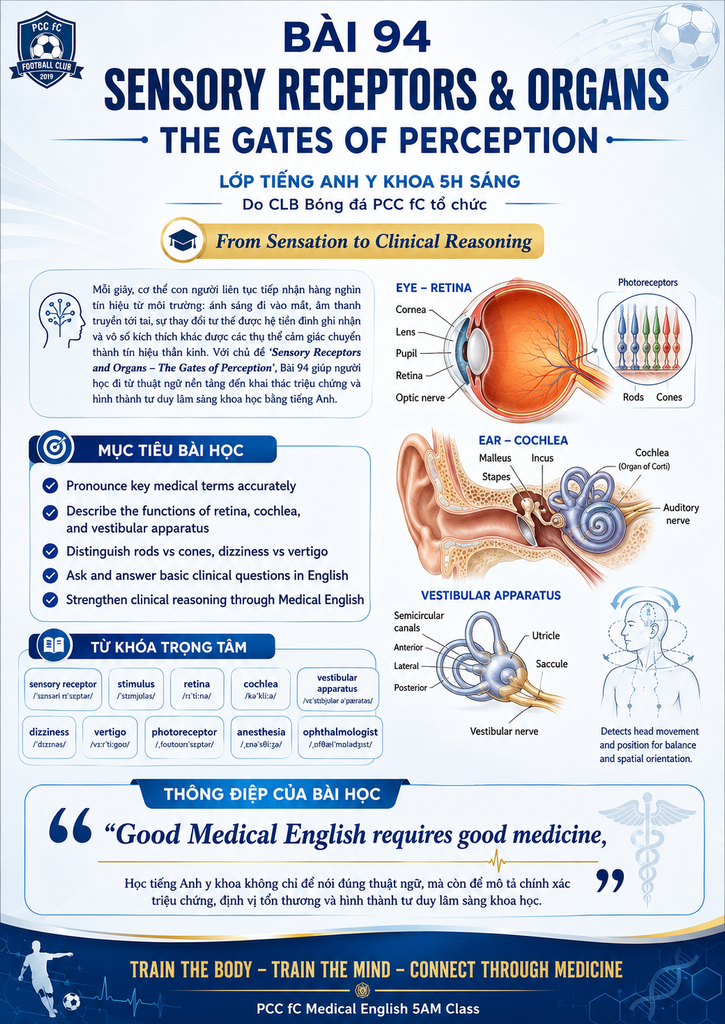
| Cochlea /’kɑːk.li.ə/ | A snail-shaped area inside the inner ear containing sensory receptors for hearing. | Ốc tai (cấu trúc hình ốc ở tai trong chứa thụ thể cảm giác thính giác). |
| Vestibular Apparatus /ve’stɪb.jə.lər æp.ə’ræt.əs/ | Structures in the inner ear that detect head position, body direction, and maintain balance. | Tiền đình / Bộ máy tiền đình (cấu trúc tai trong giúp nhận biết vị trí đầu và duy trì thăng bằng). |
| Anesthesia /æn.əs’θiː.ʒə/ | Chemicals used to prevent sensory receptors from sending pain messages to the CNS. | Thuốc tê / Thuốc mê (hóa chất ngăn thụ thể cảm giác truyền tín hiệu đau về TKTW). |
IV. LINGUISTIC FOCUS & CLINICAL GRAMMAR – CẤU TRÚC CÚ PHÁP LÂM SÀNG
1. The Clinical Passive Voice (Thể bị động lâm sàng)
- Công thức: [Subject/Patient/Anatomy] + [BE VERB] + [VERB-ED / PAST PARTICIPLE]
- Quy tắc: Dùng để nhấn mạnh vào cấu trúc giải phẫu hoặc thủ thuật y khoa được thực hiện, chứ không nhấn mạnh vào người thực hiện (agent).
- Ví dụ 1: The impulse is transmitted to the motor neuron. (Xung động được truyền đến nơ-ron vận động).
- Ví dụ 2: The myelin sheath was destroyed by the body’s defense cells. (Bao myelin đã bị phá hủy bởi các tế bào phòng vệ của cơ thể).
2. Correlative Discourse & Logical Connectors (Cấu trúc đối chiếu & Kết nối logic)
- While (Thực trạng song song / Đối lập):
- Cấu trúc: [While] + [Clause 1], [Clause 2].
- Ví dụ: While the sensory nerve functions normally, the motor nerve is paralyzed. (Trong khi thần kinh cảm giác hoạt động bình thường thì thần kinh vận động lại bị liệt).
- Cấu trúc: [While] + [Clause 1], [Clause 2].
- Therefore (Hệ quả lâm sàng):
- Cấu trúc: [Observation]. [Therefore], [Conclusion].
- Ví dụ: The axon is unmyelinated. Therefore, the signal moves slowly. (Sợi trục không có bao myelin. Do đó, tín hiệu di chuyển rất chậm).
V. CLINICAL COMPREHENSION CHECKS – BÀI TẬP KIỂM TRA LÂM SÀNG
Check 1: Multiple Choice (Đáp án & Biện luận)
- Q1. Multiple Sclerosis pathogenesis is characterized by:
- A) The continuous stimulation of synaptic vesicles.
- B) The destruction of the fatty insulation covering axons. (Đáp án đúng)
- C) The inability of the cochlea to process sound waves.
- Giải thích: MS tấn công và phá hủy bao myelin (lớp vỏ bọc chất béo cách điện của sợi trục).
- Q2. Select the grammatically correct sentence for a medical chart:
- A) While the local anesthesia applied, therefore the patient felt no pain.
- B) The anesthesia is administered, while the sensory receptors are blocked.
- C) Local anesthesia was administered; therefore, pain signals were blocked from reaching the CNS. (Đáp án đúng)
- Giải thích: Câu C sử dụng đúng thể bị động y khoa (was administered, were blocked) và liên từ chỉ quan hệ nguyên nhân – kết quả (therefore).
- Q3. If a patient presents with severe vertigo (dizziness) and loss of balance, which structure is likely compromised?
- A) The vestibular apparatus (Đáp án đúng)
- B) The cochlea
- C) The motor dendrites
- Giải thích: Bộ máy tiền đình (vestibular apparatus) kiểm soát vị trí và sự thăng bằng. Ốc tai (cochlea) kiểm soát thính giác.
Check 2: The Reflex Pathway (Cung phản xạ – Trật tự sinh lý chuẩn)
Thứ tự diễn tiến sinh lý chuẩn của một cung phản xạ khi tiếp xúc với nguồn nhiệt (bếp nóng):
- (1) Step D: Sensory receptors in the peripheral nervous system detect a painful stimulus (e.g., a hot stove). (Thụ thể cảm giác ở hệ TKNW phát hiện kích thích gây đau).
- (2) Step E: An electrical impulse is sent along an afferent sensory nerve to the spinal cord. (Xung điện được gửi dọc theo dây thần kinh cảm giác hướng tâm đến tủy sống).
- (3) Step A: The spinal cord (CNS) interprets the message and makes a rapid reflex decision. (Tủy sống giải mã thông tin và đưa ra quyết định phản xạ nhanh chóng).
- (4) Step B: The message is transmitted along an efferent motor nerve to the arm. (Tín hiệu được truyền dọc theo dây thần kinh vận động ly tâm đến tay).
- (5) Step C: The muscles in the hand and arm contract to pull away from the heat. (Các cơ ở bàn tay và cẳng tay co lại để rụt tay khỏi nguồn nhiệt).
💡 Linguistic & VN Focus:
- Afferent = Hướng tâm (dẫn truyền cảm giác VÀO tủy sống/TKTW).
- Efferent = Ly tâm (dẫn truyền vận động ĐI RA cơ quan đáp ứng).
VI. CAPSTONE CASE STUDY: POST-PROCEDURAL COMPLICATION
(Báo cáo ca lâm sàng phức tạp: Biến chứng sau thủ thuật)
1. Chief Complaint & Clinical Scenario (Bệnh cảnh):
Một bệnh nhân trải qua thủ thuật nha khoa và được gây tê vùng dây thần kinh hàm dưới (mandibular nerve block). Sau thủ thuật, bệnh nhân tê môi (dấu hiệu dự kiến), nhưng đồng thời xuất hiện nụ cười lệch và không thể chớp mắt ở bên mặt cùng bên (dấu hiệu bất thường).
2. Discussion Prompts & Clinical Answers (Đáp án biện luận):
- Question 1 (Anatomy): Is the affected nerve purely sensory, purely motor, or a mixed nerve?
- Answer: It is a mixed nerve. The mandibular division (V3) contains both sensory fibers (supplying sensation to the tongue, lower lip, and teeth) and motor fibers. The unexpected motor deficits (uneven smile, inability to blink) indicate that neighboring motor branches (e.g., branches of the facial nerve) or motor fibers within the mixed nerve trunk were affected by the anesthetic agent.
- Answer: It is a mixed nerve. The mandibular division (V3) contains both sensory fibers (supplying sensation to the tongue, lower lip, and teeth) and motor fibers. The unexpected motor deficits (uneven smile, inability to blink) indicate that neighboring motor branches (e.g., branches of the facial nerve) or motor fibers within the mixed nerve trunk were affected by the anesthetic agent.
- Question 2 (Physiology): What cellular structure is the anesthesia blocking to prevent the action potential?
- Answer: The local anesthetic blocks voltage-gated sodium channels (Na+ channels) on the axonal cell membrane of the neuron. By preventing sodium influx, it inhibits depolarization and halts the propagation of the action potential along the nerve fiber.
- Answer: The local anesthetic blocks voltage-gated sodium channels (Na+ channels) on the axonal cell membrane of the neuron. By preventing sodium influx, it inhibits depolarization and halts the propagation of the action potential along the nerve fiber.
- Question 3 (Reporting – Chart Documentation): Construct 2 sentences using Clinical Passive Voice and Logical Connectors (While/Therefore).
- Sentence 1: While local anesthesia was administered for a routine mandibular block, motor function of the facial muscles was inadvertently impaired.
- Sentence 2: Na+ channels on the nerve membrane were blocked; therefore, electrical impulses could not be transmitted along both sensory and motor pathways.
💡 TAKE-HOME MESSAGES (THÔNG ĐIỆP CỐT LÕI):
- Precision in Terminology: Dùng “compromised” và “blunted” để mô tả chính xác mức độ tổn thương chức năng thay cho các từ chung chung.
- Afferent vs. Efferent: Luôn nhớ Afferent (Hướng tâm – Cảm giác đi vào TKTW) và Efferent (Ly tâm – Vận động đi ra ngoại vi).
- Passive & Logical Flow: Báo cáo hồ sơ y khoa chuẩn luôn ưu tiên Thể bị động y khoa (was administered, was impaired) kết hợp với các liên từ biện luận (Therefore, While) để thể hiện rõ tư duy lâm sàng.