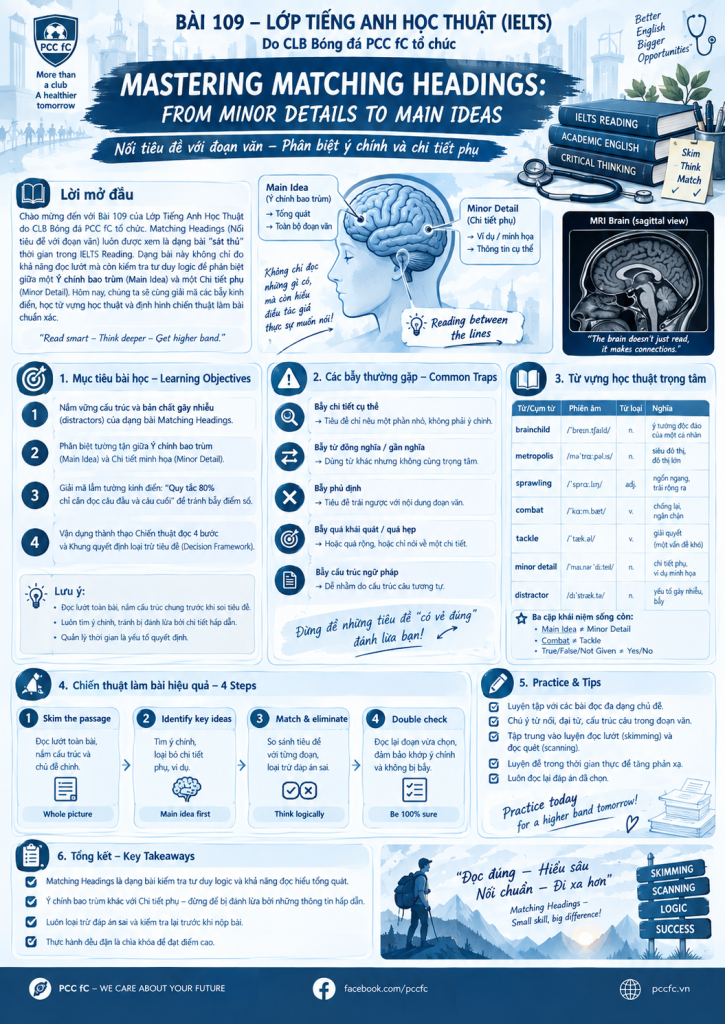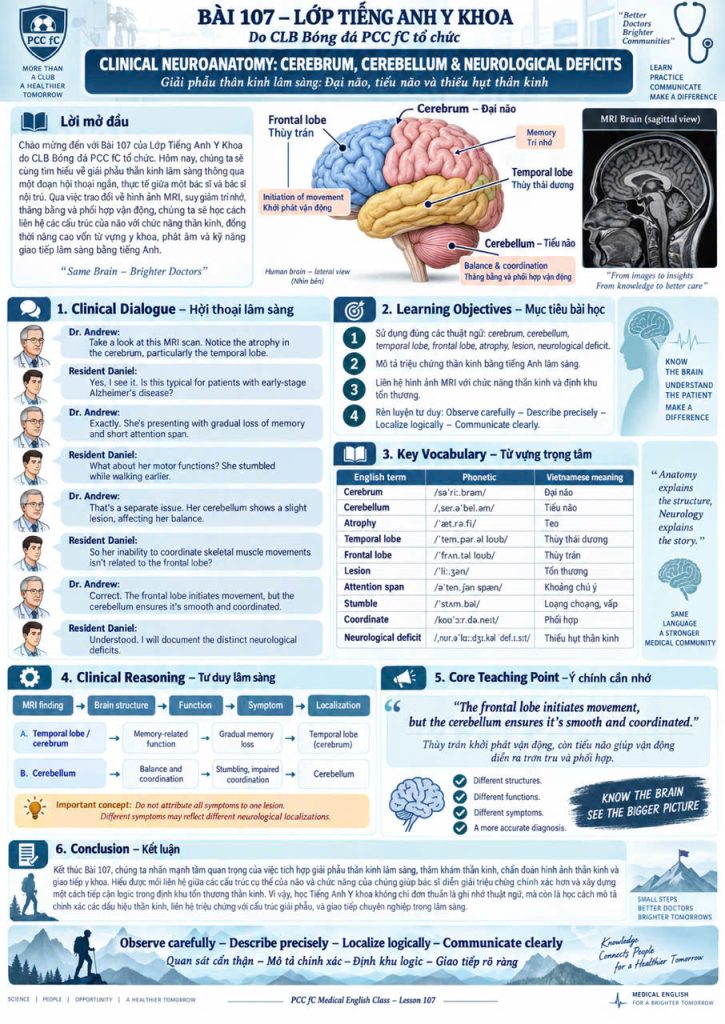
Bài ôn tập Tuần 18: Lớp Tiếng Anh Y Khoa!
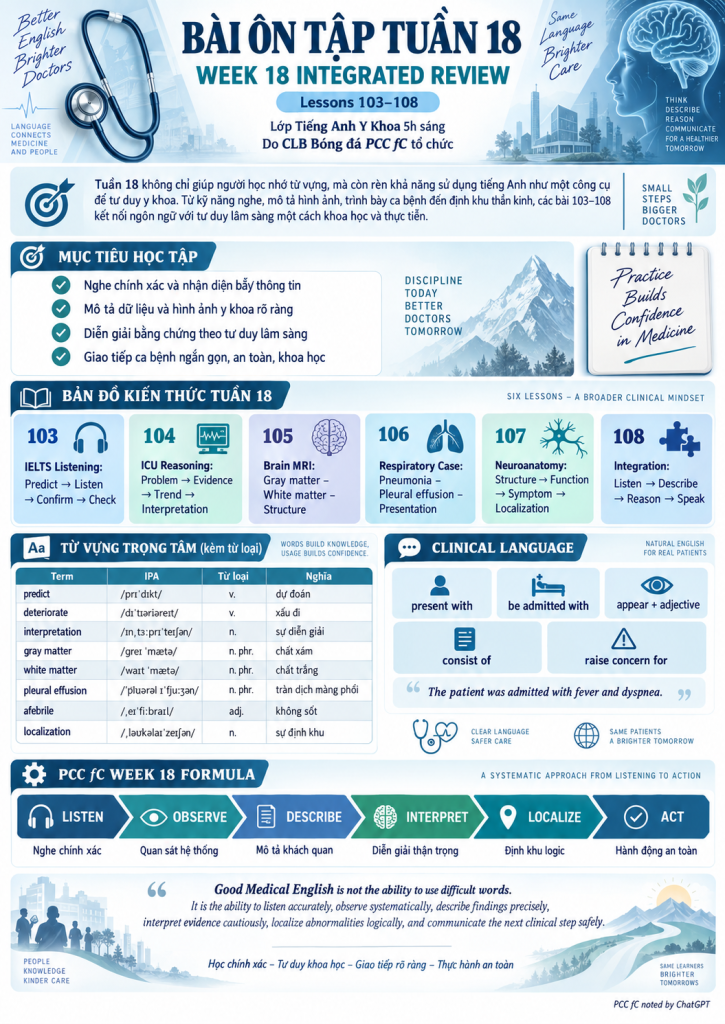
PCC Language – Thăng Long, ngày 13/8/2026, Bước sang Tuần 18, Lớp Tiếng Anh Y Khoa 5h sáng do CLB Bóng đá PCC fC tổ chức tiếp tục hướng tới một mục tiêu quan trọng hơn việc chỉ ghi nhớ từ vựng: sử dụng tiếng Anh như một công cụ để tư duy y khoa. Từ kỹ năng nghe chính xác trong IELTS, phân tích diễn biến người bệnh tại ICU, mô tả hình ảnh MRI não, trình bày bệnh lý hô hấp đến định khu thần kinh, các bài 103–108 tạo nên một chuỗi học tập liên tục, kết nối ngôn ngữ với kiến thức và tư duy lâm sàng. Bài ôn tập Tuần 18 được thiết kế theo hướng giáo dục chủ động và khoa học, giúp người học không chỉ biết một từ “nghĩa là gì” mà còn biết từ đó thuộc từ loại nào, phát âm ra sao, đi cùng cấu trúc nào và được sử dụng thế nào trong bối cảnh y khoa thực tế. Qua đó, mỗi học viên từng bước hình thành một quy trình tư duy rõ ràng: Listen – Observe – Describe – Interpret – Localize – Act. Mục tiêu cuối cùng không phải là nói tiếng Anh thật phức tạp, mà là nghe chính xác hơn, mô tả rõ hơn, lập luận chặt chẽ hơn và giao tiếp y khoa an toàn hơn. Đó cũng chính là tinh thần mà lớp học 5h sáng PCC fC theo đuổi: học đều mỗi ngày, học có hệ thống và biến kiến thức thành năng lực sử dụng thực tế.
BÀI ÔN TẬP TUẦN 18 – WEEK 18 INTEGRATED REVIEW
LESSONS 103–108
LỚP TIẾNG ANH Y KHOA 5H SÁNG
Do CLB Bóng đá PCC fC tổ chức
LISTEN → OBSERVE → DESCRIBE → INTERPRET → LOCALIZE → ACT
Nghe chính xác → Quan sát có hệ thống → Mô tả rõ ràng → Diễn giải khoa học → Định khu logic → Hành động phù hợp
I. LEARNING OBJECTIVES – MỤC TIÊU HỌC TẬP
Sau bài ôn tập, học viên có thể:
1. Knowledge – Kiến thức
- Nhắc lại những kiến thức cốt lõi của Lessons 103–108.
- Hiểu các thuật ngữ quan trọng trong ICU, hô hấp, MRI não và thần kinh học.
- Phân biệt clinical finding – interpretation – diagnosis – action.
2. Language – Ngôn ngữ
- Sử dụng đúng từ vựng y khoa kèm từ loại.
- Phát âm đúng các thuật ngữ thường gặp.
- Vận dụng các cấu trúc:
- present with
- be admitted with
- consist of
- appear + adjective
- Present Perfect
- Passive Voice
- suggest / indicate / raise concern for
3. Clinical reasoning – Tư duy lâm sàng
Chuyển từ:
DATA → MEANING → CLINICAL PRIORITY
Không chỉ nói:
Creatinine has increased.
Mà tiến tới:
Creatinine has increased, suggesting deterioration in renal function; therefore, renal function and potentially nephrotoxic medications should be reassessed.
4. Communication – Giao tiếp
Trình bày một ca bệnh ngắn trong 60–90 giây bằng tiếng Anh có cấu trúc.
II. WEEK 18 KNOWLEDGE MAP – BẢN ĐỒ KIẾN THỨC
| Lesson | Nội dung trọng tâm | Năng lực cần đạt |
| 103 | IELTS Listening – Form Completion | Predict → Listen → Confirm → Check |
| 104 | ICU bedside reasoning | Data → Trend → Interpretation → Priority |
| 105 | Brain anatomy & MRI | Structure → Description → Function |
| 106 | Pneumonia & pleural effusion | History → Imaging → Microbiology → Status |
| 107 | Clinical neuroanatomy | Structure → Function → Symptom → Localization |
| 108 | Integrated Review | Listen → Describe → Reason → Communicate |
III. LESSON 103
LISTENING ACCURATELY – NGHE CHÍNH XÁC
1. Scientific learning point
Trong Listening, người học không chỉ cần nghe được từ, mà phải xử lý đồng thời:
Prediction → Auditory recognition → Working memory → Error correction → Final confirmation
Công thức PCC fC
PREDICT → LISTEN → CONFIRM → CHECK
2. The correction trap – Bẫy tự sửa thông tin
Ví dụ:
“The appointment is on Tuesday… sorry, I mean Thursday.”
Không chọn Tuesday.
✅ Đáp án cuối cùng:
Thursday
Golden rule
Record the final confirmed information, not necessarily the first information you hear.
Hãy ghi thông tin cuối cùng đã được xác nhận, không nhất thiết là thông tin đầu tiên nghe thấy.
3. Prediction before listening
Trước khi audio chạy, hãy xác định chỗ trống cần:
- a noun – danh từ?
- a number – con số?
- a date – ngày tháng?
- a place – địa điểm?
- an adjective – tính từ?
- a unit – đơn vị?
- singular or plural?
Đây chính là điểm gặp nhau giữa grammar prediction và listening comprehension.
IV. LESSON 104
ICU BEDSIDE REASONING – TƯ DUY TẠI GIƯỜNG BỆNH
1. Không nhầm dữ liệu với diễn giải
DATA – Dữ liệu
Procalcitonin has risen to 3.01 ng/mL.
Đây mới là observation.
INTERPRETATION – Diễn giải
The rising procalcitonin level may support ongoing bacterial infection in the appropriate clinical context.
ACTION – Hành động
The patient should be clinically reassessed, together with microbiological, imaging, and organ-function data.
2. Scientific caution
Một dấu ấn sinh học không phải là chẩn đoán
Không nên nói:
High procalcitonin means sepsis.
Nên nói thận trọng hơn:
An elevated procalcitonin level may support the diagnosis of bacterial infection when interpreted together with the clinical picture.
Language of scientific uncertainty
- suggest – gợi ý
- indicate – cho thấy
- be consistent with – phù hợp với
- raise concern for – làm tăng lo ngại về
- may represent – có thể biểu hiện
- should be interpreted in context – cần được diễn giải trong bối cảnh lâm sàng
Đây là cách nói khoa học hơn việc khẳng định tuyệt đối.
3. PCC fC ICU REASONING MODEL
PROBLEM
↓
EVIDENCE
↓
TREND
↓
INTERPRETATION
↓
PRIORITY
↓
ACTION
V. LESSON 105
BRAIN ANATOMY ON MRI
1. Gray matter – Chất xám
Gray matter contains neuronal cell bodies, dendrites, synapses, glial cells, and relatively fewer myelinated axons.
Chất xám chứa chủ yếu thân tế bào thần kinh, dendrite, synapse và tế bào đệm.
2. White matter – Chất trắng
White matter is composed predominantly of myelinated axons that connect different regions of the central nervous system.
Chất trắng chủ yếu gồm các sợi trục được myelin hóa giúp kết nối các vùng thần kinh.
3. Important scientific note
Không nên hiểu đơn giản rằng:
Gray matter = gray on every MRI
White matter = white on every MRI
Tín hiệu MRI phụ thuộc vào:
- T1-weighted sequence
- T2-weighted sequence
- FLAIR
- diffusion-weighted imaging
- tissue composition
Clinical language
Gray–white matter differentiation is preserved.
Sự phân biệt chất xám – chất trắng còn bảo tồn.
4. Structure → Function
Cerebral cortex
→ higher cortical functions
White matter
→ neural connectivity
Cerebellum
→ coordination and balance
Frontal lobe
→ executive function and initiation of voluntary movement
Temporal lobe
→ memory and auditory processing
VI. LESSON 106
PNEUMONIA & PLEURAL EFFUSION
Một ca hô hấp nên được trình bày theo logic:
PRESENTATION → EXAMINATION → IMAGING → MICROBIOLOGY → RESPONSE
1. Presentation
The patient was admitted with fever, cough, fatigue, and shortness of breath.
2. Imaging
Chest CT showed right-sided pulmonary consolidation with pleural effusion.
3. Microbiology
Escherichia coli was isolated from the pleural fluid.
4. Current clinical status
The patient is currently afebrile, fully conscious, and breathing comfortably on room air.
5. Scientific distinction
Pneumonia
Nhiễm trùng nhu mô phổi.
Consolidation
Một radiological/physical finding, không phải lúc nào cũng đồng nghĩa với pneumonia.
Pleural effusion
Sự tích tụ dịch bất thường trong khoang màng phổi.
Positive culture
Phải được diễn giải cùng:
- specimen quality
- clinical presentation
- imaging
- previous antimicrobial therapy
- possibility of contamination
VII. LESSON 107
CLINICAL NEUROANATOMY – ĐỊNH KHU THẦN KINH
The neurological reasoning chain
STRUCTURE → FUNCTION → DEFICIT → LOCALIZATION
Cerebellum
Normal function
- balance
- coordination
- timing of movement
Possible clinical manifestations
- ataxia
- dysmetria
- intention tremor
- gait instability
Frontal lobe
Liên quan:
- executive function
- behavior
- motor planning
- initiation of voluntary movement
Temporal lobe
Liên quan:
- memory
- auditory processing
- language comprehension in the dominant hemisphere
Clinical reasoning example
Observation
The patient has an unsteady gait.
Interpretation
Gait instability may suggest dysfunction involving the cerebellum, vestibular system, sensory pathways, motor system, or other structures.
Localization
Không nên kết luận ngay:
Unsteady gait = cerebellar lesion.
Cần thêm:
- coordination testing
- eye movements
- strength
- sensation
- vestibular symptoms
- imaging when indicated
Golden rule
Don’t diagnose from one symptom. Localize systematically.
Đừng chẩn đoán từ một triệu chứng đơn lẻ. Hãy định khu có hệ thống.
VIII. WEEK 18 CORE VOCABULARY
TỪ VỰNG TRỌNG TÂM
Quy ước từ loại
- n. = noun – danh từ
- v. = verb – động từ
- adj. = adjective – tính từ
- adv. = adverb – trạng từ
- phr. = phrase – cụm từ
- phr.v. = phrasal verb – cụm động từ
| Word / Phrase | IPA | Từ loại | Nghĩa | Medical usage |
| predict | /prɪˈdɪkt/ | v. | dự đoán | predict the type of information |
| confirmation | /ˌkɒnfəˈmeɪʃən/ | n. | sự xác nhận | diagnostic confirmation |
| deteriorate | /dɪˈtɪəriəreɪt/ | v. | xấu đi | renal function deteriorated |
| deterioration | /dɪˌtɪəriəˈreɪʃən/ | n. | sự xấu đi | clinical deterioration |
| reassess | /ˌriːəˈses/ | v. | đánh giá lại | reassess the patient |
| interpret | /ɪnˈtɜːprɪt/ | v. | diễn giải | interpret laboratory results |
| interpretation | /ɪnˌtɜːprɪˈteɪʃən/ | n. | sự diễn giải | clinical interpretation |
| persistent | /pəˈsɪstənt/ | adj. | kéo dài, dai dẳng | persistent fever |
| critically ill | /ˈkrɪtɪkəli ɪl/ | adj. phr. | bệnh nặng/nguy kịch | critically ill patient |
| cerebral cortex | /səˈriːbrəl ˈkɔːteks/ | n. phr. | vỏ đại não | cerebral cortex |
| gray matter | /ɡreɪ ˈmætə/ | n. phr. | chất xám | cortical gray matter |
| white matter | /waɪt ˈmætə/ | n. phr. | chất trắng | white-matter lesion |
| myelinated | /ˈmaɪəlɪneɪtɪd/ | adj. | được myelin hóa | myelinated axons |
| axon | /ˈæksɒn/ | n. | sợi trục | neuronal axon |
| differentiation | /ˌdɪfərenʃiˈeɪʃən/ | n. | sự phân biệt | gray–white matter differentiation |
| consolidation | /kənˌsɒlɪˈdeɪʃən/ | n. | đông đặc | pulmonary consolidation |
| pleural effusion | /ˈplʊərəl ɪˈfjuːʒən/ | n. phr. | tràn dịch màng phổi | bilateral pleural effusions |
| isolate | /ˈaɪsəleɪt/ | v. | phân lập | bacteria were isolated |
| afebrile | /ˌeɪˈfiːbraɪl/ | adj. | không sốt | the patient is afebrile |
| coordination | /kəʊˌɔːdɪˈneɪʃən/ | n. | sự phối hợp | motor coordination |
| coordinate | /kəʊˈɔːdɪneɪt/ | v. | phối hợp | coordinate movement |
| ataxia | /əˈtæksiə/ | n. | thất điều | gait ataxia |
| neurological | /ˌnjʊərəˈlɒdʒɪkəl/ | adj. | thuộc thần kinh | neurological examination |
| deficit | /ˈdefɪsɪt/ | n. | thiếu hụt/khiếm khuyết | neurological deficit |
| localize | /ˈləʊkəlaɪz/ | v. | định khu | localize the lesion |
| localization | /ˌləʊkəlaɪˈzeɪʃən/ | n. | sự định khu | neurological localization |
IX. WORD FAMILY – HỌC THEO GIA ĐÌNH TỪ
Học từ đơn lẻ rất dễ quên.
Hãy học theo word family.
1. interpret
interpret – v. – diễn giải
↓
interpretation – n. – sự diễn giải
↓
interpretable – adj. – có thể diễn giải
2. deteriorate
deteriorate – v. – xấu đi
↓
deterioration – n. – sự xấu đi
3. coordinate
coordinate – v. – phối hợp
↓
coordination – n. – sự phối hợp
↓
coordinated – adj. – phối hợp tốt
4. localize
localize – v. – định khu
↓
localization – n. – sự định khu
↓
localized – adj. – khu trú
5. assess
assess – v. – đánh giá
↓
assessment – n. – sự đánh giá
↓
reassess – v. – đánh giá lại
↓
reassessment – n. – sự đánh giá lại
X. GRAMMAR & CLINICAL LANGUAGE
1. PRESENT WITH + symptom/sign
The patient presented with confusion and ataxia.
Không nói:
The patient presented confusion.
2. BE ADMITTED WITH/FOR
He was admitted with fever and dyspnea.
He was admitted for further evaluation.
3. PRESENT PERFECT
has/have + past participle
Dùng để mô tả diễn biến có liên quan đến hiện tại.
Renal function has deteriorated.
Procalcitonin has risen.
Hemoglobin has fallen.
4. PASSIVE VOICE
be + past participle
E. coli was isolated from the pleural fluid.
The medication should be reassessed.
Electrolytes should be corrected.
Bị động đặc biệt thường gặp trong văn phong khoa học vì nhấn mạnh process/result hơn người thực hiện.
5. APPEAR + ADJECTIVE
The cerebral cortex appears intact.
The patient appears stable.
6. CONSIST OF
White matter consists predominantly of myelinated axons.
Không dùng:
consists from ❌
7. SUGGEST / INDICATE / BE CONSISTENT WITH
suggest
The findings suggest cerebellar dysfunction.
indicate
The results indicate clinical improvement.
be consistent with
The CT findings are consistent with pneumonia.
Lưu ý:
suggest không đồng nghĩa với prove.
XI. PRONUNCIATION LAB
1. breath vs breathe
breath /breθ/ – n. – hơi thở
shortness of breath
breathe /briːð/ – v. – thở
The patient can breathe comfortably.
2. affect vs effect
affect /əˈfekt/ – v. – ảnh hưởng
The lesion may affect coordination.
effect /ɪˈfekt/ – n. – tác động
The treatment had a beneficial effect.
3. rise vs raise
rise /raɪz/ – v., nội động từ
Procalcitonin has risen.
raise /reɪz/ – v., ngoại động từ
This finding raises concern for infection.
XII. INTEGRATED CLINICAL CASE
CA LÂM SÀNG TÍCH HỢP
Clinical vignette
A 76-year-old man was admitted with fever, productive cough, confusion, and shortness of breath. Chest CT showed right lower-lobe consolidation associated with a small pleural effusion. His inflammatory markers have increased over the last 24 hours. On neurological examination, the physician notices an unsteady gait.
STEP 1 – IDENTIFY
What are the main clinical problems?
- Respiratory infection
- Pulmonary consolidation
- Pleural effusion
- Confusion
- Gait instability
STEP 2 – DESCRIBE
The patient was admitted with fever, productive cough, confusion, and dyspnea.
STEP 3 – INTERPRET
The respiratory symptoms and imaging findings raise concern for lower respiratory tract infection.
Chú ý:
raise concern for ≠ prove
STEP 4 – LOCALIZE
His gait instability requires further neurological localization.
Có thể cân nhắc:
- cerebellar system
- vestibular system
- proprioceptive pathways
- motor pathways
- medication/toxic effects
- systemic illness
Không nên kết luận cerebellar lesion chỉ từ một triệu chứng.
STEP 5 – PRIORITIZE
Trong bệnh nhân cấp tính:
Stabilization precedes detailed localization.
Ổn định người bệnh luôn đi trước định khu chi tiết.
Đánh giá ưu tiên:
Airway → Breathing → Circulation → Disability → Exposure
sau đó mới mở rộng đánh giá nguyên nhân.
XIII. 90-SECOND CASE PRESENTATION
Hãy trình bày không nhìn bài theo cấu trúc:
1. WHO?
2. WHY ADMITTED?
3. MAJOR FINDINGS?
4. WHAT HAS CHANGED?
5. WHAT DOES IT SUGGEST?
6. WHAT NEXT?
Model presentation
This is a 76-year-old man who was admitted with fever, productive cough, confusion, and shortness of breath. Chest CT demonstrated right lower-lobe consolidation with a small pleural effusion. His inflammatory markers have increased over the last 24 hours, raising concern for ongoing infection in the appropriate clinical context. In addition, he has developed gait instability. This neurological finding requires systematic assessment and localization rather than an immediate assumption of a cerebellar lesion. The immediate priorities are clinical stabilization, reassessment of the respiratory infection, and a focused neurological examination.
XIV. ACTIVE RECALL
TỰ NHỚ CHỦ ĐỘNG
Không nhìn phần trên. Hãy trả lời:
1.
What are the six steps of the Week 18 PCC fC framework?
2.
What is the difference between:
breath and breathe?
3.
Give one example of:
Present Perfect in clinical English.
4.
What does:
pleural effusion
mean?
5.
Which word means:
“định khu tổn thương”?
6.
What is the noun form of:
deteriorate?
7.
What is the verb form of:
coordination?
8.
Why should an unsteady gait not automatically be labelled as a cerebellar lesion?
XV. MINI TEST – 15 POINTS
Question 1
White matter consists predominantly of:
A. neuronal cell bodies
B. myelinated axons
C. cerebrospinal fluid
D. blood vessels only
Question 2
Choose the correct word:
Renal function has ________.
A. deterioration
B. deteriorating
C. deteriorated
D. deteriorate
Question 3
Deterioration is:
A. verb
B. noun
C. adjective
D. adverb
Question 4
Pleural effusion is:
A. fluid within the lung parenchyma
B. fluid within the pleural space
C. air within the pleural space
D. pus within a bronchus
Question 5
Complete:
E. coli ______ isolated from the pleural fluid.
Question 6
What is the word class of afebrile?
Question 7
Translate:
The findings raise concern for ongoing infection.
Question 8
Complete:
White matter consists ______ myelinated axons.
Question 9
Which is more scientifically appropriate?
A. High procalcitonin proves sepsis.
B. Elevated procalcitonin may support bacterial infection when interpreted in the appropriate clinical context.
Question 10
The noun form of interpret is:
Question 11
The noun form of localize is:
Question 12
Which structure is especially important for coordination and balance?
A. cerebellum
B. thyroid gland
C. pleura
D. medulla of kidney
Question 13
Complete:
The patient presented ______ confusion and ataxia.
Question 14
In a Listening self-correction trap, which answer should usually be recorded?
A. the first information heard
B. the longest information
C. the final confirmed information
D. every information item
Question 15
Arrange in logical order:
Action – Evidence – Interpretation – Problem – Priority – Trend
XVI. ANSWER KEY
- B
- C
- B – noun
- B
- was
- adjective
- Các phát hiện làm tăng lo ngại về tình trạng nhiễm trùng đang tiếp diễn.
- of
- B
- interpretation
- localization
- A
- with
- C
- Problem → Evidence → Trend → Interpretation → Priority → Action
XVII. SELF-ASSESSMENT RUBRIC
HỌC VIÊN TỰ ĐÁNH GIÁ
LEVEL 1 – REMEMBER
Tôi nhớ được từ vựng và cấu trúc.
LEVEL 2 – UNDERSTAND
Tôi giải thích được ý nghĩa.
LEVEL 3 – APPLY
Tôi sử dụng được trong câu y khoa.
LEVEL 4 – ANALYZE
Tôi phân biệt được dữ liệu và diễn giải.
LEVEL 5 – INTEGRATE
Tôi kết hợp tiếng Anh với tư duy lâm sàng.
LEVEL 6 – COMMUNICATE
Tôi có thể trình bày một ca bệnh 60–90 giây bằng tiếng Anh rõ ràng và an toàn.
XVIII. THE GOLDEN PARAGRAPH OF WEEK 18
Good Medical English is not the ability to use difficult words. It is the ability to listen accurately, observe systematically, describe findings precisely, interpret evidence cautiously, localize abnormalities logically, and communicate the next clinical step safely.
Tiếng Anh Y khoa tốt không phải là khả năng sử dụng những từ thật khó. Đó là khả năng nghe chính xác, quan sát có hệ thống, mô tả phát hiện chính xác, diễn giải bằng chứng thận trọng, định khu bất thường logic và truyền đạt bước xử trí tiếp theo một cách an toàn.
XIX. PCC fC WEEK 18 FORMULA
LISTEN
Nghe chính xác
↓
OBSERVE
Quan sát có hệ thống
↓
DESCRIBE
Mô tả khách quan
↓
INTERPRET
Diễn giải thận trọng
↓
LOCALIZE
Định khu logic
↓
ACT
Hành động an toàn
XX. TAKE-HOME MESSAGE
DON’T JUST LEARN MEDICAL ENGLISH.
LEARN TO THINK MEDICINE IN ENGLISH.
ĐỪNG CHỈ HỌC TIẾNG ANH Y KHOA.
HÃY TẬP TƯ DUY Y KHOA BẰNG TIẾNG ANH.
Week 18 | Lessons 103–108
Medical English 5 AM – PCC fC
Learn accurately • Think scientifically • Speak clearly • Act safely
Học chính xác – Tư duy khoa học – Giao tiếp rõ ràng – Thực hành an toàn
Mỗi ngày một chút – Kiên trì tạo nên khác biệt.