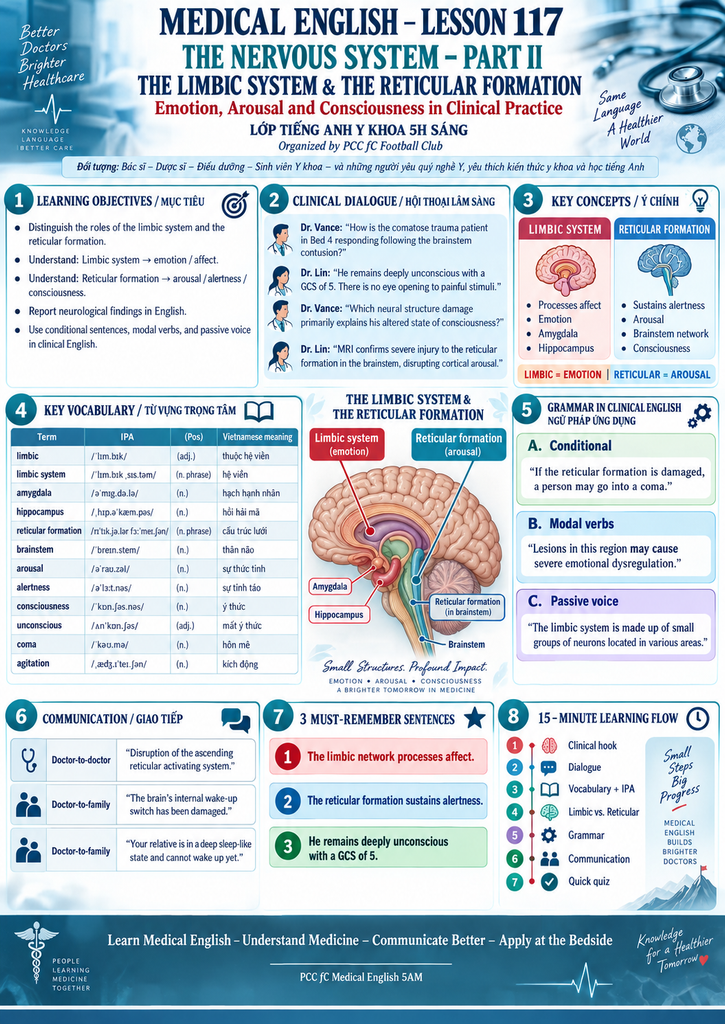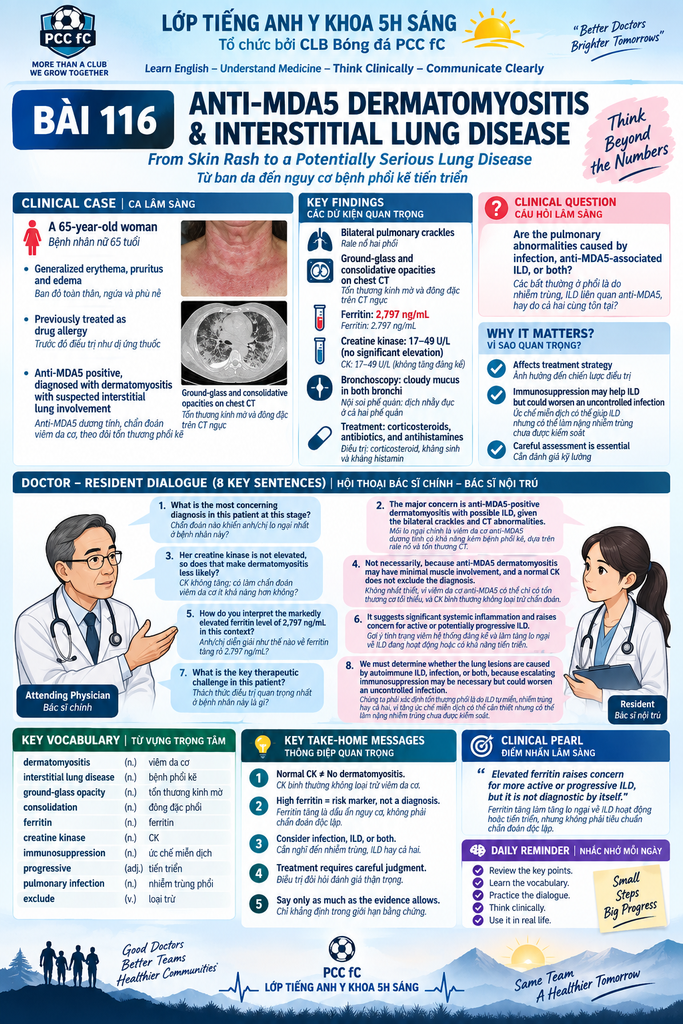
Bài 118 – Tiếng Anh Y Khoa – Suy gan cấp kèm suy đa tạng * Acute Liver Failure with Multiorgan Dysfunction
PCC Language – Thăng Long, Hà Nội, ngày 24/9/2026, Bài 118 của Lớp Tiếng Anh Y khoa 5H sáng do CLB Bóng đá PCC fC tổ chức tiếp tục đưa người học đến gần hơn với ngôn ngữ thực hành lâm sàng qua một ca bệnh nặng có suy gan, rối loạn đông máu, bệnh não gan, suy thận, nhiễm trùng và suy đa cơ quan. Thay vì chỉ học từ vựng rời rạc, bài học tập trung vào cách trình bày bệnh nhân, diễn giải xét nghiệm, nhận định mức độ nặng và xác định ưu tiên điều trị bằng tiếng Anh y khoa ở mức nâng cao, tương đương IELTS 8.0. Đặc biệt, phần nghe thụ động được thiết kế theo dạng một bài đọc liền mạch khoảng 3 phút, giúp học viên vừa luyện phản xạ nghe, vừa làm quen với tư duy hội chẩn và ngôn ngữ đi buồng trong môi trường hồi sức. Mục tiêu cuối cùng không chỉ là “nói đúng tiếng Anh”, mà là diễn đạt được tư duy lâm sàng một cách chính xác, mạch lạc và chuyên nghiệp.
BÀI 118 – MEDICAL ENGLISH 5 A.M.
Acute Liver Failure with Multiorgan Dysfunction
Case-Based ICU Morning-Round Dialogue – IELTS 8.0 Level
Lớp Tiếng Anh Y khoa do CLB Bóng đá PCC fC tổ chức
1. Learning objectives
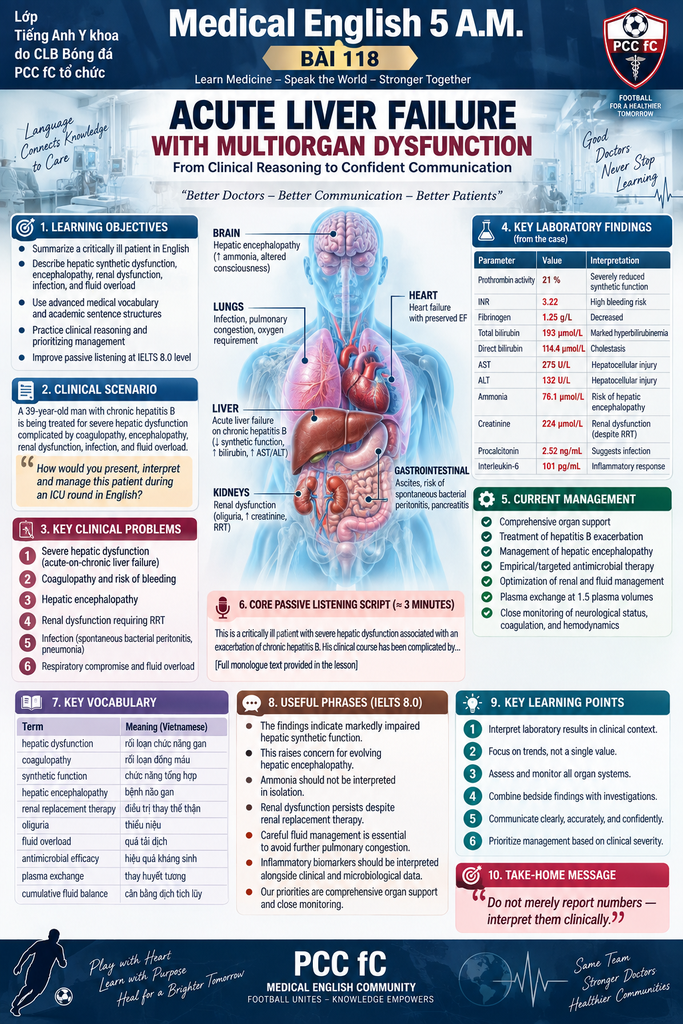
Sau bài học, học viên có thể: trình bày ngắn gọn một bệnh nhân suy gan nặng trong buổi đi buồng; mô tả hepatic synthetic dysfunction, hepatic encephalopathy, renal dysfunction, infection và fluid overload; sử dụng các cấu trúc hỏi–đáp ở mức học thuật cao; đồng thời luyện cách đưa ra assessment → interpretation → monitoring → treatment priorities bằng tiếng Anh y khoa.
Ca bệnh được xây dựng từ hồ sơ thực tế: PT 21%, INR 3.22, fibrinogen 1.25 g/L; ammonia 76.1 µmol/L; creatinine 224 µmol/L và bệnh nhân được chỉ định thay huyết tương 1.5 thể tích huyết tương.
2. Clinical scenario
A 39-year-old man with chronic hepatitis B is being treated for severe hepatic dysfunction complicated by coagulopathy, encephalopathy, renal dysfunction, infection, and fluid overload.
Clinical challenge:
How should a resident present this critically ill patient concisely and respond to a senior physician’s questions during an ICU morning round?
3. Core Dialogue – 8 Sentences
1. Senior Doctor:
Given the patient’s acute liver failure on a background of chronic hepatitis B, how would you characterize the severity of his current hepatic dysfunction?
2. Resident:
The severity is substantial, as evidenced by a prothrombin activity of 21%, an INR of 3.22, and a fibrinogen level of 1.25 g/L, all of which indicate markedly impaired hepatic synthetic function.
3. Senior Doctor:
How do you interpret the rise in serum ammonia in the context of his fluctuating level of consciousness?
4. Resident:
An ammonia concentration of 76.1 micromoles per liter, together with reduced alertness, raises concern for evolving hepatic encephalopathy and warrants frequent neurological reassessment rather than reliance on ammonia alone.
5. Senior Doctor:
What is the clinical significance of his persistent renal dysfunction despite renal replacement therapy?
6. Resident:
With creatinine still elevated at 224 micromoles per liter and a recent history of oliguria requiring continuous renal replacement therapy, careful monitoring of urine output, electrolytes, acid–base status, and cumulative fluid balance remains essential.
7. Senior Doctor:
Considering the coexisting infection, respiratory compromise, and multiorgan dysfunction, what should be our immediate therapeutic priorities?
8. Resident:
We should continue comprehensive organ support, treat the hepatitis B flare and hepatic encephalopathy, reassess antimicrobial efficacy, optimize volume and renal management, and proceed with plasma exchange at 1.5 plasma volumes while closely monitoring neurological status and coagulation.
4. Vietnamese Translation
BS chính: Với tình trạng suy gan cấp trên nền viêm gan B mạn, em đánh giá mức độ rối loạn chức năng gan hiện tại của bệnh nhân như thế nào?
BS nội trú: Tình trạng rất nặng, thể hiện qua PT chỉ còn 21%, INR 3,22 và fibrinogen 1,25 g/L; các chỉ số này cho thấy chức năng tổng hợp của gan bị suy giảm rõ rệt.
BS chính: Em diễn giải tình trạng ammonia máu tăng trong bối cảnh mức độ ý thức của bệnh nhân dao động như thế nào?
BS nội trú: Ammonia 76,1 µmol/L kết hợp với giảm tỉnh táo làm tăng lo ngại về bệnh não gan đang tiến triển; vì vậy cần đánh giá thần kinh thường xuyên, thay vì chỉ dựa vào nồng độ ammonia.
BS chính: Rối loạn chức năng thận kéo dài mặc dù đã điều trị thay thế thận có ý nghĩa lâm sàng gì?
BS nội trú: Creatinine vẫn ở mức 224 µmol/L và bệnh nhân có tiền sử thiểu niệu cần lọc máu liên tục; do đó phải theo dõi chặt lượng nước tiểu, điện giải, thăng bằng kiềm–toan và cân bằng dịch tích lũy.
BS chính: Trong bối cảnh đồng thời có nhiễm trùng, suy hô hấp và suy đa cơ quan, các ưu tiên điều trị ngay lúc này là gì?
BS nội trú: Cần tiếp tục hỗ trợ đa cơ quan, điều trị đợt tiến triển viêm gan B và bệnh não gan, đánh giá lại hiệu quả kháng sinh, tối ưu quản lý dịch và chức năng thận, đồng thời tiến hành thay huyết tương 1,5 thể tích và theo dõi sát thần kinh cũng như đông máu.
5. Key Medical Vocabulary
| Vocabulary | IPA | Word class | Medical meaning |
|---|---|---|---|
| hepatic dysfunction | /hɪˈpætɪk dɪsˈfʌŋkʃən/ | noun phrase | rối loạn chức năng gan |
| coagulopathy | /kəʊˌæɡjəˈlɒpəθi/ | noun | rối loạn đông máu |
| synthetic function | /sɪnˈθetɪk ˈfʌŋkʃən/ | noun phrase | chức năng tổng hợp |
| encephalopathy | /enˌsefəˈlɒpəθi/ | noun | bệnh não |
| fluctuating | /ˈflʌktʃueɪtɪŋ/ | adjective | dao động, thay đổi |
| alertness | /əˈlɜːtnəs/ | noun | mức độ tỉnh táo |
| evolving | /ɪˈvɒlvɪŋ/ | adjective | đang tiến triển |
| reassessment | /ˌriːəˈsesmənt/ | noun | đánh giá lại |
| persistent | /pəˈsɪstənt/ | adjective | kéo dài, dai dẳng |
| oliguria | /ˌɒlɪˈɡjʊəriə/ | noun | thiểu niệu |
| renal replacement therapy | /ˈriːnəl rɪˈpleɪsmənt ˈθerəpi/ | noun phrase | điều trị thay thế thận |
| cumulative fluid balance | /ˈkjuːmjələtɪv ˈfluːɪd ˈbæləns/ | noun phrase | cân bằng dịch tích lũy |
| respiratory compromise | /rɪˈspɪrətri ˈkɒmprəmaɪz/ | noun phrase | suy giảm chức năng hô hấp |
| therapeutic priorities | /ˌθerəˈpjuːtɪk praɪˈɒrətiz/ | noun phrase | các ưu tiên điều trị |
| antimicrobial efficacy | /ˌæntimaɪˈkrəʊbiəl ˈefɪkəsi/ | noun phrase | hiệu quả kháng vi sinh vật |
| plasma exchange | /ˈplæzmə ɪksˌtʃeɪndʒ/ | noun | thay huyết tương |
6. IELTS 8.0 Clinical Language
Thay vì nói đơn giản:
“His liver is very bad.”
Hãy dùng:
“The laboratory profile indicates markedly impaired hepatic synthetic function.”
Thay vì:
“His ammonia is high, so he has encephalopathy.”
Nên nói chính xác hơn:
“The elevated ammonia level, together with reduced alertness, raises concern for evolving hepatic encephalopathy.”
Điểm quan trọng ở mức IELTS 8.0 là tránh khẳng định quá mức. Các cấu trúc như “raises concern for…”, “is consistent with…”, “warrants…”, “should be interpreted in the context of…” rất phù hợp trong giao tiếp lâm sàng.
7. High-Yield Sentence Structures
Given + clinical condition, how would you characterize…?
→ Given his worsening coagulopathy, how would you characterize the severity of liver dysfunction?
As evidenced by + objective findings
→ The disease remains severe, as evidenced by an INR of 3.22.
Together with…, raises concern for…
→ Reduced alertness together with hyperammonemia raises concern for hepatic encephalopathy.
Warrants + noun / V-ing
→ This finding warrants frequent neurological reassessment.
Despite + treatment/intervention
→ Renal dysfunction persists despite renal replacement therapy.
Considering + multiple problems, what should…?
→ Considering his multiorgan dysfunction, what should our priorities be?
8. Eight Review Questions
- What evidence suggests severe impairment of hepatic synthetic function?
- Why should ammonia not be interpreted in isolation?
- What neurological parameters should be monitored in hepatic encephalopathy?
- What does persistent renal dysfunction imply after CRRT?
- Why is cumulative fluid balance important in critically ill patients?
- What does respiratory compromise mean in clinical practice?
- Why should antimicrobial efficacy be reassessed repeatedly?
- What are the major therapeutic priorities in this patient?
9. Clinical Summary Practice
Học viên luyện nói trong 45–60 giây:
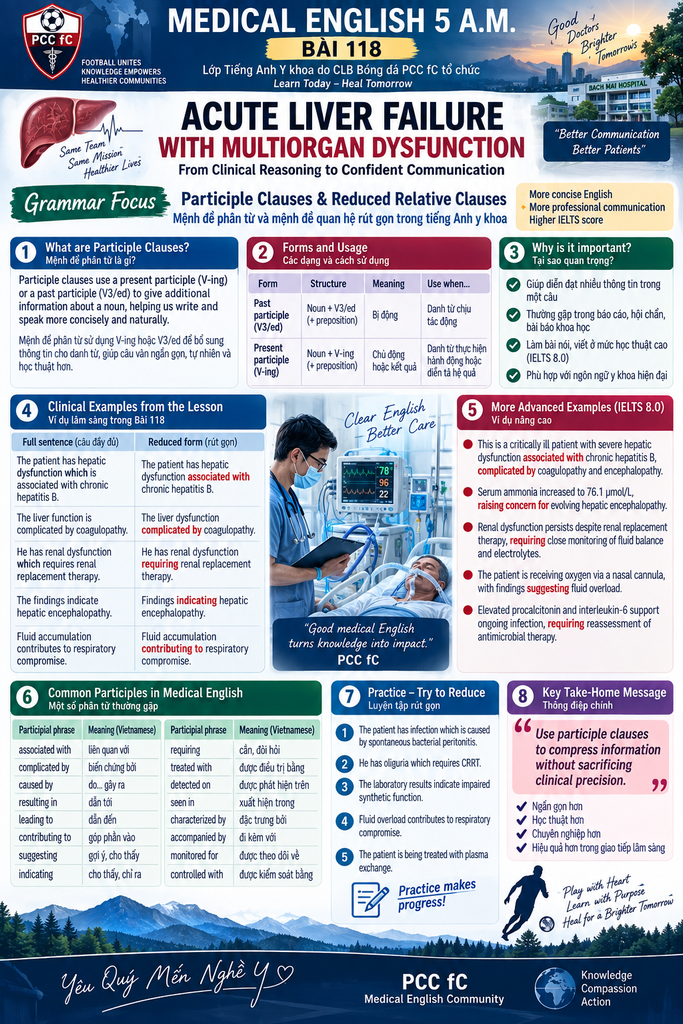
“This is a critically ill patient with severe hepatic dysfunction associated with chronic hepatitis B, complicated by significant coagulopathy, evolving hepatic encephalopathy, renal dysfunction requiring renal replacement therapy, infection, and fluid overload. Current priorities include close neurological and coagulation monitoring, infection control, optimization of renal and volume management, treatment of hepatitis B, and continued organ support including plasma exchange when indicated.”
10. Take-home message
Do not merely report numbers — interpret them clinically.
Một bác sĩ nội trú trình bày tốt không chỉ nói:
“PT is 21%, INR is 3.22.”
Mà cần nói:
“These findings indicate markedly impaired hepatic synthetic function and a high risk of clinically significant deterioration.”
Đó chính là mục tiêu của Bài 118: chuyển từ Medical English for reporting sang Medical English for clinical reasoning.
Bài 118 – Passive Listening
Acute Liver Failure with Multiorgan Dysfunction
Advanced Medical English – IELTS 8.0 level
Lớp Tiếng Anh Y khoa do CLB Bóng đá PCC fC tổ chức
This is a critically ill patient with severe hepatic dysfunction associated with an exacerbation of chronic hepatitis B. His clinical course has been complicated by significant coagulopathy, altered mental status suggestive of hepatic encephalopathy, renal dysfunction requiring renal replacement therapy, infection, respiratory compromise, and fluid overload.
The severity of his liver dysfunction is particularly evident from the marked impairment of hepatic synthetic function. His prothrombin activity has decreased to twenty-one percent, his international normalized ratio is three point two two, and his fibrinogen level is one point two five grams per liter. Taken together, these abnormalities indicate severe impairment of coagulation factor synthesis and therefore require close clinical and laboratory monitoring, particularly for evidence of bleeding or further deterioration.
His neurological status also requires careful reassessment. The serum ammonia concentration is seventy-six point one micromoles per liter. In the context of fluctuating alertness, this finding raises concern for evolving hepatic encephalopathy. However, ammonia should never be interpreted in isolation. Serial assessment of consciousness, orientation, behavior, and the Glasgow Coma Scale remains essential when evaluating neurological progression.
Renal dysfunction continues to be another major concern. His serum creatinine remains elevated at two hundred and twenty-four micromoles per liter, and he has recently experienced oliguria requiring continuous renal replacement therapy. Management should therefore focus on urine output, electrolyte disturbances, acid-base balance, cumulative fluid balance, and the overall clinical response rather than on a single creatinine value.
Respiratory and volume status also need close observation. The patient continues to require oxygen through a nasal cannula at three liters per minute. Peripheral edema, mild abdominal distension, and bilateral pulmonary crackles suggest that fluid accumulation remains clinically relevant. Careful volume management is therefore essential to maintain adequate tissue perfusion while avoiding further pulmonary congestion and deterioration in oxygenation.
Infection remains an important component of the patient’s multiorgan illness. Procalcitonin and interleukin-six remain elevated, supporting the need for continued clinical reassessment. Nevertheless, inflammatory biomarkers alone cannot determine whether an infection is adequately controlled. They should be interpreted alongside microbiological findings, organ function, hemodynamic status, and the patient’s response to antimicrobial therapy.
The immediate therapeutic priorities are comprehensive organ support, close monitoring of neurological and coagulation status, management of hepatic encephalopathy, treatment of the hepatitis B exacerbation, reassessment of antimicrobial efficacy, and optimization of renal and fluid management. Plasma exchange at one point five plasma volumes is also being used as part of the current treatment strategy.
The key clinical lesson is that critically ill patients with multiorgan dysfunction should never be assessed on the basis of a single laboratory result. Effective clinical reasoning requires interpretation of trends, integration of laboratory and bedside findings, repeated reassessment, and recognition of the complex interaction between failing organ systems.