Bài 119 – Tiếng Anh Y Khoa: Hệ thần kinh tự động * The Autonomic Nervous System
PCC Language – Thăng Long, Hà Nội, ngày 25/9/2026, Trong Bài 119 – The Autonomic Nervous System, Lớp Tiếng Anh Y khoa 5H sáng do CLB Bóng đá PCC fC tổ chức tiếp tục đưa người học đến gần hơn với cách tư duy, trao đổi và trình bày lâm sàng bằng tiếng Anh ở mức độ nâng cao. Thông qua một đoạn hội thoại ngắn giữa bác sĩ senior và bác sĩ nội trú trong buổi đi buồng, bài học tập trung vào cách nhận diện autonomic dysfunction, phân tích sympathetic overactivity, adrenergic surge, sự thay đổi nhu động tiêu hóa và các ưu tiên theo dõi – xử trí ở người bệnh có rối loạn thần kinh tự chủ.
Không chỉ dừng lại ở việc học từ vựng, Bài 119 được thiết kế theo hướng tích hợp Nghe – Nói – Đọc – Viết, kết hợp luyện phát âm, từ loại, collocations, cấu trúc ngữ pháp học thuật và kỹ năng trình bày ca bệnh theo phong cách Advanced Medical English – IELTS 8.0 level. Mục tiêu của bài học là giúp người học từng bước chuyển từ “hiểu tiếng Anh y khoa” sang khả năng tư duy lâm sàng bằng tiếng Anh, diễn đạt chính xác, có hệ thống và tự tin hơn trong môi trường chuyên môn quốc tế.
Mỗi ngày một bài học, mỗi ngày thêm một bước tiến nhỏ. Hãy cùng bắt đầu Bài 119 với tinh thần Khoẻ – Vui – Hạnh phúc, kỷ luật và bền bỉ lúc 5 giờ sáng.
File Audio:
File bài học:
THE AUTONOMIC NERVOUS SYSTEM
Autonomic Dysfunction & Adrenergic Surge in a Critically Ill Patient
Advanced Medical English – Target level: IELTS 8.0
Lớp Tiếng Anh Y khoa 5H sáng do CLB Bóng đá PCC fC tổ chức
I. LEARNING OBJECTIVES – MỤC TIÊU BÀI HỌC
Sau bài học, học viên có thể:
- Hiểu và sử dụng chính xác các thuật ngữ liên quan đến autonomic nervous system – hệ thần kinh tự chủ.
- Phân biệt vai trò của sympathetic và parasympathetic divisions.
- Nhận diện các biểu hiện của adrenergic surge / sympathetic overactivity trong bối cảnh lâm sàng.
- Sử dụng ngôn ngữ hội chẩn chuyên nghiệp trong ICU/ED.
- Phát triển kỹ năng Listening – Speaking – Reading – Writing ở mức Advanced/IELTS 8.0.
- Rèn kỹ năng mô tả:
- clinical findings;
- pathophysiological mechanisms;
- therapeutic priorities;
- monitoring parameters.
- Nâng cao khả năng sử dụng các cấu trúc:
- Given…
- How would you characterize…?
- How do you interpret…?
- Considering…, what should…?
- to ensure that…
- participial clauses và complex noun phrases.
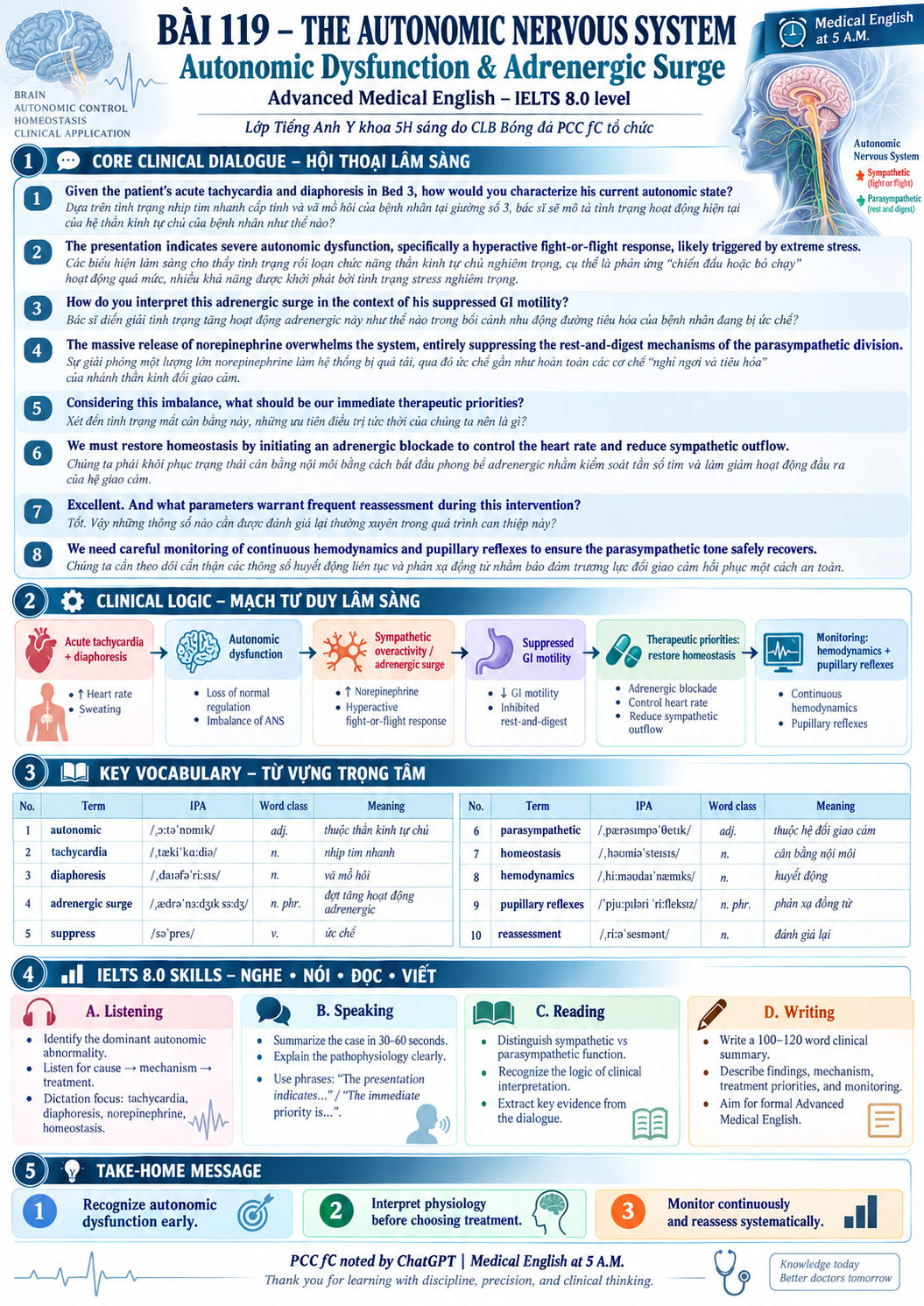
II. CORE CLINICAL DIALOGUE – HỘI THOẠI LÂM SÀNG
Clinical Morning Round – Bed 3
1. Senior Consultant
Given the patient’s acute tachycardia and diaphoresis in Bed 3, how would you characterize his current autonomic state?
Dịch:
Dựa trên tình trạng nhịp tim nhanh cấp tính và vã mồ hôi của bệnh nhân tại giường số 3, bác sĩ sẽ mô tả tình trạng hoạt động hiện tại của hệ thần kinh tự chủ của bệnh nhân như thế nào?
2. Resident
The presentation indicates severe autonomic dysfunction, specifically a hyperactive fight-or-flight response, likely triggered by extreme stress.
Dịch:
Các biểu hiện lâm sàng cho thấy tình trạng rối loạn chức năng thần kinh tự chủ nghiêm trọng, cụ thể là phản ứng “chiến đấu hoặc bỏ chạy” hoạt động quá mức, nhiều khả năng được khởi phát bởi tình trạng stress nghiêm trọng.
3. Senior Consultant
How do you interpret this adrenergic surge in the context of his suppressed GI motility?
Dịch:
Bác sĩ diễn giải tình trạng tăng hoạt động adrenergic này như thế nào trong bối cảnh nhu động đường tiêu hóa của bệnh nhân đang bị ức chế?
4. Resident
The massive release of norepinephrine overwhelms the system, entirely suppressing the rest-and-digest mechanisms of the parasympathetic division.
Dịch:
Sự giải phóng một lượng lớn norepinephrine làm hệ thống bị quá tải, qua đó ức chế gần như hoàn toàn các cơ chế “nghỉ ngơi và tiêu hóa” của nhánh thần kinh đối giao cảm.
5. Senior Consultant
Considering this imbalance, what should be our immediate therapeutic priorities?
Dịch:
Xét đến tình trạng mất cân bằng này, những ưu tiên điều trị tức thời của chúng ta nên là gì?
6. Resident
We must restore homeostasis by initiating an adrenergic blockade to control the heart rate and reduce sympathetic outflow.
Dịch:
Chúng ta phải khôi phục trạng thái cân bằng nội môi bằng cách bắt đầu phong bế adrenergic nhằm kiểm soát tần số tim và làm giảm hoạt động đầu ra của hệ giao cảm.
7. Senior Consultant
Excellent. And what parameters warrant frequent reassessment during this intervention?
Dịch:
Tốt. Vậy những thông số nào cần được đánh giá lại thường xuyên trong quá trình can thiệp này?
8. Resident
We need careful monitoring of continuous hemodynamics and pupillary reflexes to ensure the parasympathetic tone safely recovers.
Dịch:
Chúng ta cần theo dõi cẩn thận các thông số huyết động liên tục và phản xạ đồng tử nhằm bảo đảm trương lực đối giao cảm hồi phục một cách an toàn.
III. CLINICAL LOGIC – MẠCH TƯ DUY LÂM SÀNG
Đoạn hội thoại được xây dựng theo chuỗi tư duy:
Clinical manifestations
→ acute tachycardia + diaphoresis
↓
Recognition of autonomic dysfunction
→ sympathetic hyperactivity
↓
Physiological interpretation
→ adrenergic surge
→ norepinephrine release
↓
Effects on other systems
→ reduced GI motility
→ suppression of parasympathetic activity
↓
Therapeutic response
→ restore homeostasis
→ reduce excessive sympathetic activity
↓
Monitoring
→ hemodynamics
→ pupillary reflexes
→ reassessment of autonomic balance
IV. KEY VOCABULARY – TỪ VỰNG TRỌNG TÂM
| Vocabulary | IPA | Word class | Nghĩa |
|---|---|---|---|
| autonomic | /ˌɔːtəˈnɒmɪk/ | adjective | thuộc thần kinh tự chủ |
| autonomic dysfunction | /ˌɔːtəˈnɒmɪk dɪsˈfʌŋkʃən/ | noun phrase | rối loạn chức năng thần kinh tự chủ |
| tachycardia | /ˌtækiˈkɑːdiə/ | noun | nhịp tim nhanh |
| diaphoresis | /ˌdaɪəfəˈriːsɪs/ | noun | vã mồ hôi |
| characterize | /ˈkærəktəraɪz/ | verb | mô tả, đặc trưng hóa |
| presentation | /ˌprezənˈteɪʃən/ | noun | biểu hiện lâm sàng |
| hyperactive | /ˌhaɪpərˈæktɪv/ | adjective | tăng hoạt động |
| fight-or-flight response | /ˌfaɪt ɔːr ˈflaɪt rɪˌspɒns/ | noun phrase | phản ứng chiến đấu hoặc bỏ chạy |
| trigger | /ˈtrɪɡər/ | verb/noun | kích hoạt; yếu tố khởi phát |
| adrenergic | /ˌædrəˈnɜːdʒɪk/ | adjective | thuộc hệ adrenergic |
| surge | /sɜːdʒ/ | noun/verb | sự tăng vọt |
| adrenergic surge | /ˌædrəˈnɜːdʒɪk sɜːdʒ/ | noun phrase | đợt tăng hoạt động adrenergic |
| suppress | /səˈpres/ | verb | ức chế |
| motility | /məʊˈtɪləti/ | noun | nhu động |
| GI motility | /ˌdʒiː ˈaɪ məʊˈtɪləti/ | noun phrase | nhu động đường tiêu hóa |
| norepinephrine | /ˌnɔːrepɪˈnefrɪn/ | noun | norepinephrine, noradrenaline |
| overwhelm | /ˌəʊvəˈwelm/ | verb | làm quá tải |
| parasympathetic | /ˌpærəsɪmpəˈθetɪk/ | adjective | thuộc hệ đối giao cảm |
| sympathetic | /ˌsɪmpəˈθetɪk/ | adjective | thuộc hệ giao cảm |
| division | /dɪˈvɪʒən/ | noun | nhánh, phân hệ |
| imbalance | /ɪmˈbæləns/ | noun | mất cân bằng |
| therapeutic | /ˌθerəˈpjuːtɪk/ | adjective | thuộc điều trị |
| priority | /praɪˈɒrəti/ | noun | ưu tiên |
| homeostasis | /ˌhəʊmiəˈsteɪsɪs/ | noun | cân bằng nội môi |
| initiate | /ɪˈnɪʃieɪt/ | verb | bắt đầu, khởi trị |
| blockade | /blɒˈkeɪd/ | noun | sự phong bế |
| sympathetic outflow | /ˌsɪmpəˈθetɪk ˈaʊtfləʊ/ | noun phrase | hoạt động đầu ra của hệ giao cảm |
| parameter | /pəˈræmɪtər/ | noun | thông số |
| warrant | /ˈwɒrənt/ | verb | đòi hỏi, cần thiết |
| reassessment | /ˌriːəˈsesmənt/ | noun | đánh giá lại |
| intervention | /ˌɪntəˈvenʃən/ | noun | can thiệp |
| hemodynamics | /ˌhiːməʊdaɪˈnæmɪks/ | noun | huyết động |
| pupillary | /ˈpjuːpɪləri/ | adjective | thuộc đồng tử |
| reflex | /ˈriːfleks/ | noun | phản xạ |
| tone | /təʊn/ | noun | trương lực |
| recover | /rɪˈkʌvər/ | verb | hồi phục |
V. WORD FAMILIES – HỌ TỪ
1. suppress
- suppress – verb – ức chế
- suppression – noun – sự ức chế
- suppressive – adjective – có tính ức chế
- suppressed – adjective – bị ức chế
Clinical example:
Sympathetic activation may suppress gastrointestinal motility.
2. activate
- activate – v.
- activation – n.
- active – adj.
- activity – n.
- hyperactive – adj.
- hyperactivity – n.
3. assess
- assess – v.
- assessment – n.
- reassess – v.
- reassessment – n.
4. respond
- respond – v.
- response – n.
- responsive – adj.
- responsiveness – n.
5. regulate
- regulate – v.
- regulation – n.
- regulatory – adj.
- dysregulation – n.
autonomic dysregulation
= rối loạn điều hòa thần kinh tự chủ.
VI. ESSENTIAL COLLOCATIONS
Học theo cụm từ, không chỉ học từ đơn:
- acute tachycardia
- profuse diaphoresis
- autonomic dysfunction
- autonomic instability
- sympathetic activation
- sympathetic overactivity
- adrenergic surge
- catecholamine release
- suppressed GI motility
- parasympathetic tone
- sympathetic outflow
- restore homeostasis
- therapeutic priority
- initiate treatment
- continuous hemodynamic monitoring
- frequent reassessment
- pupillary reflexes
- clinical deterioration
VII. GRAMMAR FOR IELTS 8.0
1. GIVEN + NOUN PHRASE
Given the patient’s acute tachycardia and diaphoresis…
Ở đây given mang nghĩa:
considering / taking into account
→ “Xét đến / dựa trên…”
Cấu trúc:
Given + noun phrase, main clause
Ví dụ:
Given the patient’s persistent hypotension, vasopressor therapy should be reassessed.
Given the worsening neurological status, urgent neuroimaging is warranted.
Đây là cấu trúc rất hữu ích trong:
- ward rounds;
- case presentations;
- IELTS Writing;
- academic medical writing.
VIII. COMPLEX QUESTION STRUCTURE
How would you characterize his current autonomic state?
Cấu trúc:
How + would + subject + verb + object?
“Would” làm câu hỏi mang tính:
- chuyên nghiệp hơn;
- thăm dò nhận định;
- phù hợp hội chẩn hơn câu hỏi trực tiếp.
So sánh:
What is his autonomic state?
với:
How would you characterize his current autonomic state?
Câu thứ hai có register học thuật cao hơn rõ rệt.
IX. REPORTING CLINICAL INTERPRETATION
The presentation indicates…
Đây là cấu trúc quan trọng trong báo cáo ca bệnh.
Có thể thay bằng:
- The findings indicate…
- The clinical picture suggests…
- The presentation is consistent with…
- These findings raise concern for…
- The overall pattern is suggestive of…
Thang mức độ chắc chắn
confirms
↓
strongly indicates
↓
suggests
↓
is consistent with
↓
may represent
↓
could reflect
Người học IELTS 8.0 cần biết điều chỉnh mức độ chắc chắn thay vì luôn dùng is.
X. PARTICIPIAL CLAUSE
…likely triggered by extreme stress.
Đây là dạng rút gọn của:
…, which is likely triggered by extreme stress.
Past participle triggered mang nghĩa bị động.
Các mẫu tương tự:
- caused by…
- associated with…
- complicated by…
- characterized by…
- mediated by…
- triggered by…
- accompanied by…
XI. TRANSITIVE VERBS – NGOẠI ĐỘNG TỪ
Trong hội thoại có nhiều ngoại động từ quan trọng.
characterize
characterize + object
characterize his autonomic state
trigger
trigger a response
suppress
suppress GI motility
overwhelm
overwhelm the system
restore
restore homeostasis
control
control the heart rate
reduce
reduce sympathetic outflow
ensure
ensure safe recovery
Các động từ này cần tân ngữ trực tiếp.
XII. INTRANSITIVE VERB – NỘI ĐỘNG TỪ
recover
Trong:
the parasympathetic tone safely recovers
recover không cần tân ngữ.
Subject:
the parasympathetic tone
Adverb:
safely
Verb:
recovers
XIII. CAUSE → EFFECT LANGUAGE
Một kỹ năng thiết yếu của IELTS 8.0:
The massive release of norepinephrine overwhelms the system, entirely suppressing…
Mệnh đề chính:
The massive release of norepinephrine overwhelms the system
Kết quả:
entirely suppressing…
Cấu trúc:
S + V…, thereby/resulting in/leading to + consequence
Ví dụ nâng cao:
Excessive sympathetic activation increases cardiac workload, thereby raising myocardial oxygen demand.
XIV. PURPOSE CLAUSE
…to control the heart rate and reduce sympathetic outflow.
to + verb diễn đạt mục tiêu.
Có thể nâng cấp:
in order to control…
hoặc:
with the aim of controlling…
XV. ENSURE + CLAUSE
…to ensure the parasympathetic tone safely recovers.
Cấu trúc:
ensure + subject + verb
Ví dụ:
Frequent reassessment is required to ensure the patient remains hemodynamically stable.
XVI. LISTENING SKILLS – IELTS 8.0
Listening Task 1 – Gist Listening
Nghe toàn bộ hội thoại một lần, không nhìn transcript.
Trả lời:
- What is the principal physiological abnormality discussed?
- Which division of the autonomic nervous system appears dominant?
- What gastrointestinal abnormality is mentioned?
- What neurotransmitter is discussed?
- What is the principal therapeutic objective?
Listening Task 2 – Detail Listening
Điền từ còn thiếu:
- Given the patient’s acute ________ and diaphoresis…
- The presentation indicates severe autonomic ________.
- …a hyperactive ________ response.
- How do you interpret this adrenergic ________?
- The massive release of ________ overwhelms the system.
- …suppressing the ________ mechanisms…
- We must restore ________.
- …reduce sympathetic ________.
- What parameters warrant frequent ________?
- …monitoring of continuous ________ and pupillary reflexes.
XVII. LISTENING TASK 3 – CLINICAL SIGNAL WORDS
Khi nghe, tập trung nhận diện:
Given…
→ mở đầu bằng dữ kiện.
indicates…
→ chuyển sang nhận định.
specifically…
→ làm rõ.
in the context of…
→ kết nối bối cảnh.
considering…
→ chuyển sang quyết định.
to control…
→ mục tiêu điều trị.
to ensure…
→ mục tiêu theo dõi.
Đây chính là những discourse markers giúp người nghe IELTS cấp cao theo được logic bài nói.
XVIII. LISTENING TASK 4 – SHADOWING
Thực hành theo ba vòng.
Round 1 – Chunking
Đọc theo cụm:
Given the patient’s acute tachycardia / and diaphoresis in Bed 3 / how would you characterize / his current autonomic state?
Round 2 – Shadowing
Nghe và lặp lại sau người nói khoảng 0,5–1 giây.
Không dừng audio.
Round 3 – Simultaneous shadowing
Nói gần đồng thời với audio.
Tập trung:
- sentence stress;
- linking;
- intonation;
- medical terminology;
- natural rhythm.
XIX. PRONUNCIATION FOCUS
Các từ cần luyện kỹ:
tachycardia
/ˌtækiˈkɑːdiə/
Nhấn âm CAR.
diaphoresis
/ˌdaɪəfəˈriːsɪs/
Nhấn âm REE.
adrenergic
/ˌædrəˈnɜːdʒɪk/
Nhấn âm NER.
norepinephrine
/ˌnɔːrepɪˈnefrɪn/
Nhấn âm NEF.
parasympathetic
/ˌpærəsɪmpəˈθetɪk/
Nhấn âm THET.
hemodynamics
/ˌhiːməʊdaɪˈnæmɪks/
Nhấn âm NAM.
XX. SPEAKING – IELTS 8.0
Speaking Task 1 – 30-second Clinical Summary
Không nhìn bài, trình bày trong khoảng 30 giây:
Summarize the patient’s autonomic disturbance.
Cấu trúc gợi ý:
The patient presents with…
These findings suggest…
This may reflect…
The associated suppression of… supports…
The immediate priorities are…
Close monitoring should focus on…
XXI. SPEAKING TASK 2 – ONE-MINUTE CASE PRESENTATION
Prompt
You are the resident on an ICU morning round. Present the patient’s autonomic abnormalities to the senior consultant in approximately one minute.
Yêu cầu bắt buộc sử dụng:
- autonomic dysfunction
- tachycardia
- diaphoresis
- adrenergic surge
- GI motility
- sympathetic outflow
- homeostasis
- hemodynamic monitoring
XXII. SPEAKING TASK 3 – SENIOR–RESIDENT ROLE PLAY
Student A – Senior Consultant
Hỏi về:
- autonomic state;
- mechanism;
- GI effects;
- therapeutic priorities;
- monitoring.
Student B – Resident
Mỗi câu trả lời phải gồm:
Finding → Interpretation → Mechanism → Clinical implication
Ví dụ mô hình:
The patient has marked tachycardia and diaphoresis, which suggest excessive sympathetic activation. This may reflect increased catecholaminergic activity and warrants close cardiovascular monitoring.
XXIII. SPEAKING TASK 4 – IELTS 8.0 CRITICAL DISCUSSION
Trả lời 1–2 phút:
Question
Why is autonomic balance important in critically ill patients?
Phát triển theo:
- definition;
- cardiovascular effects;
- gastrointestinal effects;
- neurological manifestations;
- clinical monitoring;
- implications for treatment.
Useful expressions:
- From a physiological perspective…
- One important consideration is…
- This becomes particularly relevant when…
- A further concern is…
- Clinically, this means that…
- Taken together, these findings suggest…
XXIV. READING – ADVANCED MEDICAL ENGLISH
Passage
The autonomic nervous system plays a central role in maintaining physiological stability by continuously regulating cardiovascular, respiratory, gastrointestinal, thermoregulatory, and pupillary functions. Its two major components—the sympathetic and parasympathetic divisions—normally operate in a dynamic balance rather than as completely independent systems.
During acute physiological or psychological stress, sympathetic activity may increase substantially. This response promotes tachycardia, increases vascular tone, enhances sweating, and redistributes blood flow toward organs required for immediate survival. At the same time, gastrointestinal activity may decrease as digestive functions become temporarily less important.
When sympathetic activation becomes excessive or poorly regulated, however, the resulting autonomic imbalance may contribute to cardiovascular instability, altered gastrointestinal motility, abnormal sweating, and changes in pupillary responses. Recognition of these patterns requires clinicians to integrate vital signs, neurological findings, medication exposure, underlying disease processes, and the overall clinical context.
Careful reassessment is therefore essential. Rather than relying on a single physiological variable, clinicians should evaluate trends in heart rate, blood pressure, perfusion, temperature, mental status, gastrointestinal function, and other relevant indicators. The ultimate clinical objective is not merely to normalize an isolated number but to restore stable physiological regulation while addressing the underlying cause of the autonomic disturbance.
XXV. READING COMPREHENSION
Questions
- What is the primary physiological role of the autonomic nervous system?
- Which two major divisions are described?
- What happens to sympathetic activity during acute stress?
- Why may gastrointestinal activity decrease?
- What clinical manifestations may accompany excessive sympathetic activation?
- Why is reliance on a single physiological variable insufficient?
- What is the ultimate clinical objective?
- Identify one sentence demonstrating contrast.
- Find one word meaning “poorly controlled.”
- Find one expression meaning “changes over time rather than isolated measurements.”
XXVI. TRUE / FALSE / NOT GIVEN
- The sympathetic and parasympathetic systems always act independently.
- Acute stress can increase sympathetic activity.
- Sympathetic activation always represents disease.
- GI activity may decrease during the fight-or-flight response.
- A single heart-rate measurement is sufficient to assess autonomic dysfunction.
- The underlying cause of autonomic dysfunction should also be addressed.
XXVII. READING – VOCABULARY IN CONTEXT
Tìm từ/cụm tương đương:
- preserve physiological equilibrium
→ maintain physiological stability - rapidly changing balance
→ dynamic balance - movement of blood to priority organs
→ redistributes blood flow - excessive activation
→ excessive sympathetic activation - repeated clinical assessment
→ careful reassessment - values evolving over time
→ trends
XXVIII. WRITING – SENTENCE TRANSFORMATION
Viết lại nhưng không đổi nghĩa.
1.
The patient has tachycardia and diaphoresis. These findings suggest sympathetic activation.
→
The patient has tachycardia and diaphoresis, findings that suggest sympathetic activation.
2.
Norepinephrine is released excessively. GI motility may consequently decrease.
→
Excessive norepinephrine release may result in reduced GI motility.
3.
Clinicians monitor hemodynamics carefully because they want to identify deterioration early.
→
Clinicians carefully monitor hemodynamics in order to identify deterioration early.
XXIX. WRITING TASK 1 – CLINICAL SUMMARY
Requirement
Viết 100–120 từ.
Prompt
Summarize the patient’s autonomic abnormalities, their likely physiological basis, and the monitoring priorities described in the clinical discussion.
Bố cục:
Sentence 1: presentation
Sentence 2: interpretation
Sentence 3: mechanism
Sentence 4: systemic effect
Sentence 5: therapeutic aim
Sentence 6: monitoring
XXX. WRITING TASK 2 – IELTS 8.0 STYLE
Essay question
“Restoring physiological balance is more important than correcting individual abnormal vital signs in critically ill patients.” Discuss this statement.
Target: 250–300 words
Suggested structure
Paragraph 1 – Introduction
- paraphrase the statement;
- define physiological balance.
Paragraph 2 – Why individual parameters matter
- heart rate;
- blood pressure;
- temperature;
- oxygenation.
Paragraph 3 – Why integrated physiology matters more
- interaction between systems;
- compensatory responses;
- trends;
- underlying mechanisms.
Paragraph 4 – Clinical implications
- monitoring;
- reassessment;
- individualized treatment.
Paragraph 5 – Conclusion
- integrate individual variables within the whole physiological context.
XXXI. IELTS 8.0 LANGUAGE BANK
Thay vì:
The patient is very sick.
Dùng:
The patient demonstrates marked physiological instability.
Thay vì:
The heart rate is high.
Dùng:
The patient is markedly tachycardic.
Thay vì:
The sympathetic system is active.
Dùng:
There is evidence of pronounced sympathetic activation.
Thay vì:
We need to watch him carefully.
Dùng:
The patient warrants close and continuous clinical reassessment.
Thay vì:
The gut is not moving normally.
Dùng:
Gastrointestinal motility appears significantly suppressed.
Thay vì:
We need to find the cause.
Dùng:
Identification and treatment of the underlying precipitating factor remain essential.
XXXII. CLINICAL PARAPHRASING DRILL
autonomic dysfunction
→ autonomic dysregulation
→ impaired autonomic control
→ disturbance of autonomic function
adrenergic surge
→ excessive adrenergic activation
→ heightened catecholaminergic activity
suppressed GI motility
→ reduced gastrointestinal motility
→ impaired gut motility
→ decreased gastrointestinal activity
restore homeostasis
→ re-establish physiological stability
→ restore physiological equilibrium
frequent reassessment
→ serial reassessment
→ repeated clinical evaluation
→ close ongoing assessment
XXXIII. RAPID-FIRE QUESTIONS
Học viên trả lời trong ≤10 giây/câu:
- What does ANS stand for?
- What are its two principal divisions?
- What is tachycardia?
- What is diaphoresis?
- Which autonomic division mediates fight-or-flight responses?
- Which division is associated with rest-and-digest functions?
- What happens to GI motility during strong sympathetic activation?
- What is homeostasis?
- What does “adrenergic” mean?
- Why is reassessment important?
XXXIV. HIGHER-ORDER QUESTIONS
- How can autonomic dysfunction affect multiple organ systems simultaneously?
- Why should clinicians interpret tachycardia in its clinical context rather than in isolation?
- How might medications alter autonomic findings?
- Why can trends be more informative than single measurements?
- How would you differentiate physiological sympathetic activation from pathological autonomic dysregulation?
- Which clinical findings would suggest deterioration?
- What additional information would you request before determining the underlying cause?
- How could autonomic findings influence monitoring priorities in the ICU?
XXXV. 5-MINUTE DAILY PRACTICE
Minute 1
Đọc 8 câu hội thoại thành tiếng.
Minute 2
Shadowing câu 1–4.
Minute 3
Shadowing câu 5–8.
Minute 4
Không nhìn bài:
- tóm tắt ca bệnh trong 5–6 câu tiếng Anh.
Minute 5
Trả lời:
What is happening physiologically in this patient?
XXXVI. 10-MINUTE 5 A.M. LEARNING MODEL
0–2 min — LISTEN
Nghe đoạn hội thoại không nhìn chữ.
2–4 min — READ
Đọc transcript và đánh dấu từ khóa.
4–6 min — SPEAK
Shadowing + role play.
6–8 min — VOCABULARY
Ôn 8 từ:
- autonomic
- tachycardia
- diaphoresis
- adrenergic
- norepinephrine
- homeostasis
- hemodynamics
- reassessment
8–10 min — OUTPUT
Nói hoặc viết tóm tắt ca bệnh.
XXXVII. SELF-CHECK
Sau bài học, học viên tự đánh giá:
□ Tôi đọc đúng tachycardia.
□ Tôi đọc đúng diaphoresis.
□ Tôi đọc đúng adrenergic.
□ Tôi đọc đúng parasympathetic.
□ Tôi giải thích được fight-or-flight.
□ Tôi giải thích được rest-and-digest.
□ Tôi dùng được cấu trúc Given + noun phrase.
□ Tôi dùng được indicate / suggest / be consistent with.
□ Tôi trình bày được ca bệnh trong 60 giây.
□ Tôi viết được clinical summary 100–120 từ.
□ Tôi có thể nghe lại hội thoại mà không cần nhìn transcript.
XXXVIII. TAKE-HOME MESSAGE
Medicine
Recognize → Interpret → Explain the mechanism → Prioritize → Monitor → Reassess
Medical English
Listen → Understand → Shadow → Speak → Read → Write → Repeat
Key sentence
Do not learn Medical English as isolated vocabulary; learn to think, communicate, and reason clinically in English.
PCC fC – MEDICAL ENGLISH AT 5 A.M.
Learn every day – Think clinically – Communicate precisely.
Học đều mỗi ngày – Tư duy lâm sàng – Giao tiếp y khoa chính xác.