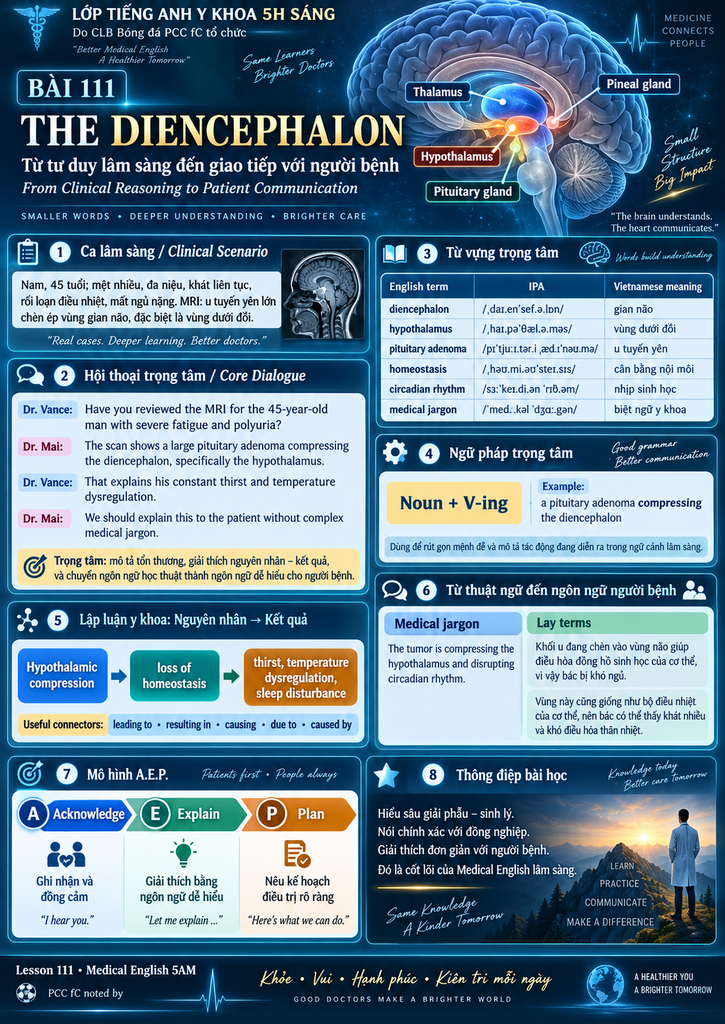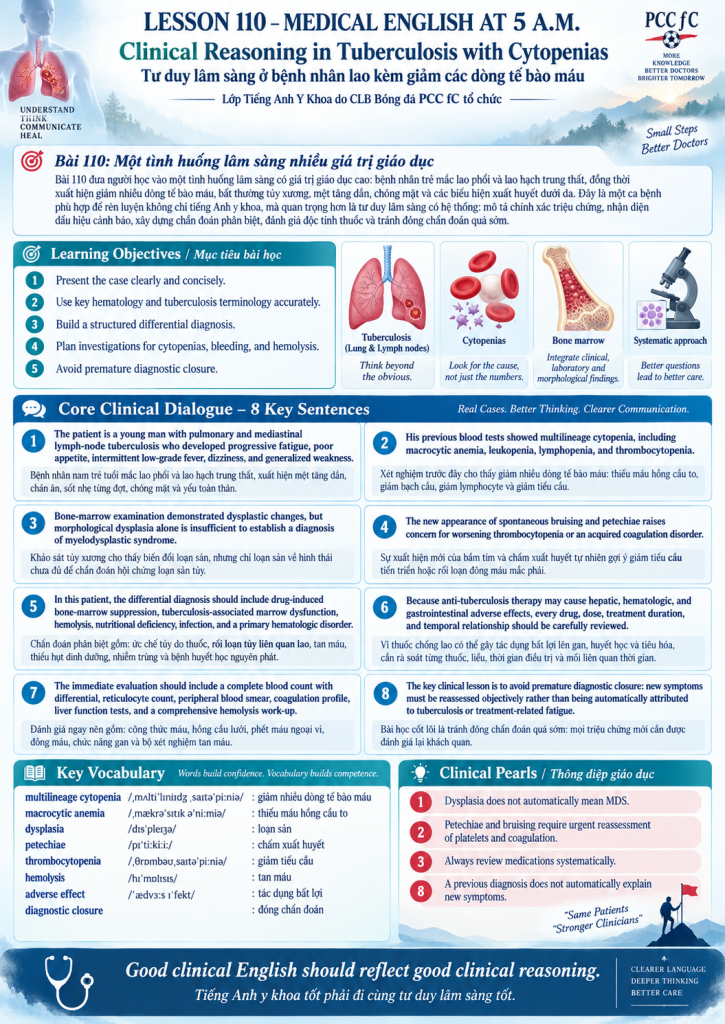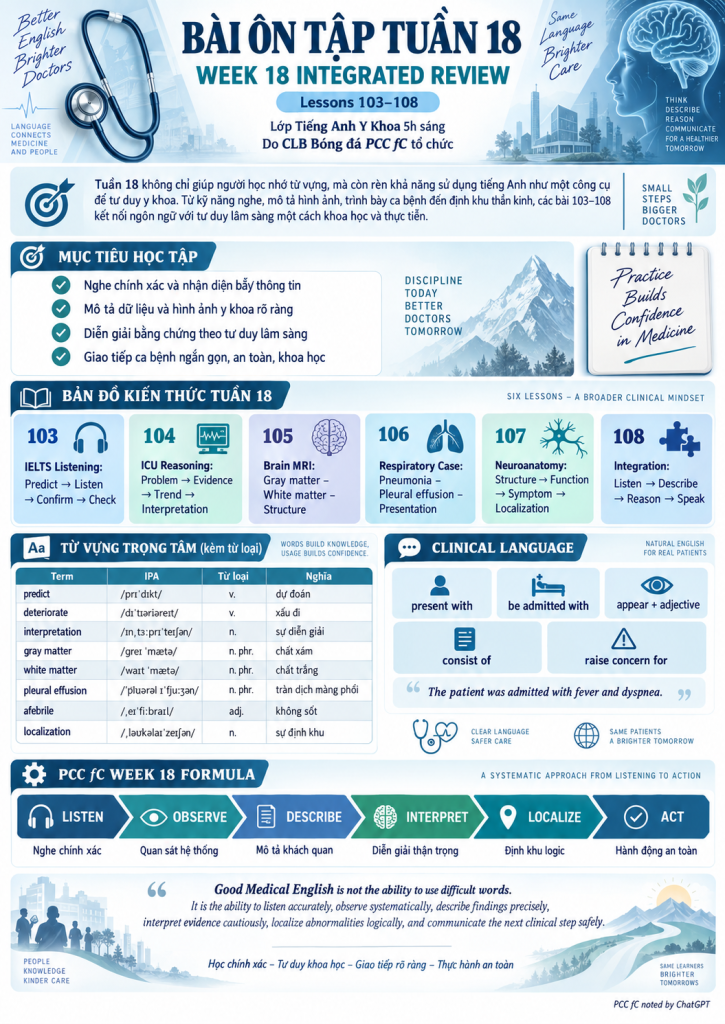
Bài 112 – Tiếng Anh Y khoa: Viêm tụy cấp với suy đa tạng * Acute pancreatitis with multiorgan dysfunction
PCC Language – Thăng Long Hà Nội, ngày 17/9/2026, Trong hồi sức và cấp cứu, những con số “đẹp lên” trên xét nghiệm chưa chắc đồng nghĩa với việc cơ quan đã thực sự hồi phục. Một bệnh nhân viêm tụy cấp có thể đồng thời xuất hiện rối loạn chức năng gan, tổn thương thận cấp, rối loạn đông máu, hạ đường huyết và những biến động chuyển hóa đe dọa tính mạng; vì vậy, điều quan trọng không chỉ là nhận diện bất thường mà còn phải hiểu điều gì đang thúc đẩy diễn biến bệnh, đâu là hậu quả của bệnh lý nền, đâu là tác động của các biện pháp hỗ trợ như CRRT hay thay huyết tương, và khi nào cần thay đổi chiến lược điều trị. Bài 112 của Lớp Tiếng Anh Y Khoa 5H sáng do CLB Bóng đá PCC fC tổ chức đưa người học vào một cuộc trao đổi ở mức bác sĩ chuyên khoa – bác sĩ nội trú, nơi mỗi câu hỏi đều đòi hỏi tư duy phản biện, diễn đạt sự chưa chắc chắn một cách chính xác và chuyển dữ liệu lâm sàng thành quyết định điều trị. Qua bài học, chúng ta không chỉ luyện Medical English ở mức nâng cao với các cấu trúc như “raise the possibility that…”, “reflect A rather than B”, “Were + subject + to + verb…”, mà còn học cách nói như một bác sĩ thực thụ: thận trọng với bằng chứng, rõ ràng trong lập luận và luôn đặt an toàn người bệnh ở trung tâm của mọi quyết định.
Tài liệu:
BÀI 112 – LỚP TIẾNG ANH Y KHOA 5H SÁNG
CLB Bóng đá PCC fC tổ chức
Acute Pancreatitis with Multiorgan Dysfunction
Consultant–Resident Clinical Reasoning at an Advanced English Level
Thông điệp của bài học: Do not merely describe the abnormality; explain what it means, what may have caused it, and what you would do next.
Đừng chỉ mô tả bất thường; hãy giải thích ý nghĩa, nguyên nhân có thể và bước xử trí tiếp theo.
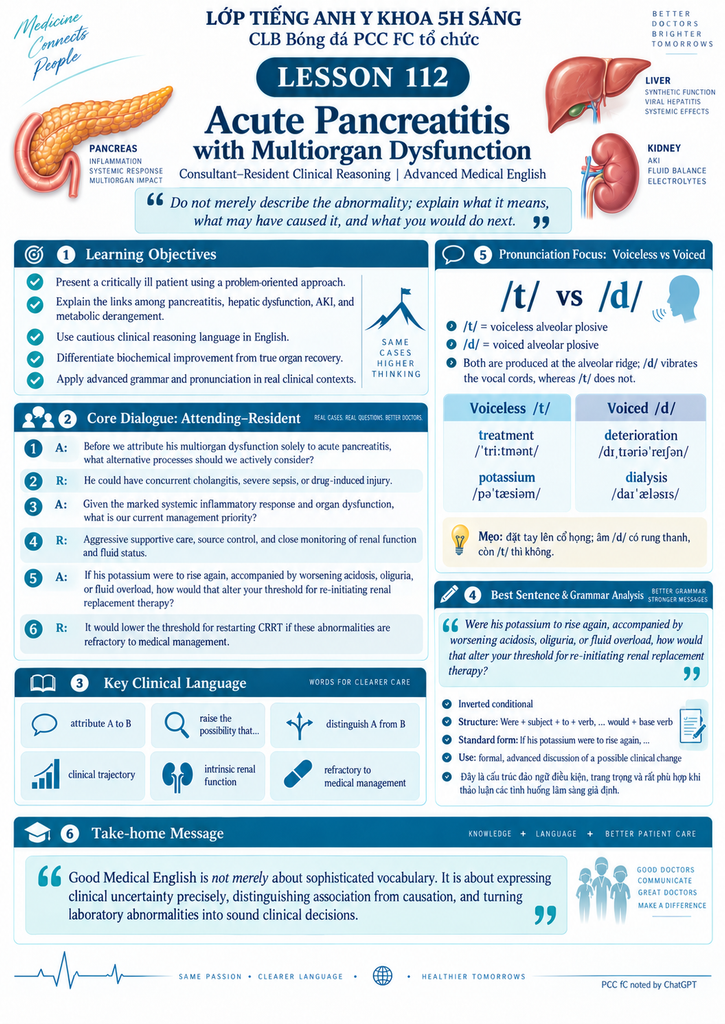
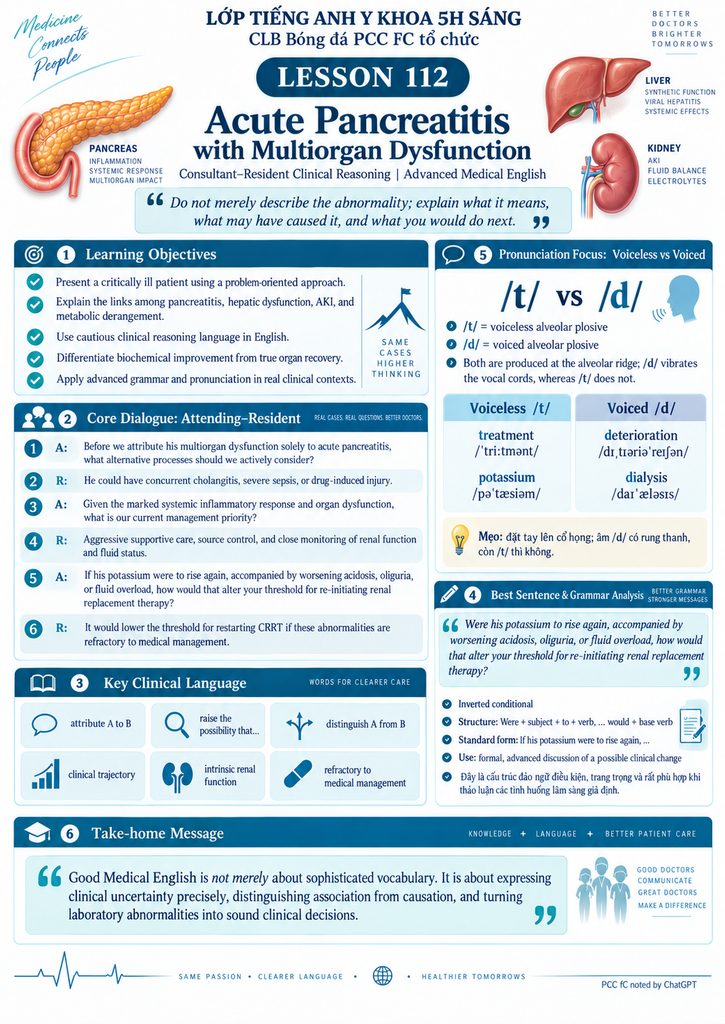
1. Learning objectives
Sau bài học, học viên có thể:
- Tóm tắt một ca bệnh nặng bằng problem-oriented presentation.
- Trình bày mối liên hệ giữa acute pancreatitis – hepatic dysfunction – AKI – metabolic derangement.
- Sử dụng ngôn ngữ thận trọng trong suy luận y khoa: may, might, suggest, raise the possibility, rather than.
- Phân biệt biochemical improvement với true organ recovery.
- Sử dụng cấu trúc nâng cao như Were + subject + to + verb…, Given that…, Although…, rather than….
- Trao đổi giữa bác sĩ chuyên khoa và bác sĩ nội trú ở mức Medical English nâng cao.
2. Clinical lead-in
A critically ill patient presents with acute pancreatitis, jaundice, severe renal dysfunction, hyperkalemia, coagulopathy, recurrent hypoglycemia, and a markedly elevated HBV DNA level.
The key question is no longer simply:
“What diagnoses does he have?”
The more important questions are:
“Which process is driving the deterioration?”
“Which abnormalities represent true organ failure?”
“Which apparent improvements may simply reflect extracorporeal support?”
“What would make us escalate treatment?”
Đây chính là chuyển đổi từ medical description sang clinical reasoning.
3. Core dialogue – Attending vs Resident
1. Attending
“Before we attribute his multiorgan dysfunction solely to acute pancreatitis, what alternative or concurrent processes should we be actively considering?”
Dịch: Trước khi quy toàn bộ tình trạng rối loạn chức năng đa cơ quan cho viêm tụy cấp, chúng ta cần chủ động cân nhắc những quá trình bệnh lý thay thế hoặc xảy ra đồng thời nào?
Clinical phrase:
attribute A to B /əˈtrɪbjuːt/ (v.) – quy A là do B
concurrent /kənˈkʌrənt/ (adj.) – đồng thời
2. Resident
“Although pancreatitis may have triggered a profound systemic inflammatory response, the markedly elevated HBV DNA level raises the possibility that active viral replication is independently contributing to the deterioration in hepatic function.”
Dịch: Mặc dù viêm tụy có thể đã khởi phát phản ứng viêm hệ thống mạnh, tải lượng HBV DNA tăng rất cao làm dấy lên khả năng virus đang nhân lên mạnh và độc lập góp phần làm chức năng gan xấu đi.
Clinical English:
raise the possibility that… = làm dấy lên khả năng rằng…
Đây là cách nói tốt hơn “This proves that…” khi quan hệ nhân quả chưa được chứng minh hoàn toàn.
3. Attending
“Precisely. Given that his INR remains prolonged despite plasma exchange, how would you distinguish a transient correction resulting from factor replacement from genuine recovery of hepatic synthetic function?”
Dịch: Chính xác. Xét việc INR vẫn kéo dài dù đã thay huyết tương, em sẽ phân biệt như thế nào giữa sự cải thiện tạm thời do bổ sung yếu tố đông máu và sự hồi phục thực sự chức năng tổng hợp của gan?
Key expression:
distinguish A from B = phân biệt A với B
transient /ˈtrænziənt/ (adj.) = thoáng qua
synthetic function = chức năng tổng hợp
4. Resident
“I would place greater emphasis on the trend after the transfused coagulation factors have had time to dissipate, while simultaneously assessing bilirubin, glucose homeostasis, mental status, lactate, and the overall clinical trajectory.”
Dịch: Em sẽ chú trọng hơn vào xu hướng sau khi tác động của các yếu tố đông máu được truyền vào đã giảm đi, đồng thời đánh giá bilirubin, khả năng duy trì đường huyết, ý thức, lactate và diễn biến lâm sàng tổng thể.
Advanced collocations:
place greater emphasis on = chú trọng hơn vào
glucose homeostasis = cân bằng nội môi glucose
clinical trajectory = quỹ đạo/diễn biến lâm sàng
5. Attending
“Now, considering that continuous renal replacement therapy has been discontinued, why would it be potentially misleading to interpret the fall in serum creatinine as evidence that the kidneys have recovered?”
Dịch: Bây giờ, khi CRRT đã ngừng, tại sao việc coi creatinine huyết thanh giảm là bằng chứng cho thấy thận đã hồi phục có thể gây hiểu nhầm?
Useful pattern:
It would be misleading to interpret A as evidence of B.
Đây là mẫu câu rất mạnh trong phản biện khoa học và bàn luận ca bệnh.
6. Resident
“Because creatinine was being continuously cleared by the extracorporeal circuit, the apparent biochemical improvement may primarily reflect dialysis efficiency rather than restoration of intrinsic renal function; urine output and the post-CRRT biochemical trend are therefore more informative.”
Dịch: Vì creatinine liên tục được loại bỏ qua hệ thống tuần hoàn ngoài cơ thể, sự cải thiện xét nghiệm biểu kiến có thể chủ yếu phản ánh hiệu quả lọc máu hơn là sự phục hồi chức năng thận nội tại; do đó lượng nước tiểu và xu hướng sinh hóa sau CRRT có giá trị hơn.
Key contrast:
reflect A rather than B
= phản ánh A hơn là B.
7. Attending
“Were his potassium to rise again, accompanied by worsening acidosis, oliguria, or fluid overload, how would that alter your threshold for re-initiating renal replacement therapy?”
Dịch: Nếu kali tăng trở lại, kèm theo tình trạng toan máu nặng hơn, thiểu niệu hoặc quá tải dịch, điều đó sẽ thay đổi ngưỡng quyết định tái khởi động điều trị thay thế thận của em như thế nào?
Đây là câu ngữ pháp trọng tâm của Bài 112.
8. Resident
“I would have a low threshold for restarting CRRT if those abnormalities proved refractory to medical management, particularly because delaying organ support in a patient with limited renal reserve could allow potentially reversible metabolic disturbances to become life-threatening.”
Dịch: Em sẽ có ngưỡng thấp để tái khởi động CRRT nếu các bất thường đó không đáp ứng với điều trị nội khoa, đặc biệt vì trì hoãn hỗ trợ cơ quan ở người bệnh có dự trữ chức năng thận hạn chế có thể khiến những rối loạn chuyển hóa vốn còn khả năng hồi phục trở nên đe dọa tính mạng.
4. Vocabulary focus
| Word / phrase | IPA | Word class | Nghĩa |
|---|---|---|---|
| attribute | /əˈtrɪbjuːt/ | verb | quy cho, cho là do |
| concurrent | /kənˈkʌrənt/ | adjective | đồng thời |
| deterioration | /dɪˌtɪəriəˈreɪʃən/ | noun | sự xấu đi |
| transient | /ˈtrænziənt/ | adjective | thoáng qua |
| dissipate | /ˈdɪsɪpeɪt/ | verb | giảm dần, tiêu biến |
| trajectory | /trəˈdʒektəri/ | noun | diễn biến, quỹ đạo |
| intrinsic | /ɪnˈtrɪnsɪk/ | adjective | nội tại |
| refractory | /rɪˈfræktəri/ | adjective | kháng trị, không đáp ứng |
| renal reserve | — | noun phrase | dự trữ chức năng thận |
| re-initiate | /ˌriːɪˈnɪʃieɪt/ | verb | khởi động lại |
5. Grammar Mastery – IELTS 8.0+
Inverted conditional
Câu trong bài:
“Were his potassium to rise again, how would that alter your threshold for re-initiating renal replacement therapy?”
Dạng thông thường:
If his potassium were to rise again, how would that alter your threshold…?
Dạng nâng cao:
Were his potassium to rise again, how would that alter your threshold…?
Công thức:
Were + Subject + to + Verb, Subject + would/could/might + Verb
Ví dụ y khoa:
Were his blood pressure to fall further, we would need to reassess his volume status and consider vasopressor support.
→ Nếu huyết áp tiếp tục giảm, chúng ta sẽ cần đánh giá lại tình trạng thể tích và cân nhắc thuốc vận mạch.
Điểm quan trọng: cấu trúc này phù hợp khi nói về một tình huống giả định có khả năng xảy ra trong tương lai, đặc biệt hữu ích trong ward round, ICU discussion và thi nói trình độ cao.
6. Clinical reasoning language
Một bác sĩ nói tiếng Anh tốt không nhất thiết phải dùng từ thật khó. Điểm quan trọng hơn là biết mức độ chắc chắn của bằng chứng.
Thay vì:
“HBV caused the liver failure.”
Nên nói:
“Active HBV replication may be contributing substantially to the deterioration in hepatic function.”
Thay vì:
“His kidneys have recovered because creatinine has fallen.”
Nên nói:
“The fall in creatinine should be interpreted cautiously because extracorporeal clearance may account for much of the apparent improvement.”
Thay vì:
“He needs CRRT again.”
Nên nói:
“Were hyperkalemia, acidosis, or fluid overload to recur despite medical management, the threshold for restarting CRRT would be considerably lower.”
Đó chính là ngôn ngữ của evidence-based clinical reasoning.
7. Pronunciation focus: /t/ versus /d/
Hai âm này rất phù hợp với bài vì xuất hiện thường xuyên trong Medical English.
/t/ – voiceless alveolar plosive: dây thanh không rung
Ví dụ: treatment, transient, potassium
/d/ – voiced alveolar plosive: dây thanh rung
Ví dụ: deterioration, dialysis, disorder
Luyện cặp:
treatment – deterioration
to – do
ten – den
Đặt đầu ngón tay lên thanh quản: phát âm /d/ cảm nhận rung rõ hơn /t/.
8. Consultant-level expressions to remember
Học viên nên thuộc và chủ động sử dụng 8 cụm:
attribute A to B
raise the possibility that…
given that…
distinguish A from B
place greater emphasis on…
reflect A rather than B
have a low threshold for…
prove refractory to medical management
Chỉ cần sử dụng tự nhiên các cụm này, chất lượng một cuộc thảo luận ca bệnh bằng tiếng Anh sẽ tăng rõ rệt.
9. Speaking challenge
Attending asks:
“The laboratory results appear to be improving, but does biochemical improvement necessarily imply organ recovery?”
Học viên trả lời trong 45–60 giây, bắt buộc sử dụng ít nhất ba cụm:
rather than – may reflect – given that – clinical trajectory – intrinsic renal function.
Một câu trả lời mẫu mức cao:
“Not necessarily. Given that the patient has recently undergone both plasma exchange and CRRT, some of the apparent biochemical improvement may reflect extracorporeal clearance or factor replacement rather than genuine organ recovery. I would therefore place greater emphasis on the post-treatment clinical trajectory, particularly mental status, glucose homeostasis, urine output, coagulation parameters, and the stability of renal function after CRRT has been discontinued.”
Take-home message
Good Medical English is not merely about sophisticated vocabulary. It is about expressing clinical uncertainty precisely, distinguishing association from causation, and turning laboratory abnormalities into sound clinical decisions.
Tiếng Anh Y khoa tốt không đơn thuần là sử dụng từ vựng khó; đó là khả năng diễn đạt chính xác sự chưa chắc chắn, phân biệt liên quan với quan hệ nhân quả và biến các bất thường xét nghiệm thành quyết định lâm sàng hợp lý.
LESSON 112
Think critically – Speak precisely – Treat safely.
PCC fC Medical English Class