Bài 122 – Tiếng Anh Y Khoa: Từ suy hô hấp tới tình trạng bệnh nặng đa cơ quan * From respiratory failure to multisystem critical illness
PCC Language – Thăng Long, Hà Nội, ngày 29/9/2026, trong hồi sức cấp cứu, bệnh nhân hiếm khi diễn biến đúng theo một “kịch bản” cố định. Một đợt cấp COPD ban đầu có thể nhanh chóng tiến triển thành suy hô hấp, thất bại thông khí không xâm nhập, viêm phổi nặng, sốc nhiễm khuẩn và rối loạn chức năng đa cơ quan. Khi những bằng chứng mới xuất hiện — chẳng hạn phát hiện Strongyloides trong bệnh phẩm đường hô hấp ở bệnh nhân đang sử dụng corticosteroid — người bác sĩ phải biết dừng lại, đánh giá lại và sẵn sàng điều chỉnh chẩn đoán cũng như chiến lược điều trị.
File Audio:
Bài 122 – From Respiratory Failure to Multisystem Critical Illness đưa chúng ta vào một cuộc trao đổi ngắn nhưng chuyên sâu giữa bác sĩ chuyên khoa và bác sĩ nội trú. Qua 8 câu hội thoại ở mức IELTS 8.0+, chúng ta không chỉ học cách sử dụng những thuật ngữ như hemodynamic instability, impending ventilatory failure, hyperinfection, disseminated disease hay continuous reassessment, mà quan trọng hơn là học cách kết nối dữ kiện, giải thích quyết định và trình bày tư duy lâm sàng bằng tiếng Anh.
Bài học được thiết kế tích hợp cả 4 kỹ năng: Listening – Speaking – Reading – Writing, theo một chuỗi thống nhất:
Listen to understand → Speak to communicate → Read to update → Write to organise → Reason to decide.
Mỗi buổi sáng, chúng ta không cần học quá nhiều. Chỉ cần 20–25 phút học thật đều đặn: nghe một tình huống thực tế, nói lại bằng ngôn ngữ của mình, đọc sâu hơn một chút và viết lại những gì đã hiểu. Khi được lặp lại mỗi ngày, tiếng Anh Y khoa sẽ dần chuyển từ một “môn học” thành một công cụ nghề nghiệp và một thói quen tư duy.
Bài 122 vì thế không chỉ đặt câu hỏi: “What is the diagnosis?” mà còn hướng tới những câu hỏi quan trọng hơn: “What has changed? Why has it changed? What should we do next?”
Think clinically. Communicate clearly. Reassess continuously.
Lớp Tiếng Anh Y khoa 5H sáng – do CLB Bóng đá PCC fC tổ chức
Vì một đam mê Khoẻ Vui Hạnh phúc!
BÀI 122 – TIẾNG ANH Y KHOA 5H SÁNG
FROM RESPIRATORY FAILURE TO MULTISYSTEM CRITICAL ILLNESS
Specialist–Resident Clinical Discussion
IELTS 8.0+ | Listening – Speaking – Reading – Writing | Clinical Reasoning
Lớp Tiếng Anh Y khoa 5H sáng – do CLB Bóng đá PCC fC tổ chức
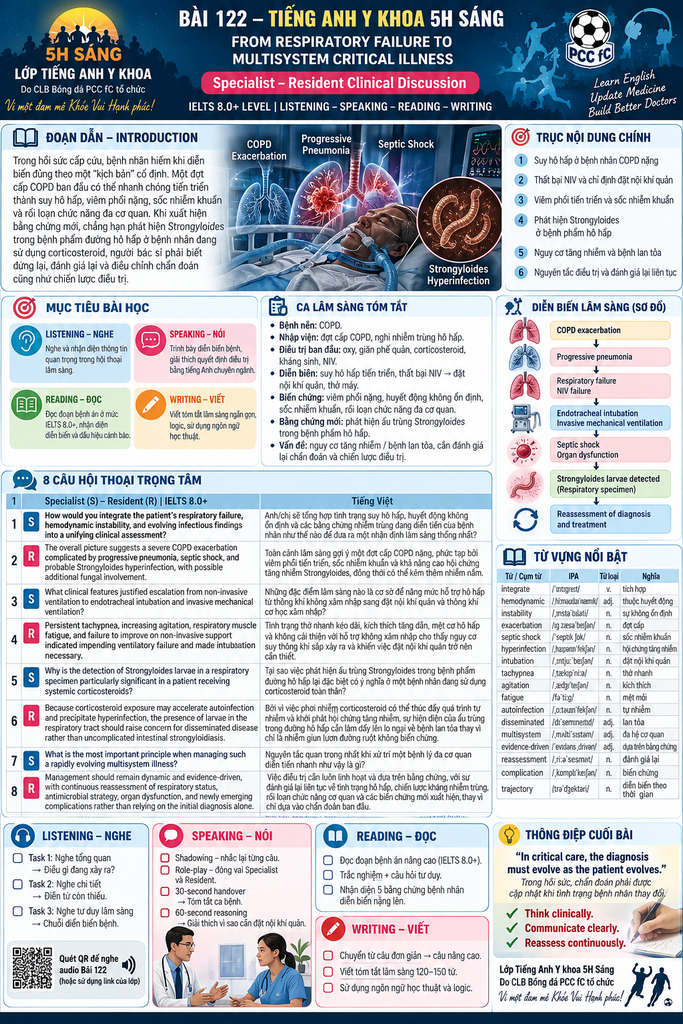
I. LEARNING OBJECTIVES – MỤC TIÊU BÀI HỌC
Sau bài học, học viên có thể phát triển đồng thời 4 kỹ năng tiếng Anh y khoa:
🎧 LISTENING – NGHE
Nghe và nhận diện những thông tin quan trọng trong một cuộc trao đổi chuyên môn giữa bác sĩ chuyên khoa và bác sĩ nội trú về một bệnh nhân hồi sức diễn biến phức tạp.
🗣️ SPEAKING – NÓI
Trình bày diễn biến bệnh, giải thích quyết định điều trị và bảo vệ nhận định lâm sàng bằng tiếng Anh chuyên ngành.
📖 READING – ĐỌC
Đọc một đoạn bệnh án ở mức IELTS 8.0+, nhận diện diễn biến bệnh, quan hệ nguyên nhân – hậu quả và các dấu hiệu cảnh báo.
✍️ WRITING – VIẾT
Viết một clinical summary ngắn gọn, logic, sử dụng ngôn ngữ học thuật và tư duy lâm sàng.
CENTRAL CLINICAL QUESTION
How should clinicians respond when a patient’s condition evolves beyond the initial diagnosis?
Bác sĩ nên ứng phó như thế nào khi tình trạng của bệnh nhân diễn biến vượt ra ngoài chẩn đoán ban đầu?
II. WARM-UP – KHỞI ĐỘNG
Trước khi nghe, hãy thử trả lời bằng tiếng Anh:
1. What are the warning signs of NIV failure?
Những dấu hiệu cảnh báo thất bại của thông khí không xâm nhập là gì?
2. When should a critically ill patient be intubated?
Khi nào một bệnh nhân nguy kịch cần được đặt nội khí quản?
3. Why can corticosteroids be dangerous in patients with Strongyloides infection?
Tại sao corticosteroid có thể nguy hiểm ở bệnh nhân nhiễm Strongyloides?
4. Why should clinicians continuously reassess their initial diagnosis?
Tại sao bác sĩ cần liên tục đánh giá lại chẩn đoán ban đầu?
Mục tiêu: Không cần trả lời hoàn hảo. Hãy kích hoạt medical vocabulary + clinical reasoning trước khi bắt đầu bài nghe.
III. LISTENING – NGHE HIỂU
Task 1 – First Listening: Listen for the Big Picture
Nghe toàn bộ cuộc hội thoại không nhìn văn bản.
Chỉ trả lời một câu hỏi:
What is happening to this patient?
A. The patient is recovering from a simple COPD exacerbation.
B. The patient is developing a progressively complex multisystem critical illness.
C. The patient has uncomplicated intestinal strongyloidiasis.
D. The primary problem is isolated fungal pneumonia.
Answer: B
Task 2 – Second Listening: Listen for Clinical Details
Nghe lần thứ hai và điền từ còn thiếu:
- The patient developed respiratory failure and _________ instability.
- The initial respiratory illness was complicated by progressive pneumonia and _________ shock.
- Persistent tachypnea and respiratory muscle _________ suggested failure of non-invasive support.
- Systemic corticosteroids may accelerate Strongyloides _________.
- The presence of larvae in the respiratory tract raises concern for _________ disease.
- Management should remain dynamic and _________-driven.
Answers
1. hemodynamic
2. septic
3. fatigue
4. autoinfection
5. disseminated
6. evidence
Task 3 – Third Listening: Listen for Clinical Reasoning
Lần nghe thứ ba, không cố gắng nghe từng từ. Hãy nhận diện chuỗi diễn biến lâm sàng:
COPD exacerbation
↓
Progressive respiratory deterioration
↓
Failure of NIV
↓
Endotracheal intubation
↓
Progressive infection / septic shock
↓
Strongyloides larvae detected in respiratory specimen
↓
Concern for hyperinfection / disseminated disease
↓
Reassessment of diagnosis and treatment
LISTENING PEARL
Khi nghe tiếng Anh y khoa nâng cao, đừng cố hiểu 100% từng từ.
Hãy tập trung tìm:
Problem → Deterioration → Evidence → Decision → Response
Vấn đề → Diễn biến xấu → Bằng chứng → Quyết định → Đáp ứng xử trí
IV. SPECIALIST–RESIDENT CLINICAL DISCUSSION
8 CÂU HỘI THOẠI TRỌNG TÂM
1. SPECIALIST
How would you integrate the patient’s respiratory failure, hemodynamic instability, and evolving infectious findings into a unifying clinical assessment?
Dịch: Anh/chị sẽ tổng hợp tình trạng suy hô hấp, huyết động không ổn định và các bằng chứng nhiễm trùng đang diễn tiến của bệnh nhân như thế nào để đưa ra một nhận định lâm sàng thống nhất?
2. RESIDENT
The overall picture suggests a severe COPD exacerbation complicated by progressive pneumonia, septic shock, and probable Strongyloides hyperinfection, with possible additional fungal involvement.
Dịch: Toàn cảnh lâm sàng gợi ý một đợt cấp COPD nặng, phức tạp bởi viêm phổi tiến triển, sốc nhiễm khuẩn và khả năng cao hội chứng tăng nhiễm Strongyloides, đồng thời có thể kèm thêm nhiễm nấm.
3. SPECIALIST
What clinical features justified escalation from non-invasive ventilation to endotracheal intubation and invasive mechanical ventilation?
Dịch: Những đặc điểm lâm sàng nào là cơ sở để nâng mức hỗ trợ hô hấp từ thông khí không xâm nhập sang đặt nội khí quản và thông khí cơ học xâm nhập?
4. RESIDENT
Persistent tachypnea, increasing agitation, respiratory muscle fatigue, and failure to improve on non-invasive support indicated impending ventilatory failure and made intubation necessary.
Dịch: Tình trạng thở nhanh kéo dài, kích thích tăng dần, mệt cơ hô hấp và không cải thiện với hỗ trợ không xâm nhập cho thấy nguy cơ suy thông khí sắp xảy ra và khiến việc đặt nội khí quản trở nên cần thiết.
5. SPECIALIST
Why is the detection of Strongyloides larvae in a respiratory specimen particularly significant in a patient receiving systemic corticosteroids?
Dịch: Tại sao việc phát hiện ấu trùng Strongyloides trong bệnh phẩm đường hô hấp lại đặc biệt có ý nghĩa ở một bệnh nhân đang sử dụng corticosteroid toàn thân?
6. RESIDENT
Because corticosteroid exposure may accelerate autoinfection and precipitate hyperinfection, the presence of larvae in the respiratory tract should raise concern for disseminated disease rather than uncomplicated intestinal strongyloidiasis.
Dịch: Bởi vì việc phơi nhiễm corticosteroid có thể thúc đẩy quá trình tự nhiễm và khởi phát hội chứng tăng nhiễm, sự hiện diện của ấu trùng trong đường hô hấp cần làm dấy lên lo ngại về bệnh lan tỏa thay vì chỉ là nhiễm giun lươn đường ruột không biến chứng.
7. SPECIALIST
What is the most important principle when managing such a rapidly evolving multisystem illness?
Dịch: Nguyên tắc quan trọng nhất khi xử trí một bệnh lý đa cơ quan diễn tiến nhanh như vậy là gì?
8. RESIDENT
Management should remain dynamic and evidence-driven, with continuous reassessment of respiratory status, antimicrobial strategy, organ dysfunction, and newly emerging complications rather than relying on the initial diagnosis alone.
Dịch: Việc điều trị cần luôn linh hoạt và dựa trên bằng chứng, với sự đánh giá lại liên tục về tình trạng hô hấp, chiến lược kháng nhiễm trùng, rối loạn chức năng cơ quan và các biến chứng mới xuất hiện, thay vì chỉ dựa vào chẩn đoán ban đầu.
V. SPEAKING – LUYỆN NÓI
Task 1 – Shadowing
Nghe từng câu → dừng → nhắc lại.
Không đọc từng từ riêng lẻ. Hãy chia câu thành các meaning chunks – cụm ý:
The overall picture suggests / a severe COPD exacerbation / complicated by progressive pneumonia / septic shock / and probable Strongyloides hyperinfection.
Mục tiêu:
Không dịch từng từ → Nghe theo cụm → Hiểu theo ý → Nói lại theo cụm.
Task 2 – Specialist–Resident Role-play
Hai học viên đóng vai:
Student A – Specialist:
Đặt câu hỏi, yêu cầu giải thích và phản biện.
Student B – Resident:
Tóm tắt bệnh nhân, đưa ra bằng chứng và giải thích quyết định điều trị.
Sau đó đổi vai.
Task 3 – 30-Second Clinical Handover
Không nhìn văn bản.
Hãy trình bày bệnh nhân trong 30 giây, cố gắng sử dụng ít nhất 5 cụm:
severe COPD exacerbation
progressive pneumonia
respiratory failure
NIV failure
septic shock
Strongyloides hyperinfection
corticosteroid exposure
continuous reassessment
Task 4 – 60-Second Clinical Reasoning Challenge
Why was intubation necessary?
Hãy trả lời theo cấu trúc:
CLAIM → EVIDENCE → INTERPRETATION → DECISION
Model Answer
Intubation became necessary because the patient showed several features of NIV failure, including persistent tachypnea, increasing agitation, and respiratory muscle fatigue. Taken together, these findings suggested impending ventilatory failure, making continued non-invasive support unsafe and insufficient.
Dịch: Đặt nội khí quản trở nên cần thiết vì bệnh nhân xuất hiện nhiều dấu hiệu thất bại của NIV, bao gồm thở nhanh kéo dài, kích thích tăng dần và mệt cơ hô hấp. Khi xem xét tổng thể, những dấu hiệu này gợi ý tình trạng suy thông khí sắp xảy ra, khiến việc tiếp tục hỗ trợ không xâm nhập trở nên không an toàn và không còn đầy đủ.
VI. READING – ĐỌC HIỂU
Advanced Clinical Reading – IELTS 8.0+
A patient with underlying chronic obstructive pulmonary disease was initially managed for an acute exacerbation complicated by suspected respiratory infection. Despite oxygen therapy, bronchodilators, systemic corticosteroids, antibiotics, and non-invasive ventilatory support, his respiratory condition progressively deteriorated.
Persistent tachypnea, agitation, respiratory muscle fatigue, and failure to improve with non-invasive ventilation raised concern for impending ventilatory failure. Endotracheal intubation was therefore performed, followed by invasive mechanical ventilation.
The subsequent clinical course became increasingly complex. Progressive pulmonary infection was accompanied by hemodynamic instability and organ dysfunction, raising concern for severe infection and septic shock. Importantly, Strongyloides larvae were subsequently detected in a respiratory specimen.
This finding carried particular clinical significance because systemic corticosteroid exposure may facilitate accelerated autoinfection and the development of Strongyloides hyperinfection. Detection of larvae outside their usual gastrointestinal context, particularly within the respiratory tract, should therefore prompt consideration of severe hyperinfection or disseminated disease in an appropriate clinical setting.
The case illustrates an important principle of critical care: an initial diagnosis should be regarded as a working diagnosis rather than an immutable conclusion. As the patient’s clinical trajectory changes and new evidence emerges, clinicians must repeatedly reassess the differential diagnosis, treatment strategy, organ support, and potential complications.
VII. READING COMPREHENSION
Question 1
Why was non-invasive ventilation considered unsuccessful?
A. The patient developed mild cough.
B. Respiratory distress resolved but oxygen saturation remained low.
C. Tachypnea, agitation, and respiratory muscle fatigue persisted despite NIV.
D. Strongyloides larvae were detected.
Answer: C
Question 2
What made the detection of Strongyloides particularly concerning?
A. The patient had COPD.
B. The patient had received systemic corticosteroids.
C. The patient was receiving oxygen.
D. The patient had hypertension.
Answer: B
Question 3
What does “working diagnosis” imply in this passage?
A. The diagnosis is definitely correct.
B. The diagnosis should never be changed.
C. It is a provisional clinical interpretation that may require revision.
D. Treatment should be postponed until the final diagnosis is established.
Answer: C
Question 4 – Higher-order Thinking
Why is the phrase “clinical trajectory” important in critical care?
Suggested answer:
Changes in the patient’s condition over time may provide more clinically meaningful information than a single observation and may require clinicians to revise both diagnosis and management.
VIII. ADVANCED MEDICAL VOCABULARY
TỪ MỚI – PHIÊN ÂM – TỪ LOẠI – NGHĨA
| Từ / Cụm từ | IPA | Từ loại | Nghĩa |
|---|---|---|---|
| integrate | /ˈɪntɪɡreɪt/ | verb (v.) | tích hợp, tổng hợp |
| respiratory failure | /rɪˈspɪrətri ˈfeɪljə(r)/ | noun phrase (n. phr.) | suy hô hấp |
| hemodynamic | /ˌhiːməʊdaɪˈnæmɪk/ | adjective (adj.) | thuộc huyết động |
| instability | /ˌɪnstəˈbɪləti/ | noun (n.) | sự không ổn định |
| evolving | /ɪˈvɒlvɪŋ/ | adjective (adj.) | đang diễn tiến/phát triển |
| unifying | /ˈjuːnɪfaɪɪŋ/ | adjective (adj.) | mang tính tổng hợp/thống nhất |
| assessment | /əˈsesmənt/ | noun (n.) | sự đánh giá, nhận định |
| exacerbation | /ɪɡˌzæsəˈbeɪʃən/ | noun (n.) | đợt cấp, sự nặng lên |
| progressive | /prəˈɡresɪv/ | adjective (adj.) | tiến triển, tăng dần |
| septic shock | /ˈseptɪk ʃɒk/ | noun phrase | sốc nhiễm khuẩn |
| hyperinfection | /ˌhaɪpərɪnˈfekʃən/ | noun (n.) | hội chứng tăng nhiễm |
| fungal | /ˈfʌŋɡəl/ | adjective (adj.) | thuộc nấm |
| involvement | /ɪnˈvɒlvmənt/ | noun (n.) | sự liên quan/tham gia của cơ quan hoặc bệnh lý |
| escalation | /ˌeskəˈleɪʃən/ | noun (n.) | sự nâng mức/tăng cường |
| intubation | /ˌɪntjuːˈbeɪʃən/ | noun (n.) | đặt nội khí quản |
| invasive | /ɪnˈveɪsɪv/ | adjective (adj.) | xâm nhập |
| persistent | /pəˈsɪstənt/ | adjective (adj.) | kéo dài, dai dẳng |
| tachypnea | /ˌtækɪpˈniːə/ | noun (n.) | thở nhanh |
| agitation | /ˌædʒɪˈteɪʃən/ | noun (n.) | kích thích, bồn chồn |
| fatigue | /fəˈtiːɡ/ | noun (n.) | sự mệt mỏi |
| impending | /ɪmˈpendɪŋ/ | adjective (adj.) | sắp xảy ra, cận kề |
| ventilatory | /ˈventɪlətəri/ | adjective (adj.) | thuộc thông khí |
| detection | /dɪˈtekʃən/ | noun (n.) | sự phát hiện |
| larva / larvae | /ˈlɑːvə/; /ˈlɑːviː/ | noun (n.) | ấu trùng / các ấu trùng |
| specimen | /ˈspesɪmən/ | noun (n.) | bệnh phẩm, mẫu xét nghiệm |
| corticosteroid | /ˌkɔːtɪkəʊˈsterɔɪd/ | noun (n.) | corticosteroid |
| accelerate | /əkˈseləreɪt/ | verb (v.) | thúc đẩy, làm tăng tốc |
| autoinfection | /ˌɔːtəʊɪnˈfekʃən/ | noun (n.) | tự nhiễm |
| precipitate | /prɪˈsɪpɪteɪt/ | verb (v.) | thúc đẩy/khởi phát đột ngột |
| disseminated | /dɪˈsemɪneɪtɪd/ | adjective (adj.) | lan tỏa |
| strongyloidiasis | /ˌstrɒŋɡɪlɔɪˈdaɪəsɪs/ | noun (n.) | bệnh giun lươn |
| multisystem | /ˌmʌltiˈsɪstəm/ | adjective (adj.) | đa hệ cơ quan |
| evidence-driven | /ˈevɪdəns ˌdrɪvən/ | adjective (adj.) | dựa trên bằng chứng |
| reassessment | /ˌriːəˈsesmənt/ | noun (n.) | sự đánh giá lại |
| antimicrobial | /ˌæntimaɪˈkrəʊbiəl/ | adjective/noun | kháng vi sinh vật |
| dysfunction | /dɪsˈfʌŋkʃən/ | noun (n.) | rối loạn chức năng |
| emerging | /ɪˈmɜːdʒɪŋ/ | adjective (adj.) | mới xuất hiện |
| complication | /ˌkɒmplɪˈkeɪʃən/ | noun (n.) | biến chứng |
| trajectory | /trəˈdʒektəri/ | noun (n.) | quỹ đạo, diễn biến theo thời gian |
| provisional | /prəˈvɪʒənəl/ | adjective (adj.) | tạm thời, sơ bộ |
| immutable | /ɪˈmjuːtəbəl/ | adjective (adj.) | không thể thay đổi |
IX. HIGH-VALUE MEDICAL COLLOCATIONS
Không chỉ học từng từ riêng lẻ. Hãy học theo cụm từ chuyên ngành:
hemodynamic instability – huyết động không ổn định
progressive respiratory deterioration – tình trạng hô hấp xấu dần
respiratory muscle fatigue – mệt cơ hô hấp
impending ventilatory failure – suy thông khí sắp xảy ra
escalation of respiratory support – nâng mức hỗ trợ hô hấp
accelerate autoinfection – thúc đẩy quá trình tự nhiễm
precipitate hyperinfection – khởi phát/thúc đẩy hội chứng tăng nhiễm
disseminated disease – bệnh lan tỏa
clinical trajectory – diễn biến lâm sàng theo thời gian
working diagnosis – chẩn đoán làm việc/chẩn đoán tạm thời
evidence-driven management – điều trị dựa trên bằng chứng
continuous reassessment – đánh giá lại liên tục
newly emerging complications – các biến chứng mới xuất hiện
X. FROM BASIC ENGLISH TO IELTS 8.0+ MEDICAL ENGLISH
BASIC
The patient became worse.
ADVANCED
The patient’s clinical condition progressively deteriorated.
BASIC
The patient did not get better with NIV.
ADVANCED
The patient failed to demonstrate meaningful clinical improvement despite non-invasive ventilatory support.
BASIC
Doctors found Strongyloides in his lungs.
ADVANCED
Strongyloides larvae were detected in a respiratory specimen, raising concern for hyperinfection or disseminated disease.
BASIC
Doctors changed the diagnosis.
ADVANCED
The working diagnosis was revised in light of newly emerging clinical and microbiological evidence.
BASIC
We need to check the patient again.
ADVANCED
The patient’s evolving clinical status requires continuous reassessment.
XI. WRITING – LUYỆN VIẾT
Task 1 – Sentence Transformation
Chuyển các câu tiếng Anh đơn giản thành Advanced Medical English.
1.
The patient got worse despite NIV.
→ Despite non-invasive ventilatory support, the patient’s respiratory condition continued to deteriorate.
2.
Doctors found Strongyloides in his lungs.
→ Strongyloides larvae were detected in a respiratory specimen, raising concern for hyperinfection or disseminated disease.
3.
Doctors had to change their diagnosis.
→ The emergence of new clinical and microbiological evidence necessitated reassessment of the initial working diagnosis.
XII. WRITING TASK – CLINICAL SUMMARY
Write 120–150 words:
Summarise the patient’s clinical deterioration and explain why continuous reassessment was essential.
Suggested Structure
Initial presentation
↓
Initial treatment
↓
Clinical deterioration
↓
NIV failure
↓
Intubation
↓
New infectious evidence
↓
Significance of Strongyloides
↓
Clinical lesson
MODEL ANSWER – IELTS 8.0+
The patient was initially treated for a severe exacerbation of COPD complicated by suspected respiratory infection. Despite appropriate supportive therapy and non-invasive ventilation, his respiratory status progressively deteriorated, with persistent tachypnea, agitation, and respiratory muscle fatigue suggesting impending ventilatory failure. Endotracheal intubation and invasive mechanical ventilation therefore became necessary. His subsequent course was complicated by progressive pulmonary infection, hemodynamic instability, and organ dysfunction. The detection of Strongyloides larvae in a respiratory specimen was particularly concerning in the context of systemic corticosteroid exposure, as this raised suspicion of hyperinfection or disseminated disease. This case demonstrates why the initial diagnosis in critically ill patients should remain provisional. Continuous reassessment of the clinical trajectory, microbiological findings, organ dysfunction, and response to treatment is essential to ensure that management evolves as new evidence emerges.
XIII. INTEGRATED FOUR-SKILL CHALLENGE
🎧 LISTEN
Nghe 8 câu không nhìn transcript.
Mục tiêu: tìm được Problem – Evidence – Decision – Response.
🗣️ SPEAK
Đóng văn bản và tóm tắt bệnh nhân trong 60 giây.
📖 READ
Đọc lại clinical passage và xác định 5 bằng chứng cho thấy bệnh nhân đang diễn biến nặng lên.
✍️ WRITE
Viết một clinical summary 120–150 từ mà không sao chép model answer.
XIV. THE FIVE CLINICAL QUESTIONS
Sau khi hoàn thành bài học, hãy CLOSE THE TEXT và tự trả lời bằng tiếng Anh:
1. What happened?
Chuyện gì đã xảy ra?
2. Why did it happen?
Tại sao nó xảy ra?
3. What did we do?
Chúng ta đã xử trí như thế nào?
4. Why did we do it?
Tại sao chúng ta lựa chọn cách xử trí đó?
5. What should we reassess next?
Tiếp theo chúng ta cần đánh giá lại những gì?
Nếu học viên có thể trả lời được 5 câu hỏi này bằng tiếng Anh, mục tiêu không còn đơn thuần là học từ vựng tiếng Anh y khoa, mà đã tiến tới:
THINKING CLINICALLY IN ENGLISH
TƯ DUY LÂM SÀNG BẰNG TIẾNG ANH
XV. 5H MORNING – 25-MINUTE METHOD
0–3 phút: Passive Listening – nghe thụ động toàn bài
3–7 phút: Active Listening – nghe chủ động, bắt keywords
7–11 phút: Shadowing – luyện phát âm, trọng âm và cụm ý
11–15 phút: Specialist–Resident Role-play – luyện hội thoại
15–19 phút: Reading + Clinical Reasoning – đọc và tư duy lâm sàng
19–23 phút: Writing Challenge – viết tóm tắt
23–25 phút: 60-Second Clinical Summary – đóng tài liệu và trình bày lại ca bệnh
CÔNG THỨC BÀI 122
LISTEN → UNDERSTAND → SPEAK → READ → REASON → WRITE → RECALL
Nghe → Hiểu → Nói → Đọc → Tư duy → Viết → Tái hiện
XVI. TAKE-HOME MESSAGE
In critical care, the diagnosis must evolve as the patient evolves.
Trong hồi sức, chẩn đoán phải được cập nhật khi tình trạng bệnh nhân thay đổi.
In Medical English, language should evolve from vocabulary to communication, and from communication to clinical reasoning.
Trong Tiếng Anh Y khoa, việc học cần tiến từ từ vựng đến giao tiếp, và từ giao tiếp đến tư duy lâm sàng.
Đừng chỉ học thuộc một từ.
Hãy đặt từ đó vào một câu.
Đừng chỉ học thuộc một câu.
Hãy đặt câu đó vào một tình huống lâm sàng.
Đừng chỉ mô tả một tình huống lâm sàng.
Hãy sử dụng tiếng Anh để giải thích và bảo vệ quyết định chuyên môn.
MỖI SÁNG 20–25 PHÚT
Listen to understand.
Nghe để hiểu.
Speak to communicate.
Nói để giao tiếp.
Read to update.
Đọc để cập nhật.
Write to organise your thinking.
Viết để hệ thống hóa tư duy.
Reason to become an independent clinician and learner.
Tư duy để trở thành người thầy thuốc và người học độc lập.
LỚP TIẾNG ANH Y KHOA 5H SÁNG
Listening – Speaking – Reading – Writing – Clinical Reasoning
Learning English – Updating Medicine – Building Daily Habits
Do CLB Bóng đá PCC fC tổ chức
Vì một đam mê Khoẻ Vui Hạnh phúc!
PCC fC