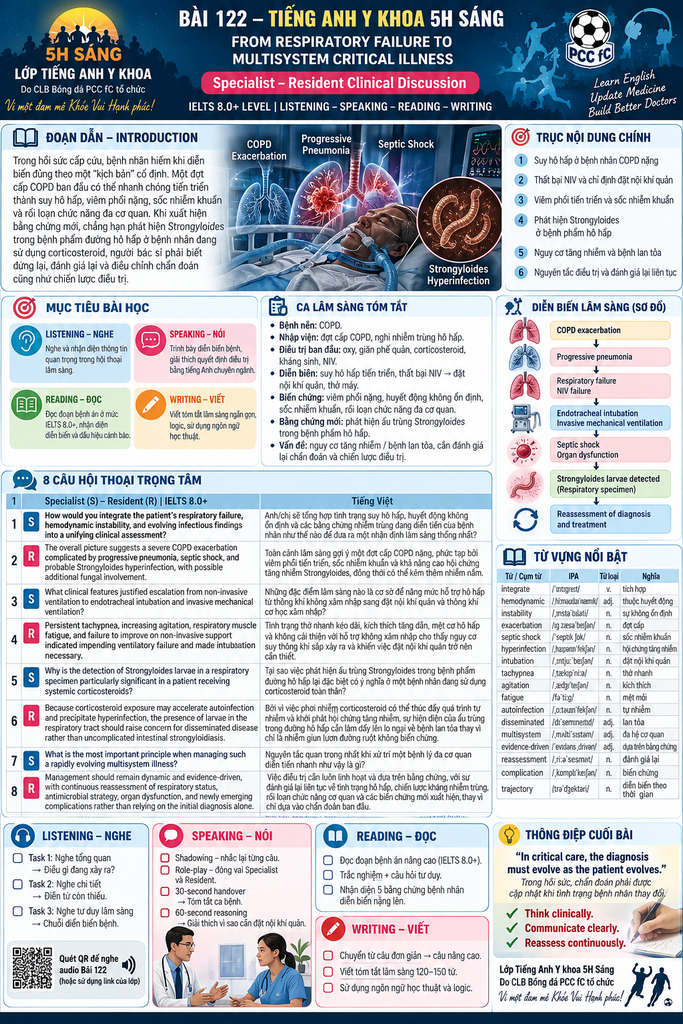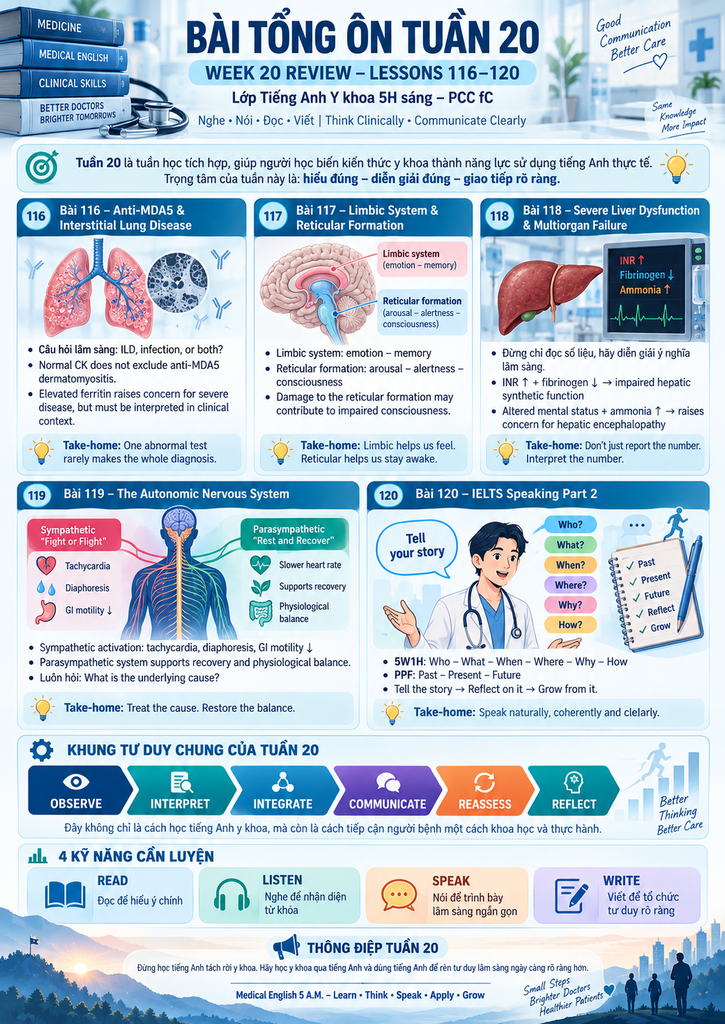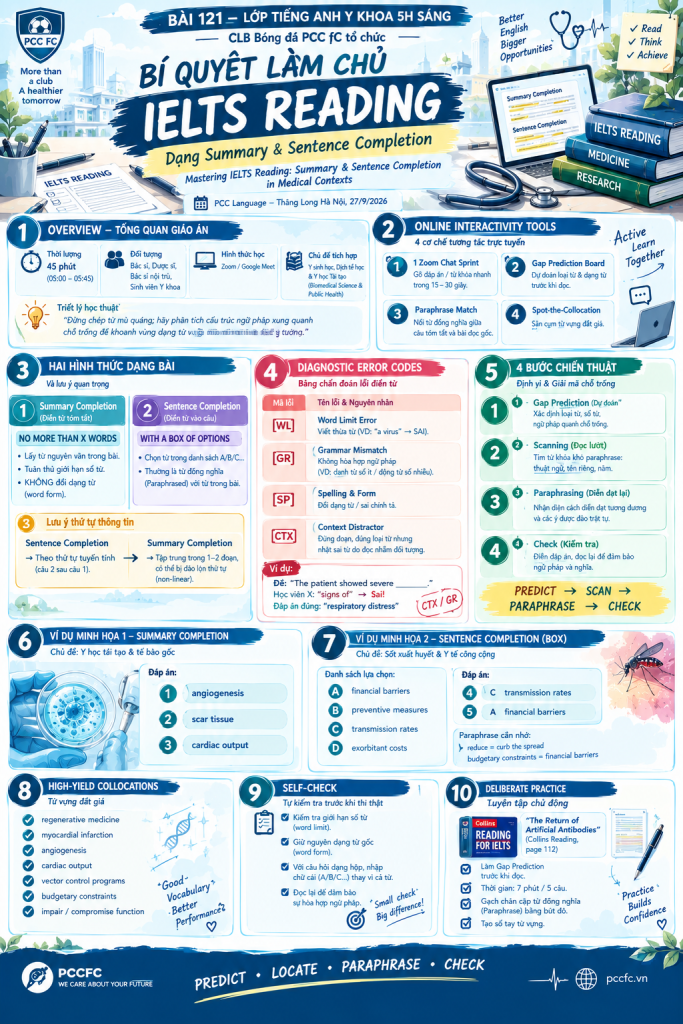
Bài 123 – Tiếng Anh Y khoa: Bản đồ hệ thần kinh tự chủ: từ tín hiệu hướng tâm đến đáp ứng chiến đấu hay bỏ chạy * The autonomic blueprint: from afferent input to the fight-or-flight response
PCC Language – Thăng Long, Hà Nội, ngày 30/9/2026, Trong thực hành lâm sàng, có những biểu hiện tưởng như rất đơn giản—nhịp tim nhanh, vã mồ hôi, giãn đồng tử hay cảm giác hoảng sợ—nhưng phía sau chúng là cả một hệ thống điều hòa thần kinh tinh vi đang hoạt động từng giây. Bài 123 – The Autonomic Blueprint đưa chúng ta đi từ một tình huống quen thuộc là cơn hoảng loạn cấp đến cách cơ thể tiếp nhận kích thích, xử lý thông tin tại hệ thần kinh trung ương và tạo ra đáp ứng tự chủ thông qua các đường hướng tâm và ly tâm. Qua một đoạn hội thoại lâm sàng ngắn nhưng giàu giá trị, học viên sẽ đồng thời củng cố kiến thức về Autonomic Nervous System, làm chủ các thuật ngữ như afferent, efferent, diaphoresis, tachycardia, pupillary dilation và luyện cách giải thích cơ chế sinh lý bằng tiếng Anh ở mức IELTS 8.0. Mục tiêu của bài học không chỉ là biết thêm từ mới, mà là rèn một năng lực quan trọng hơn: quan sát chính xác, tư duy theo cơ chế, diễn đạt mạch lạc và giao tiếp y khoa tự tin bằng tiếng Anh. Mỗi buổi sáng 5H là một bước nhỏ, nhưng khi được duy trì đều đặn, những bước nhỏ ấy sẽ tạo nên một nền tảng chuyên môn và ngôn ngữ ngày càng vững chắc.
Tài liệu:
BÀI 123 – TIẾNG ANH Y KHOA 5H SÁNG
THE AUTONOMIC BLUEPRINT
From Afferent Input to the Fight-or-Flight Response
IELTS 8.0+ | Advanced Medical English | Clinical Communication
Listening – Speaking – Reading – Writing – Vocabulary – Pronunciation – Clinical Reasoning
Lớp Tiếng Anh Y Khoa 5H sáng
Do CLB Bóng đá PCC fC tổ chức
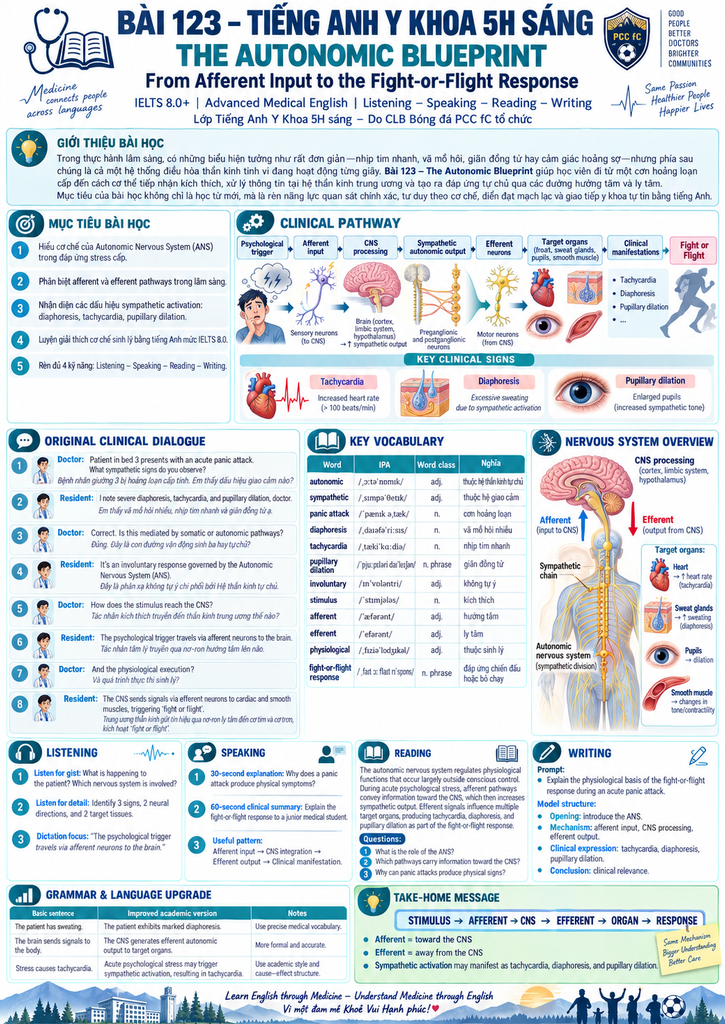
I. LESSON OVERVIEW – TỔNG QUAN BÀI HỌC
Trong thực hành lâm sàng, một biểu hiện đơn giản như nhịp tim nhanh, vã mồ hôi hay giãn đồng tử có thể phản ánh cả một chuỗi đáp ứng thần kinh – sinh lý phức tạp.
Bài học hôm nay sử dụng tình huống acute panic attack để luyện đồng thời ba năng lực:
- Hiểu cơ chế y khoa
- Diễn đạt cơ chế bằng tiếng Anh học thuật
- Giao tiếp lâm sàng rõ ràng, súc tích và logic
Central question
How does a psychological stimulus become a measurable physiological response?
Từ câu hỏi này, chúng ta sẽ đi theo chuỗi:
Stimulus → Afferent pathway → CNS processing → Efferent pathway → Target organ → Clinical manifestation
II. LEARNING OBJECTIVES – MỤC TIÊU HỌC TẬP
Sau bài học, học viên có thể:
Medical knowledge
- Nhận diện các biểu hiện của sympathetic activation.
- Phân biệt afferent và efferent pathways.
- Giải thích khái niệm involuntary autonomic response.
- Mô tả cơ chế fight-or-flight response.
Medical English
- Sử dụng chính xác các thuật ngữ:
diaphoresis, tachycardia, pupillary dilation, autonomic, sympathetic, afferent, efferent, trigger, mediate, physiological response. - Mô tả cơ chế theo trình tự nguyên nhân–kết quả.
- Sử dụng cấu trúc ngôn ngữ học thuật ở mức IELTS 8.0.
Communication
- Trình bày cơ chế sinh lý trong 30–60 giây.
- Tóm tắt ca bệnh bằng ngôn ngữ chuyên nghiệp.
- Thảo luận giữa bác sĩ chuyên khoa và bác sĩ nội trú.
IELTS skills
- Nghe lấy ý chính và chi tiết.
- Đọc hiểu cơ chế sinh lý.
- Nói mạch lạc, có tổ chức.
- Viết đoạn giải thích khoa học 150–180 từ.
III. 5-MINUTE CLINICAL WARM-UP
Clinical scenario
A patient suddenly develops:
- intense fear;
- tachycardia;
- marked sweating;
- dilated pupils;
- rapid breathing.
Ask yourself
1. Is this response voluntary or involuntary?
2. Which division of the nervous system is primarily involved?
3. How does information travel toward the brain?
4. How does the brain transmit a response back to target organs?
5. Why do several organs respond at approximately the same time?
Key concept
The clinical manifestations are not isolated events.
They form part of a coordinated autonomic response.
IV. ORIGINAL CLINICAL DIALOGUE
1. Doctor
Patient in bed 3 presents with an acute panic attack. What sympathetic signs do you observe?
Tiếng Việt
Bệnh nhân giường 3 bị hoảng loạn cấp tính. Em thấy dấu hiệu giao cảm nào?
Language focus
present with + symptom/sign
= đến khám hoặc biểu hiện với một vấn đề lâm sàng.
Ví dụ:
The patient presented with sudden-onset chest pain.
The patient presented with altered mental status.
2. Resident
I note severe diaphoresis, tachycardia, and pupillary dilation, doctor.
Tiếng Việt
Em thấy vã mồ hôi nhiều, nhịp tim nhanh và giãn đồng tử ạ.
Clinical pattern
Diaphoresis + Tachycardia + Pupillary dilation
→ suggest sympathetic activation
IELTS language point
Thay vì nói:
The patient has sweating.
Nên nói:
The patient exhibits marked diaphoresis.
Hoặc:
Marked diaphoresis is evident on examination.
3. Doctor
Correct. Is this mediated by somatic or autonomic pathways?
Tiếng Việt
Đúng. Đây là con đường vận động sinh ba hay tự chủ?
Key verb
mediate
= làm trung gian / chi phối / đóng vai trò trong cơ chế.
Ví dụ:
The response is mediated primarily by sympathetic autonomic pathways.
4. Resident
It’s an involuntary response governed by the Autonomic Nervous System (ANS).
Tiếng Việt
Đây là phản xạ không tự ý chi phối bởi Hệ thần kinh tự chủ.
High-level paraphrase
The response occurs largely outside conscious control and is regulated by the autonomic nervous system.
5. Doctor
How does the stimulus reach the CNS?
Tiếng Việt
Tác nhân kích thích truyền đến thần kinh trung ương thế nào?
Useful structure
How does X reach Y?
Có thể mở rộng trong thảo luận lâm sàng:
How does the toxin reach the CNS?
How does the signal reach the target tissue?
How does the pathogen enter the bloodstream?
6. Resident
The psychological trigger travels via afferent neurons to the brain.
Tiếng Việt
Tác nhân tâm lý truyền qua nơ-ron hướng tâm lên não.
Core concept
Afferent = toward the CNS
Một mẹo ghi nhớ:
AFFERENT = ARRIVES
Thông tin đi vào hệ thần kinh trung ương.
7. Doctor
And the physiological execution?
Tiếng Việt
Và quá trình thực thi sinh lý?
Meaning
Câu hỏi chuyển từ:
How is the stimulus received?
sang:
How is the response carried out?
8. Resident
The CNS sends signals via efferent neurons to cardiac and smooth muscles, triggering ‘fight or flight’.
Tiếng Việt
Trung ương thần kinh gửi tín hiệu qua nơ-ron ly tâm đến cơ tim và cơ trơn, kích hoạt ‘fight or flight’.
Core concept
Efferent = away from the CNS
Mẹo:
EFFERENT = EXITS
Tín hiệu đi ra khỏi CNS tới cơ quan đích.
V. THE COMPLETE PHYSIOLOGICAL CHAIN
Step 1 – Stimulus
Psychological trigger
Một yếu tố cảm xúc hoặc nhận thức được não bộ nhận diện như một mối đe dọa.
↓
Step 2 – Afferent input
Thông tin hướng tâm đi về hệ thần kinh trung ương.
Afferent pathways carry information toward the CNS.
↓
Step 3 – Central processing
Thông tin được xử lý tại não.
The CNS integrates the incoming information.
↓
Step 4 – Autonomic output
Hệ thần kinh tự chủ được hoạt hóa.
Sympathetic output increases.
↓
Step 5 – Efferent transmission
Tín hiệu đi từ CNS đến cơ quan đích.
Efferent autonomic neurons transmit the response.
↓
Step 6 – Target-organ effect
Tác động lên:
- heart;
- vascular smooth muscle;
- sweat glands;
- pupils;
- other autonomically regulated tissues.
↓
Step 7 – Clinical manifestations
Tachycardia
Diaphoresis
Pupillary dilation
↓
Step 8 – Integrated response
FIGHT OR FLIGHT
VI. CORE VOCABULARY – TỪ VỰNG CỐT LÕI
| Word / Phrase | IPA | Word class | Nghĩa |
|---|---|---|---|
| autonomic | /ˌɔːtəˈnɒmɪk/ | adj. | thuộc thần kinh tự chủ |
| sympathetic | /ˌsɪmpəˈθetɪk/ | adj. | thuộc hệ giao cảm |
| parasympathetic | /ˌpærəsɪmpəˈθetɪk/ | adj. | thuộc hệ phó giao cảm |
| panic attack | /ˈpænɪk əˌtæk/ | n. phrase | cơn hoảng loạn |
| diaphoresis | /ˌdaɪəfəˈriːsɪs/ | n. | vã mồ hôi nhiều |
| tachycardia | /ˌtækiˈkɑːdiə/ | n. | nhịp tim nhanh |
| pupil | /ˈpjuːpəl/ | n. | đồng tử |
| pupillary | /ˈpjuːpɪləri/ | adj. | thuộc đồng tử |
| dilation | /daɪˈleɪʃən/ | n. | sự giãn |
| involuntary | /ɪnˈvɒləntri/ | adj. | không tự ý |
| stimulus | /ˈstɪmjələs/ | n. | kích thích |
| stimuli | /ˈstɪmjəlaɪ/ | n. plural | các kích thích |
| afferent | /ˈæfərənt/ | adj. | hướng tâm |
| efferent | /ˈefərənt/ | adj. | ly tâm |
| neuron | /ˈnjʊərɒn/ | n. | nơ-ron |
| pathway | /ˈpɑːθweɪ/ | n. | đường dẫn truyền |
| physiological | /ˌfɪziəˈlɒdʒɪkəl/ | adj. | thuộc sinh lý |
| response | /rɪˈspɒns/ | n. | đáp ứng |
| mediate | /ˈmiːdieɪt/ | v. | làm trung gian |
| govern | /ˈɡʌvən/ | v. | điều hòa, chi phối |
| trigger | /ˈtrɪɡə(r)/ | n./v. | yếu tố kích hoạt / kích hoạt |
| cardiac | /ˈkɑːdiæk/ | adj. | thuộc tim |
| smooth muscle | /smuːð ˈmʌsəl/ | n. phrase | cơ trơn |
| fight-or-flight response | /ˌfaɪt ɔː ˈflaɪt rɪˌspɒns/ | n. phrase | đáp ứng chiến đấu hoặc bỏ chạy |
| conscious control | /ˈkɒnʃəs kənˈtrəʊl/ | n. phrase | kiểm soát có ý thức |
| activation | /ˌæktɪˈveɪʃən/ | n. | sự hoạt hóa |
| manifestation | /ˌmænɪfeˈsteɪʃən/ | n. | biểu hiện |
VII. WORD FAMILY – HỌC TỪ THEO HỌ
1. Activate
activate – verb
/kích hoạt/
activation – noun
/sự hoạt hóa/
activated – adjective
/được hoạt hóa/
Example:
Psychological stress activates sympathetic pathways.
Sympathetic activation may cause tachycardia.
2. Dilate
dilate – verb
dilation – noun
dilated – adjective
Example:
The pupils are dilated.
Pupillary dilation is present.
3. Physiology
physiology – noun
physiological – adjective
physiologically – adverb
Example:
This is a physiological response to acute stress.
VIII. COLLOCATIONS – CỤM TỪ IELTS 8.0
Học viên không nên học từ riêng lẻ mà nên học theo cụm.
acute panic attack
marked diaphoresis
sympathetic activation
autonomic pathway
afferent input
efferent output
central processing
physiological response
target organ
conscious control
autonomic regulation
pupillary dilation
cardiac acceleration
perceived threat
coordinated response
clinical manifestation
central nervous system
IX. PRONUNCIATION FOCUS
Các từ cần đặc biệt chú ý trọng âm:
sympaTHETic
autoNOMic
tachyCARdia
diaPHOResis
dilAtion
physioLOGical
maniFESTation
inVOLuntary
aFFERent
EFFERent
Important contrast
AFFERENT
/ˈæfərənt/
EFFERENT
/ˈefərənt/
Đây là cặp từ rất dễ nhầm cả khi nghe và khi nói.
X. LISTENING SKILL 1 – LISTEN FOR GIST
Nghe toàn bộ hội thoại mà không nhìn văn bản.
Chỉ trả lời ba câu hỏi:
1.
What is happening to the patient?
2.
Which nervous system is primarily involved?
3.
What is the overall physiological response being described?
Expected answers
- The patient is experiencing an acute panic attack.
- The autonomic nervous system, particularly sympathetic pathways, is involved.
- A fight-or-flight response is being activated.
XI. LISTENING SKILL 2 – LISTEN FOR DETAIL
Nghe lần hai và ghi lại:
Three signs
Two neural directions
- __________ neurons → CNS
- CNS → __________ neurons
Target tissues
- __________ muscle
- __________ muscle
Answers
- diaphoresis
- tachycardia
- pupillary dilation
- afferent
- efferent
- cardiac
- smooth
XII. LISTENING SKILL 3 – SIGNAL WORDS
Hãy chú ý các từ thể hiện quan hệ logic:
presents with
→ mô tả biểu hiện bệnh nhân
mediated by
→ cơ chế trung gian
governed by
→ hệ thống chi phối
via
→ đường truyền
triggering
→ kết quả tiếp theo
Đây là những từ giúp người nghe dự đoán cấu trúc thông tin.
XIII. LISTENING DICTATION
Nghe và viết chính xác:
The psychological trigger travels via afferent neurons to the brain.
Sau đó:
The CNS sends signals via efferent neurons to cardiac and smooth muscles, triggering fight or flight.
Challenge
Viết lại hai câu trên từ trí nhớ sau 60 giây.
XIV. SHADOWING PRACTICE
Level 1 – Chunking
Đọc theo từng nhóm nghĩa:
Patient in bed three / presents with / an acute panic attack.
What sympathetic signs / do you observe?
I note / severe diaphoresis / tachycardia / and pupillary dilation.
Level 2 – Natural rhythm
Không đọc từng từ.
Hãy nhấn các từ mang nội dung:
PATIENT – BED THREE – ACUTE PANIC ATTACK – SYMPATHETIC SIGNS
Level 3 – Clinical tone
Giọng bác sĩ:
- bình tĩnh;
- rõ;
- không quá nhanh;
- nhấn thuật ngữ chính;
- lên giọng nhẹ ở câu hỏi;
- xuống giọng ở kết luận.
XV. SPEAKING 1 – RAPID RESPONSE
Trả lời trong tối đa 10 giây.
Q1
What is diaphoresis?
Suggested answer
Diaphoresis refers to excessive or profuse sweating.
Q2
What does afferent mean?
Afferent pathways carry information toward the central nervous system.
Q3
What does efferent mean?
Efferent pathways transmit signals away from the CNS toward target organs.
Q4
What is an involuntary response?
It is a physiological response that occurs without conscious control.
XVI. SPEAKING 2 – 30-SECOND EXPLANATION
Question
Why does a panic attack produce physical symptoms?
Band 8 model answer
A panic attack can produce prominent physical symptoms because psychological stress activates autonomic pathways. Once the perceived threat is processed within the central nervous system, sympathetic output increases. Efferent autonomic signals are then transmitted to target organs, resulting in effects such as tachycardia, diaphoresis, and pupillary dilation. These manifestations form part of the body’s coordinated fight-or-flight response.
XVII. SPEAKING 3 – 60-SECOND CLINICAL PRESENTATION
Prompt
Explain the autonomic response in this patient to a junior medical student.
Suggested answer
This patient is experiencing an acute panic attack associated with marked sympathetic activation. Clinically, he demonstrates diaphoresis, tachycardia, and pupillary dilation. The initial psychological stimulus is processed by the central nervous system. Afferent pathways convey incoming information toward the CNS, where it is integrated. The CNS subsequently generates autonomic efferent output to target tissues, including cardiac and smooth muscle. This coordinated sympathetic response prepares the body to respond to a perceived threat and is commonly described as the fight-or-flight response.
XVIII. SPEAKING 4 – IELTS PART 3 STYLE
Question
Why is it important for clinicians to understand physiological mechanisms rather than simply memorising symptoms?
Band 8 approach
A strong answer should contain:
- clear position;
- explanation;
- clinical example;
- broader implication.
Model response
Understanding physiological mechanisms enables clinicians to connect apparently unrelated findings and interpret them as part of a single pathological or physiological process. For example, tachycardia, sweating, and pupillary dilation may initially appear to involve different organ systems, yet they can all result from sympathetic activation. Mechanistic understanding therefore improves clinical reasoning, reduces fragmented thinking, and allows findings to be interpreted within a coherent physiological framework.
XIX. READING PASSAGE
The Autonomic Nervous System and the Human Stress Response
The autonomic nervous system is responsible for regulating a wide range of physiological functions that occur largely outside conscious control. These include cardiac activity, vascular tone, glandular secretion, pupillary responses, and several aspects of smooth-muscle function. Its ability to coordinate multiple organ systems becomes particularly apparent during acute physical or psychological stress.
When an individual perceives a potential threat, relevant sensory and psychological information is conveyed toward the central nervous system through afferent pathways. The brain integrates this information and determines an appropriate response. If the situation is interpreted as threatening, sympathetic autonomic activity may increase substantially.
The resulting efferent signals influence multiple target organs. Cardiac activity accelerates, sweat production increases, and the pupils may dilate. Collectively, these changes prepare the organism for rapid action and constitute part of what is commonly referred to as the fight-or-flight response.
Importantly, such physiological changes are not exclusively associated with genuine physical danger. They may also occur when the threat is psychological, as in a panic attack. Consequently, clinicians must interpret autonomic signs within the broader clinical context rather than assuming that any individual manifestation has a single cause.
Understanding the distinction between afferent input, central processing, and efferent output is therefore fundamental to interpreting autonomic physiology. It transforms a list of apparently separate symptoms into a coherent sequence of events and provides a framework for clinical reasoning.
XX. READING COMPREHENSION
Question 1
What is the primary purpose of paragraph 1?
A. To describe panic disorder
B. To introduce the regulatory functions of the ANS
C. To compare cardiac and smooth muscle
D. To discuss psychiatric treatment
Answer: B
Question 2
According to the passage, afferent pathways:
A. carry signals from the CNS to muscles
B. transmit information toward the CNS
C. directly produce tachycardia
D. inhibit sympathetic activity
Answer: B
Question 3
What does “The resulting efferent signals” refer to?
Answer:
Signals generated following central processing and transmitted from the CNS toward target organs.
Question 4
Why does the author mention panic attacks?
Answer:
To demonstrate that a fight-or-flight type autonomic response may be triggered by psychological as well as physical threats.
Question 5
What is the main argument of the final paragraph?
Answer:
Understanding the sequence from afferent input to central processing and efferent output helps clinicians integrate multiple symptoms into a coherent physiological mechanism.
XXI. IELTS READING – TRUE / FALSE / NOT GIVEN
1.
The autonomic nervous system controls only cardiac function.
FALSE
2.
Sympathetic activation may affect several organs simultaneously.
TRUE
3.
All patients experiencing sympathetic activation have a psychiatric disorder.
FALSE
4.
The passage states that panic attacks always require medication.
NOT GIVEN
5.
Understanding neural pathways may improve clinical reasoning.
TRUE
XXII. SYNONYM & PARAPHRASE TRAINING
IELTS Reading thường không lặp lại nguyên từ trong câu hỏi.
Original
outside conscious control
Paraphrase
involuntary
Original
perceived threat
Paraphrase
a situation interpreted as dangerous
Original
increase substantially
Paraphrase
become markedly elevated
Original
multiple target organs
Paraphrase
several effector tissues
Original
occur
Academic alternatives
- arise
- develop
- emerge
- manifest
- take place
XXIII. GRAMMAR FOCUS 1 – PASSIVE VOICE
Medical English sử dụng bị động rất thường xuyên.
Active
The CNS sends signals to target organs.
Passive
Signals are transmitted from the CNS to target organs.
Active
Sympathetic activation causes tachycardia.
Passive
Tachycardia may be induced by sympathetic activation.
XXIV. GRAMMAR FOCUS 2 – CAUSE AND EFFECT
Basic
Stress causes tachycardia.
IELTS 7
Stress can result in tachycardia.
IELTS 8
Acute psychological stress may trigger sympathetic activation, subsequently resulting in tachycardia.
Higher-level pattern
A → activates B → which subsequently leads to C
Example:
A perceived threat activates sympathetic pathways, which subsequently lead to multiple cardiovascular and autonomic responses.
XXV. GRAMMAR FOCUS 3 – HEDGING
Y khoa cần tránh khẳng định tuyệt đối.
Không nên:
Panic attacks cause tachycardia in every patient.
Nên:
Panic attacks may be associated with tachycardia.
Hoặc:
Sympathetic activation can contribute to tachycardia during an acute panic attack.
Useful words:
- may
- can
- tends to
- is likely to
- may contribute to
- is associated with
- appears to
XXVI. ACADEMIC LANGUAGE UPGRADE
Basic → IELTS 8.0
The brain gets information.
→
The central nervous system receives and integrates afferent input.
The brain sends a signal out.
→
The CNS subsequently generates efferent autonomic output.
The heart beats faster.
→
Sympathetic activation increases cardiac activity.
The patient sweats a lot.
→
The patient develops marked diaphoresis.
The pupils become bigger.
→
Pupillary dilation occurs.
XXVII. WRITING TASK 1 – SENTENCE TRANSFORMATION
Viết lại câu ở mức học thuật hơn.
1.
The patient was scared, so his heart beat faster.
Suggested answer
Acute psychological stress was associated with sympathetic activation and subsequent tachycardia.
2.
The brain sends signals to the body.
Suggested answer
The central nervous system transmits efferent autonomic signals to peripheral target organs.
3.
The patient sweats and his pupils become larger.
Suggested answer
The patient develops diaphoresis accompanied by pupillary dilation.
XXVIII. WRITING TASK 2 – 150–180 WORDS
Topic
Explain how an acute psychological stimulus can produce systemic physiological manifestations.
Recommended structure
Paragraph opening
Define the overall process.
Mechanism 1
Describe afferent input.
Mechanism 2
Describe CNS processing.
Mechanism 3
Describe efferent autonomic output.
Clinical expression
Connect mechanism to symptoms.
Conclusion
Explain clinical relevance.
XXIX. IELTS 8.0 MODEL WRITING
An acute psychological stimulus can generate widespread physiological manifestations through activation of the autonomic nervous system. Initially, information relating to a perceived threat is conveyed toward the central nervous system through afferent neural pathways. Following central processing and integration, the brain may increase sympathetic autonomic output. Efferent signals are subsequently transmitted to peripheral target organs, including the heart, smooth muscle, sweat glands, and pupils.
As sympathetic activity increases, cardiac function may accelerate, leading clinically to tachycardia. Sweat production may become more pronounced, producing diaphoresis, while pupillary dilation may also occur. These changes do not represent unrelated abnormalities; rather, they constitute components of a coordinated physiological response designed to prepare the body for immediate action.
This integrated reaction is commonly referred to as the fight-or-flight response. Understanding its underlying neural pathways allows clinicians to interpret apparently diverse physical findings within a unified physiological framework rather than considering each manifestation in isolation.
XXX. WHY THIS IS IELTS 8.0
Đoạn trên đạt mức cao vì có:
Lexical resource
- physiological manifestations
- perceived threat
- neural pathways
- central processing
- peripheral target organs
- coordinated physiological response
- unified framework
Grammar
Có kết hợp:
- simple sentences;
- complex sentences;
- passive voice;
- subordinate clauses;
- participial structures.
Cohesion
Dùng:
Initially
Following…
Subsequently
As…
Rather…
This…
XXXI. CLINICAL REASONING CHALLENGE
Một bệnh nhân có:
- HR 130 bpm;
- diaphoresis;
- dilated pupils;
- severe anxiety.
Question
Can these three physical findings alone establish a diagnosis of panic attack?
Suggested reasoning answer
No. Although tachycardia, diaphoresis, and pupillary dilation are compatible with sympathetic activation, they are not specific to a panic attack. They should be interpreted within the overall clinical context.
Communication lesson
IELTS 8.0 medical English cần phân biệt:
compatible with
không đồng nghĩa với
diagnostic of
XXXII. ADVANCED CLINICAL LANGUAGE
compatible with
phù hợp với
suggestive of
gợi ý
consistent with
phù hợp với
associated with
liên quan đến
may indicate
có thể chỉ ra
raises the possibility of
đặt ra khả năng
does not necessarily imply
không nhất thiết đồng nghĩa với
XXXIII. DOCTOR–RESIDENT EXTENSION
Sau 8 câu gốc, có thể luyện mở rộng:
Doctor:
Why should these manifestations be interpreted as a coordinated response rather than as isolated abnormalities?
Resident:
Because sympathetic activation can simultaneously influence multiple target organs, producing cardiovascular, glandular, and pupillary changes through a common autonomic mechanism.
Doctor:
Would these findings be specific for a panic attack?
Resident:
No. They indicate autonomic activation but must be interpreted alongside the history, examination, and broader clinical context.
XXXIV. ONE-MINUTE CLINICAL CHALLENGE
Không nhìn bài, hãy nói liên tục trong 60 giây sử dụng ít nhất 10 từ:
panic attack
psychological trigger
afferent
CNS
integrate
autonomic
sympathetic
efferent
target organ
tachycardia
diaphoresis
pupillary dilation
fight or flight
XXXV. TWO-MINUTE IELTS 8.0 CHALLENGE
Question
Describe how the nervous system converts a psychological stimulus into a physical response.
Structure
Opening
State the general mechanism.
Stage 1
Afferent input.
Stage 2
Central processing.
Stage 3
Efferent output.
Stage 4
Target-organ effects.
Conclusion
Clinical relevance.
XXXVI. ERROR CORRECTION
Tìm lỗi:
1.
Afferent neurons send signals away from the CNS.
❌
Correct:
Afferent pathways carry information toward the CNS.
2.
The patient has a tachycardia.
Không tự nhiên trong phần lớn ngữ cảnh.
Tốt hơn:
The patient has tachycardia.
Hoặc:
The patient is tachycardic.
3.
His pupils are dilation.
❌
Correct:
His pupils are dilated.
Hoặc:
He has pupillary dilation.
4.
The autonomic nervous system is voluntary.
❌
Correct:
Autonomic responses are largely involuntary.
XXXVII. MINI VOCABULARY QUIZ
Điền từ:
1.
Excessive sweating is called ________.
2.
A heart rate above the normal range is called ________.
3.
Neural pathways carrying information toward the CNS are ________ pathways.
4.
Neural pathways transmitting output from the CNS are ________ pathways.
5.
A response occurring without conscious control is described as ________.
Answers
- diaphoresis
- tachycardia
- afferent
- efferent
- involuntary
XXXVIII. RAPID CLINICAL TRANSLATION
Dịch ngay trong 5–10 giây:
1.
Bệnh nhân có vã mồ hôi rõ.
The patient has marked diaphoresis.
2.
Các đồng tử giãn.
The pupils are dilated.
3.
Thông tin đi về hệ thần kinh trung ương.
The information is transmitted toward the central nervous system.
4.
Đáp ứng này được trung gian bởi hệ thần kinh tự chủ.
This response is mediated by the autonomic nervous system.
5.
Hoạt hóa giao cảm gây ra nhiều biểu hiện sinh lý.
Sympathetic activation produces multiple physiological manifestations.
XXXIX. 5H MEMORY FRAMEWORK
Chỉ cần nhớ sáu chữ:
S – A – C – E – O – R
S – Stimulus
A – Afferent
C – CNS
E – Efferent
O – Organ
R – Response
XL. THE ENTIRE LESSON IN ONE SENTENCE
A psychological stimulus generates afferent input to the CNS, which integrates the information and produces autonomic efferent output to target organs, resulting in coordinated manifestations such as tachycardia, diaphoresis, and pupillary dilation as part of the fight-or-flight response.
Nếu có thể nói trôi chảy câu này, học viên đã nắm được cả:
Vocabulary + Grammar + Physiology + Clinical English.
XLI. END-OF-LESSON SELF-CHECK
Sau buổi học, hãy tự hỏi:
Listening
Tôi có nghe được:
afferent – efferent – diaphoresis – pupillary dilation không?
Speaking
Tôi có giải thích được cơ chế trong 60 giây không?
Reading
Tôi có xác định được:
stimulus → mechanism → response không?
Writing
Tôi có viết được một đoạn 150 từ mà không lặp từ quá nhiều không?
Clinical reasoning
Tôi có phân biệt được:
sympathetic activation với một specific diagnosis không?
Nếu trả lời được 4/5 câu:
Excellent progress.
Nếu 2–3/5:
Review once more tomorrow.
XLII. 20–25 MINUTE 5H CLASS PLAN
05:00–05:03
Clinical warm-up
05:03–05:07
Original dialogue + pronunciation
05:07–05:11
Vocabulary + afferent/efferent concept
05:11–05:15
Listening + shadowing
05:15–05:19
Reading + comprehension
05:19–05:22
60-second speaking challenge
05:22–05:25
Writing + take-home message
XLIII. TAKE-HOME MESSAGE
Physiological pathway
STIMULUS
↓
AFFERENT INPUT
↓
CNS INTEGRATION
↓
AUTONOMIC ACTIVATION
↓
EFFERENT OUTPUT
↓
TARGET ORGAN
↓
CLINICAL RESPONSE
Three clinical manifestations
DIAPHORESIS
TACHYCARDIA
PUPILLARY DILATION
Two words that must never be confused
AFFERENT → ARRIVES at the CNS
EFFERENT → EXITS the CNS
XLIV. MESSAGE OF THE DAY
Medical English is not simply about learning more difficult words.
It is about learning to:
observe accurately,
think logically,
explain mechanisms clearly,
and communicate medicine confidently.
Mỗi buổi sáng 5H không cần học quá nhiều.
Chỉ cần:
một cơ chế hiểu sâu hơn,
một thuật ngữ dùng chính xác hơn,
một câu nói tự nhiên hơn,
và một ngày không bỏ cuộc.
Learn English through Medicine.
Understand Medicine through English.
LỚP TIẾNG ANH Y KHOA 5H SÁNG
CLB BÓNG ĐÁ PCC fC
Vì một đam mê Khoẻ Vui Hạnh phúc!
HỌC TIẾNG TRUNG TINH TẾ
10 từ mới – 10 câu ứng dụng – 3 điểm ngữ pháp
Chủ đề: Hệ thần kinh tự chủ và phản ứng “chiến đấu hay bỏ chạy”
Chương trình Học tiếng Trung tinh tế – CLB Bóng đá PCC fC
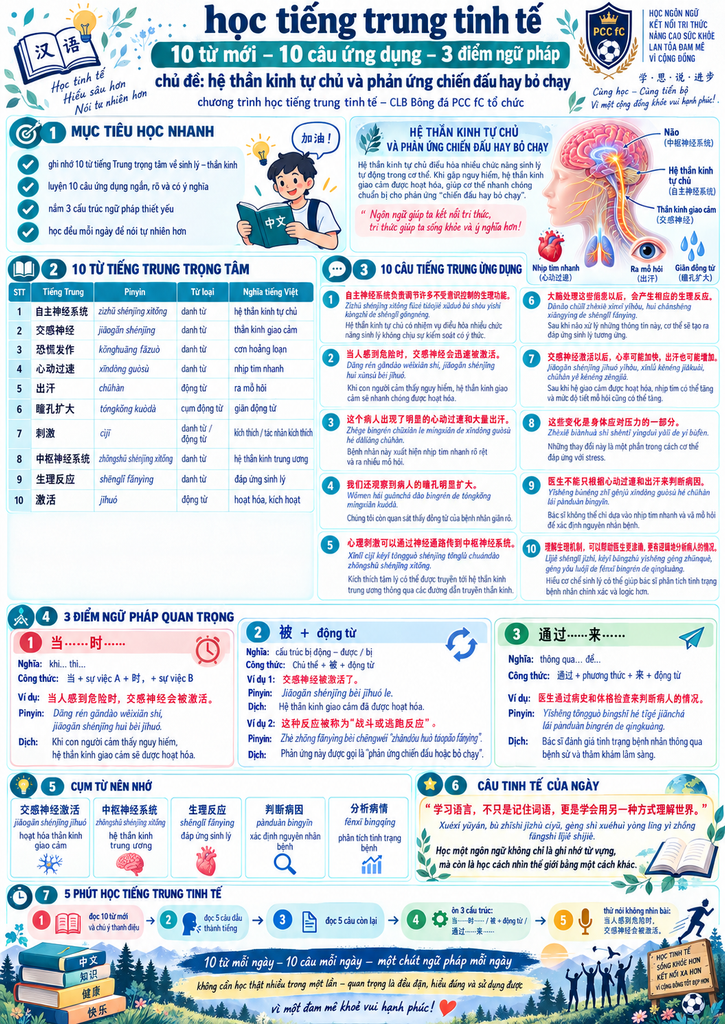
I. 10 TỪ TIẾNG TRUNG TRỌNG TÂM
| STT | Tiếng Trung | Pinyin | Từ loại | Nghĩa tiếng Việt |
|---|---|---|---|---|
| 1 | 自主神经系统 | zìzhǔ shénjīng xìtǒng | danh từ | hệ thần kinh tự chủ |
| 2 | 交感神经 | jiāogǎn shénjīng | danh từ | thần kinh giao cảm |
| 3 | 恐慌发作 | kǒnghuāng fāzuò | danh từ | cơn hoảng loạn |
| 4 | 心动过速 | xīndòng guòsù | danh từ | nhịp tim nhanh |
| 5 | 出汗 | chūhàn | động từ | ra mồ hôi |
| 6 | 瞳孔扩大 | tóngkǒng kuòdà | cụm động từ | giãn đồng tử |
| 7 | 刺激 | cìjī | danh từ / động từ | kích thích / tác nhân kích thích |
| 8 | 中枢神经系统 | zhōngshū shénjīng xìtǒng | danh từ | hệ thần kinh trung ương |
| 9 | 生理反应 | shēnglǐ fǎnyìng | danh từ | đáp ứng sinh lý |
| 10 | 激活 | jīhuó | động từ | hoạt hóa, kích hoạt |
II. 10 CÂU TIẾNG TRUNG ỨNG DỤNG
1.
自主神经系统负责调节许多不受意识控制的生理功能。
Zìzhǔ shénjīng xìtǒng fùzé tiáojié xǔduō bú shòu yìshí kòngzhì de shēnglǐ gōngnéng.
Hệ thần kinh tự chủ có nhiệm vụ điều hòa nhiều chức năng sinh lý không chịu sự kiểm soát có ý thức.
2.
当人感到危险时,交感神经会迅速被激活。
Dāng rén gǎndào wēixiǎn shí, jiāogǎn shénjīng huì xùnsù bèi jīhuó.
Khi con người cảm thấy nguy hiểm, hệ thần kinh giao cảm sẽ nhanh chóng được hoạt hóa.
3.
这个病人出现了明显的心动过速和大量出汗。
Zhège bìngrén chūxiàn le míngxiǎn de xīndòng guòsù hé dàliàng chūhàn.
Bệnh nhân này xuất hiện nhịp tim nhanh rõ rệt và ra nhiều mồ hôi.
4.
我们还观察到病人的瞳孔明显扩大。
Wǒmen hái guānchá dào bìngrén de tóngkǒng míngxiǎn kuòdà.
Chúng tôi còn quan sát thấy đồng tử của bệnh nhân giãn rõ.
5.
心理刺激可以通过神经通路传到中枢神经系统。
Xīnlǐ cìjī kěyǐ tōngguò shénjīng tōnglù chuándào zhōngshū shénjīng xìtǒng.
Kích thích tâm lý có thể được truyền tới hệ thần kinh trung ương thông qua các đường dẫn truyền thần kinh.
6.
大脑处理这些信息以后,会产生相应的生理反应。
Dànǎo chǔlǐ zhèxiē xìnxī yǐhòu, huì chǎnshēng xiāngyìng de shēnglǐ fǎnyìng.
Sau khi não xử lý những thông tin này, cơ thể sẽ tạo ra đáp ứng sinh lý tương ứng.
7.
交感神经激活以后,心率可能加快,出汗也可能增加。
Jiāogǎn shénjīng jīhuó yǐhòu, xīnlǜ kěnéng jiākuài, chūhàn yě kěnéng zēngjiā.
Sau khi hệ giao cảm được hoạt hóa, nhịp tim có thể tăng và mức độ tiết mồ hôi cũng có thể tăng.
8.
这些变化是身体应对压力的一部分。
Zhèxiē biànhuà shì shēntǐ yìngduì yālì de yí bùfen.
Những thay đổi này là một phần trong cách cơ thể đáp ứng với stress.
9.
医生不能只根据心动过速和出汗来判断病因。
Yīshēng bùnéng zhǐ gēnjù xīndòng guòsù hé chūhàn lái pànduàn bìngyīn.
Bác sĩ không thể chỉ dựa vào nhịp tim nhanh và vã mồ hôi để xác định nguyên nhân bệnh.
10.
理解生理机制,可以帮助医生更准确、更有逻辑地分析病人的情况。
Lǐjiě shēnglǐ jīzhì, kěyǐ bāngzhù yīshēng gèng zhǔnquè, gèng yǒu luójí de fēnxī bìngrén de qíngkuàng.
Hiểu cơ chế sinh lý có thể giúp bác sĩ phân tích tình trạng bệnh nhân chính xác và logic hơn.
III. 3 ĐIỂM NGỮ PHÁP QUAN TRỌNG
1. 当……时……
Dāng… shí…
Khi… thì…
Cấu trúc dùng để diễn tả một tình huống hoặc thời điểm mà một sự việc khác xảy ra.
Công thức
当 + sự việc A + 时,+ sự việc B
Ví dụ
当人感到危险时,交感神经会被激活。
Dāng rén gǎndào wēixiǎn shí, jiāogǎn shénjīng huì bèi jīhuó.
Khi con người cảm thấy nguy hiểm, hệ thần kinh giao cảm sẽ được hoạt hóa.
Ứng dụng khác
当病人出现呼吸困难时,我们需要立即评估。
Dāng bìngrén chūxiàn hūxī kùnnan shí, wǒmen xūyào lìjí pínggū.
Khi bệnh nhân xuất hiện khó thở, chúng ta cần đánh giá ngay.
2. 被 + động từ
Bèi + verb
Cấu trúc bị động
被 được dùng khi chủ thể nhận tác động từ một hành động.
Công thức
Chủ thể + 被 + động từ
Ví dụ
交感神经被激活了。
Jiāogǎn shénjīng bèi jīhuó le.
Hệ thần kinh giao cảm đã được hoạt hóa.
Ví dụ y khoa
这种反应被称为“战斗或逃跑反应”。
Zhè zhǒng fǎnyìng bèi chēngwéi “zhàndòu huò táopǎo fǎnyìng”.
Phản ứng này được gọi là “phản ứng chiến đấu hoặc bỏ chạy”.
Ghi nhớ
被 = được / bị
Trong ngôn ngữ y khoa, cấu trúc bị động được dùng rất nhiều khi mô tả:
- cơ chế;
- quá trình;
- chẩn đoán;
- điều trị;
- tác động của thuốc hoặc bệnh lý.
3. 通过……来……
Tōngguò… lái…
Thông qua… để…
Cấu trúc này dùng để mô tả phương thức hoặc cơ chế thực hiện một hành động.
Công thức
通过 + phương thức + 来 + động từ
Ví dụ
心理刺激可以通过神经通路来传到中枢神经系统。
Xīnlǐ cìjī kěyǐ tōngguò shénjīng tōnglù lái chuándào zhōngshū shénjīng xìtǒng.
Kích thích tâm lý có thể được truyền tới hệ thần kinh trung ương thông qua các đường dẫn truyền thần kinh.
Ví dụ khác
医生通过病史和体格检查来判断病人的情况。
Yīshēng tōngguò bìngshǐ hé tǐgé jiǎnchá lái pànduàn bìngrén de qíngkuàng.
Bác sĩ đánh giá tình trạng bệnh nhân thông qua bệnh sử và thăm khám lâm sàng.
IV. CỤM TỪ NÊN NHỚ
交感神经激活
jiāogǎn shénjīng jīhuó
→ hoạt hóa thần kinh giao cảm
中枢神经系统
zhōngshū shénjīng xìtǒng
→ hệ thần kinh trung ương
生理反应
shēnglǐ fǎnyìng
→ đáp ứng sinh lý
判断病因
pànduàn bìngyīn
→ xác định / đánh giá nguyên nhân bệnh
分析病情
fēnxī bìngqíng
→ phân tích tình trạng bệnh
V. CÂU TINH TẾ CỦA NGÀY
学习语言,不只是记住词语,更是学会用另一种方式理解世界。
Xuéxí yǔyán, bù zhǐshì jìzhù cíyǔ, gèng shì xuéhuì yòng lìng yì zhǒng fāngshì lǐjiě shìjiè.
Học một ngôn ngữ không chỉ là ghi nhớ từ vựng, mà còn là học cách nhìn thế giới bằng một cách khác.
VI. 5 PHÚT HỌC TIẾNG TRUNG TINH TẾ
Phút 1
Đọc 10 từ mới và chú ý thanh điệu.
Phút 2
Đọc 5 câu đầu thành tiếng.
Phút 3
Đọc 5 câu còn lại.
Phút 4
Ôn 3 cấu trúc:
当……时……
被 + động từ
通过……来……
Phút 5
Không nhìn bài và thử nói:
当人感到危险时,交感神经会被激活。
HỌC TIẾNG TRUNG TINH TẾ
Do CLB Bóng đá PCC fC tổ chức
10 từ mỗi ngày – 10 câu mỗi ngày – một chút ngữ pháp mỗi ngày.
Không cần học thật nhiều trong một lần.
Quan trọng là đều đặn, hiểu đúng và sử dụng được.
Vì một đam mê Khoẻ Vui Hạnh phúc!

HỌC TIẾNG NHẬT THỰC HÀNH
10 từ mới – 10 câu ứng dụng – 3 điểm ngữ pháp
Chủ đề: Hệ thần kinh tự chủ và phản ứng “chiến đấu hay bỏ chạy”
Chương trình Học tiếng Nhật thực hành – CLB Bóng đá PCC fC
I. 10 TỪ TIẾNG NHẬT TRỌNG TÂM
| STT | Tiếng Nhật | Hiragana | Romaji | Từ loại | Hán Việt | Nghĩa |
|---|---|---|---|---|---|---|
| 1 | 自律神経系 | じりつしんけいけい | jiritsu shinkeikei | danh từ | tự luật thần kinh hệ | hệ thần kinh tự chủ |
| 2 | 交感神経 | こうかんしんけい | kōkan shinkei | danh từ | giao cảm thần kinh | thần kinh giao cảm |
| 3 | パニック発作 | パニックほっさ | panikku hossa | danh từ | phát tác | cơn hoảng loạn |
| 4 | 頻脈 | ひんみゃく | hinmyaku | danh từ | tần mạch | nhịp tim nhanh |
| 5 | 発汗 | はっかん | hakkan | danh từ / する | phát hãn | tiết mồ hôi, vã mồ hôi |
| 6 | 瞳孔散大 | どうこうさんだい | dōkō sandai | danh từ | đồng khổng tán đại | giãn đồng tử |
| 7 | 刺激 | しげき | shigeki | danh từ / する | thích kích | kích thích |
| 8 | 中枢神経系 | ちゅうすうしんけいけい | chūsū shinkeikei | danh từ | trung xu thần kinh hệ | hệ thần kinh trung ương |
| 9 | 生理反応 | せいりはんのう | seiri hannō | danh từ | sinh lý phản ứng | đáp ứng sinh lý |
| 10 | 活性化 | かっせいか | kasseika | danh từ / する | hoạt tính hóa | hoạt hóa |
Ghi nhớ nhanh
自律(じりつ) – jiritsu → tự chủ
神経(しんけい) – shinkei → thần kinh
中枢(ちゅうすう) – chūsū → trung khu
生理(せいり) – seiri → sinh lý
反応(はんのう) – hannō → phản ứng
II. 10 CÂU TIẾNG NHẬT ỨNG DỤNG
1.
自律神経系は、意識しなくても働く多くの生理機能を調節しています。
じりつしんけいけいは、いしきしなくてもはたらくおおくのせいりきのうをちょうせつしています。
Jiritsu shinkeikei wa, ishiki shinakute mo hataraku ōku no seiri kinō o chōsetsu shiteimasu.
Hệ thần kinh tự chủ điều hòa nhiều chức năng sinh lý hoạt động mà không cần sự kiểm soát có ý thức.
2.
人が危険を感じると、交感神経が急速に活性化されます。
ひとがきけんをかんじると、こうかんしんけいがきゅうそくにかっせいかされます。
Hito ga kiken o kanjiru to, kōkan shinkei ga kyūsoku ni kasseika saremasu.
Khi con người cảm thấy nguy hiểm, hệ thần kinh giao cảm nhanh chóng được hoạt hóa.
3.
この患者には、著明な頻脈と発汗がみられます。
このかんじゃには、ちょめいなひんみゃくとはっかんがみられます。
Kono kanja ni wa, chomei na hinmyaku to hakkan ga miraremasu.
Ở bệnh nhân này, ghi nhận nhịp tim nhanh rõ và vã mồ hôi.
4.
さらに、瞳孔散大も認められます。
さらに、どうこうさんだいもみとめられます。
Sara ni, dōkō sandai mo mitomeraremasu.
Ngoài ra, tình trạng giãn đồng tử cũng được ghi nhận.
5.
心理的な刺激は、神経経路を通って中枢神経系に伝わります。
しんりてきなしげきは、しんけいけいろをとおってちゅうすうしんけいけいにつたわります。
Shinriteki na shigeki wa, shinkei keiro o tōtte chūsū shinkeikei ni tsutawarimasu.
Kích thích tâm lý được truyền tới hệ thần kinh trung ương thông qua các đường dẫn truyền thần kinh.
6.
脳が情報を処理した後、それに応じた生理反応が起こります。
のうがじょうほうをしょりしたあと、それにおうじたせいりはんのうがおこります。
Nō ga jōhō o shori shita ato, sore ni ōjita seiri hannō ga okorimasu.
Sau khi não xử lý thông tin, đáp ứng sinh lý tương ứng sẽ xảy ra.
7.
交感神経が活性化すると、心拍数が増加し、発汗も増えることがあります。
こうかんしんけいがかっせいかすると、しんぱくすうがぞうかし、はっかんもふえることがあります。
Kōkan shinkei ga kasseika suru to, shinpaku-sū ga zōka shi, hakkan mo fueru koto ga arimasu.
Khi hệ giao cảm được hoạt hóa, nhịp tim có thể tăng và mức độ tiết mồ hôi cũng có thể tăng.
8.
これらの変化は、身体がストレスに対応するための反応の一部です。
これらのへんかは、からだがストレスにたいおうするためのはんのうのいちぶです。
Korera no henka wa, karada ga sutoresu ni taiō suru tame no hannō no ichibu desu.
Những thay đổi này là một phần của đáp ứng giúp cơ thể thích nghi với stress.
9.
医師は、頻脈や発汗だけで原因を判断してはいけません。
いしは、ひんみゃくやはっかんだけでげんいんをはんだんしてはいけません。
Ishi wa, hinmyaku ya hakkan dake de gen’in o handan shite wa ikemasen.
Bác sĩ không nên chỉ dựa vào nhịp tim nhanh và vã mồ hôi để xác định nguyên nhân.
10.
生理学的な仕組みを理解することは、患者の状態をより正確かつ論理的に評価する助けになります。
せいりがくてきなしくみをりかいすることは、かんじゃのじょうたいをよりせいかくかつろんりてきにひょうかするたすけになります。
Seirigakuteki na shikumi o rikai suru koto wa, kanja no jōtai o yori seikaku katsu ronriteki ni hyōka suru tasuke ni narimasu.
Hiểu cơ chế sinh lý giúp bác sĩ đánh giá tình trạng bệnh nhân chính xác và logic hơn.
III. 3 ĐIỂM NGỮ PHÁP QUAN TRỌNG
1. ~と
“Khi… thì…” / “Hễ… thì…”
Dùng để diễn tả một kết quả xảy ra tự nhiên, có tính quy luật hoặc cơ chế.
Công thức
Động từ thể từ điển + と + kết quả
Ví dụ
交感神経が活性化すると、心拍数が増加します。
こうかんしんけいがかっせいかすると、しんぱくすうがぞうかします。
Kōkan shinkei ga kasseika suru to, shinpaku-sū ga zōka shimasu.
Khi hệ giao cảm được hoạt hóa, nhịp tim tăng.
Ứng dụng
Đây là cấu trúc rất phù hợp khi trình bày:
nguyên nhân → cơ chế → kết quả sinh lý
2. ~られる / ~される
Thể bị động: “được / bị”
Tiếng Nhật y khoa thường dùng thể bị động để trình bày khách quan.
Ví dụ 1
交感神経が活性化されます。
こうかんしんけいがかっせいかされます。
Kōkan shinkei ga kasseika saremasu.
Hệ thần kinh giao cảm được hoạt hóa.
Ví dụ 2
瞳孔散大が認められます。
どうこうさんだいがみとめられます。
Dōkō sandai ga mitomeraremasu.
Ghi nhận tình trạng giãn đồng tử.
Hai mẫu câu y khoa rất hữu ích
~がみられます
→ quan sát thấy / thấy có…
~が認められます
→ ghi nhận thấy…
3. ~ために / ~ための
“Để…” / “nhằm…” / “dùng cho…”
Dùng để thể hiện mục đích.
Công thức 1
Động từ thể từ điển + ために + hành động
Ví dụ
身体は危険に対応するために、交感神経を活性化します。
からだはきけんにたいおうするために、こうかんしんけいをかっせいかします。
Karada wa kiken ni taiō suru tame ni, kōkan shinkei o kasseika shimasu.
Cơ thể hoạt hóa hệ giao cảm để ứng phó với nguy hiểm.
Công thức 2
Động từ thể từ điển + ための + danh từ
Ví dụ
ストレスに対応するための反応
ストレスにたいおうするためのはんのう
Sutoresu ni taiō suru tame no hannō
Đáp ứng nhằm thích nghi với stress.
IV. 5 CỤM TỪ Y KHOA NÊN THUỘC
交感神経の活性化
こうかんしんけいのかっせいか
kōkan shinkei no kasseika
→ hoạt hóa thần kinh giao cảm
中枢神経系
ちゅうすうしんけいけい
chūsū shinkeikei
→ hệ thần kinh trung ương
生理反応
せいりはんのう
seiri hannō
→ đáp ứng sinh lý
原因を判断する
げんいんをはんだんする
gen’in o handan suru
→ đánh giá nguyên nhân
患者の状態を評価する
かんじゃのじょうたいをひょうかする
kanja no jōtai o hyōka suru
→ đánh giá tình trạng bệnh nhân
V. 3 MẪU CÂU LÂM SÀNG THỰC HÀNH
1. ~がみられます
… ga miraremasu
→ Quan sát thấy…
頻脈がみられます。
ひんみゃくがみられます。
Hinmyaku ga miraremasu.
Có nhịp tim nhanh.
2. ~が認められます
… ga mitomeraremasu
→ Ghi nhận thấy…
発汗が認められます。
はっかんがみとめられます。
Hakkan ga mitomeraremasu.
Ghi nhận tình trạng vã mồ hôi.
3. ~可能性があります
… kanōsei ga arimasu
→ Có khả năng…
交感神経が活性化している可能性があります。
こうかんしんけいがかっせいかしているかのうせいがあります。
Kōkan shinkei ga kasseika shite iru kanōsei ga arimasu.
Có khả năng hệ thần kinh giao cảm đang được hoạt hóa.
VI. CÂU THỰC HÀNH CỦA NGÀY
症状を見るだけでなく、その背景にある仕組みを理解することが大切です。
しょうじょうをみるだけでなく、そのはいけいにあるしくみをりかいすることがたいせつです。
Shōjō o miru dake de naku, sono haikei ni aru shikumi o rikai suru koto ga taisetsu desu.
Điều quan trọng không chỉ là nhìn vào triệu chứng, mà còn phải hiểu cơ chế nằm phía sau triệu chứng đó.
VII. CÂU TRUYỀN CẢM HỨNG
言葉を学ぶことは、新しい世界の見方を学ぶことです。
ことばをまなぶことは、あたらしいせかいのみかたをまなぶことです。
Kotoba o manabu koto wa, atarashii sekai no mikata o manabu koto desu.
Học một ngôn ngữ là học thêm một cách mới để nhìn thế giới.
VIII. 5 PHÚT HỌC TIẾNG NHẬT THỰC HÀNH
Phút 1: Đọc 10 từ mới: Kanji → Hiragana → Romaji → nghĩa.
Phút 2: Đọc thành tiếng câu 1–5.
Phút 3: Đọc câu 6–10 và che phần tiếng Việt.
Phút 4: Ôn ba cấu trúc:
~と
~られる / ~される
~ために / ~ための
Phút 5: Không nhìn tài liệu và nói:
人が危険を感じると、交感神経が急速に活性化されます。
ひとがきけんをかんじると、こうかんしんけいがきゅうそくにかっせいかされます。
Hito ga kiken o kanjiru to, kōkan shinkei ga kyūsoku ni kasseika saremasu.
HỌC TIẾNG NHẬT THỰC HÀNH
Do CLB Bóng đá PCC fC tổ chức
10 từ – 10 câu – 3 điểm ngữ pháp mỗi bài.
Học để hiểu – học để nói – học để sử dụng.