Bài 153 – Tiếng Anh Y Khoa: Tuyến tiêu hoá phụ: Gan, Túi mật, Tuỵ * Accessory Digestive Organs: The Liver, Gallbladder, and Pancreas
PCC Language – Thăng Long, ngày 4/11/2026, Trong thực hành y khoa, hiểu biết về giải phẫu và sinh lý không chỉ giúp chúng ta giải thích cách cơ thể hoạt động mà còn là nền tảng để nhận diện bệnh lý, đưa ra quyết định lâm sàng và điều trị an toàn, hiệu quả. Bài học 153 – The Clinical Round: Accessory Organs in Action đưa chúng ta khám phá mối liên hệ chặt chẽ giữa gan, túi mật và tuyến tụy – ba cơ quan giữ vai trò thiết yếu trong quá trình tiêu hóa, chuyển hóa và duy trì cân bằng nội môi. Thông qua cuộc hội thoại giữa hai bác sĩ Dr. Evans và Dr. Miller, học viên sẽ tìm hiểu cơ chế sản xuất, dự trữ và bài tiết dịch mật; quá trình nhũ tương hóa chất béo; sự hình thành sỏi mật; đồng thời phân biệt chức năng ngoại tiết và nội tiết của tuyến tụy. Đặc biệt, bài học không dừng lại ở việc ghi nhớ thuật ngữ mà hướng đến tư duy lâm sàng, phân tích nguyên nhân – kết quả và giao tiếp y khoa chuyên nghiệp. Học viên sẽ được rèn luyện từ vựng, phát âm, ngữ pháp học thuật, hội thoại và kỹ năng trình bày ca bệnh theo định hướng CEFR C1–C2, IELTS 8.5 và OET Medicine. Mục tiêu cuối cùng không chỉ là nói tiếng Anh tốt hơn, mà là suy nghĩ chính xác hơn, giao tiếp rõ ràng hơn và chăm sóc người bệnh tốt hơn.
🇬🇧 LESSON INTRODUCTION – ENGLISH
In clinical medicine, a solid understanding of anatomy and physiology is more than an academic requirement. It provides the foundation for recognizing disease, interpreting clinical findings, making informed decisions, and delivering safe, effective patient care.
Lesson 153 – The Clinical Round: Accessory Organs in Action explores the closely coordinated functions of the liver, gallbladder, and pancreas—three essential organs involved in digestion, metabolism, and physiological homeostasis.
Through a clinical dialogue between Dr. Evans and Dr. Miller, learners will examine how bile is produced, stored, and released; how dietary fats are emulsified; how gallstones develop; and how the pancreas performs its distinct exocrine and endocrine functions.
More importantly, this lesson goes beyond memorizing medical terminology. It encourages learners to connect physiological mechanisms with clinical manifestations, develop structured clinical reasoning, and communicate complex medical concepts with clarity and precision.
Designed for advanced learners working towards CEFR C1–C2, IELTS 8.5, and OET Medicine communication standards, the lesson integrates medical vocabulary, pronunciation, advanced grammar, clinical dialogue, and case-based discussion.
Ultimately, our goal is not merely to speak better English, but to think more critically, communicate more effectively, and provide better care for every patient.
MEDICAL ENGLISH AT 5 AM – LESSON 153
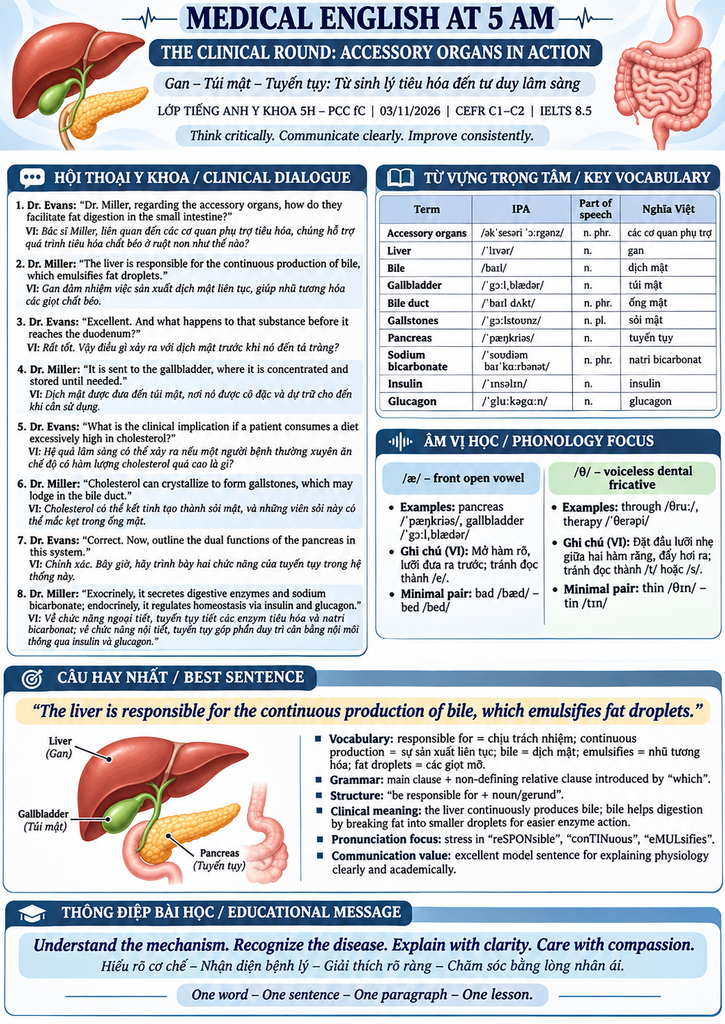
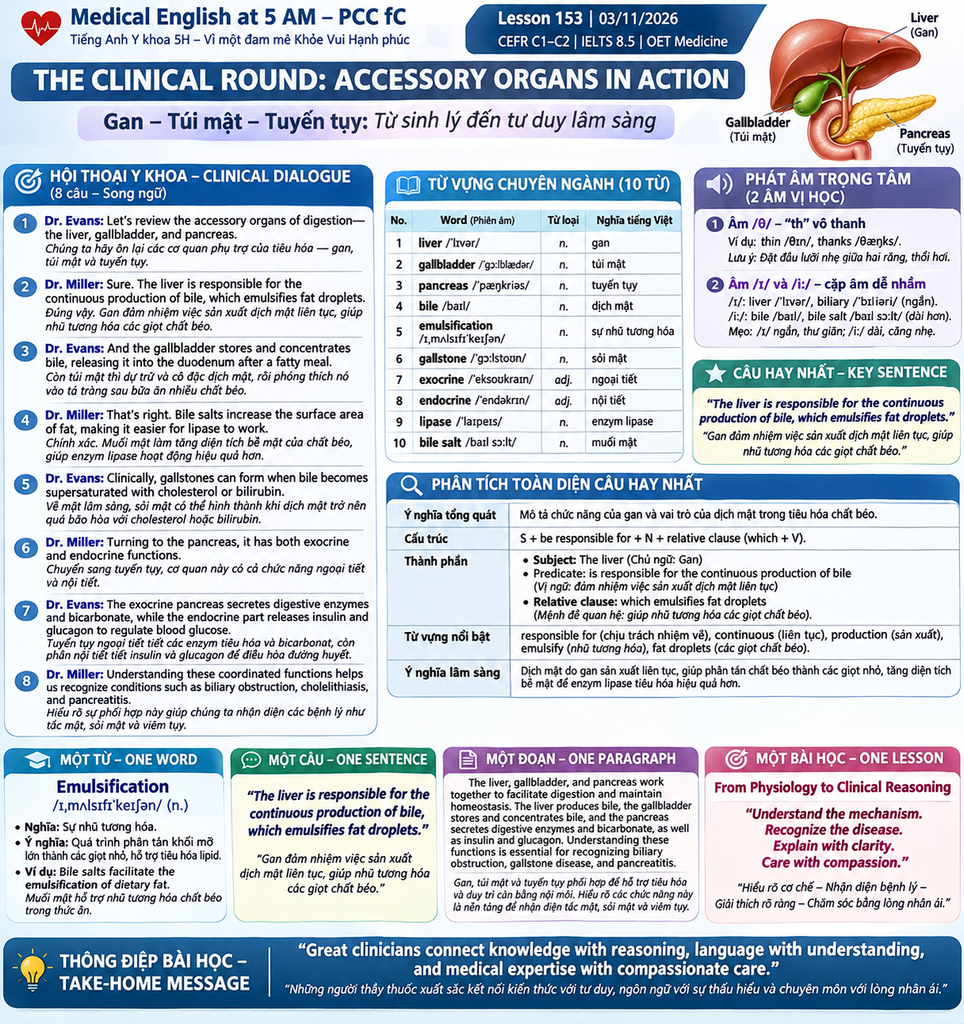
THE CLINICAL ROUND: ACCESSORY ORGANS IN ACTION
Gan – Túi mật – Tuyến tụy: Từ sinh lý tiêu hóa đến thực hành lâm sàng
LỚP TIẾNG ANH Y KHOA 5H – PCC fC
Ngày: 03/11/2026 | Thời gian: 05:00–05:30 | Trình độ: CEFR C1–C2 | Mục tiêu IELTS: 8.5
Educational philosophy: Think critically. Communicate clearly. Improve consistently.
PHẦN 1. THÔNG TIN BÀI HỌC – LESSON INFORMATION
Chủ đề: Accessory Digestive Organs: The Liver, Gallbladder, and Pancreas.
Đối tượng: Bác sĩ, bác sĩ nội trú, sinh viên y khoa và học viên tiếng Anh y khoa trình độ nâng cao.
Phương pháp: Case-based learning, clinical dialogue, shadowing, retrieval practice, clinical reasoning và formative assessment.
Định hướng tham khảo:
- AMEE: Outcome-based education, constructive alignment và active learning.
- OET Medicine: Clear explanations, appropriate language, clinical communication và checking understanding.
- CEFR C1–C2: Precision, fluency, coherent argumentation và appropriate professional register.
- IELTS 8.5: Advanced vocabulary, grammatical range and accuracy, coherence and pronunciation.
Phân bổ 30 phút:
- 00–03 phút: Giới thiệu tình huống, mục tiêu và kiến thức nền.
- 03–07 phút: Thuật ngữ chuyên ngành.
- 07–13 phút: Hội thoại nguyên văn, dịch và luyện phát âm.
- 13–17 phút: Ngữ pháp và diễn đạt học thuật.
- 17–23 phút: Luyện nghe – nói – đọc – viết, kết hợp thảo luận ca bệnh.
- 23–28 phút: Kiểm tra và phản hồi.
- 28–30 phút: Tổng kết, ứng dụng và thông điệp giáo dục.
Bài nghe thụ động 3 phút được sử dụng để tự học trước hoặc sau buổi học, không bắt buộc nghe toàn bộ trong 30 phút học trực tiếp.
PHẦN 2. CHUẨN ĐẦU RA – MEASURABLE LEARNING OUTCOMES
By the end of this lesson, learners will be able to:
LO1 – Explain: Describe at least three physiological functions of the liver, gallbladder, and pancreas in accurate medical English within 60 seconds.
Giải thích ít nhất ba chức năng sinh lý của các cơ quan phụ trợ tiêu hóa trong 60 giây.
LO2 – Apply: Use at least eight of the ten target medical terms accurately in clinical explanations or case discussions.
Sử dụng chính xác ít nhất 8/10 thuật ngữ chuyên ngành.
LO3 – Communicate: Perform the eight-turn clinical dialogue with intelligible pronunciation, appropriate stress, and no major loss of meaning.
Thực hành hội thoại 8 lượt, phát âm rõ ràng, nhấn trọng âm phù hợp và bảo đảm ý nghĩa.
LO4 – Analyze: Identify two advanced grammatical structures and apply them correctly in two original clinical sentences.
Nhận diện hai cấu trúc ngữ pháp và tạo hai câu lâm sàng mới.
LO5 – Evaluate: Present a 60–90-second clinical assessment of suspected choledocholithiasis, including differential diagnosis, initial investigations, and appropriate next steps.
Trình bày đánh giá một ca nghi sỏi ống mật chủ, bao gồm chẩn đoán phân biệt, cận lâm sàng ban đầu và định hướng xử trí.
Tiêu chí hoàn thành: Đạt ít nhất 80% bài kiểm tra cuối buổi và thực hiện được phần trình bày lâm sàng có cấu trúc.
PHẦN 3. TÌNH HUỐNG LÂM SÀNG – CLINICAL SCENARIO
Case title: From Fat Digestion to Biliary Obstruction
A 45-year-old patient presents to the emergency department with severe right upper quadrant abdominal pain, nausea, and jaundice. The pain began approximately eight hours earlier. The patient reports several previous episodes of abdominal discomfort after meals.
On examination, the patient is alert, with a temperature of 37.8°C, a heart rate of 104 beats per minute, and a blood pressure of 118/76 mmHg.
Initial laboratory tests reveal elevated bilirubin and liver enzymes. Abdominal ultrasound demonstrates gallstones and a dilated common bile duct, but no definite ductal stone is visualized.
Bản dịch tiếng Việt:
Một người bệnh 45 tuổi đến khoa Cấp cứu vì đau dữ dội vùng hạ sườn phải, buồn nôn và vàng da. Cơn đau xuất hiện khoảng 8 giờ trước nhập viện. Người bệnh cho biết từng có nhiều đợt khó chịu vùng bụng sau ăn.
Khám lâm sàng: tỉnh táo, nhiệt độ 37,8°C, mạch 104 lần/phút, huyết áp 118/76 mmHg.
Xét nghiệm ban đầu ghi nhận bilirubin và các enzym gan tăng. Siêu âm bụng phát hiện sỏi túi mật và giãn ống mật chủ, nhưng chưa quan sát rõ sỏi trong ống mật.
Clinical reasoning questions:
- Which accessory digestive organ produces bile?
- What is the physiological role of the gallbladder?
- How does bile contribute to fat digestion?
- What conditions should be considered in this patient?
- What investigations and management priorities would you recommend?
Expected clinical interpretation:
The leading concern is common bile duct obstruction due to suspected choledocholithiasis. Acute cholangitis, acute cholecystitis, and gallstone pancreatitis should also be considered.
The clinician should assess for systemic infection, evolving organ dysfunction, and the need for urgent biliary drainage. Appropriate investigations include liver biochemistry, full blood count, inflammatory markers, renal function, and lipase; further biliary imaging depends on risk stratification and clinical stability.
Clinical message: A dilated bile duct and elevated bilirubin increase suspicion, but neither finding alone establishes the presence of a common bile duct stone.
PHẦN 4. MEDICAL VOCABULARY – 10 THUẬT NGỮ TRỌNG TÂM
1. Accessory organs
- IPA: /əkˈsesəri ˈɔːrɡənz/
- Part of speech: Noun phrase (plural).
- Nghĩa: Các cơ quan phụ trợ.
- Example: The accessory digestive organs support digestion without food passing directly through them.
- Dịch: Các cơ quan phụ trợ tiêu hóa hỗ trợ quá trình tiêu hóa mà thức ăn không đi trực tiếp qua chúng.
2. Liver
- IPA: /ˈlɪvər/
- Part of speech: Noun.
- Nghĩa: Gan.
- Example: The liver continuously produces bile to facilitate lipid digestion.
- Dịch: Gan liên tục sản xuất dịch mật để hỗ trợ tiêu hóa lipid.
3. Bile
- IPA: /baɪl/
- Part of speech: Noun.
- Nghĩa: Dịch mật.
- Example: Bile salts facilitate the emulsification of dietary fats.
- Dịch: Muối mật hỗ trợ quá trình nhũ tương hóa chất béo trong thức ăn.
4. Gallbladder
- IPA: /ˈɡɔːlˌblædər/
- Part of speech: Noun.
- Nghĩa: Túi mật.
- Example: The gallbladder stores and concentrates bile between meals.
- Dịch: Túi mật dự trữ và cô đặc dịch mật giữa các bữa ăn.
5. Bile duct
- IPA: /ˈbaɪl dʌkt/
- Part of speech: Noun phrase.
- Nghĩa: Ống mật.
- Example: A gallstone lodged in the common bile duct may cause obstructive jaundice.
- Dịch: Sỏi mắc kẹt trong ống mật chủ có thể gây vàng da tắc mật.
6. Gallstones
- IPA: /ˈɡɔːlstoʊnz/
- Part of speech: Noun (plural).
- Nghĩa: Sỏi mật.
- Example: Gallstones may contain cholesterol, bilirubin pigments, or a mixture of substances.
- Dịch: Sỏi mật có thể chứa cholesterol, sắc tố bilirubin hoặc hỗn hợp nhiều thành phần.
7. Pancreas
- IPA: /ˈpæŋkriəs/
- Part of speech: Noun.
- Nghĩa: Tuyến tụy.
- Example: The pancreas performs both exocrine and endocrine functions.
- Dịch: Tuyến tụy thực hiện cả chức năng ngoại tiết và nội tiết.
8. Sodium bicarbonate
- IPA: /ˈsoʊdiəm baɪˈkɑːrbənət/
- Part of speech: Noun phrase.
- Nghĩa: Natri bicarbonat.
- Example: Pancreatic bicarbonate helps neutralize acidic chyme entering the duodenum.
- Dịch: Bicarbonat do tụy tiết ra giúp trung hòa dịch dưỡng trấp có tính acid đi vào tá tràng.
9. Insulin
- IPA: /ˈɪnsəlɪn/
- Part of speech: Noun.
- Nghĩa: Insulin.
- Example: Insulin promotes glucose uptake and storage, contributing to blood glucose regulation.
- Dịch: Insulin thúc đẩy thu nhận và dự trữ glucose, góp phần điều hòa glucose máu.
10. Glucagon
- IPA: /ˈɡluːkəɡɑːn/
- Part of speech: Noun.
- Nghĩa: Glucagon.
- Example: Glucagon stimulates hepatic glucose production during fasting.
- Dịch: Glucagon kích thích gan sản xuất glucose trong thời gian nhịn đói.
Advanced terminology extension:
- Cholelithiasis: Sỏi túi mật hoặc bệnh sỏi mật.
- Choledocholithiasis: Sỏi ống mật chủ.
- Cholecystectomy: Phẫu thuật cắt túi mật.
- Cholestasis: Ứ mật.
- Emulsification: Nhũ tương hóa.
- Exocrine secretion: Bài tiết ngoại tiết.
- Endocrine regulation: Điều hòa nội tiết.
Word formation:
Chole- (mật) + lith (sỏi) + -iasis (tình trạng bệnh lý) = Cholelithiasis.
Endo- (bên trong) + -crine (tiết) = Endocrine.
Exo- (ra ngoài) + -crine (tiết) = Exocrine.
PHẦN 5. CLINICAL DIALOGUE – HỘI THOẠI Y KHOA SONG NGỮ
Nguồn: Trang 2/5, tài liệu The Clinical Round: Accessory Organs in Action.
Yêu cầu: Giữ nguyên toàn bộ 8 lượt thoại tiếng Anh; bản dịch tiếng Việt được bổ sung để phục vụ học tập.
1. Dr. Evans:
Dr. Miller, regarding the accessory organs, how do they facilitate fat digestion in the small intestine?
Dịch: Bác sĩ Miller, liên quan đến các cơ quan phụ trợ tiêu hóa, chúng hỗ trợ quá trình tiêu hóa chất béo ở ruột non như thế nào?
2. Dr. Miller:
The liver is responsible for the continuous production of bile, which emulsifies fat droplets.
Dịch: Gan đảm nhiệm việc sản xuất dịch mật liên tục, giúp nhũ tương hóa các giọt chất béo.
3. Dr. Evans:
Excellent. And what happens to that substance before it reaches the duodenum?
Dịch: Rất tốt. Vậy điều gì xảy ra với dịch mật trước khi nó đến tá tràng?
4. Dr. Miller:
It is sent to the gallbladder, where it is concentrated and stored until needed.
Dịch: Dịch mật được đưa đến túi mật, nơi nó được cô đặc và dự trữ cho đến khi cần sử dụng.
5. Dr. Evans:
What is the clinical implication if a patient consumes a diet excessively high in cholesterol?
Dịch: Hệ quả lâm sàng có thể xảy ra nếu một người bệnh thường xuyên ăn chế độ có hàm lượng cholesterol quá cao là gì?
6. Dr. Miller:
Cholesterol can crystallize to form gallstones, which may lodge in the bile duct.
Dịch: Cholesterol có thể kết tinh tạo thành sỏi mật, và những viên sỏi này có thể mắc kẹt trong ống mật.
7. Dr. Evans:
Correct. Now, outline the dual functions of the pancreas in this system.
Dịch: Chính xác. Bây giờ, hãy trình bày hai chức năng của tuyến tụy trong hệ thống này.
8. Dr. Miller:
Exocrinely, it secretes digestive enzymes and sodium bicarbonate; endocrinely, it regulates homeostasis via insulin and glucagon.
Dịch: Về chức năng ngoại tiết, tuyến tụy tiết các enzym tiêu hóa và natri bicarbonat; về chức năng nội tiết, tuyến tụy góp phần duy trì cân bằng nội môi thông qua insulin và glucagon.
Clinical language notes – C1–C2:
- “Facilitate” trang trọng và chính xác hơn “help” trong mô tả chức năng sinh lý.
- “Be responsible for” giúp diễn đạt trách nhiệm hoặc chức năng của một cơ quan.
- “Which may lodge in…” là mệnh đề quan hệ bổ sung hậu quả có thể xảy ra.
- “Outline” trong ngữ cảnh giảng dạy yêu cầu trình bày ngắn gọn các ý chính.
- “Homeostasis” là một khái niệm rộng; khi đề cập insulin và glucagon, nên xác định cụ thể “glucose homeostasis”.
Advanced paraphrasing – Diễn đạt nâng cao, không thuộc hội thoại gốc:
Original: “Exocrinely, it secretes digestive enzymes and sodium bicarbonate.”
Advanced: “Through its exocrine function, the pancreas releases digestive enzymes and bicarbonate-rich fluid into the duodenum.”
Original: “Endocrinely, it regulates homeostasis via insulin and glucagon.”
Advanced: “Through its endocrine function, the pancreas contributes to glucose homeostasis by secreting insulin and glucagon.”
Discussion: Why is distinguishing the endocrine and exocrine functions of the pancreas essential when assessing pancreatic diseases?
PHẦN 6. PRONUNCIATION FOCUS – PHÁT ÂM TRỌNG TÂM
A. Nguyên âm trọng tâm: /æ/
Ví dụ: pancreas /ˈpæŋkriəs/, gallbladder /ˈɡɔːlˌblædər/.
Đặc điểm:
- Nguyên âm trước, mở, không tròn môi.
- Hạ hàm rõ, lưỡi hướng ra trước.
- Tránh đọc thành /e/ hoặc /ɑː/.
Minimal pair:
- Bad /bæd/ – Bed /bed/.
- Bat /bæt/ – Bet /bet/.
B. Phụ âm trọng tâm: /θ/
Ví dụ: through /θruː/, therapy /ˈθerəpi/.
Cách phát âm:
- Đầu lưỡi đặt nhẹ giữa hoặc sát hai hàm răng.
- Luồng khí đi qua khe hẹp.
- Không rung dây thanh.
- Phân biệt /θ/ với /t/ và /s/.
Minimal pair:
- Thin /θɪn/ – Tin /tɪn/.
- Think /θɪŋk/ – Sink /sɪŋk/.
C. Trọng âm từ – Word stress
- PAN-cre-as.
- GALL-blad-der.
- BI-car-bo-nate: trọng âm chính ở âm tiết “car” trong bicarbonate /baɪˈkɑːrbənət/.
- EM-ul-si-fi-CA-tion: trọng âm chính ở “ca”.
- HO-me-o-STA-sis: trọng âm chính ở “sta”.
D. Sentence stress and intonation
Sentence: “The LIVER is responsible for the continuous production of BILE.”
Nhấn các từ mang thông tin chính: LIVER – PRODUCTION – BILE.
Sentence: “What is the clinical implication if a patient consumes a diet excessively high in cholesterol?”
Đặc biệt chú ý nhịp nói ở các cụm “clinical implication” và “excessively high in cholesterol”.
E. Shadowing practice
Round 1: Listen and identify the stressed words.
Round 2: Repeat each sentence with natural rhythm and intonation.
Round 3: Deliver the sentences without looking at the transcript.
Pronunciation target: Clear, intelligible and professionally appropriate speech. Accent imitation is less important than accurate pronunciation, rhythm and meaning.
PHẦN 7. ADVANCED GRAMMAR – HAI CẤU TRÚC NGỮ PHÁP
STRUCTURE 1: NON-DEFINING RELATIVE CLAUSES
Mệnh đề quan hệ không xác định.
Câu nguyên văn:
“The liver is responsible for the continuous production of bile, which emulsifies fat droplets.”
Phân tích:
- Main clause: The liver is responsible for the continuous production of bile.
- Non-defining relative clause: which emulsifies fat droplets.
- Relative pronoun: which.
- Chức năng: Bổ sung thông tin giải thích đặc điểm hoặc chức năng của “bile”.
Cấu trúc:
Main clause + comma + which + verb + additional information.
Advanced examples:
- Bile salts facilitate fat emulsification, which enhances the accessibility of lipids to digestive enzymes.
- The patient developed obstructive jaundice, which raised concern about a common bile duct stone.
IELTS application: Sử dụng mệnh đề quan hệ để liên kết các ý, tăng độ mạch lạc và giảm lặp từ.
Common error: Không nên dùng dấu phẩy tùy tiện trước mọi mệnh đề quan hệ. Phân biệt defining và non-defining relative clauses.
STRUCTURE 2: PASSIVE VOICE IN CLINICAL EXPLANATIONS
Thể bị động trong diễn giải y khoa.
Câu nguyên văn:
“It is sent to the gallbladder, where it is concentrated and stored until needed.”
Phân tích:
- It: Bile.
- Is sent: Present simple passive.
- Is concentrated: Present simple passive.
- Is stored: Present simple passive.
- Where: Relative adverb referring to the gallbladder.
Cấu trúc:
Subject + am/is/are + past participle.
Mục đích:
Nhấn mạnh quá trình sinh lý, hành động hoặc kết quả thay vì chủ thể thực hiện.
Advanced examples:
- Bile is produced by hepatocytes and is subsequently modified by bile duct epithelial cells.
- The patient was assessed for possible biliary obstruction before further imaging was requested.
Language transformation:
Active: The gallbladder stores and concentrates bile.
Passive: Bile is stored and concentrated in the gallbladder.
Clinical communication principle: Use the passive voice when the process is central, but prefer active voice when identifying responsibility improves clarity and patient safety.
PHẦN 8. INTEGRATED SKILLS – LISTENING, SPEAKING, READING AND WRITING
A. LISTENING – NGHE CHỦ ĐỘNG
Listen to the original dialogue twice.
First listening:
- Identify the three accessory organs.
- Determine which organ produces bile.
- Identify the two principal pancreatic functions.
Second listening:
- Write down “continuous production”, “concentrated and stored”, and “regulates homeostasis”.
- Identify one relative clause and one passive construction.
B. SPEAKING – HỘI THOẠI LÂM SÀNG
Pair work: Dr. Evans and Dr. Miller.
Task 1: Reproduce the original eight-turn dialogue.
Task 2: Give a 60-second clinical explanation of suspected choledocholithiasis.
Suggested professional response:
“The patient’s symptoms and biochemical abnormalities raise concern for biliary obstruction, potentially caused by a common bile duct stone. Although ultrasonography has demonstrated bile duct dilatation, further assessment is required to establish the diagnosis and determine the urgency of intervention. We should also assess for cholangitis and gallstone pancreatitis.”
OET-oriented task:
Explain to a patient, in plain English, why additional tests may be necessary.
Suggested response:
“Your symptoms and scan suggest that bile may not be draining normally. One possible cause is a stone in the bile duct. We need to check whether there is a blockage or infection before deciding on the safest treatment. What concerns you most about the tests?”
C. READING – ĐỌC HIỂU HỌC THUẬT
Reading passage:
“The liver, gallbladder, and pancreas perform complementary functions in digestion. Hepatocytes produce bile, while the gallbladder concentrates and stores it between meals. In response to a meal, bile is released into the duodenum, where bile salts facilitate lipid emulsification and micelle formation. The exocrine pancreas secretes digestive enzymes and bicarbonate-rich fluid, whereas pancreatic endocrine cells regulate glucose metabolism through hormones such as insulin and glucagon. Dysfunction of these organs can result in malabsorption, metabolic disturbances, or biliary complications.”
Reading questions:
- Why is the gallbladder not essential for bile production?
- How does bicarbonate support intestinal digestion?
- What distinguishes the endocrine function of the pancreas from its exocrine function?
D. WRITING – VIẾT Y KHOA
Write a 70–90-word clinical summary using at least five target terms and one non-defining relative clause.
Suggested opening:
“A 45-year-old patient presented with right upper quadrant pain and jaundice, raising suspicion of biliary obstruction…”
Assessment focus:
- Clinical accuracy.
- Logical organization.
- Appropriate terminology.
- Grammar and coherence.
- Concise and precise communication.
E. PASSIVE LISTENING – BÀI NGHE THỤ ĐỘNG 3 PHÚT
Title: Three Organs, One Coordinated Digestive System
Listening script – approximately three minutes at a measured pace
Good morning, and welcome to Medical English at 5 AM, Lesson 153.
Today, we will explore an important concept in digestive physiology: the coordinated functions of the liver, gallbladder, and pancreas.
These organs are called accessory digestive organs because they support digestion without food passing directly through them.
Let us begin with the liver.
The liver continuously produces bile, a fluid that plays a crucial role in the digestion and absorption of dietary fats. Bile salts facilitate fat emulsification and micelle formation, allowing lipids to be processed and absorbed more efficiently.
Now, consider the gallbladder.
The gallbladder does not produce bile. Instead, it stores and concentrates bile between meals. When food enters the small intestine, particularly when it contains fat, the gallbladder contracts and releases bile into the duodenum.
An important clinical condition is gallstone disease.
Gallstones may form when the composition of bile becomes abnormal. Some stones contain cholesterol, while others contain bilirubin pigments. If a stone enters and obstructs the common bile duct, the patient may develop abdominal pain, jaundice, or serious complications.
The pancreas has two major functions.
Its exocrine function involves the secretion of digestive enzymes and bicarbonate-rich fluid. These substances support the digestion of carbohydrates, proteins, and fats while helping neutralize acidic material entering the duodenum.
Its endocrine function involves the release of hormones, particularly insulin and glucagon, which contribute to glucose homeostasis.
Now imagine a patient presenting with right upper quadrant pain, nausea, and jaundice.
As clinicians, we must do more than recognize anatomical structures. We must connect physiology with symptoms, interpret investigations, and identify potentially dangerous complications.
Could the patient have a common bile duct stone? Is there evidence of acute cholangitis? Is the pancreas involved?
These questions require structured clinical reasoning, careful assessment, and clear communication.
Remember, professional medical English is not simply the ability to pronounce complex terminology. It is the ability to explain difficult concepts accurately, communicate uncertainty responsibly, and help patients understand their conditions.
Learn the anatomy. Understand the physiology. Recognize the pathology. Communicate with clarity.
One word. One sentence. One paragraph. One lesson.
Think critically. Communicate clearly. Improve consistently.
This is Medical English at 5 AM – PCC fC.
Together, we learn for knowledge, competence, and better patient care.
Passive listening tasks:
First listening: Focus on the main message.
Second listening: Identify the roles of each organ.
Third listening: Repeat five useful expressions.
Fourth listening: Summarize the content in three English sentences without looking at the script.
PHẦN 9. ASSESSMENT, ANSWER KEY AND FEEDBACK
A. KNOWLEDGE CHECK – 5 QUESTIONS
Question 1. Which organ continuously produces bile?
A. Gallbladder
B. Liver
C. Pancreas
D. Duodenum
Question 2. What is the main role of pancreatic bicarbonate?
A. Stimulate insulin secretion
B. Produce cholesterol
C. Help neutralize acidic chyme
D. Store bile
Question 3. Which statement is correct?
A. The gallbladder produces bile.
B. All gallstones are composed entirely of cholesterol.
C. The pancreas has both endocrine and exocrine functions.
D. Every patient with gallstones requires urgent ERCP.
Question 4. Identify the grammatical structure:
“Bile is stored and concentrated in the gallbladder.”
A. Active voice
B. Passive voice
C. Conditional sentence
D. Reported speech
Question 5. A patient has right upper quadrant pain, jaundice, elevated bilirubin, and bile duct dilatation without a visible ductal stone. What is the most appropriate interpretation?
A. Choledocholithiasis is completely excluded.
B. Emergency ERCP is mandatory solely because the duct is dilated.
C. Further risk assessment and appropriate biliary imaging are needed.
D. No additional evaluation is necessary.
B. SHORT-ANSWER TASK
Question 6: Explain the difference between exocrine and endocrine pancreatic functions in no more than 50 English words.
Question 7: Name two potentially serious complications of common bile duct obstruction.
Question 8: Rewrite the following sentence in the passive voice:
“The gallbladder stores and concentrates bile.”
C. ANSWER KEY
- B – Liver.
- C – Help neutralize acidic chyme.
- C – The pancreas has both endocrine and exocrine functions.
- B – Passive voice.
- C – Further risk assessment and appropriate biliary imaging are needed.
- Suggested answer:
“The exocrine pancreas secretes digestive enzymes and bicarbonate-rich fluid into the intestine, facilitating digestion and acid neutralization. In contrast, the endocrine pancreas releases hormones, including insulin and glucagon, into the bloodstream to regulate glucose metabolism.”
- Acute cholangitis and gallstone pancreatitis.
- “Bile is stored and concentrated in the gallbladder.”
D. SCORING RUBRIC – THANG ĐIỂM 20
- Five multiple-choice questions: 5 points.
- Question 6: 3 points.
- Question 7: 2 points.
- Question 8: 2 points.
- Speaking: Clinical accuracy and coherence – 4 points.
- Speaking: Pronunciation, fluency and appropriate terminology – 4 points.
Performance bands:
- 18–20: Excellent – Advanced clinical communication.
- 16–17: Very good – Minor improvements needed.
- 13–15: Satisfactory – Further practice recommended.
- Below 13: Review vocabulary, physiology and clinical reasoning.
Đây là thang đánh giá nội bộ của bài học, không phải thang điểm quy đổi chính thức của IELTS hoặc OET.
E. FORMATIVE FEEDBACK – PHẢN HỒI HỌC TẬP
Positive feedback:
“Your explanation demonstrates a clear understanding of digestive physiology and appropriate use of medical terminology.”
Developmental feedback:
“Try to distinguish more precisely between bile production and bile storage, and explain the mechanism of obstruction before discussing treatment.”
Clinical communication feedback:
“Your clinical reasoning is well structured. To improve further, acknowledge diagnostic uncertainty and explain the rationale for additional investigations.”
PHẦN 10. EVIDENCE-BASED MEDICINE – CẬP NHẬT VÀ HIỆU CHỈNH KHOA HỌC
10.1. Bile production and bile storage
Source statement: “The liver is responsible for the continuous production of bile.”
Scientific clarification:
Bile is formed by hepatocytes and modified by cholangiocytes. The gallbladder stores and concentrates bile, but does not synthesize it.
The gallbladder releases bile mainly in response to postprandial hormonal and neural signals, particularly cholecystokinin.
10.2. The physiological function of bile
Bile salts facilitate emulsification and micelle formation, supporting intestinal fat digestion and absorption.
Bile itself does not contain the principal lipase responsible for triglyceride hydrolysis. Pancreatic lipase performs that enzymatic role.
10.3. Cholesterol and gallstone formation
Source statement: “Cholesterol can crystallize to form gallstones.”
Scientific clarification:
Cholesterol gallstones arise through interacting mechanisms, including cholesterol supersaturation of bile, nucleation, and impaired gallbladder motility.
A diet high in cholesterol alone is not sufficient to explain all gallstones. Risk factors include obesity, metabolic abnormalities, rapid weight loss, and other individual characteristics.
10.4. Pancreatic exocrine and endocrine functions
Exocrine pancreas:
- Digestive enzymes, including lipase, amylase, and protease precursors.
- Bicarbonate-rich secretion, particularly from ductal cells.
- Digestion and neutralization of acidic chyme.
Endocrine pancreas:
- Insulin from pancreatic beta cells.
- Glucagon from pancreatic alpha cells.
- Other hormones, including somatostatin.
These endocrine products contribute to metabolic regulation, particularly glucose homeostasis.
10.5. Diagnosis of suspected gallstone disease
Clinical assessment should consider:
- Symptoms and vital signs.
- Evidence of jaundice, sepsis, or organ dysfunction.
- Liver biochemistry and bilirubin.
- Ultrasonography as an initial imaging investigation.
- MRCP or EUS when additional clarification of suspected common bile duct stones is indicated.
10.6. Risk stratification for choledocholithiasis
According to ASGE guidance, high-risk features that can justify direct therapeutic ERCP include:
- A common bile duct stone demonstrated on imaging.
- Clinical ascending cholangitis.
- Total bilirubin greater than 4 mg/dL together with a dilated common bile duct.
Intermediate-risk patients may undergo MRCP, EUS, or appropriate intraoperative biliary assessment.
10.7. Treatment principles
Symptomatic gallbladder stones are generally managed with laparoscopic cholecystectomy when appropriate.
Confirmed common bile duct stones may require endoscopic or surgical duct clearance.
ERCP is primarily a therapeutic procedure and should not be used indiscriminately when non-invasive diagnostic strategies are more appropriate.
Patients with suspected acute cholangitis require prompt assessment, supportive treatment, appropriate antibiotics, and evaluation for urgent biliary drainage.
10.8. Gallstone pancreatitis
In gallstone pancreatitis without cholangitis or evidence of persistent biliary obstruction or choledocholithiasis, routine urgent ERCP within 48 hours is not recommended.
Clinical assessment should focus on severity, organ dysfunction, obstruction and associated infection.
10.9. Dietary advice after cholecystectomy
Most patients can return to a balanced diet following gallbladder removal.
A lifelong strict low-fat diet is not routinely required. Individual dietary adjustment may be useful when symptoms persist.
This replaces the overly broad implication in the original educational material that all patients must continue a low-fat diet after cholecystectomy.
10.10. Lithotripsy and contemporary management
Shock-wave lithotripsy is not a routine first-line treatment for most gallstones or common bile duct stones.
For difficult common bile duct stones, selected endoscopic techniques, including cholangioscopy-guided intraductal lithotripsy, may be considered according to available expertise.
Evidence-based conclusion:
The most important clinical skill is not memorizing the names of organs but connecting anatomy, physiology, pathology, diagnostic probability, and evidence-based management.
TÀI LIỆU THAM KHẢO – REFERENCES
- Source PDF: The Clinical Round: Accessory Organs in Action – Accessory_Organs_Medical_English.pdf. Five pages. Source dialogue, vocabulary, grammar and clinical exercises.
- NICE. Gallstone Disease: Diagnosis and Management. Clinical Guideline CG188. Published 2014.
https://www.nice.org.uk/guidance/cg188 - ASGE Standards of Practice Committee. ASGE Guideline on the Role of Endoscopy in the Evaluation and Management of Choledocholithiasis. Gastrointestinal Endoscopy. 2019;89(6):1075–1105.e15.
https://doi.org/10.1016/j.gie.2018.10.001 - National Institute of Diabetes and Digestive and Kidney Diseases (NIDDK). Gallstones: Symptoms, Causes and Treatment.
https://www.niddk.nih.gov/health-information/digestive-diseases/gallstones - Cambridge University Hospitals NHS Foundation Trust. Dietary Advice for Patients with Gallstones or Inflammation of the Gallbladder. Updated 2025.
https://www.cuh.nhs.uk/patient-information/dietary-advice-for-patients-with-gallstones/ - AMEE. Designing and Planning Learning. Outcome-based education, curriculum alignment and learning outcomes.
https://amee.org/education/courses/designing-and-planning-learning/ - OET. Speaking Assessment Criteria and Clinical Communication Guide. Linguistic competence and patient-centred communication.
https://oet.com
THÔNG ĐIỆP GIÁO DỤC – EDUCATIONAL MESSAGE
“Learn the anatomy to understand the structure. Study physiology to explain the function. Master clinical reasoning to recognize disease. Develop medical English to communicate knowledge with clarity, compassion, and responsibility.”
Học giải phẫu để hiểu cấu trúc. Học sinh lý để giải thích chức năng. Rèn tư duy lâm sàng để nhận diện bệnh lý. Làm chủ tiếng Anh y khoa để truyền đạt kiến thức bằng sự rõ ràng, lòng nhân ái và tinh thần trách nhiệm.
One word – One sentence – One paragraph – One lesson.
Think critically. Communicate clearly. Improve consistently.
PCC fC – Vì một đam mê Khỏe Vui Hạnh phúc.