Bài 155 – Tiếng Anh Y Khoa: Chuyên đề Tiếng Anh trong đời sống: Trí thông minh phi thường của bạch tuộc: Từ sinh học biển đến khoa học thần kinh y học * The extraordinary Intelligence of Octopuses: From Marine Biology to Medical Neuroscience
PCC Language – Thăng Long, ngày 5/11/2026, Bạn có biết rằng bạch tuộc sở hữu khoảng 500 triệu tế bào thần kinh, có khả năng giải quyết vấn đề, sử dụng công cụ, ghi nhớ kinh nghiệm và thậm chí có thể trải nghiệm cảm giác đau? Điều đặc biệt là phần lớn tế bào thần kinh của chúng nằm ở tám cánh tay, tạo nên một hệ thống xử lý thông tin phân tán vô cùng độc đáo.
Trong Bài 155 – How Intelligent Are Octopuses?, chúng ta sẽ khám phá những bí ẩn thú vị về trí thông minh, hệ thần kinh, khả năng thích nghi và sự tiến hóa của bạch tuộc. Từ đó, bài học mở rộng sang những vấn đề quan trọng trong y học như nhận thức, cảm nhận đau, đánh giá người bệnh không thể giao tiếp và tư duy dựa trên bằng chứng khoa học.
Thông qua hai bài đọc khoa học, 10 từ vựng học thuật, hội thoại y khoa song ngữ, luyện phát âm, ngữ pháp nâng cao và thực hành bốn kỹ năng, học viên không chỉ phát triển năng lực tiếng Anh mà còn rèn luyện tư duy phản biện, khả năng giao tiếp chuyên nghiệp và tinh thần học hỏi suốt đời.
Thông điệp: Trí thông minh không nằm ở việc suy nghĩ giống người khác, mà ở khả năng học hỏi, thích nghi, sáng tạo và không ngừng tiến bộ.
English
Did you know that an octopus possesses approximately 500 million neurons and can solve problems, use tools, learn from experience, and potentially experience pain? Even more remarkably, most of its neurons are located in its eight arms, forming an extraordinary distributed nervous system.
In Lesson 155 – How Intelligent Are Octopuses?, we will explore the fascinating science of octopus intelligence, neural organization, adaptability, and evolution. We will also connect these discoveries to important medical concepts, including cognition, pain perception, assessment of non-communicative patients, and evidence-based clinical reasoning.
Through two scientific reading passages, ten advanced vocabulary items, a bilingual medical dialogue, pronunciation practice, sophisticated grammar, and integrated language activities, learners will strengthen not only their English proficiency but also their critical thinking, professional communication, and commitment to lifelong learning.
Take-home message: Intelligence is not about thinking like everyone else. It is about learning, adapting, creating, and continuously improving.
PCC fC – Think critically. Communicate clearly. Improve consistently.
Vì một đam mê Khỏe Vui Hạnh phúc.
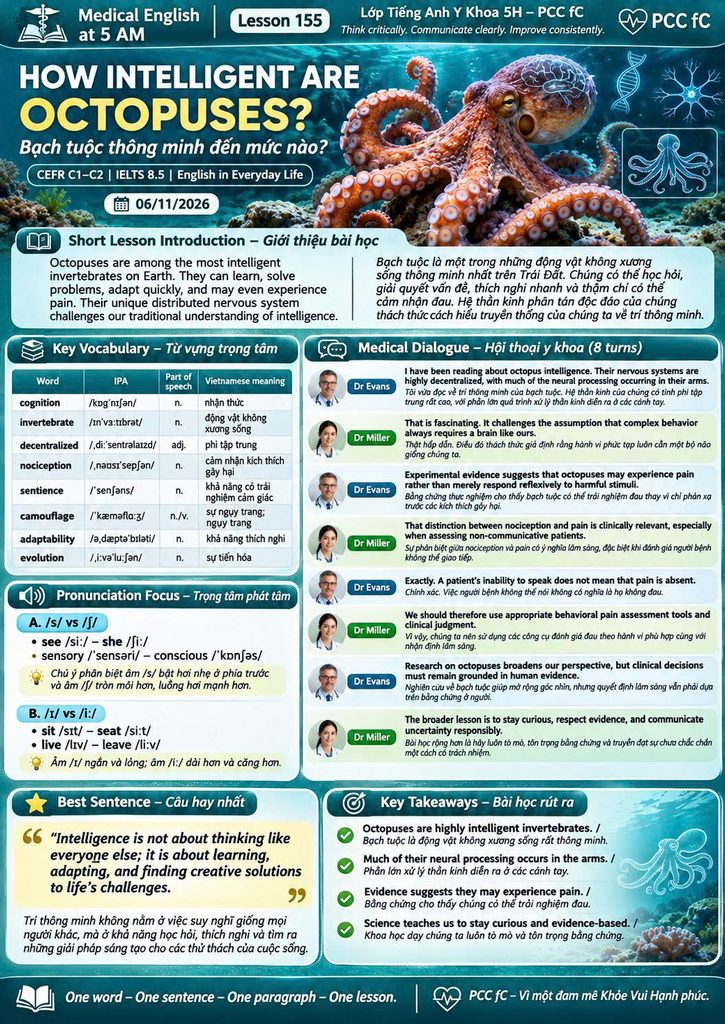
MEDICAL ENGLISH AT 5 AM – LESSON 155
HOW INTELLIGENT ARE OCTOPUSES?
The Extraordinary Intelligence of Octopuses: From Marine Biology to Medical Neuroscience
LỚP TIẾNG ANH Y KHOA 5H – PCC fC
Chuyên đề: English in Everyday Life – Tiếng Anh trong đời sống
Ngày học: Friday, 06 November 2026
Thời gian: 05:00–05:30 (GMT+7)
Trình độ định hướng: CEFR C1–C2 | IELTS 8.5
Tham khảo phương pháp: AMEE – Outcome-Based Education | OET Medicine – Clinical Communication
Phương châm: Think critically. Communicate clearly. Improve consistently.
PART 1. LESSON INFORMATION – THÔNG TIN BÀI HỌC
1.1. Topic Overview – Tổng quan chủ đề
Octopuses are among the most cognitively sophisticated invertebrates. Their remarkable abilities to learn, solve problems, and adapt to challenging environments raise profound questions about intelligence, consciousness, and the evolution of nervous systems.
Bạch tuộc nằm trong số những động vật không xương sống có năng lực nhận thức phát triển nhất. Khả năng học hỏi, giải quyết vấn đề và thích nghi với môi trường đầy thử thách của chúng đặt ra những câu hỏi sâu sắc về trí thông minh, ý thức và sự tiến hóa của hệ thần kinh.
1.2. Two Scientific Reading Passages – Hai bài đọc khoa học
READING A – The Extraordinary Intelligence of Octopuses
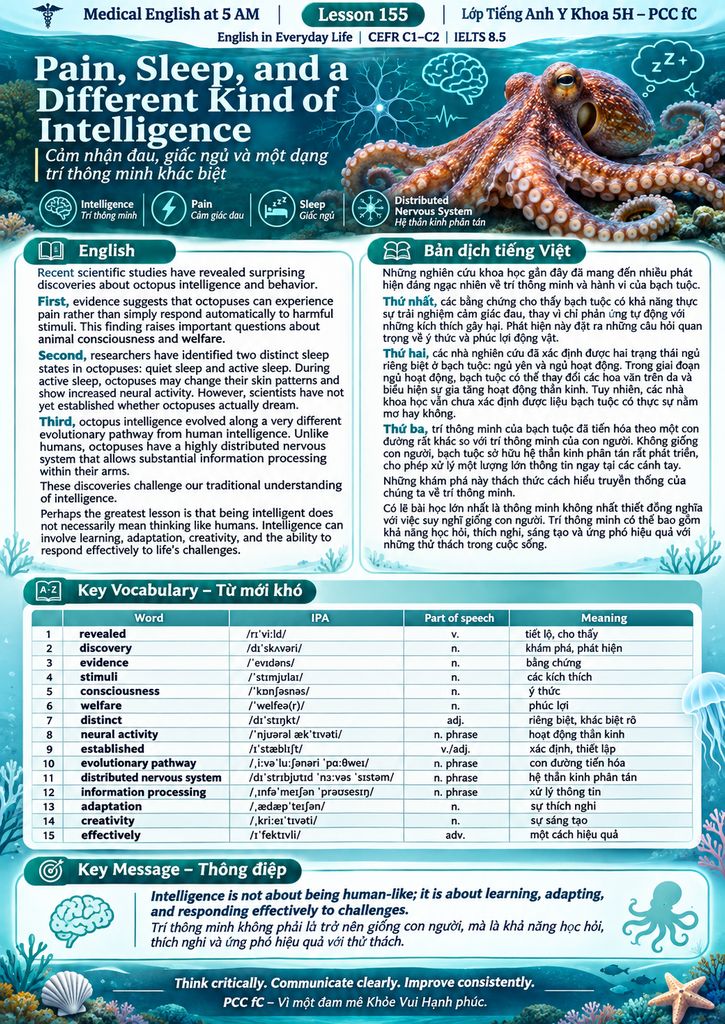
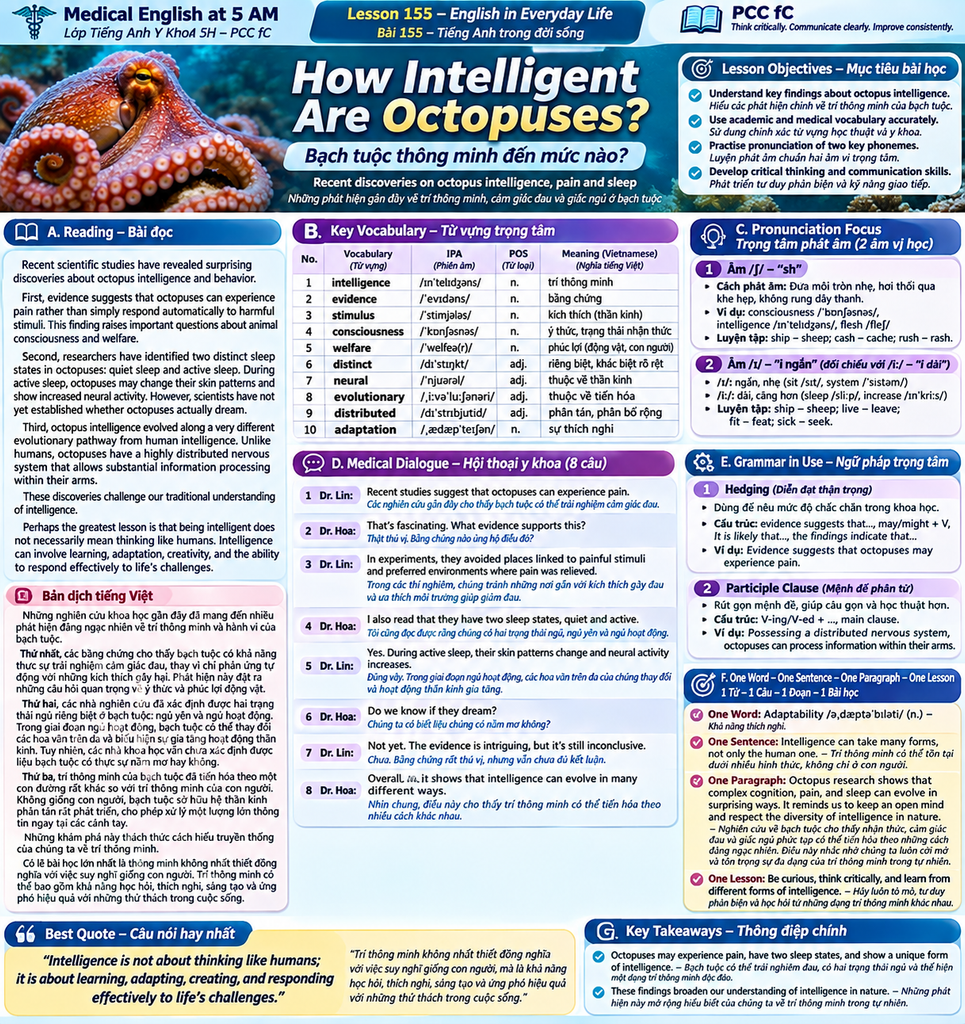
Octopuses possess remarkable cognitive abilities despite having nervous systems that differ fundamentally from those of humans. They can learn through experience, solve problems, manipulate objects, and adapt to unfamiliar situations. The common octopus has approximately 500 million neurons, with a substantial majority distributed throughout its eight arms. This decentralized organization enables extensive local sensory processing and motor coordination.
Some octopuses even use coconut shells as portable shelters, illustrating a remarkable form of tool use. Their ability to change skin coloration and texture also demonstrates sophisticated sensory-motor coordination. Together, these characteristics suggest that complex intelligence can evolve through biological pathways very different from our own.
Bản dịch tiếng Việt
Bạch tuộc sở hữu những năng lực nhận thức đáng kinh ngạc, mặc dù hệ thần kinh của chúng khác biệt căn bản so với con người. Chúng có thể học hỏi từ kinh nghiệm, giải quyết vấn đề, thao tác với đồ vật và thích nghi với những tình huống không quen thuộc. Bạch tuộc thường có khoảng 500 triệu tế bào thần kinh, trong đó phần lớn phân bố tại tám cánh tay. Cấu trúc phi tập trung này cho phép xử lý thông tin cảm giác và phối hợp vận động đáng kể ngay tại các cánh tay.
Một số loài bạch tuộc thậm chí sử dụng vỏ dừa làm nơi trú ẩn di động, minh họa một hình thức sử dụng công cụ đặc biệt. Khả năng thay đổi màu sắc và cấu trúc bề mặt da cũng thể hiện sự phối hợp cảm giác–vận động tinh vi. Những đặc điểm này cho thấy trí thông minh phức tạp có thể tiến hóa thông qua những con đường sinh học rất khác biệt so với con người.
READING B – Pain, Sleep, and the Evolution of Consciousness
Recent research has revealed compelling evidence that octopuses may experience pain rather than merely exhibit reflexive responses to harmful stimuli. Experiments involving conditioned place preferences suggest that they can associate particular environments with unpleasant experiences and pain relief.
Scientists have also identified two distinct sleep states: quiet sleep and active sleep. During active sleep, octopuses display changes in skin patterns and neural activity resembling certain aspects of wakefulness. However, whether they experience dreams remains uncertain.
These discoveries challenge the assumption that sophisticated cognition and subjective experience require a human-like brain. Nevertheless, researchers must distinguish well-established findings from hypotheses that remain under investigation.
Bản dịch tiếng Việt
Các nghiên cứu gần đây đã cung cấp những bằng chứng thuyết phục cho thấy bạch tuộc có thể trải nghiệm cảm giác đau, thay vì chỉ biểu hiện các phản xạ đối với kích thích gây hại. Những thí nghiệm về sự ưa thích môi trường có điều kiện cho thấy chúng có thể liên hệ những môi trường cụ thể với trải nghiệm khó chịu và sự giảm đau.
Các nhà khoa học cũng đã xác định hai trạng thái ngủ riêng biệt: ngủ yên và ngủ hoạt động. Trong giai đoạn ngủ hoạt động, bạch tuộc biểu hiện những thay đổi về hoa văn da và hoạt động thần kinh có một số đặc điểm tương đồng với trạng thái thức. Tuy nhiên, liệu chúng có trải nghiệm giấc mơ hay không vẫn chưa được xác định.
Những khám phá này thách thức quan điểm cho rằng nhận thức phức tạp và trải nghiệm chủ quan nhất thiết đòi hỏi một bộ não giống con người. Tuy vậy, các nhà nghiên cứu cần phân biệt những phát hiện đã được xác lập vững chắc với các giả thuyết vẫn đang được kiểm chứng.
1.3. Teaching Schedule – Kế hoạch 30 phút
- 05:00–05:03: Introduction and learning outcomes.
- 05:03–05:06: Clinical scenario and critical thinking.
- 05:06–05:11: Vocabulary and pronunciation.
- 05:11–05:16: Medical dialogue and grammar.
- 05:16–05:23: Integrated listening, speaking, reading, and writing.
- 05:23–05:28: Mini-assessment and feedback.
- 05:28–05:30: Reflection and educational message.
Lưu ý: Bài nghe thụ động 3 phút được cung cấp như tài liệu nghe trước hoặc sau giờ học, giúp bảo đảm chương trình trực tiếp kết thúc đúng 05:30.
PART 2. MEASURABLE LEARNING OUTCOMES – CHUẨN ĐẦU RA
By the end of this 30-minute lesson, learners will be able to:
LO1 – Scientific Comprehension
Identify and accurately explain at least three distinctive characteristics of octopus cognition, achieving at least 3/4 correct answers on comprehension questions.
Xác định và giải thích chính xác ít nhất ba đặc điểm nổi bật của nhận thức ở bạch tuộc, đạt tối thiểu 3/4 câu hỏi đọc hiểu.
LO2 – Academic Vocabulary
Use at least 8 out of 10 target vocabulary items accurately in spoken or written scientific explanations.
Sử dụng chính xác ít nhất 8/10 từ vựng trọng tâm trong giải thích khoa học bằng lời nói hoặc văn bản.
LO3 – Clinical Communication
Deliver a 45–60-second explanation of the difference between nociception and pain, using understandable language and at least one appropriate expression of scientific uncertainty.
Giải thích trong 45–60 giây sự khác biệt giữa quá trình cảm nhận kích thích gây hại và trải nghiệm đau, sử dụng ngôn ngữ dễ hiểu và ít nhất một cách diễn đạt mức độ chưa chắc chắn của bằng chứng.
LO4 – Grammar and Pronunciation
Produce two scientifically accurate sentences using advanced hedging structures and participle clauses, while pronouncing at least 4/5 selected technical terms intelligibly.
Tạo hai câu khoa học chính xác sử dụng cấu trúc diễn đạt thận trọng và mệnh đề phân từ, đồng thời phát âm dễ hiểu ít nhất 4/5 thuật ngữ được lựa chọn.
LO5 – Critical Thinking
Distinguish two evidence-supported claims from one unproven claim and justify the distinction in English.
Phân biệt hai nhận định có bằng chứng hỗ trợ với một nhận định chưa được chứng minh và giải thích lý do bằng tiếng Anh.
Educational alignment: Learning outcomes → Learning activities → Assessment → Feedback.
PART 3. CLINICAL SCENARIO – TÌNH HUỐNG LÂM SÀNG
Scenario: Pain Assessment in a Non-Communicative Patient
Setting: Intensive Care Unit – Morning Clinical Discussion
Participants: Dr Evans (Intensivist) and Dr Miller (Neurology Fellow)
Patient: A 62-year-old mechanically ventilated patient receiving sedation following severe pneumonia.
The patient cannot communicate verbally. During repositioning, the patient develops facial grimacing and increased muscle tension.
Clinical question:
“Does a patient’s inability to communicate mean that they cannot experience pain?”
Câu hỏi lâm sàng:
“Liệu việc người bệnh không thể giao tiếp có đồng nghĩa với việc họ không thể cảm nhận đau?”
Scientific Connection – Liên hệ khoa học
Octopus research provides an interesting comparative perspective on pain, nociception, and the relationship between neural processing and subjective experience.
However, human clinical assessment must rely on validated human evidence and appropriate clinical tools, not on extrapolating findings directly from octopuses.
In critically ill adults who cannot self-report, behavioral assessment tools such as the Critical-Care Pain Observation Tool (CPOT) or Behavioral Pain Scale (BPS) may be appropriate when validly applicable.
Physiological indicators such as heart rate and blood pressure alone are not reliable substitutes for a structured pain assessment.
Key distinction:
Nociception is the neural processing of potentially harmful stimuli.
Pain is an unpleasant sensory and emotional experience associated with, or resembling that associated with, actual or potential tissue damage.
Nociception and pain are related but not identical.
Thông điệp lâm sàng:
Không có khả năng nói hoặc tự báo cáo đau không đồng nghĩa với không có trải nghiệm đau. Cần đánh giá có hệ thống, sử dụng công cụ phù hợp và xem xét toàn bộ bối cảnh lâm sàng.
Critical Thinking Prompt
“How can we assess a subjective experience when direct communication is impossible?”
Chúng ta có thể đánh giá một trải nghiệm chủ quan như thế nào khi không thể giao tiếp trực tiếp?
PART 4. TEN ESSENTIAL VOCABULARY ITEMS – 10 TỪ VỰNG CHUYÊN SÂU
Pronunciation convention: British English IPA.
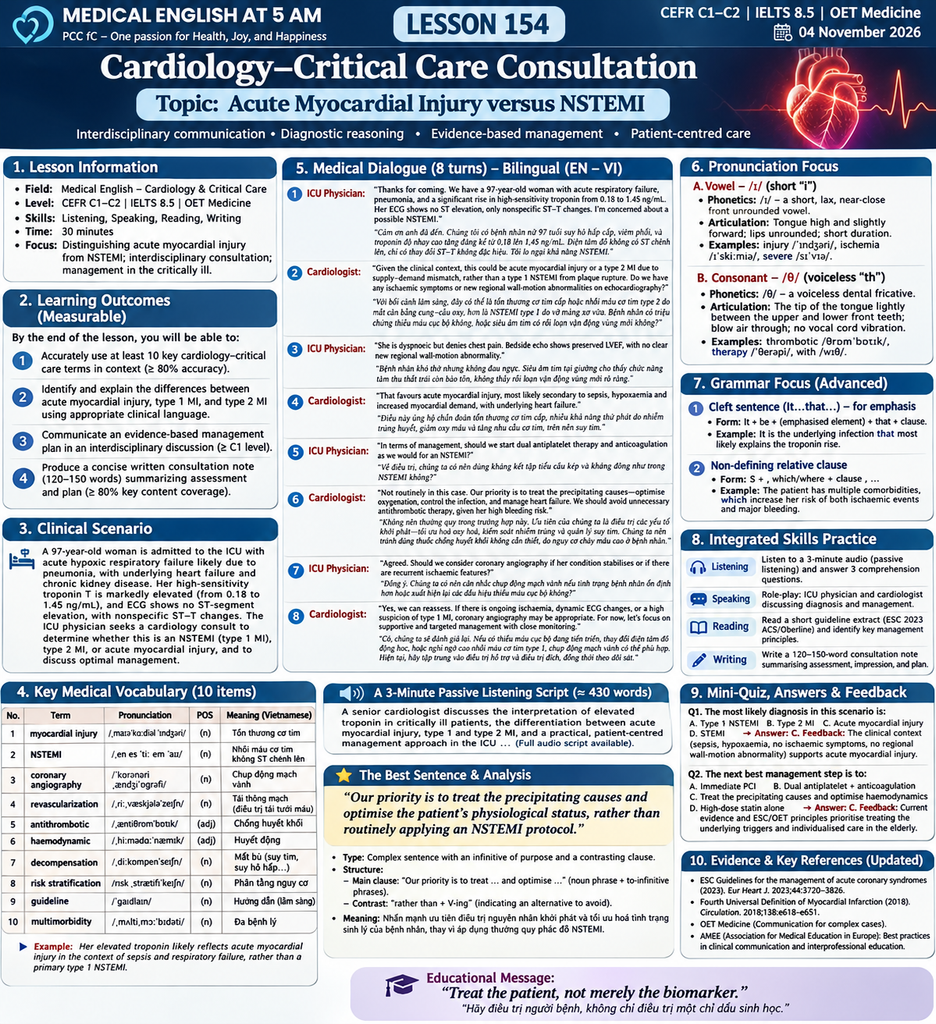
1. Cognition (n.)
IPA: /kɒɡˈnɪʃən/
Meaning: Nhận thức; quá trình tiếp nhận, xử lý và sử dụng thông tin.
Example: Octopus cognition challenges traditional assumptions about intelligence.
Dịch: Nhận thức của bạch tuộc thách thức những giả định truyền thống về trí thông minh.
2. Invertebrate (n.)
IPA: /ɪnˈvɜːtɪbrət/
Meaning: Động vật không xương sống.
Example: Octopuses are among the most cognitively sophisticated invertebrates.
Dịch: Bạch tuộc nằm trong số những động vật không xương sống có năng lực nhận thức phát triển nhất.
3. Decentralized (adj.)
IPA: /ˌdiːˈsentrəlaɪzd/
Meaning: Phi tập trung; không tập trung toàn bộ quyền điều khiển hoặc xử lý tại một vị trí.
Example: Their decentralized nervous system supports local sensory processing.
Dịch: Hệ thần kinh phi tập trung của chúng hỗ trợ xử lý thông tin cảm giác tại chỗ.
4. Neuroplasticity (n.)
IPA: /ˌnjʊərəʊplæˈstɪsəti/
Meaning: Tính dẻo thần kinh; khả năng hệ thần kinh thay đổi cấu trúc hoặc chức năng theo trải nghiệm và các yếu tố khác.
Example: Neuroplasticity contributes to learning and adaptation in many nervous systems.
Dịch: Tính dẻo thần kinh góp phần vào quá trình học tập và thích nghi trong nhiều hệ thần kinh.
Scientific note: This is a general neuroscience concept; the sentence does not claim that every mechanism of octopus learning has been established.
5. Nociception (n.)
IPA: /ˌnəʊsɪˈsepʃən/
Meaning: Quá trình thần kinh nhận biết và xử lý các kích thích có khả năng gây tổn thương.
Example: Nociception does not necessarily imply a conscious experience of pain.
Dịch: Quá trình cảm nhận kích thích gây hại không nhất thiết đồng nghĩa với trải nghiệm đau có ý thức.
6. Sentience (n.)
IPA: /ˈsenʃəns/
Meaning: Khả năng có trải nghiệm chủ quan, bao gồm các trạng thái dễ chịu hoặc khó chịu.
Example: Evidence of octopus sentience has important implications for animal welfare.
Dịch: Bằng chứng về khả năng có trải nghiệm chủ quan ở bạch tuộc có ý nghĩa quan trọng đối với phúc lợi động vật.
7. Camouflage (n./v.)
IPA: /ˈkæməflɑːʒ/
Meaning: Sự ngụy trang; ngụy trang.
Example: Rapid camouflage enables octopuses to avoid predators.
Dịch: Khả năng ngụy trang nhanh chóng giúp bạch tuộc tránh kẻ săn mồi.
8. Adaptability (n.)
IPA: /əˌdæptəˈbɪləti/
Meaning: Khả năng thích nghi linh hoạt.
Example: Adaptability is essential for survival in unpredictable environments.
Dịch: Khả năng thích nghi rất quan trọng để tồn tại trong những môi trường khó dự đoán.
9. Neural circuitry (n. phrase)
IPA: /ˈnjʊərəl ˈsɜːkɪtri/
Meaning: Hệ thống mạch thần kinh; các mạng kết nối thần kinh thực hiện chức năng xử lý và điều khiển.
Example: Distributed neural circuitry enables complex arm movements.
Dịch: Hệ thống mạch thần kinh phân tán cho phép các cánh tay thực hiện những chuyển động phức tạp.
10. Convergent evolution (n. phrase)
IPA: /kənˈvɜːdʒənt ˌiːvəˈluːʃən/
Meaning: Tiến hóa hội tụ; sự hình thành độc lập những đặc điểm tương tự ở các nhánh tiến hóa khác nhau.
Example: Octopuses illustrate how sophisticated cognitive abilities can evolve independently in distant evolutionary lineages.
Dịch: Bạch tuộc minh họa cách những năng lực nhận thức phức tạp có thể tiến hóa độc lập ở các nhánh tiến hóa xa nhau.
Vocabulary Application
Complete the sentence:
“Although octopuses are __________, their __________ nervous systems support remarkable __________ and problem-solving.”
Suggested answer: invertebrates – decentralized – adaptability.
PART 5. EIGHT-TURN MEDICAL DIALOGUE – HỘI THOẠI Y KHOA 8 LƯỢT
Title: What Can Octopuses Teach Us About Pain?
Setting: ICU Teaching Round
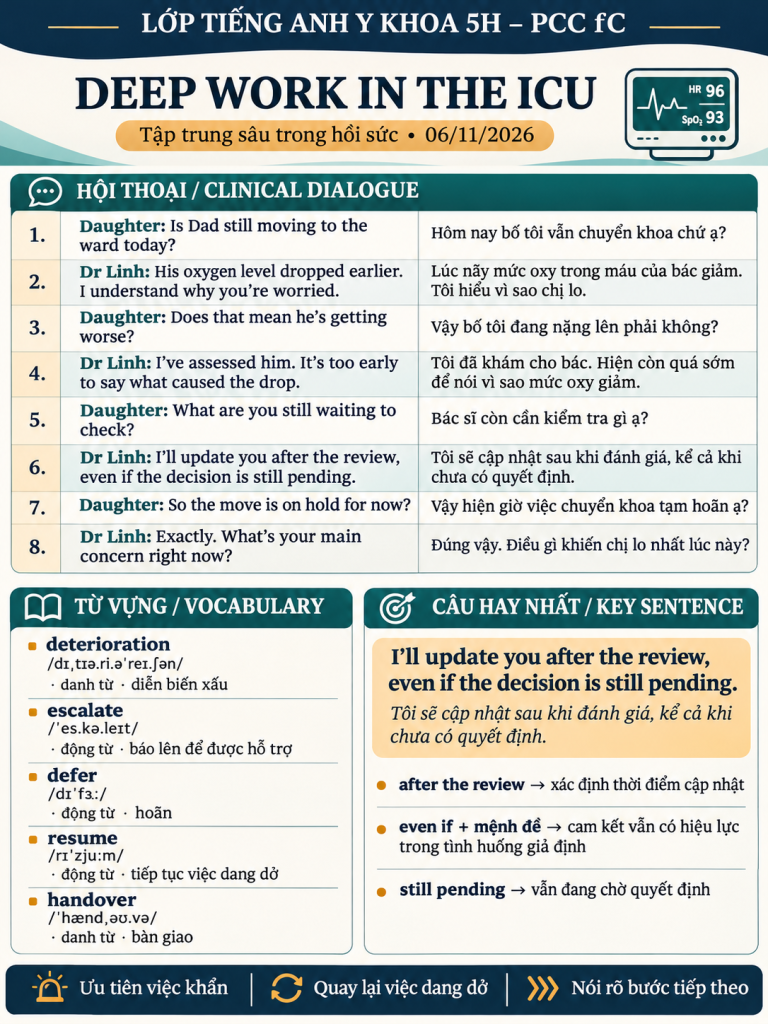
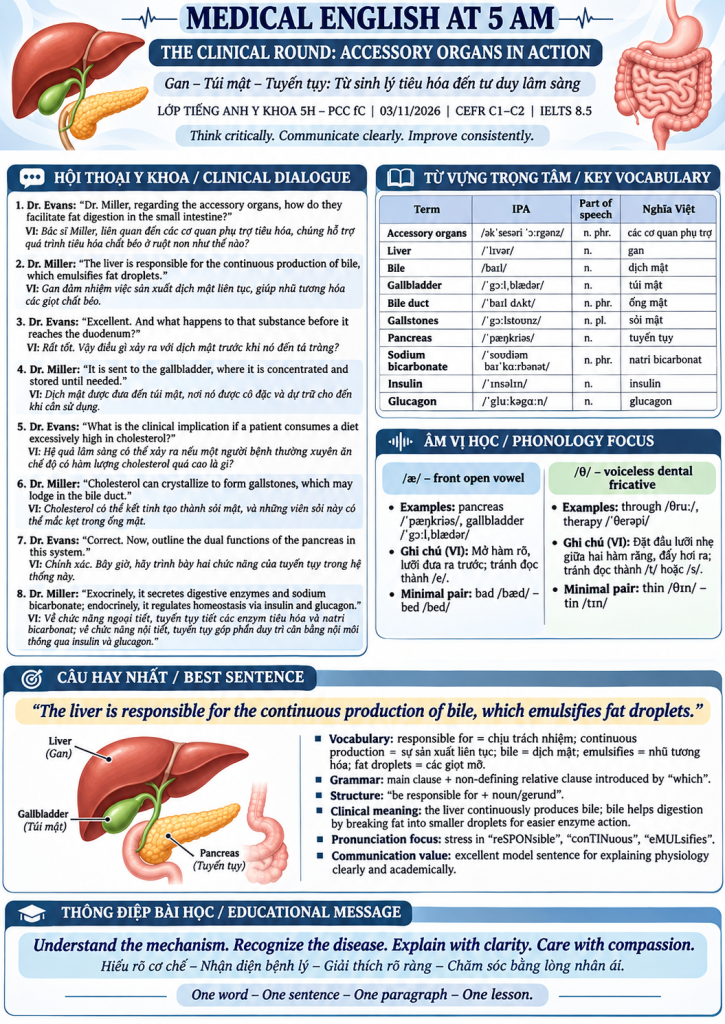
Turn 1 – Dr Evans
English: I’ve been reading about octopus intelligence. Apparently, their nervous systems are highly decentralized, with much of the neural processing occurring in their arms.
Vietnamese: Tôi vừa đọc về trí thông minh của bạch tuộc. Có vẻ như hệ thần kinh của chúng mang tính phi tập trung rất cao, với phần lớn hoạt động xử lý thần kinh diễn ra ở các cánh tay.
Turn 2 – Dr Miller
English: That’s fascinating. It challenges the assumption that complex behavior necessarily requires a brain organized like ours.
Vietnamese: Điều đó thật thú vị. Nó thách thức giả định rằng hành vi phức tạp nhất thiết phải cần một bộ não được tổ chức giống bộ não con người.
Turn 3 – Dr Evans
English: More importantly, experimental evidence suggests that octopuses may experience pain rather than merely respond reflexively to harmful stimuli.
Vietnamese: Quan trọng hơn, bằng chứng thực nghiệm cho thấy bạch tuộc có thể trải nghiệm đau thay vì chỉ phản ứng theo phản xạ trước những kích thích gây hại.
Turn 4 – Dr Miller
English: That distinction between nociception and pain is clinically relevant, particularly when assessing patients who cannot communicate.
Vietnamese: Sự phân biệt giữa quá trình cảm nhận kích thích gây hại và trải nghiệm đau có ý nghĩa lâm sàng, đặc biệt khi đánh giá những người bệnh không thể giao tiếp.
Turn 5 – Dr Evans
English: Exactly. Our ventilated patient is unable to report pain, but that does not mean pain is absent. We should use an appropriate validated behavioral assessment tool.
Vietnamese: Chính xác. Người bệnh đang thở máy của chúng ta không thể tự báo cáo đau, nhưng điều đó không có nghĩa là họ không đau. Chúng ta nên sử dụng một công cụ đánh giá đau dựa trên hành vi đã được thẩm định và phù hợp.
Turn 6 – Dr Miller
English: Agreed. We should also consider the patient’s clinical condition and avoid relying solely on physiological indicators.
Vietnamese: Tôi đồng ý. Chúng ta cũng cần xem xét tình trạng lâm sàng của người bệnh và tránh chỉ dựa vào các chỉ số sinh lý.
Turn 7 – Dr Evans
English: Precisely. Research on octopuses broadens our perspective, but clinical decisions must remain grounded in evidence obtained from humans.
Vietnamese: Chính xác. Nghiên cứu trên bạch tuộc giúp mở rộng góc nhìn của chúng ta, nhưng các quyết định lâm sàng vẫn phải dựa trên bằng chứng thu được từ nghiên cứu ở người.
Turn 8 – Dr Miller
English: So the broader lesson is to remain intellectually curious, distinguish evidence from speculation, and communicate uncertainty responsibly.
Vietnamese: Như vậy, bài học rộng hơn là luôn duy trì sự tò mò trí tuệ, phân biệt bằng chứng với suy đoán và truyền đạt sự chưa chắc chắn một cách có trách nhiệm.
OET Medicine – Communication Focus
Useful professional expressions:
- “The available evidence suggests that…” – Bằng chứng hiện có cho thấy rằng…
- “We should distinguish between…” – Chúng ta nên phân biệt giữa…
- “It would be inappropriate to assume that…” – Sẽ không phù hợp nếu cho rằng…
- “Let me explain what this means in practice.” – Để tôi giải thích điều này có ý nghĩa gì trong thực hành.
- “What concerns you most about this?” – Điều gì khiến anh/chị lo lắng nhất về vấn đề này?
- “Could you tell me what you understand so far?” – Anh/chị có thể cho tôi biết đến lúc này mình đã hiểu những gì không?
Teaching point: Khi giao tiếp với người bệnh hoặc gia đình, tránh sử dụng thuật ngữ phức tạp mà không giải thích. Cần thể hiện sự đồng cảm, kiểm tra mức độ hiểu và sử dụng ngôn ngữ phù hợp với người nghe.
PART 6. PRONUNCIATION FOCUS – TRỌNG TÂM PHÁT ÂM
6.1. Five Priority Words
1. Cognition /kɒɡˈnɪʃən/
Syllable stress: second syllable.
Phần nhấn âm nằm ở âm tiết thứ hai.
2. Nociception /ˌnəʊsɪˈsepʃən/
Primary stress: third syllable.
Nhấn chính vào âm tiết thứ ba.
3. Sentience /ˈsenʃəns/
Primary stress: first syllable.
Chú ý âm /ʃ/ như trong “she”.
4. Neuroplasticity /ˌnjʊərəʊplæˈstɪsəti/
Primary stress: fourth syllable.
Luyện đọc rõ phụ âm /pl/ và nhóm âm /st/.
5. Decentralized /ˌdiːˈsentrəlaɪzd/
Primary stress: second syllable.
Chú ý phân biệt /s/ và /z/ ở các vị trí khác nhau trong từ.
6.2. Phoneme Contrast
/s/ versus /ʃ/
- See /siː/
- She /ʃiː/
- Sensory /ˈsensəri/
- Conscious /ˈkɒnʃəs/
/ɪ/ versus /iː/
- Sit /sɪt/
- Seat /siːt/
- Live /lɪv/
- Leave /liːv/
6.3. Connected Speech Practice
Read the following sentence naturally:
“Evidence suggests that octopuses may experience pain.”
Pronunciation practice:
- Stress: EVidence – sugGESTS – OCtopuses – exPERience – PAIN.
- Reduce the unstressed words naturally.
- Maintain clear articulation of important scientific terms.
- Do not rush through long multisyllabic words.
Micro-task: Each learner selects one difficult term and produces one meaningful scientific sentence.
PART 7. ADVANCED GRAMMAR – HAI CẤU TRÚC NGỮ PHÁP C1–C2
Structure 1. Scientific Hedging – Diễn đạt thận trọng trong khoa học
Form
Subject + may / might / appear to / seem to + verb
It is possible that + clause
Evidence suggests that + clause
Examples
Example A:
“Octopuses may experience affective pain.”
Bạch tuộc có thể trải nghiệm khía cạnh cảm xúc của đau.
Example B:
“The findings suggest that complex cognition can evolve independently.”
Các phát hiện cho thấy nhận thức phức tạp có thể tiến hóa độc lập.
Advanced Comparison
Overstatement:
“Octopuses definitely dream.”
Khẳng định quá mức: Bạch tuộc chắc chắn nằm mơ.
Scientific alternative:
“Octopuses exhibit active sleep, although whether they dream remains uncertain.”
Diễn đạt khoa học: Bạch tuộc có biểu hiện ngủ hoạt động, mặc dù việc chúng có nằm mơ hay không vẫn chưa được xác định.
Application
Rewrite:
“Octopuses understand human emotions.”
Suggested answer:
“Some octopuses display complex behavioral responses, but there is insufficient evidence to conclude that they understand human emotions.”
Key lesson: Academic excellence requires not only advanced vocabulary but also appropriate calibration of scientific certainty.
Structure 2. Participle Clauses – Mệnh đề phân từ
Form A: Present Participle
V-ing + …, main clause.
Example:
“Possessing highly distributed nervous systems, octopuses can coordinate complex arm movements.”
Sở hữu hệ thần kinh phân tán rất phát triển, bạch tuộc có thể phối hợp các chuyển động phức tạp của cánh tay.
Form B: Past Participle
V-ed / past participle + …, main clause.
Example:
“Supported by experimental evidence, this hypothesis deserves further investigation.”
Được hỗ trợ bởi bằng chứng thực nghiệm, giả thuyết này xứng đáng được tiếp tục nghiên cứu.
Grammar Rule
The implied subject of a participle clause should normally be the same as the subject of the main clause.
Chủ ngữ ngầm của mệnh đề phân từ thông thường phải trùng với chủ ngữ của mệnh đề chính.
Common Error
Incorrect:
“Having studied octopus intelligence, the findings were fascinating.”
Correct:
“Having studied octopus intelligence, the researchers found the results fascinating.”
Practice
Combine the sentences:
“Octopuses have flexible arms. They can manipulate objects efficiently.”
Suggested answer:
“Possessing highly flexible arms, octopuses can manipulate objects efficiently.”
PART 8. INTEGRATED SKILLS – LISTENING, SPEAKING, READING AND WRITING
8.1. LISTENING – NGHE HIỂU
Task: Listen and identify three important scientific findings.
Questions:
- What makes octopus nervous systems unusual?
- What evidence suggests that octopuses may experience pain?
- Why is it scientifically inappropriate to conclude that octopuses dream?
Listening target: Identify main ideas, supporting evidence, and expressions of uncertainty.
THREE-MINUTE PASSIVE LISTENING SCRIPT
Title: Eight Arms, Extraordinary Intelligence
Suggested delivery: Approximately 110–120 words per minute, with natural pauses.
Good morning, everyone.
Today, let us explore one of the most remarkable creatures in the ocean: the octopus.
At first glance, an octopus might seem completely different from us. It has eight flexible arms, a soft body, and an extraordinary ability to change its appearance.
Yet beneath this unusual anatomy lies a highly sophisticated nervous system.
The common octopus possesses approximately five hundred million neurons. Remarkably, most of these neurons are located in its arms rather than its central brain.
This arrangement allows extensive sensory processing and motor coordination to occur locally.
In other words, the octopus demonstrates that intelligence does not always depend on a highly centralized system.
Octopuses can learn from experience, solve problems, and manipulate objects.
Some species even carry coconut shells and use them as protective shelters.
Their ability to adapt to unfamiliar situations has fascinated scientists for decades.
But perhaps the most intriguing discoveries concern pain and sleep.
Experimental studies suggest that octopuses can experience an unpleasant aspect of pain, rather than merely responding automatically to harmful stimuli.
Researchers have also identified two distinct sleep states: quiet sleep and active sleep.
During active sleep, octopuses display changes in skin patterns and neural activity.
However, scientists have not established whether these animals actually dream.
This distinction is essential.
In science, we must distinguish what has been demonstrated from what remains uncertain.
These discoveries also offer an interesting perspective for healthcare professionals.
In clinical medicine, we encounter patients who cannot communicate their experiences directly.
Their inability to speak does not necessarily mean that they cannot experience pain.
We therefore need reliable assessment methods, clinical judgment, and compassionate communication.
Research on octopuses cannot replace human clinical evidence, but it can encourage us to think more deeply about nervous systems and subjective experience.
The broader lesson extends beyond biology and medicine.
Intelligence can take many forms.
Different minds may solve problems in different ways.
Creativity, adaptability, and curiosity are valuable capacities in both nature and human life.
As we begin another day of learning, remember this message:
Stay curious.
Question your assumptions.
Respect the evidence.
And never stop learning.
Because the true purpose of education is not merely to accumulate knowledge, but to develop the wisdom to use it responsibly.
8.2. SPEAKING – LUYỆN NÓI
Task A – Scientific Explanation
Speak for 45–60 seconds:
“Why are octopuses considered intelligent?”
Use at least three target vocabulary items.
Suggested response:
“Octopuses are considered highly intelligent because they demonstrate sophisticated cognition, remarkable adaptability, and effective problem-solving. Their decentralized nervous systems allow extensive sensory processing within their arms. Moreover, their ability to learn from experience and manipulate objects illustrates a form of intelligence that evolved independently of human cognition.”
Task B – OET-Informed Clinical Explanation
Explain to a family member why a mechanically ventilated patient may still experience pain despite being unable to speak.
Suggested response:
“I understand why this is worrying. Although your family member cannot tell us whether they are in pain, that does not necessarily mean they are comfortable. We assess possible pain by observing their behavior and using appropriate clinical tools. We also consider their overall condition and response to treatment. Our aim is to keep them as comfortable and safe as possible.”
Speaking Feedback Criteria
Assess:
- Clarity and intelligibility.
- Fluency and logical organization.
- Accurate scientific language.
- Appropriate expression of uncertainty.
- Empathy and audience-appropriate communication.
8.3. READING – ĐỌC HIỂU
Read the two passages in Part 1.
Question 1: Why is octopus intelligence evolutionarily significant?
Question 2: What is the advantage of distributed neural processing?
Question 3: What evidence supports the possibility of affective pain in octopuses?
Question 4: Why should active sleep not automatically be equated with dreaming?
Reading strategy:
Identify the claim, supporting evidence, scientific limitation, and overall conclusion.
8.4. WRITING – LUYỆN VIẾT
Academic Writing Task
Write a 60–80-word paragraph responding to:
“What can healthcare professionals learn from octopus research?”
Requirements:
- Use at least three advanced vocabulary items.
- Include one scientific hedging expression.
- Include one participle clause.
- Distinguish scientific inspiration from direct clinical evidence.
Model Answer
“Studying octopus cognition provides valuable insights into the diversity of nervous systems. Possessing decentralized neural networks, octopuses demonstrate remarkable adaptability and behavioral flexibility. Research also suggests that they may experience affective pain, raising important questions about sentience. For healthcare professionals, these findings encourage scientific curiosity and critical thinking. Nevertheless, clinical decisions must remain grounded in validated human evidence, particularly when assessing pain in non-communicative patients.”
Self-Editing Checklist
- Is the scientific claim accurate?
- Have I avoided unnecessary certainty?
- Is the grammar correct?
- Is the vocabulary precise?
- Is the conclusion logically supported?
PART 9. MINI-ASSESSMENT, ANSWER KEY AND FEEDBACK – KIỂM TRA, ĐÁP ÁN VÀ PHẢN HỒI
Suggested assessment: 10 questions, 10 points, approximately 5 minutes.
Instructions: Choose the best answer or complete the sentence.
SECTION A – SCIENTIFIC KNOWLEDGE
Q1. Approximately how many neurons does the common octopus possess?
A. 5 million
B. 50 million
C. 500 million
D. 5 billion
Q2. Which statement is scientifically most accurate?
A. Octopuses definitely dream.
B. Octopuses have nine fully independent brains.
C. Octopuses exhibit distributed neural processing.
D. Octopuses possess the same consciousness as humans.
Q3. Which statement best distinguishes nociception from pain?
A. They are always identical.
B. Nociception refers to neural processing of harmful stimuli, whereas pain involves an unpleasant experience.
C. Pain can only occur when a patient speaks.
D. Nociception always requires conscious awareness.
Q4. Which observation provides evidence relevant to affective pain in octopuses?
A. The presence of eight arms.
B. Rapid changes in skin color alone.
C. Avoidance of environments associated with noxious stimulation and preference for contexts associated with pain relief.
D. The presence of three hearts.
SECTION B – VOCABULARY AND GRAMMAR
Q5. Choose the best word.
“The __________ organization of the octopus nervous system supports local information processing.”
A. decentralized
B. unconscious
C. rigid
D. vertebral
Q6. Which sentence demonstrates appropriate scientific hedging?
A. Octopuses unquestionably experience human-like dreams.
B. Research suggests that octopuses may experience affective pain.
C. All octopuses have human intelligence.
D. Scientists have proven that octopuses think exactly like humans.
Q7. Choose the grammatically correct sentence.
A. Having highly flexible arms, objects can be manipulated by octopuses.
B. Possessing highly flexible arms, octopuses can manipulate objects efficiently.
C. Possessed highly flexible arms, octopuses manipulating objects.
D. Having flexible arms, the experiment was successful.
Q8. Which word is closest in meaning to “sentience”?
A. Rapid movement.
B. The capacity for subjective experience.
C. Genetic mutation.
D. Physical strength.
SECTION C – CLINICAL COMMUNICATION
Q9. A mechanically ventilated patient cannot report pain. What is the most appropriate response?
A. Assume the patient is pain-free.
B. Use heart rate alone to determine pain severity.
C. Use an appropriate validated behavioral pain assessment tool and clinical judgment.
D. Withhold pain assessment until the patient can speak.
Q10. Which statement best demonstrates responsible scientific communication?
A. “There is absolutely no uncertainty.”
B. “We can ignore conflicting findings.”
C. “The available evidence supports this interpretation, although some questions remain unresolved.”
D. “Scientific theories never change.”
ANSWER KEY – ĐÁP ÁN
Q1: C. Approximately 500 million neurons, based on estimates for the common octopus.
Q2: C. Distributed neural processing is a defining feature of the octopus nervous system. The phrase “nine independent brains” is an oversimplification.
Q3: B. Nociception and pain are related but distinct phenomena.
Q4: C. Conditioned place avoidance and preference associated with pain relief support the interpretation of affective pain.
Q5: A. Decentralized means that neural processing is distributed across multiple anatomical structures.
Q6: B. “Suggests” and “may” appropriately communicate uncertainty.
Q7: B. The subject of the participle clause is consistent with the subject of the main clause.
Q8: B. Sentience refers to the capacity for subjective experience, including pleasant and unpleasant states.
Q9: C. Pain assessment should use suitable validated tools and clinical evaluation, considering their applicability to the patient’s condition.
Q10: C. Scientific communication should accurately reflect both the evidence and its limitations.
FEEDBACK AND PERFORMANCE INTERPRETATION
9–10 points – Excellent
Strong scientific comprehension, accurate academic English, and sound critical thinking.
Feedback: Extend your answers by comparing evidence across studies and explaining limitations more precisely.
7–8 points – Proficient
Good understanding with minor weaknesses in technical vocabulary or evidence interpretation.
Feedback: Revisit scientific hedging, the distinction between nociception and pain, and the use of participle clauses.
5–6 points – Developing
Basic comprehension is present, but greater precision is required.
Feedback: Review the ten vocabulary items, repeat the medical dialogue, and practise explaining scientific claims in simpler English.
0–4 points – Needs Reinforcement
Further foundational practice is recommended.
Feedback: Re-read both passages, identify five essential ideas, and practise producing short, accurate sentences before progressing to complex academic explanations.
Formative Assessment Principles
Feedback should be:
- Specific – identify the exact strength or error.
- Actionable – explain what the learner should improve.
- Timely – provide feedback immediately after practice.
- Constructive – encourage reflection and continued development.
Reminder: This mini-test assesses achievement of the lesson objectives; it does not constitute a validated CEFR, IELTS, or OET score.
PART 10. EDUCATIONAL MESSAGE – THÔNG ĐIỆP GIÁO DỤC
DIFFERENT MINDS. DIFFERENT PATHWAYS. ENDLESS POSSIBILITIES.
English
“The octopus reminds us that intelligence does not follow a single evolutionary pathway.
In medicine, as in nature, progress depends not only on what we know, but also on our willingness to question assumptions, adapt to new evidence, and remain open to different perspectives.
A truly excellent clinician is not someone who claims to know everything, but someone who thinks critically, communicates compassionately, and continues learning throughout life.
Stay curious. Respect the evidence. Care for others. Never stop improving.”
Tiếng Việt
“Bạch tuộc nhắc nhở chúng ta rằng trí thông minh không chỉ phát triển theo một con đường tiến hóa duy nhất.
Trong y học cũng như trong tự nhiên, sự tiến bộ không chỉ phụ thuộc vào những gì chúng ta đã biết, mà còn phụ thuộc vào sự sẵn sàng đặt câu hỏi trước các giả định, thích nghi với bằng chứng mới và cởi mở trước những góc nhìn khác biệt.
Một bác sĩ thực sự xuất sắc không phải là người tuyên bố mình biết mọi điều, mà là người luôn tư duy phản biện, giao tiếp bằng lòng nhân ái và không ngừng học hỏi suốt cuộc đời.
Hãy luôn tò mò khám phá. Tôn trọng bằng chứng. Quan tâm đến người khác. Và không ngừng tiến bộ.”
ONE WORD – ONE SENTENCE – ONE PARAGRAPH – ONE LESSON
One Word: Adaptability /əˌdæptəˈbɪləti/ (n.) – Khả năng thích nghi.
One Sentence:
“Intelligence flourishes when curiosity meets adaptability.”
Trí thông minh phát triển mạnh mẽ khi sự tò mò gặp gỡ khả năng thích nghi.
One Paragraph:
“Nature teaches us that intelligence takes many forms. By embracing curiosity, evaluating evidence, and adapting to change, we become better learners, more responsible professionals, and more compassionate human beings.”
Thiên nhiên dạy chúng ta rằng trí thông minh tồn tại dưới nhiều hình thức. Bằng cách nuôi dưỡng sự tò mò, đánh giá bằng chứng và thích nghi với thay đổi, chúng ta trở thành những người học tốt hơn, những người làm nghề có trách nhiệm hơn và những con người giàu lòng nhân ái hơn.
One Lesson:
“Learn with curiosity. Think with evidence. Act with compassion.”
Học bằng sự tò mò. Tư duy dựa trên bằng chứng. Hành động bằng lòng nhân ái.
REFERENCES – TÀI LIỆU THAM KHẢO
Medical Education and Language Assessment
- Harden RM, Crosby JR, Davis MH. AMEE Guide No. 14: Outcome-based education: Part 1—An introduction to outcome-based education. Medical Teacher. 1999;21(1):7–14. DOI: 10.1080/01421599979969.
- AMEE. Designing and Planning Learning. AMEE educational course resources. https://amee.org/education/courses/designing-and-planning-learning/
- OET. OET Test Teachers’ Handbook. 2024. Sections on Speaking assessment and clinical communication. https://cdn-aus.aglty.io/oet/OET%20Test%20teachers%20handbook%202024.pdf
Octopus Neuroscience and Cognition
- Schnell AK, Amodio P, Boeckle M, Clayton NS. How intelligent is a cephalopod? Lessons from comparative cognition. Biological Reviews. 2021;96(1):162–178. DOI: 10.1111/brv.12651.
- Albertin CB, et al. The octopus genome and the evolution of cephalopod neural and morphological novelties. Nature. 2015;524:220–224. DOI: 10.1038/nature14668.
- Finn JK, Tregenza T, Norman MD. Defensive tool use in a coconut-carrying octopus. Current Biology. 2009;19(23)–R1070. DOI: 10.1016/j.cub.2009.10.052.
- Crook RJ. Behavioral and neurophysiological evidence suggests affective pain experience in octopus. iScience. 2021;24(3):102229. DOI: 10.1016/j.isci.2021.102229.
- Pophale A, et al. Wake-like skin patterning and neural activity during octopus sleep. Nature. 2023;619:129–134. DOI: 10.1038/s41586-023-06203-4.
- Olson SS, Ragsdale CW. Toward an understanding of octopus arm motor control. Integrative and Comparative Biology. 2023;63(6):1277–1284. DOI: 10.1093/icb/icad069.
PCC fC – Vì một đam mê Khỏe Vui Hạnh phúc.
Think critically. Communicate clearly. Improve consistently.