Bài 32 – Tiếng Anh Y Khoa: Lời kể của bệnh nhân trở thành bệnh án * Hematemesis & Melena
PCC fC Language – Thăng Long, Hà Nội, ngày 16/06/2026, Trong thực hành lâm sàng, có những triệu chứng chỉ nghe qua đã khiến người thầy thuốc phải lập tức cảnh giác: nôn ra máu, đi ngoài phân đen, da niêm mạc nhợt, hemoglobin giảm sâu. Đó không chỉ là những dấu hiệu của mất máu, mà còn là lời cảnh báo về một bệnh cảnh có thể diễn biến nhanh, nặng và cần xử trí kịp thời: xuất huyết tiêu hóa trên. Bài 32 hôm nay đưa chúng ta đến với một ca bệnh điển hình: một bệnh nhân nam 53 tuổi, có tiền sử uống rượu kéo dài và tự dùng thuốc giảm đau lâu ngày, vào viện vì hematemesis và melena. Từ một lời kể rất đời thường của bệnh nhân — “tôi nôn ra máu và đi ngoài phân đen” — chúng ta sẽ học cách chuyển hóa thành ngôn ngữ y khoa chuẩn xác: hematemesis, melena, epigastric pain, esophageal varices, gastric ulceration, cirrhosis.
Điểm đặc biệt của bài học hôm nay là chúng ta không chỉ học tiếng Anh, mà học cách tư duy như một người thầy thuốc. Chúng ta sẽ nhìn ca bệnh bằng hai lăng kính: lăng kính ngôn ngữ học để hiểu từ, cấu trúc câu và cách trình bày bệnh án; lăng kính lâm sàng để hiểu cơ chế bệnh sinh, nhận diện nguy cơ, phân tích nguyên nhân và định hướng xử trí.
Từ alcohol đến cirrhosis, từ cirrhosis đến portal hypertension, từ portal hypertension đến esophageal varices, và cuối cùng là hematemesis, melena — mỗi mắt xích là một bài học về y học, cũng là một bài học về cách dùng tiếng Anh chính xác.
Bài học hôm nay nhắc chúng ta rằng: Tiếng Anh Y khoa không phải là học thuộc từ vựng rời rạc. Tiếng Anh Y khoa là năng lực biến lời kể của bệnh nhân thành bệnh án, biến bệnh án thành lập luận, và biến lập luận thành hành động điều trị.
From words to diagnosis.
From diagnosis to treatment.
From treatment to prevention.
Chúng ta cùng bắt đầu Bài 32: Upper Gastrointestinal Bleeding.
BÀI 32 – LỚP TIẾNG ANH Y KHOA 5 GIỜ SÁNG
Upper Gastrointestinal Bleeding
Giải mã bệnh án bằng “Dual-Lens Framework”: Ngôn ngữ học & Lâm sàng
Chủ đề: Xuất huyết tiêu hóa trên ở bệnh nhân xơ gan do rượu và loét dạ dày do dùng thuốc giảm đau kéo dài.
Thông điệp bài học:
Một bệnh án tốt không chỉ kể lại triệu chứng, mà phải biến triệu chứng thành ngôn ngữ y khoa, biến dữ kiện thành lập luận lâm sàng, và biến can thiệp cấp cứu thành kế hoạch dự phòng tái phát.
Sĩ số: 50/98
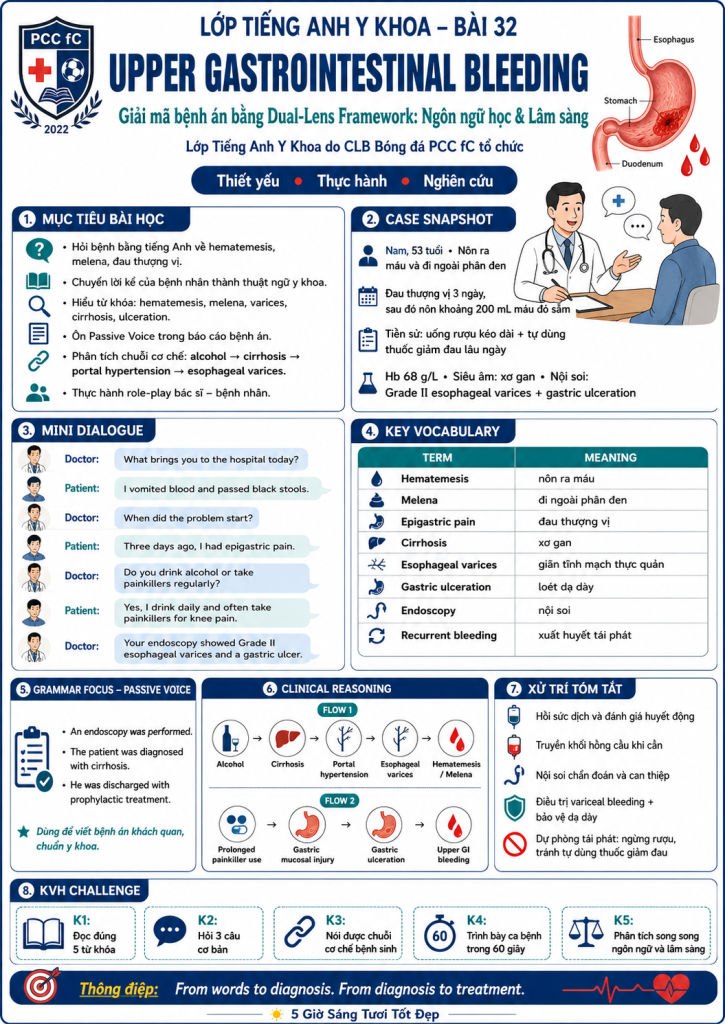
1. Mục tiêu bài học
Sau bài này, học viên có thể:
- Hỏi bệnh bằng tiếng Anh về nôn máu, đi ngoài phân đen, đau thượng vị, uống rượu và dùng thuốc giảm đau.
- Chuyển ngôn ngữ đời thường của bệnh nhân thành thuật ngữ y khoa chính xác.
- Hiểu và sử dụng các từ khóa: hematemesis, melena, varices, cirrhosis, ulceration, hemodynamically stable, endoscopy, ligation, prophylaxis, recurrent bleeding.
- Dùng Passive Voice trong báo cáo y khoa.
- Trình bày ngắn gọn cơ chế:
Alcohol → cirrhosis → portal hypertension → esophageal varices → hematemesis/melena. - Phân biệt xử trí cấp cứu và quản lý dự phòng sau xuất huyết.
2. Cấu trúc 25 phút
05:00 – 05:03 | Warm-up: “From black stool to melena”
Giáo viên hỏi nhanh:
Question 1:
If a patient says, “I vomited blood,” how do we write it in a medical report?
Expected answer:
The patient had hematemesis.
Question 2:
If a patient says, “I passed black, tarry stools,” how do we write it?
Expected answer:
The patient had melena.
Question 3:
If a patient has twisted, enlarged veins in the esophagus, what are they called?
Expected answer:
They are called esophageal varices.
3. Case Input – The Raw Data
A 53-year-old male was admitted because of hematemesis and melena.
He had a history of heavy alcohol consumption and prolonged self-medication with painkillers for knee pain.
Three days before admission, he developed epigastric pain.
One day later, he vomited about 200 mL of dark-red blood and subsequently passed black, tarry stools several times.
On examination, he was alert and hemodynamically stable.
He had pale conjunctivae and skin. Abdominal examination was unremarkable, without ascites or hepatosplenomegaly.
Laboratory tests showed moderate anemia, with hemoglobin of 68 g/L.
Abdominal ultrasound demonstrated cirrhotic changes of the liver.
Upper gastrointestinal endoscopy revealed Grade II esophageal varices and gastric ulceration.
4. Core Dialogue – Doctor and Patient
Doctor: Good morning. I’m Dr. ___. What brings you to the hospital today?
Patient: Good morning, doctor. I vomited blood and passed black stools.
Doctor: When did the problem start?
Patient: Three days ago, I started having pain in the upper part of my abdomen.
Doctor: Was the pain in the epigastric area, just below the breastbone?
Patient: Yes, that’s right.
Doctor: Did you vomit blood after that?
Patient: Yes. One day later, I vomited about 200 milliliters of dark-red blood.
Doctor: Did you pass black, tarry stools?
Patient: Yes, several times.
Doctor: Have you ever had this problem before?
Patient: No, this is the first time.
Doctor: Do you drink alcohol?
Patient: Yes, I drink about 300 milliliters every day. I have done that for about 20 years.
Doctor: Do you take any medicines regularly?
Patient: Yes, I often take painkillers for my knee pain.
Doctor: Were they prescribed by a doctor?
Patient: No, I bought them myself and took them for a long time.
Doctor: Do you feel dizzy, tired, or short of breath?
Patient: I feel tired and weak, but I can still talk normally.
Doctor: Your blood pressure and pulse are stable, but you look pale. Your blood test shows anemia. Your hemoglobin is 68 grams per liter.
Patient: Is that serious?
Doctor: It means you have lost a significant amount of blood. We need to monitor you carefully, stabilize you, and find the bleeding source.
Patient: What may have caused the bleeding?
Doctor: There are two possible causes. Long-term alcohol use may have caused cirrhosis, leading to esophageal varices. Long-term painkiller use may also have caused a gastric ulcer.
Patient: What did the endoscopy show?
Doctor: It showed Grade II esophageal varices and a gastric ulcer.
Patient: What will you do next?
Doctor: We will stabilize your circulation, give blood transfusion if needed, treat the bleeding source by endoscopy, protect your stomach, and prevent recurrent bleeding.
Patient: What should I avoid after discharge?
Doctor: You should stop alcohol completely and avoid taking painkillers without medical advice.
5. Từ vựng trọng tâm có phiên âm
Nhóm triệu chứng
- Hematemesis /ˌhiː.məˈtem.ə.sɪs/
Nôn ra máu. - Melena /məˈliː.nə/
Đi ngoài phân đen do máu đã tiêu hóa. - Epigastric pain /ˌep.ɪˈɡæs.trɪk peɪn/
Đau thượng vị. - Black, tarry stools /blæk ˈtɑː.ri stuːlz/
Phân đen như hắc ín. - Pale conjunctivae /peɪl kənˌdʒʌŋkˈtaɪ.viː/
Kết mạc nhợt.
Nhóm chẩn đoán – cơ chế bệnh sinh
- Cirrhosis /sɪˈroʊ.sɪs/
Xơ gan. - Portal hypertension /ˈpɔːr.təl ˌhaɪ.pərˈten.ʃən/
Tăng áp lực tĩnh mạch cửa. - Esophageal varices /ɪˌsɑː.fəˈdʒiː.əl ˈver.ɪ.siːz/
Giãn tĩnh mạch thực quản. - Gastric ulceration /ˈɡæs.trɪk ˌʌl.səˈreɪ.ʃən/
Loét dạ dày. - Moderate anemia /ˈmɑː.dər.ət əˈniː.mi.ə/
Thiếu máu mức độ vừa.
Nhóm xử trí
- Fluid resuscitation /ˈfluː.ɪd rɪˌsʌs.ɪˈteɪ.ʃən/
Hồi sức dịch. - Packed red blood cells /pækt red blʌd selz/
Khối hồng cầu. - Endoscopy /enˈdɑː.skə.pi/
Nội soi. - Band ligation /bænd laɪˈɡeɪ.ʃən/
Thắt vòng qua nội soi. - Propranolol /proʊˈpræn.ə.lɔːl/
Thuốc chẹn beta dùng để giảm nguy cơ xuất huyết tái phát ở bệnh nhân phù hợp. - Recurrent bleeding /rɪˈkɝː.ənt ˈbliː.dɪŋ/
Xuất huyết tái phát. - Prophylaxis /ˌproʊ.fəˈlæk.sɪs/
Dự phòng.
6. Giải mã từ vựng bằng hình thái học
Hematemesis
Hemato- = blood
-emesis = vomiting
→ Hematemesis = vomiting blood
→ Nôn ra máu.
Melena
Melan- = black
-a = noun ending
→ Melena = black stool caused by digested blood
→ Đi ngoài phân đen.
Hemoptysis
Hemo- = blood
-ptysis = spitting/coughing up
→ Hemoptysis = coughing up blood
→ Ho ra máu.
Điểm phân biệt quan trọng:
Hematemesis là nôn máu từ đường tiêu hóa.
Hemoptysis là ho ra máu từ đường hô hấp.
7. Synonym Match – Chuyển lời bệnh nhân thành thuật ngữ y khoa
| Layman’s term | Medical terminology |
| Vomiting blood | Hematemesis |
| Black, tarry stools | Melena |
| Twisted, enlarged veins | Varices |
| Pain in the upper abdomen | Epigastric pain |
| Long-term alcohol drinking | Chronic alcohol consumption |
| Taking painkillers for a long time | Prolonged self-medication with analgesics |
8. Grammar Focus – Clinical Passive Voice
Trong báo cáo y khoa, thể bị động giúp câu văn khách quan hơn, tập trung vào bệnh nhân và can thiệp thay vì người thực hiện.
Công thức
Subject + was/were + past participle
Ví dụ
Active:
The doctor performed an endoscopy.
Passive:
An endoscopy was performed.
Active:
The endoscopy showed esophageal varices.
Passive / Academic style:
Upper gastrointestinal endoscopy revealed esophageal varices.
Active:
We diagnosed the patient with cirrhosis.
Passive:
The patient was diagnosed with cirrhosis.
Active:
We discharged him with propranolol.
Passive:
He was discharged with propranolol.
9. Clinical Reasoning – Bản đồ tư duy lâm sàng
Chuỗi nguyên nhân 1: Rượu và xơ gan
Heavy alcohol consumption
→ Cirrhotic changes of the liver
→ Portal hypertension
→ Esophageal varices
→ Hematemesis and melena
Chuỗi nguyên nhân 2: Thuốc giảm đau và loét dạ dày
Prolonged self-medication with painkillers
→ Gastric mucosal injury
→ Gastric ulceration
→ Upper gastrointestinal bleeding
→ Hematemesis and melena
10. Clinical Interpretation – Đọc hiểu chi tiết bệnh án
“The patient was hemodynamically stable.”
Nghĩa là huyết áp và nhịp tim hiện chưa bị ảnh hưởng nặng.
Tuy nhiên, ổn định huyết động không có nghĩa là bệnh nhân nhẹ, vì hemoglobin đã giảm còn 68 g/L.
“The patient was alert.”
Bệnh nhân tỉnh táo, chưa có biểu hiện bệnh não gan rõ.
“Without ascites.”
Chưa có bằng chứng báng bụng trên khám lâm sàng.
“Without hepatosplenomegaly.”
Không thấy gan lách to khi thăm khám, nhưng không loại trừ xơ gan.
“Grade II esophageal varices.”
Có giãn tĩnh mạch thực quản mức độ II, là nguồn chảy máu tiềm tàng hoặc thực sự trong bối cảnh nôn máu và đi ngoài phân đen.
11. Treatment Rationale Matrix – Ma trận logic xử trí
| Intervention | Phase | Clinical rationale |
| Fluid resuscitation | Acute stabilization | Restore circulating volume |
| Packed red blood cells | Acute stabilization | Correct significant anemia |
| Upper GI endoscopy | Diagnosis and treatment | Identify and treat bleeding source |
| Band ligation | Acute control | Control esophageal variceal bleeding |
| PPI therapy | Ulcer management | Support treatment of gastric ulceration |
| Non-selective beta-blocker | Secondary prevention | Reduce risk of recurrent variceal bleeding when appropriate |
| Alcohol cessation | Long-term prevention | Prevent progression of liver disease |
| Avoid unsupervised painkillers | Long-term prevention | Reduce recurrent ulcer risk |
12. IELTS 8.5 Upgrade – Nâng cấp câu báo cáo
Basic sentence
The patient drank alcohol for many years.
Academic medical sentence
The patient had a long history of chronic alcohol consumption.
Basic sentence
He took painkillers by himself.
Academic medical sentence
He had prolonged self-medication with analgesics for knee pain.
Basic sentence
He vomited blood and had black stools.
Academic medical sentence
He presented with hematemesis and melena.
Basic sentence
The ultrasound showed liver cirrhosis.
Academic medical sentence
Abdominal ultrasound demonstrated cirrhotic changes of the liver.
Basic sentence
The endoscopy showed varices and a stomach ulcer.
Academic medical sentence
Upper gastrointestinal endoscopy revealed Grade II esophageal varices and gastric ulceration.
13. Practice 1 – Find the Error
Sentence 1
The patient was prescripted propranolol for prevent recurrent bleeding.
Correction
The patient was prescribed propranolol to prevent recurrent bleeding.
Sentence 2
The doctor performed an endoscopy and it showed varices.
Correction
An endoscopy was performed, which revealed esophageal varices.
Sentence 3
He has black stool many times.
Correction
He passed black, tarry stools several times.
Sentence 4
He drink alcohol 300 mL every day for 20 years.
Correction
He had consumed approximately 300 mL of alcohol daily for 20 years.
14. Practice 2 – Role-play theo cặp
Student A: Doctor
Nhiệm vụ:
- Hỏi lý do vào viện.
- Hỏi thời điểm khởi phát.
- Hỏi nôn máu.
- Hỏi đi ngoài phân đen.
- Hỏi tiền sử uống rượu.
- Hỏi tiền sử dùng thuốc giảm đau.
- Giải thích kết quả nội soi.
- Dặn dò sau ra viện.
Student B: Patient
Thông tin:
- Nam, 53 tuổi.
- Đau thượng vị 3 ngày.
- Nôn khoảng 200 mL máu đỏ sẫm.
- Đi ngoài phân đen vài lần.
- Uống khoảng 300 mL rượu mỗi ngày trong 20 năm.
- Tự dùng thuốc giảm đau kéo dài vì đau khớp gối.
- Mệt, yếu, nhưng vẫn tỉnh táo.
15. Practice 3 – One-minute Case Presentation
Mẫu trình bày:
This is a 53-year-old male who was admitted with hematemesis and melena.
He had a long history of chronic alcohol consumption and prolonged self-medication with analgesics for knee pain.
Three days before admission, he developed epigastric pain. One day later, he vomited approximately 200 mL of dark-red blood and subsequently passed black, tarry stools several times.
On examination, he was alert and hemodynamically stable, but he had pale conjunctivae and skin. Laboratory tests showed moderate anemia, with a hemoglobin level of 68 g/L.
Abdominal ultrasound demonstrated cirrhotic changes of the liver. Upper gastrointestinal endoscopy revealed Grade II esophageal varices and gastric ulceration.
The patient was managed with stabilization, endoscopic treatment, gastric protection, and secondary prevention of recurrent bleeding.
16. Phân tầng nhiệm vụ K1–K5
K1 – Khởi đầu
Đọc đúng 5 từ:
hematemesis, melena, varices, cirrhosis, endoscopy.
K2 – Khai mở
Nói được 3 câu hỏi bệnh:
- When did the bleeding start?
- Did you vomit blood?
- Did you pass black stools?
K3 – Kết nối
Nói được chuỗi nguyên nhân:
Alcohol may cause cirrhosis.
Cirrhosis may cause portal hypertension.
Portal hypertension may lead to esophageal varices.
Varices may cause hematemesis and melena.
K4 – Khá giỏi
Trình bày case trong 60 giây bằng tiếng Anh.
K5 – Kiệt xuất
Phân tích song song ngôn ngữ và lâm sàng:
The word hematemesis combines “hemato-”, meaning blood, and “-emesis”, meaning vomiting. Clinically, hematemesis indicates upper gastrointestinal bleeding. In this patient, the bleeding may be related to esophageal varices caused by portal hypertension secondary to cirrhosis, and also to gastric ulceration associated with prolonged analgesic use.
17. Câu hỏi kiểm tra nhanh cuối bài
- What does hematemesis mean?
- What does melena mean?
- What is the difference between hematemesis and hemoptysis?
- What does “hemodynamically stable” mean?
- What may long-term alcohol use cause?
- What may prolonged painkiller use cause?
- What did the endoscopy reveal?
- Why do we use Passive Voice in medical reports?
- How can we say “the doctor performed an endoscopy” in Passive Voice?
- What should the patient avoid after discharge?
18. Đáp án mẫu
- Hematemesis means vomiting blood.
- Melena means black, tarry stools caused by digested blood.
- Hematemesis comes from the gastrointestinal tract, while hemoptysis comes from the respiratory tract.
- Hemodynamically stable means blood pressure and heart rate are still maintained.
- Long-term alcohol use may cause cirrhosis.
- Prolonged painkiller use may cause gastric ulceration.
- Endoscopy revealed Grade II esophageal varices and gastric ulceration.
- Passive Voice makes medical writing more objective.
- An endoscopy was performed.
- The patient should avoid alcohol and unsupervised painkiller use.
19. KVH Challenge – Bài tập sau buổi học
Mỗi học viên gửi một bản ghi âm 45–60 giây, chọn một trong ba nhiệm vụ:
Nhiệm vụ 1 – K1/K2
Đọc 10 từ vựng chính và nghĩa tiếng Việt.
Nhiệm vụ 2 – K3/K4
Đóng vai bác sĩ hỏi bệnh nhân xuất huyết tiêu hóa.
Nhiệm vụ 3 – K5
Trình bày case bằng tiếng Anh học thuật, có ít nhất 5 từ:
hematemesis, melena, cirrhosis, varices, endoscopy, recurrent bleeding.
20. Closing Message
Bài học hôm nay cho chúng ta thấy:
Tiếng Anh Y khoa không chỉ là học từ vựng.
Đó là năng lực biến lời kể của bệnh nhân thành bệnh án, biến bệnh án thành lập luận, và biến lập luận thành hành động điều trị chính xác.
From words to diagnosis.
From diagnosis to treatment.
From treatment to prevention.
That is the real power of Medical English.
CLB Bóng đá PCC fC