Bài 80 – Tiếng Anh Y Khoa: Từ phơi nhiễm tới chẩn đoán, ngộ độc đa cơ quan và hỗ trợ tạng suy * From Exposure to Diagnosis, Multiorgan Toxicity, and Organ Support
PCC Language – Thăng Long Hà Nội, 10/8/2026, Trong bài học hôm nay, chúng ta sẽ cùng tìm hiểu một trường hợp ngộ độc cantharidin cấp nặng sau khi bệnh nhân ăn phải các con bọ ban miêu có chứa cantharidin. Bệnh nhân nhanh chóng xuất hiện độc tính đường tiêu hóa, đái máu đại thể, sốc tuần hoàn, và sau đó tiến triển thành rối loạn chức năng đa cơ quan nặng, bao gồm tổn thương thận cấp, toan chuyển hóa, tiêu cơ vân, rối loạn đông máu và suy giảm ý thức. Thông qua một đoạn hội thoại lâm sàng gồm 8 câu, chúng ta sẽ theo dõi một trình tự tư duy lâm sàng rõ ràng: phơi nhiễm → chẩn đoán → độc tính đa cơ quan → hỗ trợ cơ quan. Khung tư duy này không chỉ giúp chúng ta học các từ vựng và cấu trúc ngữ pháp quan trọng trong Tiếng Anh Y Khoa, mà còn giúp rèn luyện cách trình bày một bệnh nhân ngộ độc nặng một cách ngắn gọn, logic và chuyên nghiệp. Trọng tâm ngôn ngữ của bài học sẽ bao gồm các cách diễn đạt dùng để mô tả phơi nhiễm chất độc, diễn biến lâm sàng xấu đi, rối loạn chức năng cơ quan, hỗ trợ huyết động, liệu pháp thay thế thận, bảo vệ đường thở và thở máy xâm nhập. Sau bài học này, học viên sẽ có thể trình bày một ca ngộ độc nặng tự tin hơn và giải thích rõ vì sao các biện pháp hỗ trợ cơ quan quan trọng lại cần được chỉ định. Hãy nhớ: Đừng chỉ liệt kê các bất thường — hãy kể lại toàn bộ câu chuyện lâm sàng. Phơi nhiễm → Chẩn đoán → Độc tính đa cơ quan → Hỗ trợ cơ quan.
Welcome to Lesson 80 of the PCC fC Medical English Class. In today’s lesson, we will explore a severe case of acute cantharidin poisoning following the ingestion of cantharidin-containing blister beetles. The patient rapidly developed gastrointestinal toxicity, gross hematuria, circulatory shock, and subsequently severe multiorgan dysfunction, including acute kidney injury, metabolic acidosis, rhabdomyolysis, coagulopathy, and impaired consciousness. Through an eight-sentence clinical dialogue, we will follow a clear clinical reasoning pathway: exposure → diagnosis → multiorgan toxicity → organ support. This framework will help us learn not only important vocabulary and grammatical structures in Medical English, but also how to present a critically ill poisoned patient in a concise, logical, and professional manner.
Our key language focus will include expressions used to describe toxic exposure, clinical deterioration, organ dysfunction, hemodynamic support, renal replacement therapy, airway protection, and mechanical ventilation.
By the end of this lesson, you should be able to describe a severe poisoning case more confidently and explain why major organ-support interventions are required.
Remember: Don’t simply list abnormalities—tell the clinical story.
Exposure → Diagnosis → Multiorgan Toxicity → Organ Support.
PCC fC MEDICAL ENGLISH – LESSON 80
ACUTE CANTHARIDIN POISONING WITH MULTIORGAN TOXICITY
From Exposure to Diagnosis, Multiorgan Toxicity, and Organ Support
Lớp Tiếng Anh Y Khoa do CLB Bóng đá PCC fC tổ chức
Clinical Focus
Cantharidin poisoning • Gastrointestinal toxicity • Hematuria • Circulatory shock • Acute kidney injury • Metabolic acidosis • Rhabdomyolysis • Coagulopathy • CRRT • Airway protection • Mechanical ventilation

Welcome Speech – Introducing Our Special Guest Instructors
Good morning, everyone!
Today is a truly special morning for our PCC fC Medical English Class, and I am absolutely delighted to welcome two wonderful guest instructors who have joined us all the way from the United Kingdom — Ellen Taylor and Immy Eyre from the University of Sheffield.
Ellen and Immy, thank you so much for being here with us. And perhaps an even bigger thank-you for agreeing to teach at five o’clock in the morning! I think that alone officially makes you honorary members of the PCC fC family!
For our class, Medical English is not simply about learning vocabulary or grammar. It is about learning how to think clinically, communicate clearly, share knowledge confidently, and connect with colleagues across the world. Having you with us today makes that idea very real.
We are especially excited because this is not just a lesson with two guests from another country. It is an opportunity for young doctors, healthcare professionals, and learners in Vietnam to experience authentic English, exchange perspectives, and build a genuine friendship with two medical students from the University of Sheffield.
Ellen and Immy, please feel completely at home with us today. Ask us questions, challenge us, correct our English, laugh with us — and most importantly, enjoy the morning with us. We hope that when you return to Sheffield, you will remember not only our Medical English Class, but also the energy, friendship, and slightly unusual enthusiasm of a group of Vietnamese people who voluntarily wake up at 5 a.m. to study English together!
On behalf of the PCC fC Football Club and the entire Medical English Class, it is my great pleasure to say: Welcome to our class, Ellen Taylor and Immy Eyre!
We are very happy to have you here, and we are looking forward to learning, sharing, and having a wonderful time together.
Welcome to PCC fC — where football brings us together, and Medical English connects us with the world! 🇬🇧🇻🇳⚽️📚
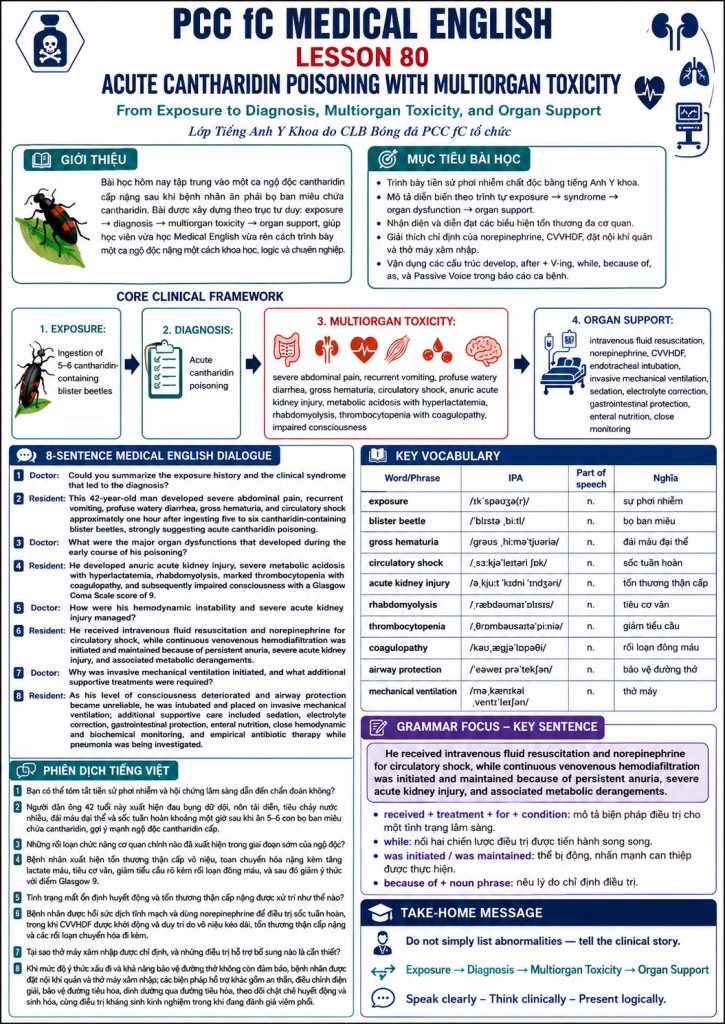
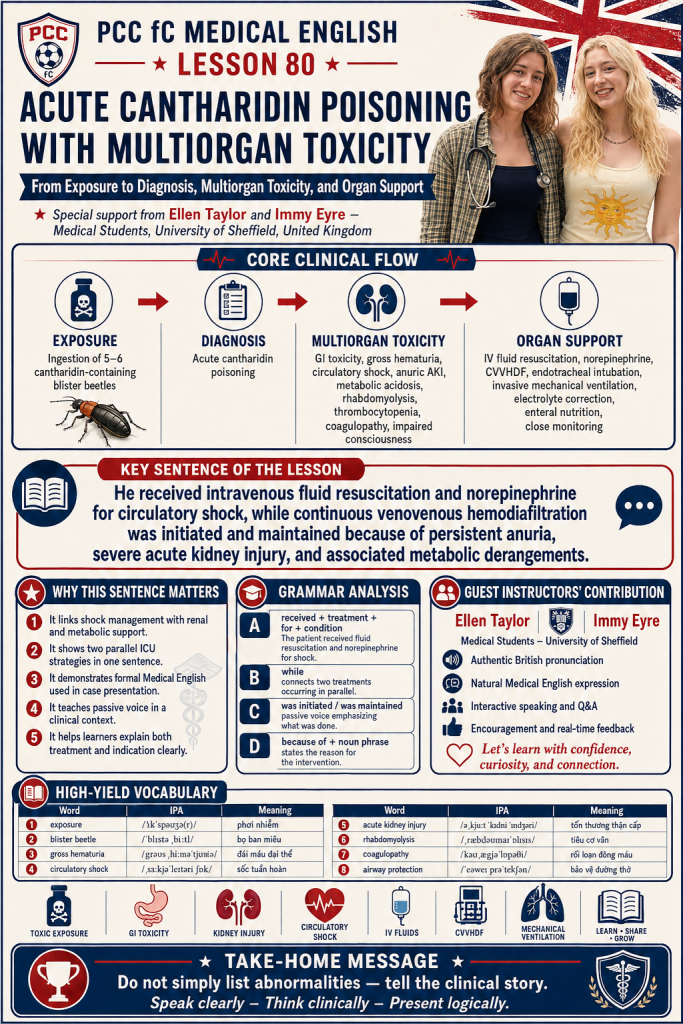
I. CORE CLINICAL FRAMEWORK
EXPOSURE → DIAGNOSIS → MULTIORGAN TOXICITY → ORGAN SUPPORT
Đây là trục tư duy xuyên suốt của Lesson 80.
1. EXPOSURE
What was the exposure?
The patient ingested five to six cantharidin-containing blister beetles.
↓
2. DIAGNOSIS
What clinical syndrome followed the exposure?
Severe abdominal pain
- recurrent vomiting
- profuse watery diarrhea
- gross hematuria
- circulatory shock
→ Acute cantharidin poisoning
↓
3. MULTIORGAN TOXICITY
Which organs were affected?
Kidney
→ anuric acute kidney injury
Metabolic system
→ severe metabolic acidosis
→ hyperlactatemia
Skeletal muscle
→ rhabdomyolysis
Hematologic system
→ thrombocytopenia
→ coagulopathy
Central nervous system
→ impaired consciousness
→ GCS 9
Cardiovascular system
→ circulatory shock
↓
4. ORGAN SUPPORT
What life-support therapies were required?
Circulation
→ intravenous fluid resuscitation
→ norepinephrine
Kidney / metabolism
→ continuous venovenous hemodiafiltration
Airway / breathing
→ endotracheal intubation
→ invasive mechanical ventilation
General ICU support
→ sedation
→ electrolyte correction
→ gastrointestinal protection
→ enteral nutrition
→ close monitoring
II. LEARNING OBJECTIVES – MỤC TIÊU BÀI HỌC
Sau Lesson 80, học viên có thể:
- Trình bày toxic exposure history bằng Medical English.
- Tóm tắt một ca ngộ độc theo trình tự:
exposure → syndrome → organ dysfunction → organ support. - Mô tả các biểu hiện tổn thương đa cơ quan một cách khoa học.
- Giải thích bằng tiếng Anh lý do sử dụng vận mạch, CRRT và thở máy.
- Sử dụng đúng các cấu trúc:
- develop + complication
- after + V-ing
- strongly suggesting + diagnosis
- while + clause
- because of + noun phrase
- as + clause
- Passive Voice
- Trình bày lại ca bệnh trong 30–60 giây bằng tiếng Anh.
III. FULL 8-SENTENCE MEDICAL ENGLISH DIALOGUE
Read the whole dialogue first.
1. Doctor:
Could you summarize the exposure history and the clinical syndrome that led to the diagnosis?
2. Resident:
This 42-year-old man developed severe abdominal pain, recurrent vomiting, profuse watery diarrhea, gross hematuria, and circulatory shock approximately one hour after ingesting five to six cantharidin-containing blister beetles, strongly suggesting acute cantharidin poisoning.
3. Doctor:
What were the major organ dysfunctions that developed during the early course of his poisoning?
4. Resident:
He developed anuric acute kidney injury, severe metabolic acidosis with hyperlactatemia, rhabdomyolysis, marked thrombocytopenia with coagulopathy, and subsequently impaired consciousness with a Glasgow Coma Scale score of 9.
5. Doctor:
How were his hemodynamic instability and severe acute kidney injury managed?
6. Resident:
He received intravenous fluid resuscitation and norepinephrine for circulatory shock, while continuous venovenous hemodiafiltration was initiated and maintained because of persistent anuria, severe acute kidney injury, and associated metabolic derangements.
7. Doctor:
Why was invasive mechanical ventilation initiated, and what additional supportive treatments were required?
8. Resident:
As his level of consciousness deteriorated and airway protection became unreliable, he was intubated and placed on invasive mechanical ventilation; additional supportive care included sedation, electrolyte correction, gastrointestinal protection, enteral nutrition, close hemodynamic and biochemical monitoring, and empirical antibiotic therapy while pneumonia was being investigated.
IV. BẢN DỊCH TOÀN BỘ HỘI THOẠI
1. Bác sĩ:
Bạn có thể tóm tắt tiền sử phơi nhiễm và hội chứng lâm sàng đã dẫn đến chẩn đoán không?
2. Bác sĩ nội trú:
Người đàn ông 42 tuổi này xuất hiện đau bụng dữ dội, nôn tái diễn, tiêu chảy nước nhiều, đái máu đại thể và sốc tuần hoàn khoảng một giờ sau khi ăn 5–6 con bọ ban miêu có chứa cantharidin, qua đó gợi ý mạnh ngộ độc cantharidin cấp.
3. Bác sĩ:
Những rối loạn chức năng cơ quan chính nào đã xuất hiện trong giai đoạn sớm của tình trạng ngộ độc?
4. Bác sĩ nội trú:
Bệnh nhân xuất hiện tổn thương thận cấp vô niệu, toan chuyển hóa nặng kèm tăng lactate máu, tiêu cơ vân, giảm tiểu cầu rõ kèm rối loạn đông máu, và sau đó giảm ý thức với điểm Glasgow 9.
5. Bác sĩ:
Tình trạng mất ổn định huyết động và tổn thương thận cấp nặng của bệnh nhân được xử trí như thế nào?
6. Bác sĩ nội trú:
Bệnh nhân được hồi sức dịch đường tĩnh mạch và norepinephrine để điều trị sốc tuần hoàn, trong khi lọc máu liên tục theo phương thức thẩm tách–siêu lọc tĩnh mạch–tĩnh mạch liên tục được khởi động và duy trì do vô niệu kéo dài, tổn thương thận cấp nặng và các rối loạn chuyển hóa đi kèm.
7. Bác sĩ:
Tại sao thở máy xâm nhập được bắt đầu, và những biện pháp điều trị hỗ trợ bổ sung nào là cần thiết?
8. Bác sĩ nội trú:
Khi mức độ ý thức của bệnh nhân xấu đi và khả năng tự bảo vệ đường thở không còn đảm bảo, bệnh nhân được đặt nội khí quản và thở máy xâm nhập; các biện pháp hỗ trợ bổ sung bao gồm an thần, điều chỉnh điện giải, bảo vệ đường tiêu hóa, dinh dưỡng đường tiêu hóa, theo dõi chặt chẽ huyết động và các chỉ số sinh hóa, cùng với điều trị kháng sinh kinh nghiệm trong khi đang đánh giá khả năng viêm phổi.
V. HOW THE DIALOGUE IS BUILT
Toàn bộ hội thoại thực chất trả lời 4 câu hỏi lâm sàng lớn.
Question 1 – EXPOSURE & DIAGNOSIS
What happened?
→ Ingestion of blister beetles
What followed?
→ Gastrointestinal toxicity + hematuria + shock
What does this suggest?
→ Acute cantharidin poisoning
Question 2 – MULTIORGAN TOXICITY
Which organs became dysfunctional?
- Kidney
- Metabolic system
- Muscle
- Hematologic system
- Brain
- Circulation
Question 3 – CIRCULATORY & RENAL SUPPORT
How was shock treated?
→ Fluid resuscitation
→ Norepinephrine
How was severe AKI supported?
→ CVVHDF
Question 4 – AIRWAY & GENERAL ICU SUPPORT
Why was he intubated?
→ Deteriorating consciousness
→ Unreliable airway protection
What other support was provided?
→ Sedation
→ Electrolyte correction
→ Enteral nutrition
→ Monitoring
→ Empirical antibiotics while evaluating pneumonia
VI. KEY VOCABULARY
| Word / Phrase | IPA | Part of speech | Nghĩa |
| exposure | /ɪkˈspəʊʒə(r)/ | n. | sự phơi nhiễm |
| ingest | /ɪnˈdʒest/ | v. | ăn, uống, nuốt vào |
| ingestion | /ɪnˈdʒestʃən/ | n. | sự ăn/uống phải |
| cantharidin | /kænˈθærɪdɪn/ | n. | cantharidin |
| blister beetle | /ˈblɪstə ˌbiːtl/ | n. | bọ ban miêu |
| recurrent | /rɪˈkʌrənt/ | adj. | tái diễn |
| profuse | /prəˈfjuːs/ | adj. | nhiều, ồ ạt |
| watery diarrhea | /ˈwɔːtəri ˌdaɪəˈrɪə/ | n. | tiêu chảy nước |
| gross hematuria | /ɡrəʊs ˌhiːməˈtjʊəriə/ | n. | đái máu đại thể |
| circulatory shock | /ˌsɜːkjəˈleɪtəri ʃɒk/ | n. | sốc tuần hoàn |
| organ dysfunction | /ˈɔːɡən dɪsˈfʌŋkʃən/ | n. | rối loạn chức năng cơ quan |
| anuric | /ænˈjʊərɪk/ | adj. | vô niệu |
| acute kidney injury | /əˌkjuːt ˈkɪdni ˈɪndʒəri/ | n. | tổn thương thận cấp |
| metabolic acidosis | /ˌmetəˈbɒlɪk ˌæsɪˈdəʊsɪs/ | n. | toan chuyển hóa |
| hyperlactatemia | /ˌhaɪpəlæktəˈtiːmiə/ | n. | tăng lactate máu |
| rhabdomyolysis | /ˌræbdəʊmaɪˈɒlɪsɪs/ | n. | tiêu cơ vân |
| thrombocytopenia | /ˌθrɒmbəʊsaɪtəˈpiːniə/ | n. | giảm tiểu cầu |
| coagulopathy | /kəʊˌæɡjəˈlɒpəθi/ | n. | rối loạn đông máu |
| impaired consciousness | /ɪmˈpeəd ˈkɒnʃəsnəs/ | n. | giảm ý thức |
| hemodynamic instability | /ˌhiːməʊdaɪˈnæmɪk ˌɪnstəˈbɪləti/ | n. | mất ổn định huyết động |
| fluid resuscitation | /ˈfluːɪd rɪˌsʌsɪˈteɪʃən/ | n. | hồi sức dịch |
| norepinephrine | /ˌnɔːrepɪˈnefrɪn/ | n. | norepinephrine |
| persistent | /pəˈsɪstənt/ | adj. | kéo dài, dai dẳng |
| metabolic derangement | /ˌmetəˈbɒlɪk dɪˈreɪndʒmənt/ | n. | rối loạn chuyển hóa |
| deteriorate | /dɪˈtɪəriəreɪt/ | v. | xấu đi |
| airway protection | /ˈeəweɪ prəˈtekʃən/ | n. | bảo vệ đường thở |
| intubate | /ˈɪntjubeɪt/ | v. | đặt nội khí quản |
| mechanical ventilation | /məˌkænɪkəl ˌventɪˈleɪʃən/ | n. | thở máy |
| sedation | /sɪˈdeɪʃən/ | n. | an thần |
| electrolyte correction | /ɪˈlektrəlaɪt kəˈrekʃən/ | n. | điều chỉnh điện giải |
| enteral nutrition | /ˈentərəl njuːˈtrɪʃən/ | n. | dinh dưỡng đường tiêu hóa |
| empirical | /ɪmˈpɪrɪkəl/ | adj. | theo kinh nghiệm |
| subsequently | /ˈsʌbsɪkwəntli/ | adv. | sau đó |
VII. PRONUNCIATION FOCUS
1. Cantharidin
/kænˈθærɪdɪn/
can – THAR – i – din
Nhấn âm: THAR
2. Rhabdomyolysis
/ˌræbdəʊmaɪˈɒlɪsɪs/
rhab – do – myo – OL – y – sis
3. Thrombocytopenia
/ˌθrɒmbəʊsaɪtəˈpiːniə/
throm – bo – cy – to – PEE – ni – a
4. Coagulopathy
/kəʊˌæɡjəˈlɒpəθi/
co – ag – u – LOP – a – thy
5. Hemodiafiltration
/ˌhiːməʊdaɪəfɪlˈtreɪʃən/
hemo – dia – fil – TRA – tion
VIII. ⭐ KEY GRAMMAR SENTENCE OF LESSON 80
Sentence 6
He received intravenous fluid resuscitation and norepinephrine for circulatory shock, while continuous venovenous hemodiafiltration was initiated and maintained because of persistent anuria, severe acute kidney injury, and associated metabolic derangements.
Đây là câu trọng tâm vì kết hợp được 4 cấu trúc rất quan trọng trong Medical English.
IX. DETAILED GRAMMAR ANALYSIS
STRUCTURE 1
receive + treatment + for + condition
He received intravenous fluid resuscitation and norepinephrine for circulatory shock.
Công thức
Patient + received + treatment + for + indication
Ví dụ:
The patient received atropine for symptomatic bradycardia.
→ Bệnh nhân được dùng atropine để điều trị nhịp chậm có triệu chứng.
He received intravenous bicarbonate for severe metabolic acidosis.
→ Bệnh nhân được dùng bicarbonate đường tĩnh mạch để điều trị toan chuyển hóa nặng.
X. STRUCTURE 2 – “WHILE”
Câu:
…, while CVVHDF was initiated and maintained…
Trong ngữ cảnh này, while giúp nối hai chiến lược điều trị đang diễn ra song song.
Strategy A
Hemodynamic support
fluid resuscitation
- norepinephrine
Strategy B
Renal/metabolic support
CVVHDF
Công thức
Treatment A was given, while Treatment B was initiated.
Ví dụ:
Norepinephrine was continued, while CRRT was initiated for worsening renal failure.
XI. STRUCTURE 3 – PASSIVE VOICE
CVVHDF was initiated and maintained.
Cấu trúc
Subject + be + past participle
was initiated
→ được bắt đầu
was maintained
→ được duy trì
Medical English thường dùng thể bị động vì điều quan trọng là:
WHAT was done?
hơn là:
WHO did it?
So sánh:
The ICU team initiated CVVHDF.
và:
CVVHDF was initiated.
Trong case presentation, câu thứ hai thường tự nhiên và chuyên nghiệp hơn.
XII. STRUCTURE 4 – “BECAUSE OF”
because of persistent anuria, severe acute kidney injury, and associated metabolic derangements
Công thức
because of + noun / noun phrase
Ví dụ:
CRRT was initiated because of refractory hyperkalemia.
So sánh
because of + noun
because + subject + verb
Ví dụ:
CRRT was initiated because of severe acidosis.
vs.
CRRT was initiated because the patient had severe acidosis.
XIII. SECOND HIGH-YIELD GRAMMAR POINT
Sentence 8
As his level of consciousness deteriorated and airway protection became unreliable, he was intubated and placed on invasive mechanical ventilation.
Cấu trúc
As + clinical deterioration, intervention was performed.
Ở đây:
as
≈ when / because
Ý nghĩa
Khi hoặc do tình trạng lâm sàng xấu đi, một can thiệp trở nên cần thiết.
Ví dụ:
As respiratory failure worsened, the patient was intubated.
→ Khi suy hô hấp nặng lên, bệnh nhân được đặt nội khí quản.
XIV. MEDICAL ENGLISH COLLOCATIONS
Học theo cụm từ hoàn chỉnh sẽ hiệu quả hơn học từ đơn lẻ.
TOXICOLOGY
toxic exposure
→ phơi nhiễm chất độc
ingest a toxic substance
→ uống/ăn phải chất độc
acute poisoning
→ ngộ độc cấp
strongly suggest poisoning
→ gợi ý mạnh tình trạng ngộ độc
KIDNEY
develop acute kidney injury
become anuric
persistent anuria
require renal replacement therapy
initiate CRRT
CIRCULATION
circulatory shock
hemodynamic instability
fluid resuscitation
vasopressor support
require norepinephrine
AIRWAY
impaired consciousness
level of consciousness deteriorated
airway protection became unreliable
endotracheal intubation
invasive mechanical ventilation
XV. IMPORTANT LANGUAGE DISTINCTIONS
1. develop
Dùng để mô tả bệnh nhân xuất hiện một biến chứng hoặc tình trạng mới.
He developed acute kidney injury.
He developed shock.
He developed rhabdomyolysis.
2. become
Dùng khi tính trạng thái thay đổi.
He became anuric.
He became hypotensive.
He became unconscious.
3. require
Dùng để nói một biện pháp điều trị trở nên cần thiết.
He required norepinephrine.
He required CRRT.
He required mechanical ventilation.
Đây là động từ cực kỳ quan trọng khi trình bày bệnh nhân ICU.
XVI. COMMON ERRORS
❌ He was shock.
✅ He developed shock.
hoặc:
✅ He was in shock.
❌ He was anuria.
✅ He developed anuria.
hoặc:
✅ He became anuric.
❌ He was ventilation.
✅ He was mechanically ventilated.
hoặc:
✅ Mechanical ventilation was initiated.
❌ Because severe acidosis…
✅ Because of severe acidosis…
hoặc:
✅ Because the patient had severe acidosis…
❌ He appeared acute kidney injury.
✅ He developed acute kidney injury.
XVII. CLINICAL ENGLISH FORMULA
Khi trình bày một ca ngộ độc nặng, hãy đi theo 5 bước:
1. EXPOSURE
The patient presented after ingesting…
↓
2. EARLY SYNDROME
He initially developed…
↓
3. ORGAN DYSFUNCTION
His clinical course was complicated by…
↓
4. ORGAN SUPPORT
He required…
↓
5. ONGOING CARE
He was closely monitored for…
XVIII. 30-SECOND CASE PRESENTATION
This 42-year-old man presented approximately one hour after ingesting five to six cantharidin-containing blister beetles. He rapidly developed severe gastrointestinal symptoms, gross hematuria, and circulatory shock. His condition progressed to anuric acute kidney injury, severe metabolic acidosis, rhabdomyolysis, coagulopathy, and impaired consciousness. He required intravenous fluid resuscitation, norepinephrine, CVVHDF, endotracheal intubation, and invasive mechanical ventilation.
Vietnamese
Người đàn ông 42 tuổi này vào viện khoảng một giờ sau khi ăn 5–6 con bọ ban miêu chứa cantharidin. Bệnh nhân nhanh chóng xuất hiện các triệu chứng tiêu hóa nặng, đái máu đại thể và sốc tuần hoàn. Tình trạng tiến triển thành tổn thương thận cấp vô niệu, toan chuyển hóa nặng, tiêu cơ vân, rối loạn đông máu và giảm ý thức. Bệnh nhân cần hồi sức dịch, norepinephrine, CVVHDF, đặt nội khí quản và thở máy xâm nhập.
XIX. ONE-MINUTE CASE PRESENTATION
This 42-year-old man developed severe abdominal pain, recurrent vomiting, profuse watery diarrhea, gross hematuria, and circulatory shock approximately one hour after ingesting five to six cantharidin-containing blister beetles. His clinical course was complicated by anuric acute kidney injury, severe metabolic acidosis with hyperlactatemia, rhabdomyolysis, marked thrombocytopenia with coagulopathy, and impaired consciousness. He received intravenous fluid resuscitation and norepinephrine for circulatory shock, while CVVHDF was initiated and maintained for persistent anuria and severe acute kidney injury. As his consciousness deteriorated and airway protection became unreliable, he was intubated and placed on invasive mechanical ventilation, together with comprehensive supportive care and close monitoring.
XX. RAPID RESPONSE PRACTICE
Giảng viên hỏi, học viên trả lời trong 5–10 giây.
1.
What was the toxic exposure?
He ingested five to six cantharidin-containing blister beetles.
2.
How soon did symptoms develop?
Approximately one hour after ingestion.
3.
What were the major gastrointestinal manifestations?
Severe abdominal pain, recurrent vomiting, and profuse watery diarrhea.
4.
What renal complication developed?
Anuric acute kidney injury.
5.
What metabolic abnormality developed?
Severe metabolic acidosis with hyperlactatemia.
6.
Why was CVVHDF initiated?
Because of persistent anuria, severe acute kidney injury, and metabolic derangements.
7.
Why was the patient intubated?
Because his consciousness deteriorated and airway protection became unreliable.
8.
What major organ-support therapies were required?
Vasopressor support, CVVHDF, endotracheal intubation, and invasive mechanical ventilation.
XXI. TRANSLATION PRACTICE
Vietnamese → English
1.
Bệnh nhân xuất hiện sốc tuần hoàn khoảng một giờ sau khi ăn bọ ban miêu.
The patient developed circulatory shock approximately one hour after ingesting the blister beetles.
2.
Bệnh nhân xuất hiện tổn thương thận cấp vô niệu.
The patient developed anuric acute kidney injury.
3.
CVVHDF được bắt đầu do vô niệu kéo dài.
CVVHDF was initiated because of persistent anuria.
4.
Bệnh nhân được sử dụng norepinephrine để điều trị sốc.
The patient received norepinephrine for circulatory shock.
5.
Khi ý thức xấu đi, bệnh nhân được đặt nội khí quản.
As his level of consciousness deteriorated, he was intubated.
XXII. MINI GRAMMAR EXERCISE
Điền một trong bốn từ:
after – while – because of – as
- The patient developed severe vomiting ______ ingesting the toxin.
- CVVHDF was initiated ______ persistent anuria.
- Norepinephrine was administered, ______ CRRT was continued.
- ______ his consciousness deteriorated, the patient was intubated.
Answers
- after
- because of
- while
- as
XXIII. SPEAKING CHALLENGE
Present the case in four sentences.
Sentence 1 – Exposure
This 42-year-old man presented after ingesting five to six cantharidin-containing blister beetles.
Sentence 2 – Early syndrome
He rapidly developed severe gastrointestinal symptoms, gross hematuria, and circulatory shock.
Sentence 3 – Multiorgan toxicity
His condition progressed to anuric acute kidney injury, metabolic acidosis, rhabdomyolysis, coagulopathy, and impaired consciousness.
Sentence 4 – Organ support
He required norepinephrine, CVVHDF, endotracheal intubation, and invasive mechanical ventilation.
XXIV. THE MASTER SENTENCE PATTERN
Học viên nên nhớ công thức sau:
After + EXPOSURE,
the patient developed + CLINICAL SYNDROME,
which progressed to + ORGAN DYSFUNCTION;
therefore, he required + ORGAN SUPPORT.
Example
After ingesting cantharidin-containing blister beetles, the patient developed severe gastrointestinal toxicity and circulatory shock, which progressed to multiorgan dysfunction; therefore, he required vasopressor support, continuous renal replacement therapy, and invasive mechanical ventilation.
XXV. FIVE EXPRESSIONS TO REMEMBER
1. strongly suggesting acute cantharidin poisoning
→ gợi ý mạnh ngộ độc cantharidin cấp
2. during the early course of poisoning
→ trong giai đoạn sớm của diễn biến ngộ độc
3. persistent anuria
→ vô niệu kéo dài
4. associated metabolic derangements
→ các rối loạn chuyển hóa đi kèm
5. airway protection became unreliable
→ khả năng tự bảo vệ đường thở không còn đảm bảo
XXVI. TAKE-HOME MESSAGE
Do not simply list abnormalities.
Tell the clinical story.
EXPOSURE
What did the patient take?
↓
DIAGNOSIS
What syndrome followed?
↓
MULTIORGAN TOXICITY
Which organs were affected?
↓
ORGAN SUPPORT
What life-support therapies were required?
LESSON 80 – CORE MESSAGE
EXPOSURE → DIAGNOSIS → MULTIORGAN TOXICITY → ORGAN SUPPORT
Một bài trình bày ca bệnh tốt không chỉ trả lời:
“What abnormalities did the patient have?”
mà quan trọng hơn phải trả lời được:
What happened? → Why did we diagnose it? → Which organs failed? → What support was required?
Đó là cách kết hợp Medical English với clinical reasoning.
PCC fC MEDICAL ENGLISH – LESSON 80
ACUTE CANTHARIDIN POISONING WITH MULTIORGAN TOXICITY
From Exposure to Diagnosis, Multiorgan Toxicity, and Organ Support
Speak clearly – Think clinically – Present logically.