Bài 36 – Tiếng Anh Y Khoa: Vận động phòng chống thuốc lá và xây dựng thế hệ không khói thuốc * Tobacco Prevention and Smoke-Free Generation Advocacy!
PCC fC Language – Thăng Long, Hà Nội, ngày 20/6/2026, WHO nêu thuốc lá gây hơn 7 triệu ca tử vong mỗi năm, gồm khoảng 1,6 triệu người không hút thuốc nhưng phơi nhiễm khói thuốc thụ động. WHO cũng đánh giá cao lập trường mạnh của Việt Nam trong kiểm soát thuốc lá điện tử và thuốc lá nung nóng để bảo vệ thanh thiếu niên. Mô hình “smoke-free generation” đã được Anh luật hóa với mốc cấm bán thuốc lá cho người sinh từ hoặc sau 01/01/2009
BÀI 35 – LỚP TIẾNG ANH Y KHOA
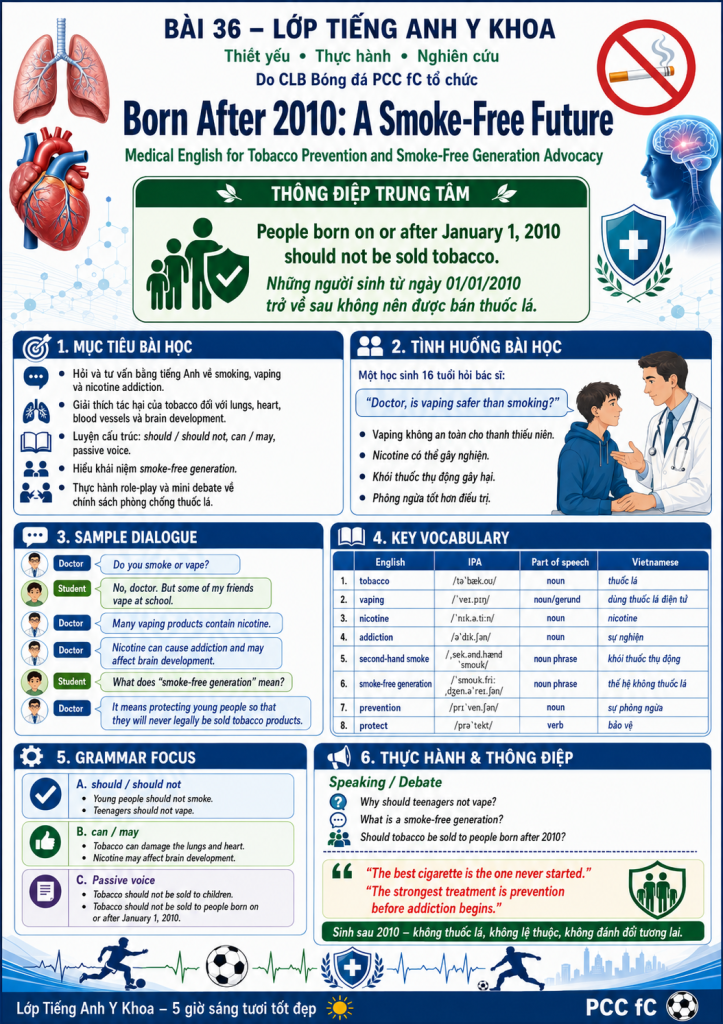
Born After 2010: A Smoke-Free Future
Medical English for Tobacco Prevention and Smoke-Free Generation Advocacy
Lớp Tiếng Anh Y Khoa – Thiết yếu • Thực hành • Nghiên cứu
Do CLB Bóng đá PCC fC tổ chức
Sỹ số: /100
I. TÊN BÀI HỌC
Born After 2010: A Smoke-Free Future
Sinh sau 2010: Hướng tới một tương lai không thuốc lá
Câu trung tâm của bài
People born on or after January 1, 2010 should not be sold tobacco.
Dịch:
Những người sinh từ ngày 01/01/2010 trở về sau không nên được bán thuốc lá.
II. THÔNG ĐIỆP CHÍNH
Bài học này không chỉ là một bài tiếng Anh.
Đây là một bài học về y học dự phòng, y tế công cộng và trách nhiệm của thầy thuốc với thế hệ trẻ.
Thuốc lá không chỉ gây hại cho một người.
Thuốc lá gây hại cho gia đình, bệnh viện, xã hội và nhiều thế hệ.
Vì vậy, thông điệp của bài học hôm nay là:
The best cigarette is the one never started.
Điếu thuốc tốt nhất là điếu thuốc chưa bao giờ được bắt đầu.
Và mục tiêu chính sách được thảo luận trong bài là:
Ban the sale of tobacco to anyone born on or after January 1, 2010.
Phấn đấu cấm bán thuốc lá cho bất kỳ ai sinh từ ngày 01/01/2010 trở về sau.
III. MỤC TIÊU BÀI HỌC
Sau bài học, học viên có thể:
- Hỏi bằng tiếng Anh về tình trạng hút thuốc lá, dùng thuốc lá điện tử và tiếp xúc với nicotine.
- Giải thích ngắn gọn tác hại của thuốc lá đối với phổi, tim mạch, não bộ và nguy cơ ung thư.
- Phân biệt được smoking, vaping, nicotine addiction và second-hand smoke.
- Sử dụng cấu trúc should / should not để đưa ra lời khuyên y khoa.
- Sử dụng cấu trúc can / may để giải thích nguy cơ sức khỏe.
- Sử dụng câu bị động should not be sold trong ngữ cảnh chính sách y tế công cộng.
- Trình bày được khái niệm smoke-free generation bằng tiếng Anh.
- Thực hành tư vấn ngắn cho học sinh, phụ huynh hoặc người bán hàng về phòng chống thuốc lá.
- Tham gia mini debate về chủ đề:
Should tobacco be sold to people born on or after January 1, 2010?
IV. DẪN NHẬP CHO GIẢNG VIÊN
Trong điều trị, chúng ta thường gặp bệnh nhân khi bệnh đã xảy ra: ung thư phổi, COPD, nhồi máu cơ tim, đột quỵ, suy hô hấp mạn tính.
Nhưng trong phòng chống thuốc lá, chúng ta có một cơ hội rất đặc biệt:
We can prevent addiction before it begins.
Chúng ta có thể phòng ngừa nghiện trước khi nó bắt đầu.
Một học sinh sinh năm 2010 sẽ bước vào tuổi vị thành niên trong giai đoạn có rất nhiều yếu tố nguy cơ: bạn bè rủ rê, quảng cáo trá hình, thuốc lá điện tử, thuốc lá nung nóng, mạng xã hội và các sản phẩm nicotine mới.
Nếu chúng ta chỉ chờ đến khi người trẻ đã nghiện rồi mới khuyên bỏ thuốc, thì có thể đã quá muộn.
Vì vậy, bài học hôm nay đặt trọng tâm vào một tư duy rất quan trọng của y tế công cộng:
Prevention before addiction.
Phòng ngừa trước khi nghiện.
V. TÌNH HUỐNG BÀI HỌC
Một học sinh 16 tuổi đến buổi truyền thông sức khỏe học đường và hỏi bác sĩ:
Doctor, is vaping safer than smoking?
Bác sĩ ơi, thuốc lá điện tử có an toàn hơn thuốc lá thường không?
Bác sĩ cần giải thích bằng tiếng Anh đơn giản, chính xác và dễ nhớ:
- Thuốc lá không an toàn.
- Thuốc lá điện tử không an toàn cho thanh thiếu niên.
- Nicotine có thể gây nghiện.
- Nicotine có thể ảnh hưởng đến sự phát triển não bộ.
- Khói thuốc thụ động có thể gây hại cho trẻ em và phụ nữ mang thai.
- Cấm bán thuốc lá cho thế hệ sinh sau 2010 là một mục tiêu bảo vệ sức khỏe, không phải trừng phạt.
VI. WARM-UP – KHỞI ĐỘNG 3 PHÚT
Giảng viên hỏi nhanh cả lớp:
Question 1
Do you think vaping is safe for teenagers?
Bạn có nghĩ thuốc lá điện tử an toàn cho thanh thiếu niên không?
Suggested answer:
No, vaping is not safe for teenagers.
Question 2
Why do young people start smoking or vaping?
Vì sao người trẻ bắt đầu hút thuốc hoặc dùng thuốc lá điện tử?
Suggested answers:
Because of peer pressure.
Vì áp lực bạn bè.
Because of curiosity.
Vì tò mò.
Because of advertising.
Vì quảng cáo.
Because they think it is harmless.
Vì họ nghĩ nó vô hại.
Question 3
What is better: treating addiction or preventing addiction?
Điều gì tốt hơn: điều trị nghiện hay phòng ngừa nghiện?
Suggested answer:
Preventing addiction is better than treating addiction.
VII. SAMPLE DIALOGUE
Dialogue: A Teenager Asks About Smoking and Vaping
Doctor: Good morning. Do you smoke or vape?
Student: No, doctor. But some of my friends vape at school.
Doctor: Have you ever tried smoking or vaping?
Student: I tried vaping once at a party. I thought it was not very harmful.
Doctor: Many young people think that, but vaping is not safe for teenagers.
Student: Why is it dangerous?
Doctor: Many vaping products contain nicotine. Nicotine can cause addiction and may affect brain development.
Student: So vaping can make me addicted?
Doctor: Yes. Nicotine addiction can start very early, and it can be difficult to stop later.
Student: What about cigarettes?
Doctor: Cigarettes can damage the lungs, heart, blood vessels, and many other organs. Smoking can cause cancer, stroke, heart disease, and chronic lung disease.
Student: I see. So prevention is better than treatment.
Doctor: Exactly. That is why many public health experts support a smoke-free generation.
Student: What does “smoke-free generation” mean?
Doctor: It means protecting young people so that they will never legally be sold tobacco products.
Student: Like people born after 2010?
Doctor: Yes. One strong public health goal is to ban the sale of tobacco to anyone born on or after January 1, 2010.
Student: That sounds strict.
Doctor: It is not about punishment. It is about protection. The goal is to stop addiction before it starts.
Student: What should I tell my friends?
Doctor: Tell them: “Don’t trade your lungs, your brain, and your future for nicotine.”
Student: I will remember that.
Doctor: Good. A healthy generation is stronger than any tobacco industry.
VIII. DỊCH HỘI THOẠI
Doctor: Chào em. Em có hút thuốc hoặc dùng thuốc lá điện tử không?
Student: Không ạ. Nhưng một số bạn của em dùng thuốc lá điện tử ở trường.
Doctor: Em đã từng thử hút thuốc hoặc dùng thuốc lá điện tử chưa?
Student: Em đã thử thuốc lá điện tử một lần ở một bữa tiệc. Em nghĩ nó không có hại lắm.
Doctor: Nhiều người trẻ cũng nghĩ như vậy, nhưng thuốc lá điện tử không an toàn cho thanh thiếu niên.
Student: Vì sao nó nguy hiểm ạ?
Doctor: Nhiều sản phẩm thuốc lá điện tử chứa nicotine. Nicotine có thể gây nghiện và có thể ảnh hưởng đến sự phát triển não bộ.
Student: Vậy thuốc lá điện tử có thể làm em nghiện ạ?
Doctor: Đúng vậy. Nghiện nicotine có thể bắt đầu rất sớm và sau này rất khó bỏ.
Student: Còn thuốc lá thường thì sao ạ?
Doctor: Thuốc lá có thể gây tổn thương phổi, tim, mạch máu và nhiều cơ quan khác. Hút thuốc có thể gây ung thư, đột quỵ, bệnh tim và bệnh phổi mạn tính.
Student: Em hiểu rồi. Vậy phòng ngừa tốt hơn điều trị.
Doctor: Chính xác. Đó là lý do nhiều chuyên gia y tế công cộng ủng hộ một thế hệ không thuốc lá.
Student: “Thế hệ không thuốc lá” nghĩa là gì ạ?
Doctor: Nghĩa là bảo vệ người trẻ để họ sẽ không bao giờ được bán hợp pháp các sản phẩm thuốc lá.
Student: Ví dụ như những người sinh sau năm 2010 ạ?
Doctor: Đúng vậy. Một mục tiêu y tế công cộng mạnh mẽ là cấm bán thuốc lá cho bất kỳ ai sinh từ ngày 01/01/2010 trở về sau.
Student: Nghe có vẻ nghiêm khắc ạ.
Doctor: Đây không phải là trừng phạt. Đây là bảo vệ. Mục tiêu là ngăn nghiện trước khi nó bắt đầu.
Student: Em nên nói gì với các bạn của em?
Doctor: Hãy nói với các bạn: “Đừng đánh đổi phổi, não bộ và tương lai của mình lấy nicotine.”
Student: Em sẽ nhớ điều đó.
Doctor: Tốt. Một thế hệ khỏe mạnh mạnh hơn bất kỳ ngành công nghiệp thuốc lá nào.
IX. KEY VOCABULARY – TỪ VỰNG, PHIÊN ÂM VÀ LOẠI TỪ
| English | IPA | Part of speech | Vietnamese |
| tobacco | /təˈbæk.oʊ/ | noun | thuốc lá |
| cigarette | /ˌsɪɡ.əˈret/ | noun | điếu thuốc lá |
| smoking | /ˈsmoʊ.kɪŋ/ | noun / gerund | việc hút thuốc |
| smoke | /smoʊk/ | verb / noun | hút thuốc / khói |
| smoker | /ˈsmoʊ.kər/ | noun | người hút thuốc |
| vaping | /ˈveɪ.pɪŋ/ | noun / gerund | việc dùng thuốc lá điện tử |
| vape | /veɪp/ | verb / noun | hút thuốc lá điện tử / thiết bị vape |
| nicotine | /ˈnɪk.ə.tiːn/ | noun | nicotine |
| addiction | /əˈdɪk.ʃən/ | noun | sự nghiện |
| addictive | /əˈdɪk.tɪv/ | adjective | gây nghiện |
| second-hand smoke | /ˌsek.ənd.hænd ˈsmoʊk/ | noun phrase | khói thuốc thụ động |
| smoke-free | /ˈsmoʊk.friː/ | adjective | không khói thuốc / không thuốc lá |
| smoke-free generation | /ˈsmoʊk.friː ˌdʒen.əˈreɪ.ʃən/ | noun phrase | thế hệ không thuốc lá |
| public health | /ˌpʌb.lɪk ˈhelθ/ | noun phrase | y tế công cộng |
| public health policy | /ˌpʌb.lɪk ˈhelθ ˈpɑː.lə.si/ | noun phrase | chính sách y tế công cộng |
| prevention | /prɪˈven.ʃən/ | noun | sự phòng ngừa |
| prevent | /prɪˈvent/ | verb | phòng ngừa |
| protect | /prəˈtekt/ | verb | bảo vệ |
| protection | /prəˈtek.ʃən/ | noun | sự bảo vệ |
| teenager | /ˈtiːnˌeɪ.dʒər/ | noun | thanh thiếu niên |
| young people | /jʌŋ ˈpiː.pəl/ | noun phrase | người trẻ |
| ban | /bæn/ | verb / noun | cấm / lệnh cấm |
| ban the sale of tobacco | /bæn ðə seɪl əv təˈbæk.oʊ/ | verb phrase | cấm bán thuốc lá |
| retailer | /ˈriː.teɪ.lər/ | noun | người bán lẻ |
| sell | /sel/ | verb | bán |
| be sold | /bi soʊld/ | passive verb phrase | được bán |
| born on or after | /bɔːrn ɑːn ɔːr ˈæf.tər/ | phrase | sinh vào hoặc sau |
| January | /ˈdʒæn.ju.er.i/ | noun | tháng Một |
| born on or after January 1, 2010 | /bɔːrn ɑːn ɔːr ˈæf.tər ˈdʒæn.ju.er.i fɜːrst ˌtwɛn.ti ten/ | phrase | sinh từ ngày 01/01/2010 trở về sau |
| lifelong addiction | /ˈlaɪf.lɔːŋ əˈdɪk.ʃən/ | noun phrase | nghiện suốt đời |
| harm | /hɑːrm/ | noun / verb | tác hại / gây hại |
| harmful | /ˈhɑːrm.fəl/ | adjective | có hại |
| brain development | /breɪn dɪˈvel.əp.mənt/ | noun phrase | sự phát triển não bộ |
| lung | /lʌŋ/ | noun | phổi |
| blood vessel | /blʌd ˈves.əl/ | noun phrase | mạch máu |
| cancer | /ˈkæn.sər/ | noun | ung thư |
| heart disease | /hɑːrt dɪˈziːz/ | noun phrase | bệnh tim |
| stroke | /stroʊk/ | noun | đột quỵ |
| chronic lung disease | /ˈkrɑː.nɪk lʌŋ dɪˈziːz/ | noun phrase | bệnh phổi mạn tính |
| tobacco industry | /təˈbæk.oʊ ˈɪn.də.stri/ | noun phrase | ngành công nghiệp thuốc lá |
| industry tactics | /ˈɪn.də.stri ˈtæk.tɪks/ | noun phrase | chiến thuật của ngành công nghiệp |
| enforceable | /ɪnˈfɔːr.sə.bəl/ | adjective | có thể thực thi được |
| prevention before addiction | /prɪˈven.ʃən bɪˈfɔːr əˈdɪk.ʃən/ | noun phrase | phòng ngừa trước khi nghiện |
X. PRONUNCIATION FOCUS – TRỌNG TÂM PHÁT ÂM
1. Tobacco
/təˈbæk.oʊ/
Trọng âm rơi vào âm thứ hai: BAK.
Practice:
tobacco
tobacco products
tobacco prevention
Tobacco can damage your lungs.
2. Nicotine
/ˈnɪk.ə.tiːn/
Trọng âm rơi vào âm đầu: NI.
Âm cuối /tiːn/ đọc gần giống “teen”.
Practice:
nicotine
nicotine addiction
Nicotine can cause addiction.
3. Addiction
/əˈdɪk.ʃən/
Trọng âm rơi vào âm thứ hai: DIC.
Practice:
addiction
lifelong addiction
We should prevent lifelong addiction.
4. Smoke-free generation
/ˈsmoʊk.friː ˌdʒen.əˈreɪ.ʃən/
Practice:
smoke-free generation
a smoke-free generation
We protect the smoke-free generation.
5. Born on or after January 1, 2010
Practice slowly:
born on or after
born on or after January 1, 2010
People born on or after January 1, 2010 should not be sold tobacco.
XI. GRAMMAR FOCUS 1
Should / Should not – lời khuyên y khoa và khuyến cáo chính sách
Dùng should để đưa ra lời khuyên, khuyến cáo hoặc định hướng chính sách.
Structure
Subject + should + verb infinitive
Examples
Young people should not smoke.
Người trẻ không nên hút thuốc.
Teenagers should not vape.
Thanh thiếu niên không nên dùng thuốc lá điện tử.
Doctors should explain the harms of tobacco clearly.
Bác sĩ nên giải thích rõ tác hại của thuốc lá.
Schools should protect students from nicotine addiction.
Nhà trường nên bảo vệ học sinh khỏi nghiện nicotine.
We should build a smoke-free generation.
Chúng ta nên xây dựng một thế hệ không thuốc lá.
XII. GRAMMAR FOCUS 2
Can / May – giải thích nguy cơ sức khỏe
Dùng can khi nói về nguy cơ rõ ràng, thường gặp hoặc đã được chứng minh mạnh.
Dùng may khi nói về khả năng có thể xảy ra hoặc cần diễn đạt thận trọng hơn.
Examples with “can”
Smoking can cause cancer.
Hút thuốc có thể gây ung thư.
Tobacco can damage the lungs and heart.
Thuốc lá có thể gây tổn thương phổi và tim.
Nicotine can cause addiction.
Nicotine có thể gây nghiện.
Second-hand smoke can harm children.
Khói thuốc thụ động có thể gây hại cho trẻ em.
Examples with “may”
Vaping may affect brain development in teenagers.
Thuốc lá điện tử có thể ảnh hưởng đến sự phát triển não bộ ở thanh thiếu niên.
Nicotine exposure may increase the risk of lifelong addiction.
Phơi nhiễm nicotine có thể làm tăng nguy cơ nghiện kéo dài suốt đời.
XIII. GRAMMAR FOCUS 3
Passive Voice – câu bị động trong ngôn ngữ chính sách
Trong chính sách y tế công cộng, câu bị động rất quan trọng vì trọng tâm không phải là “ai bán”, mà là “sản phẩm không được bán cho ai”.
Structure
Subject + should not be + past participle
Examples
Tobacco should not be sold to children.
Thuốc lá không nên được bán cho trẻ em.
Vaping products should not be promoted to teenagers.
Sản phẩm thuốc lá điện tử không nên được quảng bá tới thanh thiếu niên.
Tobacco should not be sold to anyone born on or after January 1, 2010.
Thuốc lá không nên được bán cho bất kỳ ai sinh từ ngày 01/01/2010 trở về sau.
Nicotine products should not be designed to attract young people.
Các sản phẩm nicotine không nên được thiết kế để thu hút người trẻ.
XIV. GRAMMAR FOCUS 4
Born on or after… – cấu trúc mốc thời gian trong chính sách
Đây là cấu trúc trung tâm của bài học.
Pattern
People born on or after + date
Examples
People born on or after January 1, 2010 should not be sold tobacco.
Anyone born on or after January 1, 2010 belongs to the smoke-free generation.
This policy protects children born on or after January 1, 2010.
The goal is to prevent nicotine addiction among people born on or after January 1, 2010.
XV. GRAMMAR FOCUS 5
Aim to / Strive to – diễn đạt mục tiêu phấn đấu
Dùng aim to để nói “nhằm mục tiêu”.
Dùng strive to để nói “phấn đấu”.
Examples
This policy aims to create a smoke-free generation.
Chính sách này nhằm tạo ra một thế hệ không thuốc lá.
We strive to protect young people from nicotine addiction.
Chúng ta phấn đấu bảo vệ người trẻ khỏi nghiện nicotine.
Viet Nam can strive to build a tobacco-free future for children born after 2010.
Việt Nam có thể phấn đấu xây dựng một tương lai không thuốc lá cho trẻ em sinh sau năm 2010.
XVI. PHRASE BANK – CÂU MẪU THỰC HÀNH
1. Hỏi về hút thuốc và thuốc lá điện tử
Do you smoke?
Bạn có hút thuốc không?
Do you vape?
Bạn có dùng thuốc lá điện tử không?
Have you ever tried smoking or vaping?
Bạn đã từng thử hút thuốc hoặc dùng thuốc lá điện tử chưa?
When did you first try it?
Bạn thử lần đầu khi nào?
Do your friends smoke or vape?
Bạn bè của bạn có hút thuốc hoặc dùng thuốc lá điện tử không?
Do you feel pressured to try vaping?
Bạn có cảm thấy bị áp lực phải thử thuốc lá điện tử không?
2. Tư vấn nguy cơ sức khỏe
Vaping is not safe for teenagers.
Thuốc lá điện tử không an toàn cho thanh thiếu niên.
Nicotine can cause addiction.
Nicotine có thể gây nghiện.
Smoking can damage your lungs and heart.
Hút thuốc có thể làm tổn thương phổi và tim.
Second-hand smoke can harm children and pregnant women.
Khói thuốc thụ động có thể gây hại cho trẻ em và phụ nữ mang thai.
Prevention is better than treatment.
Phòng bệnh tốt hơn chữa bệnh.
3. Nói về chính sách y tế công cộng
We should protect young people from nicotine addiction.
Chúng ta nên bảo vệ người trẻ khỏi nghiện nicotine.
Tobacco should not be sold to children.
Thuốc lá không nên được bán cho trẻ em.
People born on or after January 1, 2010 should not be sold tobacco.
Những người sinh từ ngày 01/01/2010 trở về sau không nên được bán thuốc lá.
This policy aims to create a smoke-free generation.
Chính sách này nhằm tạo ra một thế hệ không thuốc lá.
The goal is not punishment, but prevention.
Mục tiêu không phải là trừng phạt, mà là phòng ngừa.
XVII. ROLE-PLAY 1
Doctor and Teenager
Student A: Doctor
Student B: Teenager
Task
Hỏi và trả lời ít nhất 6 câu.
Suggested dialogue
Doctor: Do you smoke or vape?
Teenager: No, but some of my friends vape.
Doctor: Have you ever tried vaping?
Teenager: Yes, I tried it once.
Doctor: Why did you try it?
Teenager: My friends said it was safe.
Doctor: Vaping is not safe for teenagers. Many products contain nicotine.
Teenager: Can nicotine make me addicted?
Doctor: Yes. Nicotine can cause addiction and may affect brain development.
Teenager: What should I do?
Doctor: You should avoid smoking and vaping. You should also talk to your friends about the risks.
XVIII. ROLE-PLAY 2
Doctor and Parent
Student A: Doctor
Student B: Parent
Situation
Một phụ huynh lo lắng vì con mình có bạn bè dùng thuốc lá điện tử.
Suggested dialogue
Parent: Doctor, I am worried because my son’s friends are vaping.
Doctor: You are right to be concerned. Vaping is not safe for teenagers.
Parent: What should I do?
Doctor: Talk to him calmly. Explain that nicotine can cause addiction.
Parent: Should I punish him if he tries vaping?
Doctor: The first step should be communication, not punishment.
Parent: Should schools be involved?
Doctor: Yes. Families, schools, doctors, and communities should work together.
XIX. ROLE-PLAY 3
Public Health Advocate and Shop Owner
Student A: Public health advocate
Student B: Shop owner
Situation
Một cán bộ y tế công cộng giải thích với người bán hàng về mục tiêu cấm bán thuốc lá cho thế hệ sinh sau 2010.
Suggested dialogue
Advocate: Tobacco should not be sold to young people.
Shop owner: But adults can choose for themselves.
Advocate: This policy is about protecting children before addiction starts.
Shop owner: What does “born on or after January 1, 2010” mean?
Advocate: It means anyone born from that date should not be legally sold tobacco.
Shop owner: So the goal is prevention?
Advocate: Exactly. The goal is not punishment, but prevention.
Shop owner: I understand. Clear rules can help protect young people.
XX. MINI DEBATE
Debate topic
Should Viet Nam ban the sale of tobacco to anyone born on or after January 1, 2010?
Dịch:
Việt Nam có nên cấm bán thuốc lá cho bất kỳ ai sinh từ ngày 01/01/2010 trở về sau không?
Group 1: Supporters
Key sentences:
This policy protects young people before addiction begins.
Most smokers start when they are young.
Nicotine addiction can last for life.
A smoke-free generation will reduce cancer, heart disease, stroke, and chronic lung disease.
Children deserve a tobacco-free future.
Group 2: Critical Thinkers
Key sentences:
A policy must be clear, fair, and enforceable.
Education is also important.
Families and schools must be involved.
Retailers need clear guidance.
Law enforcement must be realistic.
Group 3: Medical Moderators
Key sentences:
The goal is not punishment, but prevention.
The policy should be combined with education, counseling, taxation, advertising control, and cessation support.
Doctors should communicate clearly and respectfully.
Public health policy should protect freedom from addiction, not freedom to become addicted.
XXI. IELTS 8.0–8.5 UPGRADE
1. Basic sentence
Smoking is bad for health.
Better sentence
Smoking can damage the lungs, heart, and blood vessels.
IELTS 8.0 sentence
Tobacco use remains a major public health threat because it causes preventable disease, disability, and premature death.
2. Basic sentence
Young people should not smoke.
Better sentence
Young people should be protected from smoking and vaping.
IELTS 8.0 sentence
Protecting adolescents from nicotine exposure is essential because addiction often begins before individuals fully understand the long-term consequences.
3. Basic sentence
We should ban tobacco for people born after 2010.
Better sentence
Tobacco should not be sold to people born on or after January 1, 2010.
IELTS 8.5 sentence
A generational ban on tobacco sales for those born on or after January 1, 2010 could become a powerful public health strategy to prevent nicotine addiction before it begins.
4. Basic sentence
Vaping is not safe.
Better sentence
Vaping is not safe for teenagers because many vaping products contain nicotine.
IELTS 8.0 sentence
Although some adolescents perceive vaping as harmless, nicotine-containing vaping products may expose young people to addiction and long-term health risks.
XXII. 5-MINUTE SPEAKING CHALLENGE
Mỗi học viên chọn một chủ đề và nói trong 30–45 giây.
Topic 1
Why should teenagers not vape?
Suggested answer:
Teenagers should not vape because many vaping products contain nicotine. Nicotine can cause addiction and may affect brain development. Vaping is not a safe habit for young people.
Topic 2
What is a smoke-free generation?
Suggested answer:
A smoke-free generation means a generation of young people who are protected from tobacco sales and nicotine addiction. The goal is to help them grow up without starting smoking.
Topic 3
Should tobacco be sold to people born after 2010?
Suggested answer:
In my opinion, tobacco should not be sold to people born on or after January 1, 2010. This policy is not about punishment. It is about prevention, health protection, and a better future.
XXIII. QUICK CHECK – KIỂM TRA NHANH
Question 1
What does smoke-free generation mean?
A. A generation that smokes less
B. A generation protected from tobacco use and tobacco sales
C. A generation that only uses e-cigarettes
D. A generation that smokes outside hospitals
Answer: B
Question 2
Which sentence is correct?
A. Tobacco should sold to teenagers.
B. Tobacco should be sell to teenagers.
C. Tobacco should not be sold to teenagers.
D. Tobacco should not sold to teenagers.
Answer: C
Question 3
Which word means sự nghiện?
A. prevention
B. protection
C. addiction
D. generation
Answer: C
Question 4
Which sentence is best for public health advocacy?
A. Smoking is fun.
B. Vaping is always safe.
C. The goal is not punishment, but prevention.
D. Tobacco helps young people relax.
Answer: C
Question 5
How do we say sinh từ ngày 01/01/2010 trở về sau in English?
A. born before January 1, 2010
B. born on or after January 1, 2010
C. born around January 1, 2010
D. born under January 1, 2010
Answer: B
XXIV. TRANSLATION PRACTICE
Translate into English.
Vietnamese 1
Thuốc lá có thể gây ung thư, bệnh tim và đột quỵ.
Suggested answer:
Tobacco can cause cancer, heart disease, and stroke.
Vietnamese 2
Nicotine có thể gây nghiện.
Suggested answer:
Nicotine can cause addiction.
Vietnamese 3
Thuốc lá không nên được bán cho trẻ em.
Suggested answer:
Tobacco should not be sold to children.
Vietnamese 4
Chúng ta cần bảo vệ thế hệ không thuốc lá.
Suggested answer:
We need to protect the smoke-free generation.
Vietnamese 5
Những người sinh từ ngày 01/01/2010 trở về sau không nên được bán thuốc lá.
Suggested answer:
People born on or after January 1, 2010 should not be sold tobacco.
XXV. HOMEWORK
Task 1: Speaking
Record a 45-second message with the title:
Why should we protect the smoke-free generation?
Use at least 3 of these phrases:
- nicotine addiction
- smoke-free generation
- born on or after January 1, 2010
- public health policy
- prevention before addiction
- tobacco should not be sold
Task 2: Writing
Write 5 sentences using should / should not.
Examples:
- Teenagers should not vape.
- Doctors should explain the harms of tobacco.
- Tobacco should not be sold to children.
- Schools should teach students about nicotine addiction.
- We should protect the smoke-free generation.
Task 3: Mini advocacy message
Write one short slogan in English and Vietnamese.
Example:
Born after 2010 – breathe free, live free.
Sinh sau 2010 – không thuốc lá, không lệ thuộc, không đánh đổi tương lai.
XXVI. GỢI Ý CHẤM ĐIỂM KVH
1 điểm KVH
Học viên đọc đúng 5 từ khóa:
- tobacco
- nicotine
- addiction
- smoke-free generation
- born on or after January 1, 2010
2 điểm KVH
Học viên hoàn thành một role-play với ít nhất 5 câu hỏi hoặc câu trả lời.
3 điểm KVH
Học viên ghi âm bài nói 45 giây có ít nhất 3 cụm từ trọng tâm.
Điểm thưởng
Học viên đưa ra một thông điệp truyền thông ngắn, rõ, truyền cảm hứng.
Examples:
Prevention before addiction.
Phòng ngừa trước khi nghiện.
Don’t trade your future for nicotine.
Đừng đánh đổi tương lai của bạn lấy nicotine.
Born after 2010 – breathe free, live free.
Sinh sau 2010 – không thuốc lá, không lệ thuộc, không đánh đổi tương lai.
XXVII. GỢI Ý PHÂN CÔNG TRONG LỚP
Giảng viên chính
Dẫn nhập, đọc hội thoại mẫu, nhấn mạnh thông điệp y tế công cộng.
Trợ giảng 1
Hướng dẫn phát âm các từ khó:
tobacco, nicotine, addiction, smoke-free generation, born on or after.
Trợ giảng 2
Điều phối role-play theo cặp.
Trợ giảng 3
Chấm nhanh phần speaking challenge.
Người phụ trách KVH
Ghi nhận học viên phát biểu, học viên role-play, học viên ghi âm và học viên có khẩu hiệu hay.
XXVIII. THÔNG ĐIỆP PCC fC
Trong bóng đá, một đội mạnh không chỉ thắng một trận đấu.
Một đội mạnh là đội biết bảo vệ tương lai của thế hệ tiếp theo.
Trong y học, một bác sĩ giỏi không chỉ điều trị bệnh.
Một bác sĩ giỏi còn biết phòng bệnh trước khi bệnh bắt đầu.
Trong kiểm soát thuốc lá, chiến thắng lớn nhất không phải là giúp một người bỏ thuốc sau nhiều năm nghiện.
Chiến thắng lớn nhất là giúp một thế hệ không bao giờ bắt đầu hút thuốc.
The best cigarette is the one never started.
The strongest treatment is prevention before addiction begins.
Born after 2010 – breathe free, live free.
Sinh sau 2010 – không thuốc lá, không lệ thuộc, không đánh đổi tương lai.
XXIX. CÂU KẾT BÀI
In medicine, we treat disease.
Trong y học, chúng ta điều trị bệnh.
In public health, we prevent disease.
Trong y tế công cộng, chúng ta phòng bệnh.
In tobacco control, we protect a generation before addiction begins.
Trong kiểm soát thuốc lá, chúng ta bảo vệ cả một thế hệ trước khi nghiện bắt đầu.
Prevention before addiction. Protection before disease. A smoke-free future before it is too late.
CLB Bóng đá PCC fC