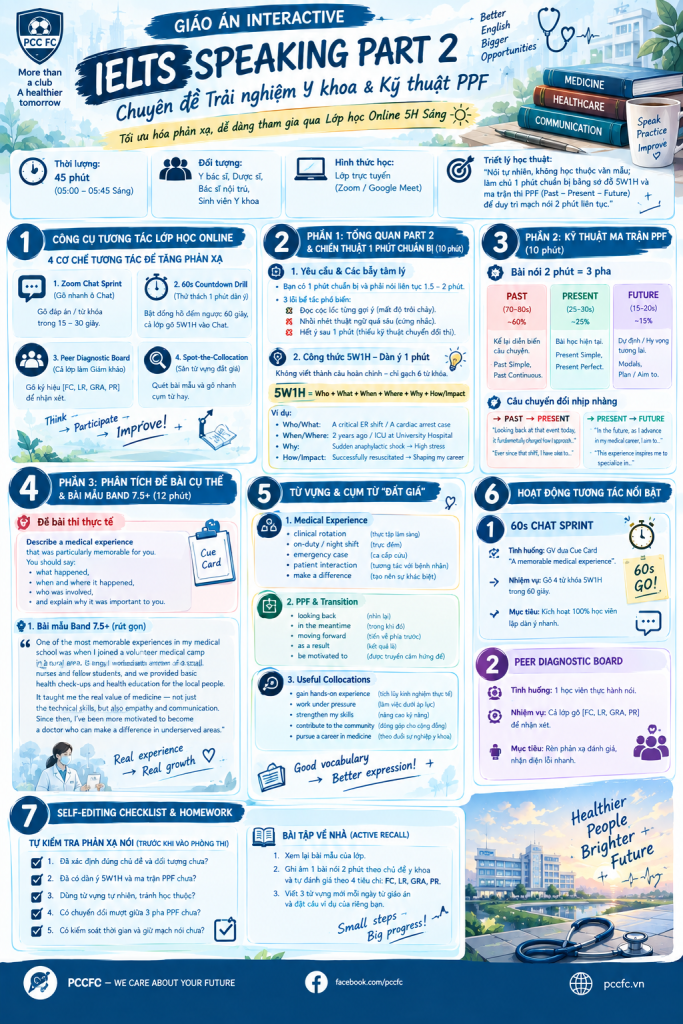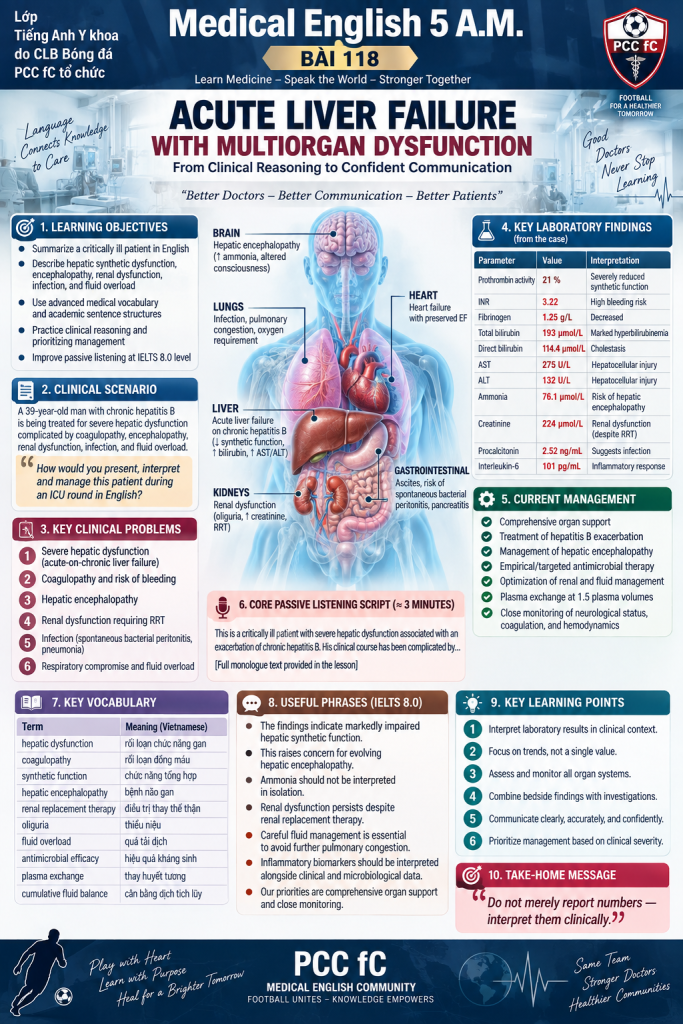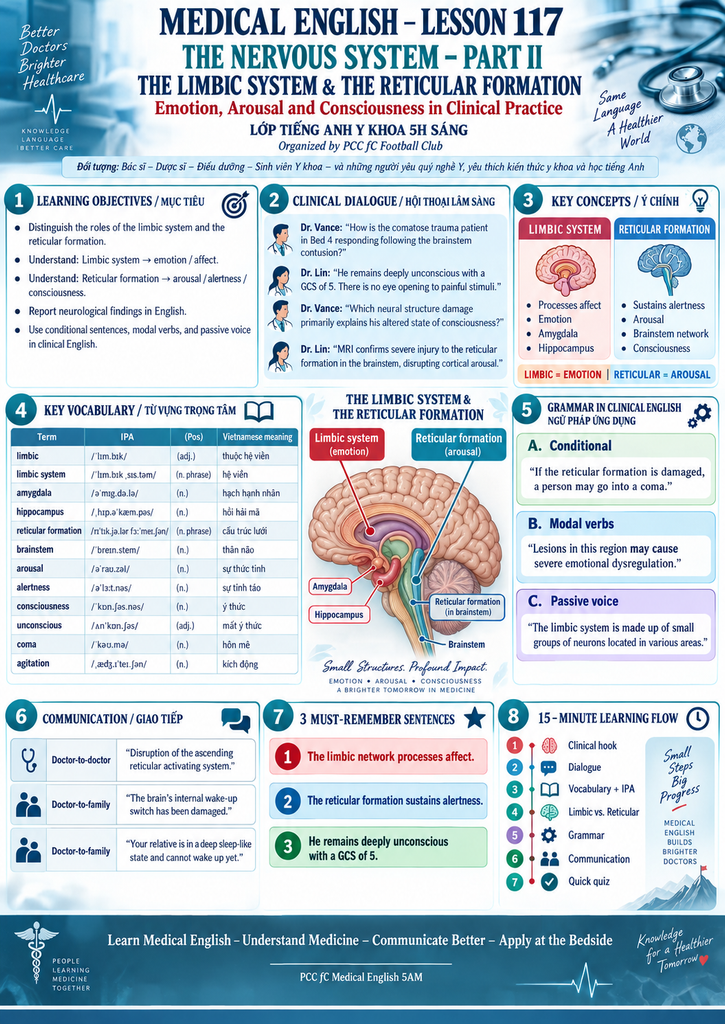
Bài 37 – Tiếng Anh Y Khoa: Cỗ máy cơ thể * The Human Machine
PCC fC Language – Thăng Long, Hà Nội, ngày 22/6/2026, Hôm nay, chúng ta đến với Bài 37: The Human Machine – Cỗ máy cơ thể người. Đây là một bài học rất nền tảng nhưng cũng rất quan trọng, vì nó giúp chúng ta nhìn cơ thể không chỉ như một tập hợp các cơ quan, mà như một hệ thống sống luôn phối hợp, điều chỉnh và tự bảo vệ. Trong bóng đá, một đội hình tốt cần có sự cân bằng: hậu vệ giữ vị trí, tiền vệ kết nối, tiền đạo tạo cơ hội, thủ môn bảo vệ khung thành. Nếu đội bóng mất cân bằng, nguy cơ thủng lưới sẽ tăng lên. Cơ thể con người cũng vậy. Mỗi tế bào, mỗi mô, mỗi cơ quan và mỗi hệ cơ quan đều có vai trò riêng, nhưng tất cả cùng hướng tới một mục tiêu chung: duy trì sự sống và giữ cân bằng nội môi – homeostasis.
Ở bài học này, chúng ta sẽ học cách phân biệt Anatomy – cấu trúc và vị trí của cơ thể, với Physiology – chức năng và cơ chế hoạt động. Chúng ta cũng sẽ đi từ đơn vị nhỏ nhất là cell, đến tissue, organ, organ system, rồi hiểu vì sao cơ thể có thể run khi lạnh, vã mồ hôi khi nóng, thở nhanh khi thiếu oxy, hoặc rụt tay ngay lập tức khi chạm vào vật nóng.
Thông điệp của bài học hôm nay là:
From structure to function, every part serves life.
Từ cấu trúc đến chức năng, mọi bộ phận đều phục vụ sự sống.
Mong rằng sau bài học này, mỗi chúng ta không chỉ học thêm từ vựng tiếng Anh y khoa, mà còn hiểu sâu hơn về vẻ đẹp của cơ thể người – một hệ thống sống thông minh, cân bằng và kỳ diệu.
BÀI GIẢNG 37 – LỚP TIẾNG ANH Y KHOA PCC fC
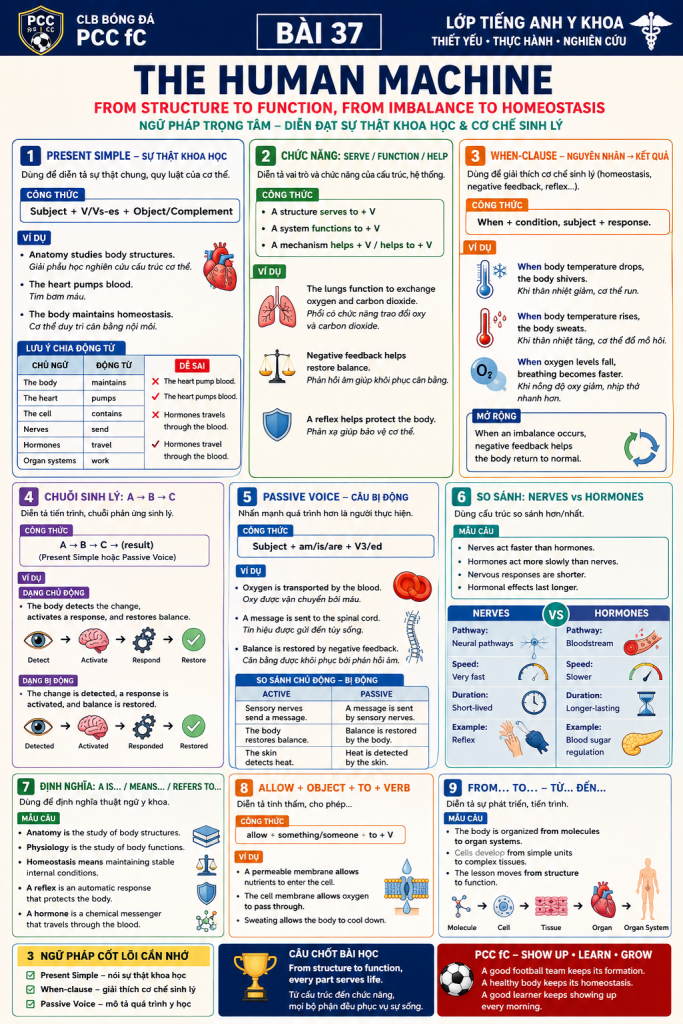
THE HUMAN MACHINE
From Structure to Function, From Imbalance to Homeostasis
Từ cấu trúc đến chức năng – Từ mất cân bằng đến tự điều chỉnh
Nguồn nền tảng: Dựa trên tài liệu The Interactive Medical Lexicon, nội dung về anatomy, physiology, homeostasis, cell, tissue, organ, organ system, permeability, negative feedback, reflex, nerves và hormones.
Sĩ số: /
1. Tinh thần bài học
Bài 37 được thiết kế cho Lớp Tiếng Anh Y khoa – Thiết yếu • Thực hành • Nghiên cứu do CLB Bóng đá PCC fC tổ chức.
Thông điệp chính:
The human body is like a football team:
every part has a position, every function has a purpose, and the whole system must keep balance.
Dịch:
Cơ thể người giống như một đội bóng:
mỗi bộ phận có một vị trí, mỗi chức năng có một nhiệm vụ, và toàn hệ thống phải giữ được sự cân bằng.
2. Mục tiêu bài học
Sau bài học, học viên có thể:
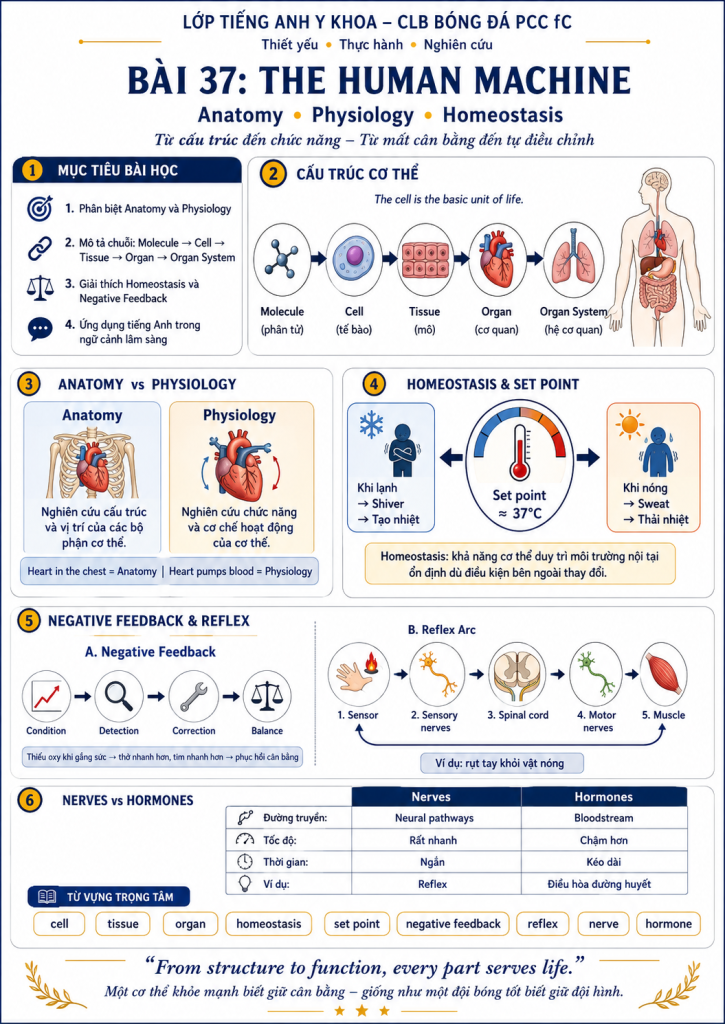
1. Phân biệt được Anatomy và Physiology
Anatomy = structure and location.
Physiology = function and mechanism.
2. Mô tả được các cấp độ tổ chức của cơ thể
Molecule → Cell → Tissue → Organ → Organ System → Human Body.
3. Giải thích được Homeostasis bằng tiếng Anh đơn giản
Homeostasis is the body’s ability to maintain stable internal conditions.
4. Sử dụng được 15 từ vựng y khoa nền tảng trong câu lâm sàng
Ví dụ: cell, tissue, organ, homeostasis, set point, negative feedback, reflex, nerve, hormone.
5. Nói được 30–60 giây về một tình huống sinh lý thường gặp
Ví dụ: rét run, vã mồ hôi, phản xạ rụt tay, thở nhanh khi thiếu oxy.
3. Cấu trúc buổi học 5h sáng
Tổng thời lượng gợi ý: 25 phút
| Thời gian | Nội dung | Người phụ trách |
| 05:00–05:03 | Khởi động – Football analogy | GV/TG |
| 05:03–05:08 | Vocabulary core | TG |
| 05:08–05:13 | Anatomy vs Physiology | GV |
| 05:13–05:18 | Homeostasis & Negative Feedback | GV/TG |
| 05:18–05:23 | Clinical dialogue & role-play | Học viên |
| 05:23–05:25 | KVH challenge & homework | Ban điều hành |
4. Warm-up – Football × Medicine
Câu hỏi mở đầu
Question 1:
In football, what happens if a team loses balance?
Suggested answer:
The team becomes vulnerable and may concede a goal.
Question 2:
In the human body, what happens if internal balance is lost?
Suggested answer:
The body activates feedback mechanisms to restore balance.
Question 3:
What is the medical word for internal balance?
Answer:
Homeostasis.
5. Key Vocabulary – Từ vựng trọng tâm
| English | Pronunciation | Vietnamese | Simple sentence |
| Anatomy | /əˈnætəmi/ | Giải phẫu học | Anatomy studies body structures. |
| Physiology | /ˌfɪziˈɒlədʒi/ | Sinh lý học | Physiology studies body functions. |
| Homeostasis | /ˌhoʊmi.oʊˈsteɪsɪs/ | Cân bằng nội môi | The body maintains homeostasis. |
| Cell | /sel/ | Tế bào | The cell is the basic unit of life. |
| Tissue | /ˈtɪʃuː/ | Mô | Tissues form organs. |
| Organ | /ˈɔːrɡən/ | Cơ quan | The stomach is an organ. |
| Organ system | /ˈɔːrɡən ˈsɪstəm/ | Hệ cơ quan | The digestive system is an organ system. |
| Nucleus | /ˈnuːkliəs/ | Nhân tế bào | The nucleus controls the cell. |
| DNA | /ˌdiː en ˈeɪ/ | Vật chất di truyền | DNA carries genetic instructions. |
| Cytoplasm | /ˈsaɪtəplæzəm/ | Bào tương | Cytoplasm fills the cell. |
| Organelle | /ˌɔːrɡəˈnel/ | Bào quan | Organelles are specialized cell parts. |
| Permeable | /ˈpɜːrmiəbl/ | Có tính thấm | A permeable membrane allows substances to pass. |
| Set point | /set pɔɪnt/ | Điểm cân bằng mục tiêu | Body temperature has a set point. |
| Negative feedback | /ˈneɡətɪv ˈfiːdbæk/ | Phản hồi âm | Negative feedback restores balance. |
| Reflex | /ˈriːfleks/ | Phản xạ | A reflex is an automatic response. |
| Nerve | /nɜːrv/ | Dây thần kinh | Nerves send fast messages. |
| Hormone | /ˈhɔːrmoʊn/ | Hormone | Hormones travel through the blood. |
6. Nội dung bài giảng chính
A. Anatomy vs Physiology
1. Anatomy
Anatomy is the study of body structures and their locations.
Dịch:
Giải phẫu học là ngành học về cấu trúc cơ thể và vị trí của các bộ phận.
Ví dụ:
The heart is located in the chest.
The lungs are inside the thoracic cavity.
2. Physiology
Physiology is the study of body functions and mechanisms.
Dịch:
Sinh lý học là ngành học về chức năng và cơ chế hoạt động của cơ thể.
Ví dụ:
The heart pumps blood.
The lungs exchange oxygen and carbon dioxide.
3. Football analogy
Anatomy is the formation.
Physiology is the way the team plays.
Dịch:
Anatomy giống như sơ đồ đội hình.
Physiology giống như cách đội bóng vận hành.
Ví dụ:
A defender’s position is anatomy.
How the defender protects the goal is physiology.
B. Biological Building Blocks – Các cấp độ tổ chức cơ thể
Câu trung tâm:
The human body is organized from small structures to complex systems.
Chuỗi tổ chức:
Molecule → Cell → Tissue → Organ → Organ System → Human Body
Giải thích nhanh:
Molecules form cells.
Phân tử tạo thành tế bào.
Cells form tissues.
Tế bào tạo thành mô.
Tissues form organs.
Mô tạo thành cơ quan.
Organs form organ systems.
Cơ quan tạo thành hệ cơ quan.
Organ systems form the human body.
Các hệ cơ quan tạo thành cơ thể người.
C. The Cell – Basic Unit of Life
Câu cần học thuộc:
The cell is the basic unit of life.
Các thành phần chính:
Nucleus
The nucleus is the cell’s control center.
DNA
DNA is the genetic instruction book.
Cytoplasm
Cytoplasm is the jelly-like material inside the cell.
Organelles
Organelles are small specialized parts inside the cell.
D. Permeability – Tính thấm
Câu chính:
A permeable membrane allows liquids, gases, or nutrients to pass through.
Dịch:
Màng có tính thấm cho phép dịch, khí hoặc chất dinh dưỡng đi qua.
Ví dụ đơn giản:
Oxygen enters the cell.
Carbon dioxide leaves the cell.
Sugar enters the cell to provide energy.
Liên hệ lâm sàng:
When cell membranes are damaged, cells may lose their ability to maintain a stable internal environment.
Dịch:
Khi màng tế bào bị tổn thương, tế bào có thể mất khả năng duy trì môi trường bên trong ổn định.
E. Homeostasis – Cân bằng nội môi
Định nghĩa đơn giản:
Homeostasis is the body’s ability to maintain stable internal conditions despite external changes.
Dịch:
Cân bằng nội môi là khả năng cơ thể duy trì môi trường bên trong ổn định dù môi trường bên ngoài thay đổi.
Ví dụ thân nhiệt:
The body temperature set point is about 37°C.
Khi lạnh:
Temperature drops → the body shivers → heat is produced.
Khi nóng:
Temperature rises → the body sweats → heat is lost.
F. Negative Feedback – Phản hồi âm
Công thức 4 bước:
Condition → Detection → Correction → Balance
Ví dụ khi tập thể thao cường độ cao:
Condition:
The person exercises intensely.
Detection:
The body detects low oxygen.
Correction:
Breathing becomes faster and heart rate increases.
Balance:
Oxygen levels are restored.
Câu mẫu:
Negative feedback helps the body return to normal.
Dịch:
Phản hồi âm giúp cơ thể trở về trạng thái bình thường.
G. Reflex – Phản xạ
Ví dụ: chạm tay vào vật nóng.
5 bước:
1. Sensor
The skin detects heat or pain.
2. Sensory nerves
Sensory nerves send an alert message inward.
3. Spinal cord
The spinal cord interprets the message.
4. Motor nerves
Motor nerves send instructions outward.
5. Muscle
The muscle contracts and pulls the hand away.
Câu cần nhớ:
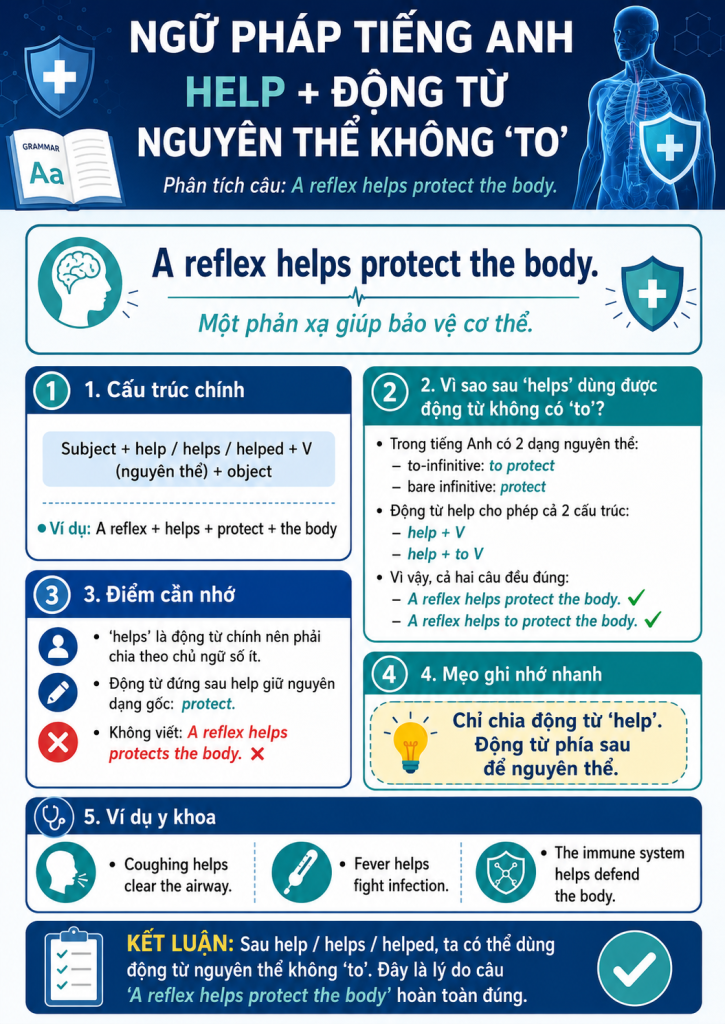
A reflex is an automatic response that protects the body.
Dịch:
Phản xạ là đáp ứng tự động giúp bảo vệ cơ thể.
H. Nerves vs Hormones
| Feature | Nerves | Hormones |
| Pathway | Neural pathways | Bloodstream |
| Speed | Very fast | Slower |
| Duration | Short-lived | Longer-lasting |
| Example | Reflex | Blood sugar regulation |
Câu mẫu:
Nerves act fast, like a quick pass in football.
Hormones act slowly, like a long-term team strategy.
Dịch:
Dây thần kinh hoạt động nhanh, giống như một đường chuyền nhanh trong bóng đá.
Hormone hoạt động chậm hơn, giống như chiến lược dài hạn của đội bóng.
7. Clinical Dialogue – Hội thoại lâm sàng
Chủ đề: Fever, chills and sweating
Doctor: Good morning. What brings you here today?
Patient: I have fever and chills.
Doctor: Do you also sweat?
Patient: Yes, I sweated a lot last night.
Doctor: Your body is trying to maintain homeostasis.
Patient: What does that mean?
Doctor: It means your body tries to keep internal conditions stable. When your temperature rises, sweating helps cool the body down.
Patient: So sweating can be a normal response?
Doctor: Yes, but we still need to find the cause of your fever.
Patient: I understand.
Doctor: We will check your temperature, heart rate, blood pressure, and some basic tests.
8. Phiên bản dễ học cho học viên K1–K2
Doctor: You have fever and chills.
Patient: Yes, I feel very cold.
Doctor: Your body is trying to keep balance.
Patient: Is that homeostasis?
Doctor: Yes. Homeostasis means keeping the body stable.
Patient: Thank you, doctor.
9. Phiên bản nâng cao cho K4–K5
Doctor: Your fever, chills, and sweating are part of a physiological response.
Patient: Is my body trying to regulate temperature?
Doctor: Exactly. Your body has a temperature set point. When your temperature changes, negative feedback mechanisms help restore balance.
Patient: So chills and sweating are both protective responses?
Doctor: Correct. However, we must identify the underlying cause, such as infection or inflammation.
10. Speaking Practice – 30 giây mỗi học viên
Mỗi học viên chọn 1 câu hỏi:
Topic 1:
What is the difference between anatomy and physiology?
Topic 2:
How does the body maintain temperature?
Topic 3:
What happens when you touch something hot?
Topic 4:
What is the difference between nerves and hormones?
Topic 5:
Why is homeostasis important?
Mẫu trả lời 30 giây
Anatomy studies the structure and location of body parts. Physiology studies how body parts work. For example, anatomy tells us that the heart is in the chest, while physiology explains how the heart pumps blood. Both are important in medicine.
11. Bài tập trên lớp
Exercise 1. Matching
Match the term with the correct definition.
| Term | Definition |
| 1. DNA | A. The fluid inside the cell |
| 2. Permeable | B. A small specialized part inside the cell |
| 3. Organelle | C. Allowing substances to pass through |
| 4. Cytoplasm | D. The genetic instruction book |
Answer:
1-D, 2-C, 3-B, 4-A.
Exercise 2. Fill in the blanks
Word bank:
Organ – Organ systems – Negative feedback – Set point
1. The ideal body temperature of about 37°C is called the body’s __________.
2. When temperature drops, a __________ loop helps generate heat.
3. The stomach is an __________ made of different tissues.
4. The circulatory and digestive systems are examples of __________.
Answer:
- set point
- negative feedback
- organ
- organ systems
12. PCC fC KVH Challenge
Thử thách 1 điểm KVH
Học viên ghi âm 45–60 giây với chủ đề:
Explain homeostasis using a football example.
Gợi ý:
The human body is like a football team. When the team loses balance, players adjust their positions. Similarly, when the body loses internal balance, negative feedback helps restore normal conditions. This process is called homeostasis.
Thử thách 2 điểm KVH
Đóng vai bác sĩ – bệnh nhân trong tình huống:
Patient has fever, chills, and sweating.
Doctor explains homeostasis and negative feedback.
Yêu cầu có ít nhất 5 từ:
fever, chills, sweating, homeostasis, temperature, negative feedback, set point.
13. Bài tập về nhà
Task 1. Viết 5 câu tiếng Anh
Dùng 5 từ sau:
anatomy, physiology, homeostasis, reflex, hormone.
Ví dụ:
A reflex is an automatic response that protects the body.
Task 2. Ghi âm phát âm
Ghi âm 10 từ:
anatomy
physiology
homeostasis
cytoplasm
organelle
permeable
set point
negative feedback
reflex
hormone
Task 3. Mini-poster
Thiết kế 1 poster nhỏ với chủ đề:
Homeostasis: How the Body Keeps Balance
Bố cục gợi ý:
Cold → Shivering → Heat production → Balance
Hot → Sweating → Heat loss → Balance
14. Câu chốt truyền cảm hứng
A good football team keeps its formation.
A healthy body keeps its homeostasis.
A good learner keeps showing up every morning.
Dịch:
Một đội bóng tốt biết giữ đội hình.
Một cơ thể khỏe mạnh biết giữ cân bằng.
Một học viên tốt là người bền bỉ có mặt mỗi sáng.
15. Tên bài chính thức đề xuất

From Football Balance to Body Balance
Từ cân bằng đội hình đến cân bằng cơ thể
CLB Bóng đá PCC fC