Bài 51 – Tiếng Anh Y Khoa: Đọc hiểu cột sống, nói chuẩn y khoa * Reading the Spine, Speaking Medicine
PCC Language – Thăng Long, Hà Nội, ngày 8/7/2026, Trong thực hành lâm sàng, đau lưng không chỉ là một triệu chứng đơn giản. Đằng sau câu nói rất đời thường của người bệnh: “My back hurts” có thể là thoát vị đĩa đệm, hẹp ống sống, chèn ép rễ thần kinh, vẹo cột sống hoặc bệnh lý thoái hóa cột sống. Bài học hôm nay giúp học viên chuyển đổi từ ngôn ngữ đời thường của bệnh nhân sang ngôn ngữ y khoa chính xác của bác sĩ. Khi hiểu được cấu trúc cột sống, bệnh lý thường gặp và cách diễn đạt bằng tiếng Anh, chúng ta không chỉ học từ vựng, mà còn học cách tư duy lâm sàng.
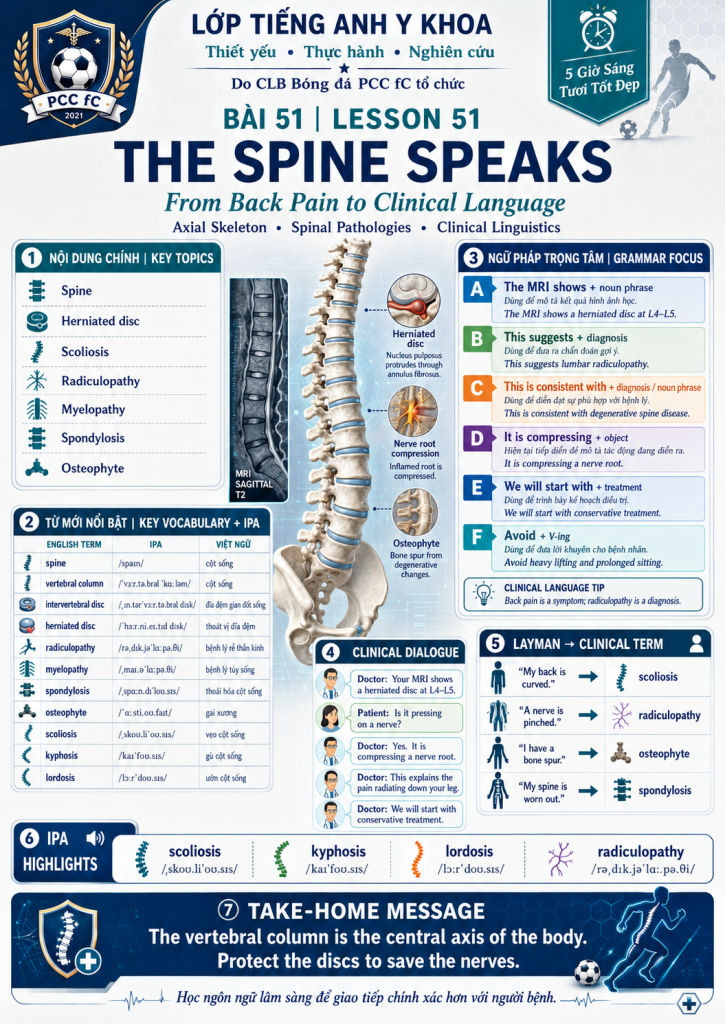
MEDICAL ENGLISH LESSON 51
THE SPINE SPEAKS: From Back Pain to Clinical Language
Lớp Tiếng Anh Y Khoa – Thiết yếu • Thực hành • Nghiên cứu
Do CLB Bóng đá PCC fC tổ chức
“5 Giờ Sáng Tươi Tốt Đẹp”
I. ĐOẠN DẪN BÀI HỌC
Trong thực hành lâm sàng, đau lưng không chỉ là một triệu chứng đơn giản. Đằng sau câu nói rất đời thường của người bệnh: “My back hurts” có thể là thoát vị đĩa đệm, hẹp ống sống, chèn ép rễ thần kinh, vẹo cột sống hoặc bệnh lý thoái hóa cột sống.
Bài học hôm nay giúp học viên chuyển đổi từ ngôn ngữ đời thường của bệnh nhân sang ngôn ngữ y khoa chính xác của bác sĩ. Khi hiểu được cấu trúc cột sống, bệnh lý thường gặp và cách diễn đạt bằng tiếng Anh, chúng ta không chỉ học từ vựng, mà còn học cách tư duy lâm sàng.
The spine is the central axis of the body.
Clinical language is the central axis of medical communication.
II. MỤC TIÊU BÀI HỌC
Sau bài học, học viên có thể:
- Gọi tên các cấu trúc cơ bản của cột sống bằng tiếng Anh.
- Mô tả một số bệnh lý thường gặp:
- herniated disc
- scoliosis
- kyphosis
- lordosis
- spondylosis
- radiculopathy
- myelopathy
- Chuyển đổi lời than phiền của bệnh nhân thành thuật ngữ y khoa.
- Đọc và giải thích một kết quả MRI cột sống đơn giản bằng tiếng Anh.
- Sử dụng các cấu trúc ngữ pháp thường gặp trong hội thoại y khoa:
- “The MRI shows…”
- “This suggests…”
- “This is consistent with…”
- “You may need…”
- Phát âm đúng các thuật ngữ chính bằng IPA.
III. WARM-UP: THE 5 AM EMOJI BONE-SCAN
1. Spine
Spine /spaɪn/
Cột sống
Example:
The spine supports the body and protects the spinal cord.
Cột sống nâng đỡ cơ thể và bảo vệ tủy sống.
2. Herniated disc
Herniated disc /ˈhɜːr.ni.eɪ.tɪd dɪsk/
Thoát vị đĩa đệm
Example:
A herniated disc may compress a nerve root.
Thoát vị đĩa đệm có thể chèn ép rễ thần kinh.
3. Scoliosis
Scoliosis /ˌskoʊ.liˈoʊ.sɪs/
Vẹo cột sống
Example:
Scoliosis is an abnormal lateral curvature of the spine.
Vẹo cột sống là tình trạng cong bất thường sang bên của cột sống.
IV. CORE DIALOGUE: READING A SPINAL MRI
Clinical Situation
A patient presents with low back pain radiating down the leg. The doctor explains the MRI findings.
Doctor – Patient Dialogue
Doctor: Your MRI shows a herniated disc at the L4–L5 level.
Patient: What does that mean, doctor?
Doctor: It means that one of the discs between your vertebrae has slipped out of place.
Patient: Is it pressing on a nerve?
Doctor: Yes. The disc is compressing a nerve root, which explains the pain going down your leg.
Patient: Is that called sciatica?
Doctor: Yes, clinically we call it radiculopathy.
Patient: Do I need surgery?
Doctor: Not immediately. We will start with medication, physiotherapy, and close monitoring.
Patient: What should I avoid?
Doctor: Avoid heavy lifting, sudden twisting, and prolonged sitting.
V. PHÂN TÍCH HỘI THOẠI
1. “Your MRI shows…”
Cấu trúc dùng để trình bày kết quả hình ảnh học.
Examples:
- Your MRI shows a herniated disc.
- The CT scan shows spinal canal narrowing.
- The X-ray shows scoliosis.
2. “It means that…”
Cấu trúc dùng để giải thích thuật ngữ y khoa cho bệnh nhân.
Example:
It means that one of the discs has moved out of its normal position.
3. “This explains…”
Cấu trúc dùng để liên hệ tổn thương với triệu chứng.
Example:
This explains the pain going down your leg.
4. “Not immediately.”
Cách trả lời mềm mại khi bệnh nhân hỏi về phẫu thuật.
Example:
Not immediately. We will try conservative treatment first.
VI. KEY VOCABULARY
1. Axial skeleton
/ˈæk.si.əl ˈskel.ɪ.tən/
Bộ xương trục
The axial skeleton includes the skull, vertebral column, ribs, and sternum.
2. Vertebral column
/ˈvɜːr.tə.brəl ˈkɑː.ləm/
Cột sống
The vertebral column protects the spinal cord.
3. Vertebral canal
/ˈvɜːr.tə.brəl kəˈnæl/
Ống sống
The spinal cord passes through the vertebral canal.
4. Intervertebral disc
/ˌɪn.tərˈvɜːr.tə.brəl dɪsk/
Đĩa đệm gian đốt sống
An intervertebral disc acts as a cushion between two vertebrae.
5. Herniated disc
/ˈhɜːr.ni.eɪ.tɪd dɪsk/
Thoát vị đĩa đệm
A herniated disc can compress a nerve root.
6. Radiculopathy
/rəˌdɪk.jəˈlɑː.pə.θi/
Bệnh lý rễ thần kinh
Radiculopathy causes pain, numbness, or weakness along a nerve pathway.
7. Myelopathy
/ˌmaɪ.əˈlɑː.pə.θi/
Bệnh lý tủy sống
Cervical myelopathy may cause weakness and gait disturbance.
8. Spondylosis
/ˌspɑːn.dɪˈloʊ.sɪs/
Thoái hóa cột sống
Spondylosis is a degenerative condition of the spine.
9. Osteophyte
/ˈɑː.sti.oʊ.faɪt/
Gai xương
Osteophytes may narrow the spinal canal.
10. Scoliosis
/ˌskoʊ.liˈoʊ.sɪs/
Vẹo cột sống
Scoliosis is a sideways curvature of the spine.
11. Kyphosis
/kaɪˈfoʊ.sɪs/
Gù cột sống
Kyphosis is an excessive forward curvature of the spine.
12. Lordosis
/lɔːrˈdoʊ.sɪs/
Ưỡn cột sống
Lordosis is an excessive inward curvature of the lumbar spine.
VII. LAYMAN’S COMPLAINTS → CLINICAL TERMS
1. “My back is curved.”
Clinical term: Scoliosis
Vietnamese: Vẹo cột sống
2. “I have a bone spur.”
Clinical term: Osteophyte
Vietnamese: Gai xương
3. “A nerve is pinched.”
Clinical term: Radiculopathy
Vietnamese: Bệnh lý rễ thần kinh
4. “My spine is worn out.”
Clinical term: Spondylosis
Vietnamese: Thoái hóa cột sống
5. “The pain runs down my leg.”
Clinical term: Sciatica / Lumbar radiculopathy
Vietnamese: Đau thần kinh tọa / bệnh lý rễ thần kinh thắt lưng
VIII. GRAMMAR FOCUS: DESCRIBING IMAGING FINDINGS
Pattern 1: The MRI shows + noun phrase
Examples:
- The MRI shows a herniated disc.
- The MRI shows spinal canal narrowing.
- The MRI shows compression of the nerve root.
Pattern 2: This suggests + diagnosis
Examples:
- This suggests lumbar radiculopathy.
- This suggests degenerative spinal disease.
- This suggests spinal cord compression.
Pattern 3: This is consistent with + diagnosis
Examples:
- This is consistent with spondylosis.
- This is consistent with cervical myelopathy.
- This is consistent with L4–L5 disc herniation.
Pattern 4: You may need + treatment
Examples:
- You may need medication.
- You may need physiotherapy.
- You may need further evaluation by a spine specialist.
IX. CLINICAL COLLOCATIONS
Học viên cần nhớ các cụm từ thường đi với nhau:
- lumbar spine
Cột sống thắt lưng - cervical spine
Cột sống cổ - thoracic spine
Cột sống ngực - herniated lumbar disc
Thoát vị đĩa đệm thắt lưng - nerve root compression
Chèn ép rễ thần kinh - spinal canal stenosis
Hẹp ống sống - degenerative spine disease
Bệnh thoái hóa cột sống - radiating pain
Đau lan - numbness and weakness
Tê bì và yếu - conservative treatment
Điều trị bảo tồn
X. SPEAKING PRACTICE
Task 1: Explain to a patient
Translate and speak aloud:
- MRI của anh/chị cho thấy thoát vị đĩa đệm L4–L5.
- Đĩa đệm đang chèn ép rễ thần kinh.
- Điều này giải thích vì sao đau lan xuống chân.
- Hiện tại chưa cần phẫu thuật ngay.
- Chúng ta sẽ bắt đầu bằng điều trị bảo tồn.
Suggested answers:
- Your MRI shows a herniated disc at L4–L5.
- The disc is compressing a nerve root.
- This explains why the pain radiates down your leg.
- You do not need surgery immediately.
- We will start with conservative treatment.
Task 2: Doctor–Patient Role Play
Student A: Doctor
Student B: Patient
Situation:
The patient has chronic low back pain and numbness in the right leg. MRI shows lumbar spondylosis and L5 nerve root compression.
Use these phrases:
- Your MRI shows…
- This means that…
- This explains…
- We will start with…
- Please avoid…
XI. MINI QUIZ
Question 1
What is the English term for “thoát vị đĩa đệm”?
A. Scoliosis
B. Herniated disc
C. Osteophyte
D. Kyphosis
Answer: B. Herniated disc
Question 2
What does “radiculopathy” mean?
A. Bone infection
B. Spinal curvature
C. Nerve root disease
D. Muscle inflammation
Answer: C. Nerve root disease
Question 3
Which phrase means “hẹp ống sống”?
A. Spinal canal stenosis
B. Vertebral fracture
C. Disc infection
D. Bone spur
Answer: A. Spinal canal stenosis
Question 4
Which sentence is correct?
A. The MRI show a herniated disc.
B. The MRI shows a herniated disc.
C. The MRI showing a herniated disc.
D. The MRI showed by herniated disc.
Answer: B. The MRI shows a herniated disc.
Question 5
“Bone spur” is the layman’s term for:
A. Osteophyte
B. Myelopathy
C. Scoliosis
D. Lordosis
Answer: A. Osteophyte
XII. CLINICAL PEARLS
- Back pain is a symptom, not a diagnosis.
Đau lưng là triệu chứng, không phải chẩn đoán. - Radiating pain suggests nerve involvement.
Đau lan gợi ý có tổn thương hoặc chèn ép thần kinh. - MRI findings must be correlated with clinical symptoms.
Kết quả MRI phải được đối chiếu với triệu chứng lâm sàng. - Not every herniated disc requires surgery.
Không phải mọi thoát vị đĩa đệm đều cần phẫu thuật. - Clear explanation reduces patient anxiety.
Giải thích rõ ràng giúp bệnh nhân bớt lo lắng.
XIII. PRONUNCIATION DRILL
Repeat 3 times:
- Intervertebral
/ˌɪn.tərˈvɜːr.tə.brəl/ - Radiculopathy
/rəˌdɪk.jəˈlɑː.pə.θi/ - Myelopathy
/ˌmaɪ.əˈlɑː.pə.θi/ - Scoliosis
/ˌskoʊ.liˈoʊ.sɪs/ - Kyphosis
/kaɪˈfoʊ.sɪs/ - Lordosis
/lɔːrˈdoʊ.sɪs/ - Spondylosis
/ˌspɑːn.dɪˈloʊ.sɪs/ - Osteophyte
/ˈɑː.sti.oʊ.faɪt/
XIV. TAKE-HOME MESSAGE
The vertebral column is the central axis of the body.
Protect the discs to save the nerves.
Use precise language to protect the patient’s understanding.
Dịch:
Cột sống là trục trung tâm của cơ thể.
Bảo vệ đĩa đệm là bảo vệ thần kinh.
Sử dụng ngôn ngữ chính xác là bảo vệ sự thấu hiểu của người bệnh.
XV. HOMEWORK
Assignment 1
Write 5 sentences using the phrase:
The MRI shows…
Example:
The MRI shows a herniated disc at L4–L5.
Assignment 2
Translate into English:
- Bệnh nhân đau lưng lan xuống chân phải.
- MRI cho thấy thoát vị đĩa đệm thắt lưng.
- Đĩa đệm đang chèn ép rễ thần kinh.
- Bệnh nhân có thể cần vật lý trị liệu.
- Chưa có chỉ định phẫu thuật ngay.
Assignment 3
Record a 60-second explanation for a patient with lumbar disc herniation.
Use these words:
- herniated disc
- nerve root
- radiating pain
- conservative treatment
- physiotherapy
XVI. SLOGAN BÀI 51
Learn the spine. Speak with clarity. Heal with understanding.
Dịch:
Hiểu cột sống. Nói rõ ràng. Chữa lành bằng sự thấu hiểu.
XVII. THÔNG ĐIỆP PCC fC
Một bác sĩ giỏi không chỉ đọc được phim MRI, mà còn phải giải thích được cho người bệnh hiểu.
Một học viên giỏi không chỉ học thuộc từ vựng, mà còn phải biến từ vựng thành năng lực giao tiếp lâm sàng.
5 giờ sáng không chỉ là giờ học tiếng Anh.
Đó là giờ rèn trí tuệ, kỷ luật và bản lĩnh của người thầy thuốc.
PCC FC