Bài 61 – Tiếng Anh Y Khoa: Từ tín hiệu thần kinh đến co cơ * From Neural Signal to Muscle Contraction!
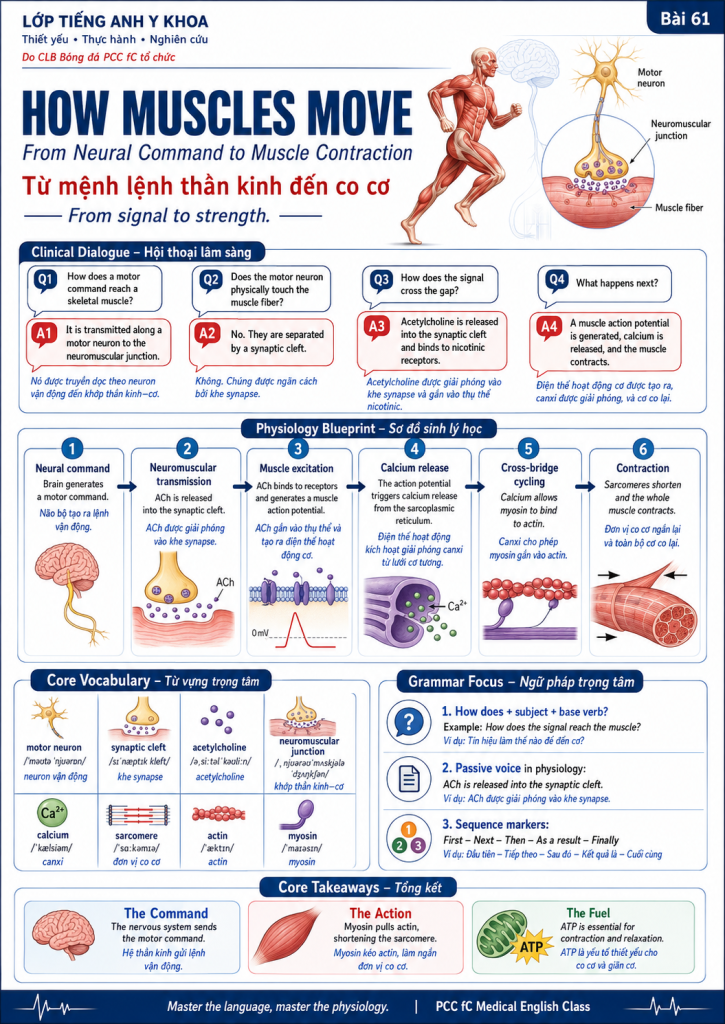
PCC Language – Thăng Long, Hà Nội, ngày 19/7/2026, Mỗi bước chạy, cú sút bóng hay động tác cầm dụng cụ y khoa đều bắt đầu bằng một tín hiệu điện trong hệ thần kinh. Tín hiệu ấy được truyền qua neuron vận động, chuyển thành thông điệp hóa học tại khớp thần kinh–cơ, rồi tiếp tục kích hoạt quá trình tương tác giữa actin và myosin bên trong sarcomere. Trong Bài 61, học viên sẽ sử dụng tiếng Anh để trả lời một câu hỏi sinh lý học quan trọng: How does a neural signal become muscle contraction? Một tín hiệu thần kinh biến thành sự co cơ như thế nào? Bài học không chỉ dừng lại ở acetylcholine và ATP mà bổ sung mắt xích sinh lý thiết yếu là calcium, giúp hoàn thiện chuỗi: Neural command → Neuromuscular transmission → Muscle action potential → Calcium release → Cross-bridge cycling → Contraction.
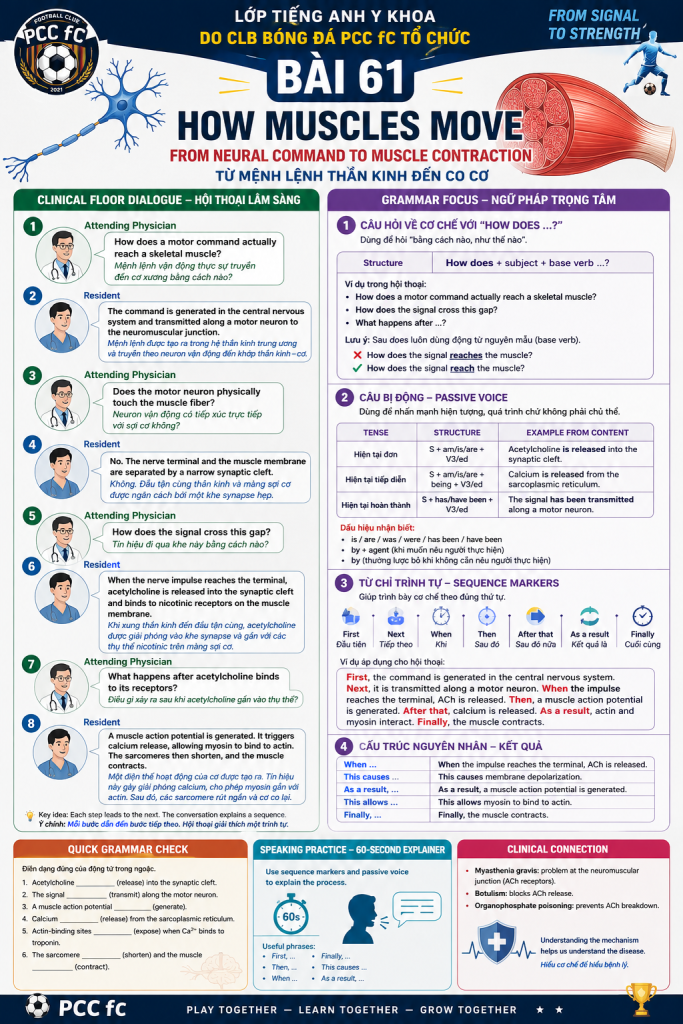
BÀI 61 – HOW MUSCLES MOVE
From Neural Signal to Muscle Contraction
Từ tín hiệu thần kinh đến co cơ
Lớp Tiếng Anh Y Khoa – Thiết yếu • Thực hành • Nghiên cứu
Do CLB Bóng đá PCC fC tổ chức
Master the language, master the physiology.
Làm chủ ngôn ngữ – làm chủ sinh lý học.
Bài học được xây dựng từ đoạn hội thoại về đường truyền tín hiệu từ não, neuron vận động, khe synapse và acetylcholine trong tài liệu bác sĩ cung cấp.
I. Mục tiêu bài học – Learning Objectives
Sau bài học, học viên có thể:
- Trình bày bằng tiếng Anh quá trình tín hiệu vận động truyền từ não đến cơ.
- Mô tả vai trò của motor neuron, neuromuscular junction, acetylcholine, sarcomere, actin, myosin và ATP.
- Sử dụng chính xác cấu trúc câu hỏi về cơ chế sinh lý:
- How does…?
- Do/Does…?
- Which…?
- What happens when…?
- Sử dụng câu bị động để mô tả quá trình:
- is sent
- is released
- is generated
- is pulled
- Phân biệt các động từ khoa học:
- send – transmit – release – bind – generate – contract – relax
- Thực hiện một bài trình bày ngắn về cơ chế co cơ bằng tiếng Anh.
II. Clinical Floor Dialogue
Hội thoại tại buồng bệnh
1. Attending Physician
How does the signal to move actually reach the skeletal muscle?
Tín hiệu vận động thực sự truyền đến cơ xương bằng cách nào?
2. Resident
Motor commands are generated in the central nervous system and transmitted along motor neurons to the muscle.
Các mệnh lệnh vận động được tạo ra trong hệ thần kinh trung ương và truyền theo neuron vận động đến cơ.
3. Attending Physician
Do the motor neurons physically touch the muscle fibers?
Các neuron vận động có tiếp xúc trực tiếp với sợi cơ không?
4. Resident
No. The nerve terminal and the muscle fiber are separated by a narrow space called the synaptic cleft.
Không. Đầu tận cùng thần kinh và sợi cơ được ngăn cách bởi một khoảng hẹp gọi là khe synapse.
5. Attending Physician
How does the signal cross the synaptic cleft?
Tín hiệu đi qua khe synapse bằng cách nào?
6. Resident
When the nerve impulse reaches the terminal, a neurotransmitter is released and diffuses across the cleft.
Khi xung thần kinh đến đầu tận cùng, một chất dẫn truyền thần kinh được giải phóng và khuếch tán qua khe synapse.
7. Attending Physician
Which neurotransmitter activates skeletal muscle fibers?
Chất dẫn truyền thần kinh nào hoạt hóa các sợi cơ xương?
8. Resident
Acetylcholine, or ACh, binds to receptors on the muscle membrane and triggers an electrical signal that initiates muscle contraction.
Acetylcholine, hay ACh, gắn vào các thụ thể trên màng sợi cơ và khởi phát tín hiệu điện bắt đầu quá trình co cơ.
Scientific refinement
Trong bản gốc, chất dẫn truyền thần kinh được mô tả là “jumps across the gap”. Trong ngôn ngữ sinh lý học chính xác hơn, nên dùng:
ACh is released into the synaptic cleft and diffuses across it.
Acetylcholine không “nhảy” qua khe synapse mà được giải phóng từ túi synapse rồi khuếch tán qua khe.
III. Medical Vocabulary
Từ vựng trọng tâm
| Thuật ngữ | Phiên âm | Nghĩa |
| skeletal muscle | /ˈskelɪtəl ˈmʌsəl/ | cơ xương |
| motor neuron | /ˈməʊtə ˈnjʊərɒn/ | neuron vận động |
| nerve impulse | /nɜːv ˈɪmpʌls/ | xung thần kinh |
| nerve terminal | /nɜːv ˈtɜːmɪnəl/ | đầu tận cùng thần kinh |
| neuromuscular junction | /ˌnjʊərəʊˈmʌskjələ ˈdʒʌŋkʃən/ | khớp thần kinh–cơ |
| synaptic cleft | /sɪˈnæptɪk kleft/ | khe synapse |
| neurotransmitter | /ˌnjʊərəʊtrænzˈmɪtə/ | chất dẫn truyền thần kinh |
| acetylcholine | /əˌsiːtəlˈkəʊliːn/ | acetylcholine |
| receptor | /rɪˈseptə/ | thụ thể |
| muscle fiber | /ˈmʌsəl ˌfaɪbə/ | sợi cơ |
| muscle membrane | /ˈmʌsəl ˈmembreɪn/ | màng sợi cơ |
| electrical signal | /ɪˈlektrɪkəl ˈsɪɡnəl/ | tín hiệu điện |
| sarcomere | /ˈsɑːkəmɪə/ | đơn vị co cơ |
| myofibril | /ˌmaɪəʊˈfaɪbrəl/ | tơ cơ |
| myofilament | /ˌmaɪəʊˈfɪləmənt/ | vi sợi cơ |
| actin | /ˈæktɪn/ | actin |
| myosin | /ˈmaɪəsɪn/ | myosin |
| ATP | /ˌeɪ tiː ˈpiː/ | phân tử cung cấp năng lượng |
| contraction | /kənˈtrækʃən/ | sự co cơ |
| relaxation | /ˌriːlækˈseɪʃən/ | sự giãn cơ |
Tài liệu minh họa cấu trúc sarcomere, vị trí actin–myosin và vai trò của ATP trong co và giãn cơ.
IV. Word Anatomy
Giải phẫu từ vựng
1. Motor neuron
- motor = movement – vận động
- neuron = nerve cell – tế bào thần kinh
A motor neuron carries an electrical signal from the central nervous system to a muscle.
2. Neurotransmitter
- neuro- = nerve – thần kinh
- transmit = carry or send – truyền hoặc gửi
- -er = tác nhân thực hiện hành động
A neurotransmitter carries a chemical message between cells.
3. Neuromuscular
- neuro- = thần kinh
- muscular = thuộc về cơ
The neuromuscular junction is the site where a motor neuron communicates with a skeletal muscle fiber.
4. Sarcomere
- sarco- = flesh or muscle – thịt hoặc cơ
- -mere = part – phần
A sarcomere is the contractile unit located between two Z-lines.
5. Contract
- Trọng âm động từ: con-TRACT /kənˈtrækt/
- Danh từ: CON-tract /ˈkɒntrækt/ có nghĩa là hợp đồng
When sarcomeres shorten, the muscle contracts.
V. The Physiology Blueprint
Bản thiết kế của vận động
Phase 1. Neural command – Mệnh lệnh thần kinh
- The brain generates a motor command.
- The signal travels along a motor neuron.
- The nerve impulse reaches the neuromuscular junction.
- Acetylcholine is released into the synaptic cleft.
- ACh binds to receptors on the muscle membrane.
- An electrical signal is generated in the muscle fiber.
Phase 2. The sarcomere at rest – Sarcomere khi nghỉ
Khi chưa co cơ:
- Actin được neo vào các Z-lines.
- Myosin nằm ở trung tâm sarcomere.
- Đ vào các Z-lines.
- Myosin nằm ở trung tâm sarcomere.
- Đầu myosin ở trạng thái sẵn sàng hoạt động.
- Khoảng cách giữa hai Z-line còn rộng.
- Sarcomere chưa rút ngắn.
Phase 3. Muscle contraction – Co cơ
- Myosin heads bind to actin.
- Myosin pulls the actin filaments toward the center.
- The Z-lines move closer together.
- The sarcomere shortens.
- Multiple sarcomeres shorten simultaneously.
- The whole muscle contracts.
The filaments do not become shorter. They slide past one another.
Các sợi actin và myosin không tự ngắn đi; chúng trượt lên nhau, làm sarcomere rút ngắn.
Phase 4. Relaxation – Giãn cơ
ATP có vai trò quan trọng trong việc tách đầu myosin khỏi actin.
ATP binds to myosin and allows the myosin head to detach from actin.
Nếu không có ATP, myosin không thể tách khỏi actin một cách bình thường. Nội dung này được nh The Role of ATP” của tài liệu. fileciteturn0file0L10-L12
VI. Grammar Focus 1
Cấu trúc “How does…?”
Dùng để hỏi về cơ chế, quá trình hoặc phương thức hoạt động.
Công thức
How does + chủ ngữ số ít + động từ nguyên mẫu?
Ví dụ
- How does the signal reach the muscle?
- How does ACh activate the muscle fiber?
- How does ATP support muscle relaxation?
- How does the sarcomere shorten?
Lưu ý
Không dùng:
❌ How does the signal reaches the muscle?
Dùng đúng:
✅ How does the signal reach the muscle?
Sau does, động từ trở về dạng nguyên mẫu.
VII. Grammar Focus 2
Câu bị động trong mô tả sinh lý học
Câu bị động được sử dụng khi cần nhấn mạnh quá trình hoặc đối tượng chịu tác động, thay vì tác nhân.
Công thức
Subject + be + past participle
Ví dụ trong bài
- The motor command is generated in the brain.
- The signal is transmitted along a motor neuron.
- Acetylcholine is released into the synaptic cleft.
- The receptors are activated by ACh.
- Actin is pulled toward the center.
- ATP is produced mainly by mitochondria.
Chuyển chủ động sang bị động
Active:
The motor neuron releases acetylcholine.
Passive:
Acetylcholine is released by the motor neuron.
VIII. Grammar Focus 3
Mệnh đề quan hệ với “which” và “that”
1. Which
Dùng để bổ sung thông tin về sự vật hoặc cả mệnh đề trước đó.
ACh binds to its receptor, which generates an electrical response in the muscle fiber.
2. That
Thường dùng trong mệnh đề xác định.
The electrical signal that reaches the muscle membrane initiates contraction.
Câu trọng tâm
Acetylcholine is a neurotransmitter that activates skeletal muscle fibers.
IX. Grammar Focus 4
Trình tự quá trình với “when”, “before”, “after” và “until”
When
When the nerve impulse reaches the terminal, ACh is released.
After
After ACh binds to its receptors, an electrical signal develops in the muscle fiber.
Before
Before the muscle can contract again, the myosin head must be reactivated.
Until
The muscle cannot fully relax until the myosin heads detach from actin.
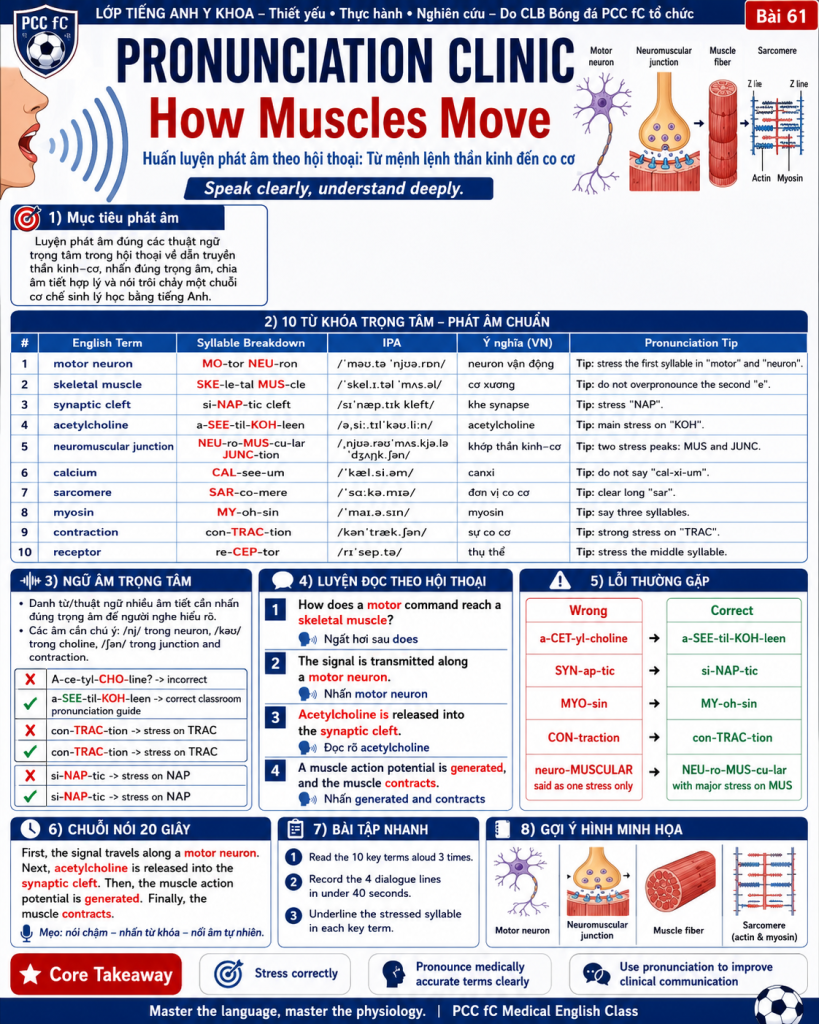
X. Pronunciation Clinic
Luyện phát âm trọng tâm
1. Neuron
NEU-ron
/ˈnjʊərɒn/
Không đọc thành “nơ-rôn” quá tách rời.
2. Neurotransmitter
NEU-ro-trans-MIT-ter
/ˌnjʊərəʊtrænzˈmɪtə/
Trọng âm chính rơi vào MIT.
3. Acetylcholine
a-SEE-təl-KOH-leen
/əˌsiːtəlˈkəʊliːn/
Chú ý phần cuối:
-choline /ˈkəʊliːn/
4. Synaptic
si-NAP-tic
/sɪˈnæptɪk/
Trọng âm rơi vào NAP.
5. Sarcomere
SAR-co-mere
/ˈsɑːkəmɪə/
6. Myosin
MY-o-sin
/ˈmaɪəsɪn/
7. Myofibril
my-o-FY-bril
/ˌmaɪəʊˈfaɪbrəl/
Cặp từ dễ nhầm
| Từ | Nghĩa |
| neural | thuộc hệ thần kinh |
| neuronal | thuộc neuron |
| muscular | thuộc cơ |
| skeletal | thuộc bộ xương |
| contract | co lại |
| relax | giãn ra |
| release | giải phóng |
| detach | tách khỏi |
| transmit | truyền tín hiệu |
| generate | tạo ra |
XI. Scientific Language Upgrade
Chuẩn hóa cách diễn đạt khoa học
Cách nói đơn giản
A neurotransmitter jumps across the gap.
Cách nói khoa học hơn
A neurotransmitter is released into the synaptic cleft and diffuses across it.
Cách nói đơn giản
Myosin pushes actin.
Cách nói chính xác hơn
Myosin heads bind to actin and pull the actin filaments toward the center of the sarcomere.
Cách nói đơn giản
ATP makes the muscle move.
Cách nói chính xác hơn
ATP provides the energy required for cross-bridge cycling and allows myosin to detach from actin.
XII. Clinical Extension
Liên hệ lâm sàng
1. Myasthenia gravis
Trong nhược cơ, các kháng thể làm giảm chức năng của thụ thể acetylcholine tại khớp thần kinh–cơ.
In myasthenia gravis, impaired neuromuscular transmission causes fatigable muscle weakness.
2. Organophosphate poisoning
Acetylcholinesterase bị ức chế, làm acetylcholine tích tụ tại synapse.
Organophosphate poisoning causes excessive acetylcholine accumulation at muscarinic and nicotinic receptors.
Tại khớp thần kinh–cơ, kích thích kéo dài có thể dẫn đến:
- muscle fasciculations
- muscle weakness
- respiratory paralysis
3. Botulism
Độc tố botulinum ngăn giải phóng acetylcholine tại đầu tận cùng thần kinh.
Botulinum toxin prevents acetylcholine release and causes descending flaccid paralysis.
4. Neuromuscular blocking agents
Một số thuốc gây mê tác động lên thụ thể nicotinic tại khớp thần kinh–cơ.
Neuromuscular blocking agents interfere with signal transmission from the motor neuron to the skeletal muscle.
XIII. Practice 1 – Fill in the Blanks
Điền từ thích hợp:
motor neuron – synaptic cleft – acetylcholine – receptors – sarcomere – ATP
- A __________ carries the signal from the nervous system to the muscle.
- The nerve ending and muscle membrane are separated by the __________.
- __________ is released from the nerve terminal.
- ACh binds to __________ on the muscle membrane.
- The basic contractile unit of skeletal muscle is the __________.
- __________ is required for myosin to detach from actin.
XIV. Practice 2 – Arrange the Sequence
Sắp xếp các bước theo đúng trình tự:
A. Myosin binds to actin and pulls it toward the center.
B. Acetylcholine is released into the synaptic cleft.
C. The sarcomere shortens.
D. The brain sends a signal along a motor neuron.
E. ACh generates an electrical response in the muscle fiber.
Đáp án trình tự
D → B → E → A → C
Bài tậpence of Events” trong tài liệu. fileciteturn0file0L13-L14
XV. Practice 3 – True or False
- Motor neurons physically touch skeletal muscle fibers.
- Acetylcholine crosses the synaptic cleft.
- ATP is mainly produced in the nucleus.
- Myosin pulls actin toward the center of the sarcomere.
- Sarcomeres become longer during contraction.
- ATP is necessary for myosin to detach from actin.
Đáp án
- False – They are separated by a synaptic cleft.
- True
- False – ATP is predominantly generated through mitochondrial metabolism.
- True
- False – Sarcomeres shorten during contraction.
- True
Nội dung đúng–sai được phálý học ở trang 14 của tài liệu. fileciteturn0file0L15-L15
XVI. Practice 4 – Correct the Sentences
1.
❌ The brain sends messages along motor neuron.
✅ The brain sends messages along motor neurons.
2.
❌ Acetylcholine release into the synaptic cleft.
✅ Acetylcholine is released into the synaptic cleft.
3.
❌ How does the signal reaches the muscle?
✅ How does the signal reach the muscle?
4.
❌ Actin pushes myosin during contraction.
✅ Myosin pulls actin toward the center of the sarcomere during contraction.
5.
❌ ATP is produced in the nucleus of the muscle fiber.
✅ Most ATP used for sustained muscle activity is generated through mitochondrial metabolism.
XVII. Speaking Practice
Trình bày 60 giây
Học viên sử dụng khung sau:
First, a motor command is generated in the central nervous system.
Next, the signal travels along a motor neuron to the neuromuscular junction.
When the nerve impulse reaches the terminal, acetylcholine is released into the synaptic cleft.
Then, ACh binds to receptors on the muscle membrane and produces an electrical signal.
As a result, myosin binds to actin and pulls the actin filaments toward the center of the sarcomere.
Finally, the sarcomere shortens and the muscle contracts. ATP is required for continued cross-bridge cycling and muscle relaxation.
XVIII. Mini Clinical Presentation
The patient developed progressive muscle weakness because neuromuscular transmission was impaired. Normally, acetylcholine is released from the motor nerve terminal and binds to receptors on the muscle membrane. This generates an electrical signal and initiates muscle contraction. Any disorder that interferes with acetylcholine release, receptor binding, or muscle membrane activation may cause weakness or paralysis.
XIX. Homework
Nhiệm vụ 1
Viết sáu câu mô tả quá trình co cơ, bắt buộc sử dụng:
- is transmitted
- is released
- binds to
- is generated
- contracts
- ATP
Nhiệm vụ 2
Ghi âm bài trình bày từ 45–60 giây với chủ đề:
How does a neural signal produce muscle contraction?
Nhiệm vụ 3
Phân biệt cơ chế yếu cơ trong ba tình trạng:
- Myasthenia gravis
- Botulism
- Organophosphate poisoning
Mỗi tình trạng trình bày bằng một câu tiếng Anh.
XX. Answer Key
Practice 1
- motor neuron
- synaptic cleft
- acetylcholine
- receptors
- sarcomere
- ATP
Core sequence
Brain → motor neuron → ACh release → muscle electrical signal → actin–myosin interaction → sarcomere shortening → muscle contraction
XXI. Core Takeaways
The Command – Mệnh lệnh
The nervous system sends the motor command through motor neurons.
The Bridge – Cầu nối
Acetylcholine carries the chemical signal across the synaptic cleft.
The Action – Hoạt động
Myosin pulls actin toward the center, shortening the sarcomere.
The Fuel – Năng lượng
ATP supports cross-bridge cycling and is essential for muscle relaxation.
Ba nội dung cốt lõi “The Command – The Actiđiệp tổng kết của tài liệu gốc. fileciteturn0file0L16-L16
Thông điệp Bài 61
Movement begins as an electrical command, crosses the neuromuscular junction as a chemical message, and becomes mechanical force inside the sarcomere.
Chuyển động khởi đầu bằng một mệnh lệnh điện học, vượt qua khớp thần kinh–cơ dưới dạng thông điệp hóa học và trở thành lực cơ học bên trong sarcomere.
CLB PCC fC