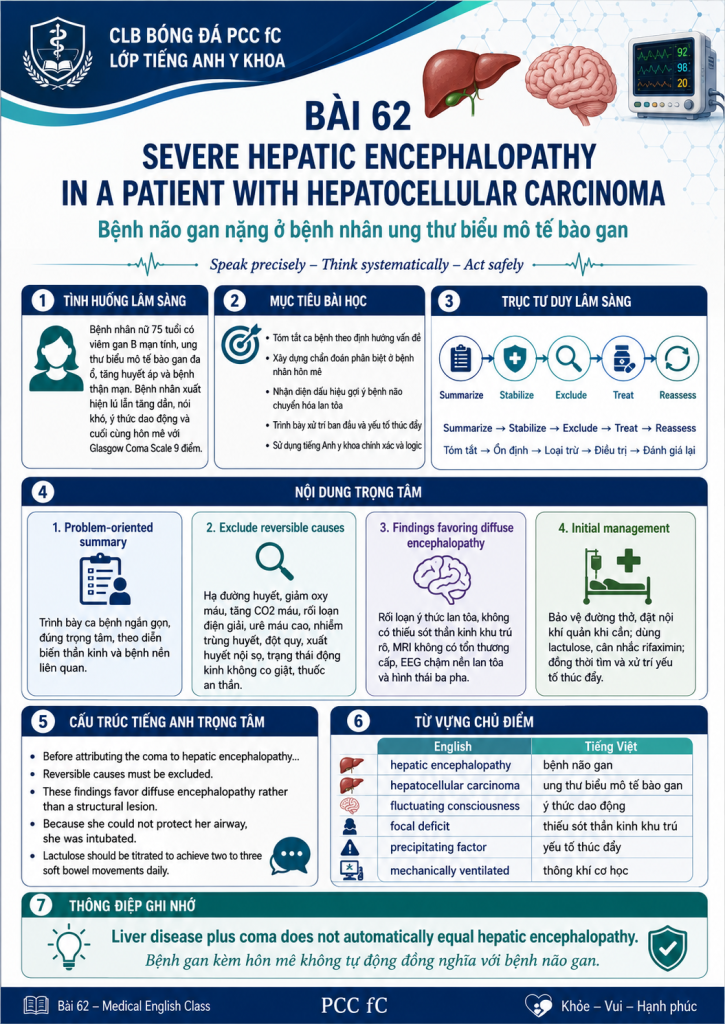
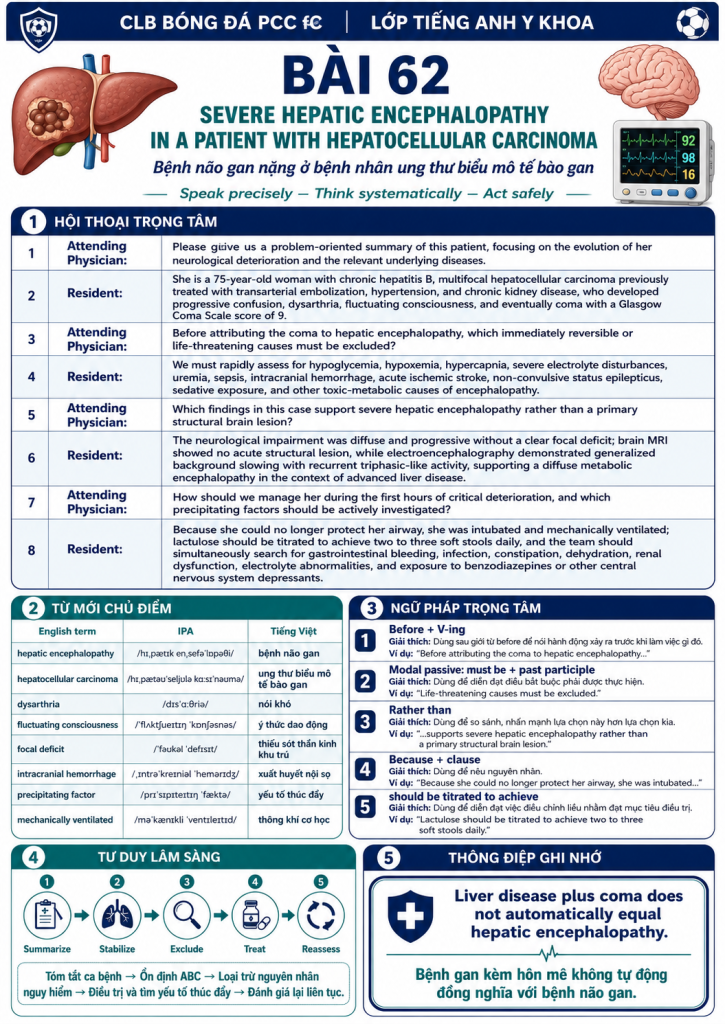
Bài 62 – Tiếng Anh Y Khoa: Bệnh não gan nặng ở bệnh nhân ung thư biểu mô tế bào gan * Severe hepatic encephalopathy
PCC Language – Thăng Long, Hà Nội, ngày 21/7/2026, Trong thực hành lâm sàng, hôn mê ở bệnh nhân mắc bệnh gan mạn tính thường khiến bác sĩ nhanh chóng nghĩ đến bệnh não gan. Tuy nhiên, việc quy mọi rối loạn ý thức cho bệnh não gan có thể dẫn đến bỏ sót những nguyên nhân nguy hiểm nhưng có khả năng đảo ngược như hạ đường huyết, thiếu oxy, rối loạn điện giải, nhiễm trùng huyết, đột quỵ, xuất huyết não, trạng thái động kinh không co giật hoặc ngộ độc thuốc an thần. Bài 62 đưa người học tiếp cận một bệnh nhân nữ 75 tuổi mắc viêm gan B mạn và ung thư biểu mô tế bào gan đa ổ, xuất hiện lú lẫn tăng dần, nói khó, ý thức dao động và cuối cùng hôn mê. Thông qua cuộc trao đổi giữa bác sĩ điều trị và bác sĩ nội trú, học viên sẽ luyện cách tóm tắt ca bệnh theo định hướng vấn đề, xây dựng chẩn đoán phân biệt, nhận diện các dấu hiệu gợi ý bệnh não chuyển hóa lan tỏa, xác định yếu tố thúc đẩy và trình bày chiến lược xử trí ban đầu bằng tiếng Anh y khoa chính xác, logic và an toàn.
BÀI 62 – LỚP TIẾNG ANH Y KHOA
SEVERE HEPATIC ENCEPHALOPATHY
IN A PATIENT WITH HEPATOCELLULAR CARCINOMA
Bệnh não gan nặng ở bệnh nhân ung thư biểu mô tế bào gan
Đơn vị tổ chức: Câu lạc bộ Bóng đá PCC fC
Thời lượng: 20–25 phút
Trình độ: K4–K5
Bối cảnh: Giao ban hồi sức – trình bày ca bệnh – tư duy chẩn đoán phân biệt
Clinical message:
Do not attribute coma to hepatic encephalopathy until other reversible and life-threatening causes have been excluded.
I. TRỤC TƯ DUY CỦA BÀI HỌC
Bài học được triển khai theo năm bước:
1. Summarize
Tóm tắt bệnh nhân theo định hướng vấn đề.
2. Stabilize
Đánh giá và bảo vệ đường thở, hô hấp, tuần hoàn.
3. Exclude
Loại trừ các nguyên nhân hôn mê nguy hiểm hoặc có thể đảo ngược.
4. Treat
Điều trị bệnh não gan và yếu tố thúc đẩy.
5. Reassess
Đánh giá lại ý thức, đáp ứng điều trị và chẩn đoán.
Công thức ghi nhớ
Summarize → Stabilize → Exclude → Treat → Reassess
II. MỤC TIÊU BÀI HỌC
Sau bài học, học viên có thể:
- Trình bày một ca bệnh bằng cấu trúc problem-oriented summary.
- Mô tả diễn biến rối loạn ý thức bằng tiếng Anh y khoa.
- Nêu được các nguyên nhân cần loại trừ trước khi chẩn đoán bệnh não gan.
- Phân biệt bệnh não chuyển hóa lan tỏa với tổn thương cấu trúc não.
- Trình bày các ưu tiên xử trí trong những giờ đầu.
- Xác định những yếu tố thúc đẩy bệnh não gan.
- Sử dụng chính xác các cấu trúc:
- Before + V-ing
- must be excluded
- support/favor A rather than B
- Because + clause
- should be titrated to achieve
III. TÌNH HUỐNG LÂM SÀNG
Bệnh nhân nữ 75 tuổi có tiền sử:
- Viêm gan B mạn tính.
- Ung thư biểu mô tế bào gan đa ổ.
- Đã được điều trị bằng nút động mạch qua catheter.
- Tăng huyết áp.
- Bệnh thận mạn.
Bệnh nhân xuất hiện:
- Lú lẫn tăng dần.
- Nói khó.
- Ý thức dao động.
- Sau đó hôn mê.
- Glasgow Coma Scale: 9 điểm.
Câu hỏi trung tâm
Is this severe hepatic encephalopathy, or is there another reversible cause of coma?
Đây có phải bệnh não gan nặng hay còn một nguyên nhân hôn mê có thể đảo ngược khác?
Lưu ý khoa học
Việc bệnh nhân có viêm gan B hoặc ung thư gan không tự động chứng minh rằng hôn mê là do bệnh não gan. Bác sĩ còn phải đánh giá mức độ suy chức năng gan hoặc tuần hoàn bàng hệ cửa–chủ, tìm yếu tố thúc đẩy và loại trừ các nguyên nhân thần kinh, nhiễm trùng, độc chất và chuyển hóa khác. Bệnh não gan chủ yếu là một chẩn đoán lâm sàng và chẩn đoán loại trừ.
IV. HỘI THOẠI CHUẨN HÓA
1. Attending Physician
Please give us a problem-oriented summary of this patient, focusing on the evolution of her neurological deterioration and the relevant underlying conditions.
Hãy trình bày tóm tắt bệnh nhân theo định hướng vấn đề, tập trung vào diễn biến suy giảm thần kinh và các bệnh nền liên quan.
2. Resident
She is a 75-year-old woman with chronic hepatitis B, multifocal hepatocellular carcinoma previously treated with transarterial embolization, hypertension, and chronic kidney disease. She developed progressive confusion, dysarthria, fluctuating consciousness, and eventually coma, with a Glasgow Coma Scale score of 9.
Bệnh nhân nữ 75 tuổi có viêm gan B mạn tính, ung thư biểu mô tế bào gan đa ổ đã được điều trị bằng nút động mạch qua catheter, tăng huyết áp và bệnh thận mạn. Bệnh nhân xuất hiện lú lẫn tăng dần, nói khó, ý thức dao động và cuối cùng hôn mê với Glasgow Coma Scale 9 điểm.
3. Attending Physician
Before attributing the coma to hepatic encephalopathy, which immediately reversible or life-threatening causes must be excluded?
Trước khi quy tình trạng hôn mê cho bệnh não gan, những nguyên nhân đe dọa tính mạng hoặc có thể đảo ngược ngay nào phải được loại trừ?
4. Resident
We must rapidly assess for hypoglycemia, hypoxemia, hypercapnia, severe electrolyte disturbances, uremia, sepsis, intracranial hemorrhage, acute ischemic stroke, non-convulsive status epilepticus, sedative exposure, and other toxic-metabolic causes of encephalopathy.
Chúng ta phải nhanh chóng đánh giá hạ đường huyết, giảm oxy máu, tăng carbon dioxide máu, rối loạn điện giải nặng, hội chứng urê máu cao, nhiễm trùng huyết, xuất huyết nội sọ, đột quỵ thiếu máu não cấp, trạng thái động kinh không co giật, phơi nhiễm thuốc an thần và các nguyên nhân độc chất – chuyển hóa khác.
5. Attending Physician
Which findings favor severe hepatic encephalopathy rather than a primary structural brain lesion?
Những dấu hiệu nào nghiêng về bệnh não gan nặng hơn là một tổn thương cấu trúc nguyên phát của não?
6. Resident
Her neurological impairment was diffuse and progressive, without a clear focal deficit. Brain MRI showed no acute structural lesion, while EEG demonstrated generalized background slowing with discharges of triphasic morphology. These findings support a diffuse encephalopathic process in the setting of chronic liver disease, although they are not specific for hepatic encephalopathy.
Tình trạng suy giảm thần kinh có tính chất lan tỏa và tăng dần, không có thiếu sót thần kinh khu trú rõ ràng. MRI não không ghi nhận tổn thương cấu trúc cấp tính, trong khi điện não đồ cho thấy hoạt động nền chậm lan tỏa và các phóng lực có hình thái ba pha. Những dấu hiệu này ủng hộ một quá trình bệnh não lan tỏa trong bối cảnh bệnh gan mạn tính, nhưng không đặc hiệu cho bệnh não gan.
Vì sao chỉnh câu này?
Thuật ngữ discharges of triphasic morphology phù hợp hơn cách gọi “triphasic waves”. Hình thái ba pha có thể xuất hiện trong nhiều bệnh não chuyển hóa, độc chất hoặc các tình trạng thần kinh khác; vì vậy, không được sử dụng riêng lẻ để xác định bệnh não gan.
7. Attending Physician
How should she be managed during the first hours of critical deterioration, and which precipitating factors should be actively investigated?
Bệnh nhân cần được xử trí như thế nào trong những giờ đầu khi tình trạng diễn biến nguy kịch, và cần chủ động tìm kiếm những yếu tố thúc đẩy nào?
8. Resident
Because she could no longer protect her airway, she was intubated and mechanically ventilated. Lactulose should be administered and titrated to achieve two to three soft bowel movements daily. Rifaximin may be continued or added when clinically indicated. At the same time, the team should investigate gastrointestinal bleeding, infection, constipation, dehydration, renal dysfunction, electrolyte abnormalities, increased protein catabolism, and exposure to benzodiazepines or other central nervous system depressants.
Do bệnh nhân không còn khả năng tự bảo vệ đường thở, bệnh nhân được đặt nội khí quản và thông khí cơ học. Lactulose cần được sử dụng và điều chỉnh để đạt hai đến ba lần đi ngoài phân mềm mỗi ngày. Rifaximin có thể được tiếp tục hoặc phối hợp khi có chỉ định phù hợp. Đồng thời, nhóm điều trị phải tìm kiếm xuất huyết tiêu hóa, nhiễm trùng, táo bón, mất nước, suy giảm chức năng thận, rối loạn điện giải, tăng dị hóa protein và việc sử dụng benzodiazepine hoặc các thuốc ức chế thần kinh trung ương khác.
Điểm chỉnh sửa khoa học
Không nên mặc định rằng mọi bệnh nhân bệnh não gan cấp đều “phải tiếp tục rifaximin” nếu chưa biết bệnh nhân đã sử dụng thuốc trước đó hay chưa. Lactulose là điều trị đầu tay trong bệnh não gan biểu hiện rõ; rifaximin thường được sử dụng phối hợp theo bối cảnh lâm sàng, đặc biệt trong dự phòng tái phát.
V. PHÂN TÍCH TƯ DUY LÂM SÀNG
Bước 1. Stabilize the patient
Các ưu tiên tức thì
- Assess the airway.
- Assess breathing and oxygenation.
- Check circulation and blood pressure.
- Check bedside blood glucose.
- Evaluate the depth and progression of coma.
Mẫu câu
Our first priority is to determine whether she can protect her airway.
Because she was unable to protect her airway, endotracheal intubation was indicated.
Ở bệnh nhân bệnh não gan nặng, cần đánh giá đường thở thận trọng; đặt nội khí quản được cân nhắc khi bệnh nhân không thể bảo vệ đường thở hoặc có bệnh não độ nặng. Không nên sử dụng riêng điểm Glasgow như tiêu chuẩn duy nhất mà phải đánh giá toàn bộ khả năng bảo vệ đường thở, tiết đờm, hô hấp và diễn biến thần kinh.
Bước 2. Exclude dangerous mimics
A. Metabolic causes
- Hypoglycemia
- Hyperglycemic emergencies
- Hyponatremia or hypernatremia
- Hypercalcemia
- Uremia
- Hypercapnia
- Hypoxemia
B. Neurological causes
- Intracranial hemorrhage
- Acute ischemic stroke
- Subdural hematoma
- Non-convulsive status epilepticus
- Central nervous system infection
C. Infectious and systemic causes
- Sepsis
- Pneumonia
- Urinary tract infection
- Spontaneous bacterial peritonitis
- Shock
D. Toxicological causes
- Benzodiazepines
- Opioids
- Sedative–hypnotic agents
- Alcohol
- Other central nervous system depressants
Mẫu câu
Before diagnosing hepatic encephalopathy, we must exclude other reversible causes of coma.
Bước 3. Determine whether the pattern is diffuse or focal
Dấu hiệu gợi ý bệnh não lan tỏa
- Progressive confusion
- Fluctuating consciousness
- Bilateral or symmetrical abnormalities
- Absence of a persistent focal deficit
- Generalized EEG slowing
- No acute structural lesion on neuroimaging
Dấu hiệu khiến phải nghĩ đến tổn thương khu trú
- Unilateral weakness
- Facial asymmetry
- Gaze deviation
- New anisocoria
- Sudden-onset aphasia
- Abrupt neurological deterioration
Mẫu so sánh
The diffuse neurological impairment favors a metabolic encephalopathy rather than a focal structural lesion.
MRI không có tổn thương cấp hỗ trợ loại trừ một số nguyên nhân cấu trúc, nhưng không tự xác nhận bệnh não gan. EEG hữu ích trong đánh giá bệnh não lan tỏa và loại trừ động kinh không co giật, song các bất thường như chậm nền hoặc hình thái ba pha không đặc hiệu cho một nguyên nhân duy nhất.
Bước 4. Search for precipitating factors
Dùng công thức:
The Five I’s plus medications
1. Infection
- Pneumonia
- Urinary tract infection
- Spontaneous bacterial peritonitis
- Bacteremia
2. Intestinal bleeding
- Gastrointestinal bleeding
- Increased nitrogen load
3. Infrequent bowel movements
- Constipation
- Ileus
4. Insufficient circulating volume
- Dehydration
- Vomiting
- Diarrhea
- Excessive diuretic therapy
5. Impaired renal or metabolic function
- Acute kidney injury
- Uremia
- Hypokalemia
- Hyponatremia
- Acid–base disturbance
6. Medications
- Benzodiazepines
- Opioids
- Sedatives
- Other central nervous system depressants
Nhiễm trùng, xuất huyết tiêu hóa, thuốc và mất nước là những yếu tố thúc đẩy quan trọng; xác định và điều chỉnh nguyên nhân thúc đẩy là phần trung tâm trong xử trí một đợt bệnh não gan cấp.
Bước 5. Initiate treatment
Nguyên tắc
- Support vital functions.
- Identify and correct the precipitating factor.
- Administer lactulose when clinically appropriate.
- Use rifaximin as adjunctive therapy when indicated.
- Correct electrolyte and volume abnormalities.
- Avoid unnecessary sedative medications.
- Reassess neurological status frequently.
Mục tiêu lactulose
Titrate lactulose to achieve two to three soft bowel movements per day.
Không nên gây tiêu chảy quá mức vì mất nước và rối loạn điện giải có thể làm tình trạng bệnh não xấu hơn. Mục tiêu thường được khuyến nghị là hai đến ba lần đại tiện mỗi ngày.
VI. NHỮNG DỮ LIỆU CÒN THIẾU TRONG CA BỆNH
Để đánh giá ca bệnh đầy đủ hơn, cần hỏi hoặc bổ sung:
Liver-related data
- Bilirubin
- INR
- Albumin
- AST and ALT
- History of cirrhosis
- Ascites
- Previous hepatic encephalopathy
- Portosystemic shunting
- Recent cancer treatment
Metabolic data
- Bedside glucose
- Sodium and potassium
- Calcium and magnesium
- Arterial blood gas
- Urea and creatinine
- Acid–base status
Infection screening
- Temperature
- Complete blood count
- C-reactive protein or procalcitonin
- Blood and urine cultures
- Chest imaging
- Ascitic fluid analysis when indicated
Neurological evaluation
- Onset and progression
- Pupillary findings
- Focal neurological deficits
- Neuroimaging
- EEG when non-convulsive seizures are suspected
Medication history
- Benzodiazepines
- Opioids
- Antihistamines
- Antipsychotics
- Sleeping tablets
- Recent changes in medication
Ammonia concentration
Ammonia có thể hỗ trợ đánh giá trong bối cảnh phù hợp nhưng không nên được sử dụng đơn độc để xác định chẩn đoán, mức độ nặng hoặc tiên lượng bệnh não gan. Nồng độ ammonia bình thường ở một bệnh nhân được cho là mắc bệnh não gan biểu hiện rõ cần thúc đẩy việc đánh giá lại chẩn đoán.
VII. NGÔN NGỮ Y KHOA TRỌNG TÂM
1. Presenting a problem-oriented summary
Cấu trúc
This is a + age-year-old + patient with + relevant history, who developed + clinical progression.
Ví dụ
This is a 75-year-old woman with chronic hepatitis B and multifocal hepatocellular carcinoma who developed progressive confusion and eventually became comatose.
Không cần đưa vào phần tóm tắt ban đầu
- Các chi tiết không liên quan.
- Danh sách toàn bộ xét nghiệm bình thường.
- Tiền sử không ảnh hưởng đến vấn đề hiện tại.
- Các nhận định chưa có bằng chứng.
2. Before + V-ing
Before attributing the coma to hepatic encephalopathy, other reversible causes must be excluded.
Ví dụ:
- Before making the diagnosis…
- Before administering sedatives…
- Before performing lumbar puncture…
- Before discontinuing treatment…
Lỗi thường gặp
Sai: Before attribute the coma…
Đúng: Before attributing the coma…
3. Modal verb in the passive voice
Công thức
Subject + must/should + be + past participle
Ví dụ:
- Hypoglycemia must be excluded.
- The airway must be assessed.
- Lactulose should be titrated.
- Precipitating factors should be investigated.
4. Favor or support A rather than B
The diffuse pattern favors a metabolic encephalopathy rather than a focal structural lesion.
Phân biệt mức độ chắc chắn
- is diagnostic of: có giá trị chẩn đoán xác định
- strongly suggests: rất gợi ý
- supports: ủng hộ
- favors: nghiêng về
- is compatible with: phù hợp với
- does not exclude: không loại trừ
Trong ca này, nên dùng supports, favors hoặc is compatible with, không nên dùng confirms.
5. Because and because of
Because + mệnh đề
Because she could not protect her airway, she was intubated.
Because of + cụm danh từ
Because of her inability to protect her airway, she was intubated.
Lỗi thường gặp
Sai: Because of she could not protect her airway…
Đúng: Because she could not protect her airway…
6. Titrate to achieve a target
Lactulose should be titrated to achieve two to three soft bowel movements daily.
Các mẫu tương tự:
- Titrate vasopressors to maintain adequate perfusion.
- Titrate insulin to achieve the target glucose range.
- Titrate oxygen therapy to maintain the target saturation.
- Titrate sedation to the lowest effective dose.
VIII. TỪ VỰNG THEO NHÓM
A. Neurological deterioration
| Thuật ngữ | Nghĩa |
|---|---|
| progressive confusion | lú lẫn tăng dần |
| dysarthria | nói khó |
| fluctuating consciousness | ý thức dao động |
| neurological deterioration | diễn biến thần kinh xấu đi |
| focal neurological deficit | thiếu sót thần kinh khu trú |
| coma | hôn mê |
| airway protection | khả năng bảo vệ đường thở |
B. Differential diagnosis
| Thuật ngữ | Nghĩa |
| hypoglycemia | hạ đường huyết |
| hypoxemia | giảm oxy máu |
| hypercapnia | tăng carbon dioxide máu |
| uremia | hội chứng urê máu cao |
| intracranial hemorrhage | xuất huyết nội sọ |
| ischemic stroke | đột quỵ thiếu máu não |
| non-convulsive status epilepticus | trạng thái động kinh không co giật |
| toxic-metabolic encephalopathy | bệnh não do độc chất – chuyển hóa |
C. Investigation and treatment
| Thuật ngữ | Nghĩa |
| generalized background slowing | chậm hoạt động nền lan tỏa |
| triphasic morphology | hình thái ba pha |
| precipitating factor | yếu tố thúc đẩy |
| mechanically ventilated | được thông khí cơ học |
| titrate | điều chỉnh liều theo mục tiêu |
| bowel movement | lần đại tiện |
| central nervous system depressant | thuốc ức chế thần kinh trung ương |
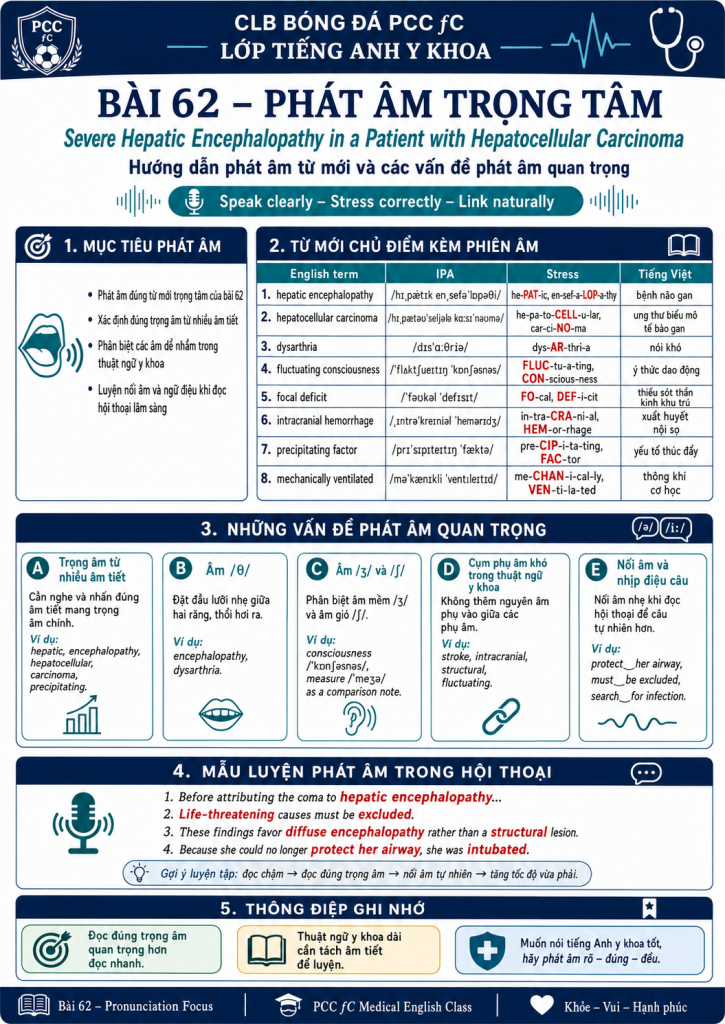
IX. PHÁT ÂM TRỌNG TÂM
Trọng âm
- he-PAT-ic
- en-ce-pha-LOP-a-thy
- he-pa-to-CELL-u-lar
- car-ci-NO-ma
- neu-ro-LOG-i-cal
- de-te-ri-o-RA-tion
- hy-per-CAP-ni-a
- dys-AR-thri-a
- pre-CIP-i-ta-ting
Các âm cần luyện
Âm /θ/
- encephalopathy
- pathology
- catheter
Âm /ʒ/
- confusion
- exposure
- seizure
Nối âm
- protect‿her airway
- must‿be excluded
- search‿for infection
- showed‿no lesion
- with‿advanced disease
X. MẪU TRÌNH BÀY CA BỆNH TRONG 60 GIÂY
This is a 75-year-old woman with chronic hepatitis B, multifocal hepatocellular carcinoma previously treated with transarterial embolization, hypertension, and chronic kidney disease. She developed progressive confusion, dysarthria, fluctuating consciousness, and eventually coma with a GCS score of 9. Her neurological impairment was diffuse, without a clear focal deficit. Brain MRI showed no acute structural lesion, while EEG demonstrated generalized background slowing with discharges of triphasic morphology. Severe hepatic encephalopathy was considered, but hypoglycemia, hypoxemia, hypercapnia, electrolyte disturbances, uremia, sepsis, acute stroke, intracranial hemorrhage, non-convulsive status epilepticus, and sedative exposure had to be excluded. Because she could not protect her airway, she was intubated and mechanically ventilated. Lactulose was administered, and the team actively investigated and corrected potential precipitating factors.
XI. BÀI TẬP THỰC HÀNH
Exercise 1. Complete the clinical pathway
Điền các động từ:
exclude – protect – summarize – treat – reassess
- __________ the patient using relevant clinical information.
- __________ the airway and stabilize vital functions.
- __________ reversible and life-threatening causes.
- __________ hepatic encephalopathy and its precipitating factors.
- __________ consciousness and treatment response.
Exercise 2. Choose the most accurate expression
1.
A. The EEG confirmed hepatic encephalopathy.
B. The EEG supported a diffuse encephalopathic process.
C. The EEG excluded all structural brain diseases.
2.
A. Before attribute the coma to hepatic encephalopathy…
B. Before attributed the coma to hepatic encephalopathy…
C. Before attributing the coma to hepatic encephalopathy…
3.
A. Hypoglycemia must exclude.
B. Hypoglycemia must be excluded.
C. Hypoglycemia must be excluding.
4.
A. Because she could not protect her airway, she was intubated.
B. Because of she could not protect her airway, she was intubated.
C. Because she could not protect her airway, she intubated.
5.
A. Lactulose should be titrated to achieve two to three soft bowel movements daily.
B. Lactulose should titrate for three diarrhea daily.
C. Lactulose must cause continuous diarrhea.
Exercise 3. Translate into English
- Bệnh nhân xuất hiện lú lẫn tăng dần và ý thức dao động.
- Trước khi chẩn đoán bệnh não gan, phải loại trừ các nguyên nhân hôn mê có thể đảo ngược.
- Bệnh nhân không có thiếu sót thần kinh khu trú rõ ràng.
- Điện não đồ ủng hộ một quá trình bệnh não lan tỏa nhưng không đặc hiệu cho bệnh não gan.
- Vì bệnh nhân không thể bảo vệ đường thở, bệnh nhân được đặt nội khí quản.
- Nhóm điều trị phải tìm kiếm và điều chỉnh các yếu tố thúc đẩy.
Exercise 4. Clinical role-play
Attending Physician
Hỏi năm câu:
- Please give me a problem-oriented summary.
- Which reversible causes must be excluded?
- What findings favor a diffuse encephalopathy?
- What are your immediate management priorities?
- Which precipitating factors should be investigated?
Resident
Trả lời trong 60–90 giây và bắt buộc sử dụng:
- Before attributing…
- must be excluded
- rather than
- Because…
- should be titrated
- at the same time
XII. ĐÁP ÁN
Exercise 1
- Summarize
- Protect
- Exclude
- Treat
- Reassess
Exercise 2
- B
- C
- B
- A
- A
Exercise 3 – Suggested answers
- The patient developed progressive confusion and fluctuating consciousness.
- Before diagnosing hepatic encephalopathy, reversible causes of coma must be excluded.
- The patient had no clear focal neurological deficit.
- The EEG supported a diffuse encephalopathic process but was not specific for hepatic encephalopathy.
- Because the patient could not protect her airway, she was intubated.
- The medical team must identify and correct the precipitating factors.
XIII. ĐÁNH GIÁ CUỐI BÀI
Học viên trả lời ngắn bằng tiếng Anh:
- Why is hepatic encephalopathy considered a diagnosis of exclusion?
- Which reversible cause should be assessed immediately at the bedside?
- What neurological findings suggest a structural brain lesion?
- Does triphasic morphology confirm hepatic encephalopathy?
- When should airway protection be considered?
- What are the common precipitating factors?
- What is the therapeutic target of lactulose?
- When should the diagnosis be reconsidered?
XIV. TAKE-HOME MESSAGES
Clinical message
Liver disease plus coma does not automatically equal hepatic encephalopathy.
Diagnostic message
Exclude reversible, structural, epileptic, infectious, toxic, and metabolic causes.
Treatment message
Protect the airway, identify precipitants, initiate appropriate therapy, and reassess repeatedly.
Language message
Use “supports” or “favors” when the evidence is suggestive but not diagnostic.
PCC fC – MEDICAL ENGLISH CLASS
BÀI 62
Severe Hepatic Encephalopathy in a Patient with Hepatocellular Carcinoma
Speak precisely – Think systematically – Act safely
Học tiếng Anh chuẩn xác – Rèn tư duy lâm sàng – Vì người bệnh an toàn
Câu lạc bộ Bóng đá PCC fC
Vì một đam mê Khỏe – Vui – Hạnh phúc