Bài 78 – Tiếng Anh Y Khoa: Tổn thương gan cấp kèm tắc mật * Acute liver injury with biliary obstruction
PCC Language – Thăng Long, Hà Nội, ngày 7/8/2026, Trong thực hành lâm sàng, các xét nghiệm chức năng gan bất thường không phải lúc nào cũng phản ánh đầy đủ toàn bộ vấn đề. ALT giảm có thể gợi ý sự cải thiện, nhưng bilirubin liên hợp tiếp tục tăng lại có thể báo hiệu một quá trình ứ mật hoặc tắc nghẽn đường mật đang tiến triển. Trong Bài 78, chúng ta sẽ cùng theo dõi một bệnh nhân nam 65 tuổi bị tổn thương gan cấp, với diễn biến các chỉ số sinh hóa và hình ảnh MRCP phát hiện hẹp đoạn xa ống mật chủ. Thông qua ca bệnh này, chúng ta sẽ học cách mô tả diễn biến các xét nghiệm gan, diễn giải hình ảnh đường mật, thảo luận những chẩn đoán phân biệt quan trọng và trình bày rõ ràng các bước chẩn đoán tiếp theo bằng tiếng Anh y khoa.
In clinical practice, abnormal liver tests do not always tell the whole story. A falling ALT may suggest improvement, yet a rising conjugated bilirubin can signal an evolving cholestatic or obstructive process. In Lesson 78, we follow a 65-year-old man with acute liver injury whose biochemical trends and MRCP findings reveal a distal common bile duct stricture. Through this case, we will learn how to describe liver-test evolution, interpret biliary imaging, discuss key differential diagnoses, and communicate the next diagnostic steps clearly in medical English.
PCC FC MEDICAL ENGLISH CLASS
LESSON 78 — ACUTE LIVER INJURY WITH BILIARY OBSTRUCTION
From Abnormal Liver Tests to a Distal Common Bile Duct Stricture
Organized by PCC FC — Poison Control Center Football Club
Clinical focus:
Acute liver injury • Conjugated hyperbilirubinemia • Cholestasis • MRCP • Distal common bile duct stricture • Differential diagnosis • EUS • ERCP
I. LEARNING OBJECTIVES
By the end of this lesson, learners should be able to:
- Summarize a patient presenting with acute liver injury and jaundice.
- Describe changes in liver biochemical tests over time.
- Report important MRCP findings using standard medical English.
- Recognize a possible transition from a predominantly hepatocellular pattern to a mixed or cholestatic picture.
- Discuss the differential diagnosis of a distal common bile duct stricture.
- Propose appropriate next diagnostic steps using professional clinical English.
II. CLINICAL SCENARIO
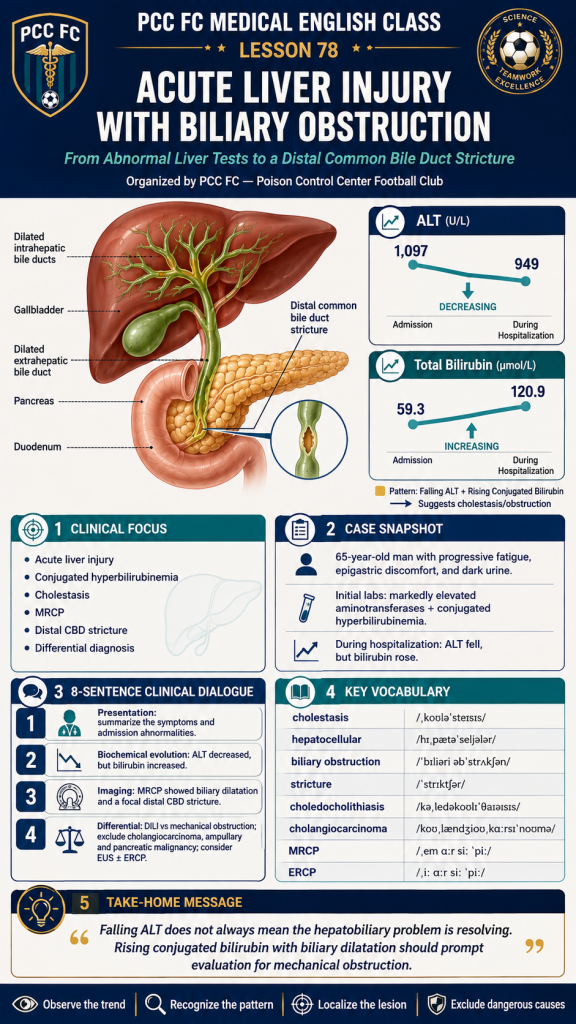
A 65-year-old man was admitted with progressive fatigue, epigastric discomfort, and dark urine.
Initial laboratory testing showed:
- Markedly elevated aminotransferases
- Hyperbilirubinemia, predominantly conjugated
- Evidence of acute liver injury
During hospitalization:
- ALT decreased from 1,097 to 949 U/L
- Total bilirubin increased from 59.3 to 120.9 μmol/L
MRCP subsequently demonstrated:
- Intrahepatic biliary dilatation
- Extrahepatic biliary dilatation
- A focal distal common bile duct stricture
- No definite choledocholithiasis
- No obvious pancreatic mass
The major clinical question is:
Is the worsening jaundice due to liver injury alone, or is there a superimposed mechanical biliary obstruction?
III. 8-SENTENCE CLINICAL DIALOGUE
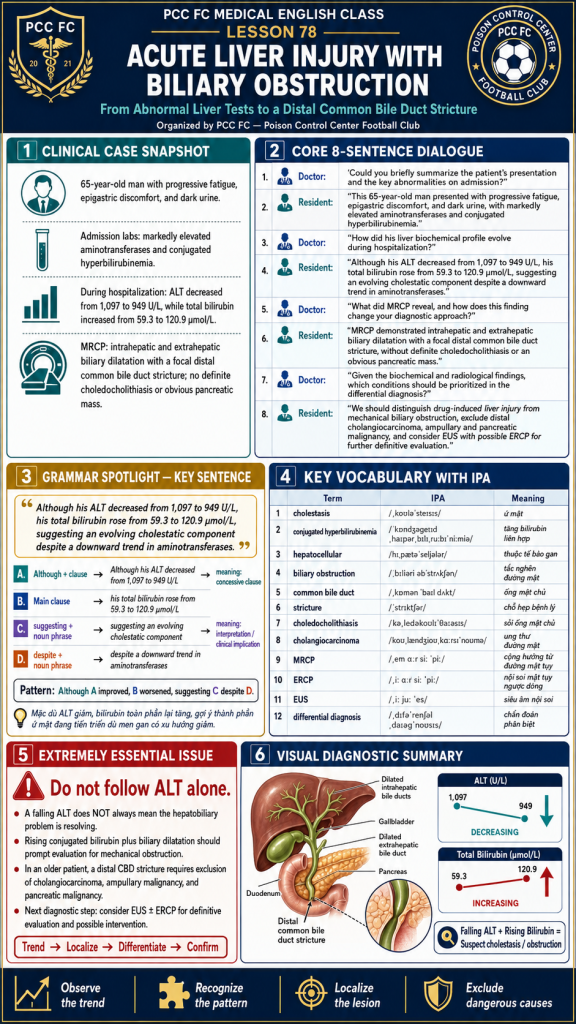
1. Doctor
Could you briefly summarize the patient’s presentation and the key abnormalities on admission?
2. Resident
This 65-year-old man presented with progressive fatigue, epigastric discomfort, and dark urine, with markedly elevated aminotransferases and conjugated hyperbilirubinemia.
3. Doctor
How did his liver biochemical profile evolve during hospitalization?
4. Resident
Although his ALT decreased from 1,097 to 949 U/L, his total bilirubin rose from 59.3 to 120.9 μmol/L, suggesting an evolving cholestatic component despite a downward trend in aminotransferases.
5. Doctor
What did MRCP reveal, and how does this finding change your diagnostic approach?
6. Resident
MRCP demonstrated intrahepatic and extrahepatic biliary dilatation with a focal distal common bile duct stricture, without definite choledocholithiasis or an obvious pancreatic mass.
7. Doctor
Given the biochemical and radiological findings, which conditions should be prioritized in the differential diagnosis?
8. Resident
We should distinguish drug-induced liver injury from mechanical biliary obstruction, exclude distal cholangiocarcinoma, ampullary and pancreatic malignancy, and consider EUS with possible ERCP for further definitive evaluation.
IV. CLINICAL REASONING PATHWAY
Step 1 — Recognize the initial pattern
The patient has:
Marked aminotransferase elevation + conjugated hyperbilirubinemia
This initially suggests significant hepatocellular injury, although the full biochemical pattern should ideally be assessed using ALT, alkaline phosphatase, bilirubin, and the R ratio when appropriate.
Step 2 — Follow the biochemical trend
During hospitalization:
ALT ↓
1,097 → 949 U/L
but:
Total bilirubin ↑
59.3 → 120.9 μmol/L
The important point is that a decrease in ALT alone does not prove that the underlying hepatobiliary process is resolving.
A rising conjugated bilirubin should raise concern for:
- Evolving cholestasis
- Impaired bile flow
- Mechanical obstruction
- Mixed hepatocellular–cholestatic injury
Step 3 — Localize the problem with imaging
MRCP demonstrates:
Intrahepatic biliary dilatation
+
Extrahepatic biliary dilatation
+
Distal CBD stricture
This strongly shifts the diagnostic reasoning toward a structural or obstructive biliary process.
Step 4 — Identify the cause of the stricture
A distal CBD stricture may be caused by:
- Choledocholithiasis
- Benign inflammatory stricture
- Distal cholangiocarcinoma
- Ampullary tumor
- Pancreatic head malignancy
- Chronic pancreatitis
- IgG4-related disease
- Other less common benign or malignant causes
In parallel, drug-induced liver injury (DILI) may still need to be considered depending on the medication and exposure history.
Step 5 — Decide the next investigation
If MRCP identifies a distal CBD stricture without a definite cause:
EUS
may help evaluate:
- Distal CBD
- Ampulla
- Pancreatic head
- Small occult masses
- Regional lymph nodes
ERCP
may be considered when there is a need for:
- Direct cholangiography
- Tissue sampling
- Brush cytology or biopsy
- Biliary drainage
- Therapeutic intervention
V. KEY VOCABULARY & PRONUNCIATION
| Term | IPA | Vietnamese meaning |
| acute liver injury | /əˈkjuːt ˈlɪvər ˈɪndʒəri/ | tổn thương gan cấp |
| aminotransferase | /əˌmiːnoʊˈtrænsfəreɪs/ | men aminotransferase |
| hyperbilirubinemia | /ˌhaɪpərˌbɪlɪˌruːbɪˈniːmiə/ | tăng bilirubin máu |
| conjugated bilirubin | /ˈkɑːndʒəɡeɪtɪd ˌbɪlɪˈruːbɪn/ | bilirubin liên hợp |
| cholestasis | /ˌkoʊləˈsteɪsɪs/ | ứ mật |
| cholestatic | /ˌkoʊləˈstætɪk/ | có tính chất ứ mật |
| hepatocellular | /hɪˌpætəˈseljələr/ | thuộc tế bào gan |
| biliary obstruction | /ˈbɪliˌeri əbˈstrʌkʃən/ | tắc nghẽn đường mật |
| biliary dilatation | /ˈbɪliˌeri ˌdaɪləˈteɪʃən/ | giãn đường mật |
| intrahepatic | /ˌɪntrəhɪˈpætɪk/ | trong gan |
| extrahepatic | /ˌekstrəhɪˈpætɪk/ | ngoài gan |
| common bile duct | /ˌkɑːmən ˈbaɪl dʌkt/ | ống mật chủ |
| distal | /ˈdɪstəl/ | đoạn xa |
| stricture | /ˈstrɪktʃər/ | chỗ hẹp bệnh lý |
| choledocholithiasis | /kəˌledəkoʊlɪˈθaɪəsɪs/ | sỏi ống mật chủ |
| cholangiocarcinoma | /koʊˌlændʒioʊˌkɑːrsɪˈnoʊmə/ | ung thư đường mật |
| ampullary malignancy | /æmˈpʊləri məˈlɪɡnənsi/ | ung thư vùng bóng Vater |
| pancreatic malignancy | /ˌpæŋkriˈætɪk məˈlɪɡnənsi/ | ung thư tụy |
| drug-induced liver injury | /drʌɡ ɪnˈduːst ˈlɪvər ˈɪndʒəri/ | tổn thương gan do thuốc |
| differential diagnosis | /ˌdɪfəˈrenʃəl ˌdaɪəɡˈnoʊsɪs/ | chẩn đoán phân biệt |
| diagnostic approach | /ˌdaɪəɡˈnɑːstɪk əˈproʊtʃ/ | cách tiếp cận chẩn đoán |
| mechanical obstruction | /məˈkænɪkəl əbˈstrʌkʃən/ | tắc nghẽn cơ học |
| definitive evaluation | /dɪˈfɪnətɪv ɪˌvæljuˈeɪʃən/ | đánh giá xác định |
VI. ABBREVIATIONS
ALT
Alanine aminotransferase
CBD
Common bile duct
MRCP
Magnetic resonance cholangiopancreatography
Pronunciation:
M-R-C-P
/ˌem ɑːr siː ˈpiː/
EUS
Endoscopic ultrasonography
E-U-S
/ˌiː juː ˈes/
ERCP
Endoscopic retrograde cholangiopancreatography
E-R-C-P
/ˌiː ɑːr siː ˈpiː/
DILI
Drug-induced liver injury
Usually pronounced:
“DIL-ee”
/ˈdɪli/
VII. FIVE DIFFICULT WORDS TO MASTER
1. Cholestasis
/ˌkoʊləˈsteɪsɪs/
Breakdown:
cho-le-STA-sis
Stress the syllable:
STA
2. Hyperbilirubinemia
/ˌhaɪpərˌbɪlɪˌruːbɪˈniːmiə/
Breakdown:
hyper – bilirubin – emia
Stress near the end:
NEE
3. Choledocholithiasis
/kəˌledəkoʊlɪˈθaɪəsɪs/
Breakdown:
choledocho – lithiasis
Remember:
lithiasis = stone formation
4. Cholangiocarcinoma
/koʊˌlændʒioʊˌkɑːrsɪˈnoʊmə/
Breakdown:
cholangio + carcinoma
5. Hepatocellular
/hɪˌpætəˈseljələr/
Breakdown:
hepato + cellular
Useful phrase:
hepatocellular injury
VIII. KEY SENTENCE ANALYSIS
Sentence 4
Although his ALT decreased from 1,097 to 949 U/L, his total bilirubin rose from 59.3 to 120.9 μmol/L, suggesting an evolving cholestatic component despite a downward trend in aminotransferases.
This is the most useful sentence in Lesson 78 for both clinical reasoning and English grammar.
Structure
1. Although + clause
Although his ALT decreased from 1,097 to 949 U/L
= mặc dù ALT giảm từ…
Although introduces a contrast.
2. Main clause
his total bilirubin rose from 59.3 to 120.9 μmol/L
= bilirubin toàn phần lại tăng…
3. V-ing participial phrase
suggesting an evolving cholestatic component
= gợi ý thành phần ứ mật đang tiến triển
The V-ing phrase explains the clinical implication of the preceding finding.
4. Despite + noun phrase
despite a downward trend in aminotransferases
= mặc dù aminotransferase có xu hướng giảm
Remember:
Although + subject + verb
but:
Despite + noun / noun phrase
IX. GRAMMAR PATTERN OF THE DAY
Although A improved, B worsened, suggesting C.
This pattern is extremely useful in medical case presentations.
Example 1
Although the aminotransferases decreased, bilirubin continued to rise, suggesting persistent cholestasis.
Example 2
Although the patient became afebrile, his inflammatory markers increased, suggesting ongoing infection.
Example 3
Although blood pressure improved, serum lactate remained elevated, suggesting persistent tissue hypoperfusion.
X. USEFUL CLINICAL ENGLISH PATTERNS
Asking for a summary
Could you briefly summarize the patient’s presentation?
Asking about evolution
How did his biochemical profile evolve during hospitalization?
Asking about imaging
What did MRCP reveal?
Connecting imaging and diagnosis
How does this finding change your diagnostic approach?
Asking for differential diagnosis
Which conditions should be prioritized in the differential diagnosis?
Comparing two diagnoses
We should distinguish A from B.
Example:
We should distinguish drug-induced liver injury from mechanical biliary obstruction.
Highlighting a dangerous diagnosis
We need to exclude malignancy.
or
Malignancy must be excluded.
Suggesting the next step
We should consider EUS for further evaluation.
ERCP may be required for tissue sampling or biliary drainage.
XI. PRONUNCIATION PRACTICE
Read slowly first, then at normal clinical-round speed:
Sentence A
The patient presented with conjugated hyperbilirubinemia and markedly elevated aminotransferases.
Focus:
conjugated — hyperbilirubinemia — aminotransferases
Sentence B
MRCP demonstrated intrahepatic and extrahepatic biliary dilatation.
Focus:
MRCP — intrahepatic — extrahepatic — biliary — dilatation
Sentence C
A focal distal common bile duct stricture was identified.
Focus:
focal — distal — common bile duct — stricture
Sentence D
Distal cholangiocarcinoma should be excluded.
Focus:
distal — cholangiocarcinoma — excluded
XII. CLINICAL PEARLS
Pearl 1
Do not interpret ALT in isolation.
A falling ALT does not necessarily indicate complete clinical improvement.
Pearl 2
Follow trends, not single values.
Serial changes in:
- ALT
- AST
- ALP
- GGT
- Total bilirubin
- Direct bilirubin
- INR
are often more informative than one isolated result.
Pearl 3
Conjugated hyperbilirubinemia plus biliary dilatation should prompt evaluation for obstruction.
Pearl 4
A distal CBD stricture is a diagnosis to explain, not an endpoint.
The next question should be:
Why is the bile duct narrowed?
Pearl 5
In an older patient, a new distal biliary stricture requires careful exclusion of:
cholangiocarcinoma, ampullary malignancy, and pancreatic malignancy.
XIII. CLINICAL REASONING IN ONE LINE
Symptoms → biochemical pattern → biochemical trend → anatomical localization → differential diagnosis → definitive evaluation
or:
Observe → Trend → Localize → Differentiate → Confirm
XIV. TAKE-HOME MESSAGE
Falling ALT does not necessarily mean the hepatobiliary problem is resolving.
In this patient:
ALT ↓
but
bilirubin ↑
followed by:
biliary dilatation + distal CBD stricture
should prompt a shift from simply monitoring acute liver injury toward identifying and characterizing a possible mechanical biliary obstruction.
Remember:
Biochemistry tells us what is happening.
Imaging helps tell us where it is happening.
Clinical reasoning helps determine why it is happening.
Targeted procedures help establish the diagnosis and, when indicated, provide treatment.
PCC FC MEDICAL ENGLISH — LESSON 78
From Abnormal Liver Tests to Clinical Reasoning
Observe the trend.
Recognize the pattern.
Localize the lesion.
Exclude dangerous causes.
Choose the next diagnostic step.