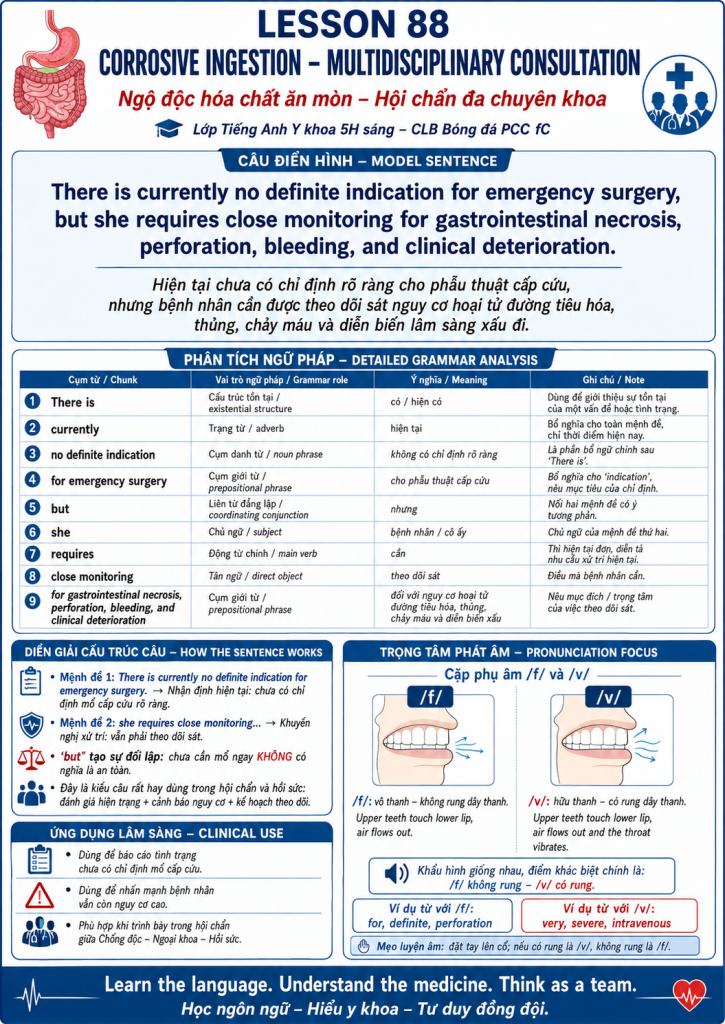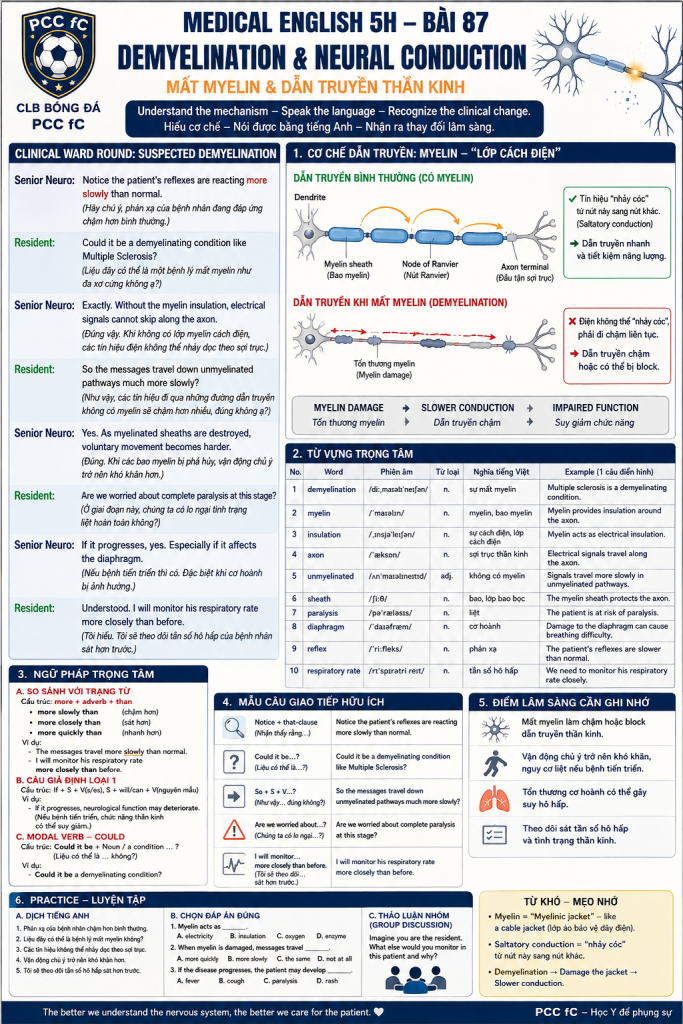
Bài 89 – Tiếng Anh Y Khoa: Liệt mặt cấp và đường dẫn truyền thần kinh * Acute facial palsy & neural pathways
PCC Language – Thăng Long, Hà Nội, ngày 20/8/2026, Trong thực hành lâm sàng, một biểu hiện tưởng như đơn giản như liệt mặt cấp có thể mở ra cả một chuỗi tư duy về cấu trúc và chức năng của hệ thần kinh ngoại biên. Để đánh giá đúng người bệnh, bác sĩ không chỉ cần nhận diện dây thần kinh sọ bị ảnh hưởng, mà còn phải hiểu rõ sự khác biệt giữa đường hướng tâm (afferent) và đường ly tâm (efferent), cấu trúc của fascicle, cũng như cách các tín hiệu cảm giác và vận động được truyền dẫn. Bài 89 sử dụng tình huống “Evaluating Acute Facial Palsy” để kết nối kiến thức giải phẫu – sinh lý thần kinh với ngôn ngữ y khoa thực hành, giúp người học vừa hiểu cơ chế bệnh học, vừa rèn cách mô tả, phân tích và trao đổi lâm sàng bằng tiếng Anh một cách logic, chính xác và tự tin hơn.
In clinical practice, a seemingly simple presentation such as acute facial palsy can open the door to a much broader understanding of the structure and function of the peripheral nervous system. To assess the patient accurately, clinicians need not only to identify which cranial nerve is involved, but also to understand the distinction between afferent and efferent pathways, the structural role of fascicles, and the way sensory and motor signals are transmitted. Lesson 89 uses the clinical scenario “Evaluating Acute Facial Palsy” to connect neuroanatomy and neurophysiology with practical medical English, helping learners understand the underlying mechanisms while developing the ability to describe, analyze, and discuss neurological problems in English with greater logic, precision, and confidence.
BÀI 89
LIỆT MẶT CẤP VÀ ĐƯỜNG DẪN TRUYỀN THẦN KINH
ACUTE FACIAL PALSY & NEURAL PATHWAYS
Chủ đề: Peripheral Nervous System – Nerves
Trọng tâm lâm sàng: Đánh giá tổn thương dây thần kinh mặt trong liệt mặt cấp
Trọng tâm ngôn ngữ: afferent – efferent – mixed nerve – fascicle – comprised of – while
Nội dung bài học được xây dựng trực tiếp từ phần “Clinical Dialogue: Evaluating Acute Facial Palsy” trong tài liệu Clinical Nerve Deconstruction.
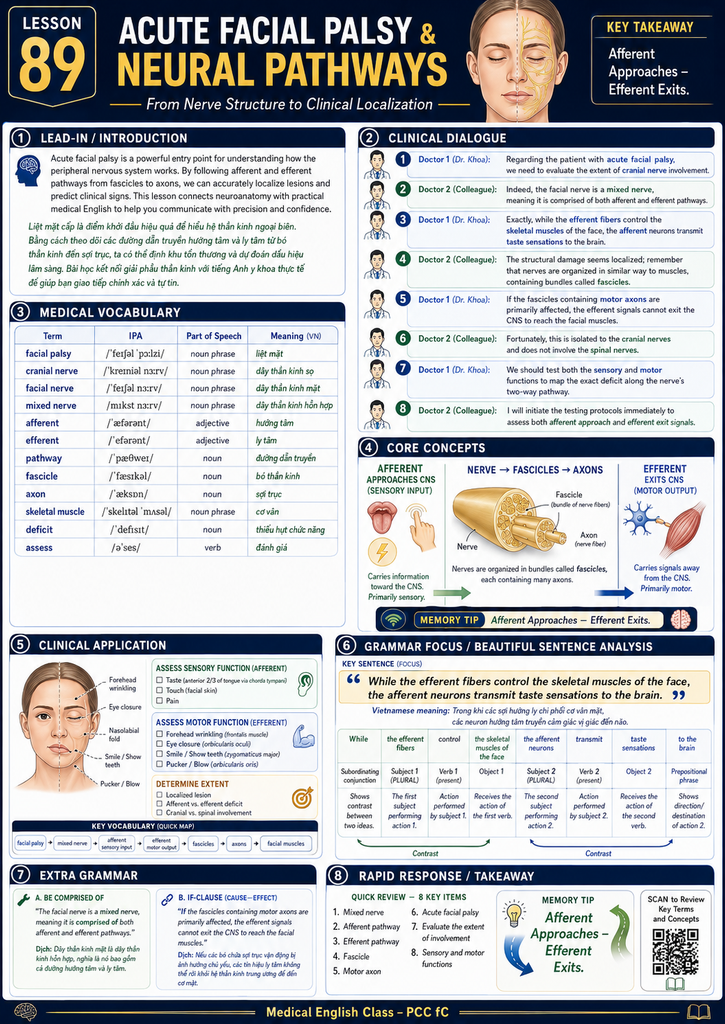
I. MỤC TIÊU BÀI HỌC – LEARNING OBJECTIVES
Sau bài học, người học có thể:
- Mô tả dây thần kinh hỗn hợp – mixed nerve.
- Phân biệt:
- afferent pathway – đường hướng tâm
- efferent pathway – đường ly tâm
- Hiểu cấu trúc:
nerve → fascicles → axons - Sử dụng từ vựng thần kinh học trong hội thoại lâm sàng.
- Vận dụng cấu trúc:
- be comprised of
- while
- if …, …
- both A and B
- Trình bày ngắn gọn cách đánh giá một bệnh nhân acute facial palsy bằng tiếng Anh.
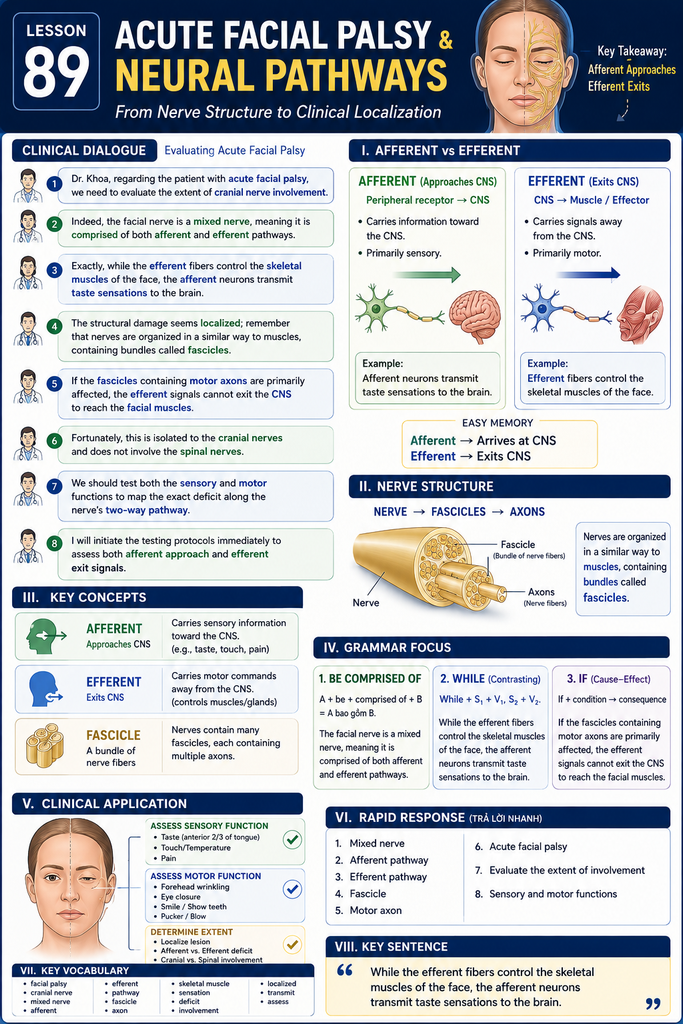
II. CLINICAL DIALOGUE
Evaluating Acute Facial Palsy
Doctor 1
Dr. Khoa, regarding the patient with acute facial palsy, we need to evaluate the extent of cranial nerve involvement.
Dịch:
Bác sĩ Khoa, đối với bệnh nhân bị liệt mặt cấp, chúng ta cần đánh giá mức độ liên quan của các dây thần kinh sọ.
Doctor 2
Indeed, the facial nerve is a mixed nerve, meaning it is comprised of both afferent and efferent pathways.
Dịch:
Đúng vậy, dây thần kinh mặt là một dây thần kinh hỗn hợp, nghĩa là nó bao gồm cả các đường dẫn truyền hướng tâm và ly tâm.
Doctor 1
Exactly, while the efferent fibers control the skeletal muscles of the face, the afferent neurons transmit taste sensations to the brain.
Dịch:
Chính xác. Trong khi các sợi ly tâm điều khiển các cơ vân của mặt, các neuron hướng tâm truyền cảm giác vị giác về não.
Doctor 2
The structural damage seems localized; remember that nerves are organized in a similar way to muscles, containing bundles called fascicles.
Dịch:
Tổn thương cấu trúc dường như khu trú; hãy nhớ rằng dây thần kinh được tổ chức theo cách tương tự cơ, chứa các bó được gọi là bó thần kinh (fascicles).
Doctor 1
If the fascicles containing motor axons are primarily affected, the efferent signals cannot exit the CNS to reach the facial muscles.
Dịch:
Nếu các bó chứa sợi trục vận động bị tổn thương chủ yếu, các tín hiệu ly tâm sẽ không thể đi ra khỏi hệ thần kinh trung ương để tới các cơ mặt.
Doctor 2
Fortunately, this is isolated to the cranial nerves and does not involve the spinal nerves.
Dịch:
May mắn là tổn thương này khu trú ở dây thần kinh sọ và không liên quan đến các dây thần kinh gai sống.
Doctor 1
We should test both the sensory and motor functions to map the exact deficit along the nerve’s two-way pathway.
Dịch:
Chúng ta nên kiểm tra cả chức năng cảm giác và vận động để xác định chính xác vị trí thiếu hụt chức năng trên đường dẫn truyền hai chiều của dây thần kinh.
Doctor 2
I will initiate the testing protocols immediately to assess both afferent approach and efferent exit signals.
Dịch sát tài liệu:
Tôi sẽ bắt đầu ngay các quy trình kiểm tra để đánh giá cả tín hiệu hướng tâm đi vào và tín hiệu ly tâm đi ra.
Language note: Tài liệu gốc sử dụng cụm “afferent approach”. Trong giao tiếp y khoa tự nhiên hơn, có thể diễn đạt afferent input và efferent output. Đây là phần mở rộng ngôn ngữ, không thay đổi hội thoại gốc.
III. MEDICAL VOCABULARY
| Từ/Cụm từ | IPA | Từ loại | Nghĩa |
| facial palsy | /ˈfeɪʃəl ˈpɔːlzi/ | noun phrase | liệt mặt |
| cranial nerve | /ˈkreɪniəl nɜːrv/ | noun phrase | dây thần kinh sọ |
| facial nerve | /ˈfeɪʃəl nɜːrv/ | noun phrase | dây thần kinh mặt |
| mixed nerve | /mɪkst nɜːrv/ | noun phrase | dây thần kinh hỗn hợp |
| afferent | /ˈæfərənt/ | adjective | hướng tâm |
| efferent | /ˈefərənt/ | adjective | ly tâm |
| pathway | /ˈpæθweɪ/ | noun | đường dẫn truyền |
| fascicle | /ˈfæsɪkəl/ | noun | bó thần kinh |
| axon | /ˈæksɒn/ | noun | sợi trục |
| skeletal muscle | /ˈskelɪtəl ˈmʌsəl/ | noun phrase | cơ vân |
| sensation | /senˈseɪʃən/ | noun | cảm giác |
| deficit | /ˈdefɪsɪt/ | noun | thiếu hụt chức năng |
| involvement | /ɪnˈvɒlvmənt/ | noun | sự liên quan/tổn thương |
| localized | /ˈləʊkəlaɪzd/ | adjective | khu trú |
| transmit | /trænzˈmɪt/ | verb | truyền dẫn |
| assess | /əˈses/ | verb | đánh giá |
IV. CORE CONCEPT
AFFERENT vs EFFERENT
AFFERENT = APPROACHES THE CNS
Peripheral receptor → CNS
- Mang thông tin về hệ thần kinh trung ương.
- Chủ yếu liên quan tín hiệu cảm giác.
Example:
Afferent neurons transmit taste sensations to the brain.
→ Neuron hướng tâm truyền cảm giác vị giác về não.
EFFERENT = EXITS THE CNS
CNS → muscle / effector
- Mang tín hiệu ra khỏi hệ thần kinh trung ương.
- Thường liên quan chức năng vận động.
Example:
Efferent fibers control the skeletal muscles of the face.
→ Các sợi ly tâm điều khiển cơ vân vùng mặt.
Mẹo nhớ
Afferent → Arrives at CNS
Efferent → Exits CNS
V. STRUCTURAL CONCEPT
NERVE → FASCICLES → AXONS
Một ý quan trọng trong tài liệu:
“Nerves are organized in a similar way to muscles, containing bundles called fascicles.”
Có thể hình dung:
NERVE
↓
FASCICLES
↓
AXONS
Fascicle
A fascicle is a bundle of nerve fibers/axons within a nerve.
→ Fascicle là một bó các sợi thần kinh nằm bên trong một dây thần kinh.
Tài liệu dành riêng phần từ vựng để phân tích nerve, fascicle, cranial nerves và spinal nerves.
VI. GRAMMAR FOCUS 1
BE COMPRISED OF
Cấu trúc
A + be + comprised of + B
= A bao gồm B.
Câu trong bài
The facial nerve is a mixed nerve, meaning it is comprised of both afferent and efferent pathways.
Phân tích
The facial nerve
→ Subject – chủ ngữ
is
→ Linking verb
a mixed nerve
→ Subject complement
meaning…
→ participial clause, bổ sung giải thích cho mệnh đề phía trước
it
→ pronoun, thay cho the facial nerve
is comprised of
→ cấu trúc bị động chỉ thành phần cấu tạo
both afferent and efferent pathways
→ hai thành phần song song.
Công thức quan trọng
be comprised of + components
Ví dụ:
A peripheral nerve is comprised of multiple fascicles.
VII. GRAMMAR FOCUS 2
WHILE – DIỄN TẢ SỰ TƯƠNG PHẢN
Câu điển hình của Bài 89
While the efferent fibers control the skeletal muscles of the face, the afferent neurons transmit taste sensations to the brain.
Phân tích từng thành phần
While
→ subordinating conjunction
→ liên từ phụ thuộc
→ ở đây mang nghĩa “trong khi / trái lại”.
the efferent fibers
→ subject 1
control
→ verb 1
the skeletal muscles of the face
→ object 1
,
the afferent neurons
→ subject 2
transmit
→ verb 2
taste sensations
→ object 2
to the brain
→ prepositional phrase chỉ hướng truyền tín hiệu.
Mô hình
While + S₁ + V₁, S₂ + V₂.
Dùng để đặt hai chức năng sinh lý đối lập hoặc khác nhau cạnh nhau.
Ví dụ mới
While afferent nerves carry sensory information toward the CNS, efferent nerves carry motor signals away from the CNS.
VIII. GRAMMAR FOCUS 3
IF – CLINICAL CAUSE–EFFECT
Câu trong bài
If the fascicles containing motor axons are primarily affected, the efferent signals cannot exit the CNS to reach the facial muscles.
Cấu trúc
If + condition → clinical consequence
Ở đây không đơn thuần là câu điều kiện giả định mà diễn tả một quan hệ bệnh sinh – hậu quả lâm sàng.
If motor fascicles are affected
↓
Efferent signals cannot exit the CNS
↓
Facial muscles cannot receive normal motor commands
IX. USEFUL CLINICAL EXPRESSIONS
1. Regarding the patient with…
Regarding the patient with acute facial palsy…
→ Về bệnh nhân bị liệt mặt cấp…
2. We need to evaluate…
We need to evaluate the extent of cranial nerve involvement.
→ Chúng ta cần đánh giá mức độ tổn thương dây thần kinh sọ.
3. The damage seems localized.
→ Tổn thương dường như khu trú.
4. We should test both…
We should test both the sensory and motor functions.
→ Chúng ta nên kiểm tra cả chức năng cảm giác và vận động.
5. I will initiate…
I will initiate the testing protocols immediately.
→ Tôi sẽ bắt đầu ngay quy trình kiểm tra.
X. SPEAKING PRACTICE
Doctor A
What type of nerve is the facial nerve?
Doctor B
It is a mixed nerve comprised of both afferent and efferent pathways.
Doctor A
What do the efferent fibers do?
Doctor B
They control the skeletal muscles of the face.
Doctor A
What about the afferent pathway?
Doctor B
It transmits sensory information, including taste sensations, toward the brain.
Doctor A
What should we assess in a patient with acute facial palsy?
Doctor B
We should assess both sensory and motor functions to determine the extent of nerve involvement.
XI. RAPID RESPONSE
Giảng viên nói tiếng Việt – học viên trả lời ngay bằng tiếng Anh:
1. Dây thần kinh hỗn hợp
→ Mixed nerve
2. Đường hướng tâm
→ Afferent pathway
3. Đường ly tâm
→ Efferent pathway
4. Bó thần kinh
→ Fascicle
5. Sợi trục vận động
→ Motor axon
6. Liệt mặt cấp
→ Acute facial palsy
7. Đánh giá mức độ tổn thương
→ Evaluate the extent of involvement
8. Chức năng cảm giác và vận động
→ Sensory and motor functions
XII. MINI QUIZ
Question 1
A mixed nerve contains:
A. Only motor pathways
B. Only sensory pathways
C. Both afferent and efferent pathways
D. Neither sensory nor motor pathways
Answer: C
Question 2
Which pathway carries information toward the CNS?
A. Efferent
B. Afferent
C. Motor only
D. Fascicular
Answer: B
Question 3
Which sentence correctly uses while?
A. While afferent fibers approach the CNS, efferent fibers carry signals away from it.
B. While the nerve comprised of fascicles.
C. While efferent is a muscle.
D. While axons nerve CNS.
Answer: A
Question 4
Complete the sentence:
The facial nerve is ______ both afferent and efferent pathways.
→ comprised of
XIII. CASE CHALLENGE
A patient presents with acute facial weakness. Motor function is impaired, but some sensory function remains intact.
Discuss:
- Which pathway may be predominantly affected?
- Is the deficit primarily afferent or efferent?
- What additional sensory and motor functions should be examined?
- How would you describe the problem to a colleague in English?
Suggested response
The patient may have predominant involvement of the efferent pathway. We should assess both motor and sensory functions to determine the exact extent of facial nerve involvement.
XIV. KEY SENTENCE OF LESSON 89
“While the efferent fibers control the skeletal muscles of the face, the afferent neurons transmit taste sensations to the brain.”
Một câu nhưng tích hợp đồng thời:
Anatomy + Physiology + Neurology + Medical Vocabulary + Grammar
Đây là câu trung tâm phù hợp để học viên luyện đọc – dịch – phân tích – nói lại – ứng dụng lâm sàng.
XV. TAKE-HOME MESSAGE
AFFERENT APPROACHES — EFFERENT EXITS
Hiểu hướng dẫn truyền giúp hiểu chức năng.
Hiểu chức năng giúp định khu tổn thương.
Hiểu cách diễn đạt giúp biến kiến thức y khoa thành Medical English có thể sử dụng trong thực hành lâm sàng.
BÀI 89
From Nerve Structure to Clinical Localization
Từ cấu trúc dây thần kinh đến định khu tổn thương lâm sàng
PCC fC