Bài ôn tập Tuần 14: Từ đường dẫn truyền thần kinh tới quyết định lâm sàng * From neural pathway to the clinical decision
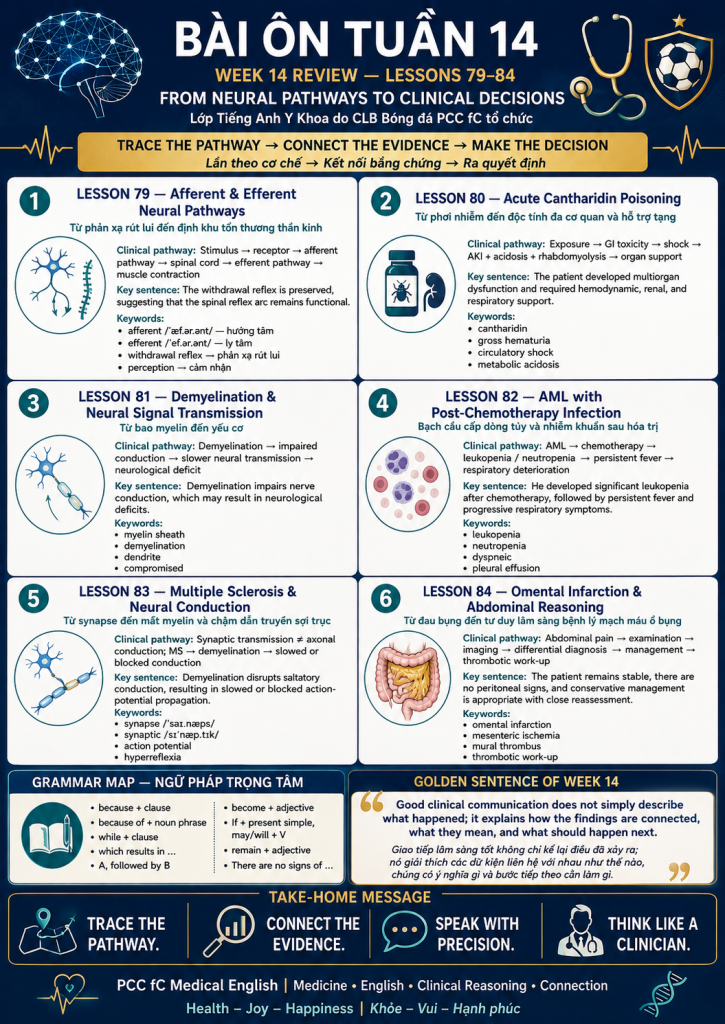
PCC Language – Thăng Long, ngày 15/8/2026, tuần 14 của Lớp Tiếng Anh Y Khoa do CLB Bóng đá PCC fC tổ chức đưa chúng ta đi qua một hành trình rất đặc biệt: từ đường dẫn truyền thần kinh, phản xạ hướng tâm – ly tâm, mất myelin, đến ngộ độc đa cơ quan, nhiễm trùng sau hóa trị và tư duy chẩn đoán bệnh lý mạch máu ổ bụng. Sáu bài học 79–84 tuy thuộc những lĩnh vực khác nhau nhưng cùng gặp nhau ở một năng lực cốt lõi của người thầy thuốc: biết lần theo cơ chế, kết nối các dữ kiện và đưa ra quyết định lâm sàng hợp lý. Vì vậy, bài ôn tuần này không chỉ nhằm ghi nhớ từ vựng hay cấu trúc ngữ pháp, mà quan trọng hơn là luyện cách dùng tiếng Anh để mô tả chính xác, giải thích logic và tư duy như một clinician. Hãy cùng ôn lại với thông điệp: Trace the pathway – Connect the evidence – Make the decision.
WEEK 14 REVIEW — PCC fC MEDICAL ENGLISH
LESSONS 79–84
FROM NEURAL PATHWAYS TO CLINICAL DECISIONS
TỪ ĐƯỜNG DẪN TRUYỀN THẦN KINH ĐẾN QUYẾT ĐỊNH LÂM SÀNG
Lớp Tiếng Anh Y Khoa do CLB Bóng đá PCC fC tổ chức
Ngày ôn tập: 15/08/2026
Review philosophy
TRACE → CONNECT → INTERPRET → ACT → REASSESS
Lần theo cơ chế → Kết nối dữ kiện → Diễn giải → Hành động → Đánh giá lại
Medical English is not only the language we use to describe disease; it is the language we use to organize clinical thinking.
Tiếng Anh Y khoa không chỉ là ngôn ngữ dùng để mô tả bệnh; đó còn là công cụ giúp chúng ta tổ chức tư duy lâm sàng.
I. LEARNING OBJECTIVES — MỤC TIÊU ÔN TẬP
Sau bài ôn tuần 14, học viên có thể:
- Tóm tắt được nội dung cốt lõi của sáu bài 79–84 bằng tiếng Anh Y khoa.
- Mô tả một neural pathway từ kích thích → dẫn truyền → đáp ứng.
- Phân biệt afferent với efferent, synaptic transmission với axonal conduction.
- Trình bày một ca ngộ độc nặng theo chuỗi:
Exposure → Toxicity → Organ dysfunction → Organ support. - Trình bày bệnh nhân AML sau hóa trị theo chuỗi:
Underlying disease → Treatment → Complication → Infection → Respiratory deterioration → Management. - Mô tả một bệnh nhân đau bụng từ:
Symptoms → Examination → Imaging → Differential diagnosis → Management → Etiologic work-up. - Sử dụng chính xác các cấu trúc ngữ pháp lâm sàng trọng tâm của tuần.
- Trình bày một clinical case ngắn trong 30–60 giây bằng tiếng Anh mạch lạc và có reasoning.
Các bài 79–84 trên PCC Language lần lượt bao phủ đường hướng tâm–ly tâm và phản xạ, ngộ độc cantharidin đa cơ quan, mất myelin, AML sau hóa trị, MS và dẫn truyền thần kinh, rồi đến nhồi máu mạc nối và khảo sát nguyên nhân huyết khối.
II. THE BIG PICTURE — BẢN ĐỒ TUẦN 14
LESSON 79 — AFFERENT & EFFERENT NEURAL PATHWAYS
From Withdrawal Reflex to Neurologic Localization
Từ phản xạ rút lui đến định khu tổn thương thần kinh
Clinical pathway
Painful stimulus
→ Sensory receptor
→ Afferent pathway
→ Spinal cord
→ Interneuron
→ Efferent pathway
→ Muscle contraction
Đồng thời, tín hiệu cảm giác tiếp tục đi lên não để tạo ra conscious pain perception.
Core concept
AFFERENT = ARRIVES at the CNS
Hướng tâm → đi về hệ thần kinh trung ương.
EFFERENT = EXITS the CNS
Ly tâm → đi ra khỏi hệ thần kinh trung ương.
Một phản xạ rút lui có thể vẫn xảy ra trước khi bệnh nhân ý thức đầy đủ về đau. Đây là nền tảng để suy luận vị trí tổn thương thần kinh.
Sentence to remember
The withdrawal reflex is preserved, suggesting that the spinal reflex arc remains functional.
→ Phản xạ rút lui còn bảo tồn, gợi ý cung phản xạ tại tủy vẫn hoạt động.
Language focus
because / since + clause
The brain did not receive normal sensory input because the afferent pathway was disrupted.
LESSON 80 — ACUTE CANTHARIDIN POISONING
From Exposure to Multiorgan Toxicity and Organ Support
Từ phơi nhiễm đến độc tính đa cơ quan và hỗ trợ tạng
Clinical pathway
Ingestion
→ GI toxicity
→ Gross hematuria
→ Circulatory shock
→ AKI + metabolic acidosis + rhabdomyolysis + coagulopathy
→ CRRT + vasopressor + airway support
Bài 80 đặc biệt có giá trị ở cách biến một danh sách bất thường thành một clinical story: từ phơi nhiễm cantharidin đến tổn thương đa cơ quan và các biện pháp hồi sức.
Sentence to remember
He received intravenous fluid resuscitation and norepinephrine for circulatory shock, while continuous renal replacement therapy was initiated because of severe acute kidney injury and metabolic derangements.
Language focus
while + clause → hai quá trình diễn ra song song
because of + noun phrase → nguyên nhân
be + past participle → câu bị động y khoa
Don’t simply list abnormalities — tell the clinical story.
LESSON 81 — DEMYELINATION & NEURAL SIGNAL TRANSMISSION
From the Myelin Sheath to Muscle Weakness
Từ bao myelin đến yếu cơ
Mechanism
Demyelination
→ impaired axonal conduction
→ slower / less efficient neural transmission
→ motor or sensory dysfunction
Các thuật ngữ quan trọng gồm neuron, axon, dendrite, myelin sheath, synapse, neurotransmitter, receptor, afferent, efferent.
Sentence to remember
Demyelination impairs nerve conduction, which may result in neurological deficits.
Language focus
X causes Y, which results in Z.
Ví dụ:
Demyelination damages the myelin sheath, which slows neural conduction.
Clinical English pearl
Khi bằng chứng hình ảnh chưa tự nó xác lập toàn bộ chẩn đoán, cách nói thận trọng hơn là:
MRI shows lesions suggestive of demyelination.
thay vì khẳng định quá mức:
MRI proves multiple sclerosis.
LESSON 82 — AML WITH POST-CHEMOTHERAPY INFECTION
Acute Myeloid Leukemia – Leukopenia – Infection – Respiratory Deterioration
Clinical pathway
AML
→ Chemotherapy
→ Leukopenia / neutropenia
→ Persistent fever
→ Pulmonary infection
→ Dyspnea / oxygen requirement
→ Antimicrobial therapy + source investigation
Ca bệnh trong bài là bệnh nhân AML sau điều trị, xuất hiện giảm bạch cầu, sốt kéo dài, khó thở và tổn thương phổi trên CT; trọng tâm ngôn ngữ là kể diễn biến theo thời gian và kết nối bằng chứng với hành động lâm sàng.
Sentence to remember
He developed significant leukopenia after chemotherapy, followed by persistent fever and progressive respiratory symptoms.
Language focus
A, followed by B
→ A xảy ra trước, sau đó là B.
become + adjective
- become dyspneic
- become hypotensive
- become confused
- become tachypneic
Finding + so + clinical action
The patient remains febrile, so we are continuing antimicrobial therapy while searching for the infectious source.
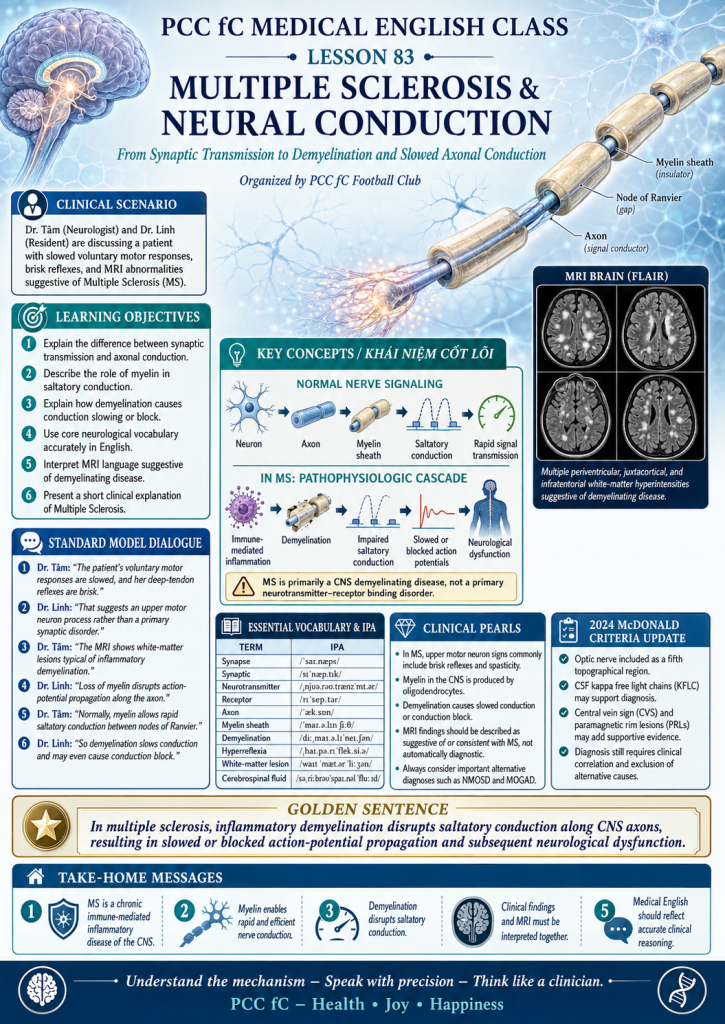
LESSON 83 — MULTIPLE SCLEROSIS & NEURAL CONDUCTION
From Synaptic Transmission to Demyelination and Slowed Axonal Conduction
The key distinction
Synaptic transmission
Neuron → neurotransmitter → receptor → next neuron
khác với:
Axonal conduction
Action potential → propagation along the axon
Trong MS, trọng tâm cơ chế là tổn thương myelin ở hệ thần kinh trung ương, gây conduction slowing hoặc conduction block. Bài 83 cũng nhấn mạnh cần phân biệt chính xác dẫn truyền qua synapse và dẫn truyền dọc sợi trục.
Pronunciation trap
synapse /ˈsaɪ.næps/
nhưng:
synaptic /sɪˈnæp.tɪk/
Sentence to remember
Demyelination disrupts saltatory conduction, resulting in slowed or blocked action-potential propagation.
Grammar focus — First Conditional
If + present simple, … will / may + V
If demyelination becomes severe, conduction may be blocked.
Clinical precision
Không nên đồng nhất mọi bất thường phản xạ với “delayed reflexes”. Trong tổn thương đường tháp do MS, cần mô tả chính xác các dấu hiệu khám thực tế như hyperreflexia, spasticity, weakness khi chúng hiện diện.
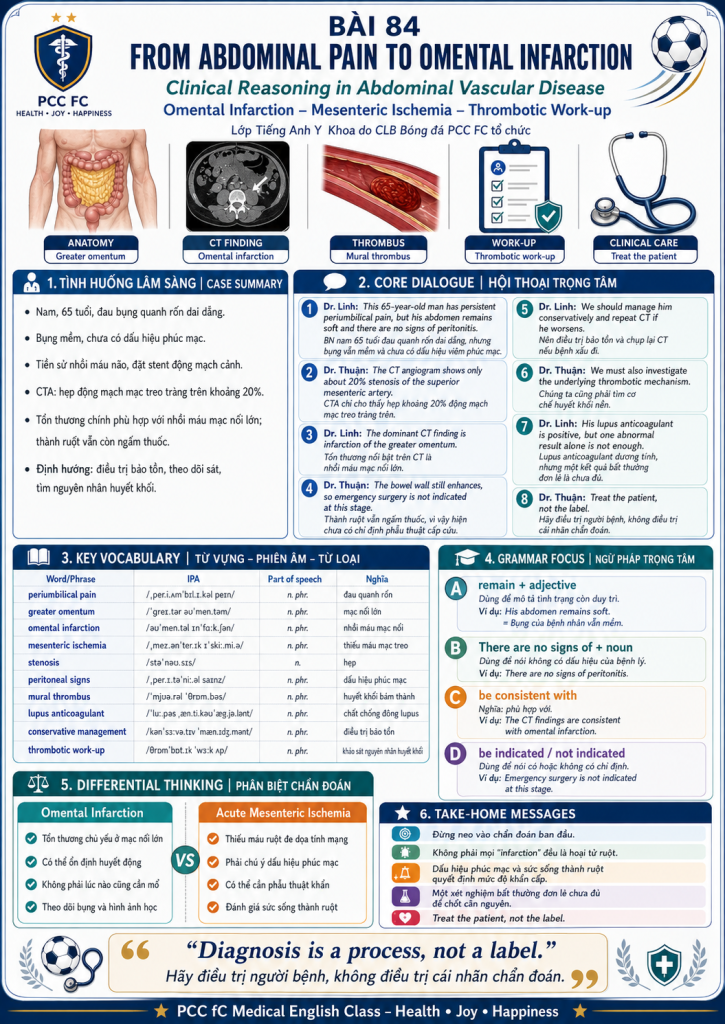
LESSON 84 — FROM ABDOMINAL PAIN TO OMENTAL INFARCTION
Clinical Reasoning in Abdominal Vascular Disease
Clinical pathway
Abdominal pain
→ Examination
→ CT / vascular imaging
→ Omental infarction vs mesenteric ischemia
→ Assess severity
→ Conservative management or urgent intervention
→ Thrombotic work-up
Ca bệnh nhấn mạnh rằng dù ban đầu lo ngại tắc mạch mạc treo, hình ảnh và diễn biến lâm sàng cần được đánh giá tổng thể; bệnh nhân ổn định, bụng mềm, không có dấu hiệu phúc mạc và tổn thương nổi bật là nhồi máu mạc nối. Sau đó câu hỏi chuyển từ “What is the lesion?” sang “Why did thrombosis occur?”
Sentence to remember
His abdomen remains soft, there are no peritoneal signs, and he remains hemodynamically stable, so conservative management is appropriate with close reassessment.
Language focus
remain + adjective
- remains soft
- remains stable
- remains afebrile
There is/are no evidence/signs of + disease
There are no signs of peritonitis.
Clinical philosophy
Treat the patient, not the label.
Một kết quả xét nghiệm bất thường đơn độc không nhất thiết đủ để thiết lập toàn bộ chẩn đoán căn nguyên; Bài 84 dùng chính nguyên tắc này khi bàn về khảo sát cơ chế huyết khối.
III. 24 HIGH-YIELD WORDS — 24 TỪ TRỌNG TÂM
| Lesson | Vocabulary | IPA | Nghĩa |
|---|---|---|---|
| 79 | afferent | /ˈæf.ər.ənt/ | hướng tâm |
| 79 | efferent | /ˈef.ər.ənt/ | ly tâm |
| 79 | withdrawal reflex | /wɪðˈdrɔː.əl ˈriː.fleks/ | phản xạ rút lui |
| 79 | perception | /pəˈsep.ʃən/ | sự cảm nhận |
| 80 | cantharidin | /kænˈθær.ɪ.dɪn/ | cantharidin |
| 80 | gross hematuria | /ɡrəʊs ˌhiː.məˈtjʊə.ri.ə/ | đái máu đại thể |
| 80 | circulatory shock | /ˌsɜː.kjəˈleɪ.tər.i ʃɒk/ | sốc tuần hoàn |
| 80 | metabolic acidosis | /ˌmet.əˈbɒl.ɪk ˌæs.ɪˈdəʊ.sɪs/ | toan chuyển hóa |
| 81 | myelin sheath | /ˈmaɪ.ə.lɪn ʃiːθ/ | bao myelin |
| 81 | demyelination | /diːˌmaɪ.əl.ɪˈneɪ.ʃən/ | mất myelin |
| 81 | dendrite | /ˈden.draɪt/ | sợi nhánh |
| 81 | compromised | /ˈkɒm.prə.maɪzd/ | bị suy giảm |
| 82 | leukopenia | /ˌluː.kəˈpiː.ni.ə/ | giảm bạch cầu |
| 82 | neutropenia | /ˌnjuː.trəˈpiː.ni.ə/ | giảm bạch cầu trung tính |
| 82 | dyspneic | /dɪspˈniː.ɪk/ | khó thở |
| 82 | pleural effusion | /ˈplʊə.rəl ɪˈfjuː.ʒən/ | tràn dịch màng phổi |
| 83 | synapse | /ˈsaɪ.næps/ | khớp thần kinh |
| 83 | synaptic | /sɪˈnæp.tɪk/ | thuộc synapse |
| 83 | action potential | /ˈæk.ʃən pəˌten.ʃəl/ | điện thế hoạt động |
| 83 | hyperreflexia | /ˌhaɪ.pə.rɪˈflek.si.ə/ | tăng phản xạ |
| 84 | omental infarction | /əʊˈmen.təl ɪnˈfɑːk.ʃən/ | nhồi máu mạc nối |
| 84 | mesenteric ischemia | /ˌmez.ənˈter.ɪk ɪˈskiː.mi.ə/ | thiếu máu mạc treo |
| 84 | mural thrombus | /ˈmjʊə.rəl ˈθrɒm.bəs/ | huyết khối bám thành |
| 84 | thrombotic work-up | /θrɒmˈbɒt.ɪk ˈwɜːk.ʌp/ | khảo sát nguyên nhân huyết khối |
Nguồn từ vựng được chọn trực tiếp từ các bảng vocabulary của Bài 79–84.
IV. WEEK 14 GRAMMAR MAP — BẢN ĐỒ NGỮ PHÁP
1. Because + clause
The patient did not perceive pain because the afferent pathway was disrupted.
2. Because of + noun phrase
CRRT was initiated because of severe acute kidney injury.
3. Passive voice
Mechanical ventilation was initiated.
Trong case presentation, trọng tâm thường là what was done, không phải luôn là who did it.
4. While — hai diễn biến song song
Norepinephrine was continued while CRRT was initiated.
5. Which + verb — nối cơ chế với hậu quả
Demyelination impairs conduction, which results in neurological deficits.
6. Might not + verb — diễn đạt thận trọng
The signal might not propagate normally.
7. Fail to + verb
The neuron fails to transmit the signal effectively.
Các cấu trúc which, might not, fail to và be compromised là trọng tâm Bài 81.
8. A, followed by B
Neutropenia was followed by persistent fever.
9. Become + adjective
The patient has become dyspneic.
10. Finding + so + action
The patient remains febrile, so antimicrobial therapy is being continued.
Các mô hình này là trọng tâm trình bày diễn biến ở Bài 82.
11. First Conditional
If demyelination becomes severe, conduction may be blocked.
12. Remain + adjective
His abdomen remains soft.
13. There is/are no evidence/signs of…
There are no signs of peritonitis.
V. THE MASTER CLINICAL REASONING FRAMEWORK
Tuần 14 có thể được nén lại thành 5 câu hỏi vàng:
1. WHAT HAPPENED?
What happened to the patient?
Exposure?
Symptoms?
New neurological deficit?
Post-chemotherapy complication?
2. WHERE IS THE PROBLEM?
Where might the lesion or dysfunction be located?
Peripheral nerve?
Spinal cord?
Central nervous system?
Kidney?
Lung?
Abdominal vasculature?
3. WHAT DOES THE EVIDENCE SUGGEST?
What do the examination, laboratory findings, or imaging suggest?
4. WHAT NEEDS TO BE DONE NOW?
Does the patient need supportive care, antimicrobial therapy, organ support, surgery, or observation?
5. WHY DID THIS HAPPEN?
What is the underlying mechanism or cause?
Đây chính là bước biến:
Medical vocabulary → Medical communication → Clinical reasoning.
VI. SIX ONE-SENTENCE CHALLENGES
Lesson 79
A preserved withdrawal reflex despite impaired conscious pain perception suggests that the spinal reflex arc may remain intact.
Lesson 80
Following cantharidin ingestion, the patient developed shock and multiorgan dysfunction requiring hemodynamic, renal, and respiratory support.
Lesson 81
Demyelination damages the myelin sheath and compromises efficient propagation of neural signals along the axon.
Lesson 82
After chemotherapy, the patient developed leukopenia followed by persistent fever and progressive respiratory symptoms, raising concern for severe infection.
Lesson 83
In multiple sclerosis, demyelinating lesions can slow or block axonal conduction and produce neurological deficits.
Lesson 84
Although abdominal vascular disease was initially suspected, the clinical and imaging findings favored omental infarction without evidence requiring immediate surgery.
Challenge
Học viên chọn ngẫu nhiên 1/6 câu, nói lại không nhìn tài liệu, sau đó mở rộng thành 30 giây clinical presentation.
VII. RAPID-FIRE REVIEW — HỎI NHANH ĐÁP GỌN
Q1. What is the difference between afferent and efferent pathways?
Afferent pathways carry sensory information toward the CNS; efferent pathways carry motor signals away from the CNS.
Q2. Can a withdrawal reflex occur before conscious pain perception?
Yes.
Q3. What is the clinical story in severe cantharidin poisoning?
Exposure → toxicity → multiorgan dysfunction → organ support.
Q4. What does myelin do?
It facilitates rapid and efficient axonal conduction.
Q5. What can demyelination cause?
Conduction slowing or conduction block.
Q6. What major complication should we consider in a patient with leukemia, neutropenia, and persistent fever?
Severe infection.
Q7. How do we describe two events occurring in sequence?
Use A, followed by B.
Q8. How do we connect a clinical finding to an action?
Use so.
Q9. Is synaptic transmission the same as conduction along an axon?
No.
Q10. What findings argue against immediate abdominal surgery in Lesson 84?
Hemodynamic stability, a soft abdomen, and absence of peritoneal signs.
VIII. MINI TEST — WEEK 14
Part A — Vocabulary
1. AFFERENT means:
A. Away from the CNS
B. Toward the CNS
C. Inside the muscle
D. Across the synapse
2. “Gross hematuria” means:
A. Thiểu niệu
B. Protein niệu
C. Đái máu đại thể
D. Vô niệu
3. “Demyelination” means:
A. Tăng sinh myelin
B. Mất/hủy myelin
C. Tổn thương cơ
D. Tăng phản xạ
4. “Thrombotic work-up” means:
A. Điều trị huyết khối
B. Phẫu thuật lấy huyết khối
C. Khảo sát nguyên nhân huyết khối
D. Theo dõi đông máu
Part B — Grammar
5. CRRT was initiated ______ severe metabolic acidosis.
A. because
B. because of
C. while
D. followed by
6. The patient developed neutropenia, ______ persistent fever.
A. resulting
B. because of
C. followed by
D. although
7. His abdomen remains ______.
A. softly
B. soft
C. softness
D. soften
8. If demyelination becomes severe, conduction ______ be blocked.
A. may
B. has
C. was
D. does
Part C — Clinical reasoning
9. A patient withdraws his hand from a painful stimulus but reports no conscious pain. Which concept should be assessed first?
A. Hepatic metabolism
B. Afferent/efferent pathways and reflex arc
C. Renal filtration
D. Pulmonary diffusion
10. A poisoned patient becomes anuric with severe metabolic acidosis. Which intervention may be considered as organ support when clinically indicated?
A. CRRT
B. Bronchoscopy
C. Lumbar puncture
D. EEG
11. An immunocompromised patient has persistent fever and worsening respiratory symptoms. What is the best communication pattern?
A. List every laboratory value without interpretation
B. Connect underlying disease → complication → evidence → management
C. State a definitive pathogen without evidence
D. Ignore the temporal sequence
12. A patient with abdominal pain remains stable, the abdomen is soft, and there are no peritoneal signs. What principle is most appropriate?
A. Operate based on the diagnostic label alone
B. Treat the patient, not the label
C. Ignore imaging
D. Stop reassessment
IX. ANSWER KEY
1B – 2C – 3B – 4C – 5B – 6C – 7B – 8A – 9B – 10A – 11B – 12B
Score interpretation
11–12: Excellent — Think and speak clinically.
9–10: Very good — Strong clinical English foundation.
7–8: Good — Review grammar and clinical collocations.
≤6: Go back to the pathways — understand first, then memorize.
X. 60-SECOND SPEAKING CHALLENGE
Học viên chọn một trong ba tình huống:
A. Neurology
Explain:
Stimulus → afferent pathway → spinal cord → efferent pathway → response
sau đó nối với:
Myelin → axonal conduction → demyelination → neurological deficit
B. ICU / Toxicology
Present:
Exposure → clinical manifestations → organ dysfunction → organ support
C. Clinical reasoning
Present:
Abdominal pain → examination → imaging → differential diagnosis → management → underlying cause
Required expressions
Trong 60 giây phải sử dụng ít nhất ba cụm:
- suggestive of
- consistent with
- because of
- followed by
- while
- which results in
- remain stable
- there are no signs of
- we should also investigate
XI. GOLDEN SENTENCE OF WEEK 14
“Good clinical communication does not simply describe what happened; it explains how the findings are connected, what they mean, and what should happen next.”
Giao tiếp lâm sàng tốt không chỉ kể lại điều đã xảy ra; nó giải thích các dữ kiện liên hệ với nhau như thế nào, chúng có ý nghĩa gì và bước tiếp theo cần làm gì.
Đó chính là sợi dây nối cả sáu bài:
79: Trace the neural pathway.
80: Trace the toxicological course.
81: Understand the mechanism.
82: Connect the clinical sequence.
83: Distinguish mechanisms precisely.
84: Integrate evidence before making a decision.
XII. WEEK 14 TAKE-HOME MESSAGE
TRACE THE PATHWAY.
CONNECT THE EVIDENCE.
SPEAK WITH PRECISION.
THINK LIKE A CLINICIAN.
Đừng học tiếng Anh Y khoa như những từ rời rạc.
Hãy dùng tiếng Anh để lần theo cơ chế, kết nối bằng chứng và trình bày quyết định.
One pathway at a time.
One clinical sentence at a time.
One better decision at a time.
⚽ PCC fC MEDICAL ENGLISH
Medicine • English • Clinical Reasoning • Connection
Health – Joy – Happiness | Khỏe – Vui – Hạnh phúc